

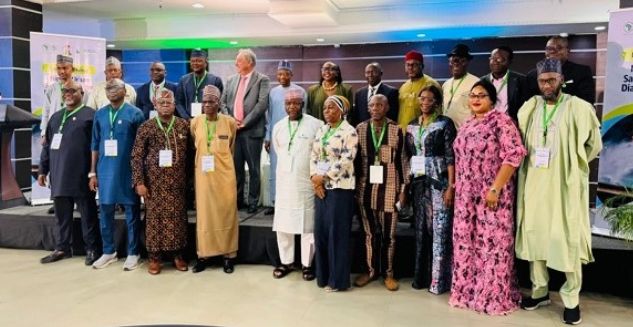

Stakeholders in Nigeria’s water and sanitation sector have called for accelerated reforms, increased investment and stronger collaboration to tackle urban sanitation challenges.
The call was made in Abuja at the unveiling of the Nigeria Urban Sanitation Sector Diagnostic Study Report, conducted by the African Water Facility under the African Urban Sanitation Investment Initiative (AUSII).
The Minister of Water Resources and Sanitation, Professor Joseph Utsev, represented by Acting Permanent Secretary, Ali Dallah, said the report, marked a milestone toward achieving safely managed sanitation services.
Professor Utsev thanked the African Water Facility, the African Development Bank (AfDB) and other development partners for supporting Nigeria’s Water, Sanitation and Hygiene (WASH) sector.
He said that the study reflected Nigeria’s commitment to strengthening partnerships, mobilising investment and accelerating reforms to improve public health, protect the environment and enhance livelihoods.
He said that sanitation is a strategic investment that reduces disease burden, protects water resources, creates jobs and promotes sustainable economic growth.
Professor Utsev said that the report assesses Nigeria’s urban sanitation sector and identifies measures to strengthen regulation, improves utility performance, attracts private investment and develops bankable sanitation projects.
He stressed that no single institution can deliver safely managed sanitation services alone, adding that the ministry would deepen collaboration with partners under AUSII.
He said that the partnership would support inclusive sanitation, faecal sludge management, resource recovery, institutional capacity building and climate-resilient sanitation systems.
The Director of Water Quality Control and Sanitation, Jamilu Danhabu, said that rapid urbanisation, population growth, inadequate water supply and underinvestment are worsening sanitation challenges.
He said that the report reviewed Nigeria’s sanitation status, highlighted achievements and challenges, and outlined government’s reform priorities.
Danhabu said that access to basic sanitation stands at about 60 per cent nationwide, while safely managed sanitation remains at about 20 per cent.
He added that hygiene service coverage stands at about 25 per cent, school sanitation at 44 per cent, healthcare facilities at 15 per cent, while only 20 per cent of public places has adequate sanitation.
He said that rapid urbanisation continues to outpace sanitation infrastructure, with most urban households relying on on-site sanitation due to limited sewerage networks.
He called for increased investment in faecal sludge collection, transportation, treatment, reuse and resource recovery, as well as stronger collaboration among stakeholders.
He said that government has developed policies, including the National Action Plan for WASH Revitalisation and the National Policy on Water Supply and Sanitation, which is under review.
Earlier, AfDB Lead Operations Manager, Orison Amu, said the report was a roadmap for action and not merely a catalogue of challenges.
He said that achieving universal sanitation by 2030 requires coordinated efforts by governments, development partners, financial institutions, communities and the private sector.
Also speaking, Mrs. Jeanne-Astrid Ngako of the AfDB said that Nigeria’s projected population of more than 400 million made expanding safe sanitation services urgent.
She said that urban sanitation is a national development priority requiring collaboration among governments, partners, academia, civil society and the private sector.
Mrs. Ngako said that conventional sewerage systems alone cannot meet future sanitation needs due to high costs and complex infrastructure requirements.
She said that AfDB and partners established AUSII to bridge the financing gap, adding that the initiative aimed to provide safe sanitation services to 15 million people.
She said that AUSII would mobilise seven billion dollars in additional investments over the next decade to accelerate sanitation development.
Ngako urged stakeholders to translate commitments into action, stressing that investment in sanitation supported public health, environmental sustainability, productivity and human dignity.