Love him or loath him, you can’t take one thing away from Prince Nduka Obaigbena: his phenomenal pluck. The word “impossibility” simply doesn’t exist to him. So, he dares where most will dither. He throws himself and everything and everyone around at his latest ideas. And he is always brimming with them, for he is an ideas man, a dreamer of dreams. But he is not just an idle dreamer. He is also a man of action. The possibility of failures scares him not, fazes him not, immobilises him not. So he keeps walking. And dreaming.
If the dream turns sour—as dreams sometimes do— he just pauses, then dreams more. And when he succeeds—as dreamers sometimes do— he barely pauses, savours the fruit of his dream a bit, then dreams more. He comes across as someone who gets bored easily and is constantly looking for new grounds to break. His is a spirit in constant exploratory mode. You can accuse Obaigbena of many things, but it is difficult to successfully indict him of lacking imagination, or of not daring to dream BIG.
Obaigbena’s first audacious move that captured the country’s imagination was in 1986 when as a 27-year-old he started ThisWeek, an all-gloss national news magazine. Though he had had some stint as a cartoonist and satirist at The Nigerian Observer (published out of Benin City) and as a representative of the supplement sections of Newsweek and Time magazines, Obaigbena did not have the intimidating journalistic pedigree of a Dele Giwa (who with three other journalism notables of the era started Nigeria’s first quality news magazine, Newswatch in 1985) or the deep pockets and national name recognition of an MKO Abiola (publisher of the Concord Group of newspapers) or the old money background of a Alex Ibru (who was assisted by the legendary Stanley Macebuh to start The Guardian, which for a long time towered, colossus-like, above the quality newspaper landscape in Nigeria).
What Obaigbena lacked in all of that, he more than compensated for with uncommon boldness. He plunged headlong into the elite league of magazine publishing in Nigeria. And he did it in a way that couldn’t but be noticed, with nerve and panache, two attributes he will later be known for down the decades. The new kid on the media block in 1987 was not there to play. Rather, he was there to play big. He pulled together a respectable board of directors that included the late Gamaliel Onosode and renowned journalists from the leading media houses of the time, led by the inimitable Sonala Olumhense.
And not a man for half measures, he wanted his newsmagazine to be comparable to Time and Newsweek not just in terms of content but also in print quality. ThisWeek was thus printed in London, freighted into Lagos, and sold in major cities in Nigeria. In short steps, ThisWeek became a force to reckon with, giving Newswatch (the king of the pack of that period) a good run for its money. But ThisWeek’s dazzling run came to an end in 1991. This happened due to different reasons, depending on whom you speak to. Based on how the experiment ended, most people would be traumatised. And even if they are not, it would be impossible to convince investors and journalists to come with them again. But not Obaigbena. It was just a break in transmission. He would be back.
And he did come back. After a not-so-eventful stint in politics, he returned with THISDAY in 1995. Not many gave the refreshing newspaper a chance—including my humble self. The received wisdom was that whatever initial advantage that THISDAY enjoyed was because the major newspapers of the day were under proscription. Once the ban on established newspapers like National Concord, The Guardian, Punch and others was lifted, THISDAY and others that came to fill the void would pack up. The established papers returned, and indeed most of the space fillers gasped and disappeared. But not THISDAY. The paper is not just still here as the paper of choice for Nigeria’s political and business elite and getting ready to mark its 25th anniversary in January, it has been a major force in Nigeria’s media landscape. It would be hard for anyone to write an authoritative history of Nigeria’s traditional media in the last three decades and not devote sizeable space to THISDAY, and I say this as a more than casual student of the 160 years of newspapering in Nigeria.
THISDAY’s reputation as a media trailblazer is not in doubt. I am one of those who still think that the paper could have done much more and probably be better managed. But even at that, the sterling contributions of THISDAY to the following milestones in Nigeria’s media cannot be over-emphasised: the comprehensive treatment of breaking stories, the prioritisation of political and economic analyses, the emergence and popularity of back-page columnists, the tasty coverage of fashion and high society in glossy pull-outs, and the emergence of full-colour newspapers.
At some point, THISDAY almost became synonymous with not just breaking stories but also breaking new grounds for the industry, a trait that Obaigbena has also taken into other trailblazing and pan-African ventures such as THISDAY Excellence Awards, THISDAY South Africa, THISDAY International, THISDAY Music and Fashion Festival, and ARISE Television. To be sure, the staff and management of THISDAY and others contribute in no small way to this pioneering propensity. But the bulk of the credit must go to Obaigbena who constantly pushes the limits and refuses to believe anything is impossible.
This publisher (who actually prefers to be called the editor-in-chief or just a reporter, depending on his mood) is not your passive publisher. He is always in the thick of things, working his expansive rolodex and access for stories and insights, deploying his artistic impulses to give the paper and other ventures distinct aesthetic edge, tapping into his cosmopolitan reach to comb for ideas that can be simultaneously localized and internationalized, and spotting and playing talents to their sometimes hidden strengths.
There are two other personal attributes that I don’t think people give Obaigbena enough credits for: he can be surprisingly generous and he can be disarmingly forgiving. Those early days of THISDAY, he would return from trips abroad with gifts for his staff, and because he has a good taste you could be sure of the quality of what you get from him, be it wrist watches, perfumes or shirts. Beyond token gifts, he is also known for giving out major gifts, including brand new cars. I have been one of such beneficiaries, even when I was no longer in his employ. How forgiving he could be is the more surprising for me. THISDAY is known as the place that ex-staff could always return to, even if they had a hostile exit. I joke that he embodies the free-entry/free-exit spirit of the competitive market (he is an unapologetic believer of the gospel of Free Market).
Like the rest of us, he is just human. A Hausa proverb says the best a man can be is nine out of ten (and not a perfect ten). But his talents, his boldness, his contributions to journalism and cultural landscapes, and those touching traits give, in my book, a rounded and more than redeeming view of this exceptional prince of Owa Oyibu who is also a citizen of the world. As the man for whom the word audaciousness seemed coined turns sixty on July 14th, I wish him good health and many more years of pluck and possibilities.
Adio is former staff of THISDAY and now the executive secretary of NEITI.
The Central Bank of Nigeria (CBN) has made another intervention in the retail Secondary Market Intervention Sales (SMIS) to the tune of $2698.71million in addition to CNY 39.69million in the spot and short tenured forwards segment of the inter-bank foreign market.
The Director in the Corporate Communications Department of the apex bank, Isaac Okorafor, said today, July 12 that the interventions in dollars were to meet requests in the agricultural and raw materials sectors even as the transactions in Chinese Yuan were for Renminbi- denominated Letters of Credit.
Okorafor said that the bank’s management is satisfied with the stability in the forex market, stressing that the bank would continue to make necessary interventions in order to ensure liquidity in the Nigerian foreign exchange market.
He said that the bank is encouraged by the improved inflow of foreign exchange, which has kept the exchange rate around the N360/$1 for close to 30 months.
While calling on Nigerians to continue to support the policies of the CBN aimed at boosting the production capacity of local industries as well as creating jobs for citizens, he assured that the bank would remain committed to ensuring that all the sectors of the forex market continue to enjoy access to the needed foreign exchange.
Meanwhile, a dollar exchanged for N360 while CNY1 exchanged at N55, at the Bureau de Change (BDC) segment of the foreign exchange market today, July 12.
Former Nigeria President, Dr. Goodluck Jonathan has given reasons why his government could not implement the recommendations of the 2014 National Conference which he convened to address some of the challenges the country was facing, including security and national cohesion.
Speaking today, July 11 in Lagos at the launch of a book to commemorate the 80th birthday of a frontline politician, Senator Femi Okurounmu, Dr. Jonathan said: ”my administration was prepared to change the narrative for our constitutional democracy with the assurance that sovereignty really belongs to the people.
”However, we were time constrained. The conference was concluded less than one year to the end of my tenure. We received the report specifically on August 21, 2014, at a time the nation was in the mood of electioneering.
”Then, members of the National Assembly, whose duty it was to consider and validate the process were pre-occupied with the battle of political survival.
The former president said the implementation of the recommendations of the conference required amendment of the constitution and the National Assembly did not have the time to go through the process.
”I noticed that each time I express this belief and optimism, I always get hit with the counter narrative that seems to question my inability to implement the recommendations during my presidency.
”This is a question I have answered in many fora. In my book,”My Transition Hours”, Chapter 10 provided detailed answers in this regard.
”I believed that given the nature of the consultations and due deliberations involved in advancing the process, an orderly and systematic implementation could have been concluded in less than a year. It was obvious we did not have that time before the end of my administration.”
Jonathan said his administration did not insist on a rushed implementation because he did not want be seen to have organized the conference to gain political popularity.
Jonathan, who was chairman of the book launch, said he believed the implementation of the conference report would heal frayed nerves and promote solidarity, adding that the solutions to most of the problems Nigeria is facing today “lie in our honest assessment of the recommendations of the 2014 National Conference.
”Our country is faced on all corners by a multiplicity of challenges, bothering mainly on security and national cohesion. Although these problems are not new, the discord has continued to widen over time.
”I understand that efforts are being made toward addressing some of these challenges, however, we seem to play politics with sensitive and serious matters.
”The call for reforms has continued to grow louder, gathering the kind of momentum that should no longer be overlooked, if the nation must make real progress.
”If we take politics out of our consideration, there is every likelihood that a diligent implementation of the key recommendations of the conference will lead the nation out of the woods,”
The former president described the author as a great politician who was not given to politics of bitterness.
He said Okurounmu was one of the critics of his administration, but his observations were always constructive and helpful.
Dr. Jonathan commended the politician for documenting his experiences in the memoir, saying that the book would provide great lessons for the present generation and posterity.
”He has shown courage by documenting some of his experiences in the course of his glorious service to his nation and community for the sake of posterity,” he said.
The book, a memoir by the politician, is titled: ”The Dream: Pursuing the Black Renaissance Through The Murky Waters of Nigerian Politics.”
Prominent Nigerian moneybags have promised to dole out dollars on Super Eagles as the players prepare to take on the next opponents in the semi final in the ongoing Africa Cup of Nations (AFCON) 2019 in Egypt.
Prominent among such personalities are billionaires, Aliko Dangote and Femi Otedola who promised to dole out $75,000 to the Eagles for every goal scored in their remaining games.
While Dangote promised $50,000 per goal, Otedola on the hand pledged the sum of $25,000 for each goal scored by the eagles.
One of the official sponsors of the senior men national team, Aiteo group had earlier given the eagles $75,000 for the three goals scored in their 3-2 victory over Cameroon at the knockout stage.
Also a businessman, Hosea Wells Okunbo pledged the sum of $20,000 per player, while Lagos State Governor, Babajide Sanwo-Olu rewarded the team with $5,000 per player.
The Gernot Rohr’s boys had, yesterday, trashed the Bafana Bafana of South Africa by 3-2 in the quarter final of the tournament at the Cairo international stadium, progressing to the semi-final.
The Super Eagles will take on the winner between Algeria and Cote D’Ivoire in the semi final game.
For criticizing the government of Nasir Ahmed el-Rufai of Kaduna State, one Aliyu Jaafaru Abubakar has lost the chance to be a commissioner in the cabinet of the government as his nomination by the same governor was rejected by theState House of Assembly.
In spite of his alleged criticism of Governor el-Rufai in his facebook wall sometimes ago, the governor still included his name in the list of would-be commissioners he forwarded to the legislature.
The Speaker of the House of Assembly, Aminu Abdullahi Shagali, who presided over the screening of commissioner nominees, said that Jaafaru Abubakar’s rejection followed his criticism of the el-Rufai’s policy since 2017 on his Facebook handle.
Aminu Abdullahi Shagali cited the issue of unqualified primary school teachers who could not pass primary four examinations.
The Speaker said: “In your (nominee) Facebook account, you said ‘there is nothing like making Kaduna State great again and that it is a deceptive cliche used by politicians to deceive the masses’ and ‘We will make Kaduna great at the appropriate time. It is a responsibility for those who are truly sincere not for those who are inherently sarcastic.’
“You also said El-Rufai must learn to tackle issues with human face, and said you are ‘an advocate of change that goes to the root and cause not only the symptoms’
“You also said in the same post, ‘stop comparing me with El-Rufai who thinks he is more intelligent than intelligence itself.’”
The House Committee Chairman on Media and Public Affairs, Alhaji Tanimu Musa, also said: “Jaafaru has been a critic of this administration on social media. Why did he want to work with the governor?”
The House unanimously rejected the nominee after the Speaker had announced.
Other nominees screened and confirmed were Thomas Gyang (Commissioner for Planning and Budget Commission), Hassan Usman Mahmud (Commissioner in the Governor’s Office for Riots, Damage, Rehabilitation and Resettlement), and Atiku Musa (Auditor for General Local Government).
Somehow and, understandably, Comrade Adams Oshiomhole, the national chairman of our great party, the All Progressives Congress (APC), has become an issue in the ever-increasing conversations around leadership and reforms in our party. He has also become the issue in the calculated attempts by desperate forces to insinuate him into everything negative that has happened to anyone in the party on account of the new deal and pristine approach to party administration.
Pigeonholing him for denunciation by those who have lost either entirely or partly their pseudo-political empires in their respective states is the essential burden that the comrade chair has stoically borne in the task of cleansing the Augean stables of pestilential indiscipline and monumental disrespect for party supremacy.
While some forces, especially those who lost control of party structures in their states, have sworn to a life and time of revenge, those that the new leadership style has liberated are in a celebratory mood and would remain eternally grateful to Oshiomhole’s single-minded leadership in helping to redefine their essences in APC’s political enclave such that members have taken ownership of the party.
Indeed, Oshiomhole’s role in bringing that about is a throwback to his many years of active struggles as a peripatetic labour unionist in the circumference of the Textile Unions, which he led at different times and in different capacities and the Nigeria Labour Congress (NLC) over which he would later preside from 1999 to 2006 or thereaout. On that pedestal, he had led a series of protests against perceived anti-people policies of the Federal Government.
In September 2004, for instance, the NLC under his leadership gave the Federal Government an ultimatum to reverse the decision to reintroduce the controversial fuel tax or face a nationwide protest and strike. His inimitable spirit was not shy of galvanizing the strike despite a ruling by a Federal High Court in an earlier dispute that the NLC lacked legal power to call a general strike over government policies.
He was arrested on October 9, 2004 at a protest at Nnamdi Azikiwe Airport and later released after a “chat” with officials of the State Security Services (SSS). He had many confrontations with the state in the course of discharging his onerous responsibility of providing proactive leadership to the labour movement. For a man who was burnished in the blistering furnace of labour unionism, he defined his eon by deploying his stentorian voice in ceaseless articulations of pro-workers, pro-people issues.
Oshiomhole’s luminous epoch in socio-economic and political crusading and the legacy of commitment to good causes that he left behind in the labour tradition of struggles would recommend him highly for appropriation and endorsement by the political elite in Edo state in their search for a new leadership in a great moment of anxiety over the future of the state.
To upend the business-as-usual approach to governance in the state that was under the overbearing influence of some obdurate godfathers, Oshiomhole was summoned by providence to become a battle axe in the hands of politicians with whom he was in consensus ad idem to dismantle the conservative culture of executive genuflection at the table of godfathers.
Stepping in the saddle as governor following his victory at the Court of Appeal, he invested all that was at his disposal to overwhelm the tribe of godfathers in the state. For eight years as governor, Oshiomhole provided leadership that reset the politics of Edo and ensured that the people decided who their governor would be and not the godfathers in the old-fashioned style of obligated imposition of candidates.
Today, as much as I have always contended that godfatherism is an ecumenical concept and a cosmopolitan reality, Oshiomhole’s attitude to politicking and succession politics in Edo explicates his republican spirit that drove the choice of leaders through utilitarian engagements, catholic conversations and coruscating selection processes that placed the people above the leaders and thereby put the party in their hands.
And, as national chair of the APC, he is replicating that exemplar. Indeed, at the intersection at which he accepted the challenge to step in the saddle of leadership in June last year, it was clear to Oshiomhole that the political voyage was not going to be jollity. One, he must have realised that Edo state is just a microcosm of the Nigerian nation-state. Therefore, he was prepped to deploy his vast knowledge and experience acquired in the labour struggles and governance of Edo state in dealing with problems confronting the APC.
He identified indiscipline among party leaders and members as one problem. The significant other was contempt for party supremacy. Basking in a vaudeville of countrywide approbation that culminated in his emergence as a consensus candidate, he knew much would be expected from him by the powerful forces that rallied support for him in the spirit of quid pro quo.
But as one who is not given to such mundane considerations that discount the place of the people in the leadership of the party (and to be sure, while in Edo, he promoted the mantra of ‘let the people lead’ and the philosophy of “one-man;one vote”), Oshiomhole knew from the outset that human nature would always resist changes; and on that score, he was going to have problems with many of his associates.
Regardless, he was in that context, and acting in pari materia with the zeitgeist that recommended him for the assignment, committed to take both the credit and the blame for actions and inactions of the party leadership on his watch. And, expectedly, he has been getting both commendations and condemnations. He has taken both in his strides and he remains sharply-focused on consolidating the party on the trajectory of finding anchorage in members who are in the majority rather than in the minuscule leadership.
This explicates his dignified silence in the face of a carefully-composed symphony by some aggrieved leaders about his alleged actions and inactions that led to losses by the party in some states. Specifically, the court decisions that stymied the participation of the APC in all the state-based elections in Rivers and Zamfara states were beyond the contemplation of Oshiomhole.
The denouements in both states were products of the pigheadedness of local political warlords who were inebriated by power and would not sheathe their sword in a debilitating supremacy battle for the souls of the party. Had they been reasonable and respected the supreme decision of the party on the method of electing candidates, perhaps, the law would not have foisted the faits acomplis that paved the way for the opposition Peoples Democratic Party (PDP) to ride to power seamlessly in the affected states.
But Oshiomhole realizes that in any battle that involves attitudinal changes, getting people’s buy-in is not always easy. He has thus put his nose to the grindstone and become more sure-footed in driving the regime of reforms that is unsettling some leaders who do not believe in it. In the face of pockets of protest and resistance, underpinned, perhaps, by a grand conspiratorial alliance calculated to project him as incorrigible narcissist, the Iyamho-born labour activist turned politician continues to fix his eyes on the ball in an epistemological and enigmatic fashion.
Very knowledgeable and nimble in the milieu of the nation’s cloak and dagger politics; and, carrying on amid airs of inscrutability, the atomic Oshiomhole, like an atomic bomb, has become a veritable bugaboo to those baying for his blood, or asking for his head on a charger. Oshiomhole is enjoying well-deserved presidential approbation and support by critical stakeholders of the APC countrywide. With these providential gestures, he is primed for total victory.
Indeed, to God be the glory, the coast to the next level remains clear for Comrade Adams Oshiomhole. He has taken the opportunity to etch his name in gold. It would be said of him by posterity and as Julius Caesar said of himself after he had achieved a quick victory in his short war against Pharnacles 11 of Pontius at the Battle of Zela: “veni vidi, vici”; that he came, he saw and he conquered.
Hon. Obahiagbon, a former Chief of Staff to Oshiomhole, contributed this piece from Benin City.
The Administration of the Federal Capital Territory (FCT), Abuja, today, July 11, commenced the demolition of no fewer than 120 houses, fences and illegal attachments, especially in Lokogoma District.
The demolition is being carried out after the expiration of two-week ultimatum given to the residents and owners of such buildings that have been obstructing flood plains and natural water channels to evacuate from the properties.
It is confirmed that similar demolition will also soon be carried out in other mass housing districts of Kafe and karsana where such violations exist.
The Permanent Secretary in the FCT Administration, Chinyeaka Ohaa ordered the enforcement team of the Department of Development Control to commence the removal exercise from the IPENT II Estate of the District.
At the demolition site, the Director in Department of Development Control, Mukhtar Galadima said that the exercise may last for one month, considering the difficult terrain.
He said that legal action might be taken against offending developers as the Department is working very closely with the Legal Secretariat of the FCTA to consider its legal options.
Galadima stressed that the offending developers will not go scot-free, even as he said that all the structures being removed had received stop-work and demolition notices long before the exercise commenced today.
Lokogoma District is situated in an area through which Rivers Wumba and Kabusa navigate. However, several developers constructed houses on flood plains and water channels which often lead to severe flooding that affect lives and property.
No fewer than 37 governorship aspirants of the All Progressives Congress (APC) in Kogi State have endorsed the use of indirect primary in the forthcoming election to pick a candidate for the party in the State. This was even as they made it clear that the incumbent governor, Alhaji Yahaya Bello will be defeated even with direct primary.
The aspirants, who endorsed the direct primary including Adama Idris, Taiwo O. Mathias, Ojodomo Usman, Hon. Momoh Ismail, Ilemona Dan Sabo, Murtala Muhammed, Matifo Precious, Hon Adaji Ainoko and Irojah Femi among others. They emphasized their determination to defeat the governor right at primary election.
Addressing news men after submitting a letter addressed to the National Executive Committee of APC and other organs, convener of the forum and one of the governorship aspirants, Comrade Edime Godwin Amade, said that member of the group that earlier kicked against the indirect primary were non-APC members.
He posited that APC has grown from less than 100,000 members in 2015 to over 500,000 in 2019 in the State.
“It will take too much time, money and logistics to produce a clean and uncontested membership register between now and August 29, 2019. “Even if that impossible feat is achieved, we simply cannot organise trouble-free direct primaries for at least half a million people. Anybody can obtain our party card from anywhere and cause legal trouble.
“In fact, we have proof that in anticipation of their success in moving the NWC to adopt direct primaries, some of the aspirants who turned up here last Monday have started printing hundreds of thousands of APC Kogi membership cards.
“They are also compiling rival membership registers in a bid to make sure the confusion is complete. We, therefore, state categorically that there are no factions in Kogi APC and no rival claimants to the leadership of it.
“Alhaji Haddy Ametuo, our authentic former chairman, and Alhaji Abdullahi Bello our incumbent State Chairman have since put aside their differences and are working hand-in-hand towards the indirect primaries approved for us.
“The case filed by the Ametuo faction against the party has come to an end with the filing of a notice of withdrawal. The Supreme Court has held that by filing a notice of discontinuance such as Haddy Ametuo has done, the plaintiff voluntarily puts an end to the action he instituted. Outside of these gentlemen, there is no other person or group to whom Kogi APC owes anything beyond a level playing field.
“We totally reject anything which will throw our party into chaos on the eve of a major election, especially the imposition of Direct Primaries.
“Direct primaries are responsible for the loss of Rivers and Zamfara States to the APC. The confusion which will trail any imposition of direct primaries in Kogi State will lead to the loss of our state too. The troubles which will follow such an imposition will persist until all the INEC windows closed and the courts are given reason to rule that the APC did not hold any valid primaries. We will fight against this outcome with all our strength.
“Finally, we do not understand how somebody who calls himself a chieftain and an aspirant under a party in power can claim that he does not know the delegates who will vote in an indirect primary election. “Delegates are spelt out in the party guidelines. Delegates are clearly identifiable by their offices and statutory roles. Any aspirant who cannot woo delegates elected by his people is not fit to bear the name.
“The APC must not give room for people to tag it confused or inconsistent by changing established norms to fit every wind of opposition which blows. The legal effects could be catastrophic. Except for a few recently elected officials, delegates for Kogi APC Indirect primaries on August 29 are the same people who voted at the National Convention for the President as our flag-bearer in the 2019 general elections. They also voted for our National and State Assembly contingents at the various Primaries. We must beware of those who now want to impugn the integrity and legality of our delegates. The domino effect of undermining the legality of our delegates will be catastrophic beyond just the forthcoming governorship elections in Kogi state.”
While calling on those supporting direct primary to have a rethink, the forum said: “While we agree that every qualified person is free to aspire to be our flag-bearer, we insist that all aspirants must play by the rules, not seek to change them to scatter the party. It is on record that in 2015, the incumbent Governor was not in control of the party or the delegates yet he subjected himself to the Indirect primaries and because we knew him and what he had sacrificed for the party, he beat 25 other Aspirants to close second behind the late Prince Abubakar Audu. Similarly, every true aspirant should go and start networking the delegates and stop scandalising the party at every turn.”
The President-elect of the United Nations General Assembly and Nigeria’s Permanent Representative to the UN, Ambassador Tijjani Muhammad-Bande, has said that part of his agenda as he set to assume full operations will be to fight for return of stolen assets from European countries to where such assets were originally stolen.
Outlining his vision statement for the UNGA Presidency, today, July 11, when he visited President Muhammadu Buhari at the Presidential Villa, Abuja, Ambassador Tijjani Muhammad-Bade said that the fight against corruption and return of assets to the countries of origin is part of his agenda.
He promised to positively represent Nigeria especially on issues that are of great importance to the country today, including peace and security, poverty eradication, education, inclusion and climate action, particularly on the Lake Chad region. He stressed such issues are on the front burner of his UNGA Presidency.
“The election of Nigerian into an international position can only happen if what is happening at home has the confidence of the international community.
“The fight against corruption has already gained traction, under the leadership of Nigeria at the United Nations. Discussions on combating illicit financial flows, the fight to return assets to the countries of origin, have been led effectively by Nigeria with the support of many countries, especially Norway.”
Receiving Ambassador, President Buhari acknowledged that he had intellectually prepared himself for this position, adding that he is well experienced in the field.
He advised the UNGA President to justify the confidence reposed in him by Nigerians and the world.
“I believe you have earned the respect of your colleagues and I appreciate your coming to see us.”
The Nigerian Diplomat was on his first visit to the country since he was elected by acclamation as the 74th President of the General Assembly on June 4, 2019, in New York.
Members of the Islamic Movement in Nigeria (IMN), known as Shiites, have again clashed with the Police at the Federal Secretariat, Abuja, today, July 11.
Information reaching us said that Police fired gunshots and tear gas canisters to disperse the protesters, and in the melee, arrested five members of the group.
Report said that the clash caused panic around the federal secretariat with workers, commuters and motorists fleeing out of danger. Members of the sect later regrouped at another location to continue with their protest.
They had stormed the National Assembly complex on Tuesday, during which they shot two policemen and also torched three cars and damaged many other vehicles and property.
Forty suspects were arrested in connection with the Tuesday incident.
We use cookies on our website to give you the most relevant experience by remembering your preferences and repeat visits. By clicking “Accept”, you consent to the use of ALL the cookies.
This website uses cookies to improve your experience while you navigate through the website. Out of these, the cookies that are categorized as necessary are stored on your browser as they are essential for the working of basic functionalities of the website. We also use third-party cookies that help us analyze and understand how you use this website. These cookies will be stored in your browser only with your consent. You also have the option to opt-out of these cookies. But opting out of some of these cookies may affect your browsing experience.
Necessary cookies are absolutely essential for the website to function properly. This category only includes cookies that ensures basic functionalities and security features of the website. These cookies do not store any personal information.
Any cookies that may not be particularly necessary for the website to function and is used specifically to collect user personal data via analytics, ads, other embedded contents are termed as non-necessary cookies. It is mandatory to procure user consent prior to running these cookies on your website.


 The Central Bank of Nigeria (CBN) has made another intervention in the retail Secondary Market Intervention Sales (SMIS) to the tune of $2698.71million in addition to CNY 39.69million in the spot and short tenured forwards segment of the inter-bank foreign market.
 Prominent Nigerian moneybags have promised to dole out dollars on Super Eagles as the players prepare to take on the next opponents in the semi final in the ongoing Africa Cup of Nations (AFCON) 2019 in Egypt.
 For criticizing the government of Nasir Ahmed el-Rufai of Kaduna State, one Aliyu Jaafaru Abubakar has lost the chance to be a commissioner in the cabinet of the government as his nomination by the same governor was rejected by the
 The Administration of the Federal Capital Territory (FCT), Abuja, today, July 11, commenced the demolition of no fewer than 120 houses, fences and illegal attachments, especially in Lokogoma District.
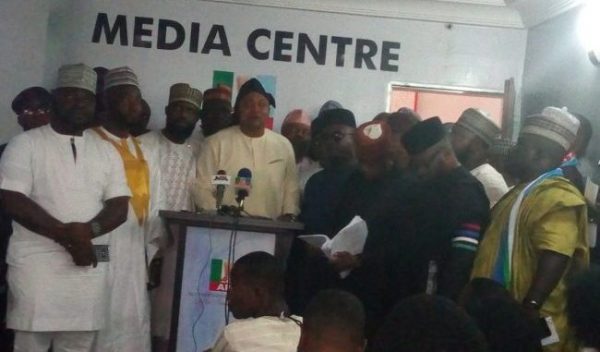 No fewer than 37 governorship aspirants of the All Progressives Congress (APC) in Kogi State have endorsed the use of indirect primary in the forthcoming election to pick a candidate for the party in the State. This was even as they made it clear that the incumbent governor, Alhaji Yahaya Bello will be defeated even with direct primary.
 The President-elect of the United Nations General Assembly and Nigeria’s Permanent Representative to the UN, Ambassador Tijjani Muhammad-Bande, has said that part of his agenda as he set to assume full operations will be to fight for return of stolen assets from European countries to where such assets were originally stolen.
 Members of the Islamic Movement in Nigeria (IMN), known as Shiites, have again clashed with the Police at the Federal Secretariat, Abuja, today, July 11.

Salute To Nduka Obaigbena, The Duke Of Possibilities
Love him or loath him, you can’t take one thing away from Prince Nduka Obaigbena: his phenomenal pluck. The word “impossibility” simply doesn’t exist to him. So, he dares where most will dither. He throws himself and everything and everyone around at his latest ideas. And he is always brimming with them, for he is an ideas man, a dreamer of dreams. But he is not just an idle dreamer. He is also a man of action. The possibility of failures scares him not, fazes him not, immobilises him not. So he keeps walking. And dreaming.
If the dream turns sour—as dreams sometimes do— he just pauses, then dreams more. And when he succeeds—as dreamers sometimes do— he barely pauses, savours the fruit of his dream a bit, then dreams more. He comes across as someone who gets bored easily and is constantly looking for new grounds to break. His is a spirit in constant exploratory mode. You can accuse Obaigbena of many things, but it is difficult to successfully indict him of lacking imagination, or of not daring to dream BIG.
Obaigbena’s first audacious move that captured the country’s imagination was in 1986 when as a 27-year-old he started ThisWeek, an all-gloss national news magazine. Though he had had some stint as a cartoonist and satirist at The Nigerian Observer (published out of Benin City) and as a representative of the supplement sections of Newsweek and Time magazines, Obaigbena did not have the intimidating journalistic pedigree of a Dele Giwa (who with three other journalism notables of the era started Nigeria’s first quality news magazine, Newswatch in 1985) or the deep pockets and national name recognition of an MKO Abiola (publisher of the Concord Group of newspapers) or the old money background of a Alex Ibru (who was assisted by the legendary Stanley Macebuh to start The Guardian, which for a long time towered, colossus-like, above the quality newspaper landscape in Nigeria).
What Obaigbena lacked in all of that, he more than compensated for with uncommon boldness. He plunged headlong into the elite league of magazine publishing in Nigeria. And he did it in a way that couldn’t but be noticed, with nerve and panache, two attributes he will later be known for down the decades. The new kid on the media block in 1987 was not there to play. Rather, he was there to play big. He pulled together a respectable board of directors that included the late Gamaliel Onosode and renowned journalists from the leading media houses of the time, led by the inimitable Sonala Olumhense.
And not a man for half measures, he wanted his newsmagazine to be comparable to Time and Newsweek not just in terms of content but also in print quality. ThisWeek was thus printed in London, freighted into Lagos, and sold in major cities in Nigeria. In short steps, ThisWeek became a force to reckon with, giving Newswatch (the king of the pack of that period) a good run for its money. But ThisWeek’s dazzling run came to an end in 1991. This happened due to different reasons, depending on whom you speak to. Based on how the experiment ended, most people would be traumatised. And even if they are not, it would be impossible to convince investors and journalists to come with them again. But not Obaigbena. It was just a break in transmission. He would be back.
And he did come back. After a not-so-eventful stint in politics, he returned with THISDAY in 1995. Not many gave the refreshing newspaper a chance—including my humble self. The received wisdom was that whatever initial advantage that THISDAY enjoyed was because the major newspapers of the day were under proscription. Once the ban on established newspapers like National Concord, The Guardian, Punch and others was lifted, THISDAY and others that came to fill the void would pack up. The established papers returned, and indeed most of the space fillers gasped and disappeared. But not THISDAY. The paper is not just still here as the paper of choice for Nigeria’s political and business elite and getting ready to mark its 25th anniversary in January, it has been a major force in Nigeria’s media landscape. It would be hard for anyone to write an authoritative history of Nigeria’s traditional media in the last three decades and not devote sizeable space to THISDAY, and I say this as a more than casual student of the 160 years of newspapering in Nigeria.
THISDAY’s reputation as a media trailblazer is not in doubt. I am one of those who still think that the paper could have done much more and probably be better managed. But even at that, the sterling contributions of THISDAY to the following milestones in Nigeria’s media cannot be over-emphasised: the comprehensive treatment of breaking stories, the prioritisation of political and economic analyses, the emergence and popularity of back-page columnists, the tasty coverage of fashion and high society in glossy pull-outs, and the emergence of full-colour newspapers.
At some point, THISDAY almost became synonymous with not just breaking stories but also breaking new grounds for the industry, a trait that Obaigbena has also taken into other trailblazing and pan-African ventures such as THISDAY Excellence Awards, THISDAY South Africa, THISDAY International, THISDAY Music and Fashion Festival, and ARISE Television. To be sure, the staff and management of THISDAY and others contribute in no small way to this pioneering propensity. But the bulk of the credit must go to Obaigbena who constantly pushes the limits and refuses to believe anything is impossible.
This publisher (who actually prefers to be called the editor-in-chief or just a reporter, depending on his mood) is not your passive publisher. He is always in the thick of things, working his expansive rolodex and access for stories and insights, deploying his artistic impulses to give the paper and other ventures distinct aesthetic edge, tapping into his cosmopolitan reach to comb for ideas that can be simultaneously localized and internationalized, and spotting and playing talents to their sometimes hidden strengths.
There are two other personal attributes that I don’t think people give Obaigbena enough credits for: he can be surprisingly generous and he can be disarmingly forgiving. Those early days of THISDAY, he would return from trips abroad with gifts for his staff, and because he has a good taste you could be sure of the quality of what you get from him, be it wrist watches, perfumes or shirts. Beyond token gifts, he is also known for giving out major gifts, including brand new cars. I have been one of such beneficiaries, even when I was no longer in his employ. How forgiving he could be is the more surprising for me. THISDAY is known as the place that ex-staff could always return to, even if they had a hostile exit. I joke that he embodies the free-entry/free-exit spirit of the competitive market (he is an unapologetic believer of the gospel of Free Market).
Like the rest of us, he is just human. A Hausa proverb says the best a man can be is nine out of ten (and not a perfect ten). But his talents, his boldness, his contributions to journalism and cultural landscapes, and those touching traits give, in my book, a rounded and more than redeeming view of this exceptional prince of Owa Oyibu who is also a citizen of the world. As the man for whom the word audaciousness seemed coined turns sixty on July 14th, I wish him good health and many more years of pluck and possibilities.
Adio is former staff of THISDAY and now the executive secretary of NEITI.