The new Group Managing Director (GMD) of Nigerian National Petroleum Corporation (NNPC), Mallam Mele Kyari has vowed to put a stop to importation of petroleum products into the country.
“It is painful that nearly all our petroleum products requirements are imported despite the existence of our three refineries, and the numerous attempts by successive governments to encourage the establishment of private refineries. This has to stop.”
Mele Kyari, who took over the mantle of leadership today, July 8, from retiring Dr. Maikanti Kacalla Baru, said that he would see to the successful completion of the ongoing rehabilitation of the nation’s refineries within record time.
“We will further encourage the establishment of private refineries either as independents or in some form of Public Private Collaboration.
“This we believe will help in making our Nation a net exporter of petroleum products within the life of this administration.”
The new GMD promised to continue with the revamping and rehabilitation of all downstream infrastructure particularly NNPC pipeline network which has been subject of persistent attacks by vandals.
“As a matter of responsibility, the NNPC will continue to ensure availability of petroleum products to our citizens despite the huge challenges associated with this task.
“NNPC will seek to exploit the untapped opportunities in Renewable energy value chain to promote investment diversification in clean energy. This aims at transforming the corporation from Oil and Gas entity to an Energy Corporation.” Mele Kyari made it clear that he would lead NNPC to the next level by entrenching transparency, accountability and performance excellence, adding that he would put the necessary structures in place to ensure compliance with the new direction he wants to take the Corporation.
He stressed that a new way of reporting the Corporation’s activities will be better aligned with its corporate reorganization and offer more insight into its business.
Mele Kyari made it clear that under his leadership, NNPC will strive to be a more credible, competent and accountable institution that manages the oil resources on behalf of the citizens of Nigeria, in accordance with its mandate and the core persuasions of President Muhammadu Buhari.
According to him, for NNPC to maintain positive image, more transparency, shared values of integrity and professionalism must permeate every level of the Corporation.
“We will put the necessary structures in place to ensure compliance with these principles.”
Mele Kyari said that in next couple of weeks, the Chief Operating Officers (COOs) will join him to unveil the NNPC Roadmap towards Global Excellence, adding that the roadmap will guide the corporation’s aspirations to achieve sustained outstanding performance to meet the short and long term growth objectives of the Corporation.
“We will continue to adopt technology and Innovation to refine our business processes in line with best industry practice, improve efficiency, block leakages and create desirable outcomes that will strengthen the NNPC brand.
“To build this brand, there is need to improve the synergy of teams and commitment to business objectives towards a unified enterprise view.
He expressed gratitude to President Muhammadu Buhari for entrusting him with the enormous task of leading NNPC, the same way he expressed appreciation to Dr. Maikanti Baru, adding that he is proud of the laudable achievements and the accolades which the retiring GMD brought to NNPC over the last three years of his stewardship.
“It is our aspiration to continue on this journey to consolidate these achievements and take NNPC to the Next Level. Going forward, we will seek to continuously entrench Transparency, Accountability, and Performance Excellence across all NNPC operations.”
Bola Ige left a legacy of a puritanical rhetorician in the nation’s politics. He spoke the proverbial Queen’s English with an uncommon cadence, matched with a clinical diction and easily caught the attention of listeners with a depth, laced with ideas and progressive philosophies. Check this important instance: Military leader Abdulsalami Abubakar had then asked politicians to assemble and decide the future of Nigeria’s politics, after the demise of Maximum Ruler, Sani Abacha. Venue was at the Towry Coker wing of the International Conference Centre. In audience were the cream of the Nigerian political class, comprising men and women of different political hues.
It was a de-ethnicised, detribalized and integrated gathering. All seated, the moderator beckoned on the late politician, whose hands were now up, signifying an intention to speak and who was supported by a cross-section of the assembly to articulate their plans. The man, once christened the Cicero of Esa-Oke, stepped on the microphone and began.
His voice, oscillating between the Mezzo, the Contralto, and the Tenor, was good enough to still the hall, just as it suspended them for the next sentence, evening up to deep meanings in the senses the speaker was making. He was measured, penetrating, and deliberate. When he was done, his audience applauded to know end, as he had exhausted their hearts’ desires. Bola Ige was celebrated. He was a man of ideas, rich with content and possessing a great power of conveyance. There was probably no need for anyone else to speak, afterwards, save for the replica delivery courage of Orji Nwafor-Orizu, who complemented from a “youthful” paradigm.
The Esa-Oke native proceeded, therefrom, to be a definer in the post-military era politics, playing key roles in political flows and governance, until he was cut- down by the assassin’s bullet, in his modest Ibadan home. Long gone, it would seem his pattern has also gone. But see: nature often has no place for vacuum. It might be tough to spot a mathematical resemblance. But resemblances would come all the same. Nature propels, in shapes and sizes, through learnings, via experiences and by way of understudying. Nature is beautiful, in an ability to replace, to reactivate and revive past and extant processes and procedures. It is the reason the past may be gone, but the past still lives on. It is also the reason there could be improvements, progressions and growth, despite the beauty of yesterday.
Memories, remembrances and nostalgia, might yet have their places over things gone, but the fact of continuity runs deep in the affairs of men. It is why the legendary Uncle Bola Ige may be no more, but there is a Busayo Oluwole Oke, incidentally stepping out from the Bola Ige Esa-Oke vicinity, to continue the ideas and projections of the legend and making a qualitative mark from his own anecdotal “little corner”, with great potentials for excellence.
In the first instance, however, let us see this context: Oluwole Oke has hitherto essentially operated from the prism of the Federal House of Representative. The population of the place is relatively large, at 360. Almost a crowd, it could drown, obfuscate and becloud the potentials of an individual. It could birth anonymity, and muffled the voice of even a Bola Ige. The population challenges the observer to be thorough in the recognition of quality. In nature, as well, there would always be a star, or stars. Identifying stars requires some attention to detail and with good eyes as a means. There have been stars amidst a crowd. There have been stars in the Federal House of Representatives. There are still stars, even as I write.
The legislature may be suffering from a perception of a self-aggrandizing lot, but the perception has regularly led to the danger of generalization. It is why tarring a whole with one brush is problematic for epistemology. And the more reason the unique identities of ideas and action men, like Oluwole Oke, would yet spring out. Patterned, purposeful and as rhetorical as the departed Bola Ige, Oluwole Oke is not your regular, stereotypical legislator.
Coming into politics from a business background and with interest in fiscal and monetary policies, education, security and defence management, micro-economic management, and multi-lateral integration, he performs from a pedestal of change, of progress, combined with zeal to leave a legacy. Thus far, Oke knows the pulse of his people, sensing their cynical disposition to men of power. He relates with the predilections of his class, spotting their limitations at the level of a propensity to be self-serving. He envisions tomorrow, as a day of reckoning, and is in terms with the difference he could make, so that tomorrow can exonerate him.
Oke is therefore at home with yesterday, today, and the offerings of tomorrow, over-morrow, and ever after. His missionary records in the House Defence and Procurement Committees are reference points. Check the Defence Committee for instance. First, he was committed in the drive for accountability, marshaling scary military minds, on transparency, accountability and openness, in a traditionally and statutorily reticent sector, needing a new wave of improvement in a collective quest to secure the nation’s borders and to deal with internal insurrection.
In the process, he crossed paths, ruffled feathers, but managed to survive, until his passion for service delivery was identified as his reason. He did no less in procurement, the forte where this writer first encountered him. Over here, he was focused on the mission and the vision of the reform, highlighting the details of quality, competition and value-for-money, which the programme came with. The procurement reform was to ensure the closure to previous losses in the government contracting and expenditure process.
Oke led the expansion of ideas on the scope and perimeters of the transformation, through the legislature. He operated from the point of view that implementation is partly a function of understanding and meaningful exchanges. He regularly brought this to the fore, while he functioned as the house chair on procurement. In the two committees, as well, Oke was noted for an easily differentiated over sighting, not one ridded with harassments, intimidation, or coercing, but rather with intellection-all geared towards performance improvement, productivity enhancement, efficiency management and sustainability.
Upon his re-election into the house, Oke has begun again. Though not yet at the level of committee performance, but through elevated political competitiveness. He aligned with like minds, including popular Ndudi Elumelu, effervescent Lynda Ikeazu and the active others like Anayo Edwin, Gideon Gwadi, Toby Okechukwu, Adekoya Abdul-Majid, Lego Idagbo, Nnoli Nnaji, and Victor Nwokolo. Others are Chris Azubogu, Sylvester Ogbaga, Edwin Anayo, Toby Okechukwu, Offor Chukwuegbo and Darlington Nwokocha from The Patriots group, and together they engineered the 9th Assembly Progressives, comprising 60 non-APC Members that saw to the emergence of Speaker Femi Gbajabiamila.
With the group at his behest, and although to the revulsion of his party, Peoples Democratic Party (PDP), Oke moved to demonstrate the glory in bi-partisan integration, sometimes important for institutional stability and growth. He was reportedly not motivated by prebendal considerations, or some anticipation for prime committee placement, but rather the discovery of the possibilities in the union of minds across aisles. He could not have been otherwise with his successes in business, his experiences as a ranking member and his personal abilities to excel, but was rather propelled by the greater glory in communion.
And to the usually ephemeral party suspension, he volunteered: “It is unfortunate if the party suspends its most loyal member for towing the path of honour and constitutionalism. I owe my party and its leaders a duty of care to advice appropriately as one of the ranking members of the House. I have discharged that duty. I advised my party leaders about our House Rules provisions about nomination of our leadership. The PDP alone cannot do it without other eight political parties. On speakership, the PDP had no candidate. I follow my conscience. I followed what my constituents clamored for. I followed practices and procedures” Just another bit of his philosophical, epistemic tendencies. Bola Ige may be gone, but it is morning yet for a protégé. Bon Vogage, Busayo Oluwole Oke.
Dr. Adeniyi, University Lecturer, Communication and Public Affairs Expert, wrote in from Abuja.
The South African President, Cyril Ramaphosa, has embraced a Chinese technology giant, Huawei, towards unlocking economic opportunities in the digital era.
Speaking at the first South African Digital Economy Summit in Johannesburg, President Cyril Ramaphosa outlined his government’s strategy to gain from the experiences of the Chinese technological miracles.
“We support a company that is going to take our country and indeed the world to better technologies, and that is 5G. We cannot afford to have our economy to be held back because of this fight. We are pleased that at the G20 Summit, China and US were able to meet and they said they will relax some of the constraints being imposed on Huawei, so that it can continue to deal with other various companies.”
The President expressed concern on the standoff between China and the US where the technology company Huawei is being used as victim because of its successes is an example of protectionism that will affect our own telecommunications sector, particularly the efforts to roll out the 5G network, causing a setback on other networks as well.
He said that a number of telecommunication companies had written to him to express their concerns about trade restrictions that had been imposed on Huawei by the US government.
“Telecom companies got together and wrote me a letter saying that this tussle between the US and China around the company called Huawei is going to hurt us because we can’t go to 5G and only Huawei can lead us to 5G.”
President Ramaphosa said that the US action against Huawei was an example of protectionism which would affect South Africa’s telecommunications sector. He added that the Chinese telecom giant is a victim of the US unfavourable policy, just as the trade discussions between the US and China is about to resume.
Former political ally and confidant of President Muhammadu Buhari, Buba Galadima has given reasons why he abandoned his political leader even as he made it clear that even though he supports the Presidential candidate of the Peoples Democratic Party (PDP), Atiku Abubakar in the 2019 elections but that he has never been a member of the PDP.
Buba Galadima who testified against President Buhari at the Presidential Election Petition Tribunal in Abuja today, July, 8, said that he parted ways with Buhari because he (Buhari) failed to protect lives and properties of citizens and did not allow the rule of law to prevail.
Under cross examination by Buhari’s counsel, Chief Olanipekun, Buba Galadima admitted that he supported Buhari in the 2003, 2007, 2011 and 2015 presidential elections but parted ways with him due to Buhari’s alleged unfulfilled promises on governance to Nigerians.
He denied the fact that he parted ways with Buhari because he was denied certain privileges when Buhari assumed office after winning the 2015 election, even as he said that he supported Atiku in the 2019 election because he was a better candidate who is educated, God-fearing and capable of providing good governance in the country.
And under cross examination by the APC counsel, Lateef Fagbemi, Galadima, Buba Galadima told the tribunal that he has never been a member of the PDP but that his factional party – Reformed All Progressives Congress (RAPC) had a Memorandum of Understanding with Atiku and PDP on how to make life bearable for Nigerians, ensure security of life and property and allow the rule of law to prevail.
“The problem we are having in this country is this, and I will continue to say it that the number one problem of Nigeria is Obasanjo (former Nigeria’s President, Olusegun Obasanjo).”
The Oba of Lagos, Rilwan Akiolu, made this pronouncement today, July 8 at the public presentation of Chief Olusegun Osoba’s autobiography titled: “Battlelines: Adventures in Journalism and Politics,” Osoba is one of the leaders of the ruling All Progressives Congress (APC) in the Southwest.
The public presentation was held at the Eko Hotels, Victoria Island, Lagos and was attended by the Vice President, Yemi Osinbajo; Senate President, Ahmed Lawan; Deputy Speaker, House of Reps Ibrahim Wase; APC National Leader, Bola Tinubu; governors in the South West, Bayelsa State Governor, Seriake Dickson, former governors, ministers, diplomats, traditional rulers, among others.
Oba Akiolu made reference to a section of the Osoba’s book where he (Osoba) said that Obasanjo deceived the then governors of the Alliance for Democracy and Afenifere. The traditional ruler said he had always believed that the former president was deceptive.
Vice President Yemi Osinbajo has identified the only ideology of Boko Haram, the Islamic State (ISIS), Islamic State West Africa Province (ISWAP) and many Salafist-Jihadist as hatred for anybody that does not belong to their particular sect.
He said that these deadly groups have no redressible grievances and theredore there are no terms of reference for peace.
Speaking at the presentation today, July 8, of Chief Olusegun Osoba’s Memoir, titled: “Battle Line: Adventure in Journalism And Politics,” Professor Osinbajo said: “they are fanatics committed to a twisted creed. They exploit the ignorance of the tenets of Islam, poverty and exclusion, recruit men and women and use children to perpetuate the most heinous atrocities. “They are motivated by a satanic desire to control communities by murder and terror. Whether it is in Iraq, Borno or Syria, their victims are men, women and children, Muslim or Christians, so long as they do not share their sick ideology. They target churches, mosques, markets and motor parks, where people gather, using children as human bombs to kill randomly, regardless of tribe or faith. “I have seen the charred bodies of the dead men, women, children killed by suicide bombers in Gombe, Borno and Kano. The bombs are the ultimate agnostic destroyers, no discrimination in death.”
Vice President Osinbajo said that attempts by the political elite to delegitimize the government by the suggestions that it promotes insurgency are dangerous mainly because they help the insurgents by weakening the opposition to them. He warned that all forms of insurgencies are evils that must be seen as the common enemy of all faiths, including Islam, quoting President Buhari who once said: “anyone who says Allahu Akbar and goes on to kill is either insane or dangerously ignorant of the tenets of Islam.” Professor Osinajo said that the challenge for us is to recognize the religious extremism for what it is and to form alliances across faiths and ethnicities, “to destroy an evil that confronts us all. “Every evil that confronts our nation and our people can be defeated by the power of unity; a recognition that we are stronger together than apart.” Speaking on the subject of the book presentation, the Vice President said that Chief Osoba’s life and times speaks most eloquently to the power of building bridges, finding common ground, and resisting divisive narratives, especially in a country as diverse as Nigeria; a country where it is extremely easy to find reasons to languish in stereotypes and suspicions, where far too many of us by default, lapse into ethnic camps. “Virtually every major actor in the Nigerian story over the last six decades shows up in the pages of Chief Osoba’s book. He tells us and I quote from page 177 of the book, “There was no nightclub I did not visit with the likes of Babangida, Ike Nwachukwu, Air Marshal Abass, Air Marshal Bello and Sam Amuka, Moses Gowon, Fela Marsh, Alhaji Usman Nagogo, Ciroma Minna, Alhaji Bamanga Tukur, and Isyaku Ibrahim. We tagged Isyaku Ibrahim as the Godfather of our social circle of the era.” “Well, while I do not recommend night clubs, we must never underestimate the significance of interaction, and a willingness to understand the other person’s point of view.”
President Buhari holds a bilateral meeting with Dr. Mansur Muhtar, Vice President, Islamic Development Bank (IDB) at the sidelines of the 12th Extra-Ordinary Session of the Assembly of African Union Heads of State and Government on 7th July 2019 | State House photo
President Muhammadu Buhari has told Islamic Development Bank that despite the huge assistance it had rendered, Nigeria, like Oliver Twist, will continue to ask for more.
He said that with a growing population and infrastructure deficit, no amount of money is too much to revamp the country’s development challenges.
‘‘We need all the support we can get on infrastructure because the oil will not last forever,’’ President Buhari told Dr. Mansur Muhtar, Vice President, Islamic Development Bank (IDB), during a bilateral meeting on the margins of the AU Summit in Niamey, the Republic of Niger.
President Buhari thanked the IDB for ongoing interventions in agriculture, trade and investment, rural development and food security in Nigeria, noting that the county will appreciate more support in other critical sectors.
Dr. Muhtar commended Nigeria for signing the African Continental Free Trade Area (AfCFTA) Agreement, saying it was good the country is now on board the trade deal.
While congratulating President Buhari on a successful outing at the AU Summit, the IDB Vice President pledged the Bank’s continued support to development efforts in the country
He said the President of the IDB would like to visit Nigeria to commission the Bank’s new office, adding that Nigeria is a regional hub for the Islamic Development Bank Group
The Executive Director of Nigerian Export Promotion Council, Segun Awolowo, has said that President Muhammadu Buhari has approved a total of N350 billion to pay Nigerian exporters which the federal government owed them over the years.
“I thank him (President Buhari) that we have paid the backlog on the export expansion grant; that is an incentive that we give to exporters. We owed them for several years but we have reversed the whole system and the President approved N350 billion to pay them.”
Segun Awolowo, who spoke to news men at the Presidential Villa, Abuja, shortly after a private audience with President Buhari at the weekend, said that the President was very pleased with the situation and had promised to give continuous support for export.
He said that already, the National Assembly has appropriated and approved N190 billion out of the total amount the President approved, adding: “we are paying it through the Debt Management Office (DMO). They will get certificate which they will use to cover their loans, debts, pay AMCORN and pay taxes as well.”
He described Buhari government as the one that has been doing more with less revenue, saying: ´that really is the message I want to get across.”
Awolowo said that he briefed the President on the zero oil implementation plans, the setting up of national committee on export promotion by NEC, chaired by the governor of Jigawa State and how to diversify the economy.
“What we hope to achieve is to raise more revenue for Nigeria from other sources. You know 90 percent of our revenue is from oil and we cannot survive. Even though oil prices are rising a bit because of Iran, there is problem there. But we we should not rest on our oars because, those days of $140 per barrel is gone forever. So we have to look inwards and produce more.
“The zero oil plan is about raising production and productivity, we identified 22 sectors where we can earn foreign exchange apart from oil. We are hoping that in the next 10-15 years we will be able to raise $150 billion from sources outside oil. That is what we are working on and we are galvanizing the whole states behind us in other to raise production and productivity. We are working with the relevant MDAs to achieve this. You know the CBN just announced an initiative on five of our products and giving them low interest rates to farm and raise production.”
Segun Awolowo named one of the sectors as cocoa, which he said is an immediate win for Nigeria because, it has been the number one none oil revenue making.
But we are on less than 300,000 metric tons, Ghana is heading to 900,000, Cote d’ Ivoire almost two million metric. So, how do we compete? Meanwhile if you see the landmass in Nigeria, you can imagine what we can do. Another sector is sheanut, cashew is another breadwinner for us, so let’s raise production, let’s give our farmers, plantations low interest loan so that they can raise production for us. We are also looking at value addition for all because that is the way you create jobs; we cannot continue to sell the raw materials.
I was happy to present to Mr. President some tomatoes and Bell peppers from a green house in Benin, I also presented him Casanovas, which is cassava chips which a cottage industry is producing in Idu Industrial Estate, that is already being exported to Germany. And that is the future for Nigeria. We are about to enter into African Continental Free Trade Area (AfCFTA) Agreement, which is the biggest in the world, we don’t want to be a dumping ground and that is why Mr. President refused signing until we are ready. We must be competitive, we must produce more, and we must help our manufacturers get into this market.”
On packaging and substandard products, he said: “our products are no longer substandard and we are exporting all over West Africa and Inter-land Africa. We have a few challenges here and there but I always tell people, the journey of processing raw materials to producing goods is not going to happen overnight. We are going to have rejects but we will not succumb to them. Our packaging is improving and we are even packaging and labeling in different languages so we can get into those markets, particularly when Africa opens up for us now. For instance, you know we use to send our goods to west African countries but you know we are surrounded by francophone countries and we don’t even label our products in French but now we are not even doing that.
“All the products you mentioned are farm produce and we have problems with storage, is there a plan for a policy to ensure standard storage facility?
“To avoid wastage, we don’t have wastage with cashew because we are moving them through the ports and you are aware government has declared a state of emergency on Apapa Port. But in storage we are looking at aggregation centers and it is part of the zero oil plan. The Nigerian Export Promotion Council have put two giant aggregators in place so that we can process in those. Processing is very important for us, if we are able to do that we will be exporting all those things.”
The Federal High Court sitting in Lagos, has started the process of investigation into the payments and companies for electricity generation in Nigeria from the regime of Olusegun Obasanjo, through late Umaru Musa Yar’Adua, Goodluck Jonathan and Muhammadu Buhari.
In a landmark judgment today, July 7, Justice Chuka Austine Obiozor, a Professor of Law, ordered the “immediate release of details of payments to all defaulting and allegedly corrupt electricity contractors and companies
The judgment came from a Freedom of Information suit number FHC/L/CS/105/19, brought by the Socio-Economic Rights and Accountability Project (SERAP).
Justice Obiozor also ordered: “the full disclosure and publication of the names of companies and the whereabouts of the contractors paid by successive governments since the return of democracy in 1999 to carry out electricity projects across the country but disappeared with the money without executing any projects.”
In a statement, SERAP Deputy Director, Kolawole Oluwadare, said that the details ordered by the court to be disclosed and published on a dedicated website and widely, include information on: “specific names and details about contractors and companies paid by each government, the total amounts paid by each government and the objects for the payments, the level of implementation of electricity projects, as well as details and specific locations of projects executed across the country by each government since 1999.”
The court also ruled in the suit brought against the Federal Government and the Ministry of Power, that: “the failure by the government of President Muhammadu to provide SERAP with the details of payments made to contractors by each government since 1999 is a breach of the Freedom of Information Act, 2011.”
The court also ordered the government of President Muhammadu Buhari to “urgently disclose if there is an ongoing investigation or prosecution of contractors and companies paid by successive governments since 1999 to carry out electricity projects but failed to execute the projects for which public funds were collected.”
Justice Obiozor in his judgment granted the following reliefs:
A DECLARATION is hereby made that the failure and/or refusal of the Respondent [Federal Government/Ministry of Power] to provide SERAP with documents and information containing the specific names and details of contractors and companies that have been engaged in the power sector by successive governments since 1999, details, of specific projects and the amounts that have been paid to the contractors and companies, details on the level of implementation of electricity projects and their specific locations across the country, and failure to widely publish it on a dedicated website, any of such information, amounts to a breach of the obligations under the Freedom of Information Act 2011
A DECLARATION is hereby made that the failure and/or refusal of the Respondent [Federal Government/Ministry of Power] to provide SERAP with specific documents and information containing the specific names and details of contractors and companies that allegedly collected money for electricity projects from successive governments since 1999 but failed to execute any of such projects, and failure to widely publish it on a dedicated website, any of such information, amounts to a breach of the Respondent’s responsibility/obligation under the Freedom of Information Act 2011
AN ORDER OF MANDAMUS is made directing and compelling the Respondent [Federal Government/Ministry of Power] to urgently compile and make available to SERAP documents and information containing the specific names and details of contactors and companies that have been engaged in the power sector by successive governments since the return of democracy in 1999 to date, details of specific projects and the amounts that have been paid to the contracts and companies, details on the level of implementation of electricity projects and their specific locations across the country and to publish widely including on a dedicated website, any of such information
AN ORDER OF MANDAMUS is made directing and compelling the Respondent [Federal Government/Ministry of Power] to urgently compile and make available to SERAP documents and information containing the specific names and details of contactors and companies that allegedly collected money for electricity projects from successive governments since 1999 but failed to execute any projects
A DECLARATION is hereby made that the failure and/or refusal of the Respondent [Federal Government/Ministry of Power] to urgently disclose if there is an ongoing investigation or prosecution of allegedly corrupt contractors and companies in the electricity sector, amounts to a breach of the Respondent’s responsibility/obligation under the Freedom of Information Act 2011.
President Muhammadu Buhari has called on African leaders to take the advantage of the newly establishedAfrican Continental Free Trade Area (AfCFTA) to develop African economies and create jobs for Africans.
The President insisted that “as African leaders, our attention should now focus on implementing the AfCFTA in a way that develops our economies and creates jobs for our young, dynamic and hardworking population.
‘‘I wish to assure you that Nigeria shall sustain its strong leadership role in Africa, in the implementation of the AfCFTA. We shall also continue to engage, constructively with all African countries to build the Africa that we want.”
The Nigerian leader, who spoke today in Niamey, Republic of Niger after formally signing the Agreement to take Nigeria into the African Continental Free Trade Area (AfCFTA), warned however that free trade must be made to be truly fair trade.
President Buhari appended his signature to the treaty at exactly in the presence of other African Heads of State and Government, delegates and representatives from the private sector, civil society and the media attending the 12th Extraordinary Summit of the African Union on Launch of the Operational Phase of the AfCFTA.
The President declared that Nigeria’s commitment to trade and African integration have never been in doubt nor was it ever under threat.
He told the Summit that Nigeria will build on the event by proceeding expeditiously with the ratification of the AfCFTA.
“I have just had the honour of signing the agreement establishing the African Continental Free Trade Area (AfCFTA), on behalf of my country, the Federal Republic of Nigeria.
“This is coming over a year since the AfCFTA Agreement was opened for signature in Kigali, Rwanda, at the 10th Extraordinary Summit of the African Union, on 21st March 2018.
“In fact, you will recall that the treaty establishing the African Economic Community was signed in Abuja in 1991.
“We fully understand the potential of the AfCFTA to transform trade in Africa and contribute towards solving some of the continent’s challenges, whether security, economic or corruption.
“But it is also clear to us that for AfCFTA to succeed, we need the full support and buy-in of our private sector and civil society stakeholders and the public in general.
“It is against this background that we embarked on an extensive nationwide consultation and sensitization programme of our domestic stakeholders on the AfCFTA.
“Our consultations and assessments reaffirmed that the AfCFTA can be a platform for African manufacturers of goods and providers of service to construct regional value chains for made in Africa goods and services.
“It was also obvious that we have a lot of work to do to prepare our nation to achieve our vision for intra-African trade which is the free movement of ‘made in Africa goods’
“Some of the critical challenges that we identified will require our collective action as a Union and we will be presenting them for consideration at the appropriate AfCFTA fora.
“Examples are tackling injurious trade practices by third parties and attracting the investment we need to grow local manufacturing and service capacities.”
President Buhari said that Nigeria’s signing of the AfCFTA and its Operational Launch at the 12th Extraordinary Summit was an additional major step forward on the AU’s Agenda 2063.
Meanwhile, with Nigeria and Benin Republic signing the Agreement at the Summit, 54 out of 55 African countries have signed the world’s largest free trade area deal, encompassing 55 countries and 1.2 billion people.
Eritrea is the only African country yet to sign the agreement.
A total of 26 African countries have deposited instruments of ratification, with Gabon being the latest after depositing her instrument of ratification during the Extraordinary Summit.
The AfCFTA Agreement came into force on May 30, 2019 thirty days after having received the twenty-second instrument of ratification on 29 April, 2019 in conformity with legal provision.
We use cookies on our website to give you the most relevant experience by remembering your preferences and repeat visits. By clicking “Accept”, you consent to the use of ALL the cookies.
This website uses cookies to improve your experience while you navigate through the website. Out of these, the cookies that are categorized as necessary are stored on your browser as they are essential for the working of basic functionalities of the website. We also use third-party cookies that help us analyze and understand how you use this website. These cookies will be stored in your browser only with your consent. You also have the option to opt-out of these cookies. But opting out of some of these cookies may affect your browsing experience.
Necessary cookies are absolutely essential for the website to function properly. This category only includes cookies that ensures basic functionalities and security features of the website. These cookies do not store any personal information.
Any cookies that may not be particularly necessary for the website to function and is used specifically to collect user personal data via analytics, ads, other embedded contents are termed as non-necessary cookies. It is mandatory to procure user consent prior to running these cookies on your website.



 The South African President, Cyril Ramaphosa, has embraced a Chinese technology giant, Huawei, towards unlocking economic opportunities in the digital era.
 Former political ally and confidant of President Muhammadu Buhari, Buba Galadima has given reasons why he abandoned his political leader even as he made it clear that even though he supports the Presidential candidate of the Peoples Democratic Party (PDP), Atiku Abubakar in the 2019 elections but that he has never been a member of the PDP.
 “The problem we are having in this country is this, and I will continue to say it that the number one problem of Nigeria is Obasanjo (former Nigeria’s President, Olusegun Obasanjo).”

 The Executive Director of Nigerian Export Promotion Council, Segun Awolowo, has said that President Muhammadu Buhari has approved a total of N350 billion to pay Nigerian exporters which the federal government owed them over the years.
 Segun Awolowo, who spoke to news men at the Presidential Villa, Abuja, shortly after a private audience with President Buhari at the weekend, said that the President was very pleased with the situation and had promised to give continuous support for export.
 The Federal High Court sitting in Lagos, has started the process of investigation into the payments and companies for electricity generation in Nigeria from the regime of Olusegun Obasanjo, through late Umaru Musa Yar’Adua, Goodluck Jonathan and Muhammadu Buhari.
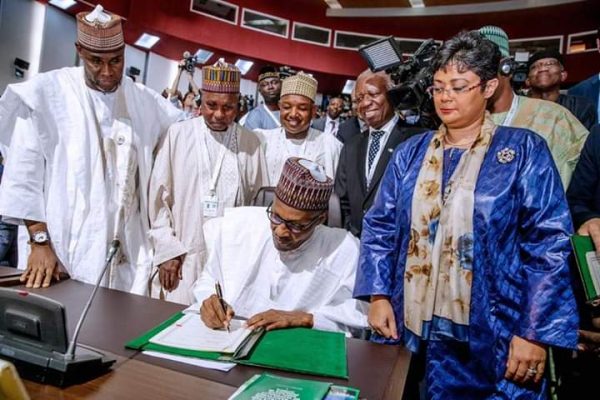 President Muhammadu Buhari has called on African leaders to take the advantage of the newly established African Continental Free Trade Area (AfCFTA) to develop African economies and create jobs for Africans.

Bola Ige, Oke And Continuing Politics Of Ideas, By Abiodun Adeniyi
Bola Ige left a legacy of a puritanical rhetorician in the nation’s politics. He spoke the proverbial Queen’s English with an uncommon cadence, matched with a clinical diction and easily caught the attention of listeners with a depth, laced with ideas and progressive philosophies. Check this important instance: Military leader Abdulsalami Abubakar had then asked politicians to assemble and decide the future of Nigeria’s politics, after the demise of Maximum Ruler, Sani Abacha. Venue was at the Towry Coker wing of the International Conference Centre. In audience were the cream of the Nigerian political class, comprising men and women of different political hues.
It was a de-ethnicised, detribalized and integrated gathering. All seated, the moderator beckoned on the late politician, whose hands were now up, signifying an intention to speak and who was supported by a cross-section of the assembly to articulate their plans. The man, once christened the Cicero of Esa-Oke, stepped on the microphone and began.
His voice, oscillating between the Mezzo, the Contralto, and the Tenor, was good enough to still the hall, just as it suspended them for the next sentence, evening up to deep meanings in the senses the speaker was making. He was measured, penetrating, and deliberate. When he was done, his audience applauded to know end, as he had exhausted their hearts’ desires. Bola Ige was celebrated. He was a man of ideas, rich with content and possessing a great power of conveyance. There was probably no need for anyone else to speak, afterwards, save for the replica delivery courage of Orji Nwafor-Orizu, who complemented from a “youthful” paradigm.
The Esa-Oke native proceeded, therefrom, to be a definer in the post-military era politics, playing key roles in political flows and governance, until he was cut- down by the assassin’s bullet, in his modest Ibadan home. Long gone, it would seem his pattern has also gone. But see: nature often has no place for vacuum. It might be tough to spot a mathematical resemblance. But resemblances would come all the same. Nature propels, in shapes and sizes, through learnings, via experiences and by way of understudying. Nature is beautiful, in an ability to replace, to reactivate and revive past and extant processes and procedures. It is the reason the past may be gone, but the past still lives on. It is also the reason there could be improvements, progressions and growth, despite the beauty of yesterday.
Memories, remembrances and nostalgia, might yet have their places over things gone, but the fact of continuity runs deep in the affairs of men. It is why the legendary Uncle Bola Ige may be no more, but there is a Busayo Oluwole Oke, incidentally stepping out from the Bola Ige Esa-Oke vicinity, to continue the ideas and projections of the legend and making a qualitative mark from his own anecdotal “little corner”, with great potentials for excellence.
In the first instance, however, let us see this context: Oluwole Oke has hitherto essentially operated from the prism of the Federal House of Representative. The population of the place is relatively large, at 360. Almost a crowd, it could drown, obfuscate and becloud the potentials of an individual. It could birth anonymity, and muffled the voice of even a Bola Ige. The population challenges the observer to be thorough in the recognition of quality. In nature, as well, there would always be a star, or stars. Identifying stars requires some attention to detail and with good eyes as a means. There have been stars amidst a crowd. There have been stars in the Federal House of Representatives. There are still stars, even as I write.
The legislature may be suffering from a perception of a self-aggrandizing lot, but the perception has regularly led to the danger of generalization. It is why tarring a whole with one brush is problematic for epistemology. And the more reason the unique identities of ideas and action men, like Oluwole Oke, would yet spring out. Patterned, purposeful and as rhetorical as the departed Bola Ige, Oluwole Oke is not your regular, stereotypical legislator.
Coming into politics from a business background and with interest in fiscal and monetary policies, education, security and defence management, micro-economic management, and multi-lateral integration, he performs from a pedestal of change, of progress, combined with zeal to leave a legacy. Thus far, Oke knows the pulse of his people, sensing their cynical disposition to men of power. He relates with the predilections of his class, spotting their limitations at the level of a propensity to be self-serving. He envisions tomorrow, as a day of reckoning, and is in terms with the difference he could make, so that tomorrow can exonerate him.
Oke is therefore at home with yesterday, today, and the offerings of tomorrow, over-morrow, and ever after. His missionary records in the House Defence and Procurement Committees are reference points. Check the Defence Committee for instance. First, he was committed in the drive for accountability, marshaling scary military minds, on transparency, accountability and openness, in a traditionally and statutorily reticent sector, needing a new wave of improvement in a collective quest to secure the nation’s borders and to deal with internal insurrection.
In the process, he crossed paths, ruffled feathers, but managed to survive, until his passion for service delivery was identified as his reason. He did no less in procurement, the forte where this writer first encountered him. Over here, he was focused on the mission and the vision of the reform, highlighting the details of quality, competition and value-for-money, which the programme came with. The procurement reform was to ensure the closure to previous losses in the government contracting and expenditure process.
Oke led the expansion of ideas on the scope and perimeters of the transformation, through the legislature. He operated from the point of view that implementation is partly a function of understanding and meaningful exchanges. He regularly brought this to the fore, while he functioned as the house chair on procurement. In the two committees, as well, Oke was noted for an easily differentiated over sighting, not one ridded with harassments, intimidation, or coercing, but rather with intellection-all geared towards performance improvement, productivity enhancement, efficiency management and sustainability.
Upon his re-election into the house, Oke has begun again. Though not yet at the level of committee performance, but through elevated political competitiveness. He aligned with like minds, including popular Ndudi Elumelu, effervescent Lynda Ikeazu and the active others like Anayo Edwin, Gideon Gwadi, Toby Okechukwu, Adekoya Abdul-Majid, Lego Idagbo, Nnoli Nnaji, and Victor Nwokolo. Others are Chris Azubogu, Sylvester Ogbaga, Edwin Anayo, Toby Okechukwu, Offor Chukwuegbo and Darlington Nwokocha from The Patriots group, and together they engineered the 9th Assembly Progressives, comprising 60 non-APC Members that saw to the emergence of Speaker Femi Gbajabiamila.
With the group at his behest, and although to the revulsion of his party, Peoples Democratic Party (PDP), Oke moved to demonstrate the glory in bi-partisan integration, sometimes important for institutional stability and growth. He was reportedly not motivated by prebendal considerations, or some anticipation for prime committee placement, but rather the discovery of the possibilities in the union of minds across aisles. He could not have been otherwise with his successes in business, his experiences as a ranking member and his personal abilities to excel, but was rather propelled by the greater glory in communion.
And to the usually ephemeral party suspension, he volunteered: “It is unfortunate if the party suspends its most loyal member for towing the path of honour and constitutionalism. I owe my party and its leaders a duty of care to advice appropriately as one of the ranking members of the House. I have discharged that duty. I advised my party leaders about our House Rules provisions about nomination of our leadership. The PDP alone cannot do it without other eight political parties. On speakership, the PDP had no candidate. I follow my conscience. I followed what my constituents clamored for. I followed practices and procedures” Just another bit of his philosophical, epistemic tendencies. Bola Ige may be gone, but it is morning yet for a protégé. Bon Vogage, Busayo Oluwole Oke.