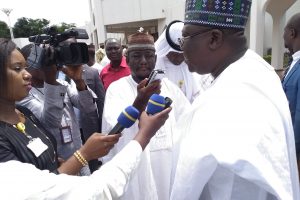
The All Progressives Congress (APC) has effectively taken over the entire leadership of the National Assembly, with Femi Gbajabiamila being elected as Speaker of the 9th House of Representatives. Ahmed Idris Wase was elected unopposed as his deputy.
The new speaker, who completed today’s (June 11) winning streak of the ruling party, starting from the Senate where Ahmed Lawan won the Presidency, secured 283 votes to defeat his only challenger, Umar Bago who garnered a paltry 76 votes.
His supporters, including National chairman of the APC, Comrade Adams Oshiomhole, couldn’t hide their excitement immediately he got the threshold.
Gbajabiamila Olufemi Hakeem was born on June 25, 1962 into the family of Lateef and Olufunke Gbajabiamila. He had his elementary education in Lagos at the Mainland Preparatory School and proceeded to Igbobi College, Yaba in 1973 for his secondary education where he graduated in 1978.
Gbajabiamila enrolled at the King Williams College, Isle of Man, United Kingdom for his ‘A Levels’ and graduated in 1980.
He returned to Nigeria and was accepted into the University of Lagos for LLB (Bachelor of Law) degree programme. He graduated with honors in 1983, proceeded to the Nigerian Law School and was called to the Nigerian bar in 1984.
Years later, Gbajabiamila established his own law firm, Femi Gbaja and Co. on Broad Street, Lagos, before traveling to the United States for further education.
He attended John Marshall Law School in Atlanta Georgia where he graduated top of his class earning himself a Juris Doctorate.
Gbajabiamila started his journey in politics when he joined the defunct Alliance for Democracy (AD) and won his first term election in the House of Representatives in 2003.
He was re-elected in 2007 and elected as Action Congress (AC) leader and Minority Whip of the House.
Bills and motions he supported, among others, were the Employee Rights Bill, Local content in Construction Industry Bill, Vocational Schools Bill, The Economic Stimulus Bill, Interest-Free Students Loan and Establishment of Nigeria Education Bank Bill.
In 2011, Gbajabiamila contested and won a third term on the platform of Action Congress of Nigeria (ACN). He was again re-elected ACN leader and leader of the opposition in the House.
The Joint Admission and Matriculation Board (JAMB) has approved 160 and above as the national minimum cutoff mark for admission into state and federal Universities in Nigeria for the year 2019.
The decision was taken at 19th Policy Meeting on Admissions to Tertiary Institutions in Nigeria held at Bola Babalakin Auditorium, Gbongan, Osun State today, June 11.
It was also agreed that the minimum UTME score for admission into private Universities should be 140.
120 UTME score was approved for polytechnics while 110 score was approved as the least score for admission into private polytechnic.
An All Progressives Congress (APC) leader in Lagos State, Hon Adeyinka Adedoyin, on Tuesday said the election of Rt. Hon Femi Gbajabiamila as Speaker of the House of Representatives was a sign of further development, true federalism and respect for the rule of law in Nigeria.
Adedoyin spoke at a gathering of religious leaders, politicians, women and youth leaders in Surulere.
He said Gbajabiamila’s victory was well deserved as “it is the result of hard work, confidence and above all, God’s intervention.”
“I consider it remarkable that the representative of Surulere Constituency 1 is occupying the speakership position. I am confident that those values which inspired the Honourable Members to elect him will be maintained and even surpassed.”
He called on Gbajabiamila to engage the National Assembly members, Presidency and the leadership of APC in new and exciting ways.
Adedoyin who congratulated Gbajabiamila on his election as Speaker urged him to fashion out strategies to run his office efficiently and work out how to relate with the presidency without losing the confidence and respect of Nigerians or his colleagues in the National Assembly.
“I am sure with the impeccable credentials, strong character, honest disposition and accessibility, Gbajabiamila will discharge the burden of the new office and take Nigeria to new heights.”
Specifically, he urged Gbajabiamila to ensure that his words and actions promote peace, harmony and development.
He appealed to members of the 9thAssembly to be committed to their legislative and oversight functions.
President Muhammadu Buhari has prayed the Presidential Election Petition Tribunal to dismiss the petition filed by the Peoples Democratic Party (PDP) and its Presidential Candidate, Atiku Abubakar against his February23 re-election.
Buhari made the prayer through his Counsel, Chief Wole Olanipekun (SAN), in a motion adopted and argued on Tuesday before Justice Mohammed Garba-led five-man panel in Abuja.
Olanipekun submitted that the petition was fundamentally defective, adding that his client won the presidential “square and clear’’.
He explained that the allegations advanced by the petitioners were mere theoretical assumptions that could not stand the test of critical legal debate.
The tribunal also entertained the president’s motion that sought to effect amendment on the identities and addresses of counsel representing him.
Another of Buhari’s application seeking to mandate the tribunal to entertain all interlocutory motions before the commencement of proper hearing of the main petition was also adopted and argued.
Similarly, the Independent National Electoral Commission (INEC) asked the tribunal to dismiss the petition brought by PDP and Atiku against a “flawless,” election that won by Buhari.
Yunus Usman (SAN), Counsel for INEC said that the electoral commission would standby the declaration of the second respondent (Buhari) as winner of the February 23 presidential election.
Usman said the petition challenging the outcome of the exercise was “misguided’’, adding that the allegations of fraud made against the electoral body was “mischievous’’.
INEC’s application is challenging the jurisdiction and competence of the tribunal to entertain the petition.
Usman urged the tribunal to dismiss the petition as the petitioners failed to include the vice president, Professor Yemi Osinbajo, as a co-winner in the election.
“ The failure of the PDP and Atiku to include Osinbajo’s name as party should not be overlooked because whatever affects the president affects his running mate,” Usman said.
Three other interlocutory motions filed by the All Progressive Congress were argued and dispensed with.
Chief Lateef Fagbemi (SAN), Counsel for the APC had urged the tribunal to strike out 18 paragraphs of the petition with frivolous assumptions among other prayers.
He submitted that the competence of the petition was questionable, adding that it would soon become a mere “lame duck’’.
Meanwhile, Dr Levi Uzoukwu (SAN), Counsel for the petitioners prayed the tribunal to discountenance all the arguments canvassed by the respondents, describing INEC’s position in the matter as “unusual”.
The presiding judge, therefore, fixed June 13 for the petitioners’ motions to be heard.
President Muhammadu Buhari has said that influence of money on party politics and electioneering processes can lead to enthronement of corrupt and unprincipled individuals to positions of leadership and entrench the structures of democracy devoid of accountability.
Buhari, who spoke today, June 11 at the National Democracy Day Anti-corruption Summit organized by the Economic and Financial Crimes Commission (EFCC) in Abuja, said regretted that the recent political experiences in the country have been characterized by the corrupt influence of vote-buying.
Speaking on the theme: “Curbing Electoral Spending: A Panacea for Public Corruption,” the President noted that such sordid political experiences are not limited to Nigeria alone but wide spread across Africa.
He said that the way to de-commercialize the political process so that true democracy can survive and thrive is to curb electoral spending, adding that Nigeria had sufficient legal framework in place to combat reckless electoral spending.
“The provision of Section 90 of the Electoral Act, 2010 (As Amended) explicitly puts a cap on the amount candidates for different political offices must expend on elections, failing which they are violating the law.
“Of greater significance is the provision of section 88 of the Act which prohibits a political party in Nigeria from ‘possessing any fund outside or retaining funds or other assets remitted to it from outside Nigeria.’
“The philosophical underpinning of the above provisions and other related provisions of the Act is to prevent desperate politicians from buying their ways into political offices at the expense of low – spending law-abiding individuals.
“In this connection, I urge all law enforcement agencies and the Judiciary in Nigeria, and across Africa, to tackle financial corruption in our political systems.
“Uncontrolled electoral spending and voter inducement by politicians must be combated if we want to consolidate true democracy and good governance.
“This Summit, therefore, has the potential of spurring us to action starting with the discussions and exchange of ideas among participants. It is also my hope that the participation of Heads of African anti-corruption agencies in this Summit would enrich the discussion with valuable regional and continental perspectives.
“Let us remind ourselves of the Thabo Mbeki Panel on illicit financial flaws published a few years ago. Through corruption Africa has lost over $1 trillion over the last 50 years, a figure surpassing all the combined development aid received by the continent during the same period.”
President Buhari stressed that political corruption is merely an extension of larger corruption in the wider society, saying: “if we desire to curtail political corruption in public governance, then, corruption must also be fought in the wider society.
“This underscores the guiding principle and commitment of our Administration. This commitment derives, as I once stated, from the fact that:
“Corruption runs completely counter to our shared values as Africans – the values of justice, the sense of fairness, law and order, equity and equality. Corruption rewards those who do not play by the rules and also creates a system of patronage where the resources are shared out by a small elite, while the majority are trapped in poverty.
“During the recently concluded election campaigns, I stated clearly that the major areas of priority during my second term in office as it was in my first term will be: Security, economic improvement and fight against corruption. I remain committed to the fulfillment of these promises.
“Now, as this administration commences, we are taking stock of progress made so far in the war against corruption, assessing what needs to be done and devising new strategies to address existing challenges.”
The President said that this process has already started with the recent interaction between the Presidential Advisory Committee against Corruption and all anti-corruption agencies in Nigeria.
He said that the outcome of the interaction, among others, shall serve as the basis for a more concerted effort by this administration to strengthen the capacity of the Economic and Financial Crimes Commission and other anti-corruption agencies by providing additional material, organisational and logistical support.
He added that it would close existing legislative loopholes, facilitate collaboration with the judiciary, and strengthen the criminal justice system as well as enforce effective asset declaration by public office holders and ensure sanctions by professional bodies against lawyers, bankers, brokers, public officials, and other individuals facilitating corrupt practices;
It will also “ensure comprehensive support and protection to whistleblowers, witnesses and victims of corruption; adopt and formulate the policy of ‘naming and shaming’ all those who engage in corrupt practices while encouraging and honouring those who do not; educate, mobilize and encourage Nigerians at the grassroots level to take ownership of the fight against corruption; press for a crackdown on safe havens for corrupt assets, abolishing of bank secrecy jurisdictions and tax havens on the continent and beyond; insist on the unconditional return of looted assets kept abroad and further strengthening of international cooperation through information and mutual legal assistance.
“We must henceforth see the anti-corruption fight not to end in itself but as an instrument not only to fight poverty but a means to restore the right order of things.
“As we work to integrate these outlined measures and others into the anti-corruption drive with renewed vigour, we look forward to the active support and cooperation of all.
“We also look forward to a continental strategic partnership and a global alliance to successfully defeat corruption. I urge all of you seated here to be part of such alliance and partnership.”
Senator Ovie Omo-Agege representing Delta Central has been elected deputy president of the Nigerian Senate.
The 55-year-old defeated major rival and three-time deputy Senate president, Ike Ekweremadu, on Tuesday in an election held at the National Assembly.
Mr Omo-Agege polled 68 of the 107 votes cast to beat Mr Ekweremadu, who got 37 votes.
Ekweremadu had jumped in the fray on election day after asking his colleagues not to vote for mace snatchers.
His veiled statement was in reference to Omo-Agege who allegedly facilitated the theft of the mace during the eight assembly.
Senator Ahmad Lawan had earlier been elected as President of the ninth Senate after scoring 79 votes to defeat his major rival, Ali Ndume, who got 28 votes.
The outcome of the Senate election now puts the All Progressives Congress (APC) in firm control of the upper chamber.
It is ironic that it had to take a member of the military establishment now turned democrat, that is General, now President Muhammadu Buhari for June 12 to be accorded its pride of place in the socio-political calendar of the Federal Government of Nigeria. Before now, the recognition/celebration of June 12 as a watershed in Nigerian history had been observed majorly by the states of the South West of Nigeria, thus making its symbolism and significance a restricted and ethnic referent. But that has changed, thanks to President Buhari. His decision to declare June 12 a national holiday, his award of a post-humous honour of Grand Commander of the Federal Republic (GCFR) to Chief Moshood Kashimawo Olawale (MKO) Abiola and the subsequent amendment of the Public Holidays Act to accommodate June 12 as a Federal holiday is a welcome development. President Olusegun Obasanjo (1999-2007) had pointedly ignored all entreaties for his administration to take the same step.
President Umaru Musa Yar’Adua (2007 – 2010) did not address the June 12 issue. President Goodluck Jonathan (2010 -2015) had taken steps to immortalize MKO Abiola when he decided to name the University of Lagos after the late icon of democracy, but the staff, students and the alumni of the University rejected this, as they insisted that the name University of Lagos must not be changed. The Jonathan administration would later recognize Chief MKO Abiola as one of the major Nigerians of the 20th century. That administration also considered giving Chief MKO Abiola a post-humous national award, but the then President was advised against doing so on the grounds that national honours in Nigeria are never given post-humously. Obviously, the controversy over the re-naming of the University of Lagos was so overwhelming, President Jonathan chose to listen to the Justice Alfa Belgore-led committee on national honours.
Whereas all other Presidents before him failed to make a statement with June 12, President Muhammadu Buhari has now chosen to do so. Tomorrow, all Nigerians will observe June 12 as a national holiday. It will be the first time that this will happen. This should lay to rest all the conspiracies and the revisionism involved in the attempt to reduce June 12 to a narrow, ethnic event, which it is not. The recognition of June 12 as a special national event would be one of those developments for which President Buhari will be positively remembered. It is again ironic that 26 years after, it took another member of the military elite to correct the problem caused by the military. It has taken President Buhari to correct the error committed by General Ibrahim Babangida and his group on June 23, 1993 when they chose to annul the Presidential election held in Nigeria on June 12, 1993. That unwise decision became General Babangida’s Achillee’s heel, and the ugly thing around his neck.
General Babangida or IBB as he is fondly known, could have ended up as one of Nigeria’s greats, given the performance of his government, but what is now remembered as his legacy, despite the best efforts of his biographers and PR managers, is that singular negative act, his violation of the people’s sovereignty. President Buhari is now being lauded for the courageous manner in which he has taken Nigeria beyond the denial and conspiracy foisted on the people by both the military and a segment of the professional political class. We look forward to what President Muhammadu Buhari would say to Nigerians and the international community, tomorrow, June 12. His speech writers have a good opportunity to put words in his mouth that can reverberate like the claps of thunder. They must not waste that opportunity with their sleepy prose. President Buhari should have a word for those who have kept this country down by perpetually denying the truth and turning back the hands of the country’s clock. He should take credit appropriately for the wise decision that he has taken on the matter of June 12.
I remember June 12, 1993, as clearly as if it happened only yesterday. On that day, Nigerians trooped out en masse to make a choice between the Presidential candidates of two political parties, Bashorun MKO Abiola of the Social Democratic Party (SDP) and Alhaji Bashir Tofa of the National Republican Convention (NRC). General Ibrahim Babangida was military President, ruling the country with his Armed Forces Revolutionary Council and finally getting to the final stage of a slow-moving democratic transition programme. By 1993, Nigerians were already tired of military rule and particularly of the Babangida government which seemed to have mastered the art of deception.
The people wanted the military out of the way, to allow a return to civilian rule, which had been truncated by the military at regular intervals since independence in 1960. On that day, Nigerians voted massively for the Social Democratic Party and its candidate, Bashorun MKO Abiola (8, 341, 309 million votes – 58.36%). The NRC candidate, Bashir Tofa came second (5, 952, 087 million votes – 41.64%). This was an election in which neither religion nor ethnicity – two major dividing factors in Nigeria was an issue. MKO Abiola, a Southerner got as much support in the North as he did in the South, even beating his rival, Bashir Tofa in his home state of Kano. The National Electoral Commission (NEC) was headed by political science Professor, Humphrey Nwosu. As the results were collated, it was clear that MKO Abiola (SDP) was leading in 19 states, with Bashir Tofa (NRC) winning in 11 states. On June 16 however, NEC announced that it would no longer announce the results “until further notice”. Civil society and pro-democracy protesters objected to this. It had been a free and fair election, the most peaceful that Nigeria had ever known. On June 23, 1993, the Babangida government annulled the election and suspended the Electoral Commission. The NEC Chairman, Humphrey Nwosu went underground and became incommunicado. Bashorun MKO Abiola claimed victory. The people demanded that their will as expressed on June 12, 1993 should be respected and that the results of the election should be declared.
The refusal of the military establishment brought it into direct collision with the people and the international community. June 12 became a catalyst for much that would happen to Nigeria. The crisis escalated so quickly, General Ibrahim Babangida known then as the “evil genius” had to “step aside” as President of Nigeria. He put in place as he left, an Interim National Government (ING) led by UAC chief, Ernest Shonekan with General Sani Abacha as Defence Chief. That ING survived for only 83 days. General Sani Abacha, a veteran of military coups in Nigeria, pushed aside the ING and its Head and proclaimed himself Head of State. To put it as it was, hell broke loose. Civil society became tempestuous.
Concerned Professionals, Concerned Democrats, Progressives, voices of reason in Nigeria across all divides, the church, market women, every one with a voice, took to the streets to say: “Never Again to military rule.” The general consensus was that the annulment of the June 12, 1993 election was after all a subterfuge by the military to remain in power and that IBB had played a “Maradona” game against Nigerians. “On June 12 we stand”, the people proclaimed and they took to the barricades. The diplomatic community even joined the protests, with the likes of US Ambassador Walter Carrington, leading the charge on the diplomatic front. The Abacha government was bound to fail. It died a-borning. It descended on Nigeria’s civil society and the progressive camp, and as Nigeria began to witness the worst form of dictatorship since 1960, the people fought back. And Abacha fought back. Not even newly born babies were spared. Journalists were special targets: those who were not hauled into prison, were made to flee abroad, or go underground. Those were the days of guerilla journalism in Nigeria. The people at home fought, those abroad set up a short wave radio, Radio Kudirat which reported Abacha to the world. In due course, Nigeria became a pariah nation.
Three major events made this happen: the first is the declaration by Chief MKO Abiola of his due right to the mandate that Nigerians gave him on June 12, 1993. On June 11, 1994, Chief MKO Abiola in the Epetedo area of Lagos declared himself the democratically elected President of Nigeria. That speech is now known as the Epetedo Declaration. It should be widely circulated tomorrow, June 12 and on every June 12 henceforth, for it has become one of the landmark speeches in the mapping of Nigerian history, and the trajectory of our country’s democratic evolution. I am tempted to quote from that eminently quotable speech but I recall that it was in that speech that the phrase “Enough is Enough” was first pronounced as a revolutionary call to action. Abiola said: “Today, I join you all in saying Enough is Enough! We have endured 24 years of military rule in our 34 years of independence.…Enough of military rule…” And he went on and on.…
The Epetedo Declaration became another catalyst for the Nigerian Spring! It was a call to action. The people responded. Abiola was arrested by the Abacha junta but the genie had left the bottle. The people of Nigeria heard Abiola: “Enough is Enough” and they too responded: “Never Again to military rule”. Second event: On November 10, 1995, Ken Saro-Wiwa, a writer and internationally renowned environmental rights activist was hanged by the Abacha administration. Third event: On June 9, 1996, Abiola’s wife, Kudirat was assassinated by Abacha’s killer squad. There were attempts on the lives of key pro-democracy activists as well including Chief Alfred Rewane who was murdered, and Chief Abraham Adesanya who survived. Journalists were murdered. It was as if at the Epetedo Declaration, Abiola had placed a curse on General Abacha. Nigeria suffered but the people wanted an end to it all. On June 8, 1998, General Sani Abacha died. There was dancing in the streets. But as it happened, Chief Abiola also died, in very suspicious circumstances, while still in detention, on July 7, 1998. By then, General Abdusalami Abubakar had succeeded General Abacha as military Head of State. Nigerians still didn’t give up. They wanted democracy. They wanted to be liberated from the shackles of military autocracy. On May 29, 1999, their will prevailed. General Olusegun Obasanjo who had also been framed and jailed by the Abacha government became Nigeria’s civilian president after all the turmoil.
It is sad that those who have benefitted most from the June 12 debacle have been the most desperate in denying the value and symbolism of that date and what happened therein. June 12 was a turning point for Nigeria as the foregoing narrative indicates, and it became, in its trajectory, the catalyst for Nigeria’s second liberation, that is liberation from internal colonialists, but as things stand 26 years later, we may still need to construct a strategy for a third liberation: liberation from the rent collectors who seem to have resolved that Nigeria’s progress is a threat to their own interests. By declaring June 12 a national public holiday, President Buhari has given us all an opportunity to reflect, to think and to remember. In a country where memory is short, people don’t like to think, and state institutions are constructed to erase memory, the teaching of history was even at a point “outlawed”, now it is taught as an optional subject, it is a good thing that President Buhari in making June 12 a national holiday has given us all an opportunity to do what we do not like to do in this country: to think, reflect and remember. June 12 is an idea that cannot be ignored. It is about national unity. On that day in 1993, we saw that it is possible for Nigerians, “though tongue and tribe may differ” to unite around an idea. June 12 is a philosophy, a way of thinking by a people who resolved at a critical moment in their lives to move forward. The evil agents in the military tried to block that and suppress the people’s sovereignty, but tomorrow, the point shall be made that the truth is indestructible! We hope that there will be celebration in every state of the Federation.
The story of June 12 has inspired a bibliography that should be promoted. Indeed, apart from the civil war, it is probably the most dramatic and telling incident in post-colonial Nigeria. I have been privileged to read many of the books, which I recommend to the reading public. They include, not necessarily in any order of importance, Abraham Oshoko, June12: The Struggle for Power in Nigeria, Abraham Oshoko, June 12: The Annulment; Frank Kokori, The Struggle for June 12, Omo Omoruyi, The Tale of June 12: The Betrayal of the Democratic Rights of Nigerians; Humphrey Nwosu, Laying the Foundations for Nigeria’s Democracy: My Account of June 12, 1993 Presidential election and its annulment; Wale Oshun, Clapping With One Hand; Wale Oshun, Open Grave; and Wale Oshun, Kiss of Death; Kayode Fayemi, Out of the Shadows: Exile and the Struggle for Freedom and Democracy in Nigeria; Joe Igbokwe, Heroes of Democracy; and Wole Soyinka, The Open Sore of a Continent. These works represent in varying degrees, the literature of resistance against military rule in Nigeria.
The revisionists led by General Ibrahim Babangida have tried to rewrite and revise the same story (there would have been a coup if the result was allowed (!), a cabal within the military didn’t want Abiola, it was an unfortunate incident… story…); see: their narrative is not selling. On June 12 we stand! I have also heard some people express the view that the Buhari government should go a step further and formally announce the results of the June 12, 1993 election and thereafter declare Chief Abiola the rightful winner of that election. I disagree. The June 12, 1993 process having been inchoate and the beneficiary dead, such a declaration will have no probative value. For me, what has been done serves the purpose. It would all have been better though, if June 12 had been declared MKO Abiola’s Day. He was the symbol, the rallying point, the icon of Nigeria’s second liberation in whom is fully embodied the essence of the struggle from June 12,1993 to May 29, 1999. But have we learnt any lessons from June 12? Sadly, I don’t think so.
Senator Ahmad Lawan from Yobe state has emerged the President of the Senate, following the inauguration of the 9th National Assembly today, Tuesday, June 11. Lawan, the preferred candidate of the ruling All Progressives Congress (APC), defeated his arch-rival, Senator Ali Ndume from Borno state. Dr Yahaya Abdullahi nominated Senator-Elect Ahmad Lawan, seconded by Senator Adeola Solomon Olamilekan. The nominee, Lawan accepted to stand for election and subsequently addressed his colleagues. Senator-Elect Ishiaku Agbo from Adamawa north nominated Senator Ali Ndume, seconded by Senator-Elect Nfigi from Rivers state, following which Ndume also accepted the nomination and addressed the gathering. It is recalled that the opposition Peoples Democratic Party, PDP, had in the early hours of Tuesday, endorsed the candidature of Senator Ali Ndume and Hon Umar Bago, for the positions of Senate President and Speaker of the House of Representatives respectively. Justifying the party’s position, PDP National Secretary, Sen. Umar Tsauri, had stated, “The final resolution on Sen. Ndume and Bago was reached at the end of a decisive meeting of members of the National Working Committee, party leaders, state governors as well as senators and members-elect the platform of the PDP. “This decision is in the best interest of the nation in line with our party’s determination to deepen democracy, ensure a strong and independent legislature, strict compliance with the principle of separation of powers as well as constitutional checks and balances in the polity.” “All senators and members-elect on the platform of the PDP are to be guided accordingly.”
A nationwide civil disobedience campaign is raging in Sudan with internet blackout and power outages that make communication difficult.
Information reaching us said that most parts of the capital and its key business districts remained closed as shopkeepers, traders and employees opted to remain indoors. Those who ventured out said they had to earn their livelihood.
This was even as the authorities have released three prominent rebels detained after a crackdown that left dozens dead.
The ruling military council announced that security forces on the streets would be boosted after four people were killed in clashes yesterday, Sunday – two in Khartoum and two in Omdurman, just across the Nile river.
The disobedience campaign comes a week after a deadly raid on protesters in the capital left dozens dead, and almost two months since the April 11 ouster of longtime ruler Omar al-Bashir following months of protests.
Protesters had set up roadblocks across many areas of the capital that the ruling generals have vowed to remove in order to bring “life to normal”.
Public transport buses were also ferrying passengers, while more vehicles and people were seen on the capital’s streets than the previous day.
“If I work it does not mean that I don’t support the revolution,” said bus driver Abdulmajid Mohamed.
“I have to work to support my family or else we will have no money.”
State television reported Monday that Yasir Arman, deputy chief of the Sudan People’s Liberation Movement-North which is part of the protest movement, was released along with two other leading rebels from the group, Ismail Jalab and Mubarak Ardol.
Arman arrived in Khartoum in late May to take part in talks with the ruling generals but was seized two days after the crackdown began.
Jalab and Ardol were detained after meeting visiting Ethiopian Prime Minister Abiy Ahmed in Khartoum on Friday for talks aimed at reviving negotiations.
The generals have blamed protesters for a deterioration in security in Khartoum and across the country.
“The Alliance for Freedom and Change (umbrella protest movement) is fully responsible for recent unfortunate incidents… including blocking roads which is violating international humanitarian laws,” Lieutenant General Jamaleddine Omar said on state television late Sunday.
“The Military Council has decided to reinforce the presence of armed forces, RSF and other regular forces to help normal life return,” the council member said, including the feared Rapid Support Forces, blamed by witnesses for the killings last week as a sit-in protest outside army headquarters was cleared.
He said security forces would provide “security to isolated civilians, reopen roads and facilitate the mobility of people, public and private transport and protect markets and strategic state installations”.
‘Lose our country’
Some residents called for the generals and protester leaders to narrow their differences.
“The two have to find common ground because if the situation continues like this, I’m worried we will lose our country,” said Issa Omar, an employee at a workshop in Khartoum.
The death toll since the crackdown began on June 3 has reached 118, according to a doctors committee linked to the protesters who are pressing the military to hand over power to a civilian administration.
The health ministry, for its part, says 61 people died nationwide in last week’s crackdown, 49 of them from “live ammunition” in Khartoum.
The Central Committee for Sudanese Doctors blamed forces supporting the ruling generals for the deaths on Sunday.
The Sudanese Professionals Association, which first launched protests against Bashir in December, has said the disobedience campaign would continue until power is transferred to a civilian government.
Hundreds of protesters stormed the Abuja headquarters of the All progressives Congress (APC) today, June 10, demanding that Governor Yahaya Bello of Kogi should be stopped from contesting for a second term in office.
The protesters, who grounded activities at the APC headquarters, were armed with placards carrying various anti-Bello inscriptions.
Some of the placards had messages asking the presidency to save Kogi while others demanded for full freedom for the state.
The protesters also urged the APC to declare a direct primary election for its aspirants ahead of the main election.
The News Agency of Nigeria reports that Jubril Yusuf, coordinator of the protesting group, which called itself Concerned APC members, said: “We are here to place before the Nigerian public the plight of the people of Kogi State since February 2016 when Yahaya Bello became the governor of the state.
“We have also come here to call on all men and women of conscience to put pressure on the leadership of our great party, the APC, to provide a level-playing ground for all aspirants on the platform for the governorship ticket of the party.”
He lamented the living condition in the state as worrisome saying that since February 2015, payment of salaries and pensions of civil servants had become optional and not a priority.
He alleged that workers and pensioners in the state were currently being owed many months of unpaid salaries and pensions.
“It is only when workers are paid that other citizens in the state will be able to sell their goods and services.
“Consequently, the economy of the state is reeling on the ground, many businesses have folded and potential investors have been avoiding the state like a plague. Virtually all the indices about the state are negative,”
However, drama was said to have ensued as a group of people allegedly loyal to Governor Bello stormed the APC headquarters warning against accommodating more protesters who are against the governor.
The report said that Yahaya Bello loyalists arrived at the secretariat with police patrol vans and other unmarked cars.
“We have delivered our message and we won’t make noise about it any longer. Nobody can stop Governor Bello’s re-election. All those opportunists that voted for Atiku Abubakar during presidential elections are now coming back to decide who will be the governor of Kogi.
“Why are they protesting in Abuja instead of coming to the state? These stupid protesters are lucky we did not meet them here,” they were reported to have said.
Meanwhile, Governor Yahaya Bello was said to have expressed confidence in winning the governorship election.
The governor spoke at the Kebbi governors lodge in the Asokoro area of Abuja yesterday, June 9.
We use cookies on our website to give you the most relevant experience by remembering your preferences and repeat visits. By clicking “Accept”, you consent to the use of ALL the cookies.
This website uses cookies to improve your experience while you navigate through the website. Out of these, the cookies that are categorized as necessary are stored on your browser as they are essential for the working of basic functionalities of the website. We also use third-party cookies that help us analyze and understand how you use this website. These cookies will be stored in your browser only with your consent. You also have the option to opt-out of these cookies. But opting out of some of these cookies may affect your browsing experience.
Necessary cookies are absolutely essential for the website to function properly. This category only includes cookies that ensures basic functionalities and security features of the website. These cookies do not store any personal information.
Any cookies that may not be particularly necessary for the website to function and is used specifically to collect user personal data via analytics, ads, other embedded contents are termed as non-necessary cookies. It is mandatory to procure user consent prior to running these cookies on your website.