Abdulfatai Usman Atima, a citizen of Nigeria has written an open letter to President Muhammadu Buhari over what he described as irregularities in the recruitment exercise by the Nigeria National Petroleum Corporation (NNPC).
He starts by congratulating President Buhari over his re-election victory and the just concluded swearing-in ceremony for the kick-off of next-level progressive change administration.
The letter continues:
I want to declare that I’m one of your strong admirer and supporter upon your inception into active politics. Sir, this admiration was born out of your staunch abhorrence for corruption, and your insistence for discipline, justice, simplicity, humility and sincere love for the project Nigeria.
Without too much aggrandizement, this write up has become necessary as horrendous job merchant in the NNPC with abstruse confidence are trying tooth and nail to undermine and discredit your globally recognized image as an anti-corruption crusader with zero tolerance for sharp practices. With the wide range publicity this recruitment process covers, i had passed a vote of confidence on your integrity once more to superintend over a recruitment process devoid of the usual ethnic, political, religious and other sentiments previous exercises have been known for (NPF, CBN, NSCDC, Fire Service, Prison, FRSC etc).
Sir, a potential string of anomalies is scripted out. In fact, I am writing this letter, from hindsight, a distance acquaintance of already possesses two appointment letters at N2M each from a director of the corporation. There are more under this category who are now awaiting resumption pending on the conclusion of the second and final stage of the recruitment process to illegally formalize this appointment.
Recruitment of people through the backdoor and those that do not possess the minimum requirements aid corruption and incompetence in service. It undermines the principle of justice and distorts the moral fabric of the civil/public service workforce, expected to be the engine room of any government.
Sir, the aptitude test of May 24 through May 27, 2019 conducted by NNPC was held at the discomfort of candidates who have to travel from one location to another despite the prevailing security challenges nationwide, if nothing is done to justify their sacrifices it goes to portend that, Mr President as the substantive minister of petroleum has no power whatsoever to nip in the bud this high level of corruption that makes nonsense of your covenant with Nigerian people which you gave 10 days to the 2015 general elections. It goes thus: “ what was required for Nigeria’s advancement was to galvanize all our citizens to believe once again in their government, in their country and especially to believe in themselves…”
I, therefore, ask Mr President Sir, how do you expect ordinary Nigerian youths to believe in Nigeria and themselves and overcome depression which is preparatory to suicide when you as substantive minister for petroleum cannot guarantee us a free, fair, and credible recruitment exercise. A situation where one high-profile family gets as much as ten direct slots which results into internal squabble over sharing as some members of the family already engaged with another less juicy agency of govt desires to be pencilled in for NNPC, is far from being corrupt-free. If this anomaly is allowed to happen under your watch sir, we the masses cannot easily exonerate you as it is believed that you preside over the Cooperation.
I implore you sir, Mr President to pull the veil off a potentially corrupt system that will on the long run fuel incompetence, godfatherism, harm your stance on good governance and transparency in public service. As you act expeditiously to curtail this illegality, I will suggest a forensic audit on recruitment and replacement done by the corporation since the inception of your administration.
Teachers of government primary and secondary schools across the 17 local government areas in Abia State have embarked on an indefinite strike as a result of none payment of 10 month salaries and none payment of the primary school teachers (TSS), Teachers’ Salary Structure (TSS).
A teacher in one of the State-owned primary schools in Aba, who pleaded not to be mentioned, disclosed the union decided to embark on the industrial action after attempts to persuade the state government to pay them failed.
Chairman of the State Nigeria Labour Congress (NLC), Comrade Uchenna Obigwe, confirmed that teachers have gone on strike, even as he also confirmed that the Governor, after a meeting with the leadership of Labour and NUT, directed that the sum of one billion naira should taken from the May Federation Allocation to pay some months of the accrued salary arrears.
“The leadership of NUT met on Friday to declare strike but in the meeting that Labour held with the governor and NUT on Sunday, we saw no need for the strike and they have been asked to play it down. Some teachers were paid for August last year; half of them were paid.
“But by Friday last week, N1, 050, 000, 000 (one billion, fifty million) was released to clear the other half for August and pay all of them September, October.
“So the government looked at it that if N1, 050, 000 was released for teachers’ salaries from May FAC, that a sacrifice has been made.
“A committee was set up to address other issues which they raised and government promised to be paying two months from June. So with that, the proposed strike seemed to have been collapsed.
“The kids went home on Monday but will come back to school on Thursday.
‘’The meeting held till 8:30 pm on Sunday and the outcome of the meeting would not have gone round, which was why the teachers didn’t come to school on Monday.”
The Inspector General of Police (IGP), Mohammed Adamu has called for tougher legislations against kidnapping and banditry, including possible state seizure of assets linked to illicit proceeds from kidnapping and other heinous crimes.
The police boss, who made the call today, June 5, while addressing a delegation of the Association of Local Governments of Nigeria (ALGON), Nasarawa State Chapter, believed that such tougher legislation will act as a strong disincentive to potential kidnappers and other violent criminals. According to him, the call for tougher punishment for kidnappers and other criminals is backgrounded against the increase in crimes in the society.
Mohammed Adamu, who also highlighted the successes recorded by “Operation Puff Adder” in the ongoing fight against criminal elements across the country to the visitor, led by Alhaji. Aminu Muazu Maifata, said that since the launch of Operation Puff Adder on 5th April 2019, till date, a total number of 63 Kidnapped victims were rescued unhurt by Police Operatives. “In a similar vein, Two Thousand, One Hundred and Seventy-Five (2,175) suspects were arrested for the following offences: Kidnapping – Eight Hundred and Fifty Two (852), Armed Rubbery – Eight Hundred and Sixty Five (865), Murder – Three Hundred and Fifty Nine (359) and Cultism – Ninety Nine (99). With respect to arms recovery, the IGP noted that Eight Hundred and Thirty Four (834) Arms, including Two (2) – rocket Launchers, Nineteen Thousand and Nine (19,009) live ammunition were recovered with Oyo State recording the highest number of Nine thousand, Five Hundred ( 9,500) live ammunition . The IGP stated that the Police are re-jigging their strategies to ensure proactive interception of illicit weapons destined to our country and at the same time mop up un- authorized weapons in circulation. According to the IGP, while a good number of the cases are already being prosecuted in courts across the country, many of the cases are still under active investigation owing largely to the complexity of investigating and managing organized crimes.” The IGP said that the mind-boggling size of the arrests and arms recovered so far is a testament to the efficacy of Operation Puff Adder and more importantly to the unalloyed and unwavering support of the public to the Nigeria Police and other Security agencies.
The Ambassador of the Royal Kingdom of Saudi Arabia to Nigeria, Adnan Ibn Mahmoud Bostaji has congratulated Nigeria on the occasion of the victory of Professor Tijani Mohammed as President of the United Nations General Assembly (UNGA) in New York, the United States of America.
In a statement today, June 5, Ambassador Adnan described the election of Professor Tijani as a deserved victory for the Government of President Muhammadu Buhari and Nigerian diplomacy.
He acknowledged Nigeria’s prestige among the countries of the world and the great role it has been playing as well as its influential actions in regional and international issues.
“I wish Professor Tijani every success and excellence in this international position.”
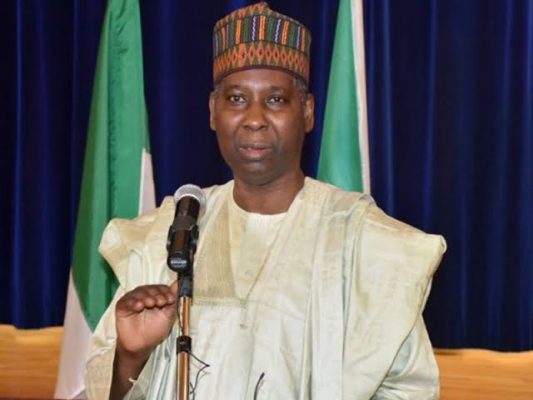
The newly elected President of the United Nations General Assembly, Professor Tijani Mohammad-Bande, has given details of his priority areas even as he secured the support of world leaders.
Professor Tijani Mohammad-Bande, who was elected today at the 87th plenary meeting of UNGA in New York,pledged to provide a vibrant and purposeful leadership anchored on accountability and transparency.
“As I announced in my mission statement and during the interactive dialogue on May 13, the implementation of existing mandates and the 2030 agenda with particular focus peace and security, poverty eradication, zero hunger, quality education, climate action and inclusion will constitute the major priority of my presidency.
“I am committed to promote partnerships that are needed from all stakeholders to achieve our objectives, and ultimately ensure that we do our best to ensure peace and prosperity, particularly for the most vulnerable.
“10:46 I wish to reiterate that as President of the 74th session of the General Assembly, openness, inclusivity and transparency will guide all actions of the office of the President of the General Assembly.”
This was even as the UN Secretary General, António Guterres, assured Professor Tijani Mohammad-Bande, of his support to actualize his vision
“It is my pleasure to congratulate Prof. Tijani Mohammad-Bande as President of the 74th session of the United Nations General Assembly.
“Prof Bande, you bring many important and remarkable qualifications to the job. From your years as Permanent Representative of Nigeria, you know the United Nations well.
“And from your wide ranging academic pursuit; you are an expert in political science and public administration.
“And as a Nigerian and an African, you have invaluable insight into the continent’s challenges such as the Sahel and the Lake Chad basin, and more broadly to the challenges our world faces across the six pillars of our work – peace, sustainable development and human rights.
“We wish you well in your preparations for this role in the months ahead.
“Mr. President-elect, we all look forward to working with you and you can count on my support, as we strive to reach our shared goals and uphold universal values.’’
In her remarks, outgoing President of the 73rd Assembly, Ms Maria Espinosa, also congratulated Mohammad-Bande, describing him as the man for the job.
“Amb. Tijani’s career and experience both as a scholar and a diplomat should serve him and the General Assembly well in a session that promises to be pivotal.
“Amb. Bande is well seasoned to provide the strong and creative leadership our august assembly requires as he positions himself to be relevant in a world in rapid change.
“Your presidency, Ambassador, comes at a very critical moment for the United Nations and multilateralism.
“I am confident, however, that under your able leadership we will make meaningful progress to advance the implementation of 2030 agenda for sustainable development, in sustaining peace and conflict prevention as well as the promotion of human rights and the empowerment of women and girls.’’
She assured the president-elect of her commitment to a smooth transition in September.
In his acceptance speech, Muhammad-Bande thanked the Federal Government for nominating him for the position, and the African Group in the Assembly for endorsing his candidacy.
The Governor of the Central Bank of Nigeria (CBN) Godwin Emefiele has said that he, together with other financial institution will create a roadmap towards absorbing international economic shocks and strengthen the nation’s economic growth.
Emefiele who just began his second term in office in a statement by the CBN Director Corporate Communications, Isaac Okoroafor, stressed that the apex bank would continue to collaborate with the fiscal authorities to strengthen growth and wealth creation in the country.
The governor who said that the bank will play an active role in supporting job and wealth creation in Nigeria, charged all stakeholders to strengthen efforts at building a healthy and stable system in the best interest of Nigeria.
“We must strengthen our efforts over the coming years to stimulate growth and job creation in critical sectors of the economy, which will help insulate our economy from shocks in the global economy.
“We must also work to build a healthy and stable financial system that will contribute to the growth of our economy, while preserving price stability.”
He promised that a new roadmap will be unfolded for the bank and economy in the days ahead, after series of consultations with critical stakeholder groups.
Emefiele had just begun his second term in office after the Senate had approved his candidacy on May 16.
According to the statement, Emefiele was sworn in for a second term by the Bank’s Secretary and Director, Corporate Secretariat Department, Mrs Alice Karau.
Former Nigerian military Head of State, retired General Ibrahim Badamasi Babangida, has said that he believed in the capacity of President Muhammadu Buhari to deal with security, economic and other challenges that the country is facing.
Speaking to news men today, June 4 at his hilltop residence in Minna, Niger State, Babangida said: “Buhari has the capacity to deal with the challenges but Nigerians need to be patient with the president. Buhari is not disposed to idle talk; he is known to be a man of his words.”
He reminded Nigerians that President Buhari had already given an assurance that his government is committed towards ending insurgency in the North-East and other security challenges across the country during his second term in office, saying: “Nigerians should hold Buhari by his words.”
According to Babangida, the resurgence of insecurity is but a temporary setback which would be overcome with time, even as he expressed confidence in the ability of the president to put the country on the path of development and growth.
The former ruler advised Nigerians to rally round the President to succeed in the task ahead and to shun divisive tendencies.
The immediate past governor of Zamfara state, Alhaji Abdul’aziz Yari has said that there is no basis to blame anyone about the outcome of political turmoil that snowballed into the All Progressives Congress (APC), losing to the Peoples Democratic Party (PDP) at Supreme Court.
“We should not blame anybody on what happened; it was ordained by Allah and since Allah designed it, nobody can change it.”
Abdul’aziz Yari spoke today, June 4 while addressing APC supporters who paid him Sallah homage in his residence in Talata-Mafara town in the Talata-Mafara local government area of the state.
The former governor, who asked the party members to accept the Supreme Court verdict as an act of God, appealed to them not to be discouraged.
“We accept the court judgment; we will continue to be opposition party and our opposition will be for the benefit of the state.”
He insisted that in spite of its loss at the Supreme Court, APC remained a strong political party in the state.
“Our party remains the strongest party in the state”
Earlier in his remarks, the state chairman of APC, Alhaji Lawal Liman, said that the visit was to show solidarity to the former governor as the only APC leader in the state.
Liman said that APC remained strong and united in the state, with no faction, adding that those parading themselves as factions of the party are not true members but only working to sabotage the party.
The current Nigeria’s Permanent Representative to the United Nations, Professor Tijjani Mohammed Bande, has been elected the 74th President of the United Nations General Assembly (UNGA).
Professor Muhammad-Bande contested as the sole candidate for the position, and was elected through acclamation at the 87th plenary meeting of the Assembly in New York today, June 4 and will be inaugurated in September.
He is the second Nigerian to hold the office after Joseph Garba, a retired military officer and diplomat, who led the organ between 1989 and 1990.
Nigerians were left speechless on May 29 when after taking the oaths of office and allegiance, President Muhammadu Buhari and Vice President Yemi Osinbajo left the Eagle Square, the venue of the Presidential Inauguration ceremony without uttering a word. The President had nothing to say to Nigerians. He simply went back into his car and returned to the Presidential Villa. I thought that was an anti-climax. It was such a beautiful ceremony, what with the prayers, parades, gun salute and the symbolic retirement of the Defence flag and the national flag and the hoisting of new ones to signal the end of a term and the beginning of another.
The Constitution does not outline how an inauguration ceremony should be conducted, except that in Nigeria’s case, a President, who has been elected for a first term, or re-elected for a second term in office, must take an oath of office. It would amount to an illegal extension of tenure to shift the day and date. Over the years, certain traditions have also developed around Presidential inaugurations; these may vary from one country to another. In the United States, an inaugural speech is standard practice. Every US President, with the exception of about eight Presidents whose predecessors suddenly died before completing their term, have delivered an inaugural speech since George Washington (1789). Be it in Brazil, Indonesia, South Africa or India, Presidents or Prime Ministers use the opportunity of Inauguration Day to set the tone for their administration, by articulating their vision and mission. A well-written inaugural speech should capture the mood of the nation, reassure the people, connect with them, stir hope and build confidence. The beginning of a new administration provides an opportunity for the leader to give the people something to look forward to. It can also be used as a platform to send a strong message to the international community and assert leadership. Great speeches have been made on Inauguration Day particularly in the United States. Abraham Lincoln’s inaugural speech (1861), Franklin Delano Roosevelt’s inaugural speech (1933) and that of John F. Kennedy (1961) are among some of the most quoted and referenced inaugural speeches ever. Some American Presidents to deepen the event have even added a touch of poetry to the occasion as President Barack Obama did with Maya Angelou in1993.
On May 29, 2019, President wasted a good opportunity to reach out to Nigerians. He made it look as if the whole event was a distraction if not a piece of inconvenience. And yet, the occasion called for a speech given the state of the nation. On Friday, May 29, 2015, the then newly elected 15th President of Nigeria, and the 4thsince 1999 seized the day when he made that famous statement: “I belong to everybody and I belong to nobody.” He tried to reassure all Nigerians who had been entertaining fears that he would be vindictive as civilian President. He told Nigerians: “..There will be no paying off old scores. The past is prologue.” He reminded Nigerians of the glory of the past and the nobility of our ancestors. Then he defined the priorities of his administration and his vision for the future. For weeks, Nigerians analysed and debated the President Buhari’s 2015 inaugural speech. There was hope in the air. President Buhari promised Nigerians he would deal with the security challenge in the country, strengthen the economy and also wage war against corruption. Those who voted him into power were excited. Every country needs such a moment of re-awakening. So why would the same man treat Nigerians with such contempt on May 29? A Presidential speech is not just words. Thousands have gone to war to defend their nation by just listening to the words of the leader. Winston Churchill was most effective in using his gift of the gab to mobilise an entire nation in pursuit of defined goals.
In the 2019 Presidential election, over 15 million Nigerians voted for President Buhari. Even if he did not have a written speech, he could have spoken ex tempore, on May 29, if only to thank his supporters and all the party members across the nation who worked hard to ensure his re-election. A day after the inauguration, the President left for Saudi Arabia to attend a meeting of the Organization of Islamic Co-operation. He could while speaking ex tempore refer to that meeting and assure Nigerians work had indeed begun. There is no rule prescribing the format or nature of a Presidential inaugural speech. During his second inauguration in 1793, President George Washington’s speech was just 135 words long!
Nonetheless, President Buhari had every reason to talk to Nigerians. There is widespread insecurity in the land, far worse than the situation Nigerians faced in 2015. If President Buhari inherited certain challenges in 2015, those challenges have become worse, four years later. Insecurity is no longer about Boko Haram but banditry, farmers-herdsmen clashes, kidnapping, and the reign of impunity in parts of the country. The Buhari government may have taken Nigeria out of economic recession, but we have also been told by those who should know that we should expect slow growth and the months ahead may bring greater hardship. The evidence is already available: the spate of suicide cases in the country continues to rise. The people are depressed, there is hunger, poverty and despair. On May 29, the President had an opportunity to talk to the people he leads and allay their fears. What the people need is someone to give them hope and who will back that promise with action. As Commander-in-Chief of the Armed Forces, the President could also have addressed the troops. Too many innocent lives have been lost in the battlefields of Nigeria: young men and women – military officers, the police, security and intelligence agents generally, whose duty it is to keep Nigeria safe and secure in the face of the assault on the integrity of the Nigerian state by bandits and terrorists. They deserved the President’s recognition and appreciation on the occasion of his swearing in for a second term in office.
Some of the President’s handlers and supporters have tried to dismiss objections to his failure or is it refusal (?) to make a speech on Inauguration day as much ado about northing. They argue that the government had announced previously that May 29 would be a low-key ceremony and that the main celebration would be on June 12 which has now been declared a Federal Holiday for the celebration of Democracy Day. We have now been told to expect a speech on Democracy Day. This sounds like some Presidential staff making an excuse for their own laziness. Inauguration Day and Democracy Day are two separate and distinct events requiring two different kinds of speeches. It is not as if the President even gave a national broadcast on May 29. If he did, then those who dropped the ball on May 29, could easily offer that as excuse. The President of a country cannot be accused of talking too much. President Ronald Reagan addressed the American people virtually every week, on television, on radio or through direct communication and appeal. Jeffrey K. Tulis in his book, The Rhetorical Presidency (1987) says the essence of the modern presidency lies in “rhetorical leadership”, that is power of words, engagement and connection with the people who the President has been elected to lead and serve. Charles O. Jones in an essay titled “The Inaugural Address: Ceremony of Transitions” (2010) argues that “the inaugural address is the most exclusive of presidential speeches.”
Those who have been defending President Buhari have also argued that the President has invited 90 or more world leaders to come and celebrate Democracy Day with Nigerians on June 12. Those world leaders who will attend the June 12 event obviously understand that they are not coming for President Buhari’s inauguration, but an entirely different event. It is up to them to decide whether to attend or not. In 2015, Nigeria invited 54 African countries to President Buhari’s inauguration. About 32 African Heads of State or their Deputies, and at least one King (the King of Swaziland) attended the event. The First Lady of Namibia, and the second Lady of Tanzania attended too; there were over 22 Foreign Ministers, the US Secretary of State, Heads of Parliaments and Heads of International Organizations including the then AU commission Chairperson, Nkosazana Dlamini-Zuma. On that occasion too, President Buhari enjoyed the solidarity of all living former Nigerian Heads of State. This year, only General Yakubu Gowon was in attendance. Nobody has told us whether other former Heads of State were invited or not, and even if they showed up on June 12 at Democracy Day celebration, it wouldn’t make up for their conspicuous absence on May 29.
In the absence of anything concrete to hold on to, Nigerians have resorted to speculations and the ridiculous about what happened on May 29 at the Eagle Square in Abuja. There are those who insist that the President indeed said a lot with his silence and body language. I don’t quite understand what that means. Every President can make a difference with his or her own style, but body language is such a confusing style that may be appropriate in the 19thcentury but certainly not in this century. It was US President Woodrow Wilson who observed in 1907 that “the President is at liberty, both in law and conscience, to be as big a man as he can.” Richard Neustadt tells us: “But nowadays he cannot be as small as he might like” (1960). Neustadt is right. The people ordinarily expect the President to rise to every occasion. When he fails them, they opt for the mundane. Heavy weather has been made out of the absence of former Heads of State at this year’s inauguration day in Abuja. There has also been some tittle-tattle about the supposedly brand new Mercedes Benz that brought President Buhari to the Eagle square. That is idle talk of course – should the President have gone to his own inauguration in a rickety vehicle?
During the Presidential campaigns, the key message by President Buhari and his party, the All Progressives Congress (APC) is that if given a second term in office, he the President will run a government that will take Nigeria to “the next level.” He is yet to define the content of that “next level”. He could have done so on May 29. Weeks after the dissolution of the Federal Executive Council and one week after his swearing-in, President Buhari is yet to take any step to indicate that the promised journey to “the next level” has begun. The minimum that Nigerians expect by way of difference is that by now, President Buhari would have announced some key appointments, even if all he does is to reappoint the same persons. South African President Cyril Ramaphosa was sworn in on May 25, three days after he was elected to his first full term as President of South Africa, with his party gaining a majority in parliament with 57.5% of total votes cast. In his inaugural address, President Ramaphosa promised South Africans “a new era.” He told them: “There shall be no longer be any person in this land who will be unable to meet their basic needs.” He invoked the name of Nelson Mandela. He paid tribute to him. Ramaphosa’s predecessor, Mr. Jacob Zuma did not attend the inauguration. He said he did not have time. This has not stopped Ramaphosa from “hitting the ground running.”
He has taken some important steps including the announcement of a cabinet within four days after he was sworn in. He has used the composition of his cabinet to make some statements. He reduced the size of the cabinet from 36 to 28 Ministers. He has also appointed a member of the opposition, Patricia de Lille (GOOD party) to head the Ministry of Public Works and Infrastructure. He got rid of persons in the former cabinet who had been implicated one way or the other in acts of corruption, except perhaps Vice President David Mabuza who seems to have been retained in order not to further factionalize the ANC. There are more young persons and women. Women constitute 50% of the new South African cabinet. Ramaphosa says: “In appointing a new national executive, I have taken a number of considerations into account: including experience, continuity, competence, generational mix, and demographic and regional diversity.”
I believe there are lessons here, that can be learnt from South Africa and also from India where Prime Minister Narendra Modi also provides a good example of how a leader can send the right signals. Modi was sworn in on Thursday, May 30. He announced a new cabinet immediately. Like President Buhari, Prime Minister Modi has been elected for a second term. Unlike Ramaphosa’s cabinet, Modi’s cabinet is big – 58 Ministers – and out of these, only six are women, and only three have been appointed to full Ministerial positions. It is not necessarily an inclusive cabinet. There is even only one Muslim Minister and he is Minister of Minority Affairs! Every country has its own politics. The Indian election 2019 was a referendum on Modi’s leadership. He has proven to be the main issue in Indian politics. He ran a Presidential-style campaign. He won by a landslide because the people trust him.
He continues to build on that trust, like Ramaphosa in South Africa, by settling down to work quickly after election and swearing-in. In Nigeria, that has not happened. One week after inauguration, we are still in the dark, stuck in a limbo. Meanwhile, some aides of the President continue to work for him. By the sheer effluxion of time, the assignment of those aides automatically ended on May 28. If the President wants to reappoint them, it is within his prerogative to do so, but they cannot continue to work for him by conduct. This would amount to a violation of Sections 151 and 171 of the 1999 Constitution. President Buhari should quickly emulate the examples of President Ramaphosa (South Africa) and PM Modi (India) and get this “next level” thing off the ground. Getting the momentum right is an essential part of Presidential power.
We use cookies on our website to give you the most relevant experience by remembering your preferences and repeat visits. By clicking “Accept”, you consent to the use of ALL the cookies.
This website uses cookies to improve your experience while you navigate through the website. Out of these, the cookies that are categorized as necessary are stored on your browser as they are essential for the working of basic functionalities of the website. We also use third-party cookies that help us analyze and understand how you use this website. These cookies will be stored in your browser only with your consent. You also have the option to opt-out of these cookies. But opting out of some of these cookies may affect your browsing experience.
Necessary cookies are absolutely essential for the website to function properly. This category only includes cookies that ensures basic functionalities and security features of the website. These cookies do not store any personal information.
Any cookies that may not be particularly necessary for the website to function and is used specifically to collect user personal data via analytics, ads, other embedded contents are termed as non-necessary cookies. It is mandatory to procure user consent prior to running these cookies on your website.




 The newly elected President of the United Nations General Assembly, Professor Tijani Mohammad-Bande, has given details of his priority areas even as he secured the support of world leaders.

 The immediate past governor of Zamfara state, Alhaji Abdul’aziz Yari has said that there is no basis to blame anyone about the outcome of political turmoil that snowballed into the All Progressives Congress (APC), losing to the Peoples Democratic Party (PDP) at Supreme Court.
 Nigerians were left speechless on May 29 when after taking the oaths of office and allegiance, President Muhammadu Buhari and Vice President Yemi Osinbajo left the Eagle Square, the venue of the Presidential Inauguration ceremony without uttering a word. The President had nothing to say to Nigerians. He simply went back into his car and returned to the Presidential Villa. I thought that was an anti-climax. It was such a beautiful ceremony, what with the prayers, parades, gun salute and the symbolic retirement of the Defence flag and the national flag and the hoisting of new ones to signal the end of a term and the beginning of another.
