President Muhammadu Buhari leaves Nigeria tomorrow, Thursday for Saudi Arabia on invitation of King Salman Bin Abdulaziz, the ruler of Saudi Arabia and Custodian of the Two Holy Mosques.
A statement today, Wednesday, by a presidential spokesman, Malam Garba Shehu said that the President, accompanied by close personal aides, will seize the opportunity of the visit to perform the Umrah (lesser pilgrimage) in the Kingdom.
Garba Shehu said that Buhari is expected back in the country next week Tuesday, May 21.
Umrah is an optional but recommended pilgrimage to Makkah that can be made at any time of the year.
The President General for the Affairs of the Two Holy Mosques in Saudi Arabia, Sheikh Dr. Abdul Rahman ibn Abdul Aziz Al Sudais has condemned what he called malicious aggression on the two pumping stations of Aramco in the two provinces of Dawadmi and Afif in Riyadh.
In a statement today, Wednesday, the President General said that the blatant aggression, the targeting and the despicable terrorist act by the terrorists was a failed attempt to undermine the security grace enjoyed by the Kingdom of Saudi Arabia and a futile attempt to undermine the country’s capabilities.
“The timing of the miserable attack in the holy month of Ramadan, the month of good and blessing, the month of fasting and performance of night prayers, the month of the Holy Quran, the month of submissiveness, is a clear indication of the misguided and misleading approach of this group which does not take into account the sanctity of time, rights and interests and flouts Islam.
“Allah Almighty says: ‘And cause not corruption upon the earth after its reformation.” They disregard the sacred and international covenants and conventions that criminalize such acts.”
Sheikh Sudais commended the country’s security personnel for their constant vigilance, adding that their instinct, alert and good readiness, dedication to protecting the homeland and the citizens, and caring for the interests of religion and their confronting all those who attempt to cause harm to the security and safety of our country are highly appreciated.
He stressed that these acts of sabotage will only increase the Saudi people’s strength, cohesion, solidarity and cooperation with their leaders.
“Moreover, this heinous behavior will not diminish the will of our soldiers, but will increase their determination to defend religion against those who dare to attack our homeland and its citizens.
Sheikh Al Sudais that Allah Almighty should protect the country, the lands of the Two Holy Mosques from evils and strengthen its safety, peace and stability and provide it with prosperity.
He also prayed for Allah Almighty to protect its leadership and grant success to Custodian of the Two Holy Mosques, King Salman bin Abdulaziz, and the Crown Prince, Mohammad Bin Salman in the service of Islam, Muslims and the holy lands and to support our soldiers and security personnel with victory.
Armed Forces of Nigeria have swung into action, mobilising all relevant law enforcement agencies to search for authors of what they called seditious document calling for a military coup against the civilian government led by President Muhammadu Buhari.
In a statement, the Defense Headquarters of the Armed Forces vowed to take appropriate actions on the authors when they are fished out, saying that the army had no hand in it.
The statement which was issued by the Navy Capt. Muhammed Wabi, Deputy Director of Defence Information named the group behind the document as Nigerian Continuity and Progress (NCP).
Captain Muhammed Wabi dissociated the Armed Forces of Nigeria “from the rascality and intentions as espoused in a document being circulated by a faceless group named Nigerian Continuity and Progress (NCP) calling for support of a revolution to oust the current democratically elected government and in its place establish an illegitimate interim government.
“The AFN outrightly condemns the undemocratic and demonic actions of the author of the document.
“Accordingly, members of the public are enjoined to discountenance the content of the documents being circulated by NCP and equally condemned in totality, the call to derail our hard earned democracy.”
Captain Muhammed Wabi said that Nigerian Army are very mindful of its constitutional responsibilities and would not be misled into any act that would undermine democracy as enshrined in the 1999 Constitution as amended.
“The AFN remains unflinchingly loyal to the Constitution, as well as President Muhammadu Buhari and Commander-in-Chief of the Armed Forces of the Federal Republic of Nigeria.”
A 400-level student of the Department of English and Literary Studies, University of Nigeria, Nsukka, (UNN), Chukwuemeka Akachi has committed suicide after two previous attempts that failed.
A senior security personnel in UNN Security Department, who pleaded anonymity, said this was not the first time Akachi wanted to commit suicide, adding that on two occasions, he had drunk kerosene and petrol to kill himself but was rescued.
“But on Monday he drank Sniper and was rushed to UNN Medical Centre first, but was later moved to UNTH Enugu, where he was confirmed dead.
It was gathered that the deceased carried out the suicide in the solitude of an uncompleted building located at Sullivan Road, Nsukka where he allegedly slipped into coma after taking two bottles of ‘Sniper’ an insecticide.
His unconscious body was however discovered by passersby.
A close friend of Akachi who preferred anonymity said that the deceased had posted a suicide note on his Facebook wall shortly before he committed suicide, which read: “Forgive me. In case you are the one who found the body, I am really sorry. It had to be someone you know.
“I have chosen Jo Nketaih’s poem as my suicide note: “They said you came looking for me. I don’t drown, I was the water,
“Where do atheists go when they die! Lol. Amen.”
Akachi was said to have also posted on his Facebook on May 12 that “My mental health has been on life support for a while now. Thanks to those who call. Text. Visit.
“Speak to me. May we always remember. May we never forget. You May have added a few hours, months or days to my time here. But you know life support is expensive right?
The Super Falcons of Nigeria have defeated Mali by 2 goals to nothing in their final Group B math of the ongoing 2019 Women’s WAFU Cup of Nations at the Stade Robert Champroux Abidjan. The Nigerian side had earlier bashed female national team of Niger by 15 goals to nothing.
It was the Nigerian team’s third win in the tournament following wins over Niger and Burkina Faso.
Second half goals from Rafiat Sule and Uchenna Kanu sealed the Super Falcons top spot in Group B.
Thomas Dennerby’s side will face Ghana in the semi final in their next game.
The Super Falcon have now scored 22 goals in three games with Uchenna Kanu scoring nine of them.
Vice President Yemi Osinbajo has blamed the widespread corruption which has been accepted by many as a norm on those he called natural custodians of societal morality, including Pastors on pulpits.
He said: “the most enduring solutions to ending corruption are those that take into account the fact the most potent weapon that corruption has, is its acceptance as the norm in any society. A situation where even the natural custodians of societal morality and values acquiesce in it; a situation where, in particular, religious pulpits, are silent about it.
Professor Osinbajo who spoke today, Tuesday at a Summit on corruption, organized by the Presidential Committee Against Corruption (PACAC), stressed that an enemy configured in such complexity cannot be defeated by solely a law and order approach.
“It requires whole new national and individual re- orientation, a focus on attitudinal change. It must involve the collaboration of government, civil society, especially the leadership of faith communities, school teachers and professional and other interest groups. This is why this meeting’s objectives are of great importance.” Full text of the Vice President speech is reproduced here:
The Presidential Advisory Committee Against Corruption (PACAC) certainly deserves our commendation, not just for their sterling, innovative contributions to the fight against corruption but for regularly setting the agenda for important conversations on the subject. This meeting, called to discuss “A collaborative approach to eradicating the evils of Corruption” is notably one of such. For years, corruption has been by far, Nigeria’s most devastating problem. A recent PRICEWATERHOUSE COOPERS (PwC) study titled the Impact of Corruption on the Nigerian Economy made the following general findings and conclusions on the effects of corruption. 1. Corruption has a dynamic impact, which is felt more by poorer households and smaller companies. 2. Countries with higher corruption are associated with lower tax revenues and lower expenditures as a percentage of GDP in the most important indicators of human development namely; health and education. 3. Corruption is associated with erosion of talent in public institutions and therefore, government’s effectiveness is eroded. 4. Corruption usually needs the creation of unnecessary bureaucracy, to enable further opportunities for bribes. This means that enforcement of contracts and property rights are hindered and weakened by corruption. 5. Corruption is associated with lower investment; and higher prices and barriers to entry for businesses. 6. Corruption is associated with lower average standard of living, education levels and greater inequality in society. 7. Nigeria’s 2030 GDP can be up by at least USD 534bn if we reduce corruption. And they said that if we reduce corruption by about 20%, we can actually have higher GDP. So, it really doesn’t matter how much revenue a country makes or how transformative its plans are. If it allows corruption to thrive; if it ensures that the majority of the people do not benefit from all of the revenues or all that the country is able to produce; or simply truncates the plans of the nation. Which is why despite the highest oil revenues in our history (the period between 2010 and 2014) debt doubled and poverty figures rose. It is for these reasons that President Muhammadu Buhari famously warned that if we don’t kill corruption, corruption will kill us. Which is why a major pillar of our government’s socio-economic agenda is the fight against corruption. And which is why perhaps one of first bodies to be set up in 2015 by the President was PACAC. And since 2015 much has been done in this battle against corruption. But we are not even slightly deluded into thinking that we have won the battle, certainly not. We are still very far away but we must admit that we are much closer to finding solutions than when we began. Our policy was to tackle grand corruption first. By this i mean the stealing of huge public resources directly from the treasury, usually at the behest of the highest levels of executive authority. And the stealing of budgeted funds through various schemes. How did we go about this – the enforcement of TSA, the Presidential Initiative on Continuous Audit, and even ensuring that most civil servants are on the IPPIS electronic platform (which simply is our way of ensuring that there are no ghost workers by putting all public officials including those in the Armed Forces and the police on the electronic payment platform) and this has greatly reduced ghost workers and ensured that all of our human resources are accounted for electronically. The judiciary also moved a little in recent times. The Supreme Court in a lead judgment of Akaahs JSC, recently held that forfeiture under Section 17 of the Advanced Fee Fraud and Other Related Offences Act is a civil matter. So, it neither requires the criminal conviction of the property owner nor his innocence. This opens the door for forfeiture of assets that the purported owner cannot explain, whether or not there is an allegation of corruption. We are now poised to deal with the wider problem of systemic corruption, especially where the average person interacts with government. It is that level of corruption that affects our people the most – where the average person is doing some business or is seeking some favour or some discretion from government. Corruption for example in the issuance of contracts, licenses and other government approvals. There is no reason why any Nigerian should have to pay bribes to law enforcement agents for obtaining drivers licenses or passports, or to clear goods at our ports. All of the relevant government agencies have shown a serious commitment to eradicating these forms of corruption, our next level is to create the environment for collaboration between our agencies, civil society and other stakeholders. But the most enduring solutions to ending corruption are those that take into account the fact the most potent weapon that corruption has, is its acceptance as the norm in any society. A situation where even the natural custodians of societal morality and values acquiesce in it, a situation where, in particular, religious pulpits, are silent about it. An enemy configured in such complexity cannot be defeated by solely a law and order approach. It requires whole new national and individual re- orientation, a focus on attitudinal change. It must involve the collaboration of government, civil society especially the leadership of faith communities, school teachers and professional and other interest groups. This is why this meeting’s objectives are of great importance. Finally, let me again congratulate PACAC on their landmark achievements in the past four years. Establishing PACAC was the first major action President Buhari took in the anti-corruption fight. Since then, under the courageous and uncompromising leadership of one of the enduring sages in the legal profession and civil society, Professor Itse Sagay, PACAC has moved from strength to strength. Professor Sagay’s interventions on various critical issues of governance, the rule of law and corruption have definitively pointed opinion in the morally and legally just direction. We must also congratulate PACAC on the recent Senate confirmation of your former Executive Secretary Prof. Bolaji Owasanoye as Chairman of the ICPC. Our struggle against corruption is one for the soul and substance of our Nation. The battle must be a collective one, corruption fights back with venom, guile and force, it is relentless and unashamed we who fight it must meet it with greater resolve and force. We can only win by working together with a common vision. While thanking you for listening it is now my pleasure and privilege to formally declare this meeting open.
President Muhammadu Buhari has assessed the performance of the National Assembly under the leadership of Senator Bukola Saraki as President and Yakubu Dogara as Speaker of the House of Representatives and concluded that it below expectations of Nigerians.
He made it clear that the nation deserved better than it got from the outgoing National Assembly, and hoped for a better working relationship between the two arms of government with the 9th National Assembly soon to come.
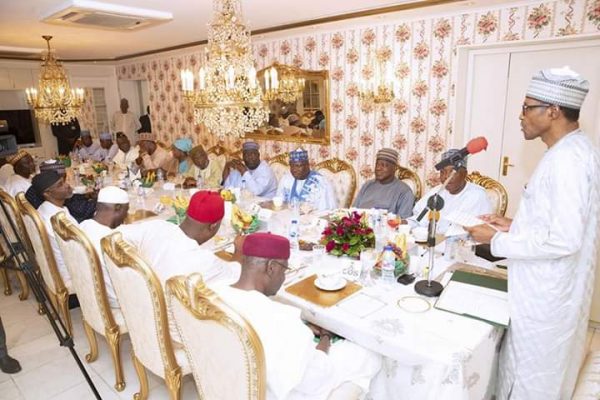
The President, who spoke today, Tuesday at Iftar dinner (breaking of fast) he hosted for the leadership of the National Assembly led by Senate President Bukola Saraki at the State House, emphasized that the relationship between the executive and the legislature has not be the best.
“Relations between the Executive and the Legislature were not the best in the 8th National Assembly. I sincerely hope each one of us will do his utmost to ensure there is a better working relationship between these two arms of government in the 9th Assembly so that we can serve the people better,” said the President.
He argued that the principal task of the National Assembly “is to cooperate with the Executive so that together we can fashion policies that will lift our people out of poverty and out of illiteracy. I appeal to the Distinguished Senators and Honourable Members to subordinate all personal interests and ambitions to the imperative of working for the common good of our people.”
The President congratulated the members-elect on their success in winning their constituency seats and opined that “this is a great burden and a great responsibility placed on you by your people. Our citizens are faced with challenges of poverty.
“Your principal task is to cooperate with the Executive so that together we can fashion policies that will lift our people out of poverty and out of illiteracy. I appeal to the Distinguished Senators and Honourable Members to subordinate all personal interests and ambitions to the imperative of working for the common good of our people.”
He assured the leaders that his doors remain open “to all of you who have genuine concerns or advice to improve the quality of governance and service delivery to our people.”
The President of the Senate, Senator Bukola Saraki assured the President that the National Assembly will maintain focus on national interest at all times.
In addition to the President of the Senate and Speaker Yakubu Dogara, the event was attended by the Deputy Senate President and the Deputy Speaker, the majority and Minority leaders and the majority and Minority Whips and their deputies.
Ambassador of the Kingdom of Saudi Arabia to Nigeria, Adnan bin Mahmoud Bostaji, today, Tuesday, May 14, broke the ninth Ramadan Fast with prominent Nigerians in Abuja, the nation’s Federal Capital Territory (FCT).
Ambassador Adnan Bostaji had earlier extended invitations to top government officials, traditional rulers, religious leaders and other notable Nigerians to the breaking of the Fast, the first that had ever been held by the Saudi Embassy in Nigeria.
In attendance were the minister of the FCT, Malam Muhammad Musa Bello, the minister of information and culture, Alhaji Lai Mohammed, representatives of the Sultan of Sokoto, Alhaji Muhammad Sa’ad Abubakar and the senior special assistant to President Muhammadu Buhari on Diaspora, Mrs. Abike Dabiri Erewa.
Also in attendance were the chairman, and chief executive officer of the National Hajj Commission of Nigerian (NAHCON), Barrister Abdullahi Mukhtar, publisher of the defunct Democrat newspaper, Alhaji Ismaila Isa Funtua; Managing Editor (North) of The Nationnewspaper, Alhaji Yusuf Ali; Editor-In-chief of Greenbarge Reporters online, Yusuf Ozi-Usman, national assembly members and other diplomatic corps as well as friends of the embassy that are not Muslims.
Addressing the guests, Ambassador Adnan Bostaji expressed gratitude for the large turnout of the embassy’s invitees even as he said that he was confidence of the unity that such gathering would foster, especially with people of mix religions in attendance.
He stressed the importance of continually developing, at any level available, the strong and cordial relation that has been existing between his country and Nigeria, one of which was the breaking of Fast with Nigerians.
“If you believe everything that comes out of the Nigerian Senate, you will have serious mental health problems. There are things that are said that are just for the gallery and for the media.”
Kaduna State Governor made the statement today, Monday while reacting to recent Senate description of Kaduna-Abuja express Way as the most dangerous highway in Africa.
Governor el-Rufai said that he believed in facts and statistics and wondered what statistics the senators used determine that the Kaduna-Abuja road is the most dangerous anywhere.
“I like facts, I like using figures. I wish the people that said that would use figures. But I am saying that no matter what anyone said, last week, I am assuring Nigerians that the Kaduna -Abuja road is quite safe now and would be so long as the initiatives put in place by the various security agencies, details of which I am not willing to disclose.
“I am saying as the governor of the state based on the security measures put in place, I am confidence that the road is safe and I drive on that road.”
He said that he had already briefed President Muhammadu Buhari on the general security situation in Kaduna which he used to do from time to time and also to update him on the various initiatives by the Inspector General of Police (IGP), the SSS, and the Army Forces with a view to improving the security situation in Kaduna in general and particularly along the Abuja-Kaduna road.
The Presidency has moved in to stop the raging dispute between the Nigerian Army and the indigenes of Abuja over 7,000 hectares of land cutting across Gwagwa, Idu, Zuba and Giri communities in the Federal Capital Territory.
Vice President Yemi Osinbajo, who was accosted last week by protesters as he went for official assignment in the Federal Capital Territory, has, according to his spokesman, Laolu Akande, already directed the authorities of the Federal Capital Territory Administration (FCTA) to submit to his office, a comprehensive report on the disputed land and what it has done to resolve the matter. The Vice President, who had a meeting with a delegation of Gbagyi leaders comprising political office holders, traditional and youth leaders, at the Presidential Villa today, Monday, gave assurance that the government will adopt all necessary measures that will lead to the amicable and just resolution of the land dispute.
Professor Osinbajo said that he had briefed President Muhammadu Buhari on the matter and would find out from the Chief of Staff to the President, what the presidential committee constituted to look into the issues has so far done. According to the Vice President, “what is very important now is that we do not allow a situation where things are not done according to the law and due process. It is also important that this issue is resolved amicably and justly. Last week Tuesday, on his way to the airport to launch the Homegrown School Feeding Programme in Ekiti state, the Vice President ran into some protesters at Goza village. The protesters blocked Osinbajo’s motorcade prompting him to alight to engage with the angry youths, a move that culminated into today’s meeting. Meanwhile, Senator Philip Aduda, representing the FCT at the National Assembly, was at the meeting with the Vice President, dismissed the claim by the Army authorities that the land was allocated to it and appreciated the intervention of the Vice President. This was even as the Secretary of the Area Councils Services Secretariat, Senator Isa Maina said that the FCT authorities in an effort to address the issue has already proposed to allocate a plot of land to the Nigerian Army in Kwali. He said that contrary to the directive by the presidential committee that all parties involved in the matter maintain status quo, the Nigerian Army has proceeded to construct structures on the disputed land. On his part, the Emir of Jiwa, Idris Musa said that the indigenous people of Abuja are not against the Nigerian Army in any way but want a just and amicable resolution of the matter.
We use cookies on our website to give you the most relevant experience by remembering your preferences and repeat visits. By clicking “Accept”, you consent to the use of ALL the cookies.
This website uses cookies to improve your experience while you navigate through the website. Out of these, the cookies that are categorized as necessary are stored on your browser as they are essential for the working of basic functionalities of the website. We also use third-party cookies that help us analyze and understand how you use this website. These cookies will be stored in your browser only with your consent. You also have the option to opt-out of these cookies. But opting out of some of these cookies may affect your browsing experience.
Necessary cookies are absolutely essential for the website to function properly. This category only includes cookies that ensures basic functionalities and security features of the website. These cookies do not store any personal information.
Any cookies that may not be particularly necessary for the website to function and is used specifically to collect user personal data via analytics, ads, other embedded contents are termed as non-necessary cookies. It is mandatory to procure user consent prior to running these cookies on your website.



 A 400-level student of the Department of English and Literary Studies, University of Nigeria, Nsukka, (UNN), Chukwuemeka Akachi has committed suicide after two previous attempts that failed.
 The Super Falcons of Nigeria have defeated Mali by 2 goals to nothing in their final Group B math of the ongoing 2019 Women’s WAFU Cup of Nations at the Stade Robert Champroux Abidjan. The Nigerian side had earlier bashed female national team of Niger by 15 goals to nothing.
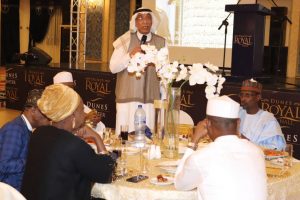 Ambassador of the Kingdom of Saudi Arabia to Nigeria, Adnan bin Mahmoud Bostaji, today, Tuesday, May 14, broke the ninth Ramadan Fast with prominent Nigerians in Abuja, the nation’s Federal Capital Territory (FCT).
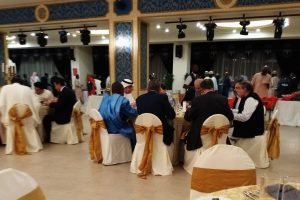 In attendance were the minister of the FCT, Malam Muhammad Musa Bello, the minister of information and culture, Alhaji Lai Mohammed, representatives of the Sultan of Sokoto, Alhaji Muhammad Sa’ad Abubakar and the senior special assistant to President Muhammadu Buhari on Diaspora, Mrs. Abike Dabiri Erewa.
 “If you believe everything that comes out of the Nigerian Senate, you will have serious mental health problems. There are things that are said that are just for the gallery and for the media.”
 The Presidency has moved in to stop the raging dispute between the Nigerian Army and the indigenes of Abuja over 7,000 hectares of land cutting across Gwagwa, Idu, Zuba and Giri communities in the Federal Capital Territory.
