The northwest Publicity Secretary of the Peoples Democratic Party (PDP), Alhaji Yusuf Adamu, has moved to the All Progressives Congress (APC).
Yusuf Adamu, who spoke to the News Agency of Nigeria (NAN) in Dutse today, Tuesday, said that his decision to dump PDP and join APC was because of the laudable efforts of President Muhammadu Buhari in fighting insecurity, corruption and unemployment in the country.
“Therefore I am defecting with about 15,000 of my supporters to my new party.”
The former Zonal Publicity Secretary of PDP explained that Buhari had really done well in repositioning the economy in just one term, adding that as a media man, “I am impressed with his achievements. Therefore Buhari deserves another term to still reposition the economy effectively.”
“It is in view of this that I dumped PDP and joined the ruling party to contribute my effort for the continuity of the president.”
Yusuf Adamu said that he will also go back to his home state Jigawa to join Governor Muhammadu Abubakar Badaru towards achieving his second term bid.
He commended Badaru for the remarkable achievements recorded in the area of agriculture, education, rural infrastructure, health care services as well as sustaining the state civil service. Source: NAN.
A Civil Society Organization, the Good Governance Advocacy Project has asked the International Criminal Court (ICC) charge the former Nigerian President, Olusegun Obasanjo and erstwhile Minister of Defence, retired General T . Y Danjuma, with war over the massive killings in Odi area of Bayelsa and Zaki Biam, Benue State during their leadership of the country.
The group insisted that the two leaders should be made to answer for the many other offences they committed against humanity between 1999 and 2007.
The National President of the group, Danelson Momoh, at a news briefing today, Tuesday, recalled that it was Dajuma’s regime as Defence Minister under the then President Olusegun Obasanjo that troops massacred innocent citizens of Zaki Biam community in Benue State.
Danelson Momoh said that both Obasanjo and Danjuma needs to hand over themselves to ICC for a probe over the massacre of innocent citizens in the communities.
“Instead of being elder statesmen as would be expected of them in their twilight they have resorted to heating up the polity and making demands of the current dispensation that they were never able to fulfil in their own times.
“Of note among these yesteryears’ men is former military chief, retired General Theophilus Yakubu (TY) Danjuma who of late has become synonymous with being an inciter of adherents of Christianity in the country to go to war with their neighbours under the guise of ethno-religious killings.
“He had in the past called on people to take up arms against their neighbours for which he was roundly censored by all well-meaning Nigerians. This does not, however, seem to have deterred him as he is back to lying bald-facedly.
“TY Danjuma purportedly issued a statement entitled “Choose your own Fulani with care,” in which he alleged that President Muhammadu Buhari is out to massacre the entire north central and southern parts of the so that he can repopulate the same areas with Fulani from other West African countries.
“While this irresponsible statement is condemnable in the strongest terms, the seeming saving grace is that Danjuma has eaten his words and distance himself from the dangerous utterance,” he said.
“We, however, want to place on record that it was not enough for him to distance himself from the offensive statement for several reasons.
“One, if he had not been in the business of making divisive utterances, mischief makers would not replicate his style of incitement to attempt doing damage to the country. He has, by the tradition he has created, made Nigeria into a land where ethnic hatred is now being treated as common place.
“We categorically state this because historically, it was Dajuma’s regime as Defence Minister under the then President Olusegun Obasanjo that troops were massacre innocent citizens of Zaki Biam community in Benue state.
“Much as the history of what happened in Zak Ibiam is being re-written to obscure the actual drivers of that pogrom, Ty Danjuma knows that the genocide that took place there was never about national security but was about protecting narrow interests that were not intended for the benefit of the larger population.
“He and Obasanjo remain the architect of the genocide in Zak Ibiam, which was not their only crime because they also jointly masterminded the scorched-earth pogrom at Odi. These actions were the foundation that sowed the seeds of discord amongst the various ethnic groups in Nigeria.”
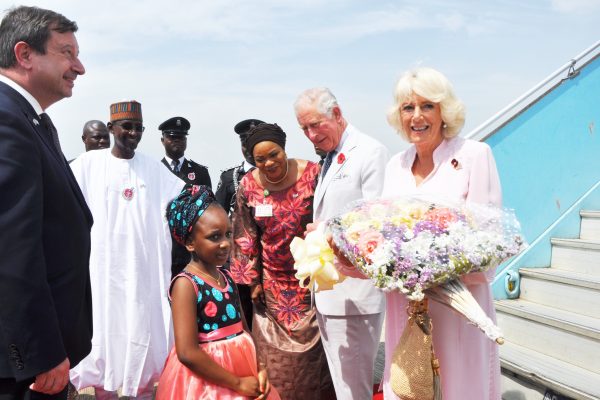
Prince of Wales and Heir to the British Throne, Prince Charles Philip Arthur George was in Abuja, the Nigeria’s Federal Capital Territory (FC) today, Tuesday, November 6,on a visit to the country. He was accompanied by the Duchess of Cornwall, Princess Camilla.
From right to left: Minister of the Federal Capital Territory, Malam Muhammad Musa Bello, Minister of State, Foreign Affairs, Khadijah Abbah Ibrahim, prince Charles Philip Arthur George and the Duchess of Cornwall, Princess Camilla at the Presidential wing of the Nnamdi Azikiwe International Airport Abuja.
It is a big relief for Nigerians that workers did not begin the much publicized nationwide indefinite strike initiated by the Nigeria Labour Congress (NLC), the Trade Union Congress (TUC) and other labour unions.
The call for nationwide strike, scheduled to begin in the early hours of today, November 6, was necessitated by the alleged failure on the part of the government to honour the N30,000 new minimum wage for average Nigerian worker as agreed on by a tripartite committee set up to deliberate on the new wage, away from the existing minimum wage of N18,000.
All said, Nigerians who have been held with fear of the Armageddon befallen the country as a result of prolonged strike, this morning, woke up to hear a cheering news that the organized labour unions had suspended the action even before it commenced. Of course, it would not have been for nothing that the labour unions quickly called off the strike if the government had not conceded to their demands, given the force with which they rose to effect the strike.
We sincerely commend the resilience and doggedness of the leadership of the labour unions and Nigerians for standing up in unison to pursue this common course of ensuring respectable living wage for the workers. The battle, which the labour unions have obviously won for the Nigerian toiling workers, will be recorded in history as a battle for the emancipation of the downtrodden.
Indeed, the battle for the increase in the minimum wage needs to be seen in the context of the beginning of the real battle for the sustenance of decency in the way wages and allowances for the workers are managed by the government at all levels. For long, it has not just been the increase in the wage that had been the headache of the workers but the continue payment of the wages and allowances.
It is on record, which everyone knows, that even as the labour unions are fighting for the new minimum wage, many state and local governments across the country have not been up to date in the payment of the old minimum wage. Some state governments are owing their workers’ salaries for an upward of ten months and more.
As a matter of fact, it would be senseless for the labour unions to stampede governments into conceding to their demand for N30,000 minimum wage only for them (labour unions) to go to sleep when such wage is not being paid. The battle for the payment of the new minimum wage, to us in Greenbarge Reporters, should be more fierce and enduring than the battle to get the government to concede to the new minimum wage.
As a matter of fact, conceding to new minimum wage by any government, especially as a way of stemming strike, is easier done than implementing, and the unions should not deceive themselves therefore, that the new minimum wage would be paid to workers in the next one year. For the federal government, the new salary scale would have to be presented in the form of Executive Order by the President to the National Assembly for approval. The National Assembly may not be in a hurry to do the needful before the end of this year, having regard to the urgent need to attend to the 2019 national budget proposal. For a fact, the new minimum wage is likely not to be reflected in the budget.
It is possible that the 2019 budget proposal has already been put together and will soon be presented to the joint session of the National Assembly anytime from now, ruling out the possibility of the new minimum wage of N30,000 being included.
As for the state governments, experience has shown that even when they were given bailout fund to settle the outstanding salary arrears to their workers, they refused to do so, much more the new minimum wage that is being proposed to be added.
How would the labour unions coordinate well to ‘force’ the recalcitrant state governments to pay the salaries and much more, the new minimum wage to their workers as and when it is due, should be the new thinking.
Failing by the unions to monitor the salary payment administration in states and local governments, as well as ensuring that it is properly reflected in the federal budget as soon as possible for workers to enjoy the fruit of the muscle that was flexed for the N30,000, would amount to taking Nigerian workers for granted and a grand deception.
Another bigger battle is the price response in the open markets to increase in national workers’ salary. There has been a trend in which mere announcement of increase in workers’ salaries would trigger astronomical rise in prices of food items and other essential commodities in the Nigerian markets.
In many case studies and realities, market women and business people are always waiting in the wings to make nonsense of the purpose of the battle which the union leaders waged to get the government to increase workers’ wages, this time, the new minimum wage. To be sure, the battle with increase in prices of essential commodities which the workers with new minimum wage ought to enjoy has never been won over the years.
It will not be surprising, by the establish standard, to wake up tomorrow and find that prices of essential commodities have gone up, even when the new minimum wage is still undergoing legal and administrative processes.
The labour unions would therefore, have to find ways of stopping such reversal of the purpose for which course the new minimum wage was fought and won.
In all, the labour unions owe the workers the task of ensuring that the Shylock business people and market women do not make great nonsense of the new minimum wage for the poor workers when it starts coming. It should take the labour unions the same dexterity and savvy with which they arm-twisted the government to agree to the new minimum wage. That is when the first battle will have some relevance in the lives of the end-users – the workers.
President Muhammadu Buhari has advised Nigerian workers not to allow themselves to be used by politicians as political weapons.
He said, as he received the report of the National Minimum Wage Committee today, Tuesday, at the Presidential Villa, Abuja: “may I therefore, implore workers and their leaders not to allow themselves to be used as political weapons.”
The President promised to quickly raise an Executive Bill to the National Assembly on the new minimum wage of N30,000 for passage within the shortest possible time, adding: “I am fully committed to having a new National Minimum Wage Act in the very near future.”
Buhari said that as the Executive arm of government commences its review of the report, it would continue to engage the labour unions and other relevant stakeholders in closing any open areas presented in the report.
“I therefore would like to ask for your patience and understanding in the coming weeks.”
He acknowledged the leadership of the organized labour and private sector as well as representatives of State and Federal Governments for all their hard work, saying that the fact that “we are here today, is a notable achievement.”
The President reviewed the work of the committee which was inaugurated on November 27 2017, adding that the setting up of the committee became necessary for many reasons.
“The last review took place in 2011. We all know since then, the prices of key consumables have increased and the most vulnerable of our workers are struggling to make ends meet.
“Since 2011, many changes have taken place. Nigeria rebased its GDP to become the largest economy in Africa. We reported very strong GDP growth rates and exceptional performance of our capital markets. However, these reported successes did not flow into the pockets and homes of majority of Nigerians.
“In the last three years, we focused on correcting this deficiency. We are working to create a diversified and inclusive economy.
“We are pushing to clear pension arrears owed to our retired workers with the limited resources available to us.
“We supported State Governments to pay workers salary. And of course, we set up a committee in order to review the minimum wage of workers.
“In constituting this committee, we took into account the need for all stakeholders to be adequately represented – the government, the private sector and most importantly the workers. Our goal was to get an outcome that was consensual.
“From the onset, we knew the committee had a difficult task ahead of it. But at the same time, we were also confident that the patriotic and professional background of its members would produce realistic, fair and implementable recommendations that will be considered by both the executive and legislative arms of government.
“I am not surprised that the committee has worked for close to one year. I am also not surprised that on a few occasions, the debates got heated and sometimes, these differences came out.
“What is truly inspiring is that, in almost all instances of disagreements, the committee members always came back to the negotiating table with a common goal of improving the welfare of Nigerian workers. On behalf of all Nigerians today, I want to thank you for your commitment and sacrifice in getting us to where we are today.
“In the past few days, I have been receiving regular updates on your deliberations. And today, I am pleased that you have completed your work in a peaceful and non-confrontational manner. The entire nation is grateful to you all.
“The Committee Chairman highlighted some of the challenges encountered during your deliberations, especially as it relates to having a consensus position acceptable by all parties.
“I understand, on the government side, the concerns raised were around affordability – that today many states struggle to meet their existing salary requirements.
“On the side of labour, the points raised focused on the need for any increase to be meaningful.
“In a way, both arguments are valid. I want to assure you all that we will immediately put in place the necessary machinery that will close out these open areas.
Organized Labour unions have called off the nationwide workers strike that was to commence today, Tuesday, in protest against alleged government failure to accept N30,000 as the new national minimum wage.
The decision to call off the strike is coming after hours of meeting yesterday, Monday between Organized Labour, represented by the Nigeria Labour Congress, United Labour Congress and the Trade Union Congress, and a Federal Government team headed by the Secretary to the Government of the Federation, Boss Mustapha.
The Federal Government team, which also included the Minister of Labour and Employment, Senator Chris Ngige, agreed to forward the two positions of the Government and Labour to President Muhammadu Buhari on Wednesday, reports said.
According to the News Agency of Nigeria (NAN)i, the Tripartite Committee on the National Minimum Wage, made up of the Government, Labour and Organised Private Sector, agreed on Monday to submit the report of the Committee to President Buhari on Tuesday at 4:15pm.
While the Federal Government is proposing N24,000 as minimum wage, the States have offered to pay N22,500, but Labour is demanding N30,000.
The President of the NLC, Ayuba Wabba, confirmed the suspension of the strike at the end of the last meeting of the tripartite committee on Monday night.
An earlier analysis of the struggle for new minimum wage by Bassey Udo is reproduced here for proper understanding:
The agitation by Nigeria Labour Congress (NLC) and affiliates for a new national minimum wage for Nigerian workers has merit.
Evidently, the current economic fundamentals do not favour continuing to keep the current N18,000 minimum wage approved since 2010. Since 2015, the pay became due for another review in line with the provisions of the National Minimum Wage Act (amendment) 2011.
Whatever indices or parameters used to arrive at N18,000 in 2010 must have become grossly obsolete.
Abuja –based economist and chief executive of Global Analytics Consulting Limited, Tope Fasua, said labour has a right to demand for higher wages at the time, given spiraling inflationary rate in the country, which has compounded since the last review in 2011.
Mr Fasua, who is also the Abundant Nigeria Renewal Party (ANRP) presidential candidate, said the value of N18,000 in 2011 has diminished to less than N8,000 today.
Economic Fundamentals
In 2011, Central Bank of Nigeria (CBN) data showed inflation at about 10.8 per cent, with exchange rate of the Naira to the dollar averaged between N151.96 and N155.26.
The country’s gross domestic products (GDP) stood at about $411.7 billion and GDP growth rate at about 8.2 per cent.
In 2018, the NBS put inflation rate in the second quarter of the year at 11.23 per cent, with exchange rate of Naira to the dollar at N306.25, or N362 in the parallel market. GDP is estimated at $375.77 billion since 2017, growing at the rate of 2.9 per cent.
To compute a minimum wage, consideration must be given to the prevailing cost of living index, inflationary trend and capacity of employers to pay a living wage.
Living wage is based on the belief a worker should earn enough income from his or her work to afford the basic living costs of his or her family.
According to WageIndicator.org, living wage is an approximate income a worker needs to meet his or her family’s basic needs for food, housing, transport, health, education, tax deductions and other necessities.
In other words, living wage should take care of the worker’s food costs, housing costs, transport costs, tax/contribution costs and other costs, including medical and children education.
Therefore, in approving minimum wage, consideration must be given to all the essential needs of workers and their families.
But, Mr Fasua said Nigerian government at all levels do not always bear in mind these factors when paying their workers.
For Ayo Teriba, an economist and chief executive officer, Economic Associates, the real issue in the minimum wage debate is no more whether the demand is necessary, but whether N18,000 take home pay will “take the workers home and allow them live reasonably”.
“Divide N18,000 by 30 days, that comes to N600 a day. What can anybody do with N600 per day?” Mr Teriba asked in an interview with Leadership Newspapers.
At N56,000 (the initial figure labour proposed), he said this would translate to a paltry N1,866, an amount he says is not even up to what some less endowed countries pay their citizens as unemployment allowance.
Is N65,000 Demand Realistic?
Since the debate shifted focus on recent demand by organised labour for N65,000 as new minimum wage, the question most concerned Nigerians are asking is: justified as the demand might seem, how realistic, affordable and achievable is it in the face of the country’s current economic reality?
The question is even more compelling when labour says at least 33 of the 36 states and the Federal Capital Territory are owing various months arrears of salaries to their workers at N18,000 a month.
Not even the so-called oil producing states that receive additional derivation revenues from the monthly federation account allocations have been able to meet this obligation.
If one is looking at the narrow view of today’s finances and state of the country’s economy, said the lead director, Centre for Social Justice (CENSOJ), Eze Onyekpere, N65,000 minimum wage is not realistic.
The economy has been struggling to stabilise, hardly able to assimilate further recurrent pressures, following its fragile recovery from one of its worst recessions in the country’s history in 2017.
At the end of the Monetary Policy Committee (MPC) meeting last week Tuesday, the CBN warned the country risked slipping back into recession if fiscal and monetary authorities are not getting their acts together to curb rising inflation and declining growth in key sectors of the economy.
One of the things these authorities have to avoid is piling further recurrent pressures on the largely deficit budget through huge overheads and unrealistic salary bills.
According to Mr Onyekpere, looking at the 2017 Budget implementation report released recently by the federal ministry of budget & national planning, the country is already bankrupt and does not need to attempt “to bite more than it cannot chew”.
He said the report shows total revenue Nigeria realised from all sources, including tax and crude oil exports, was N2.657 trillion, while recurrent expenditure, consisting overheads, workers’ salaries, service wide votes, was N2.7 trillion.
“This means the country even borrowed about N100 billion to finance recurrent budget, while the country paid N1.634 trillion as debt, meaning for every 100 kobo we (Nigeria) borrowed, 68 kobo was used to repay the debt, leaving 32 kobo. If we borrow to augment recurrent expenditure and service wide votes, it means the country is bankrupt,” Mr Onyekpere noted.
Latest data by the NBS showed that since recovering from recession in 2016, the country’s GDP, which declined from 2.05 per cent in the last quarter of 2017 to 1.95 per cent in the first quarter of 2018, slipped further by -0.45 basis points to the current 1.5 per cent.
Crude oil, which accounts for more than 80 per cent of the country’s export revenues, is at the moment selling at a high price of about $80 a barrel at the international oil market.
But, the country’s daily oil production capacity has consistently dwindled below the 2.3 million barrels projection in successive federal budgets since 2016.
From about 2.05 million barrels per day in the first quarter of 2016, the output has dropped to about 1.84 million barrels recorded in the second quarter of 2018.
Also, the country’s foreign reserves has been trending southwards, from about $45 billion at the end-July to $44 billion on September 20, while the Debt Management Office (DMO) reports a rising public debt profile currently at about N22.4trillion as at June 30.
High Minimum Wage Could Fuel Inflation
Interestingly, labour’s argument for a new minimum wage is based on the rising inflationary trend.
Regardless, the flipside of the argument has been that the demand for a new minimum wage at this time could fuel inflation in the economy.
Mr Fasua agrees.
“With the perennial mismanagement of the economy on several fronts, if government increases minimum wage to N65,000, or by over 200 per cent today, under one year, the economy will definitely spiral into a hyper-inflation that will take everything and return the workers to where they started,” Mr Fasua said.
He said the greater danger will be that the private sector, especially small and medium-scale enterprises (SMEs), would not be able to also increase their wages at the same scale. The outcome would be “shedding of weight or actual closure”.
Rather than ask for N65,000 new minimum wage, Mr Fasua said, labour should settle for about N30,000 pay, while also insisting on government to embark on mass employment for the youth.
Also, he said labour should demand for increased investment in critical sectors of the economy and social amenities that usually take a sizeable chunk of their monthly salaries.
“Government should focus on the development of social infrastructures that take a large percentage of the workers’ salaries.
“These include food production, by working with the universities and polytechnics to utilise their scientific research findings; incentivising the textile sector to produce clothes, providing low income housing and affordable mass transportation.
“When all thes are provided, Nigerians will need a behavioural change to focus more on the bare necessities and avoid frivolities,” Mr Fasua said.
Bigger Picture
For Mr Onyekpere, if we are looking at the big picture, the questions to ask are: Is Nigeria tapping all the resources available to it? Are we collecting all the taxes we are supposed to collect? Have we reformed enough to cut the cost of governance and plug all the loop holes for corruption and loses in the economy?
“If we answer these question in the positive, then we have no reason not to pay workers decent salaries. There is no reason why our ministers and members of the National Assembly are living in opulence, while the rest of Nigerians are living in poverty,” he said.
For chief executive officer, Pan Africa Develoment Corporation, Odilim Enwegbara, labour should insist Nigerian workers are paid N100,000 minimum wage.
“They should even insist they will only vote for presidential and governorship candidates who will be ready to pay a N100,000 minimum wage,” Mr Enwegbara said.
He said Nigeria has one of the lowest minimum wages in the world. He wonders how workers would be productive and shun corruption if they are not paid well.
Blaming government misplaced priorities, Mr Enwegbara urged government to downsize unproductive workforce, remove ghost workers and keep a slim and efficient workforce it can pay good salaries enough for them to lead a good living.
“If you pay peanuts, you get monkeys to work for you,” he said.
New Perspectives, More Questions
As the tripartite committee returns to conclude its assignment and give the country a new minimum wage, several other perspectives and issues have emerged from the debate.
Within the context of true federalism, should minimum wage be a national issue? Or should the federating units (the states) be allowed to pay what they can afford to the limit of their economic capacity and resources? Will the current agitation by labour end up with national minimum wage for workers in public or private sectors?
Or would the new minimum wage bridge the dichotomy between the pay to workers in the civil service and their colleagues in the commissions and parastatals under the same government? Should there be a legislation prescribing stiff sanctions against employers of labour that fail to pay their workers in accordance with the approved national minimum wage law?
In 2008, prior to the commencement of negotiations that led to the current N18,000 minimum wage, labour had proposed N52,000 as new minimum
It was learnt that at least 20 state governments submitted memoranda proposing various amounts ranging from N46,700 to as low as N10,000 a month as minimum wage.
At the end of negotiations, although the average from the various submissions tallied at about N24,000, labour settled for N18,000, taking into considerations the prevailing economic conditions in the country then, subsisting revenue allocation formula and capacity of private and public employers to pay.
Prior to the commencement of the now suspended warning strike by the NLC, the minister of labour & employment, Chris Ngige, said the work of the tripartite committee on minimum wage was stalled following some state governors’ reluctance to submit their proposal on a new wage system.
The minister said without inputs from the governors on the issue, there cannot be any agreement on a new minimum wage.
At the inauguration of the 30-member tripartite committee on minimum wage last November, President Muhammadu Buhari urged them to work towards a new minimum wage all tiers of government would be able to pay.
The president also touched on the issue of minimum wage being under the exclusive legislative list in the 1999, and not the concurrent legislative list. This puts the issue under the purview of the federal government.
A former minister of national planning, Abubakar Sulaiman, told Punch newspapers that apart from inadequate capacity of states to determine their workers’ minimum wage, they lack the requisite independence to legislate on labour related matters.
“As long as we are not practising fiscal federalism, let the centre continue to decide the minimum wage for Nigerian workers across all tiers,” the former minister said.
To give states capacity to shoulder the minimum wage obligations regularly, the governors have been asking for a review of the existing revenue sharing formula.
The formula gives federal government 52.68 per cent of total revenue from the federation account, the 36 states and the Federal Capital Territory (FCT) 26.72 per cent and the 774 local governments 20.6 per cent.
For Joe Aligbe, former national vice president, Association of Senior Civil Servants of Nigeria, as long as minimum wage is on the exclusive list, states cannot legislate on it.
He says whatever the federal government approves, the states can choose to raise it to whatever level they desire, citing the Edo State example which raised its minimum wage above N18,000 to N25,000.
Beyond the monthly allocation from the federation account, the states need to transform their internally generated revenue to enhance their capacity to pay their workers living wages in line with the size of their respective economies.
Two presidential contenders on the platform of the Social Democratic Party (SDP), Professor Jerry Gana and Donald Duke have dragged themselves to the Federal Capital Territory (FCT) High Court in the Maitama claiming that the national convention of the party that produced Donald Duke was illegal.
Jerri Gana, who instituted the suit before the court today, Monday, asked that Duke be disqualified as the party’s presidential candidate in the 2019 general elections.
Professor Gana, a former minister of information, further asked the court to nullify the emergence of the former Cross River State governor as the SDP candidate on the grounds that the process that produced him violated the constitution of the party.
Duke had polled 812 votes to defeat the former minister who scored 611 votes at the SDP National Convention held at Old Parade Ground in Abuja on October 7.
Professor Gana, however, claimed that the convention of the party which ushered in Duke as the presidential candidate of the party was illegal and flawed.
“In the party’s constitution as provided under section 15(3), it was stipulated that the party will respect the principle of rotation and zoning because it is important to building up of the Federal Republic of Nigeria.”
“The provision specifies that the position of national chairman of SDP cannot come from the same part of Nigeria.”
He told the court that the party’s constitution provides that if the chairman comes from the southern part of Nigeria, then the presidential candidate must come from the northern region.
The case has been adjourned to November 13 due to the indisposition of the presiding judge, Justice Husseini Baba Yusuf.
Defending Champions, Super Falcons of Nigeria will take off to Abidjan where they will spend eight days to go through intensive training to perfect tactics and strategy for the defence of their continental title before arriving in Ghana for the 11th Women Africa Cup of Nations finals.
The team, which has been camping in the magnificent Jubilee Chalets and Resort in Epe near Lagos, courtesy of the Lagos State Government, will travel aboard an Air Ivoire flight tomorrow Tuesday morning to the Ivorian capital.
Head Coach, Thomas Dennerby unveiled a list of 23 players who will make the trip to the world –renowned ASEC Mimosas FC academy, Sol Beni, before two players are cut for a final squad of 21 for the trip to Cape Coast.
It was learnt that the eight –time African champions will play a couple of friendly games in the Sol Beni camp before flying to Ghana on 14th November, four days to their Group B opening encounter against South Africa’s Banyana Banyana.
Nigeria will also tackle Zambia and Kenya in their pool, as they bid for a ninth continental title out of 11 championships.
Hosts Ghana, Algeria, Mali and Cameroon will battle things out in Group A in Accra.
The Director of Strategic Communications of President Muhammadu Buhari’s Campaign Organization, Festus Keyamo (SAN) has described the promise by the Peoples Democratic Party that its presidential candidate, Alhaji Atiku Abubakar, will crash fuel price from N145 to N90 if elected as President in 2019 as a sign of desperation.
In a statement today, Monday, Festus Keyamo said: “there is no better evidence of desperation and phantom promises by the main opposition’s candidate than this statement.”
“At today’s international price of gasoline, no supplier will ever contemplate any scheme that will deliver products at such ridiculous price. Those in the sector reading this must be having a good laugh at the opposition.
“A simple check at the international prices will show that even at the world market where gasoline is procured, it will cost not less than N158 to procure a litre of crude oil.
“When you add the cost of refining, plus freight, finance and port charges (premium), there is no magic that one would employ to supply the finished product at N145 a litre. Presently, the landing cost of the product in Nigeria hovers around N205 per litre.
“The claim by Alhaji Atiku Abubakar is opportunism of the highest order. Nigerians are aware that higher crude oil prices will translate to higher government revenues and a prudent administration will convert the resources to the benefit of the common man.
“This is exactly what President Muhammadu Buhari has done since he mounted the saddle in 2015. The President has worked out a transparent system whereby the whole subsidy regime and scam has been totally eliminated. There is no cash incentive or payment again to middlemen.
“In line with the President’s transparent policy, we lay bare the present system as follows:
“(1) What obtained under the past government was the ABUSE of the subsidy regime.
“(2) The system under the past Government was that independent marketers and all sort of persons were allowed to import petroleum products on their own, declare non-existent volumes of these products and get paid for these non-existent volumes.
“(3) In addition, government would then pay them cash for the “loses” (subsidy) in selling at fixed market price.
“(4) Under this old system, more than N3trillion was lost.
“(5) However, when these independent marketers could no longer bring in products due to high prices of crude and make profit at the fixed market price of N145 to a litre, President Buhari refused to further raise the price of petroleum products beyond the N145 per litre. The President was also not prepared to go back to the subsidy regime. Therefore, President Buhari stopped the scam of overblown volumes and subsidy payments to middlemen.
“(6) As a result, NNPC took full charge of getting products for consumption.
“(7) Under this arrangement, NNPC would swap crude oil for the exact value of finished products in refineries anywhere the products are available around the world.
“(8) Middlemen are only allowed to go and ferry the products and bring into the country and hand over to NNPC.
“(9) NNPC will only then pay them for the cost of the logistics of bringing the products in (this is what is called premium).
“(10) Even this cost of logistics is now subject to competitive bidding unlike before.
“(11) In the past, mareters used to charge $86 per metric ton as cost of logistics (premium) to bring in products.
“(12) Under Buhari’s regime when it was subjected to competitive bidding, the highest the government got was $7 per metric ton as cost of logistics to bring in products. More than N3billion has been saved by this bidding process.
“(13) Having gotten the value of the crude oil back in terms of finished products, NNPC will now sell at government controlled price which is far lower than the landing cost.
“(14) Presently, the landing cost is around N205 per litre, but government sells at N145 per litre.
“(15) Therefore, Government just records a loss in NNPC instead of paying cash to middlemen. That loss it suffers is fully reflected when NNPC pays money into the Federation Account.
“(16) This also further affects the money accruing to States monthly from the Federation Account.
“(17) As a result, this loss that NNPC suffers, (which is recorded as cost of operation of NNPC) is fully subjected to scrutiny by the National Economic Council which also includes the PDP Governors and the Federation Accounts Allocation Committee (FAAC), which includes Commissioners of Finance from PDP States.
“(18) If anybody alleges a scam in the process, then the PDP Governors and the States would also be involved because they are involved in jointly scrutinizing the records of NNPC at NEC and FAAC.
“(19) No cash settlement for any under recovery is involved, therefore there is no basis for any subsidy payments which is the avenue for fraud.
“(20) Therefore, it is true that Buhari is not paying subsidy to anybody.
“It has become necessary for Nigerians to interrogate Alhaji Atiku Abubakar further in order for him to lay bare before the Nigerian people the so-called ‘template’ he has developed to crash the price. This is not a game of tricks or hide-and-seek. He must come clean.
“Nigerians await the DETAILS of the TRANSPARENT system Alhaji Atiku Abubakar intends to adopt that would (1) Eliminate fraudulent cash payments to middlemen and (2) Make the product available at all times.”
The Secretary-General of Arewa Consultative Forum(ACF), Anthony Sani has advised the Presidential candidate of the opposition Peoples Democratic Party (PDP), Alhaji Atiku Abubakar not to jubilate yet about being endorsed by former President Olusegun Obasanjo as he may soon change his mind.
He recalled that it is the same Obasanjo who asked God not to forgive him if he endorsed his former Vice President that eventually went ahead to endorse him, adding: “I believe not only Nigerians but even Atiku himself cannot bask in the glow of the endorsement by Obasanjo out of the fear that the manifest of inconsistency can make him change his mind before the elections.”
The ACF Scribe acknowledged that Obasanjo is a factor in national politics having ruled the country under both military and democracy, saying that his commitment to one united Nigeria cannot be taken away from him, but that whether such attributes can translate into electoral value is in doubt.
“More so that Obasanjo has been a product beyond himself; when the late Murtala Muhammed was assassinated in 1976, the military hierarchy at that time asked Obasanjo to take over as Head of State.
“It was not his efforts that got him the position. Also in 1999, the retired Generals and Northern leaders went and brought him out and made him the president. These are not his personal efforts. So, Obasanjo is a product of forces beyond him.”
“As to whether Nigerians will pander to the former president’s endorsement of the presidential candidate of the main opposition party is also in doubt, precisely because of his inconsistency that does not accommodate conviction and vision expected of a statesman of his status.
“Consider the former president tore his party card of PDP and wrote off both APC and PDP as unserviceable. He then formed a nonpartisan Coalition Movement which he later transmuted to a political party called ADC against his earlier ‘new year resolution’ not to be partisan.
“Former President Obasanjo said God would not forgive him if he endorsed his former VP for president, only for him to now leave his ADC and endorse Atiku.”
We use cookies on our website to give you the most relevant experience by remembering your preferences and repeat visits. By clicking “Accept”, you consent to the use of ALL the cookies.
This website uses cookies to improve your experience while you navigate through the website. Out of these, the cookies that are categorized as necessary are stored on your browser as they are essential for the working of basic functionalities of the website. We also use third-party cookies that help us analyze and understand how you use this website. These cookies will be stored in your browser only with your consent. You also have the option to opt-out of these cookies. But opting out of some of these cookies may affect your browsing experience.
Necessary cookies are absolutely essential for the website to function properly. This category only includes cookies that ensures basic functionalities and security features of the website. These cookies do not store any personal information.
Any cookies that may not be particularly necessary for the website to function and is used specifically to collect user personal data via analytics, ads, other embedded contents are termed as non-necessary cookies. It is mandatory to procure user consent prior to running these cookies on your website.



 It is a big relief for Nigerians that workers did not begin the much publicized nationwide indefinite strike initiated by the Nigeria Labour Congress (NLC), the Trade Union Congress (TUC) and other labour unions.
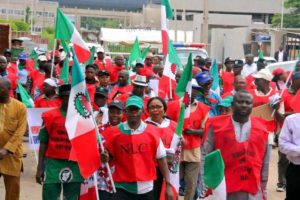 Organized Labour unions have called off the nationwide workers strike that was to commence today, Tuesday, in protest against alleged government failure to accept N30,000 as the new national minimum wage.
 Defending Champions, Super Falcons of Nigeria will take off to Abidjan where they will spend eight days to go through intensive training to perfect tactics and strategy for the defence of their continental title before arriving in Ghana for the 11th Women Africa Cup of Nations finals.


