Home Blog Page 1234

Ex Delta Gov, Uduaghan, Appears At APC Caucus Meeting In Villa

Dr. Emmanuel Uduaghan

The immediate past governor of Delta State under the platform of the Peoples Democratic Party (PDP), Dr. Emmanuel Uduaghan was among the new faces that appear today, Tuesday, at the caucus meeting of the ruling All Progressives Congress (APC) at the Presidential Villa, Abuja.

Others who showed up for the meeting are the former National Chairman of the PDP, Ali Modu-Sheriff, the National Leader of the APC, Asiwaju Bola Tinubu, former Governor of Akwa Ibom State and former Minority leader of the Senate, Godswil Akpabio, serving and formigo governors of the party, federal lawmakers, members of the National Working Committee and party Chieftains.

The meeting was the first the President was having with his party members after the gale of defection that hit the APC recently.

The presence of former Delta State Governor clad in white gown (agbada ) and red cap attracted jubilation amongst APC members.

National Chairman of the party Comrade Adams Oshiomhole arrived at the venue about 8:24pm It was also the first caucus meeting

The meeting was held in closed door.

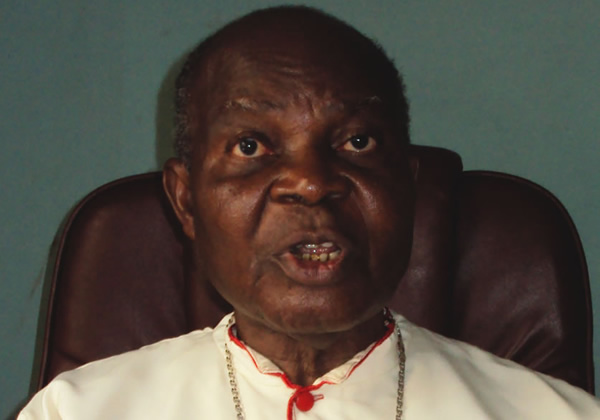
2019: Don’t Vote On Ethnic, Religious, Regional Lines – Cardinal Okogie

The Archbishop Emeritus, Catholic Archdiocese of Lagos, Anthony Cardinal Okogie has warned Nigerians not to vote for candidates seeking for election, especially, the presidency on the basis of ethnic, religious and regional lines.

In a statement today, Tuesday, the revered religious leader described the 2019 general elections as a day when all debts owed Nigerians by politicians will have to be settled.

Okogie asked Nigerians to hold every political office holder and contender to an uncompromisingly rigorous standard, saying : “this is not the time to vote on ethnic, religious or regional lines.

“Nigerians must consider if it would be in our interest and in the interest of Nigerians yet unborn to leave governance in the hands of such people.

“This is the time to vote on past records of public service. Let us not cast our votes for those who have ruined, are ruining and will ruin this country.

“Beyond the deceitful and murderous pseudo-statesmen, Nigeria deserves the best. So, we must discard the stubborn myth that any politician is indispensable.

“This country, richly blessed, has competent and wise persons who can navigate her out of the embarrassingly dubious distinction of the poorest rich nation on earth.

“If there are politicians who have not kept their promise, if there are politicians leading our beloved country into perdition, vote them out.”

Okogie expressed disgust over the politicians who are pretending to profess their love for God and for the country, whereas they only do it for their own selfish interests.

“Almost all our politicians profess belief in God. But just as they pretend to love Nigeria, they pretend to love God, treating God with contempt by treating Nigerians with contempt.

“They have no regard for morality; they pretend to love each other, they have neither permanent friends nor permanent enemies but permanent interests.

“Their membership of political parties is contingent on their selfish interests. That is why, whether or not they decamp does not affect the price of garri in the market.”

Alleged Poison: Ebonyi Seals Off Abakaliki Rice Mill

Gov. Umahi of Ebonyi state

The Ebonyi State Government has sealed off the Abakaliki Rice Mill Limited following allegation that poisonous and adulterated elements have infiltrated the  mill.

Senior Special Assistant (SSA) on Internal Security to the State Governor, Dr Kenneth Ugbala who announced the state government’s decision at a news briefing today,Tuesday, said that the closure was with immediate effect.

Dr. Ugbala said that the state Executive Council (EXCO) had received the news of the poisoned and adulterated rice with shock and deliberated extensively on it to save lives of citizens.

“The EXCO subsequently directed the concerned Ministries, Departments and Agencies (MDAs) of health, agriculture, commerce and industry and internal security to seal the rice mill for full investigations to be carried out.

“The Ministry of Environment, which firstly received the report, informed us that the products are not fit for human consumption.

“The primary aim of every government is to protect the lives of its citizens as we want to prevent unsuspecting citizens from purchasing such products.”

Also the State’s Commissioner for Information and Orientation, Senator Emmanuel Onwe, said that the government did not know the source from which the products infiltrated the market and the type of poison involved.

“We do not know whether they are rat or other type of poisons but the commissioner for environment quickly dispatched a team to the mill on receiving the news of the infiltration.

“The team confiscated some samples of the product and they had labels of ‘not fit for human consumption’ boldly written on them.

“We will not go into the semantics of such labels but any responsible government should take precautionary measures immediately such development is discovered.

“This government being a responsible one took the normal, precautionary step to safeguard its people’s lives,” he said.

Source: NAN.

Jang, Ex Plateau Gov, Swells PDP Presidential Ticket Seekers

 Jonah Jang

Former Plateau State governor and current Senator of the Federal Republic, Jonah Jang has joined the race for the Peoples Democratic Party (PDP) presidential ticket for the 2019 general elections.

Jonah Jang, who submitted his letter of interest at the party’s state secretariat today, Tuesday, said that the ticket should be zoned to the North-Central geo-political zone “in the interest of equity and fairness.”

He argued that the zone had been the belt that tied Nigerians together over time, declaring that he is “the face of that middle belt in the presidential contest.”

Jonah Jang regretted that the zone had not produced an elected president and that his election would end that injustice.

He said that Nigeria is becoming increasingly divided along various lines, blaming the nation’s enormous security challenges on inherent injustices.

“My innate desire is to rescue Nigeria from the brim of collapse; I want to restore our greatness by building a nation we shall all be proud of.”

The former governor promised to make peace and security his major focus if elected, adding that he would build the economy and end the current situation where Nigeria had been turned into a dump site.

He also promised to take a closer look at calls for restructuring of the country to ensure justice for all segments of the population.

Jonah Jang promised to tackle impunity and criminality, and vowed to apprehend gunmen that had made life so cheap.

The former governor, who represents Plateau North in the senate, promised to strengthen anti-graft agencies to fight corruption within the confines of the rule of law.

The News Agency of Nigeria (NAN) reports that Jang’s opponents for the ticket include former Vice President Atiku Abubakar, Senate President Bukola Saraki, and the former governors of Kaduna, Kano, Sokoto and Jigawa States – Ahmed Makarfi, Rabiu Kwankwaso, Attahiru Bafarawa and Sule Lamido.

Others include the incumbent governors of Sokoto and Gombe States, Aminu Tambuwal and Dankwambo.

Central Bank Uplifts Forex Market With $210 Million

The Central Bank of Nigeria (CBN) has injected another sum of $210 million into the inter-bank Foreign Exchange Market, in its desire to ensure that forex is available for customers’ needs in various segments of the market.

According to the figures obtained from the CBN today, Tuesday, the Bank offered $100 million to authorized dealers in the wholesale segment of the market, while the Small and Medium Enterprises (SMEs) segment received the sum of $55 million.

Customers requiring foreign exchange for invisibles such as tuition fees, medical payments and Basic Travel Allowance (BTA), among others, were also allocated the sum of $55 million.

The Bank’s Acting Director of Corporate Communications Department (CCD), Isaac Okorafor, reassured the public that the Bank would continue to intervene in the interbank foreign exchange market in line with its desire to sustain liquidity in the market and maintain stability.

It will be recalled that twice last week, the Bank injected a total sum of $543.22 million and CNY 63.21 million into the inter-bank foreign exchange market.

This is even as the naira has continued its stability in the FOREX market, exchanging at an average of N361/$1 in the BDC segment of the market today, Tuesday.

Rule Of Law: President Got It Wrong, By Reuben Abati

It is unfortunate that the most important statement made so far at the on-going Annual Conference of the Nigeria Bar Association, an outright derogation of the supremacy of the rule of law, has not yet generated any coherent response from either the Bar or the Bench. President Muhammadu Buhari was guest of honour on Sunday at the NBA Conference and he had the additional responsibility of declaring the Conference open. In his address, he told the gathering of eminent lawyers and judges that his administration will prioritise national security over and above the rule of law.

The “rule of law” often sounds like a catchy phrase among lawyers, and there have been so many confusing interpretations of it, especially by politicians, compelling Martin Kettle to advise in The Guardian UK, of November 25, 2006, that “we need leaders who better understand the rule of law.” Kettle is right because here is what President Buhari reportedly said: “….Rule of law must be subject to the supremacy of the nation’s security and national interest. Our apex court has had cause to adopt a position on this issue in this regard and it is now a matter of judicial recognition that where national security and public interest are threatened or there is a likelihood of their being threatened, the individual rights of those allegedly responsible  must take second place, in favour of the greater good of society…”

Politicians often get away with their own convenient interpretations of the rule of law because of the kind of acquiescent, self-denigrating reception that President Buhari received at the NBA event. The President had just invoked before an audience of officers in the temple of justice, the spirit of the notorious Decree 2 of 1984, and can you imagine? : They all clapped! The Chief Justice of the Federation, Walter Onnoghen would later mention the independence of the judiciary, but nobody thought it necessary to give some talk about the Supremacy of the Rule of Law.  The President even dabbled into case law, by referring to some subsisting decisions or judicial recognition of the Supreme Court. Politicians are closet lawyers, of course: the ones who have attended one election tribunal or the other often forget themselves and try to play around with legalism. But it is scandalous for lawyers and the judex to applaud a statement, which clearly erodes the doctrine of the separation of powers, the independence of the judiciary and the general principles of constitutionalism.

Before I go any further, let me state that I am fully aware that because of the popularity of the phrase, “the rule of law”, it has also been grossly misapplied, prompting Professor Akin Oyebode to argue in an essay titled “ From the rule of law to the rule of just law” (1994), that perhaps we should be more concerned about the “abuse of the rule of law” and argue for just law, because the rule of law can only make sense when it is rooted in “substantive and distributive justice”, more so as the “rule of law”  has become “a harlot at the disposal of everyone.”  President Buhari rather than turn national security into a fetish, must be more concerned about justice. It is only when justice is done that the “greater good of society” can be realised.

The doctrine of rule of law can be traced back to the Greek philosopher, Aristotle, but it is often associated with Professor A.V. Dicey who in 1885 provided three basic outlines for understanding it: (1) no man can be punished except under the law and before ordinary courts of the land. That is: You can only be punished according to an established law, not the whims and caprices of government or an individual (2) no man is above the law, and every man is equal before the law, be he king or plebeian and (3) the general principles of the constitution as interpreted by the courts shall prevail. In summary, therefore, the rule of law is about fairness, justice, equality, due process, accountability, impartial application of the law and proper administration of justice. Whatever other interpretations or conventions may have governed Dicey’s original clarification in other jurisdictions, there seems to be a universal meeting of minds to the effect that the rule of law is paramount. Where there are no laws, what you’d find is the rule of men. Thomas Hobbes identifies this as “a state of nature” where cruelty, nastiness and brutishness could be the order of the day. Indeed, any attempt to define the rule of law outside the province of justice, is a journey towards a state of anarchy as defined by Hobbes, or at best, what Lord Hailsham calls “elective dictatorship”.

Thus, when President Buhari stood before Nigerian judges and lawyers, and told them that the rule of law is not as important as national security, he was not talking about “justice”, he was talking about “power and might”. He was saying that regardless of what the courts may say, the government reserves the right to take decisions bordering on personal freedoms and rights in the interest of national security. In 1984 as a military Head of State, General Muhammadu Buhari as he then was, pushed this same conviction through a notorious Decree 2.  The judex of the time, the Supreme Court of Fatayi-Williams, Oputa, Eso, Obaseki, Irikefe, Bello, Karibi-Whyte, Nnaemeka-Agu, Uwaifo, Ayoola – and lawyers like Gani Fawehinmi, Abraham Adesanya, Kanmi Osobu resisted the violation of the rule of law by the military dictatorship that emerged. In 2018,  every reasonable person must insist that the rule of law is superior to national security, and where there must be a restriction of fundamental rights, only a court of law can so pronounce, not the President, not any of his agents, no matter how highly placed.

In other jurisdictions, the statement made by President Buhari would ordinarily have earned him an objection from the office of the Attorney General. The disagreement between President Trump and the former head of the Federal Bureau of Investigation (FBI) James Comey is all about the rule of law, the latter’s attempt to defend and protect it in the people’s interest, and the former’s attempt to bend the law to his own will. It is the same with the current Attorney General of the United States, Jeff Sessions who has been most critical and dismissive of President Donald Trump. Sessions insists, like Comey that his loyalty is to the rule of law and the people of the United States and not to the whims and caprices of a certain Trump. The President insists that he gave Sessions the job because he expects him to be loyal. You may not like Mr. Sessions’ abrasiveness but you cannot fault him on the grounds of principle.

In our case, Abubakar Malami, SAN owes us, the Nigerian people, a higher loyalty by ensuring that the government of the day does not turn national security into a scarecrow for violating human rights.  It is this same bogey that is used to intimidate the media and all voices of opposition in society.  But it is sad that at some point, Nigeria’s present Attorney General also had cause to express the same sentiments that President Buhari put on the table before the NBA. He was probably speaking from the mouth of the Attorney General and if this is true, then it is a tragedy.

Tom Bingham, Lord Chief Justice of England and Wales (as he then was) defines the rule of law by identifying certain abuses of it. He writes; “The hallmarks of a regime which flouts the rule of law are, alas, all too familiar: the midnight knock on the door, the sudden disappearance, the show trial, the subjection of prisoners to genetic experiment, the confession extracted by torture, the gulag and the concentration camp, the gas chamber, the practice of genocide or ethnic cleansing, the waging of aggressive war. The list is endless.” Characteristically, every dictator’s excuse for these violations of human rights is national security or national interest. Jones Abiri, a journalist,  was arrested and detained for two years, without trial,  under this administration – going by the new logic, for national security reasons. When the man was released after much public outcry, he looked as if he had been taken through an experiment.

Colonel Sambo Dasuki (rtd.), the country’s former National Security Adviser (NSA) has been granted bail by the courts six times; the West African Court has also upheld his right to fair hearing and asked that he should be granted bail, but the Nigerian government has refused to obey the courts. The leader of the Shi’ites Movement, Ibrahim el-Zakzaky, and his wife, have been in detention for more than a year.  The leader of the Indigenous Peoples of Biafra movement (IPOB) was smoked out of his residence one fateful day, like a rabbit. His whereabouts remain unknown to date. Radio stations have been demolished, media owners have been told to be careful, The President talks tough. His foot-soldiers leave no one in doubt that they are in charge and they are ready and willing to use power.

The Constitution of Nigeria is an expression of the sovereignty of the people of Nigeria and the basis for the rule of law. There can be no higher law above it, only the courts can interpret it and determine cases accordingly, including matters related to national security. When the executive arm of government takes it upon itself to determine what constitutes national security or national interest, it commits the error of acting as the judge in its own cause. This is contrary to all norms of a good society, including the body of laws on war, not even in a war situation is an individual’s rights allowed to be brazenly violated.  And say what you will, Nigeria is not at war.  The Supreme Court was referred to by President Buhari, and I urge their Lordships to remember the words of Justice Samson Uwaifo, who has been described by Professor Ben Nwabueze as “a great judge and one of the ablest judges that ever sat in the Supreme Court”. On the occasion of his retirement on 24 January 2005, Uwaifo JSC spoke about “judicial uprightness” and “the manipulative dimension prevalent in our socio-political environment” and he concluded: “The Supreme Court must always demonstrate, even more than ever in such atmosphere, that it can neither bend nor break”.  I rest my case.

II.

A Distress Call From Ghana

 I got a frantic call from Ghana the other day. It was from Lillian. The Ghanaian authorities were shutting down shops belonging to Nigerian traders at the Kwame Nkrumah Circle in Accra. The Inter-Governmental Task Force set up by the Government of Ghana to regulate retail trade had arrested about 50 Nigerians. Many of them were detained. “The situation is not good at all, someone needs to come to their rescue; “ she said.

This is not a new matter. Across Africa, the Nigerian trader is often resented by the local population, on the grounds that Nigerians are either taking over their businesses or their women.  But the reported attack on Nigerians in Ghana is most disturbing. Both countries share many affinities: historical, cultural, political and social. Nigerians love to go to Ghana. It is less than an hour away by air and it is a stable, organised society.

Since the reversal of fortunes between both countries, with the Ghanaians who used to flock to Nigeria in the 70s and 80s, now enjoying better prosperity, Nigerians are now the ones going to Ghana in droves in search of economic opportunities or a place to enjoy some sanity, away from the maddening crowd at home.  Given our people’s enterprising spirit, it is not unexpected that Nigerians will dominate the retail market in any country where they are allowed to settle in large numbers.

In 1994, Ghana introduced a law called Ghana Investment Promotion Centre Act (GIPCA), Section 19(3) of which says “in the case of trading enterprise involving only the purchasing and selling of goods, which is either wholly or partly owned by a non-Ghanaian, there shall be an investment of foreign capital or its equivalence in goods worth at least $300, 000 by way of equity capital and the enterprise shall employ at least 10 Ghanaians.” Non-Ghanaians are also required to have a residence permit and a business permit. In the past six years, the Ghana Union of Traders Association (GUTA) has been urging the GIPC to take action against foreigners involved in retail business in Ghana who they accuse of pushing them out of business.  There are over 1, 000 retail shops owned by non-Ghanaians across Ghana, most of them by Nigerians. Aggrieved Ghanaian traders want those shops shut down.

In June, the GIPC issued a notice asking the foreigners to obey the provisions of the GIPC Act or close down their shops by July 27. Most of the Nigerian retailers cannot afford $300, 000 – in Naira, that is about N108 million! The businesses they run do not need up to ten staff. These are people selling phones, textiles, electronics, or recharge cards or engaged in some other small-scale enterprise in the markets. Whereas the Ghanaian government has said the law is not targeted at Nigerians, the truth is that Ghana does not want foreigners in the retail business. Foreigners are not allowed to drive taxis in Ghana or run kiosks.

Ghana’s trade protectionism raises a question: how far can an ECOWAS member-state go in protecting the sovereign interests of its nationals in the context of binding ECOWAS protocols?  The governments of Ghana and Nigeria should take the on-going development seriously and prevent a breakdown of people-to-people diplomacy. In Kumasi, members of the Ghanaian Traders Association reportedly attacked Nigerian traders and the latter are also threatening to retaliate.  It shouldn’t get to that.

Buhari Won’t Share Nigeria’s Money For Political Patronage, Osinbajo In America

Vice President< prof. Yemi Osinbajo

Vice President Yemi Osinbajo has said that President Buhari will never signs off Nigerian money meant to execute projects to share to nigerians for the purpose seeking political patronage.
“We can say for sure that the President is not going to sign off money and just bring it out to share.”
Professor Osinbajo who fielding questions from a cross-section of Nigerians at a town hall meeting in Minnesota, the United States of America today, Monday, lamented the impact of corruption on the nation’s socio economic and political wellbeing.
“Unless we are able to deal with the fundamental questions, especially around corruption, our economic circumstance will keep going one step forward, two steps backwards.
“When you talk about corruption in Nigeria, the truth is stranger than fiction. It is the kind of thing that would cripple an economy anywhere because you simply don’t have the resources for the graft and the greed of the numbers of people who want to steal the resources.
“All that we have been able to deal with is grand corruption. When we started the TSA, the whole point was to aggregate all of the funds of government that were in private banks. So we put all of the money in the central bank so that we could at least see the movement of money and by doing so, we were able to save 50% of the corruption that was going on then.”
Vice President Osinbajo said that the problem with Nigeria is not a matter of restructuring “and we must not allow ourselves to be drawn into the argument that our problems stem from some geographical restructuring. It is about managing resources properly and providing for the people properly, that is what it is all about.
“I served for eight years as Attorney General in Lagos State and one of the chief issues that we fought for in Lagos state was what you call fiscal federalism. We felt that there was a need for the states to be stronger, for states to more or less determine their fortunes.
“So, for example, we went to court to contest the idea that every state should control, to a certain extent, its own resources (the so-called resource control debate). We were in court at that time up to the Supreme Court and the court ruled that oil-producing states should continue to get 13% derivation.
“While we were at the Supreme Court only the oil-producing states and Lagos were interested in resource control, everybody else was not interested in resource control for obvious reasons. Now, that is the way the argument has always gone, those who have the resources want to take all of it, while those who do not have want to share from others.
“My view is that we must create the environment that allows for people to realise themselves economically because that truly is what the challenge is with our country.”
The Vice President added that Buhari-led Federal Government has put in place an economic structure that is able to function properly despite previous challenges, particularly corruption that led to a slowdown in the economy.

2019: Makarfi Says PDP’s Presidential Ticket Not For Moneybags

Ahmed Makarfi, PDP National Chairman
A Presidential aspirant on the platform of the Peoples Democratic Party (PDP), Senator Ahmed Makarfi, has made it clear that the ticket will not be for the highest bidder or the moneybags, insisting that it is him that is better placed to clinch the ticket.
He said that contrary to the opinion that the party’s ticket would go to the highest bidder, money had never been the determining factor of who won the presidential ticket, but adding that with the kind of support he enjoyed among members of the party, he stood a good chance.
Makarfi, who spoke to newsmen newsmen in Lagos yesterday, was Sunday, said that he did not need to give money out to win the presidential ticket of his party.
“When did Nigeria start to produce presidents because of resources? Former presidents, Alhaji Shehu Shagari; Chief Olusegun Obasanjo; Alhaji Umaru Musa Yar’Adua; Dr. Goodluck Jonathan and now President Muhammadu Buhari, did not become president based on money.
“In one of the South West states I visited, a member said other aspirants have been giving them money and gifts, but I don’t have to give them money or gifts to vote for me in the primaries because they know I am the best man for the job.”
Makarfi said that he was able to improve the image of the PDP at the time he was at the helm of its affairs, adding that the PDP became the party to belong because of the transformation he carried out as the chairman of the caretaker committee.
“No other presidential aspirant in the party has my pedigree. I have been assured of becoming the groom by members who are aware of those efforts and have sworn they will not sell their votes at the primaries.
“Since I joined the PDP, I have never left the party.
“My experience as a member of the Senate Committee on Finance for eight years is also an advantage. I will bring the experience to bear when I pick the ticket and emerge as president.”
Ahmed Makarfi will be battling with other aspirants like Vice-President Atiku Abubakar; former Governor of Sokoto, Attahiru Bafarawa; former Governor of Kano State, Rabiu Kwankwaso; Gombe State Governor, Ibrahim Dankwambo and Senate President, Bukola Dr Bukola Saraki for the party’s presidential ticket.

Denmark Plans Dairy Farm In Kaduna

Governor Nasiru El-Rufai of Kaduna

Danish Ambassador to Nigeria,  Torben Gettermann has revealed the plan by his country to soon establish modern dairy farm in Kaduna State, Nigeria.

Ambassador Gettermann, who paid farewell visit to President Muhammadu Buhari today, he Monday at the presidential villa, Abuja said that the plan is to have 1,000 families of herdsmen with 12,000 heads of cattle in a location.

He said that they would enjoy veterinary attention, schools for their children, and generally live as a small community, adding that a Danish company, Arla, will then buy the milk off the cattle farmers.

According to him, instead of the Danish government will bring investors through its Agriculture Counsellor in the country, while the Kaduna State government will provide initial infrastructure and funding.

“Dairy farming is not exactly the same thing as ranching. It will yield better meat, and the Danish company will buy the milk from the farmers.

” A pilot project will start in Kaduna, and then move to other locations, as it becomes commercially viable. ”

Receiving the outgoing Ambassador, who spent four years in Nigeria, was President Buhari said the initiative on dairy farming being championed by the Kingdom of Denmark and the Kaduna State government would go a long way in curbing clashes between cattle herders and farmers in the country.

The President emphasised that establishment of dairy farms will save the country from the almost perennial problem of clashes between herders and farmers, made worse by population explosion.

He is confident that when the dairy farms are “economically viable, the cattle herders will see the need to stay in one place, as they will realize that productive considerations, rather than the number of heads of cattle, are more important.”

Pope Francis Describes Sexual Abuse By Church Clergies As “Open Wound”

Pope Francis has pleaded for forgiveness for all kinds of abuse of power practised by members of the church and all its institutions, admitting that the abuses, especially by clergymen are what he called “open wound”
In a speech during mass before 500,000 people in Dublin yesterday, and Sunday the pontiff spoke of meeting eight survivors of sexual abuse on Saturday, and adding: “We ask forgiveness for the time that passed without showing compassion to the survivors.
“We ask for forgiveness for the persons in charge within the church hierarchy who did not take charges against this kind of abuse”.
Pope had earlier said that clergy sex abuse scandals were an “open wound” that must be treated with “firm and decisive” action.
He said this at the Marian Shrine of Knock on Sunday, his second day in Ireland.
“This open wound challenges us to be firm and decisive in the pursuit of truth and justice,” Francis said in an Angelus message at the Marian shrine of Knock, drawing applause from the crowd.
Pope Francis had on Aug. 15 asked for forgiveness from the families of child sex abuse victims who had killed themselves as a result of their trauma.
He commended one survivor for telling his story.
In comments published in German tabloid Bild, the pope described Daniel Pittet’s memoir “Father, I Forgive You’’ as a testament to “how deeply embedded evil can be in the heart of a servant of the church.”
Advertisement ADVERTORIAL
WP2Social Auto Publish Powered By : XYZScripts.com