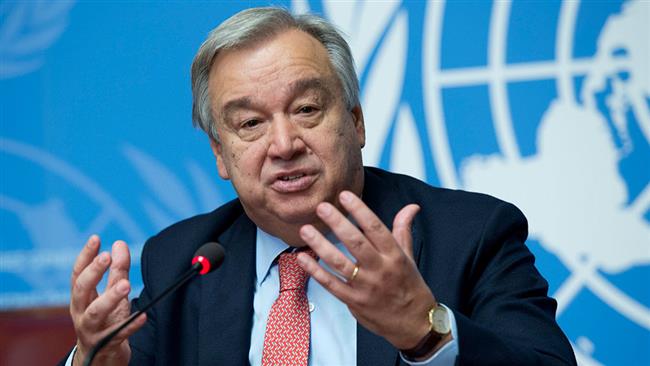
Secretary General of the United Nations (UN) Antonio Guterres has challenged countries in the Central and West Africa sub regions, devastated by lingering and escalating terrorist activities to find the root causes with a view to tackling them from the root. The UN scribe, represented by the Head of the UN office for West Africa, Mr. Mohammed Ibn Changes, threw the challenge at the opening of the Economic Community of West Africa (ECOWAS) and Economic Community of Central African (ECCAS) Summit today, Monday, in Lome, federal capital of Togo. The UN Secretary General regretted the escalation security challenges, especially Terrorism, in the two African sub regions, made up of 26 countries. He advised the leaders of these countries to critically examine the underlying factors responsible for the lingering terrorism, armed banditaries and other security challenges. According to him, one of such underlying factors is aggregated widespread poverty, caused mainly by receding Lake Chad basing which he advised the regions to put heads together to urgently address. The EOWAS chairman, who doubles as President of the host country, Togo, Mr. Faure Essozimne Gnassingbe said that the relevance of the Heads of governments in the two regional communities coming together to find common solutions to the security challenges cannot be overemphasized. He stressed the need for the ECOWAS/ECCAS not to allow their borders to be used by the terrorists and others that are threats to the security, peace, stability, terrorism and violent extremism to thrive. “We should not allowed our borders to be impediments to the efforts of our armed forces in their attempts to protect and defend the territorial integrity of the individual member nation.”
Benue state House of Assembly has made a move to impeach the state governor, Samuel Ortom.
Members of the All Progressives Congress (APC), served the governor notice of impeachment today, Monday.
The controversy rocking the Benue State House Of Assembly assumed a new dimension on Monday as some lawmakers served impeachment notice on Governor Samuel Ortom.
The lawmakers who served the impeachment notice are eight All Progressives Congress (APC) members.
The impeached the House Speaker, Terkimbi Ikyange, who served as spokesperson of the eight lawmakers told journalists that the House has commenced impeachment proceedings against Governor Ortom on the allegations of diversion of state funds and abuse of office.
Ikyange added that 15 lawmakers have been suspended for six months.
The 15 newly suspended lawmakers are part of the 22 lawmakers who impeached Ikyange, last week.
Earlier on Monday, police officers had stormed the Assembly Complex denying the 22 lawmakers who impeached the former Speaker, Ikyange entry into the House.
The crisis comes a few days after Governor Ortom defected from the APC to the Peoples Democratic Party (PDP).
It also came days after 22 lawmakers impeached the House Speaker, Terkimbi Ikyange while Titus Mba from the Peoples Democratic Party (PDP) was elected as new Speaker.
About two million Nigerians residence in Togo have lamented over which language between English and French their children should master to be able to fit into the socio-political system of their home country, Nigeria.
Speaking in an interactive session last night, Sunday, with President Muhammadu Buhari at the Nigeria Embassy in Lome, Togo, ahead of the ECOWAS/ECCAS summit today, Monday, Nigerians said that schools where English language is taught in Togo are far inadequate.
They told president Buhari that most of them are being forced to send their children to neighbouring Ghana to learn English since most schools in Togo teach only French which is their lingua franca.
They said that the Nigerian community is putting up educational institutions in Togo specifically for the teaching of English language for the purpose of making their children relevant to the Nigerian system in future.
The Nigerian Ambassador to Togo, Joseph Iji told the President that Nigerians In Togo are peaceful and industrious.
He acknowledged that their are a few bad ones but that they don’t constitute danger to the image of the home country.
Ambassador Iji said that he had been engaging Nigerians at regular meetings to address the the challenges they might face at any given time.
He appealed to president Buhari to look into the inadequate staff for the embassy and promotion of the existing ones.
President Muhammadu Buhari has made it clear that he is not bothered about those who defected from the All Progressives Congress (APC) to the opposition Peoples Democratic Party (PDP).
In an interactive session last night, Sunday, with a cross section of Nigerians residence in Togo, President Buhari said that his strength lied in the hand of God and with the ordinary Nigerians who appreciate the performance of his government.
According to him, the issue of defection by some politicians cannot affect the focus of his government in the areas of ensuring better and secured life for the citizenry.
The President insisted that those who looted the country’s treasury must be made to face the law and return the loots.
He said that as a democrat, he would follow the due legal process, adding that measures are being taken to sell off confirmed illegally acquired properties and the proceeds put in the treasury.
Buhari recounted the sorry state he met the economy, including dilapidated infrastructure despite huge revenues that accrued from oil sector in 16 years of the PDP in government.
He said that the fact that millions of ordinary Nigerians understand the efforts he had made to pull the country from economic collapse made him to feel happy “and not bothered about those who defected.”
Earlier, the Nigerian community in Togo had commended President Buhari for the various achievements his government had recorded so far, even as they appealed to him to develop Seme border to ease trade link between Nigeria and Togo.
“With Buhari as President, Nigerians are proud anywhere they are in the world now, ” they said.
President Muhammadu Buhari has ordered the assemblage of 1000-strong military force, compromising the army, air force, police and the civil defence to launch fierce attacks on the bandits terrorising the villages and towns of Zamfara State.
The President also directed that the Nigerian Air Force (NAF) should begin the deployment of fighter aircraft to Katsina, the airport with the closest proximity to Zamfara State to make for immediate and effective response to the menace of the bandits.
This had not been possible in the past because there was no fuel depot facility in Katsina, but NAF has devised a way around the problem.
The President also authorised the engagement by NAF, of advanced satellite surveillance technology to help in accurate detection of movement and locations of the bandits.
The government had to go to this extent because of the limitations of conventional surveillance, as the use of satellite technology could make the task of NAF less problematic.
Following directives from the President, at the weekend, the Chief of Air Staff, Air Marshall Sadiq Abubakar, was in Gusau where he met the Deputy Governor of the State.
The Chief of Air Staff reiterated the President’s pledge that he would never abandon victims of attacks to their fate, reaffirming that security remains one of the cardinal pillars of his campaign promises and no leader would be happy to see his own citizens killed by criminal groups across the country.
It will be recalled that since his election, the President has kept faith with his promises to re-equip and motivate the country’s military and other security services.
The army and other security services are now better equipped and motivated to face the challenges of their responsibilities.
A statement by the senior special assistant to the President on Media and publicity, Malam Garba Shehu appealed to all Nigerians to unite and speak with one voice on security issues and urges politicians to stop exploiting national security challenges.
The statement said that those praying for the President to fail in this effort can be likened to one stabbing oneself in the heart and celebrating about it.
“In this regard, security should not be reduced to petty politics as doing so could only embolden the terrorists and other murderous gangs.
“We therefore appeal to members of the Nigerian media to avoid unhelpful and deleterious sensationalism in the coverage of events that border on national security.
“The media should under no circumstances make the bandits or terrorists feel like super stars because doing so could hurt all of us.
“Terrorists seek to achieve maximum publicity and they do so by launching large scale attacks on soft targets and the media must resist every attempt to play into their hands unwittingly.”
Some victims of Benue attacks being berried, in Benue State.
An intellectual think tank in the United Kingdom (UK) , The Bridge Centre has exposed Nigerian leading opposition party, the Peoples Democratic Party (PDP), the Benue state Governor, Samuel Ortom, Senator Dino Melaye and others over the wanton killings in the North Central, which are attributed to herdsmen farmers’ crisis.
The Bridge Centre claimed that chieftains of the PDP in their desperation to get at the government of the All Progressives Congress (APC) at the centre, have been actively supporting killers, who go about massacring populations in communities that did not vote them in the 2015 general elections.
The report cited the case of wanted terrorist, Akwazar Terwase (alias Gana) of Benue State, who was propped up by the PDP governor that presided over the state between 2007 and 2015, Gabriel Suswam.
It alleged that Suswam’s successor,Samuel Ortom, even while posing as an APC member, being a closet PDP member at that time continued to provide cover or Gana while publicly castigating him for public show.
“Gana is responsible for scores of deaths, including many that were initially attributed to herdsmen. Ortom is now formally back in the PDP,” the reported asserted.
Elizebeth Robertson, Head of Research and Documentation of the organization in the report, called on the United Nations Security Council to urgently intervene before the world starts dealing with the problem of a lost generation in Nigeria. The report reads in full.
The world has on several occasions been appalled by the wanton killings in Nigeria from incidents attributed to clashes between herdsmen and farmers. Attacks upon attacks in affected communities have been blamed on “killer” herdsmen, who in such instances prove elusive as not much would be heard about the daring killer squads that carry out such crimes against humanity. The situation has triggered a cycle of blame game within Nigeria, with the consequence that the persons behind these killings, at least responsible in part, are successfully evading justice.
Findings show that these persons are of the People’s Democratic Party (PDP), which has its imprint on the Farmers/Herdsmen Crisis as the then ruling party and more recently as the country’s leading opposition party. Transhumance is a phenomenon that is not peculiar to Nigeria. It has been worsened by climate change, urban sprawl, changing cultures and economic pressure.
In the 16 years that PDP ruled Nigeria, it decided to do nothing about the realities of making changes to avert the genuine aspects that can be addressed as Farmers/Herdsmen Crisis like the current government is doing by proposing cattle ranching as a workable solution to the issues caused by nomadic cattle herding. It instead presided over the theft of the country’s resources on a scale that makes it difficult to make certain interventions that will allow livestock keepers and crop growers thrive as constituent parts of the agricultural sector. In the desperation to get at the government of the All Progressives Congress (APC) at the centre, PDP chieftains have been to known to actively support killers, who go about massacring populations in communities that did not vote them in the 2015 General Elections. These killings have been classified as part of the casualty from the Farmers/Herders’ crisis. We will name a few instances to support this position:
In Benue state, Akwazar Terwase (alias Gana) was propped up by the PDP governor that presided over the state up to 2015 (Gabriel Suswam) even though he was a known mass murderer.
The governor who took over, Mr. Samuel Ortom, even while posing as an APC member, being a closet PDP member at that time continued to provide cover or Gana while publicly castigating him for public show. Gana is responsible for scores of deaths, including many that were initially attributed to herdsmen. Ortom is now formally back in the PDP.
Aminu Yaminu (Tashaku), a known Boko Haram terrorist, was employed by PDP’s Samuel Ortom and paid from the Benue State Government account under the pretext of being the commander of the Livestock Guards. Tashaku has been arraigned for the gruesome murder of 17 worshipers in a heinous crime that was initially attributed to “killer” herdsmen. In the last week of June 2018, reprisal killings trailed the killing of scores of villagers in Plateau state.
The reprisals have now been proven to be the expected outcomes plotted by a former governor of the state and PDP lawmaker in the National Assembly, Senator Jona Jang, who had vowed to make the state ungovernable for the APC led government of Simon Bako Lalong.
Jang is known to have also instigated the killings as a way of forcing law enforcement agencies to back down from pursuing corruption cases against him in court.
Political leaders of the PDP have in the period since the party was voted out of the Federal Government engaged in the formation of militias, which they armed with weapons prohibited under several international protocols. These weapons have been deployed in commission crimes against humanity as they resulted in mass killings.
Taraba State (PDP) governor, Mr. Darius Ishaku, directly and through proxies armed and funded the Mambila Militia that was responsible for the violence that claimed scores of lives in Sardauna Local Government Area of Taraba state in the second half of 2017.
The killings were again initially linked to killer herdsmen before details emerged to confirm that the pastoral community was rather under attack. Members of the Benue State Livestock Guards, upon being arrested by the military, confessed that they were armed by the state governor, Mr. Samuel Ortom, a PDP member who was then pretending to belong to the APC.
On April 5, 2018, 33 persons were killed by gunmen who turned out to have been armed by Senator Bukola Saraki, another PDP member that hides behind the logo of the APC. The gunmen confessed that their weapons and operational vehicles came from him.
The brazen nature of the attack was initially ascribed to “killer” herdsmen. Kabiru Seidu aka Osama and Nuhu Salisu aka Small, named Senator Dino Melaye (PDP) as their gun-runner. They had used the weapons supplied by Dino Melaye for robberies and kidnaps that were at some point attributed to herdsmen.
Information at our disposal reveal that the PDP chieftain have released funds and more weapons for killers that will further attack communities as part of their ploy to campaign that President Muhammadu Buhari has failed in his campaign promise of restoring security to Nigerians. This money is coming from the 100 billion Naira fund that was previously earmarked to sabotage the country and present it as a failure.
Taking cognisance of the continued desecration of the sanctity of human life, the United Nations Security Council is invited to:
Order a full investigation into the role that politicians, especially the PDP, are playing in the killings attributed to Farmers/Herders’ crisis.
Arising from the findings of the full investigation, takes the steps necessary to deter the kind of disregard for human life as is presently the trend.
Time is of essence for whatever intervention the Council has to make since it is important that Nigerians are reassured ahead of the General Elections.
Former Nigerian military Head of State, retired General Yakubu Gowon has called on Nigerians to remove evil from their minds to enable them live in peace as United brothers and sisters
“We must remove evil from our own minds to be able to live together as Christians and Muslims, as young boys, you prepare to deal with the situation when the need arise without fear or favour,” he said.
General Gowon who spoke today, Saturday, as the Special Guest of Honour at the Nigeria Military School (NMS) 60th Speech and Prize Giving Day in Zaria, Kaduna State, lament that Nigerians are killing one another for no reasons.
The former leader advised that tolerance, understanding, brotherliness, accommodation and patriotism must be exhibited to restore peace across the country.
“Is it Nigerians that are killing Nigerians? It is of course very painful, I have to raise this for you young boys to know and understand that killing is not good.
Gowon cited Nasarawa, Plateau, Benue, Taraba, Zamfara among others as some of the most affected states, even as appealed to the citizenry to learn to tolerate one another to live in peace.
The ex-head of state lauded the efforts of the NMS Commandant, Brigadier General Muktar Bunza for moulding the boys to simultaneously acquire academics and military training.
He said NMS had remained a path for promoting national unity among Nigerians from different ethno-cultural and religious background.
According to him, the school has tremendously contributed to national growth and development through production of disciplined, patriotic, gallant and humble leaders.
Dr. Gowon advised the management to adopt world best practices in training the boys to become professional soldiers.
In his speech, the Chairman of the occasion and Governor of Zamfara State, Abdul-Aziz Yari reminded the NMS students that they were highly privileged to be enrolled into such prestigious school.
Yari, who was represented by his Chief of Staff, Alhaji Abdullahi Abdul-Karim said that sound education is the hallmark of success in life.
“Time has come for us to realise the reality that natural resources alone cannot build our nation, rather, it is our human capital, particularly the youth that must be harnessed to achieve meaningful development.
“We should not be surprised that a nation which is rich in natural resources will be struggling for survival if it lacks qualitative manpower.
“The premium placed by the present administration of President Muhammadu Buhari on national transformation is to train our youths, at tender age, to acquire relevant skills in all spheres of human endeavour,” he said.
The governor charged the students to be respectful, kind, generous and tolerant to people with different views, adding that they should also avoid terrorism, violence and hate speeches towards building a one and indivisible Nigeria.
In his speech, Bunza said the desire of the school has been to redefine its training programmes to fulfill the needs and aspirations of the Nigerian Army.
“NMS is conducting a combined training package comprising of academic and military subjects. The academic programmes are in line with the national policy on secondary education in Nigeria.
“In the same vein, the boys are adequately exposed to the basic military activities to be enlisted into the Nigerian Army as soldiers.
“To this extent, we have been able to ensure that the dreams of the founding fathers are achieved,” he said.
While assuring that the NMS had developed into a national asset, Bunza observed that the tremendous contributions of the school’s ex-boys to national development attested to their quality.
The commandant said the integrity and highest level of discipline displayed by the likes of late Maj-Gen. Tunde Idiagbon affirmed the role NMS had played in human resource development in Nigeria.
Bunza said the 60th Speech and Prize Giving Day had created a platform for those in attendance to benefit from the wealth of experience of a father, elder statesman and symbol of Nigeria’s unity, Retired Gen. Yakubu Gowon.
“The present situation in the country and the effort of the Federal Government in unifying the country calls for the need to bring in a recognised symbol of Nigerian unity to interact with these young and promising Nigerians.
“Sir, let me re-echo your desire to ensure that Nigeria remain one from your independence speech in 1967 where you made it clear that: Nigeria must remain one indivisible country,’’ he said.
The News Agency of Nigeria (NAN) reports that students who distinguished themselves and excelled in different fields were presented with awards.
A lecturer in the sociology department of the University of Abuja, Professor Abubakar Umar Kari has rendered his support to the move being made in the National Assembly to make hate speech a criminal offence punishable with death.
He insisted that the full weight of the law should always be brought to bear on perpetrators of hate speech and their collaborators.
Professor Kari, who delivered a lecture, titled: Hate Speech, The Media And Nigeria’s Unity, at the State House Press Corps (SPHC) bi-annual retreat in Epe, Lagos today, Saturday commended the bill in the Senate, sponsored by Senator Aliyu Sabi Abdullahi, which provides for death by hanging for any person found guilty of any hate speech that results in the death of another person.
“I support the speedy passage of the bill and its immediate assent. South Africa promulgated the Promotion of Unfair Discrimination Act of 2000, while in Kenya, after the 2007 political crisis that led to the death of over 1000 people, they enacted a law on hate speech, the National Cohesion and Integration Act of 2008.
“Impunity against hate speech can be tackled if we begin to seriously enforce existing laws in that regard. For instance, the Criminal Code in Sections 42, 86 and 88 deals with aspects of hate speech. Also, the Cyber Crime Act among other things prohibits and pronounces punishment against, “….any written or printed material, any image or any other representation of ideas or theories, which advocates, promotes or incites hatred, discrimination or violence, against any individual, group of individuals, based on race, colour, descent or national or ethnic origin, as well as religion.”
The University Don is not comfortable that there is no provision against hate speech in the Code of Ethics of the Nigeria Union of Journalists (NUJ), saying that it is a serious abnomality that must be corrected forthwith.
“On the contrary, the Nigerian Press Organization`s Code of Conduct contains a clause that “prohibits journalists from any justification for, or incitement to, wars of aggression…hatred or discrimination, etc.” Still this can be made more explicit.”
Full text of the lecture is reproduced here:
In recent time the ugly and worrisome phenomenon of hate speech has engaged the attention of scholars, analysts, state and non-state actors, due to sudden and unprecedented upsurge in its occurrence, caliber and sheer number of people involved, and what hate speech actually portends and represents: it is a clear and present danger to peace, public safety and national unity.
But then, hate speech is really an old-age social problem, particularly within the realm of politics, because throughout history it has been used and deployed, more often by design, but also by default, for selfish – mainly political – ends. From the classical Greek and Roman civilizations to the Medieval period in Europe, and from the epoch of the Crusades through to that of Western colonization of Africa, Asia and Latin America, hate speech was occasionally employed to justify attacks and conquests, subjugation and persecution of peoples as well as other heinous actions against individuals and groups. In the same vein, the unspeakable terror visited on Jews, communists, Blacks, gypsies and other victims of Third Reich policy of extermination had been preceded by Hitler`s cynical and murderous profiling of them in arguably contemporary history`s worst manifestation of hate speech.
Everywhere and in all circumstances, hate speech pitches persons and groups often as “us” versus “them.” For a fragile polity such as Nigeria`s, which complex diversity seems forever a source of friction and which fate almost always hangs on the edge of a precipice, every dose and every moment of hate speech takes a huge toll on the social fabric of society. In the words of Ezeibe (2015), “…Nigeria`s background of intolerance provides ample grounds for the use of hate speech. Directly, it is hate speech and indirectly it is ethnic and religious intolerance that led to the surge in violence in the country.” Indeed, hate speech is a potent polarizing, divisive and centrifugal force; and an ill-wind that blows nobody any good.
Nigerian media, just like their counterparts elsewhere, have been complicit in the matter of hate speech in a number of ways: as veritable sources of offensive and toxic hate speech materials; as platforms and peddlers of same; and for encouraging, tolerating or being indifferent to something so atrocious. This is in spite of clear moral, social and legal issues associated with hate speech, and grave consequences the phenomenon easily elicits and instigates.
These are the issues treated in this brief presentation.
MEDIA AND HATE SPEECH: IMPLICATIONS FOR NATIONAL UNITY
Although we are always talking and worried about it, and have some idea what it is, there is no agreement about what actually constitutes hate speech. Its scope is wide and its meaning varies and changes in terms of time and space. This is because so many issues are involved, including but not limited to foul and offensive language, defamatory materials, inciting and unfair characterization and profiling of individuals and people, prejudicial, false or malicious claims, condemnatory or derogatory statements about others, etc
According to Neisser (1994:337), hate speech refers to all communication (whether verbal, written or symbolic) that insults a racial, ethnic and political group, whether by suggesting that they are inferior in some respect or by indicating that they are despised or not welcome for any other reason. To Adibe (2014), hate speech employs discriminatory epithets to insult and stigmatize others on the basis of race, ethnicity, gender, sexual orientation or other forms of group membership. It is any speech, gesture, conduct, writing or display which could incite people to violence or prejudicial action. However, the most comprehensive definition is by the United Nations Committee on the Elimination of Racial Discrimination (2013:4):
Hate speech includes (a) all dissemination of ideas based on racial or ethnic superiority or hatred, by whatever means (b) incitement to hatred, contempt or discrimination against members of a group on grounds of their race, colour, descent, or national or ethnic origin; (c) threats or incitement to violence against persons or groups on the grounds of (b) above; (d) expression of insults, ridicule or slander of persons or groups or justification for hatred.
The simple interpretation is that hate speech is any expression or picture or symbol that vilifies an identifiable group. If that is the case, then, Nigerian media, both print and broadcast, are full of them. Samples:
1. The media sometimes publish and broadcast stuff that borders on hate speech: news items and headlines that stereotype groups; feature stories that drip with prejudice and scapegoating; radio shows and audience-participatory programmes on topics and issues that easily provoke or precipitate exchange of insults and hatred, etc. Radio and television shows hosts sometimes actually encourage or even lead the way through their handling (or mishandling) of proceedings, nature of questions asked, how the questions are asked, choice of words, etc. In certain instances, the very choice of guests to discuss an issue is guaranteed to generate hate speech.
2. The always widely reported, explosive, unrestrained and reckless outbursts of controversial elements such as Femi Fani Kayode, Governor Ayo Fayose, Mujahid Asari Dokubo, Dr. Junaid Mohammed and the many self-styled ethnic, geo-ethnic, “socio-cultural” groups (Afenifere, Ohaneze Ndi`Igbo, Arewa Consultative Forum) and some clearly partisan, vocal clergy whose pronouncements are often laced with venom and only help to widen and deepen the national fissures. Unfortunately the media eagerly lap up whatever toxic messages these personalities spew, sometimes unedited.
3. Columnists are not left out. Their perspectives and takes on issues sometimes degenerate into hate speech. A prominent politician (now deceased) and newspaper columnist used very inciting and murderous characterization and stereotyping to describe one of the major ethnic groups as “the Tutsis of Nigeria” who are likely to end up sharing the same bloody fate with the Tutsis of Rwanda! In 1994 an estimated 800,000 Tutsis (including sympathetic Hutus) were massacred by the Hutus. Abubakar Siddique Mohammed (cited in Usman and Abba,1995:4) placed the blame on the doorstep of the media which, he claimed, ‘effectively propagated hate against the target groups, and helped in brainwashing militant Hutu youth, organized in militias, who carried out genocidal acts.” Many a column in Nigerian newspapers and magazines is a study in incitement and dangerous profiling.
4. Sponsored newspaper, radio and television adverts, reports and documentaries. For instance, the build-up to the 2015 elections was characterized by a deluge of divisive stuff in the media. The most notorious are “The Man Buhari” and “The Lion of Bourdillion,” two scathing television documentaries against Candidate Muhammadu Buhari and Bola Ahmed Tinubu and their supporters aired on the Nigerian Television Authority and Africa Independent Television.
5. In recent times the activities of the “Herdsmedia” are a real source of worry. These are media men and women that have made Fulani herders their bogeyman. Every act of violence and crime is blamed on the Fulani herdsmen regardless of evidence to the contrary. Gradually the frontier of the scapegoating in the mischievous lens of the herdsmedia is being stretched to profile every Fulani man as a mindless killer and destroyer.
HOW TO COUNTER HATE SPEECH
As argued by Vice President Osinbajo, hate speech – which he equated with terrorism – is a cankerworm ravaging the social fabric of society and a threat to peace, stability and national unity. It must be faced squarely through a multi-pronged approach, as follows;
a. Media practitioners should be educated and re-educated on media ethics (on matters of balance, fairness and objectivity), but also on matters of public good, public safety and national security. Our reporters, writers and editors must appreciate the fact that freedom of speech is not absolute, and that no individual, group or medium has any right to publish or print materials that incite, precipitate disquiet or lead to break down of law and order.
b. Journalists should be schooled in conflict-sensitive reporting and multi-cultural awareness. In particular, they must learn to avoid “us” against “them” reporting. They should exercise professional standards in articles they write, programmes aired and learn to speak to people without taking sides.
c. Hosts of radio and television shows should be specially trained to handle particularly sensitive and controversial issues and topics, without unduly getting involved, losing control of proceedings or encouraging or tolerating hate speech.
d. Media outfits should establish monitoring and evaluation units in newsrooms.
e. The full weight of the law should always be brought to bear on perpetrators of hate speech and their collaborators. I have observed that there is a bill in the senate, sponsored by Senator Aliyu Sabi Abdullahi, which provides for death by hanging for any person found guilty of any hate speech that results in the death of another person. I support the speedy passage of the bill and its immediate assent. South Africa promulgated the Promotion of Unfair Discrimination Act of 2000, while in Kenya, after the 2007 political crisis that led to the death of over 1000 people, they enacted a law on hate speech, the National Cohesion and Integration Act of 2008.
f. Impunity against hate speech can be tackled if we begin to seriously enforce existing laws in that regard. For instance, the Criminal Code in Sections 42, 86 and 88 deals with aspects of hate speech. Also, the Cyber Crime Act among other things prohibits and pronounces punishment against, “….any written or printed material, any image or any other representation of ideas or theories, which advocates, promotes or incites hatred, discrimination or violence, against any individual, group of individuals, based on race, colour, descent or national or ethnic origin, as well as religion.”
g. I have observed that there is no provision against hate speech in the Code of Ethics of the Nigeria Union of Journalists. That is a serious anomaly that must be corrected forthwith. On the contrary, the Nigerian Press Organization`s Code of Conduct contains a clause that “prohibits journalists from any justification for, or incitement to, wars of aggression…hatred or discrimination, etc.” Still this can be made more explicit.
CONCLUSION
Hate speech, like most other social problems that beset our country, thrives mainly because of the strange and inexplicable reluctance to tackle it decisively. But we cannot afford to fold our arms and watch as it continues to wreck havoc in the land, particularly as it attacks the basis of our national cohesion and existence as one, united people. It is increasingly being used as a weapon to raise ferment, incite and instigate instability, violence and cause confusion.
The media, which share part of the blame for the prevalence of hate speech, should be in the vanguard of the efforts to curb this menace. The task, however, is a huge one and requires the participation of all stakeholders.
Nollywood actress, Cossy Ojiakor has made it clear that any man who wants to marry her should be ready to take from her double of what he will give her Speaking to Vanguard in Lagos, Cossy said: “any man that wants me should be able to give and take. What you give you will receive double. “If you give slap you will receive double slaps. If you give love you will receive it in manifold and we, women, are natural spies. “There’s no place to hide and live double life.”
The National Broadcasting Commission (NBC), has fined DAAR Communications (owner of AIT/Raypower) N500,000 for broadcasting what have been termed hate items thereby violating the provisions of the Nigeria Broadcasting Code. NBC’s Head of Public Affair, Maimuna Jimada, in a statement today, Saturday in Abuja, said that comments made on Raypower’s programme “Political Platform” was against the broadcasting code. Mrs Jimada said that the organisation was sanctioned due to “provocative, inflammatory and divisive comments” by anchors of the political platform. She said the Commission on May 2, 2017, August 15, 2017 and February 2018, held meetings with staff of DAAR Communications to caution them on unprofessional manner of anchors of the programme. According to her, the Commission had charged the team handling the programme to be fair, and balance their reportage, saying that during the February 7 meeting, the Commission stressed the need to comply with the broadcasting code to avoid sanctions. “The Political Platform episode on July 24, was marked by sensational and heated expression of opinion by its anchors, who went on to make unproven and inciting allegations. “For avoidance of doubt, the Director-General drew the attention of DAAR Communications to the following provisions of the Nigeria Broadcasting Code: (1) Section 1.9.3: “A presenter/anchor shall not express his or her personal opinion in a programme. “Also Section 5.2.7: ‘A broadcaster shall, in using political material for news, avoid taking inflammatory and divisive matter in its provocative form and Section 5.2.5 stated that political broadcasts shall be in decent language.” Mrs Jimada reiterated that broadcasting stations should ensure that anchors of their programmes were properly informed and trained on the ethics of the profession as well as the provisions of the broadcasting code.
We use cookies on our website to give you the most relevant experience by remembering your preferences and repeat visits. By clicking “Accept”, you consent to the use of ALL the cookies.
This website uses cookies to improve your experience while you navigate through the website. Out of these, the cookies that are categorized as necessary are stored on your browser as they are essential for the working of basic functionalities of the website. We also use third-party cookies that help us analyze and understand how you use this website. These cookies will be stored in your browser only with your consent. You also have the option to opt-out of these cookies. But opting out of some of these cookies may affect your browsing experience.
Necessary cookies are absolutely essential for the website to function properly. This category only includes cookies that ensures basic functionalities and security features of the website. These cookies do not store any personal information.
Any cookies that may not be particularly necessary for the website to function and is used specifically to collect user personal data via analytics, ads, other embedded contents are termed as non-necessary cookies. It is mandatory to procure user consent prior to running these cookies on your website.




 President Muhammadu Buhari has ordered the assemblage of 1000-strong military force, compromising the army, air force, police and the civil defence to launch fierce attacks on the bandits terrorising the villages and towns of Zamfara State.


 The National Broadcasting Commission (NBC), has fined DAAR Communications (owner of AIT/Raypower) N500,000 for broadcasting what have been termed hate items thereby violating the provisions of the Nigeria Broadcasting Code.
