Former President Olusegun Obasanjo has responded to President Muhammadu Buhari over his statement that he (Obasanjo) should explain to the nation what he did with N16 billion voted for power sector during his regime.
In a statement responding to Buhari’s accusation, Obasanjo said that records from the National Assembly had exculpated President Obasanjo of any wrong-doing concerning the power sector and has proved the allegations as false, even as he described Buhari as lacking proper understanding of the issue at stake.
Obasanjo therefore challenged the President to set up another enquiry if in doubt and unsatisfied with the EFCC report and that of the Hon. Aminu Tambuwal-led ad-hoc committee.
Part of the statement, issued by Obasanjo’s media aide, Kunle Somorin, goes thus:, said a statement by Kunle Somorin, his media assistant.
It has come to the attention of Chief Olusegun Obasanjo that a statement credited to President Muhammadu Buhari, apparently without correct information and based on ignorance, suggested that $16 billion was wasted on power projects by “a former President”. We believe that the President was re-echoing the unsubstantiated allegation against Chief Obasanjo by his own predecessor but one.
While it is doubtful that a President with proper understanding of the issue would utter such, it should be pointed out that records from the National Assembly had exculpated President Obasanjo of any wrong-doing concerning the power sector and has proved the allegations as false.
For the records, Chief Obasanjo has addressed the issues of the power sector and the allegations against him on many occasions and platforms, including in his widely publicised book, My Watch in which he exhaustively stated the facts and reproduced various reports by both the Economic and Financial Crimes Commission (EFCC), which conducted a clinical investigation into the allegations against Chief Obasanjo, and the Ad-Hoc Committee on the Review of the Recommendations in the Report of the Committee on Power on the Investigation into how the Huge Sums Of Money was Spent on Power Generation, Transmission And Distribution between June 1999 and May 2007 without Commensurate Result.
We recommend that the President and his co-travellers should read Chapters 41, 42, 43 and 47 of My Watch for Chief Obasanjo’s insights and perspectives on the power sector and indeed what transpired when the allegation of $16 billion on power projects was previously made. If he cannot read the three-volume book, he should detail his aides to do so and summarise the chapters in a language that he will easily understand.
In the same statement credited to the President, it was alleged that there was some bragging by Chief Obasanjo over $16 billion spent on power. To inform the uninformed, the so-called $16 billion power expenditure was an allegation against Chief Obasanjo’s administration and not his claim. The President also queried where the power generated is. The answer is simple:
The power is in the seven National Integrated Power Projects and eighteen gas turbines that Chief Obasanjo’s successor who originally made the allegation of $16 billion did not clear from the ports for over a year and the civil works done on the sites. [myad]
The Monetary Policy Committee of the Central Bank of Nigeria (CBN) has given pass mark to the economic performances of the federal government, attributing it to the steady decline in inflation, rebound in oil prices and increase in production level, as well as the continued stability in the foreign exchange market.
In a communiqué issued at the end of its meeting in Abuja today, Tuesday, the Committee referred to the data from the National Bureau of Statistics (NBS), which gave the real Gross Domestic Product (GDP) for Q4 2017 being reversed from 1.92 per cent to 2.11 per cent, while a growth of 1.95 per cent was recorded in the first quarter of 2018, up from a contraction of 0.91 per cent in the corresponding period of 2017.
“The development was due to growth in the oil and non-oil sectors by 14.77 and 0.76 per cent, respectively. The Monetary Policy Committee also noted the sustained positive outlook based on the Manufacturing, and Non-manufacturing Purchasing Managers’ Indices (PMI), which rose for thirteenth and twelfth consecutive months to 56.9 and 57.5 index points, respectively, in April 2018. The Committee welcomed this development but believes that growth remains largely fragile and could benefit from further reforms and stimulus.
“In this regard, the MPC urged the various levels of government to accelerate the settlement of contractor debt and salary arrears as well as facilitate the quick implementation of the 2018 Federal Government budget. “
The full report goes thus:
Background
The Monetary Policy Committee (MPC) met on the 21st and 22ndof May, 2018 against the backdrop of optimistic global growth outlook and sustained recovery in the domestic economy. The Committee examined the performance, risks, vulnerabilities in theglobal and domestic economiesup to May2018, and the outlook for the rest of the year. In attendance were nine members of the Committee.
Global Economic Developments
The momentum of global economic activities remained broadly sustained, with outcomes likely to be shaped by emerging geo-political issues including: easing geo-political tensions on the Korean Peninsula; reduced trade tensions between China and the United States; United States withdrawal from the 2015 Iranian Nuclear Deal; easy financing conditions in the Euro Area, the UK and Japan; as well as difficulties associated with the Brexit negotiations. Accordingly, global output is projected to grow at 3.9 per cent in 2018,up from 3.8 per cent in 2017. Growth in the advanced economies is projected to strengthen to 2.5 per cent in 2018 from 2.3 per cent in 2017 premised on improved investments and consumption spending. Similarly, output growth in the emerging markets and developing economies (EMDEs) is projected to rise marginally at 4.9 per cent in 2018 reflecting improvements from 4.8 per cent in 2017,led by oil exporters, such as Russia, Brazil, and Nigeria. The Committee noted that despite these optimistic developments, the downside risks to global growthinclude: the geo-political tensions in the Middle-East; lingering uncertainties from BREXIT negotiations; and growing trend towards trade protectionism.
Inflation in the advanced economies is projected to rise by 2.0 per cent and would remain subdued relative to the long term trend. In the emerging marketsand developing economies, price developments could surge by 4.6 per cent in 2018. The International Monetary Fund (IMF) forecasts that inflation may rise modestly over the medium to long-term, due to rising asset prices and long-term yields in the major financial markets.
Domestic Output Developments
The Committee noted improvements in the domestic economy, attributable to the steady decline in inflation, rebound in oil prices and increase in production level, as well as the continued stability in the foreign exchange market.
According to
The Committee noted that broad money supply (M2) grew by 2.16 per cent in April 2018 from 1.26 per cent in March 2018, annualised to 6.48 per cent. This was in contrast to the provisional growth benchmark of 10.48 per cent for 2018. The performance of M2 was mainly driven by the growth in Net Domestic Credit (NDC) of 6.24 per cent (annualised to 18.72%), owing largely to net credit to government, which grew by 46.13 per cent (annualised to 138.39%) against the provisional benchmark of 54.97 per cent. Credit to the private sector, however, contracted by 0.16 per cent (annualised to -0.47%) in April 2018, in contrast to the provisional annual benchmark of 5.64 per cent. Net Foreign Assets (NFA) grew by 7.38 per cent in April 2018, annualized to 22.13 per cent, compared with the provisional benchmark of 18.15 per cent. Narrow money (M1), however, contracted by3.31 per cent (annualised to -9.94%), compared with the provisional benchmark of 8.04 per cent.
Inflationary pressures continued to moderate with headline inflation (year-on-year) declining for the fifteenth consecutive month to 12.48 per cent in April 2018 from 13.34 per cent in March 2018. Food and Core inflation also decelerated to 14.80 and 10.92 per cent from 16.08 and 11.18 per cent, respectively,during the same period.
The average inter-bank call rate decreased to 3.34 per cent in April 2018 from 9.49 per cent in December 2017. Similarly, the average Open Buy Back (OBB) rate fell to 2.96 per cent in April 2018 from 8.46 per cent in December 2017. The movement in the net liquidity position and interest rates reflected the combined effects of Open Market Operations (OMO) auctions, foreign exchange interventions and statutory allocation to state and local governments.
The Committee welcomed the sustained improvement in the level of external reserves, which stood at US$47.79 billion onMay18, 2018,compared with US$46.73 billion at the end of March 2018. The Committee urged the Bank to sustain this momentum and continue to boost investor confidence in the economy. The Committee also welcomed the continued rise in the price of crude and called on the Federal Government to seize the opportunity to build fiscal buffers against future oil price shocks.
The All-Share Index (ASI)decreased by 6.6 per cent from 43,330.54 on February 28, 2018 to 40,472.45 on May18, 2018, owing largely to profit taking activities of investors,andcapital reversals in response to monetary policy normalization in some advanced economies particularly, the United States. Similarly, Market Capitalization (MC) fell by 5.7 per cent from N15.55 trillion on February 28, 2018 to N14.66 trillion on May18, 2018. The Committee noted the need to maintain remunerative domestic rates to stem the trend towards huge capital outflow.
The MPCwelcomedthe continued stability in the foreign exchange market,promoted by improved dollar liquidity in the market due to the high level of activity at the Investors’ and Exporters’ (I&E) window, that is equally driving rates towards convergence at all segments of the market.Total foreign exchange inflow through the economy from January to March 2018 stood at US$24.719billion, of which funding from the CBN was US$8.81 billion or 28.5 per cent, while autonomous sources accounted for the larger balance of US$15.91 billion or 71.5 per cent of the total. In addition, the Committee welcomed the US$2.5 billion or RMB 15 billion Currency Swap between the Central Bank of Nigeria (CBN) and the People’s Bank of China (PBoC). This swap, the Committee noted, will ease pressure in the foreign exchange market by the reduction in reliance on a thirdcurrency for trade settlement between Nigeria and China. They further noted that this swap arrangement could be the basis for an expanded and mutually beneficial economic relationship between Nigeria and China.
2.0. The Overall Outlook and Risks
The macroeconomic environment that propelled the economy’s exit from recession has remained positive and is likely to continue in the near-term. Theexpectation was premised on speedy implementation of the 2018 budget, improvedsecurity, continued stability in the foreign exchange market as well as increase in crude oil production and prices. The Committee noted the downside risks to the outlook to include:the lateapproval and implementation of the 2018 budget;farmers-herdsmen conflict; weak demand and consumer spending associated with outstanding salaries and contractor debt; and the growing level of sovereign debt.
The outlook for inflation indicates continued moderation in the price level, even though the risks include huge liquidity injections that is expected to arise from the implementation of the proposed N9.12 trillion 2018FGN budget; expenditure towards the 2019 elections;monthly FAAC injections, approval and implementation of the proposed new national minimum wage,possiblyfinanceby a supplementary budget. These could impact aggregate demand and put pressure on domestic prices in the remaining months of 2018 and may dampen the gains already made by the Bank in stabilizing prices.
Staff forecasts, given the anticipated liquidity injections into the economy, indicates upward trending pressure on domestic prices from the second half of fiscal 2018. Consequently, the Committee advocates an orderly injection of the anticipated liquidity by the fiscal authorities to prevent a negative shock to prices that would derail the positive but fragile recovery so far achieved.
Given the CBN’s interventions, the current level of oil prices and developments in the global economy, we expect rates to remain stable in the foreign exchange market in the near-term. However, the bearish signs in the capital market associated with profit taking activities of investors, call for a careful calibration of policy so as to moderate the trend of capital outflows in an era of monetary policy normalization in the United States. This is given that there are already indications of severe attacks on the foreign exchange markets of some emerging economies.
Nevertheless, there is significant high level of uncertainties that could arise from the fiscal operations of government in the near term. Amongst these are: when the implementation of the 2017 budget will end;dwindling revenue projections; as well as the possibilities of full implementation of the 2018 Federal budget. Consequently, we expect a likely bunching of government spending in view of the late passage of the budget and government’s commitment to honour prior obligations. This could pose a serious challenge to the Bank’s price stability mandate.
Revenue is expected to increase in view of the favourable prices of crude oil and improvements in non-oil revenue, particularly taxes. In addition, production levels have also increased in recent times and this is expected to be maintained. However, the implications of a China-US trade deal on China’s oil imports from Nigeria remain unclear, especially as the US has included energy imports on the list of items for negotiation with China.
3.0. The Considerations of the Committee
The Committee expressed satisfaction on the positive outlook in the domestic economic environment as the real GDP grew for the fourth consecutive quarterby the first quarter of 2018 and the positive trend in the Manufacturing and Non-manufacturing Purchasing Managers’ Indices in the first quarter of 2018.It noted the continueddeceleration in headline inflation as well as stability in the foreign exchange market and therefore,called on the Bank to sustain the momentum in order to further subdue inflation and ensure growth. The Committee expressed satisfaction with the level of activities in the Investors’ and Exporters’ (I&E) window of the foreign exchange market.
The Committee further noted the overall upward growth momentum of the economy with key activity sectors returning positive growth.Despite the improving macroeconomic environment, the Committee noted that disruptions to the supply chains in major food producing states of the country remains a concern asfood prices remained sticky downwards. It also noted the potential adverse effect of the rising global inflation on domestic prices and therefore, urged the Government not to relent on curtailing the security challenges to advance controlling inflation to its historical path.
Members of the Committee were satisfied with the progress made with the implementation of the Economic Recovery and Growth Plan,but were concerned on the effect of delay in the passage of the 2018 Appropriation could derail the programmeand urged the Federal Government to sustain its implementation to further accelerate theeconomic recovery thusfar achieved. The Committee urged the Government to set the machinery for the effective implementation of the 2018 budget to further stimulate the economy.It also encouraged the Government to sustain current efforts at boosting tax revenue generation notwithstanding the increase in crude oil and other commodity prices. The MPC, however, noted the potential effects of expansionary fiscal budget of 2018 and the liquidity impact of rising FAAC distribution,following increase in the prices of crude oil as well as thebuild up in election related spending towards the 2019 general elections.
The Committee took note of the improved performance of deposit money banks and observed thatthe relatively high levels of non-performing loans in the industry was moderating and urged Government to promptly settle outstanding contractor arrears as earlier promised. The Committee commended the effort of the Bank inachieving the positive outlookfor the industry and advice the Bank to intensify efforts to further improve banking sector soundness.It called on the Bank to sustain its monitoring apparatus to ensure compliance with existing prudential regulations andearly detectionand management of emerging vulnerabilities. Also, it similarly encouraged the Bank not to relent in ensuring that liquidity continues to flow from the banking sector to the real sector to further strengthen economic recovery and employment generation.
4.0. The Committee’s Decisions
The Committee critically evaluated the policy options in terms of developments in the international and domestic environments, noting in particular progress made in stimulating output growth, including stability in the foreign exchange market increase in the level of foreign exchange reserves,and sustained deceleration in therate of inflation.
The Committee considered the forecast of high liquidity injection in the second half of 2018, upward pressure on prices, driven largely by substantial expansionary fiscal policy, which will arise from the late passage of the 2018 appropriation bill, outstanding balance from the 2017 budget and the pre-election expenditures.Thus,tightening would ensure themop-up of excess liquidity.Mindful that despite the moderation in inflation, the current inflation rate is still above targeted single digit and that real interest rate only turned positive in the review period. The objective of the policy stance therefore, would be to accelerate a reduction in the inflation rate to single digit to promote economic stability, boost investor confidence, and promote foreign capital flows with complementary impact on exchange rate stability.
Conversely, the Committee believes that raising interest rate would, however, depress consumption and increase thecost of borrowing to the real sector. Moreover, such policy would make deposit money banks to re-price their assets.
In reviewing the choice of loosening, the Committee evaluated the potential impact of stimulating aggregate demand throughlower cost of credit.Nevertheless, the Committee deliberated on the effectiveness of the choice at a time when liquidity injection had been forecast to rise tangentially in the second half of the year. The outcome therefore, would most likely exacerbate inflationary pressure, cause higher pressure on the exchange rate as demand for forex increases and return real rate into negative territory as nominal interest rate fall lower than the inflation rate. Owing to the poor transmission mechanism as a result of structural rigidities, the reduction in the MPR may not necessarily transmit to lowering market lending rate onaccount of the high cost of doing business. The Committee further noted that loosening could worsen the current account balance through increase in importation, margin lending, lowering of risk evaluation in accessing loans which will drive up loans and likely increase in NPLs with potential negative consequence on the stability of the banking industry. The cost of liquidity management would also rise considerably.
The Committee, while arguing for a hold,observedthat the downside risk to growth and upside risk to inflation appears balanced as growth is improving while inflation is moderating. Maintaining the current policy stance would sustain gradual improvements in both indices. It was noted that there is need to see how all the components of GDP would evolve in the second quarter of 2018 in order to gain greater clarity on the direction of monetary policy.In summary, the predominant argument for a hold at this time is to await more clarity on the evolution of key indicators i.e. the passage and implementation of the budget, economic activities, and traction in fiscal policy in 2018.
Overall, the Committee was convinced that the economy needed a new impetus of increased lending by the banking system and would work with the Bank to adopt innovative ways to encourage the deposit money banks (DMBs) to adopt innovative ways to accelerate credit growth, including a reduction in the policy rate when conditions for such a decision arise. The MPC noted that at single digit inflation and higher reserve levels, the risks associated with a policy rate reduction under conditions of wavering foreign capital inflows and an unstable oil market, including other severe uncertainties, could be better managed to deliver macroeconomic stability in Nigeria. In consideration of the foregoing, therefore, the Committee decided by a vote of 8members to retain the Monetary Policy Rate (MPR) at 14.0 per cent alongside all other policy parameters. One (1) member,however,voted to increase the MPR by 50 basis points.
Consequently, the MPC voted to retain the:
(i) MPR at 14.0 per cent;
(ii) CRR at 22.5 per cent;
(iii) Liquidity Ratio at 30.0 per cent; and
(iv) Asymmetric corridor at +200 and -500 basis points around the MPR.
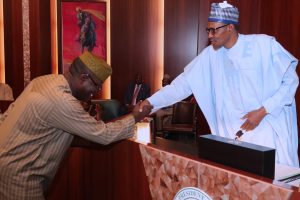
President Muhammadu Buhari addresses the Service Chiefs and Ministers during the Breaking of Ramadan Fast with Service Chiefs and Ministers at the State House in Abuja today, May 22. Photo By Sunday Aghaeze. [myad]
Just take the phrase: “impending” in the title above with a pinch of salt. I use the word because in politics as in life, things happen – as seemingly absolute situations become redeemable and what originally appears impossible could be the catalyst for fresh opportunities. Otherwise, the truth is that the ruling Nigerian political party, the All Progressives Congress is already imploding, it has in fact imploded; the party is in the throes of a debilitating illness. The implosion began almost as soon as the party assumed power in 2015. The APC emerged as a special purpose vehicle – composed almost entirely from second hand, used groups from the CPC, the ACN, APGA, ANPP, and a break away faction of the PDP, known as new PDP (nPDP) – even if there was nothing new about it, with the sole objective of taking power from the then ruling Peoples Democratic Party (PDP), and the then incumbent President Goodluck Jonathan.
Pro-APC persons described the APC as a child of necessity. They were convinced that 16 years of being in power had made the PDP complacent, arrogant and that its members had lost focus. They also argued that the Jonathan government needed to be changed by all means possible. Political coalitions often work when for one reason or the other, the ruling party loses either credibility or legitimacy, and the coalition gains the support of the people but the extent of the coalition’s success depends on its level of preparedness for office, and the quality of consensus among the partners. The APC coalition is not the first in the history of Nigerian politics, but it is perhaps the most impactful- even if driven by hate speech, populist propaganda and mass hysteria and hypnotism. It was a question of politics meeting with the public mood, and an unstoppable moment anchored on the symbolism of a strong man coming to “rescue” Nigeria. The electorate that bought into this narrative and turned it into votes is today full of regrets.
The APC began to unravel from day one, particularly at the centre. It took the government that emerged about six months to put a cabinet together, and almost two years to make some other critical appointments. Members of the coalition struggled for space, influence and power among themselves, and almost immediately, there were issues over the choice of the leaders of the National Assembly. The drama of the choice of the Senate president and the Speaker of the House of Representatives left many power brokers out in the cold. If there was any power sharing formula among the partners, somehow this was ignored by the CPC arm of the coalition led by the President, all made worse by the domination of the levers of government by CPC and Buhari loyalists. Non-Fulani members of the APC soon began to sound as if they had been attacked by a band of imported herdsmen. Party members including Governors and Senators, and party officials expressed frustration openly.
In less than three years, some of the bitterest criticisms of the party have come not from the opposition but from within the party itself: Timi Frank perpetually complaining about party processes, Shehu Sani and other Senators from Kaduna State at loggerheads with their State Governor, personality conflicts in virtually every state, most notably in Adamawa, Imo, Kano, Rivers and Lagos state, Governor Ortom of Benue openly accusing the Federal Government of negligence, Governor El-Rufai, Asiwaju Bola Tinubu and Senator Shehu Sani at various times sounding notes of warning, Senator Dino Melaye assuming the role of an in-house critic, and members of the ACN and the nPDP alleging that they have been used and dumped. The APC wing of the National Assembly is divided among its ranks, and has posed more threat to the Executive arm of government than the opposition. The APC is also the biggest challenge to its own promise. In 2015, the party promised to tackle three main issues: security, the economy and corruption. It has since found itself in the uncomfortable situation of disowning some other promises it made. It even took more than two years to launch an economic blueprint. The party over-promised and under-delivered.
It is possible to argue that differences and contestations are part of the democratic process and that this is the only way political parties can grow. Except that in this case, the conflicts are not ideas-based, even members of the APC themselves have no idea what the party really stands for, but they all seem so sure of their personal ambitions, hence the obvious lack of order and coherence. Knowing this to be so, President Muhammadu Buhari, who is also the leader of the party, had set in motion a reconciliation process, and appointed Asiwaju Bola Tinubu to lead it. This has not worked as Tinubu soon found himself in the heat of acrimony with the party Chairman, Chief John Oyegun and some of his own former protégés.
The extent of this implosion became more evident during the party’s recent state congresses. Parallel congresses were held in more than 10 states, there were reports of boycotts, violence and general confusion. Given the tone and nature of the conflict, it seems obvious that the APC is a victim of its own lack of three things – internal democracy, originality and sincerity of purpose.
It is a familiar scenario. The APC leadership should learn from the example of the PDP and how that party lost the 2015 general election. The first major crisis faced by the PDP was the failure to manage the exit of the five Governors in 2013, and the subsequent mischief over the 2015 campaign process. Powerful forces within the party for their own selfish reasons caused disaffection among members particularly at the grassroots level. Internal democracy was frustrated at all levels by those who regarded themselves as powerful Abuja forces, the same drama that is now being played out in the APC. The PDP went into the 2015 elections, as a divided party, with fifth columnists among its ranks. The APC now faces the same challenge. The nPDP wing of the APC has already served what looks like a quit notice. There are cases in court. The usual attitude is for those who emerged triumphant in the state congresses to insist that whoever wants to leave the party should do so. It was this same attitude that messed up the PDP.
Failure has taught the PDP a bitter lesson: the party is only now just in the process of reinventing itself. It is ironic for example that the same PDP in the face of likely crisis in Ekiti state recently ended up having a peaceful party primary, with the defeated congratulating the winner and promising to work for the good of the party. In Kaduna state, the PDP also put up an impressive performance in the recent local government elections. It is important however that the PDP does not begin to see the crisis within the APC as its own gain. It still has a lot to do to convince the electorate that it can be taken serious again. In 2014, PDP strategists worked on the permutation that the APC, being a community of strange bedfellows would soon fall apart to the advantage of the PDP. It was a bad strategy which did not work then and which is also not likely to work in 2019. As things stand, the APC appears as desperate for power today as it was in 2014, and those who have sworn that the Buhari government cannot be replaced would do as much as they did last Saturday, to impose their will on the Nigerian people. Politics remains warfare in Nigeria because it is the surest ticket to power, cheap money and easy life. For the Nigerian politician, winning is therefore everything.
If anyone thought 2015 was a major turning point in Nigerian politics, the 2019 general elections may even prove to be more eventful, and while the PDP may not fully resurrect, the APC may suffer worse fate, paving the way for Nigeria’s new beginning…
II. Lessons from the Royal Wedding
I could not resist the temptation to watch the royal wedding between Prince Harry and Meghan Markle. The symbolism of the event was too compelling to be ignored – a Windsor marrying a bi-racial lady, a divorcee, an American and an actress, from an obviously dysfunctional background. When King Edward VIII chose to marry an American divorcee, Wallis Simpson in 1936 – the British royalty kicked, the government and the Church demurred. the public was scandalized. Edward VIII followed his heart. He abdicated. The British monarchy has been much transformed since then. Queen Elizabeth II presides over a modern, if not post-modernist monarchy; by granting the enabling order for the wedding of Prince Harry and Meghan Markel, the Queen dug a hole through the walls of race and prejudice and offered hope. A future English prince or princess would end up having black cousins, aunties and uncles!
This symbolism was most felt at the wedding ceremony- with an all black cast of the Kingdom choir, wearing natural hair, buns and African hairstyles singing “Stand by Me”, Sheku Kanneh-Mason on the cello, and an impassioned sermon delivered by Bishop Michael Curry of the US Episcopal Church. Curry practically took Chicago to London, as he sermonized about the power of life, the fire of love, slavery…. Martin Luther King. I wouldn’t have been surprised if he had asked the congregation to stand and sing a chorus or if he asked whoever wanted to give his or her life to Jesus Christ to step forward and be blessed…Bishop Curry’s performance will be long remembered.
The wedding was orderly, simple, classy and elegant. The bride carried herself with grace and dignity – not even a trace could be seen of the pressure that had been piled on her, a few days earlier, by her father who was not too sure if he would attend or not, and her uncouth half-brother and half-sister who chose her moment of glory to bring out dirty family linens. She had to walk alone half the way, before Prince Charles took her arm and walked her down the aisle – without giving her away, though.
The guests arrived according to schedule, and every one knew where to sit. I did not see anyone running up and down trying to greet people, and generally seeking attention. The Queen and Prince Phillip did not come late, not even for a second. The Queen carried her own bag and she didn’t have a retinue of noisy courtiers attending to her. In Nigeria, “big men and women” routinely arrive late to their own events, usually so noisily. All the celebrities at the royal wedding did not have barrel-chested bodyguards. I was at a wedding event in Lagos recently, the comperes – Ali Baba and IK Osakioduwa – spent so much time begging uniformed bodyguards to allow their bosses to be human for once. Nobody listened. At another event, Bisi Olatilo kept assuring every one that no VIP at the event will come to any harm. He was ignored. Six gun-wielding policemen accompanied one state Governor into the hall and they stood behind him throughout! When he was invited to the stage to make a speech – they followed him!
Social events are thus, indeed, iconic. They reflect a people’s level of socio-economic and cultural development. The church service in London was solemn. There was nobody shouting “Amen” and “Halleluyah somebody” on top of their voices. The church did not solicit for offerings or donations. There were no politicians hugging the limelight. Heads of State were not invited. Some of the richest persons in the world would have been glad to be in attendance, but only a few were called. Ha, I forgot: there were no photographers running up and down, sweating and disrupting proceedings, pushing their cameras in people’s faces, with flashy, blinding lights – photographers can be such a nuisance at Nigerian events!
When you attend most weddings in Nigeria, so much flesh is also often on display: from the bride to her bridesmaids, there is usually a nudity competition – bare legs, bare boobs, with some of the latter even threatening to break loose. This at a point became such a serious problem that some churches now inspect wedding gowns or offer specifications. No wedding is complete these days around here without heavy make-up either. You could run into a lady whose wedding you once attended and not recognize she was the one. In an attempt to be beautiful by force, every Nigerian bride engages the services of a make-up artist, and when the make-up is done, you’d think the bride is taking a role in a movie.
Nigerian weddings provide an opportunity for the guests to show-off and steal the show. Some people even go to weddings, to as they say, network, or advertise their new wardrobe, or dance crazily, some even end up dressing better than the groom and the bride. The wedding of the Duke and Duchess of Sussex provided good lessons in taste, etiquette, elegance and the triumph of love. I enjoyed the wedding very much – on television of course.
The Yoruba proverb-omo ina li a nran si ina-transliterated as – it is the child of fire that we send to fire – quite explicates the philosophy behind the 2014 appointment of Rotimi Amaechi, who was then Rivers state governor, as director general of the All Progressives Congress (APC) Presidential Campaign Organization. His task was to coordinate the electioneering onslaught by the party’s candidate, Muhammadu Buhari, against the sitting president and candidate of the Peoples Democratic Party (PDP) in the 2015 presidential election, Dr. Goodluck Jonathan.
Although, the assignment was writ-large delicate, Amaechi’s choice was, in the context of strategic politics, in apple-pie order. What it intended to achieve was to unsettle Jonathan’s re-election gambit from within the enclave of his south-south zone. It was a creative and precise strategy that required the commitment of a gutsy politician to accomplish. Amaechi’s acceptance of the job was audacious and emphatic of his resolve to act against the run of play in the huge battle by Jonathan and his south-south allies to retain the presidency in the zone.
To be sure, Jonathan’s presidency approximated the political patrimony of the south-south zone. It was a novel reality-largely a product of an act of God and an affirmation of the same in the 2011 presidential election via a nationwide consensus- that shattered the myth that it was impossible for the minority group to appropriate presidential power in Nigeria. That reality was, however, short-lived and the oppositional momentum that resulted in that terminal earthquake bore the coordinating and operational imprimatur of Amaechi.
The decision by Amaechi to serve as the arrowhead of the huge oppositional movement to deny Jonathan (read south-south zone) a second term in office did not receive the approbation of the geopolitical region. And that was understandable. Regardless, the Ikwerre-born politician was single-minded on the electioneering that eventually resulted in Jonathan’s 2015 historic electoral defeat. Amaechi remains one of the protagonists in the story of the making of the Buhari presidency.
As director general of the presidential campaign of the APC, a rainbow coalition against the Jonathan presidency, he was the power house of the crusade while Buhari was the face. Despite the seemingly perfect oppositional configuration that the APC typified, Amaechi’s role in the campaign was, without a doubt, precarious. He, however, did not care a hoot. He had crossed the Rubicon in his grudge fight with Jonathan.
The fight had worsened when, as chairman of the Governors’ Forum, he decided to spearhead the forum’s campaign for the sharing of $1 billion ECA fund saved up in the Sovereign Wealth Fund (SWF) and the savings in the ECA to enable governors use their shares for infrastructure development and/or other issues of public importance in their respective states. The Governors’ Forum had gone to the Supreme Court in 2011 for judicial intercession on the matter, forcing the Federal Government to propose an out-of-court settlement.
For Amaechi, all gloves were off. On its part, the Jonathan government was ready to engage him bare-knuckles. One of the onslaughts resulted in the factionalisation of the Governors’ Forum. Attempt to stop the re-election of Amaechi fell through. The governors loyal to the presidency decided to nurture a factional leadership with Jonah Jang, then governor of Plateau state, as chairman. Amaechi continued to chair the forum of 19 governors that voted for him while Jang chaired the forum of 16 governors whose votes he got.
The incidents supra formed the bases of the bitterest political battle ever fought between a sitting president and a sitting governor from the south-south zone. The battle resulted in the defection of Amaechi on the wings of the new PDP to the APC. There were reports that the intrepid political navigator went for broke by heavily funding the opposition movement that swept off Jonathan from the presidency.
He made the risky moves despite that the PDP was well rooted in the south-south zone, especially in Rivers. He operated from a position of disadvantage. Indeed, while the battle was raging, the awesome federal government machine was backing Nyesom Wike, who was at the time Minister of State for Education, to take over the structure of the party in Rivers. That was the reason Amaechi could not lock in the governorship seat for his APC candidate, Dr. Dakuku Peterside.
The combined forces of Abuja and the Wike-led PDP in the state rumbled into victory in the governorship election which saw Wike emerge as governor. With Buhari appointing Amaechi as minister of transport, the machinery to wrest Rivers state from Wike and the PDP has since been revved. Instructively, through Amaechi’s resilience, the APC now has two senatorial seats, leaving the PDP with one.
Although the PDP’s candidate, Thompson Sekibo, won the Rivers East election (which incidentally is the senatorial zone of Patience Jonathan, Amaechi and Wike), in the general and the re-run elections, the APC had gone ahead to retrieve the mandate for its candidate, Andrew Uchendu, at the Appeal Court. The Appeal Court verdict was a strategic victory for the APC as it enlarged its frontiers of political control. It represents, in the main, the constriction of Wike’s political command over Rivers.
The 2019 general election would see Amaechi in action, trying to consolidate and make further incursion into Wike’s comfort zone while Wike would be fighting back to consolidate on Rivers west and reclaim Rivers East from the APC. Meanwhile, Amaechi is said to be ready with a counter action in case Senator Magnus Abe, who is presently the custodian of the Rivers Southeast senate mandate on the APC platform, decides to defect to the PDP.
The political horizon in Rivers is peripherally looking fluid, but Amaechi and the foes he is up in battle against understand the underlying dynamics and are ready to fight to the finish to regain or maintain their strangleholds on the political soul of the oil-producing state. Amaechi and Wike know each other too well. It would appear that they have equal capacity to cause collateral damage to each other’s political machines, depending on the available advantages at their disposal.
In 2015, Wike had the advantage of federal might which he deployed to stop Amaechi from enthroning Peterside as his successor. Interestingly, for the 2019 epical political battle, Amaechi has the advantage of federal might at his disposal to deploy against Wike. The only difference, this time round, is that Wike is taking a shot at re-election and not enthroning a successor. Therefore, for Wike, it is going to be a battle of his life. That is what will make it interesting even for Amaechi who has been strategically reappointed as director general of Buhari’s re-election campaign to coordinate the grand electoral plan that will ensure victory for the president as he did in 2015.
And, given that the expected victory for the president (with the presidential poll holding first by the tactical calculation of the APC), may precipitate a bandwagon effect, Amaechi is in a very good position to establish the direction and deployment of necessary goodwill and strategic forces that will coalesce in a grand tsunami that is expected to sweep off some opposition leaders occupying strategic positions in the states as well as federal political architectures, arrangements and constructions.
Although, in the unfolding scenario, Amaechi’s major concern is to prospect for Buhari’s re-election, yes, an encore, yet the possibilities of a repeat performance of the 2015 victory are great and likely to be pervasive, other things being equal; otherwise, the situation may be dicey. Nevertheless, Amaechi is certainly a rampart for effective prosecution of Buhari’s re-election battle.
President Muhammadu Buhari has asked a former head of state who he said had been bragging on how he spent $16 billion on power project in the country to give account of how the money was spent.
President Buhari who also accused the said former head of state, apparently referring to Olusegun Obasanjo, killed the rail project in the country.
Speaking when he received Buhari Support Organisation (BSO), led by the Comptroller of Customs, retired Colonel Hameed Ali, the President noted that between 1999 to 2014, when the oil price soared to about $135 and oil production of 2.1 million barrels per day, there was nothing to show for it.
He had restrained himself and his aides several times in the past from responding to various accusations of non-performance and clannishness leveled against him by Obasanjo.
According to the president, the debt incurred from the $16 billion spent by Obasanjo on power without any output was now being paid by his administration adding that in Nigeria’s history, his government had made the highest capital allocations in the 2017 and2018 budgets.
Buhari also alleged that even though the nation recorded huge profits from the sale of crude oil when the Peoples Democratic Party (PDP) was administering the country, nothing was left in the treasury when he ascended the seat of power 16 years after. He also took up members of the National Assembly, accusing them of doing nothing even though some of them have spent over a decade in the federal legislature.
Buhari however, spoke good about the former Head of State, late General Sani Abacha, who was accused of stashing billions of Nigerian money in foreign banks, saying he agreed to work with him irrespective of people’s perception about the late dictator because during his military regime, a lot of roads and medical facilities were revamped.
He described the current period in the nation’s history as terrible as he canvassed the need to revamp the country altogether, recalling how he was ruthless as a military head of state, arresting and throwing people in prison, a punishment he said was also meted to him. President Buhari urged Nigerians to remain vigilant and ensure that only “people of conscience are in-charge of governance at all levels,” as the nation prepares for general elections in 2019. According to him, “I have to repeat what I want the public to know here. Some of you may not have heard it. Either there is no power in you place or even in the television. I said and I challenge anybody to chick from Europe, Asia and America.
“You know the rail was killed and one of the former heads of state between that time was bragging that he spent more than $15 billion dollars not naira on power. Where is the power? “Where is the power? And now, we have to pay the debt. This year and last year’s budgets that I took to the National Assembly were the highest in capital projects – more than N1.3 trillion.
“Let anybody come and confront me publicly in the National Assembly. What have they been doing? Some of them have been there for 10 years.
What have they been doing? So, really, this country, luckily for me, I said it about eight years ago that we have no other country than Nigeria.
“We should remain here and salvage it together no matter what you have outside. Now, we get some of the people with houses here and maybe in Abuja or somewhere in America and Europe. They swear, some of them to God that it doesn’t belong to them. But from their accounts, through the banks, through their companies, it is their own. But they say it’s not their own. “This is a terrible time and the people are saying what are we doing? Why can’t you lock them up? And again, I went on by telling them what I said when I was in uniform, younger and rather ruthless. I got from the president downward; I locked them up in Kirikiri.
“I said ‘you’re guilty except you prove yourselves innocent. I myself was locked up and those who misappropriated public funds were given back what they have taken away. Who did anything about it? Then I decided to come and put agbada.
“ I tried one, two, three four times. God agreed. And the third time I came and met a statesman outside the Supreme Court.”
Facebook founder/Chief Executive Officer (CEO), Mark Zuckerberg has said sorry to the European Parliament today, Tuesday, pledging that the social media giant has learned hard lessons from a massive breach of users’ personal data.
Mark Zukerberg Zuckerberg’s comments, released in advance of the hearing in Brussels, are the latest part of a tour of contrition over the Cambridge Analytical scandal that began in the US Congress in April.
“Whether it’s fake news, foreign interference in elections or developers misusing people’s information, we didn’t take a broad enough view of our responsibilities,” Zuckerberg will say, according to prepared remarks e-mailed to AFP. “That was a mistake, and I’m sorry.”
The Facebook chief’s grilling by the European Parliament will be live-streamed to the public after he staged a U-turn on Monday and agreed to a webcast, in a further bid to limit the fallout from the data scandal.
Angry EU lawmakers had objected to initial plans for it to be held behind closed doors. Facebook admitted that up to 87 million users may have had their data hijacked by British consultancy Cambridge Analytica, which worked for US President Donald Trump during his 2016 campaign.
The Silicon Valley giant has told the European Commission, the EU’s executive arm, that the personal data of up to 2.7 million Europeans may have been sent inappropriately to Cambridge Analytica, which has since filed for bankruptcy in the US. – ‘Big mistake’ – Zuckerberg will also say that Facebook will make fresh investments to protect its users in the wake of the scandal.
He will tell parliament Facebook is committed to Europe, with plans to increase from 7,000 people working in a dozen European cities to 10,000 by year-end.
“I expect this will significantly impact our profitability. But I want to be clear: keeping people safe will always be more important than maximising our profits.”
Facebook also serves a valuable social role with tens of thousands of people having used its Safety Check feature “after the recent terrorist attacks in Berlin, Paris, London and here in Brussels”, Zuckerberg will say.
The hearing comes three days before the EU introduces sweeping new personal data protection rules, which the Facebook chief says he now welcomes. European Parliament President Antonio Tajani on Monday called the decision to live-stream the questioning “great news for EU citizens”.
In April, Tajani rejected Zuckerberg’s initial offer to send a more junior executive in his place, saying it would be a “big mistake” for him not to answer questions from an elected body that regulates a market of 500 million people, many of them Facebook users.
Tajani will meet him around 1600 GMT, followed by the hearing with parliamentary leaders half an hour later.
Tajani said MEPs want to know if “people used data for changing the position of the citizens,” including during the shock 2016 referendum for Britain to leave the EU. – ‘Hear the truth’ – Objecting to the latest plans for a closed-door hearing, MEPs insisted Zuckerberg face a grilling similar to his 10-hour interrogation in US Congress last month. Guy Verhofstadt, who heads the ALDE liberals group in parliament, dropped his plan to boycott the event now that it will be “transparent and public”. Inviting Europeans to send him questions for Zuckerberg, Verhofstadt, a former Belgian prime minister, tweeted that EU citizens “deserve to hear the truth.”
Udo Bullmann, of the Progressive Alliance of Socialists and Democrats in the European Parliament, said it would have been a “farce” not to have a public event. EU Justice Commissioner Vera Jourova paid Zuckerberg a backhanded compliment in recent weeks for having admitted that the Facebook scandal showed the need for strict new rules despite the reluctance of the US internet giants.
The EU’s General Data Protection Regulation (GDPR), which comes into effect on Friday, aims to give users more control over how their personal information is stored and used online, with big fines for firms that break the rules. Zuckerberg, who has repeatedly apologized for the massive data breach, told the US Congress in April that the more stringent EU rules could serve as a model globally.
The Chief Justice of the Federation, Justice Walter Onnoghen, has complained about the undue interference of politicians in judicial appointments across the country.
He explained that the appointment of Judges has always been heavily politicized.
Justice Walter Onnoghen, who was represented by Justice Olabode Rhodes-Vivour at the just concluded Lagos State Judiciary’s first Bi-annual Lecture, themed “Judicial Standards, Integrity, Respect and Public Perception: A Comparative Analysis from Independence in 1960 into the Present Millennium,” stressed that the current system of Judges’ appointment in the country is such that the Governor of a State might not allow the names of persons nominated for judicial appointment to be sent to the National Judicial Council for scrutiny if the names of the Governor’s candidates are not included on the list.
The Chief Judge said that the revelations are not novel and are known to stakeholders in the judicial sector, saying that these are perennial problems that have plagued the administration of Justice in the Country.
“Access to Justice (A2Justice) has consistently, and for over a long period, denounced the use of flawed procedures of judicial appointment to recruit Judges of superior courts and highlighted the negative impact this has had on the administration of justice.
“Political interference in the judicial appointment process, which often leads to the appointment of relatives, associates or cronies of political office holders happens because the Judiciary has not risen to the challenge of defending its space and asserting its own independence. The National Judicial Council (“NJC”) must, and we say this respectfully, share the blame for this.
“In 2014, in a bid to strengthen the integrity of the judicial appointment process, the NJCadopted new Guidelines for the appointment of judicial officers(The Extant Revised NJC Guidelines & Procedural Rules for The Appointment of Judicial Officers of All Superior Courts of Record in Nigeria.)However, the NJC has not consistently enforced those guidelines or resisted efforts to circumvent them. In some cases, the Council has practically given some Judiciaries which flouted those guidelines what amounted to a free pass even after complaints about their failure to observe the guidelines were made. This happened with the recruitments of Judges into the Federal High Court in 2015, and the appointment of Judges in Lagos State in 2017.
“Therefore, the Nigerian Judiciary should not, and cannot now blow hot and cold at the same time on the subject of political interference in the judicial recruitment process or pass the buck when it comes to the responsibility of de-politicizing the appointment process. The Constitution has given the Judiciary the autonomy it needs to effectively resist political meddlesomeness in judicial appointments, and what the National Judicial Council needs to do, respectfully, is to insist that State and Federal Judiciaries faithfully and scrupulously comply with the letter and spirit of the new Guidelines it has made. Where it fails to do so, that failure will create the space for those who have traditionally preyed on the weaknesses of our judiciary to continue to do so.
“The Nigerian people are keen to hear about practical efforts being made by our Judiciary to end political interference with the judicial appointment process in the exercise of its endowed powers under the Constitution, because strictures are not enough: no length of moral admonition to political office holders, or denunciation of what they do with judicial appointments will stop them from wanting to exert some influence over the process. What is needed from the Judiciary is a tougher resolve and commitment to defend its independence and processes from untoward influences and greater accountability for its actions.
“We thank His Lordship, the Chief Justice of Nigeria, for reprising these concerns and drawing public attention, once again, to the need to restrain political branches from interfering with the affairs of the Judiciary. We believe however, that the Judiciary needs to step up to the plate and do more than it has done in the past, to defend its independence.”
Janet Jackson, Hollywood veteran and sister of late pop star, Michael Jackson, became the first Black woman to receive the Billboard Music Icon Award as an artistic genius.
The Billboard Music Award is an annual honour given by Billboard, a publication and music popularity chart covering the music business since 1990.
Fifty-two-year-old Jackson was awarded because of the influence of her nearly 40-year career which spans television and music, earning her 35 awards and over 100 million record sales.
The youngest child of the legendary Jackson music family began her career with the variety television series ‘The Jacksons’ in 1976 and went on to appear in other television shows throughout the 1970s.
Report has it that she also used the opportunity to pay tribute to powerful women speaking against discrimination.
Before presenting Jackson with the award, R&B singer, Bruno Mars told the crowd that she “represents undeniable artistic genius.”
A retrospective documenting Jackson’s career followed, with clips of her appearance as a kid on ‘The Carol Burnett Show’ to highlights of her breakout hits.
Jackson then took the stage, performing “Nasty” from 1986’s ‘Control’ and “If” and “Throb” from ‘Janet’.
She said, “I believe that for all the challenges, for all our challenges, we live at a glorious moment in history.
“It’s a moment when at long last women have made it clear that we will no longer be controlled, manipulated, or abused.
“I stand with those women and with those men equally outraged by discrimination, who support us in heart or mind,” Jackson said.
Jackson’s honour comes just days after the 25th anniversary of her seminal album ‘Janet’, along with an appearance on the cover of Billboard Magazine.
The past recipients of the Icon Award include: Cher, Celine Dion, Jennifer Lopez and Prince.
Former President of Nigeria, Olusegun Obasanjo, has complained to the leadership of the pan-Yoruba sociology-political organization, Afenifere that because he refused to join a Southwest dominated Afenifere and Alliance (AD) in 1999, his fellow Yoruba people refused to vote for him.
“I remember visiting Pa Abraham Adesanya thrice in Lagos before the 1999 election and I was asked to join Afenifere and Alliance for Democracy then, but I told them that AD was a cul-de-sac. Pa Abraham told me that if I joined, things would change; but I refused to join them. I went back the second time, but they refused to work for my emergence.
“I went there again the third time, but Afenifere maintained their stand. They refused to vote for me; but I secured my votes outside Yorubaland, though they supported me in 2003 for my re-election.”
Obasanjo, who visited Afenifere leaders today, Monday, at the residence of Pa Reuben Fasoranti in Akure, Ondo State, asked Yoruba leaders to rescue the nation from collapse and maladministration, adding: “our priority is now one. If we do not join hands to repair this country now, it will collapse and this could be disastrous.”
Responding, Pa Fasoranti told Obasanjo: “we want to encourage you in your struggle to make Nigeria the best, said Afenifere leader. You are fearless and that is one of the traits of a good leader. We have been watching you; and your dreams of a better Nigeria shall be realized.
“Nigerians are at a crossroads; we are tired of the killings, kidnapping going on across the country and the President is mute about it.
“We are in full support of all the letters written by Obasanjo to President Muhammadu Buhari on the state of the nation. We are dissatisfied with the state of affairs in the country. The country is not being run properly.
“Nothing is being done properly in this country presently. Look at the killings in the North. The President is very silent about it.”
We use cookies on our website to give you the most relevant experience by remembering your preferences and repeat visits. By clicking “Accept”, you consent to the use of ALL the cookies.
This website uses cookies to improve your experience while you navigate through the website. Out of these, the cookies that are categorized as necessary are stored on your browser as they are essential for the working of basic functionalities of the website. We also use third-party cookies that help us analyze and understand how you use this website. These cookies will be stored in your browser only with your consent. You also have the option to opt-out of these cookies. But opting out of some of these cookies may affect your browsing experience.
Necessary cookies are absolutely essential for the website to function properly. This category only includes cookies that ensures basic functionalities and security features of the website. These cookies do not store any personal information.
Any cookies that may not be particularly necessary for the website to function and is used specifically to collect user personal data via analytics, ads, other embedded contents are termed as non-necessary cookies. It is mandatory to procure user consent prior to running these cookies on your website.
The Impending Implosion Of APC, By Reuben Abati
Pro-APC persons described the APC as a child of necessity. They were convinced that 16 years of being in power had made the PDP complacent, arrogant and that its members had lost focus. They also argued that the Jonathan government needed to be changed by all means possible. Political coalitions often work when for one reason or the other, the ruling party loses either credibility or legitimacy, and the coalition gains the support of the people but the extent of the coalition’s success depends on its level of preparedness for office, and the quality of consensus among the partners. The APC coalition is not the first in the history of Nigerian politics, but it is perhaps the most impactful- even if driven by hate speech, populist propaganda and mass hysteria and hypnotism. It was a question of politics meeting with the public mood, and an unstoppable moment anchored on the symbolism of a strong man coming to “rescue” Nigeria. The electorate that bought into this narrative and turned it into votes is today full of regrets.
The APC began to unravel from day one, particularly at the centre. It took the government that emerged about six months to put a cabinet together, and almost two years to make some other critical appointments. Members of the coalition struggled for space, influence and power among themselves, and almost immediately, there were issues over the choice of the leaders of the National Assembly. The drama of the choice of the Senate president and the Speaker of the House of Representatives left many power brokers out in the cold. If there was any power sharing formula among the partners, somehow this was ignored by the CPC arm of the coalition led by the President, all made worse by the domination of the levers of government by CPC and Buhari loyalists. Non-Fulani members of the APC soon began to sound as if they had been attacked by a band of imported herdsmen. Party members including Governors and Senators, and party officials expressed frustration openly.
In less than three years, some of the bitterest criticisms of the party have come not from the opposition but from within the party itself: Timi Frank perpetually complaining about party processes, Shehu Sani and other Senators from Kaduna State at loggerheads with their State Governor, personality conflicts in virtually every state, most notably in Adamawa, Imo, Kano, Rivers and Lagos state, Governor Ortom of Benue openly accusing the Federal Government of negligence, Governor El-Rufai, Asiwaju Bola Tinubu and Senator Shehu Sani at various times sounding notes of warning, Senator Dino Melaye assuming the role of an in-house critic, and members of the ACN and the nPDP alleging that they have been used and dumped. The APC wing of the National Assembly is divided among its ranks, and has posed more threat to the Executive arm of government than the opposition. The APC is also the biggest challenge to its own promise. In 2015, the party promised to tackle three main issues: security, the economy and corruption. It has since found itself in the uncomfortable situation of disowning some other promises it made. It even took more than two years to launch an economic blueprint. The party over-promised and under-delivered.
It is possible to argue that differences and contestations are part of the democratic process and that this is the only way political parties can grow. Except that in this case, the conflicts are not ideas-based, even members of the APC themselves have no idea what the party really stands for, but they all seem so sure of their personal ambitions, hence the obvious lack of order and coherence. Knowing this to be so, President Muhammadu Buhari, who is also the leader of the party, had set in motion a reconciliation process, and appointed Asiwaju Bola Tinubu to lead it. This has not worked as Tinubu soon found himself in the heat of acrimony with the party Chairman, Chief John Oyegun and some of his own former protégés.
The extent of this implosion became more evident during the party’s recent state congresses. Parallel congresses were held in more than 10 states, there were reports of boycotts, violence and general confusion. Given the tone and nature of the conflict, it seems obvious that the APC is a victim of its own lack of three things – internal democracy, originality and sincerity of purpose.
It is a familiar scenario. The APC leadership should learn from the example of the PDP and how that party lost the 2015 general election. The first major crisis faced by the PDP was the failure to manage the exit of the five Governors in 2013, and the subsequent mischief over the 2015 campaign process. Powerful forces within the party for their own selfish reasons caused disaffection among members particularly at the grassroots level. Internal democracy was frustrated at all levels by those who regarded themselves as powerful Abuja forces, the same drama that is now being played out in the APC. The PDP went into the 2015 elections, as a divided party, with fifth columnists among its ranks. The APC now faces the same challenge. The nPDP wing of the APC has already served what looks like a quit notice. There are cases in court. The usual attitude is for those who emerged triumphant in the state congresses to insist that whoever wants to leave the party should do so. It was this same attitude that messed up the PDP.
Failure has taught the PDP a bitter lesson: the party is only now just in the process of reinventing itself. It is ironic for example that the same PDP in the face of likely crisis in Ekiti state recently ended up having a peaceful party primary, with the defeated congratulating the winner and promising to work for the good of the party. In Kaduna state, the PDP also put up an impressive performance in the recent local government elections. It is important however that the PDP does not begin to see the crisis within the APC as its own gain. It still has a lot to do to convince the electorate that it can be taken serious again. In 2014, PDP strategists worked on the permutation that the APC, being a community of strange bedfellows would soon fall apart to the advantage of the PDP. It was a bad strategy which did not work then and which is also not likely to work in 2019. As things stand, the APC appears as desperate for power today as it was in 2014, and those who have sworn that the Buhari government cannot be replaced would do as much as they did last Saturday, to impose their will on the Nigerian people. Politics remains warfare in Nigeria because it is the surest ticket to power, cheap money and easy life. For the Nigerian politician, winning is therefore everything.
If anyone thought 2015 was a major turning point in Nigerian politics, the 2019 general elections may even prove to be more eventful, and while the PDP may not fully resurrect, the APC may suffer worse fate, paving the way for Nigeria’s new beginning…
II. Lessons from the Royal Wedding
I could not resist the temptation to watch the royal wedding between Prince Harry and Meghan Markle. The symbolism of the event was too compelling to be ignored – a Windsor marrying a bi-racial lady, a divorcee, an American and an actress, from an obviously dysfunctional background. When King Edward VIII chose to marry an American divorcee, Wallis Simpson in 1936 – the British royalty kicked, the government and the Church demurred. the public was scandalized. Edward VIII followed his heart. He abdicated. The British monarchy has been much transformed since then. Queen Elizabeth II presides over a modern, if not post-modernist monarchy; by granting the enabling order for the wedding of Prince Harry and Meghan Markel, the Queen dug a hole through the walls of race and prejudice and offered hope. A future English prince or princess would end up having black cousins, aunties and uncles!
This symbolism was most felt at the wedding ceremony- with an all black cast of the Kingdom choir, wearing natural hair, buns and African hairstyles singing “Stand by Me”, Sheku Kanneh-Mason on the cello, and an impassioned sermon delivered by Bishop Michael Curry of the US Episcopal Church. Curry practically took Chicago to London, as he sermonized about the power of life, the fire of love, slavery…. Martin Luther King. I wouldn’t have been surprised if he had asked the congregation to stand and sing a chorus or if he asked whoever wanted to give his or her life to Jesus Christ to step forward and be blessed…Bishop Curry’s performance will be long remembered.
The wedding was orderly, simple, classy and elegant. The bride carried herself with grace and dignity – not even a trace could be seen of the pressure that had been piled on her, a few days earlier, by her father who was not too sure if he would attend or not, and her uncouth half-brother and half-sister who chose her moment of glory to bring out dirty family linens. She had to walk alone half the way, before Prince Charles took her arm and walked her down the aisle – without giving her away, though.
The guests arrived according to schedule, and every one knew where to sit. I did not see anyone running up and down trying to greet people, and generally seeking attention. The Queen and Prince Phillip did not come late, not even for a second. The Queen carried her own bag and she didn’t have a retinue of noisy courtiers attending to her. In Nigeria, “big men and women” routinely arrive late to their own events, usually so noisily. All the celebrities at the royal wedding did not have barrel-chested bodyguards. I was at a wedding event in Lagos recently, the comperes – Ali Baba and IK Osakioduwa – spent so much time begging uniformed bodyguards to allow their bosses to be human for once. Nobody listened. At another event, Bisi Olatilo kept assuring every one that no VIP at the event will come to any harm. He was ignored. Six gun-wielding policemen accompanied one state Governor into the hall and they stood behind him throughout! When he was invited to the stage to make a speech – they followed him!
Social events are thus, indeed, iconic. They reflect a people’s level of socio-economic and cultural development. The church service in London was solemn. There was nobody shouting “Amen” and “Halleluyah somebody” on top of their voices. The church did not solicit for offerings or donations. There were no politicians hugging the limelight. Heads of State were not invited. Some of the richest persons in the world would have been glad to be in attendance, but only a few were called. Ha, I forgot: there were no photographers running up and down, sweating and disrupting proceedings, pushing their cameras in people’s faces, with flashy, blinding lights – photographers can be such a nuisance at Nigerian events!
When you attend most weddings in Nigeria, so much flesh is also often on display: from the bride to her bridesmaids, there is usually a nudity competition – bare legs, bare boobs, with some of the latter even threatening to break loose. This at a point became such a serious problem that some churches now inspect wedding gowns or offer specifications. No wedding is complete these days around here without heavy make-up either. You could run into a lady whose wedding you once attended and not recognize she was the one. In an attempt to be beautiful by force, every Nigerian bride engages the services of a make-up artist, and when the make-up is done, you’d think the bride is taking a role in a movie.
Nigerian weddings provide an opportunity for the guests to show-off and steal the show. Some people even go to weddings, to as they say, network, or advertise their new wardrobe, or dance crazily, some even end up dressing better than the groom and the bride. The wedding of the Duke and Duchess of Sussex provided good lessons in taste, etiquette, elegance and the triumph of love. I enjoyed the wedding very much – on television of course.