The former National Publicity Secretary of the Peoples Democratic Party (PDP), Prince Dayo Adeyeye, has formally defected to the All Progressives Congress (APC).
Adeyeye made this known in a press briefing in Ado-Ekiti today, Tuesday.
He said that he decided to join the APC because he wanted to free Ekiti State from the clutches of Governor Ayodele Fayose.
Adeyeye said that despite the intervention of some PDP leaders that he should reconsider his stance to leave the party after he failed to clinch its gubernatorial ticket in a primary election recently, he had to join former Governor Kayode Fayemi in the APC to redeem the state.
He lost the PDP ticket to Fayose’s deputy, Prof. Kolapo Olusola. [myad]
The Anambra State Police Command has warned some elements bent on causing trouble in the state that the indigenous people of Biafra (IPOB) remain outlawed and therefore, would not want to hear anything about it.
Reacting to a news that no fewer than 2,000 members of ‘outlawed’ group took to the streets and roads of Onitsha in Anambra State on peaceful march to sensitize the public on the sit- at- home order it declared on May 30, the Command said the fictitious and mischievous news was orchestrated by those elements who are not happy with the prevailing peace in the State which the Police and other Law enforcement agencies are working tirelessly to maintain. The statement, issued today, Tuesday, by the Command’s Police Public Relations Officer, Haruna Mohammed, insisted that the indigenous People of Biafra (IPOB) is still a proscribed organization and that all its activities remains illegal. The statement said that the State Commissioner of Police, Garba Baba Umar enjoined all the good people of the State to disregard alleged calls by any group urging them to sit at home on May 30 and that they should go about their lawful businesses. The Commissioner assured the Public that adequate security arrangements have been put in place by combined Security forces in the State to proactively nip in the bud any threat emanating from such groups. The statement said that the Command will not hesitate to deal decisively with and in accordance with the law any individual or groups under any guise that will disrupt Public Peace in the State. [myad]
The Aliko Dangote Foundation has flagged off its 2018 Ramadan Food distribution scheme, just as it doles out a staggering N7 billion to suppor the Internally Displaced Persons (IDPs) in Borno State.
This is coming, according to a statement by the communications department of the Dangote Group, as the Foundation will, next month, commission 200 housing units worth N2billion built by the Aliko Dangote Foundation.
The statement said that the food distribution exercise will cost the conglomerate N150illion, quoting the Managing Director/CEO of Aliko Dangote Foundation Zouera Youssoufou.
Ms Youssoufou who spoke yesterday, Monday at the flag-off ceremony in Maiduguri, Borno State Capital said the items that were being distributed to the IDPs include: Rice, Sugar, Salt, Spaghetti, Semolina, Wheat Meal, Maize and Millet.
She said the philanthropic exercise was meant to complement the effort of both State and Federal Government.
“We are supporting government reconstruction and rehabilitation effort,” she said, adding that about N7billion relief items have so far been donated to the cause of the IDPs in the state.
Mrs. Youssoufou, who was represented at the event by the Programmes Operations Manager of the Foundation Musa Bala said the gesture was a continuation of Foundation’s charity works in the state.
In his speech, Governor Kashim Shettima said the Borno State Government and its people were grateful to Dangote for the gesture.
He said that Dangote is the single largest benefactor of the IDPs after the Federal and state governments since the emergence of insurgency in the Northeast.
The Governor stated that Dangote’s contribution does not only stop at feeding and clothing the IDPs which he has been doing over the years, it also stretches to resettling and rehabilitating them.
Also in her remarks, the Chairperson of the State Emergency Management Agency, Hajiya Ya Bawa Kolo, expressed appreciation to the Foundation on behalf of the Internally Displaced Persons.
She assured the governor that the Agency will work with the Aliko Dangote Foundation’s team to ensure that only deserving persons will benefit from the gesture.
The Governor and other dignitaries later inspected the Dangote Housing Estate which will be commissioned by Alhaji Aliko Dangote next month.[myad]
The Minister of Health, Isaac Adewole, has asked the governing boards of federal tertiary health institutions to order members of the Joint Health Sector Union (JOHESU), who have been on nation-wide strike to go back to work even as he said that the principle of no-work-no-pay will be applied.
According to the minister, everyone who participated in the strike would not be paid for the period of the strike even if the strike is called off.
These were contained in a statement issued yesterday, Tuesday, by the Director, Media and Public Relations to the minister, Boade Akinola.
The minister emphasized that anyone who fails to resume after the directives of the governing boards, would be considered to have absconded from duty without leave, adding that it will be regarded as a serious misconduct in line with the Public Service rule 030413.
The health workers across secondary and tertiary health institutions in the country have been on strike in the past 41 days, demanding, among others, increment in salary and increase in retirement age of health workers. They accused the minister, who is a medical doctor of bias; and called for his sack.
This followed the threat by doctors that should the government heed the demands of JOHESU, doctors would commence a nationwide strike.
The workers strike has paralysed health service delivery across most health institutions. Doctors have been the only health professionals attending to patients. This, however has not been effective causing most ill people to seek medical attention at private health institutions.
Meanwhile, JOHESU’s President, Comrade Biobelemoye Josiah had alerted members of moves by the Federal Government to proscribe the union if it fails to suspend its ongoing strike.
Speaking at an emergency consultation meeting of all state and zonal leaders held in Abuja on Monday, he said that the Minister of Labour and Productivity, Senator Chris Ngige, issued the threat at a reconciliation meeting with the union last week.
He said that while the health workers were willing to suspend their industrial action, the federal government must, however, demonstrate sincerity of purpose in the processes activated towards achieving a peaceful resolution of the dispute.
He also accused the Incorporated Trustees of Kingdom Human Rights Foundation (KHRFI) of obtaining an order directing the JOHESU to suspend its industrial action through deceptive means.
Josiah said that the counsel to KHRFI, Barr. Nnamdi Okere, lied to the National Industrial Court that JOHESU was not involved in any reconciliation/negotiation process, and for that reason, there was no resolution to the industrial dispute in sight.
Based on that false claim, the JOHESU President said, the court ordered the health workers to suspend the strike and attend any reconciliation process that may be put in place by the Federal government.
“Last Tuesday, at a meeting with the negotiators and mediators from the Federal Government’s side, rather than talking meaningfully on how to have the disputes resolved, the Minister of Labour and Productivity, Dr. Chris Ngige, said we should stop the strike based on the order of the National Industrial Court.
“But we told him that as we speak, we have not been served the court order; we have not seen the court documents. He later threatened to have us proscribed, if we don’t obey the court order and suspend our strike.
“Before that meeting, we sent out a message asking them to tell the court to send a bailiff to serve us the order. But, that didn’t happen.
“We are not afraid to be served the court order, because even the constitution gives us the right to challenge the order. But we were not served until 5:39pm last Friday.
“We want Nigerians to know about the level of dishonesty and insincerity of the government team, who are bent on giving us a bad name to have us destroyed.
“Even the NGO that went to court misled the Judge. It said that there was no reconciliation cum negotiating team in place. But such a team is in place and have met with us over five times before the court order was obtained.”
The highpoint of the meeting was a voice vote by delegates at the meeting to continue the strike until their demands are met. [myad]
President of the Guild of Corporate Online Publishers (GOCOP), Dotun Oladapo has been scheduled to join other expert for discussion of the 2018 Edelman Trust Barometer Report in Nigeria
Edelman Trust Barometer is one of Nigeria’s leading Public Relations and Integrated Communications Consulting Firms and the Exclusive Nigerian Affiliate. The Preferred West Africa’s Partner of Edelman, the world’s largest PR firm with presence in 65 countries across the globe.
It will on May 31, host an event to unveil the report of the 2018 Edelman Trust Barometer and is the annual global trust and credibility survey conducted by Edelman Intelligence, the independent research arm of the Edelman global network.
The survey consists of 25-minute online interviews whereby respondents are asked questions on how much they trust the four mainstream institutions of society like government, business, media and non-governmental organisations to do what is right.
Since 2001, Edelman has been measuring trust in these four critical institutions of society across 28 countries, but this year is the first time Nigeria has been included in the survey.
The inclusion of an exclusive deck on Nigeria by Edelman Intelligence is on the heels of the significant impressions recorded last year when Chain Reactions hosted the presentation of the 17th edition of the annual global survey in Lagos, the first time ever in the history of Nigeria and since the survey was established in 2001.
Impressed with the positive impressions recorded with the presentation of last year’s Edelman Trust Barometer Report in Lagos, a delegation of senior Edelman executives, to be led by the Managing Director of Edelman, South Africa, Jordan Rittenberry, is scheduled to be in Nigeria to officially present the 2018 Edelman Trust Barometer Report in Lagos.
Rittenberry was also in Lagos last year for the launch of the 2017 edition, which attracted a large attendance of key representatives of government, CEOs of marketing communications firms, media executives and key representatives from non-governmental organisations.
Commenting on the significance of having exclusive data on Nigeria in this year’s survey, Managing Director/Chief Strategist of Chain Reactions Nigeria, Israel Jaiye Opayemi, expressed delight that Chain Reactions is taking leadership and stepping ahead of its peers in helping to overcome dearth of reliable data required by organisations in the public and private sectors to develop strategy for their growth.
Opayemi said: “Lack of trust is a major factor that impacts organisational reputation everywhere. It is affecting government and businesses alike. This bespoke report on how Nigerians trust their government, businesses, the media and non-governmental organisations operating in Nigeria will become the most useful manual in the hands of those saddled with running these institutions. This report will put quick insights and knowledge at the disposal of decision makers in government, business, media and non-governmental organisations on how to build or strengthen their trust equity. Last year, we made a promise to Nigerians to ensure we have a Nigeria-specific data in the 2018 survey, and we are glad to announce that together with our partners in Edelman, Chain Reactions has delivered on this noble promise. This is a demonstration of what we preach in business.”
An eight-man panel comprising seasoned professionals, media practitioners, government officials and civil society activists will be discussing the survey report and its implications for Nigeria.
Respected Investment Analyst and CEO of Financial Derivatives, Bismack Rewane, chairs the occasion.
Lead Consultant/CEO of Thistle Praxis, Ini Abimbola, and Stanbic Bank’s Executive Head of Marketing and Communications, Nkiru Olumide-Ojo, will be discussing growing trust for businesses.
Seasoned Journalist and Editor of BusinessDay newspaper, Anthony Osae-Brown, and President, Guild of Corporate Online Publishers, Dotun Oladipo, will be discussing building trust for the media in the age of fake news.
Other respected personalities expected to lend their voices to the trust discourse at the event will include Publisher of Ovation Magazine and Columnist with THISDAY newspaper, Chief Dele Momodu, as well as the Commissioner for Information and Strategy in Lagos State, Kehinde Bamigbetan, who will represent Governor Akinwunmi Ambode and occupy a place on the panel for government.
Opayemi added that the exclusive report would also help the key institutions of government, business, media and non-governmental organisations to future-proof their efficiency, value delivery and sustainability as they become more aware of how citizens perceive and trust them while they also take proactive steps to improve on their trust assets.
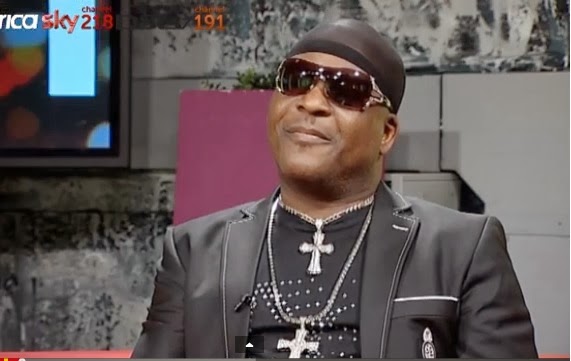
I consider it a great privilege to count Shina Peters, the Afro-Juju maestro, who turns 60 this week, as one of my friends and brothers. Dele Momodu has already penned a short tribute in his honour and a committee of friends is planning a day of tributes to coincide with his birthday on May 30. Shina Peters deserves to be celebrated, honoured and serenaded for his contribution to the arts, his place in Nigerian music, his originality and his humanism. I met Shina Peters in those early days of becoming.
I was a graduate student at the University of Ibadan and sitting through classes in musicology taught by Esi Kinni Olusayin, one of our teachers in the team-teaching component of Theatre Arts Theory and Criticism, I had begun to take a special interest in that aspect of criticism and the ethnographic accent that Nigerian-American Ms Olusayin placed on it. Now, ethno-musicology is not a joke, but what is relevant in this piece is how I developed interest in the study and the critical analysis of music. And it just happened that I wrote in those days very actively for the Nigerian press – Daily Sketch – where I did book reviews, almost weekly, Nigerian Tribune where I also wrote reviews and essays, The Times Literary Supplement anchored first by Afam Akeh and later Dapo Adeniyi, and of course the seminal Guardian Literary Series anchored by Ben Tomoloju where literature was promoted and rigorous intellection was allowed, and The Guardian opinion pages where the most serious debates in the country were conducted in a very serious manner by the country’s best and brightest.
When Chinua Acehbe writes that there was once a country, there was indeed once a country – a country where talent flourished, where the town enriched the gown and vice versa and indeed, where it was not a sin to subdue the consciously material life and seek things of the elevated mind. It was in that context that I met Shina Peters. My childhood friend, Kayode Ajala, was the editor of Hints magazine. He and Dele Momodu were the youngest editors in Nigerian journalism at the time. Our boss at Hints magazine where I was Contributing Editor was Dr. Ibe Kachikwu. Hints was a romance magazine, indeed that magazine reinvented romance journalism in Nigeria.
When Kachikwu was not attending to his daily job as a legal adviser in Mobil, he joined us at Hints, to produce a magazine that became a bestseller in Nigerian higher institutions. We were a great team because there was no publisher-staff relationship. Dr, as we called him was part of the team. He wrote columns and stories like everyone else. He joined in the proof-reading of stories. He took an interest in everything, and even joined us in the staff canteen. He was our mentor. Hints magazine was about journalism but it was also family, a significant event in the lives of everyone who worked there. It is not an accident that the magazine produced quite a number of superstars- Chidinnma Awa-Agu, Amaka Obiofuma, Hetty Ajayi, Onah Dike, Ekerete Udoh, Kayode Ajala, Chim Newton, Toni Kan Onwordi, Helon Habila, Peter Nkwoche and so on.
Then Shina Peters happened. No, scratch that. He emerged. He evolved. In 1989, Shina Peters released an album which he titled Ace (Afro—Juju series 1). It was not his first foray into music. He started music at a very young age, music being the only thing he had ever done in his life. He served apprenticeship under Chief Ebenezer Obey and later joined General Prince Adekunle’s band where he learned to play the guitar and the piano and sing. He was the superstar of the Adekunle band: young, but dexterous on the guitar and the piano. Artists are peripatetic spirits: they listen only to the Muse that controls them. The Muse that guides every artist is unique. The muse is transcendental.
Shina Peters soon left General Prince Adekunle and he teamed up with a colleague of his, Segun Adewale to form a band that was known as Sir Shina Adewale and the Superstars International. It was a case of talent meeting opportunity; the partnership was electrifying; this combination of talent in a formal sense was perhaps the first of its type in the history of juju music in Nigeria. Students of business partnerships would find in the Sir Shina Adewale example a useful case study in why partnerships fail in Nigeria or generally in business. In the course of a study of the Odutola brothers, which produced a co-authored book with my colleague and friend, Sesan Ajayi, a book that was commissioned by General Olusegun Obasanjo as he then was, we had observed that even biology does not mitigate the challenges of partnership. In the Shina Adewale case, the partnership produced extremely beautiful music: nine albums in all and all masterly experiments in sound, meaning and entertainment. Segun Adewale led the vocals; Shina Peters anchored the instrumentation. The two friends soon fell apart, and that was a tragedy for Nigerian music. Both men could not manage their success and their ego. Sir Shina Adewale remains a lost opportunity in Nigerian music and a bad script in the study of business partnership. The two men took juju music beyond the tradition already established from Roy Campbell to Ebenezer Obey and Sunny Ade, and then ruined it.
Shina Peters put into the partnership his mastery of instrumentation; melody and the rhythmic blend. Segun Adewale brought a rich, seductive, soulful voice that fitted naturally into Shina’s style, all laced with rich philosophy – a striking and intimidating combination of Ebenezer Obey, Prince Adekunle and Sunny Ade. If both had remained together, they would both have emerged as the best thing that ever happened in juju music. But they blew it. I don’t want to take sides. But Shina Peters’ position is that Segun Adewale eventually began to think that he was the secret of the team’s success. It is perhaps Karmic that Segun Adewale practically vanished along the line, after the break up, and that Shina Peters evolved, even if I consider his collaboration with Segun Adewale, the most original phase of his career, and a significant moment in the evolution of juju music.
Shina Peters evolved through Ace, and that was the point at which we met. When the album titled Ace was released in 1989, there had been nothing like it, before it, or after it. Ace was not exactly juju – Shina Peters named it Afro-juju, to be interpreted in this analysis as a medley, a fusion, hitherto unseen, of rhythm, syncopation, polyphony and dance with a touch of meta-spatial incandescence. This originality probably explains the popularity of the album. It was not just music; it was music as meaning, as psycho-motor, spatial, kinetic exploration, a combination of man and notes in the interrogation of sense and emotion. Both men and women latched on to every element of that album. Something new had happened again in the juju arena and the public could not have enough of it. Juju music is ordinarily sedate, more of sense than instrumentation and kinetics, but Shina Peters blended it all; he stretched the limits of the genre, he did to juju music what Fela did to highlife. Ace won double Platinum.
Shina Peters became a phenomenon. He sold newspaper copies. Hints magazine unleashed us on him. Dr Kachikwu wanted every possible story on this phenomenon. Kayode Ajala had a supply of status cars. Money was also not our problem. He and I followed Shina Peters everywhere. We became his friends and brothers. It was during this period that I knew the likes of Segun Awolowo (met him earlier in Ogun State University), Femi Otedola (then of Impact Press in Mushin), Lanre Tejuoso, Kweku Tandor, Abayomi Jolaoso, Dotun Olaribigbe (Lobito Disco), Dele Momodu, Mayor Akinpelu, Gboyega Okegbenro, Kunle Bakare, Dayo Olomu, Wale Olomu, Wale Oluwaleyimu, Eko Round City (later Eko Kashoggi), a long list of society women, part of that routine of course also included nights in hotels, trips to clubs, joints, breakfasts in baby mamas homes and all of that. That was also when I learnt to drink beer – from a glass to half-bottle until I chose Star – Shine Shine bobo – as my favourite brand, and practically became a connoisseur. We sat behind the stage and encouraged Shina Peters and wrote stories. We followed him everywhere. Ajala and I eventually became a member of his inner circle. We could enter every room in his house. Shina Peters is an open, unpretentious artiste. He worshipped his parents. He was devoted to his wife, Sammie who also supported him with the fanaticism of a disciple. He loves what he does –music.
In those days, he invited us to listen to his albums before they were released. After Ace and Shinamania however, Shina Peters could no longer reproduce the magic of the moment that brought him to international limelight. I may be wrong, but I attribute this to his departure from Sony Music. Art is essentially collaborative. It is an ensemble enterprise. When a critical link disappears, the implications may be far-reaching. The Sony Music team of Mrs Keji Okunowo, Laolu Akins, Tony Alenkhe provided a natural home for Shina Peters’ talent. His exit from that home robbed him of the necessary support to fill the vacuum that had been created by the illness that took Sunny Ade out of the scene for a number of years. Sunny Ade’s return and Shina’s exit from Sony music changed the game.
As someone who can claim to know Shina Peters, off and on the scene of play, I state that there are many lessons that younger musicians can learn from his career and experience. My last major piece on music in Nigeria attracted very emotional responses from young Nigerian musicians. I predicted at the time that many of those egoistic and noise-making musicians would eventually end up as complete nobodies and that only artists of real talent would survive. I believe I have been proven right. Music is not noise, it is about meaning. It is about ability, talent and relevance. Shina Peters continues to remain relevant because he is a man of true talent. His staying power is the product of his professionalism and his ability to reinvent himself. His commitment to the juju genre is impressive. In those days, he actively encouraged younger musicians particularly Dele Taiwo, and other younger juju musicians.
He can be sensitive, nervous about competition, and often insecure, but he has no doubts about his talents and capabilities. This is the source of his strength and staying power. He may not have produced any other platinum music for a while, but he has done much better than his contemporaries in the face of the competition of the musical genres: in the past it was juju vs. fuji, now the landscape is much wider and the competition is much stiffer than can be possibly imagined. When we eventually do a stock-taking of the evergreens in Nigerian music, Shina Peters and his oeuvre will certainly be close to the top of the list. That at 60, he already has an assured place among the masters is a remarkable achievement and on that I congratulate him. Star! SSP! Happy birthday, sir.
II. Kunle Ajibade at 60: A life in Journalism
Kunle Ajibade is also 60. He turned 60 on May 28. I really don’t know what to say about this one. He cannot sing. He does not dance. He does not smoke. He does not drink. He does not know how to steal or cheat. I have known him for about 30 years and I have never caught him with a girlfriend or a side chick other than his wife. He has very naughty friends like me but he has refused to allow our shortcomings to rub off on him. I have never heard of any scandal about him, really. He has never raised his voice in anger in my presence either. He is generally known as a gentleman and that is who he is – a humanist and a gentleman. Kunle Ajibade is the author of two books- Jailed for Life and What a country! And a patriot – With all that this country has done to him, he and his wife have refused to quit or give up.
He was jailed for life by the Abacha government for an offence he never committed. He was not even the one they were looking for, he just happened to be in the office and they took him. Providence came to his rescue and he has never complained since then. Kunle Ajibade is a special breed. I admire him for his strength of character, his intellect, simplicity, and self-discipline. What connects us is his intellect.
When it comes to matters of the intellect, Kunle Ajibade is that man who will tell you as it is. He writes well. He speaks well. Cant or authority do not impress him. He is above all, a fine journalist, a bibliophile, and one of the most courageous in our generation. Ex-Guardian, ex-African Concord and one of the founders of The News and Tempo magazines, Kunle Ajibade is an icon of the journalism profession in Nigeria. Congratulations my brother. Didn’t know you were older; now I have to call you Broda Kunle. Many happy returns, Broda mi, and to Madam – thank you and thank you for standing by this man through thick and thin.
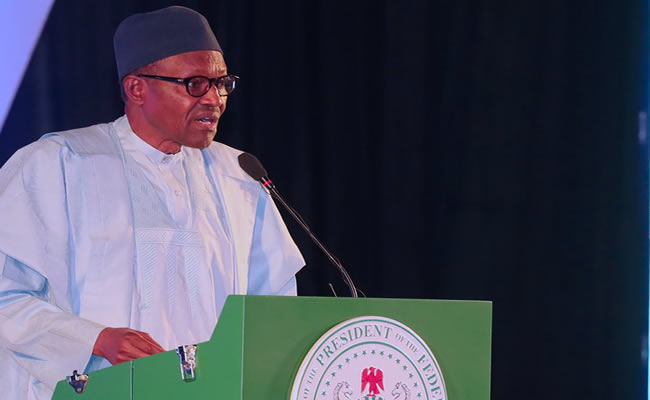
PRESIDENT MUHAMMADU BUHARI (L), PRESENTING THE 2016 APPROPRATION BILL TO A JOINT SESSION OF THE NATIONAL ASSEMBLY IN ABUJA ON TUESDAY (22/12/15).
A Federal High Court sitting in Lagos has ordered President Muhammadu Buhari to commence the prosecution of the principal officers of the National Assembly over the alleged padding of the 2016 national budget in which about N481 billion was stolen. The court, in a landmark Judgment today, Tuesday, ordered the President to “urgently instruct security and anti-corruption agencies to forward to him reports of their investigations into the matter.
The Court also ordered President Buhari to “direct the Attorney General of the Federation and Minister of Justice Abubakar Malami, SAN, and/or appropriate anti-corruption agencies to without delay commence prosecution of indicted lawmakers.”
The judgment was delivered yesterday by Justice Mohammed Idris following a mandamus suit no: FHC/L/CS/1821/2017 brought by Socio-Economic Rights and Accountability Project (SERAP).
The Court also ordered President Buhari to “direct the publication of the report of investigations by security and anti-corruption bodies into the alleged padding of the 2016 budget.”
In the suit brought against the President of Nigeria and the Attorney General of the Federation and Minister of Justice, Justice Idris further held that President Buhari in the exercise of his executive powers has a duty to ensure compliance with the provisions of article 22 of the African Charter on Human and Peoples’ Rights, holding further that Buhari is “expected to use his executive powers for the public good of Nigeria.”
Article 22 of the African Charter provides that, “All peoples shall have the right to their economic, social and cultural development with due regard to their freedom,” and that “States shall have the duty, individually or collectively, to ensure the exercise of the right to development.”
The Court also granted an order directing Buhari to “Urgently halt alleged attempt by some principal officers of the National Assembly to steal N40 billion of the N100 billion allocated by his government as ‘zonal intervention’ in the 2017 budget.”
Buhari is also ordered “to closely monitor and scrutinize the spending of N131 billion (accrued from increased oil bench mark) allocated for additional non-constituency projects expenditure, to remove the possibility of corruption.”
The Court held that “SERAP, being a human rights non-governmental organization has sufficient interest in the way and manner public funds are being utilized in this country.”
SERAP deputy director Timothy Adewale said: “This judgment confirms the pervasive corruption in the budget process and the prevailing culture of impunity of our lawmakers as well as the failure of the authorities to uphold transparency and accountability in the entire budget process and implementation. The judgement is an important step towards reversing a culture of corruption in the budget process that has meant that many of our lawmakers see the budget more as a ‘meal ticket’ to look after themselves than a social contract to meet people’s needs and advance equity and development across the country.”
“This is a crucial precedent that vindicates the right to a transparent and accountable budget process and affirms the budget as government’s most important economic policy document, which is central to the realization of all human rights including the rights to health, water, and education. We are now in the process of obtaining a certified copy of the judgment. SERAP will do everything within its power to secure the full and effective enforcement of this important judgment.”
It would be recalled that SERAP last year filed the suit after the organization said it received “credible information from multiple sources that the Department of State Services (DSS) and the Economic and Financial Crimes Commission (EFCC) have completed investigations into the allegations of padding of the 2016 budget, completed their reports, and indicted some principal officers of the House of Representatives and the Senate, and that the accounts of some of the principal officers containing allegedly illicit funds have been frozen, and that the case files for the prosecution of those indicted were ready.”
The suit filed on SERAP’s behalf by its counsel Mrs Joke Fekumo read in part: “Unless the principal officers indicted in the alleged padding of the 2016 budget are prosecuted and any stolen public funds recovered, the Federal Government will not be able to stop padding of future budgets. Alleged corruption in the budget process will not just melt away or simply evaporate without addressing the fundamental issue of impunity of perpetrators.”
“Addressing alleged corruption in the budget process by pursuing prosecution of indicted principal officers of the National Assembly will provide an important opportunity for the Federal Government to reignite the fight against corruption and fulfil a cardinal campaign promise, to show that the Federal Government works on behalf of the many, and not the few, as well as jumpstart economic activities and break the back of the recession.”
“Publishing the report of the investigation of the alleged padding of the 2016 budget, and prosecuting suspected perpetrators are absolutely important to avoid another padding, which the Federal Government can ill afford.”
“The allegations of crime of budget padding against the indicted principal officers of the National Assembly is a gross deprivation of the good people of Nigeria’s legitimate wealth and natural resources. We respectfully urge your Lordship to hold that the citizens of Nigeria have been deprived of their natural wealth and the indicted principal members be prosecuted by the Minister of Justice and Attorney-General of the Federation.”
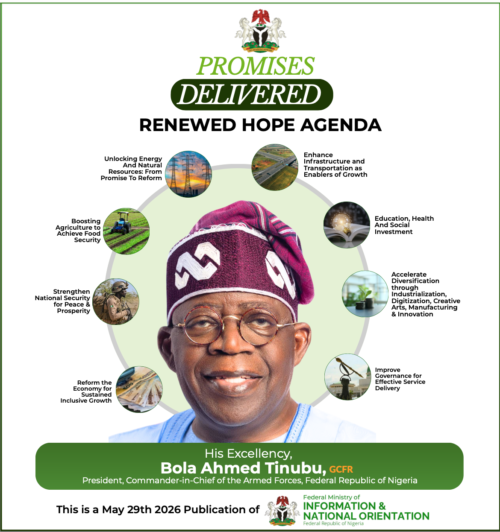
President Muhammadu Buhari has sworn that he and his team have been able to bring the change he promised Nigerians before he was elected in 2015.
He explained that his governmentcame at a time that Nigerians needed Change, saying: “the Change we promised and the Change we continue to deliver. We have faced a lot of challenges on this journey and Nigerians have stood by us in achieving the three cardinal points of this administration namely; Security, Corruption and the Economy.”
President Buhari made the statements in a nation-wide radio and television broadcast to mark Democracy Day today, May 29th.
Full text of the broadcast is reproduced here:
My Dear Nigerians!
Today marks the 19th year of our nascent democracy and the 3rd Anniversary of this administration. I am thankful to Almighty God for bringing us thus far. This administration came at a time that Nigerians needed Change, the Change we promised and the Change we continue to deliver. We have faced a lot of challenges on this journey and Nigerians have stood by us in achieving the three cardinal points of this administration namely; Security, Corruption and the Economy.
The commemoration of this year’s Democracy Day is a celebration of freedom, a salute to the resilience and determination of Nigerians and a recommitment by Government to keep its promise to lead Nigeria into a new era of justice and prosperity.
Public safety and security remains the primary duty of this Government. Before this Administration came into being 3 years ago, Boko Haram held large areas of land spanning several Local Governments in the North East.
Today, the capacity of the insurgents has been degraded leading to the re-establishment of authority of government and the release of captives including, happily, 106 Chibok and 104 Dapchi girls, and over 16,000 other persons held by the Boko Haram.
In order to minimize the impact of the insurgency on Internally Displaced Persons, Government has established secure IDP Camps and has improved the mechanism for the distribution of basic aid, foods and essential commodities using various strategies in collaboration with local and international Organizations.
Efforts are in process for resettlement of IDPs in their home communities by providing schools, hospitals, clinics, water and sanitation to facilitate a quick return to economic activities. Government is similarly implementing de-radicalization and rehabilitation programmes to facilitate sustainable peace and development.
The unfortunate incidences of kidnappings, herdsmen and farmers clashes in several communities which have led to high number of fatalities and loss of properties across the country is being addressed and the identified culprits and their sponsors shall be made to face the full wrath of the law. All the three tiers of Government are presently engaged with communities and religious organizations to restore peaceful co-existence among Nigerians.
I want to commend members of the Multinational Joint Task Force drawn from Niger, Benin, Chad, Cameroon and our own country in collaboration with the International Community who are assisting in the fight against insurgency in the North East. I also commend the gallantry of members of our Armed Forces and other security agencies that have continued to provide security for lives and properties across the country. State and Local traditional authorities are helping with much needed intelligence in this fight against insurgency.
This administration is pained over the grievous loss of lives and properties occasioned by the carnage of insurgency and other forms of criminality in the country. I wish to assure Nigerians that we will not rest until all criminal elements and their sponsors are brought to justice. Government is boosting the capacity of our security agencies through recruitment of more personnel, training and procurement of modern equipment, enhancement of intelligence gathering as well as boosting their morale in the face of daunting challenges.
The Niger Delta Region has enjoyed relative peace through social inclusiveness and cooperation of the Elders and the good people of the region. Government is committed to implementing the comprehensive peace, security and development plan for the region. The environmental clean-up of the region which commenced with the launch in Bodo, Ogoni in June, 2016 is progressing satisfactorily. Furthermore farming assets are being revived and investors in cocoa and palm oil plantations are showing serious interest.
The second primary object of this Administration is to fight corruption headlong. Like I have always said, if we don’t kill corruption, corruption will destroy the country. Three years into this Administration, Nigerians and the international community have begun to applaud our policies and determination to fight corruption. We are more than ever before determined to win this war, however hard the road is. I therefore appeal to all well-meaning Nigerians to continue to support us in this fight.
Various policy measures already put in place to stem the tide of corrupt practices are yielding remarkable results. Some of these key reform policies include:
a. The Treasury Single Account (TSA) has realized Billions of Naira being saved from maintenance fee payable to banks. N200 Billion has also been saved from elimination of ghost workers in public service.
b. The Whistle-Blowing Policy has helped to recover over N500 Billion;
c. The Presidential Initiative on Continuous Audit set up with a mandate to validate controls, assess risks, prune personnel costs, ensure compliance with Public Financial Management reforms has helped to identify and remove over 52,000 ghost workers from the Federal Government MDAs Payroll;
d. The Voluntary Asset and Income Declaration Scheme (VAIDS) aimed at expanding tax education and awareness has offered the opportunity for tax defaulters to regularise their status in order to enjoy the amnesty of forgiveness on overdue interest, penalties and the assurance of non-prosecution or subject to tax investigations.
e. The Sovereign Wealth Fund project portfolio has been expanded with an injection of US$650 million so as to strengthen its investment in local infrastructure, power, health, re-construction of Abuja-Kano road, Lagos-Ibadan Expressway, East West Road (Section V) and the Mambilla Hydro-electric Power project as well as the construction of the 2nd Niger Bridge.
The fight against corruption through the Economic and Financial Crimes Commission and the Independent Corrupt Practices and Other Related Offences Commission has resulted in recoveries of Billions of Naira, as well as forfeiture of various forms of assets. This alongside other efforts has improved Nigeria’s international image and regional cooperation.
We have retained the services of one of the world’s leading assets tracing firms to investigate and trace assets globally. This is in addition to the exploitation of provisions of existing Treaties, Conventions as well as Bilateral Agreements with Multilateral bodies and Nations. Nigeria has also signed Mutual Legal Assistance Agreements to ensure that there is no hiding place for fugitives.
This Administration has therefore focused on revamping the ailing economy it inherited in 2015. In 2016, Government executed an expansionary budget and developed the Strategic Implementation Plan. For the first time, 30% of the budget was earmarked for capital expenditure which represents an upward review when compared with the 2015 budget. The SIP was followed by the development of a comprehensive medium term plan – the Economic Recovery and Growth Plan 2017 – 2020.
The broad strategic objectives of the ERGP were to; Restore and sustain economic growth; Build a globally competitive economy; and Invest in our people. The implementation of the ERGP has started yielding results. The National Bureau of Statistics reports that the economy grew by 1.95% in 1st quarter 2018, which is a good performance when viewed against -0.91 in 1st quarter 2017 and -0.67% in 1stquarter 2016 respectively.
Our foreign reserve has improved significantly to 47.5 billion USD as of May, 2018 as against 29.6 billion USD in 2015. The inflationary rate has consistently declined every month since January, 2017.
Recently, Government conducted Focus Labs in three key sectors of the Economy namely, Agriculture & Transport, Manufacturing and Processing as well as Power and Gas. These have yielded significant prospects for investments and Job creation to the tune of US$ 22.5 billion with a potential for creating more than 500,000 jobs by 2020. These investment generation initiatives are expected to increase capital inflows in the form of foreign direct investment. There is a high prospect that the cumulative investments from this first phase of the Labs will hit US$39.2 billion by 2025.
Under agriculture, Nigeria continues to pursue a strategic food security programme built around self-sufficiency and minimization of import dependency. As a result, rice importation from other countries has been cut down by 90% which has a direct impact on foreign reserves.
The Social Investment Programmes (SIP) has been created as a means to graduating our citizens from poverty through capacity building, investment and direct support. The major strategic objective is to restore livelihood, economic opportunities and sustenance for the poor across the country. The SIP programmes and projects include:
a. Home Grown School Feeding Programme – About 8.2 million pupils are currently being fed from 24 States of the Federation with over 75,000 Catering Staff engaged under the programme.
b. The Conditional Cash Transfer has so far recorded over 297,000 caregivers and being trained by 2,495 Community Facilitators in 21 states. Less privileged Nigerians are now being paid N5,000 monthly stipend in 9 pilot States of Bauchi, Borno, Cross River, Ekiti, Kwara, Kogi, Niger, Osun and Oyo. Eventually the scheme will cover all the 36 states of the federation including the FCT.
c. Under the Government Enterprise Empowerment Programme – About 264,269 loans had been disbursed to 4,822 societies in the 36 States and FCT, while another 370,635 are awaiting release of funds.
d. N-Power Job creation Scheme – is targeted at providing jobs for unemployed young graduates and has so far recruited 200,000 youths while the next batch of 300,000 have been selected, verified and would soon be deployed across the 36 States and the FCT. Furthermore, 20,000 non-graduate volunteers have also been selected to kick off the N-Build programme in collaboration with the National Automotive Design and Development Council and the Council of Registered Builders of Nigeria.
In the area of power generation, Nigerians from all parts of the country continue to report better power supply and less use of generators. This underscores the effectiveness of the methodical plan to deliver incremental and uninterrupted power supply to our homes, markets, offices and factories.
The country achieved 5, 222.3 MW representing the highest peak of power generated onto the national grid and delivered to customers in December, 2017. With new facilities, repairs and rehabilitations by Government and private investors, generation capability now exceeds 7,500 MW.
This Administration is committed to lawful interventions to ensure the operators of the distribution business live up to expectations especially in the areas of distribution capacity, service delivery, collection efficiency, and metering to eliminate contentious estimated billing.
The Transportation Sector continues to undergo a series of reforms in order to sustain the international best practices and ensure safety and security. The nation’s major airports have witnessed reconstruction of runways, installation of navigational equipment and new international terminals due for commissioning in Abuja, Lagos, Kano and Enugu. Bilateral Air Services Agreements between Nigeria and the Governments of other countries will significantly open up new flight routes.
As a result of strict regulatory and compliance policies, Nigeria retained her Federal Aviation Administration (FAA) Category 1 status, after a routine international audit. Recently, a new Maintenance Repair and Overhaul facility with capacity for aircraft C-checks and other comprehensive levels of maintenance was established in Lagos. This would save the country an estimated $90m annually.
Giant strides have been recorded over the past three years to improve road transport infrastructure in all geopolitical zones of the country.
The Railway Sector has also received tremendous attention as this Administration is committed to the goal of linking all State capitals in the Federation by rail network to ease the movement of goods and passengers.
The Education Sector especially at tertiary level has continued to witness expansion in order to improve access to higher education by millions of youths in Nigeria. Over the last three years, Government has approved the establishment of 1 new Federal Polytechnic, granted licenses for the establishment of 4 State and 14 private-owned Universities as well as 12 private Polytechnics.
Government has also continued to support the implementation of various initiatives aimed at improving the quality of Basic Education delivery. Thus, it has ensured proper funding at the Basic Education level with the disbursement of N42.2 billion UBE Matching Grant to 26 States and the FCT, N851.5 million Special Education Grant disbursed to 23 States and private providers of Special Education and N2.2 billion Teachers Professional Development Fund to 33 States and the FCT.
The Federal Government has continued to support fiscal sustainability at the sub-national governments through the implementation of the Budget Support Facility which was accompanied by the 22- point Fiscal Sustainability Plan. Thus, bailouts funds were made available to States to ease their fiscal challenges and other obligations including payment of salaries.
In addition, a total of 73 Ecological Fund projects for the control of gully erosion in different communities across all geopolitical zones have been completed in the last three years and are undergoing commissioning while 53 other projects are ongoing. The execution of these projects has generated 357 skilled jobs and 1,350 unskilled jobs during this period.
It is pertinent to also make mention of the immeasurable contributions of the Nigerian woman to national development and advancement of democracy, over the last three years. The government and people appreciate you all as mothers of our great country.
My dear country men and women, as we all celebrate our democratic experience, let us resolve to avoid hatred and intolerance; we can only achieve our objectives in an atmosphere of harmony and peaceful co-existence.
Finally, the up-coming months will usher us into another season of general elections. Let me use this opportunity to urge us all to conduct ourselves, our wards and our constituencies with the utmost sense of fairness, justice and peaceful co-existence such that we will have not only hitch free elections but also a credible and violence free process.
In few days to come, I will be joined by many promising young Nigerians to sign into law the “Not Too Young to Run” Bill
I thank you for your attention. God bless the Federal Republic of Nigeria.
Nigerian Health workers, under the umbrella of the Joint Health Sector Union (JOHESU) have made it clear that they would not call off the strike and go back to work despite the court injunction, until the Federal Government implement certain agreements reached between the two parties on September 30, 2017.
The News Agency of Nigeria (NAN) reports that the National Industrial Court (NIC) gave an order on May 25, 2018, compelling JOHESU to call off the strike, which began on April 18.
However, JOHESU members, at a peaceful rally organized by its national body in Abuja today, May 28, said that they would not be deterred by the court’s injunction compelling its members to return to work.
National Chairman of the union, Josiah Biobelemoye, said that the rally was aimed at updating members with current developments regarding the ongoing strike, including the recent court order.
Biobelemoye emphasized that the union had every right to obey or challenge the court order, adding: “I own members the responsibility to update them on happenings between us and the government to enable them to take a decisive position. And whatever they decide is final.
“We call on the government to implement our upward adjustment and other things as contained in the agreement of Sept. 30, 2017. No going back on the strike until those things are met’’ he said.
According to him, since the union embarked on the strike on April 18, the federal government had met with the leadership eight times.
Chairman of the Presidential Advisory committee against corruption (PACAC), Professor Itse Sagay has asked former President Olusegun Obasanjo to allow Nigeria to rest.
“He (Obasanjo) got two terms and then wanted a Third Term. Nobody killed him for it even though that attempt failed woefully. So, I think Obasanjo should allow Nigeria to rest. He should give Nigeria peace. He should just go to his house and leave us alone. We have had enough of him.”
In an interview with Independent, Professor Sagay accused Obasanjo of being on ego trip, saying: “he has to be the President-General forever. He is always envious of anyone who came in after him. He has to interfere to be relevant and you must allow him preside over the presidency otherwise there will be no peace.
“He didn’t allow Yar’Adua to rest; he didn’t allow Jonathan to rest now it is the turn of Buhari. I think this tendency of putting your hands in the eyes of those who succeeded you really has to be stopped. His shenanigans have to be stopped.
“He went to Afenifere, a group he has had nothing to do with for years for support. He has formed some artificial party ADC and all sorts of ridiculous associations thinking he can destabilise this government when he was allowed a free reign as president.”
The Presidential aide asked: “how many times has Yakubu Gowon under whom Obasanjo served as a military officer criticized anybody? I am sure when he has anything to say he will go quietly. How many times has Abdulsalami Abubakar criticized anybody? Even Ibrahim Babangida was quiet before, respecting himself until Obasanjo started pushing and egging him to speak. You could see it wasn’t natural with Babangida coming out to attack a successor.” [myad]
We use cookies on our website to give you the most relevant experience by remembering your preferences and repeat visits. By clicking “Accept”, you consent to the use of ALL the cookies.
This website uses cookies to improve your experience while you navigate through the website. Out of these, the cookies that are categorized as necessary are stored on your browser as they are essential for the working of basic functionalities of the website. We also use third-party cookies that help us analyze and understand how you use this website. These cookies will be stored in your browser only with your consent. You also have the option to opt-out of these cookies. But opting out of some of these cookies may affect your browsing experience.
Necessary cookies are absolutely essential for the website to function properly. This category only includes cookies that ensures basic functionalities and security features of the website. These cookies do not store any personal information.
Any cookies that may not be particularly necessary for the website to function and is used specifically to collect user personal data via analytics, ads, other embedded contents are termed as non-necessary cookies. It is mandatory to procure user consent prior to running these cookies on your website.