President Muhammadu Buhari has described a Kano Islamic scholar and billionaire businessman, Alhaji Isyaku Rabiu, who died in London yesterday, Tuesday, after a brief illness as a honest investor and rear scholar in Islam.
“No tribute can do justice to the amazing virtues of Isyaku Rabiu in view of his vast contributions to scholarship, industrial investments and development in the country.”
In a condolence message issued by his senior special assistant on media and publicity, Malam Garba Shehu, President Buhari noted that the late Isyaku Rabiu possessed remarkable qualities of combining scholarship and vast business investments that created job opportunities for hundreds of people.
According to him, late Isyaku Rabiu attained success through honest labour and resourcefulness which helped him to achieve fame in life, saying: “such virtues are not common in the context of today’s realities where many resort to some other means to gain success.”
President Buhari advised the children of the deceased to build on the remarkable legacy of their father, reminding them that the best honour they could do to him is to live by his good examples.
In his tribute too, the former Nigeria Vice President, Atiku Abubakar said that the death of Khalifa Isyaku Rabiu has robbed Northern Nigeria and the nation of one of its greatest and most enterprising investors who rose to prominence by sheer dint of hard work.
According to Atiku: “Isyaku Rabiu’s successes and entrepreneurial spirit had motivated many younger Northern investors like myself who feel that, once you are resourceful, you can achieve success in every endeavour of life.
“Isyaku Rabiu didn’t attain success by mere luck, but used personal initiative to achieve his life’s goals.”
Atiku, who holds traditional title of Waziri Adamawa, noted that success is not for the timid or those who are afraid to take risks to achieve prosperity, even as he explained that Isyaku Rabiu was not only remarkable as a successful industrialist, but was also a great Islamic scholar who was widely respected. [myad]
Oil prices rose more than two per cent today, Wednesday, with Brent hitting a 3-1/2-year high, about 24 hours after the President of the United States of America, Donald Trump announced that he was pulling his country out of a nuclear deal with Iran. Trump had also announced the “highest level” of sanctions against the OPEC member.
Ignoring pleas by allies, Trump on Tuesday pulled the U. S. out of an international nuclear deal with Iran that was agreed in late 2015, raising the risk of conflict in the Middle East and casting uncertainty over global oil supplies amid an already tight market.
Brent crude oil futures at one point touched their highest since November 2014 at 76.75 dollars per barrel. They were still at 76.52 dollars per barrel at 0628 GMT, up 1.67 dollar or 2.2 per cent, from their last close.
U.S. West Texas Intermediate (WTI) crude futures were up 1.43 dollars per barrel, or 2.1 per cent, at 70.49 dollars a barrel, near highs also last seen in late 2014.
In China, the biggest single buyer of Iranian oil, Shanghai crude futures hit their strongest in dollar terms since they were launched in late May, above 73.20 dollars per barrel.
Analysts said the soaring prices were the result of an expected fall in Iranian oil exports.
“Iran’s exports of oil to Asia and Europe will almost certainly decline later this year and into 2019 as some nations seek alternatives in order to avoid trouble with Washington and as sanctions start to bite,” said Sukrit Vijayakar, director of energy consultancy Trifecta.
Iran re-emerged as a major oil exporter in 2016 after international sanctions against it were lifted in return for curbs on its nuclear program, with its April exports standing above 2.6 million barrels per day (bpd).
That made Iran the third biggest exporter of crude within the Organization of the Petroleum Exporting Countries (OPEC), behind Saudi Arabia and Iraq.
Walking away from the deal means that the United States will likely re-impose sanctions against Iran after 180 days, unless some other agreement is reached before then.
ANZ bank said Trump’s decision “puts into place a scenario that could see the crude oil market tighten significantly in H2 2018 and into next year”.
Several refiners in Asia told Reuters they were already seeking alternatives to supplies from Iran.
“There are worries that Iran’s oil exports could fall by about one million barrels per day (bpd) from current levels,” said Tomomichi Akuta, senior economist at Mitsubishi UFJ Research and Consulting in Tokyo.
“The oil supply/demand balance is roughly in balance now, but it could turn to a complete supply shortage (in case of new supply curbs).
“Oil prices could rise at least 10 dollars (a barrel), with Brent approaching near $90,” Akuta said.
All key crude oil futures contracts saw traded volumes jump as speculators took on new positions in the hope of profiting from rising prices, and as refiners hedged to protect themselves from higher feedstock oil prices.
Stephen Innes, head of trading for Asia-Pacific at futures brokerage Oanda in Singapore, said the climb in traded crude futures volumes was so high it was “causing clearing delays”.
Trying to ease market concerns, Saudi Arabia today, Wednesday said that it would work with other producers to lessen the impact of any shortage in oil supplies.
The country has been leading efforts since 2017 to withhold production to prop up prices.
The Sultan of Sokoto, Alhaji Muhammad Sa’ad Abubakar has expressed worry over what he called hateful development amongst politicians in Kaduna State and called for immediate stop to it. He called on such politicians to focus on promoting democracy in preparation for the 2019 general elections.
The Sultan, who spoke today, Tuesday, in an address to mark the Annual Pre-Ramadan lectures, organized by the Jama’atul Nasirul Islam (JNI) in Kaduna lamented the attitude portrayed by politicians in the State, describing it as worrisome and disturbing.
“The attitude of politicians is becoming worrisome and disturbing; especially what is happening in Kaduna should stop. Kaduna politicians should close their ranks and stop the hate speech because Kaduna is key to the survival of the region.”
Sultan Sa’ad also called for caution on the use of social media among the people, as politicians would do everything to promote religious, tribal, ethnic sentiments. [myad]
A Kano businessman and Islamic scholar, Khalifa Sheikh Isyaku Rabiu is dead. Report reaching us now, Tuesday night, said that Sheikh Isiyaku died after a brief illness in the United Kingdom. He was aged 93 (from 1925 to 2018)
A business Associate who confirmed the news to the News Digest said he will be buried according to Islamic rites as soon as his body arrives in Nigeria.
Sheikh Isyaku founded a major family operated holding company with a history of investment in manufacturing, insurance, banking and real estate.
In the 1970s, the group invested in manufacturing with its first investment being the Kano Suit and Packing Cases company, a factory producing suit cases and handbags. The firm was a joint venture with Lebanese investors.
In 1972, he formed the Bagauda Textile Mill, manufacturing woven cloths for uniforms. From then on he established a series of ventures in different segments of the economy including frozen food service, real estate, sugar and a motor vehicle and parts distribution company specialized in Daihatsu products. However, unfavourable exchange rates and economic conditions forced the company to scale back on manufacturing and returning to its trading roots.
He had a large family with many children and grandchildren, including his first son, Nafiu Rabiu; influential Nigerian businessmen, Abdulsamad Rabiu, Chairman of BUA Group; Rabiu Rabiu, owner of IRS Airlines, Naziru Rabiu, Quraish I Rabiu, Makiu Rabiu, Abdullahi Rabiu, Muhammad Rabiu and Daha Rabiu among others.
He lived in the biggest single mansion in kano. He was widely loved and respected and known for his generosity and Islamic spirituality. [myad]
The Senior Pastor at Worksword of God Church, Pastor Gabriel Adegboye, has predicted that he will be elected President of Nigeria in the 2019 election even as he claimed that President Muhammadu Buhari is destined to serve as President four years.
The Pastor, who addressing journalists in Ibadan, the Oyo State capital, over the weekend, said that he has the spiritual impartation of resolving the killings in the North-East and other parts of the country, as well as ensuring economic development in Nigeria.
He described Boko Haram as a spiritual attack on the country from North Africa.
“God sent me to become the next president of Nigeria. Over the years, God has been speaking to me and I have been communicating to past presidents, even the incumbent president, concerning the way to resolve the crisis in the country and ensure economic development. God has given me the new agenda for this country.
“We have all it takes to take the presidential seat come 2019. God has revealed to me that the tenure of President Muhammadu Buhari is only four years. And the next person that will take over the mantle of leadership is Pastor Gabriel Adegboye.
“If the Federal Government needs solution to the challenges in the country today, if I am invited, I promise that within three months, there will be peace in the North-East.” [myad]
President Donald Trump has described the American nuclear deal which the government of Barak Obama entered into with Iran as a horrible one-sided deal that should have never, ever been made, even as he pulled the country out of the deal.
Trump said: “this was a horrible one-sided deal that should have never, ever been made,” Mr. Trump said at the White House in announcing his decision. “It didn’t bring calm, it didn’t bring peace, and it never will.”
In announcing the withdrawal from the deal today, Tuesday, President Trump made clear that his patience with the deal had worn thin.
As a result of the withdrawal, the United States is now preparing to reinstate all sanctions it had waived as part of the nuclear accord, and impose additional economic penalties as well.
The withdrawal fulfills one of President Trump’s oft-repeated campaign promises, and came despite intense personal lobbying by European leaders and frantic attempts to craft fixes to the deal that would satisfy him.
President Trump’s announcement, though long anticipated and widely telegraphed, is believed to be capable of plunging America’s relations with European allies into deep uncertainty.
Trump’s decision capped a frantic four-day period in which American and European diplomats made a last-ditch effort to bridge their differences and preserve the agreement.
On Friday, Pompeo called his counterparts in Europe to tell them that Mr. Trump was planning to withdraw, but that he was trying to win a two-week reprieve for the United States and Europe to continue negotiating.
Pompeo, people familiar with the talks said, suggested that he favored a so-called soft withdrawal, in which Mr. Trump would pull out of the deal but hold off on reimposing some of the sanctions.
On Saturday, the State Department’s chief negotiator, Brian Hook, consulted with European diplomats to try to break a deadlock over the so-called “sunset provisions,” under which the restrictions on Iran’s ability to produce nuclear fuel for civilian use expire after 15 years.
The Europeans had already agreed to a significant compromise: to re-impose sanctions if there was a determination that the Iranians were within 12 months of producing a nuclear weapon. But officials said that still did not satisfy Mr. Trump, and the Europeans were not willing to go any farther.
By Monday, the White House began informing allies that Mr. Trump was going to withdraw from the deal and re-impose oil sanctions and secondary sanctions against the Central Bank of Iran.
Trump has also instructed the Treasury Department to develop additional sanctions against Iran, a process that could take several weeks.
Under the financial sanctions, European companies will have between 90 days and 180 days to wind down their operations in Iran, or they will run afoul of the American banking system. The oil sanctions will require European and Asian countries to reduce their imports from Iran.
The Central Bank of Nigeria (CBN), has once more boosted the inter-bank Foreign Exchange market with another sum of $210 million.
The Bank again offered the sum of $100 million to authorized dealers in the wholesale segment of the market. The Small and Medium Scale Enterprises (SMEs) segment received the sum of $55 million while the sum of $55 million was apportioned to invisibles such as tuition fees, medical payments and Basic Travel Allowance (BTA).
A statement from the Bank’s Acting Director, Corporate Communications Department, Isaac Okorafor, said that the apex bank is determined and has the capacity to continue to sustain the foreign exchange intervention.
Okorafor advised authorized dealers to help sustain the confidence in the foreign exchange market by continuing to honour requests from customers with genuine needs.
It will be recalled that the Central Bank of Nigeria last Friday, May 4, 2018 intervened in the Secondary Market Intervention Sales (SMIS) to the tune of $349.34m.
Meanwhile, the Naira has continued to maintain its stability in the FOREX market, exchanging at an average of N362/$1 in the BDC segment of the market today, Tuesday. [myad]
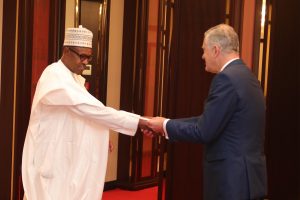
President Muhammadu Buhari, today, Tuesday, receives Letter of Credence from the Ambassador of Lebanon to Nigeria, Houssam Diab at the Aso Rock Presidential Villa before he embarked on his scheduled trip to the UK for medical checkup… Photo by Sunday Aghaeze. [myad]
The Petroleum Act 1969 (as amended) grants powers to the Ministry of Petroleum, acting through the Department of Petroleum Resources (DPR) to administer the licensing of oil blocks in the country. These include Oil Prospecting Licence (OPL), Oil Mining Licence (OML) and Oil Exploration Licence (OEL), which allow the awardees, local and foreign, to explore for and develop oil and gas resources within the country. So far, there are 65 OPLs and 99 OMLs. The last round of licensing bids was conducted in 2007. Of the existing awarded oil blocks and marginal fields, the most controversial and the best known is OPL 245, which owes its fame specifically to the allegation of a missing $1.3 billion due to the Federal Government in what is known as the Malabu oil deal.
The main actors in the Settlement Agreement involving OPL 245 continue to insist that no Federal Government money is missing, and that indeed they deserve praise for civic patriotism, for saving the Nigerian Government from embarrassment and imminent loss of money and face, due to its mismanagement of the award process in the first place. Allegations of missing money are often translated into naked truth, in this season, without due reflection, and regard for the facts of the case. This is so, in this instance, because of reports of corruption involving and surrounding the OPL 245 transactions and foreign investors – Shell and ENI, into which the courts in the home jurisdictions of those companies are inquiring. Whereas this has dominated the narrative, it is important that we go beyond the politics of name-calling, victimization, blackmail and harassment that has developed around OPL 245 and focus on the big picture.
The oil and gas industry in Nigeria is opaque; it is one of the most difficult areas of our national life. The award of exploitation and exploration licenses raises questions of transparency and accountability. Section 2 of the Petroleum Act relies on the approval of the Minister of Petroleum for a license to be awarded, and under the military, this was more or less an exclusive prerogative of the Minister of Petroleum. This is in fact why Presidents and Heads of State (Obasanjo, Buhari) hold on to the Petroleum Ministerial portfolio, and when they do not do so, they ensure that whoever is appointed to that position either as Minister or Special Adviser, or by any title whatsoever is directly answerable to them. The oil and gas sector is Nigeria’s honey pot. Whoever is awarded an oil block or marginal field is instantly a multi-billionaire, and that is why the struggle for an oil block is the most desperate struggle among Nigeria’s aspirational elite.
With the introduction of an Indigenous Exploration Policy in the 1990s, meant to ensure indigenous participation in this most strategic sector, Nigeria’s military rulers, awarded oil blocks to themselves, their friends, girlfriends and cronies. It was like another season of the oil boom and every one wanted a part of the national cake. Many of those who were given oil blocks could not even identify a Christmas tree if they ever saw one. Petty traders, hawkers, errand boys and girls and those with access to the corridors of power only needed to ask for help and that could come in the form of the gift of an oil block. Nigerians who got lucky and got such oil blocks only needed to have a foreign technical partner. This indigenization policy may have indeed been well-meaning but it created a special class of rent-collectors who lived off Nigeria. There were complaints about the ethnic extraction of those who enjoyed such privilege.
In 2002, President Olusegun Obasanjo, to moderate concerns about ethnic favouritism, and lack of transparency, introduced an open bidding and competitive process. His government also established the Nigeria Extractive Industries Transparency Initiative (NEITI), an oversight and audit agency, but despite the best intentions, oil and gas transactions remained opaque and the Obasanjo government eventually violated its own principles by resorting to discretionary awards during the 2002/2003 licensing rounds, and the adoption of a problematic policy called “forced marriages”. Forced marriages in the oil and gas sector in Nigeria have often ended in bitter divorces with collateral damages. Thus, consistently, the Nigerian government has been the author of various distortions in the oil and gas sector due to inefficiency, the politicization and personalization of national resources, and the abuse of due process.
The Malabu case provides a good illustration. Malabu, an indigenous oil and gas company, was allocated Block 245 in 1998, other local companies were also similarly allocated oil blocks, which under the Guidelines, they were required to develop in partnership with international Technical Partners. Malabu paid $2m out of the stipulated $20m at the time, and entered into a joint operation agreement with Shell Ultra Deep Limited (SNUD). The company received its operating license in April 2001 but the same license was revoked in July 2001. The Federal Government then curiously invited Exxon Mobil and Shell, Malabu’s technical partner, to bid for the same OPL 245 as contractors in partnership with the NNPC.
Shell won the bid and proceeded to begin work on the oil block. Malabu cried out that its former technical partner, Shell, had acted in bad faith, by conniving with the government to grab OPL 245 for itself. The company then petitioned the House of Representatives which directed the Federal Government to re-award Block 245 to Malabu. Malabu also went to the Federal High Court, Abuja to seek redress. The suit was struck out. Malabu headed for the Court of Appeal. While this was going on, the then Minister of State for Petroleum, Dr. Edmund Daukoru asked for settlement out of court on behalf of the Federal Government. OPL 245 had become a cause celebre.
Its association with Dan Etete, Abacha’s Minister of Petroleum, and the Federal Government’s argument that Etete awarded the oil block to himself while in office, had resulted in agitations among the people of the Niger Delta who began to ask for an audit of all oil blocks and full disclosure of the ethnic identity of their owners. The people of Odi, Etete’s home-town also protested that President Obasanjo was against the people of Odi. In 1999, President Obasanjo had been accused of ordering a military invasion of Odi following increased protest in the Niger Delta over indigenous rights to the ownership of oil resources. The people of the Niger Delta could not understand why an oil block associated with an Ijaw suddenly became the target of harassment. The delicate politics of oil block allocation was gradually being unveiled.
The Obasanjo government back-tracked and re-awarded Block 245 to Malabu but on the condition that the company would pay the new signature bonus of $210 million less the $2m it paid in 1998. Malabu paid the sum, and withdrew its case from court. But this created another problem. Shell went to arbitration at the International Centre for Settlement of Investment Disputes (ICSID) in Washington DC, and also filed a suit at the Federal High Court, Abuja. SNUD, having entered into a Production Sharing Contract (PSC) with the NNPC in 2002, had paid $1 million out of the $210 million signature bonus for OPL 245, and kept the balance of $209 million in an Escrow Account with J.P Morgan pending the resolution of the dispute over OPL 245. Shell wanted compensation and damages in excess of US$2 billion. The company further claimed that it had incurred costs de-risking the oil block.
This was yet another problem: the Federal Government received payment from two companies for the same oil block! In addition, whoever gave the approval for the de-risking of OPL 245 despite an on-going litigation that should have provided a basis for lis pendens, further complicated the situation. Every attempt to resolve the matter one way or the other failed. The possession of an oil block is a serious matter. Shell was offered another oil block; it refused. Block 245 has a total estimated value of about 9 billion barrels of crude. The Obasanjo government toyed with the idea of settlement negotiations among the feuding parties, but no concrete resolution was reached, although a Terms of Settlement Framework was eventually adopted in 2006.
This was the situation until 2010 when President Goodluck Jonathan assumed office. Malabu again petitioned the Federal Government. While taking into consideration the cost to the Federal Government of entering into litigation with Shell on one hand, and Malabu on the other, the Jonathan government resolved to enter into a Resolution Agreement with both parties, and resolve all issues amicably. Under this agreement dated April 29, 2011, Malabu resolved that it would waive all claims to OPL 245, after due compensation by the Federal Government. Shell also agreed to withdraw all suits against the Federal Government and to pay, through the Federal Government, the sum of $1.092 billion as full and final settlement of Malabu in relation to its claims on Block 245. Automatically, Block 245 would in that case revert to Shell and the Italian oil company, ENI, Shell’s new partner. In June 2013, the matter was amicably resolved on these terms. Presidential approval was then given to the effect that Malabu Oil and Gas should be paid the sum of $1.092 billion from the Federal Government’s Escrow Account with J.P. Morgan.
In every instance in this case, the Federal Government under President Jonathan acted solely as a mediator – trust between Malabu and Shell having broken down- and as an obligor seeking to resolve the crisis arising from the collection of money by a previous government from two parties for the same oil block. It is important to note that the said $1.092 billion has not even been paid in full to Malabu Oil and Gas, for whereas the Federal Government of Nigeria had given approval that the money be paid, other parties suddenly showed up to make claims on the money: Energy Venture Partners Limited (a British Virgin Island Company), International Legal Consulting (a Russian Company), Pecos Energy Limited and Mohammed Sani. In the event of these developments, Malabu ended up getting a sum of US$801.540 million and an additional US$75 million while a sum of $215 million is retained with the High Court of England pending the determination of proceedings against Malabu in the UK.
The Malabu/Shell crisis has spanned the lives of four administrations: Abacha, Obasanjo, Yar’Adua, Jonathan. The Jonathan administration helped to resolve a lingering crisis and saved the Federal Government of Nigeria from the risk of liability. If the allocation of oil blocks had not been politicized and personalized in the first place, the crisis would not have occurred. This year, the Buhari government is said to be proposing another round of oil blocks licensing; this should provide an opportunity for a rigorous review of the licensing process.
No company should be pre-qualified or favoured; the process must be truly open and competitive. Companies that are unknown to the oil and gas industry and with doubtful capacity should be barred from the process. No license that has been held for up to 20 years should be renewed and no person must be allowed to have multiple licenses either as principal partner or investor. All allocated blocks that have been left unexplored should be withdrawn and re-awarded. The Department of Petroleum Resources should publish a full list of all blocks awarded so far- offshore, deep water, shallow waters and onshore- indicating who owns them- local or foreign. The people have a right to know and all things taken together, the power to allocate oil exploration should licences should not be vested in a person.
This far-reaching reform is important again because it may be contradictory to promote indigenous participation and local content in the oil and gas sector, and at the same time, persecute select beneficiaries on the grounds that a previous government granted them an undue advantage whereas this seems to be the general pattern. Moral questions may be raised about abuse of office or undue influence, but the government that does so must be seen to be fair, just and equitable in doing so, otherwise it would project itself as selective and vindictive. We need to create a template for fairness.
Where the Federal Government can prove cases of bribery, it is up to it to prove its case, and the onus is further on it to prove if indeed the Federal Government has in any way lost any penny belonging to it in the Malabu case. But other OPLs and OMLs must also be investigated. If there are concrete, irrefutable facts, the state should make them available in the public interest. As James Comey argues forcefully in his 2018 memoir: A Higher Loyalty – Truth, Lies and Leadership, the greatest form of corruption, dishonesty and assault on democracy is when a government and its officials resort to truth-avoidance and the politics of expediency. In such a strategic sector as oil and gas, this would be rather too costly in the long run. [myad]
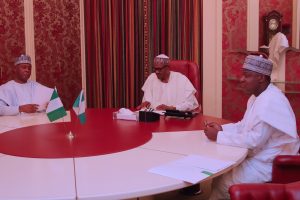
President Muhammadu Buhari (middle), seems to be asking President of the Senate, Senator Bukola Saraki and Speaker of the House Representatives, Hon Yakubu Dogara what is happening that the 2018 budget is yet to be passed, when he summoned them to the State House in Abuja today, Monday, May 7. Photo by Sunday Aghaeze. [myad]
We use cookies on our website to give you the most relevant experience by remembering your preferences and repeat visits. By clicking “Accept”, you consent to the use of ALL the cookies.
This website uses cookies to improve your experience while you navigate through the website. Out of these, the cookies that are categorized as necessary are stored on your browser as they are essential for the working of basic functionalities of the website. We also use third-party cookies that help us analyze and understand how you use this website. These cookies will be stored in your browser only with your consent. You also have the option to opt-out of these cookies. But opting out of some of these cookies may affect your browsing experience.
Necessary cookies are absolutely essential for the website to function properly. This category only includes cookies that ensures basic functionalities and security features of the website. These cookies do not store any personal information.
Any cookies that may not be particularly necessary for the website to function and is used specifically to collect user personal data via analytics, ads, other embedded contents are termed as non-necessary cookies. It is mandatory to procure user consent prior to running these cookies on your website.