A suspected leader of the outlawed Boko Haram, who has been posing as herdsman in most of the devastating attacks in Benue State whose name was given as as Aminu Yaminu, alias Tashaku, has been arrested.
In a statement today, Friday, the Assistant Director of the Nigerian Army Public Relations, Major Olabisi Ayeni said that the arrest was made possible through combined troops of 707 Special Forces Brigade, Nigeria Police and the Department of State Services in Makurdi.
In the statement, the army spokesman said: “Nigerian troops have arrested the key Boko Haram suspect known as Aminu Yaminu, nicknamed Tashaku who is believed to have masterminded most of the recent attacks in Benue State.”
He said that Aminu had concluded plans with his cohorts in Bauchi, Borno, Yobe and Nasarawa states to launch a major attack on innocent citizens in Benue State.
“As earlier reinstated, Nigerian Army will ensure enemies of peace in the state are brought to justice. Nigerian Army encourages all law abiding citizens to go about their lawful businesses without fear.
“They should also oblige the Nigerian Army and other security agencies with timely information that could lead to the arrests of criminal elements in our society.” [myad]
A member of the All Progressives Congress (APC), United Kingdom chapter, Ibrahim Emokpaire, has indicated his interest in contesting for the next national chairmanship of the party.
Emokpaire, who made his intention known in a statement today, Friday in Abuja said that he had what it takes to move the party to the next level.
He said that he had the capacity to bring lasting peace to the party and to ensure that it continued in power in 2019 and beyond.
Emokpaire, who is a former chairman of defunct Action Congress of Nigeria (ACN) in the United Kingdom, said that the race for the chairmanship is not going to be “a two-horse race.”
The aspirant, also from Edo State as the National Chairman of the party, John Odigie-Oyegun and another aspirant and former governor of the state, Adams Oshiomhole, is a management consultant.
The National Convention to elect a new national executive of the party has been scheduled for May 14.
No fewer than 46 people have been reportedly died in Katsina State as a result of the outbreak of Cerebral Spinal Meningitis (CSM).
The Social Media Focal Person of the World Health Organization (WHO) Katsina, Umole Elfrida, who announced this in a statement in the state today, Friday, said that the state recorded about 713 suspected cases of CSM from the various local government area in the state.
She said that WHO has already intervened and carried out retroactive vaccination in Four Local Government Areas of Bindawa, Main, Kurfi and Jibia with a total number of about 78,936 people immunized.
“WHO Katsina State in collaboration with KSPHCDA & other partners conducted CSM Vaccination for five days to stern the scourge of CSM outbreak.
“The State has about 713 suspected cases of CSM reported from various LGAs and 46 death cases. The retroactive vaccination was carried out in Four LGAs of Bindawa, Main, Kurfi and Jibia LGAs.
“The exercise was carried out after training of teams and sensitization of the community. Different schools, institutions and health workers were sensitized with provision of ceftriaxone for treatment of cases. The total number of people immunized is 78,936,” Elfrida stated.[myad]
Personal Assistant to President Muhammadu Buhari on Social Media, Lauretta Onochie, has said that if any leader should be accused of being complicit in the current Herdsmen/ Farmers clashes in the country, it should be ex-President Goodluck Jonathan and not President Buhari.
“The real Life Patron of Miyetti Allah is Goodluck Ebele Jonathan. So should we assume that Jonathan was behind the incessant and condemnable attacks which predated President Muhammadu Buhari Administration?”
Onochie, who responded to former Jonathan’s aide, Reno Omokri’s claim that Nigeria has become an abattoir in the hands of President Buhari, via her social media pages, said that Jonathan has remained the Grand Patron of Miyetti Allah Cattle Breeders Association.
“When Reno Omokri wrote his piece, “Nigeria, A Nation Once now an Abbatoire, I saw no need to respond to him, knowing that he is a habitual liar, he has lied many times before using his name and other aliases.
“This time around also I knew he was lying when he said President Muhammadu Buhari was somehow complicit in the Herdsmen vs. Farmers clash because he was a Patron of Miyetti Allah Association, which is not true by the way.
“It was just a deliberate attempt to cause mischief, fan the embers of hatred among citizens and their leader, politicise a very tragic event but he failed to produce even a little of evidence. So, should we believe the words of a lying Pastor in an era of fake Prophets?
“Lo and behold who is the real Life Patron of Miyetti Allah, not any other person but his erstwhile boss, Goodluck Ebele Jonathan. So should we assume that Jonathan was behind the incessant and condemnable attacks which predated President Muhammadu Buhari Administration?” [myad]
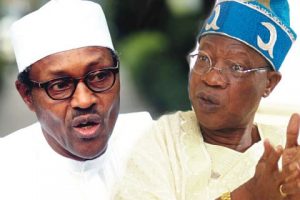
President Muhammadu Buhari has narrated how he tried to stop his information minister, Lai Mohammed from responding to ex President Olusegun Obasanjo over a ‘letter’ Obasanjo wrote in which he pinpointed the failures of his government.
“Tonight, I want to remind the people of what Lai Mohammed, Minister of Information did against my wish, in the sense that when a letter was written containing our failures as an administration, Lai Mohammed agitated that he should reply and I said no, the president said.
“I said no for two reasons: He is much younger than the person who wrote the letter and myself; two, he is from the same constituency as the person who wrote the letter.
“But when Lai Mohammed came, I said he should go out but he said he won’t go. I asked why and he said let me give him a chance to say what he wanted to do. I said go on.
“He said in what he would do, he would not mention names but only try to remind Nigerians what the country was when we came in, where we are now, and what we have done with the resources available to us.
“Eventually, I had to admit that he was right and I was wrong because a number of people who could get in touch with me have said that Lai had done a good job. A lot of them are in the media who I don’t have time to see – but of course, they are very busy people. Therefore, I am very happy with the performance of our party, the All Progressive Congress.”
President Buhari spoke in Bauchi yesterday at a reception organized in his honour, during his official visit to the State. [myad]
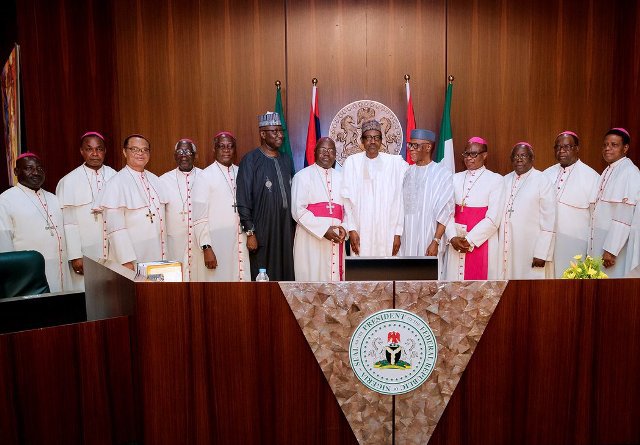
File Photo: A deligation of Catholic Bishops visited President Buhari in the Presidential Villa Last year
The Catholic Bishops Conference of Nigeria has called on President Muhammadu Buhari to resign for his inability to prevent the killing of two priest and several Christian worshipers by suspected herdsmen in Benue State.
In a statement, according to BBC, the body of Bishops wondered why the government, headed by President Buhari deliberately ignored the attacks:
“How can the Federal Government stand back while its security agencies deliberately turn a blind eye to the cries and wailing of helpless and harmless citizens who remain sitting ducks in their homes, farms, highway and now, even in sacred places of worship? “Clashes between herdsmen and farmers are increasingly common as the struggle over grazing rights and access to water becomes more acute.”
President Muhammadu Buhari has made it clear that he is not ready to negotiate the unity of Nigeria and that it will remain his paramount objective and that of his government.
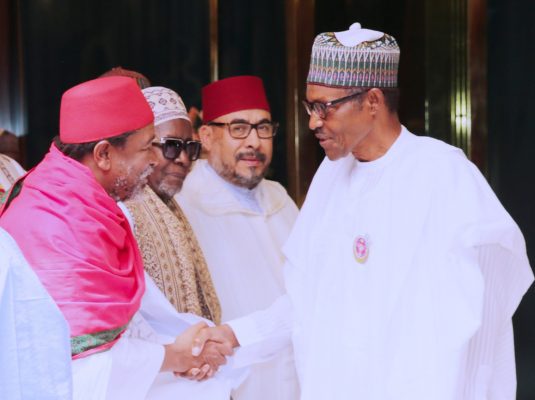
The President who received a delegation of the Tijjaniya Movement led by Sheikh Muhammadu Mahi Ibrahim Inyass at the Presidential Villa today, Friday, said: ‘‘I will continue to do everything within my powers to unite Nigeria.’’
The President commended the religious group for the peaceful conduct of their annual convention and urged them to bring the same to bear in promoting peace, unity and inter-religious harmony in Nigeria.
He lauded the group for complementing government efforts in bringing social, economic development, and stability in the country by encouraging discipline, unity and spirituality among its members.
Buhari reiterated his remarks on Thursday at the palace of Emir of Bauchi, Alhaji Rilwanu Suleiman Adamu, after he was presented with the Holy Quran, adding that the gift of Holy Quran is the highest anyone can receive and a reminder to seek and uphold justice in the service of the nation.
In his remarks, the leader of the group, Sheikh Muhammadu Mahi Ibrahim Inyass, told the President that members of the group would continue to support and appreciate his ‘‘noble agenda for the benefit of all Nigerians,’’ because they believe elected officials must be ‘‘accountable, incorruptible and God fearing.’’
‘‘It has never been easy. Even our Holy Prophet (SWA) was never totally accepted in his lifetime. It was only after he had long gone, people saw the wisdom in his preaching and sacrifices. We, therefore, urge you not to relent in your efforts.
‘‘Therefore, it is pertinent for you to note, Your Excellency, that majority of us are with your government and would ensure a total support for you in your effort to return Nigeria to the path of greater progress and development,’’ Sheikh Inyass said. [myad]
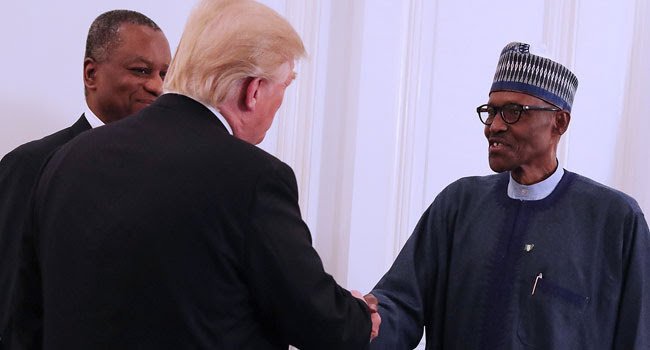
File Photo: Trump Welcomes President Buhari during the last year UN meeting, in New York
President Muhammadu Buhari is scheduled to hold bilateral meeting with President Donald Trump and a working lunch at the White House, United States of America on Monday, April 30.
Buhari, who leaves Abuja tomorrow, Saturday 28 April, for the US, on the invitation of President Donald Trump, will discuss with President Trump, on ways to enhance the strategic partnership between the two countries and to advance shared priorities, such as: promoting economic growth, fighting terrorism and other threats to peace and security.
According to a statement by the special adviser to the President on media and publicity, Femi Adesina, the meeting will further deepen the US-Nigeria relationship as the United States considers Nigeria’s economic growth, security and leadership in Africa to be critical aspects of their strategic partnership.
Adesina said that later in the day, President Buhari will meet with a group of business persons in agriculture and agro-processing, dairy and animal husbandry.
Ahead of the visit by President Buhari, meetings have been scheduled on 26th and 27th April, 2018, between senior Nigerian Government officials and executives of major US companies in the areas of agriculture, aviation and transportation.
In the area of aviation, the Nigerian officials will be meeting with Boeing, the largest aircraft manufacturer in the world, on the National Carrier Project.
On agriculture, they will meet with large equipment manufacturers with focus on harvesting and post harvesting equipment.
In the area of transportation, the officials will meet with the GE-led consortium for the implementation of the interim phase of the narrow gauge rail concession.
In the interim phase, a substantive concession agreement will be negotiated and finalized to provide the consortium the opportunity to invest an estimated $2bn, to modernize the rail line from Lagos to Kano (Western Line) and from Port Harcourt to Maiduguri (Eastern Line). During the meeting, the concession framework and the interim phase framework agreements are expected to be signed.
The Nigerian officials will also meet with US-EXIM Bank and the US Overseas Private Investment Corporation to explore competitive financing arrangements.
It is noteworthy that in 2017, Nigeria’s Federal Ministry of Industry, Trade and Investment and the United States Department of Commerce signed a Memorandum of Understanding to promote and encourage commercial and investment ties between Nigeria and the United States, with initial focus on infrastructure, agriculture, digital economy, investment and regulatory reforms. [myad]
The leadership of the All Progressives Congress (APC) in the South-west have converged on Ekiti July 14 governorship election.
The leaders, including Asiwaju Bola Ahmed Tinubu, today, Friday met with the party’s governorship aspirants in the state to assure them of their commitment and readiness to collaborate with the party’s National Working Committee in organizing a free, fair and transparent governorship primary election in the state.
The meeting was held at the old State House, Marina, Lagos and was attended by Asiwaju Bola Ahmed Tinubu; former Interim National Chairman, Chief Bisi Akande; National Vice-Chairman, South-West, Chief Pius Akinyelure; former Ogun State governor, Chief Segun Osoba; his former Ekiti State counterpart, Otunba Niyi Adebayo; Speaker, Lagos State House of Assembly, Hon. Mudashiru Obasa, and Ekiti State Chairman of the party, Chief Jide Awe. Not less than 28 governorship aspirants attended the meeting.
The party leadership in the zone advised the NWC to send credible people from Abuja to conduct the primaries already fixed for May 5. This followed the fear expressed by some of the aspirants over the need to have equally non-partisan team from Abuja to conduct the primary election. The aspirants had cited the case of the last governorship primaries of the party in Anambra State which was trailed by allegations of fraud and corruption. Members of the electoral panel were alleged to have engaged in sharp practices because they were not financially empowered for the exercise.
Speaking after the meeting, Asiwaju Tinubu said that the South-West leadership of the party called the meeting to assure the aspirants that the APC leadership in the geopolitical zone would be non-partisan and non-aligned with any of them in the forthcoming primary election.
“What I admire about them is that we called them and they answered our call. They all asked for a free, fair and transparent process and that is what we are committed to doing.
“The leadership is determined to respect that wish. There would be no interference, no collusion with any of them. But we told them they must all maintain the peace. And once we all recognise our roles and play the roles, we will all move forward.
Chief Akande said: “We are non-partisan; we are out to create a level-playing field. Whoever emerges at the end of the day is our candidate.”
One of the governorship aspirants, Chief Dele Okeya, who was mandated to speak on behalf of the aspirants, described the meeting as fruitful, while thanking the leaders for their intervention.
“We all resolved that the primary election in Ekiti would be credible, fair and transparent.
“We are happy our leaders gave the undertaking that the primaries would be transparent. The leaders pledged to come to Ekiti to ensure that the process is transparent and hitch-free. They also resolved to come after the primaries to ensure we remain cohesive and we have an all-inclusive APC going into the governorship election.”
Among the governorship aspirants at the meeting were Senator Babafemi Ojodu, Mr. Kayode Fayemi, Hon. Bimbo Daramola, Hon. Opeyemi Bamidele, Hon. Femi Bamisile, Mr. Bamidele Faparusi, Hon. Bayo Idowu, Chief Sesan Fatoba, Chief Bisi Aloba, Dr. Adebayo Orire, Dr. Femi Thomas and Dr. Wole Oluyede.
Chief Segun Oni and Senator Ayo Arise arrived shortly after the meeting had ended owing to flight delay from Abuja. They said they agreed with the resolutions reached at the meeting. [myad]
The World Bishops’ Council (WBC) has appointed the leader of Sufficient Grace and Truth Ministry (SGTM), Rehoboth Arena, Okinni, Osun State, Bishop Seun Adeoye as the council’s Coordinator in the state.
With the appointment, Bishop Adeoye, a former Chairman of Nigeria Union of Journalists (NUJ), Osun State Council will also direct the affairs of the World Federation of Churches (WFC) and World Clergies Congress (WCC) in the state.
The appointment was contained in the letter of appointment dated April 24, 2018 and sent to the cleric by the WBC Nuncio to Africa, Bishop Godspower Akandu.
Bishop Adeoye who was ordained as a pastor 25 years ago and was enthroned as a Bishop in 2016 worked with The Guardian Newspaper for 15 years as a reporter before venturing into publishing of a rested local tabloid known as West Mail Newspaper.
In the new assignment, the clergyman is expected to mobilize gospel ministers and churches and to promote inter and intra religious and community peace, unity, harmony, for development and co-operation, consecrate and ordain international clerics, ministerial licensing, mediation and conflict resolution.
He will involve in the “retraining and re-tooling of ministers and churches, for better services and galvanizing support for the government of the day, while upholding the Christian tenets, in fairness to all concern”.
In his acceptance message, Bishop Adeoye stated that he will be a good ambassador of WBC and use the new office to ensure equality of all people irrespective of their religious denominations and continuously speak for the downtrodden masses in the country. [myad]
We use cookies on our website to give you the most relevant experience by remembering your preferences and repeat visits. By clicking “Accept”, you consent to the use of ALL the cookies.
This website uses cookies to improve your experience while you navigate through the website. Out of these, the cookies that are categorized as necessary are stored on your browser as they are essential for the working of basic functionalities of the website. We also use third-party cookies that help us analyze and understand how you use this website. These cookies will be stored in your browser only with your consent. You also have the option to opt-out of these cookies. But opting out of some of these cookies may affect your browsing experience.
Necessary cookies are absolutely essential for the website to function properly. This category only includes cookies that ensures basic functionalities and security features of the website. These cookies do not store any personal information.
Any cookies that may not be particularly necessary for the website to function and is used specifically to collect user personal data via analytics, ads, other embedded contents are termed as non-necessary cookies. It is mandatory to procure user consent prior to running these cookies on your website.