President Muhammadu Buhari has expressed a deep sense of loss of the death, today, Wednesday, of a Senator representing his Katsina North Senatorial zone, Mustapha Bukar. Senator Mustapha died in Abuja after a protracted period of illness.
In a condolence message to the government and people of Katsina State, as well as the National Assembly, President Buhari said that his death was a great loss to Nigeria’s democracy and the engineering profession.
The President said that the deceased distinguished himself as an engineer before vying for political office to serve his people even as he recalled that as a young engineer, the deceased used his ingenuity to proffer a lasting solution to the perennial water crisis in Katsina, working variously as a General Manager of the Water Board, Director of National Water Rehabilitation Project and Director, Water Supply at the Federal Ministry of Water Resources.
“Senator Bukar was so dedicated to his responsibilities and hardworking that he got an appointment with the Federal Ministry of Water Resources, where he also demonstrated the same dedication and passion for service.’’
“I am always touched by the death of dedicated and creative public servants like Sen. Bukar. We should emulate such rare and hardworking Nigerians for the progress of our country.”
Also in a condolence message, Governor Aminu Masari of Katsina State expressed sadness over the death of Senator Mustapha Bukar, describing the death as a sad and painful loss for Katsina State in particular and the nation in general.
The Governor said that the deceased was a worthy son and representative of Katsina State and that he gave a good account of himself in the Senate.
He prayed to Allah to forgive him all his shortcomings, grant his soul eternal rest, and grant the bereaved the fortitude to bear the loss. [myad]
The Monetary Policy Committee (MPC) of the Central Bank of Nigeria (CBN) has delivered a verdict of Nigeria’s return to the path of sustainable positive economic growth, with the agriculture taking the lead in the Gross Domestic Product (GDP).
The Committee, at the end of its two-day meeting today, Wednesday, first in this year, in Abuja, said that the meeting was held against the backdrop of strengthening global growth and improving domestic economic conditions.
It said that data from the National Bureau of Statistics (NBS) indicated that real Gross Domestic Product (GDP) grew by 1.92 per cent in the fourth quarter of 2017, up from 1.40 and 0.72 per cent in the third and second quarters, respectively.
“The economy grew overall by 0.83 per cent in 2017. The main drivers of real GDP growth were agriculture (1.08%), industry (0.56%) and trade (0.35%). Non-oil real GDP grew by 1.45 per cent in the fourth quarter of 2017 compared with a contraction of 0.76 per cent in third quarter of 2017, indicating that the economy is gradually returning to a path of sustainable positive growth.”
The Committee also noted the continuous positive outlook based on the Manufacturing, and Non-manufacturing Purchasing Managers’ Index (PMI), which stood at 56.7 and 57.2 index points, respectively, in March 2018, indicating expansion for the twelfth and eleventh consecutive months.
The Committee believes that effective implementation of the Economic Recovery and Growth Plan (ERGP) by the Federal Government and quick passage of the 2018 budget will continue to enhance aggregate demand and confidence in the Nigerian economy.
Parts of the committee’s report are reproduced here:
Background
The re-constituted Monetary Policy Committee (MPC) held its maiden meeting, the 260th meeting of the Committee, its first in 2018, on 3rd and 4th of April, 2018 against the backdrop of strengthening global growth and improving domestic economic conditions. The Committee assessed the developments in the global and domestic economic environments during the first quarter of 2018, including the risks to price stability, financial stability, and economic growth in the short-to-medium term. Nine members of the Committee attended the meeting.
Global Economic Developments
The strong headwinds which confronted the global economy in 2017 showed signs of moderation, giving way to prospects for stronger growth in 2018. Consequently, global output is projected to grow by 3.9 per cent in 2018 from 3.7 per cent in 2017 on the heels of rebound in investment as a result of improvements in investor confidence, strengthening commodity prices, rising aggregate demand and accommodative monetary policy, especially in some advanced economies. With the sustained recovery in oil prices, aggregate demand is expected to continue to firm up. Growth in the advanced economies is projected at 2.3 per cent in 2018, and 4.9 per cent for emerging markets and developing economies (EMDEs). The Monetary Policy Committee noted some downside risks to the outlook for global growth to include: continuing normalization of monetary policy in the advanced economies; new U.S. trade policy; uncertainties associated with the BREXIT negotiations; and rising geo-political tensions in the Middle-East and on the Korean Peninsula.
In the advanced and emerging market economies, inflation is projected at 1.9 and 4.5 per cent in 2018, respectively. However, the broad indication from the IMF is that over the medium to long term, inflation may rise at a modest pace as general economic conditions remain subdued. Asset prices and long-term yields in major financial markets are also on the increase, confirming the possibility of a future rise in the price level.
Developments in Money and Prices
The Committee noted that money supply (M2) grew marginally by 0.07 per cent in February 2018 (annualised to 0.42%), in contrast to the provisional growth benchmark of 10.29 per cent for 2018. The development in M2 largely reflected growth in net domestic credit (NDC) of 4.05 per cent (annualised to 24.30%), emanating majorly from net credit to government, which grew by 19.99 per cent (annualised to 119.94%) against the provisional benchmark of 33.12 per cent. Credit to the private sector also grew by 1.49 per cent (annualised to 8.94%) in February 2018, compared with the provisional annual benchmark of 14.88 per cent. Net foreign assets (NFA), contracted by 2.82 per cent, annualized to 16.92 per cent, compared with the provisional benchmark of -29.31 per cent. Narrow money (M1), also contracted by 2.77 per cent (annualised to 16.62%). The Committee urged the Federal Government to strongly exercise restraint on domestic borrowing in order to lower the cost of credit to the private sector.
The Committee noted that the continued low level of lending by banks remains a constraint to growth of the real sector of the economy. The Committee advised the Management of the CBN to continue to provide the required policy impetus to engender improved credit delivery by the deposit money banks to the economy.
Inflationary pressures in the economy continued to moderate with headline inflation (year-on-year) receding for the thirteenth consecutive month to 14.33 per cent in February 2018 from 18.72 per cent in January 2017. Month-on-month food inflation fell by 133 basis points to 17.59 per cent in February 2018, and core inflation also declined marginally by 38 basis points to 11.71 per cent during the same period.
Money market interest rates reflected liquidity conditions in the banking system as the average inter-bank call rate increased to averagely 12.42 per cent in February 2018 from 9.49 per cent in December 2017. The Open buy back (OBB) rate also increased to 13.19 per cent in February 2018 from 8.46 per cent in December 2017. The movement in the net liquidity position and interest rates reflected the combined effects of OMO auctions, foreign exchange interventions and statutory allocation to state and local governments.
The Committee also noted the continuous improvement in the level of external reserves, which stood at US$46.699 billion as at March 29, 2018. Similarly, the All-Share Index (ASI) rose by 8.5 per cent from 38,243.19 on December 29, 2017, to 41,504.51 on March 29, 2018. Market Capitalization (MC) improved by 10.2 per cent from N13.61 trillion on December 29, 2017, to N14.99 trillion during the same period. The Committee observed that, while this development may be a reflection of improved investor confidence in the economy, it cautioned that the Management of the Bank should carefully monitor the developments and to establish mechanisms for safeguarding the stability of the foreign exchange market in the event of a sudden capital reversal. The Committee observed the continued rise in oil prices, but acknowledged the inherent volatility in commodity prices and urged the Bank not to relent in building external reserves buffers against any future price downturns and as a means of sustaining investor confidence in the economy.
The Committee noted the relative stability in the foreign exchange market, with declining premia across all segments of the market. It observed with satisfaction, the sustained high level of activity at the Investors’ and Exporters’ (I&E) window of the foreign exchange market. The window continues to attract more investors, thus boosting foreign exchange supply. Consequently, total foreign exchange inflow through the central bank increased by 73.00 per cent in February 2018, compared with the previous month. This was attributed to the increase in receipt of proceeds from Petroleum Profit Tax (PPT), royalties and crude oil & gas. Total outflow also increased in February 2018 by 15.69 per cent, as a result of higher payments for invisibles, interbank transactions as well as JVC cash call payments.
2.0. Overall Outlook and Risks
Forecasts of key macroeconomic indicators give a positive outlook for the Nigerian economy in 2018. This is predicated on the quick passage and effective implementation of the 2018 budget, improved security, foreign exchange market stability as well as favourable crude oil prices. On the downside, the Committee noted the potential impact of the 2019 election-related spending, against the weak backdrop of tax revenue efforts, herdsmen related violence and rising yields in the advanced economies. Indications in the US and the UK point to higher interest rates in the short to medium term.
3.0. The Considerations of the Committee
The Committee noted with satisfaction the gradual return to macroeconomic stability as reflected in the third consecutive quarterly growth in real GDP in the fourth quarter of 2017. It also noted the continued moderation in all measures of inflation as well as sustained stability in the naira exchange rate and urged the Bank to sustain the stability to avoid a mission drift. In particular, the Committee welcomed the narrowing of the exchange rate premium between the BDC segment and the Investors’ and Exporters’ (I&E) window of the foreign exchange market. Overall, the Committee noted that the recovery of the economy was strengthening, in view of the return to growth of the Services Sector. As the fiscal sector continues to settle its outstanding liabilities, it reduces its domestic debt profile, thus increasing the liquidity of the banking system. However, the Monetary Policy Committee observed increasing monetization of oil proceeds as evident in the growing FAAC distribution, relative to the 2017 level of disbursements. The Committee urged the Government to initiate strong stabilization programmes and to freeze the growth in its aggregate expenditure and FAAC distributions in order to create savings; needed to stabilize the economy against future oil price related shocks.
Notwithstanding the general improvement in macroeconomic conditions, the Committee noted the rather slow pace of moderation in food inflation. It also took note of the potential risk of a pass-through from rising global inflation to domestic prices. Members, however, expressed confidence that the tight stance of monetary policy would continue to complement other policies of government in addressing some of the structural issues underlying the stickiness of food prices. The Committee noted that at 14 per cent, the policy rate was tight enough to rein-in current inflationary pressures. The Committee, therefore, reaffirmed its commitment to price stability conducive to sustainable and inclusive growth.
The Committee noted with satisfaction the gradual implementation of the Economic Recovery and Growth Plan, in an effort to stimulate economic recovery. In the same vein, the Committee urged quick passage of the 2018 Appropriation Bill by the National Assembly, so as to keep fiscal policy on track and deliver the urgently needed reliefs in terms of employment and growth for the citizenry.
The Committee noted the relatively strong balance sheets of the deposit money banks’ and the stable outlook. This is in spite of the concentration of non-performing loans in a few sectors, which the Committee observed was satisfactorily being addressed by adequate mechanisms established by the Bank to address the phenomenon. The Committee also noted that as Government pays off its huge contractor debts, a sizeable portion of these non-performing loans will be addressed. The Committee urged the Bank to strengthen its supervisory oversight and early warning systems to promptly identify, monitor compliance with extant prudential regulations, sustain macro-prudential policy and manage emerging vulnerabilities in the banking system.
The Committee reiterated the Bank’s commitment to delivery of low interest credit as evidenced in its bold steps to adopt unconventional monetary policy to aid credit flow to vulnerable and growth enhancing sectors of the Nigerian economy. The Committee, therefore, enjoined the Bank to continue to support and encourage credit delivery at single digit interest rate through other mechanisms in the interim, while encouraging the banking system to establish frameworks to increase credit delivery to the employment generating sectors of the economy. In consideration of available data and evolving macroeconomic indicators, the Monetary Policy Committee is committed to revisiting its decisions in the short to medium term as the fundamentals evolve.
4.0. The Committee’s Decisions
In reaching its decision, the Committee appraised potential policy options in terms of the balance of risks. The Committee also took note of the gains made so far as a result of its earlier decisions; including the stability of the foreign exchange market, the moderation in inflation rate as well as the restoration of economic growth. The launching of the Food Security Council by the Federal Government to improve food sustainability is a step in the right direction. The Committee was concerned about the fiscal distortions associated with absence of buoyancy between GDP growth and tax revenue, and urged the fiscal authorities to deploy appropriate corrective measures to address this phenomenon.
The Committee was of the view that further tightening would strengthen the impact of monetary policy on inflation with complementary positive effects on capital flows and exchange rate stability. Nevertheless, it could potentially dampen the positive outlook for growth and financial stability. However, the Committee is of the view that loosening would strengthen the outlook for growth by stimulating domestic aggregate demand through reduced cost of borrowing. This may, however, lead to a rise in consumer prices, generating exchange rate pressures on the currency in the process. The Committee also believes that loosening could worsen the current account balance through increased importation. On the argument to hold, the Committee believes that key macroeconomic variables have continued to evolve in a positive direction in line with the current stance of macroeconomic policy and should be allowed more time to fully manifest.
In consideration of the foregoing, the Committee decided unanimously by a vote of all members present to retain the Monetary Policy Rate (MPR) at 14.0 per cent alongside all other policy parameters.
Consequently, the MPC voted unanimously to retain the
(i) MPR at 14.0 per cent;
(ii) CRR at 22.5 per cent;
(iii) Liquidity Ratio at 30.0 per cent; and
(iv) Asymmetric corridor at +200 and -500 basis points around the MPR.
I would like to state prestissimo, and from the outset of this lucubration, that I do not doubt the capacity of President Muhammadu Buhari to take our beleaguered nation out of the woods into which successive civilian administrations from 1999 had led it until 2015. Talking about 16 years of misrule by the Peoples Democratic Party (PDP) has become fashionable for good reasons. Because the Augean stables had been unconscionably polluted by the praxis of sleazy and public treasury looting game, there is pomp that there is now a Spartan Buhari in the saddle who has put his nose to the grindstone in a bid to halt the impunity and bring about national redemption.
His anti-corruption and pro-discipline antecedents as former military Head of State from 1983 to 1985 were referenced in 2015 by the vast majority of Nigerians in their decision to invest in him their mandate as a moral compass and quintessential navigator through the vaudeville acts of corruption that had submerged the philosophical essence that provided the basis for the corpus that birthed the Nigerian nation state. It is in this context that the return of Buhari as a patron saint is viewed and subjected to critical appreciation.
But unlike the military vehicle of getting into power characterized and injudiciously tempered by authoritarianism, dictatorship and Unitarianism in its modus operandi and modus Vivendi, his current intervention made possible by partisan politics is actualized through the vehicle of the All Progressives Congress (APC). His governance philosophy is thus essentially and logically preponderated by democratic tenets, constitutional circumscriptions and the reciprocal exertions in the interactions among the trinity of the executive, legislature and the judiciary.
Indeed, beyond the confines of the trinity are the public space and tentative cosmos of political party engineering where he is the Chief Engineer as the national leader of the APC, which is the political machine with which to drive the essential theme of his administration’s philosophy in the arduous and urgent task of reconstructing the nation’s socio-economic and political defence walls and moderating the ramifications of the good actions beyond 2019 and until 2023 when he will get to the terminus of his second term in office. Therefore, all that the APC needs presently is to retool and restrategise to fit into the visionaries of the inimitable anti-corruption poster boy-President Buhari.
The rationalization supra finds anchorage in the writ-large commitment by Buhari to ensure a national renaissance. That commitment cannot be questioned regardless of some perceived failings of the administration. I must state at this point that there is no perfect man; no perfect administration; no perfect political system and ideal anywhere in the world. Therefore, those who had expected so much from Buhari in a very short time within the complex Nigerian situation should have realised from the outset that he is human, shorn of the divine character of perfection and must operate in concert and dissonance with elements in the other arms of government.
This perspective has become germane in the context of the urgency that Nigerians want to see in the responses of government to existential challenges and in the execution of policies, programmes and projects. Military regimes that operate by decrees are different from democratic administrations that operate by the observance of the rule of law and due process. Regardless of the inherent limitations, Buhari has committed himself to clearing the Augean stables of public funds misappropriation and allied vices in the management of our public finance. The results may not be magical but they are steadily and incrementally manifesting.
Indeed, those whose preoccupation it is to manipulate the financial system for pecuniary interests are feeling the heat. They have been smoked out and are fighting back, even though feebly. As they continuously buckle under the moral weight of transparent leadership exemplified by Buhari, we have begun to witness cornucopia of infrastructure projects across the length and breadth of the country, resulting in exciting talking points on development issues in the political economy. It is only the naysayers in the opposition parties that would not agree that there is a great deal of difference between where the country was under the PDP rule and now.
I am aware that Nigerians are experiencing pains in some areas of their existential living. That is to be expected. These pains are inevitable and temporal. They are analogous to the pains a pregnant woman experiences in the labour room. Once she is delivered of her child, she begins to experience unspeakable joy of motherhood. The present pains due to the on-going surgical operations on the economy and other social capitals will soon be over.
We must all support the effort to rebuild our nation. The APC as a political vehicle through which Buhari got his job to attend to the bad health of the nation must double down his support for the president. Therefore, I believe that the move by the president to ensure that there is an elective national convention in June this year in line with the provisions of the APC constitution is in apple-pie order and should enjoy the backup of the NEC. The move will certainly conduce to legal propriety that will mark out the party as the bastion of respect for the rule of law and due process. Besides, it will be salutary to the consolidation of internal democracy in the APC.
This is the way to go and it is heartwarming that President Buhari is pointing in that direction. Knowing how strong willed he is as a stickler for proper conduct in public and private lives, I am confident that he would not be swayed by the shenanigans and brinksmanship being adopted by some interests in the government, acting in concert with the current NEC, to possibly compromise and befuddle the president’s unambiguous position on the testy issue of tenure elongation for the NEC.
The president had declared the decision by the NEC to extend its tenure till June 2019 illegal and I dare say, any recommendation by the Technical Committee that is not in pari materia with the president’s position, should be seen as disingenuous. Leaders of our party should not indulge in subjecting the President and his proactive intervention to the tensions of their parochial goals and objectives.
All hands must be on deck to emplace a more vibrant NEC headed with a public space national chair that will be able to adumbrate on the policies of government to party members and Nigerians at large. The president is understandably taciturn even if he is a man of action. The national chair of the party should make up for the president’s taciturnity and equanimity with his rambunctious and profound elucidation of the nitty-gritty of the president’s policy directions. The search for such an appropriate personality for the job should be our sincere preoccupation presently and not the maneuvering to supplant the president’s good counsel.
What is crystallizing in our great party is a warlike situation. As Peter Maurer was quoted to have once said, “They say that truth is the first casualty of war. But there is another casualty as well: trust. As conflict escalates, trust between people and political leaders crumbles away as surely as night follows day.” There should be restraint on the part of vested interests. President Buhari’s truth should be safeguarded. He should also be trusted to be able to pragmatically manage the fallout of the elective national convention in the praxis of fair accommodation of political interests. I hope my intervention does not attract or suffer any form of logomachy. God bless President Buhari and the APC.
Honourable Patrick Obahiagbon, an APC chieftain, contributed this piece from Benin. [myad]
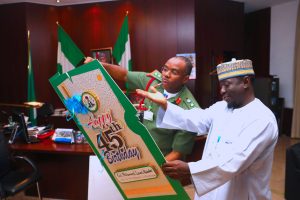
Chairman of the State House Press Corps (SHPC), Alhaji Ubale Musa, presents a giant birthday card to Colonel Mohammed Lawal Abubakar, the Aide-De-Camp (ADC) to President Muhammadu Buhari, as he marked his 45th birthday. Photo by Sunday Aghaeze. [myad]
The 24 Governors of the All Progressives Congress (APC) have finally fell in line with President Muhammadu Buhari on the end of tenure of the John Oyegun led National Executive Council of the party. The governors, who started a meeting with the President yesterday, Tuesday, at the continuation of the meeting last night, agreed to the holding of State Congresses and National convention later in the year to properly elect officers to lead the party to the 2019 general elections. Briefing news men today, Wednesday, the chairman of the Nigeria Governors’ Forum (NGF), Abdulazeez Yari, said: “We had a meeting with Mr. President yesterday (Tuesday), and we extended the meeting to night and we followed up with the consultations with the President now. “We consulted and all the 24 governors of the APC are in the same page with Mr. President that we are going to respect our party constitution, we are going to respect the constitution of the Federal Republic of Nigeria. So, we collectively agreed that we will have congresses at all levels – Local – State and National. And the committee set up by the National Secretariat of our party headed by governor of Plateau State, is presenting its report later today. The governors are also meeting with the working committee today so that we come up with convention committee names as well as timetable of the election. “So, there is no deadlock in our meeting, we have progressed and very soon you will have the names of the convention committee members as well as the timetable.” Also speaking, the Imo State Governor, Rochas Okorocha said: “I just want to let you know that there is no crisis in the APC at all. And we want to use this opportunity to advise the media operatives to stop spreading rumors of crisis in APC. There is no single crisis in APC. “The issue was one of people who believe that we did not have enough time to organize a party congress and run election. Some people felt that it was a good idea but the most important thing is that, if we do that we will be contravening both our party constitution and the constitution of the Federal Republic of Nigeria. That is the major issue that we have that they call crisis. We do not have virus. “This morning we met with Mr. President to fine-tune issues, one regarding the congress and we have resolved that the congresses at all levels and the Chairman of the elongation committee, is also fine-tuning the arrangement in the same line. To this effect, the convention committee will be set out, it will be announced. “But let me correct one impression, the issue of congress and convention does not mean that the previous people who have served the party have done badly. And it does not m an that they cannot come back or that they cannot re-contest, that is not it. We are simply saying that their tenure has ended and those who wish to re-contest can re-contest and can be elected into our party structure. So we are all one as family and we are set to go for 2019 elections in victory.”
The wing of the apex Igbo socio-cultural organization, Ohanaeze Ndigbo, has passed a vote-of-no-confidence on the President General of the main body, Chief John Nnia Nwodo.
The wing, Ohanaeze Youth Congress (OYC), in a statement its meeting held in Enugu, accused the President General of mortgaging the interest of Ndigbo and of side-lining other members of the Ohanaeze National Executive Council.
The statement was signed by OYC President, Mazi Okechukwu Isiguzoro and Mazi Okwu Nnabuike, the Secretary-General.
It read it parts: “It is with great sense of dismay and clear picture of the present debased Ohanaeze politics that we the fledgling members of the Ohanaeze Youth Council, OYC, summoned an emergency security meeting and met today, April 2nd, 2018 being Easter Monday, because it has dawned on us and every other conscious Igbo that the President General, Ohanaeze Ndigbo, Chief Nnia Nwodo has not only lost leadership mantle but veered out of the way and is hell bent to push the Ohanaeze and Ndigbo to a political cul-de-sac.
“We averred that it is high time Ndigbo rose up before Nwodo commits political suicide that would burn our hands and identity and it will only need articulate youths and wise elders and technocrats to rescue Ohanaeze Ndigbo from Nwodo’s clique and thereby, save Igbo Nation from plausible political suicide.”
The statement claimed that “out of 24-man executive of Ohanaeze Ndigbo, Nwodo uses an illegal organ of Forum Of States’ Presidents against the Constitution Of Ohanaeze to subdue, intimidate and humiliate other Ohanaeze Ndigbo executive members and thereby, forming a cabal and constituting a menace against the democratically elected members of Ohanaeze youths and women.
“In view of the foregoing, we the Ohanaeze Youth Wing, OYW presently at the receiving ends of Nwodo’s political forays and not in a haste to adopt or support any presidential candidate to avoid a repeat of the Igbo’s 2015 fate choice, that he pressures for, hereby, passed votes of no confidence on Chief Nnia Nwodo and his Ohanaeze Ndigbo presidency and we give him seven days to appear before the Ohanaeze Disciplinary committee to explain and answer for his political infidelity against Igbos.”
They listed what they called issues before Nwodo to include: “Why did he go against the Ohanaeze Ndigbo’s tradition and Constitution and abused his office by paying loyalty to Alhaji Atiku Abubakar immediately after his election on 10th January 2017, and after he was queried by his NEC, he told them that his 1st official visit to Atiku, a Northerner, was to discuss the ill-health of President Buhari, who he believed is in bad condition.
“He has rendered the office of the Secretary-General impotent, which according to Ohanaeze Constitution is the engine room of the organization and custodian of Ohanaeze Secretariat. He carefully appointed Director of Administration without Ime Obi’s approval thus assuming the powers of Secretary-General through his political appointee, Director of Administration.” [myad]
Former governor of Abia State, Dr. Orji Uzor Kalu, has described past Nigerian leaders who are busy criticizing President Muhammadu Buhari’s administration as lawless and reckless when they were in power.
Kalu said that notwithstanding the cynical and vitriolic attacks against him, the president deserves a second term in office to complete his good projects for Nigeria.
He spoke on Tuesday at the Ake Palace of the Alake and Paramount Ruler of Egbaland, Oba Adedotun Gbadebo, in Abeokuta, the Ogun State capital, when he visited the monarch.
Kalu, who is the coordinator of National Movement for Re-election of Muhammadu Buhari, declared that the president has done well to merit another term of four years in office.
The former governor’s comments came barely 24 hours after former President Olusegun Obasanjo tongue – lashed Buhari-led government for allegedly being ineffective, incompetent and reeking of failure.
According to him, Buhari has unfinished job to do and needs another tenure to complete it thoroughly.
“The greatest challenge of our country is leaders not obeying the law. When they are leaders, they don’t want to obey the law; when they go out of leadership, they criticize everybody who wants to obey the law. This is the problem of the country.
“We have had leaders who disobeyed every law of the land. We’ve also had leaders who were reckless when they were leaders and when they go out, they call people all kinds of name. We have also seen leaders that have never seen anything good in other people’s leadership, they only know about themselves.
“So, we want to thank you for the support…I know you are close friend of President Muhammadu Buhari and I want you to maintain that friendship; don’t allow anybody to distract you whether people from here or from my area, stay in course.
“President Buhari has not finished the job he came to do. If God gives him good health and long life, he has not finished. He has to go for another four years to be able to finish.
“Despite people who are criticizing and these people also took no criticism when they were in office. Despite people who are writing letters; these people we also wrote letters to them, they didn’t reply to our own letters.”
Kalu, who lauded his host for his sterling military career, numerous community services and contributions to nation-building, declared that Nigeria’s unity is non-negotiable.
He urged the Alake and members of the Egba Traditional Council not to relent in their support for the president.
“In any democracy, there must be people for and against. We are for Buhari, some people are against and we wish them well. And we want to thank you for the key role of peace that you and other traditional rulers have been playing. Nigeria unity is non-negotiable.
“We are for oneness of this country, we are for leaders who are sincere to lead us well, we are for leaders who are equally committed to the rules and tenets of democracy.”
Oba Gbadebo hailed the former Abia governor for his message of love and strong belief in Buhari’s capacity to deliver good governance for the country.
The Alake described Kalu as a great and detribalized Nigerian, whose tenure as governor was marked with monumental development of the state.
“As a key stakeholder of the Nigerian project, your patriotic contributions to nation-building are commendable,” he told Kalu.
The monarch, who noted that the nation’s Presidency remains the birthright of every Nigerian, promised to support Kalu whenever the nation beckons on him to contest as president.
According to him, there is great hope for Nigeria when somebody from the South East could be mobilizing support for a president who hails from the North.
The Alake pointed out that giving Buhari a second term in office would enable him to consolidate on the achievements already recorded by the present administration.
“So, I am part of your team in campaigning that he be given a chance for another four years because those who made the tenure to be four by two know that while you are formulating your policies while you are thinking of what to do, you need time to now expect everything you have put in place in the first four years to germinate and to bring benefits to the people.
“And we know what happens in Nigeria; there is always policy somersault. If a person goes after four years, virtually everything he has done will be turned over by whoever comes after; he won’t want the person that has come to get the credit for what he is going to sit upon. So, he would rather have it killed than to go ahead and implement.
“So, as you are going around the country, we pray that God will be with you. That this effort you are putting in for the greatness of Nigeria, some other people will do the same thing for you because the headship and Presidency of this country is the birthright of every Nigerian and I pray that in your own time too, people will go round and solicit support for you. You have proved to be a great Nigerian totally devoid of tribal sentiment.” [myad]
The Kogi State governor, Alhaji Yahaya Bello, was said to have involved in an auto accident leading to a leg injury, as a result of which he now walks with clutches.
The governor appeared today, at Aso Villa Presidential Villa to attend the All Progressive Congress (APC) governors meeting with President Muhammadu Buhari. He was walking with clutches on his two sides. His left foot is swollen up and heavily bandaged.
Information had it that governor Yahaya Bello was returning from Abuja last Friday, being driven in a BMW saloon car when the accident happened around the Lokoja market area.
He was said to have been dragged by the vehicle for some metres before the driver could realize what was happening and halted the car. The governor was said to have been rescued by the security operatives and others in the convoy.
Governor Yahaya Bello was returning from Abuja after the caucus and the National Executive Committee (NEC) meetings of the APC with the intention of attending the funeral of the late Deputy Majority Leader of the House of Representatives, Hon Buba Jubril. But the accident prevented him from attending as he was immediately rushed to an undisclosed hospital and was represented at the funeral by his deputy, Simon Achuba.
The Director General, media and publicity to the governor, Kingsley Fanwo, confirmed the incidence, saying that the governor injured his leg as he “missed his footing.”
A statement by the media aide said Yahaya Bello injured his left foot while alighting from a vehicle, denying the allegation that the governor had been flown abroad for medical attention.
The statement read: “We wish to refute rumours that the Governor of Kogi State, His Excellency, Alhaji Yahaya Bello is either hospitalised or otherwise incapacitated.
“The Governor missed his footing last Friday, March 30, 2018, while alighting from a vehicle and injured his left foot. He was treated by his doctors, who bandaged the leg and discharged him.
“We thank all the Governor’s supporters and well-wishers who reached us to inquire after his wellbeing. His Excellency is doing very well and will be at work as usual after the Easter holidays.” [myad]
A chieftain of the Peoples Democratic Party (PDP) in Plateau State, Alexander Mwolwu, has accused former President Olusegun Obasanjo of being an ungrateful and corrupt Nigerian leader.
“Even though OBJ’s plots to discredit PDP to promote his own political party, SDP, he seems to have missed it and not knowing what he is doing. He is the most ungrateful and corrupt Nigerian leader, who never knew how PDP was formed.”
Mwolwus told the News Agency of Nigeria (NAN) in Pankshin that Obasanjo introduced corruption and that he corrupted the National Assembly with his third term failed ambition.
According to him, OBJ corruptly sold out government properties to his cronies and spent billions of Naira on electricity, which Nigerians couldn’t see its impact but only darkness.
that OBJ’s pronouncement is “very unfortunate’’ and “selfish in nature’’.
The PDP Chieftain also accused Obansanjo of plotting to discredit the party to promote Social Democratic Party (SDP).
While describing PDP’s apology to Nigerians through its National Chairman as “a right step in the right direction’’, he said: “Only great men own up to their mistakes.”
“If PDP had apologized willfully haven owned up to its mistakes, I shouldn’t be castigated for that because every human organization has its own limitations
“But all the same, his party will not be anywhere close to having the confidence of Nigerians if that is the way he wants to go drumming for support to it.
“Obasandjo was never a member of PDP but out to sheer pity and magnanimity, the party brought him out of prison and made him president on a platter of Gold.”
Mwowus said: “we made him who is is today, yet he had the guts to spit and shout against us.” [myad]
A Nigerian serving Senator, representing Kogi State West Senatorial zone, Dino Melaye and the four suspects rearrested for alleged conspiracy and unlawful possession of prohibited firearms will be charged at the Federal High Court in Lokoja, Kogi on May 10.
The Nigeria Police Force Spokesman, Jimoh Moshood, who briefed newsmen on the arrest of four of the six suspects today, Tuesday in Abuja, said that two of the suspects are still at large.
The suspects are: 31 year old Kabiru Seidu, alias Osama, 25 year old Nuhu Salisu, alias small, 27 year old Musa Mohammed, alias Iko and 26 year old Emmanuel Audu. The Police Command in Kogi State had, on March 28, announced the escape from lawful custody of six suspects including Seidu and Salisu.
Jimoh Moshood said that Seidu and Salisu who were principal suspects were rearrested in Tafa Balewa Local Government Area of Bauchi State and Ganaja Village, Lokoja, Kogi.
The Police spokesman said that the six accomplice in the case arrested by the police would be prosecuted with the six rearrested suspects, adding the suspects are: John Beneche, 22, Seye Atowoju, 27 Danjuma Yunusa, 35 , Egga Ochai,50 Abbas Haruna, 30 and Gloria Audu, 28.
He said that the suspects would be arraigned in court for prosecution on completion of investigation.
Moshood warned that the police would not relent in its efforts to check activities of unscrupulous politicians, adding that they must play the game according to the rules.
He commended members of the public for giving the police timely information that aided the re-arrest of the suspects.
The spokesman said that the force`s fight against crimes and criminality in the country remained unequivocal and unwavering.
One of the suspects, Seidu had confessed that Melaye handed over to him a bag containing one AK47 rifle, two Pump Action guns and N430,000.00 to share with his boys. [myad]
We use cookies on our website to give you the most relevant experience by remembering your preferences and repeat visits. By clicking “Accept”, you consent to the use of ALL the cookies.
This website uses cookies to improve your experience while you navigate through the website. Out of these, the cookies that are categorized as necessary are stored on your browser as they are essential for the working of basic functionalities of the website. We also use third-party cookies that help us analyze and understand how you use this website. These cookies will be stored in your browser only with your consent. You also have the option to opt-out of these cookies. But opting out of some of these cookies may affect your browsing experience.
Necessary cookies are absolutely essential for the website to function properly. This category only includes cookies that ensures basic functionalities and security features of the website. These cookies do not store any personal information.
Any cookies that may not be particularly necessary for the website to function and is used specifically to collect user personal data via analytics, ads, other embedded contents are termed as non-necessary cookies. It is mandatory to procure user consent prior to running these cookies on your website.



 The 24 Governors of the All Progressives Congress (APC) have finally fell in line with President Muhammadu Buhari on the end of tenure of the John Oyegun led National Executive Council of the party.





As Buhari Navigates APC Through The Storm…By Patrick Obahiagbon
I would like to state prestissimo, and from the outset of this lucubration, that I do not doubt the capacity of President Muhammadu Buhari to take our beleaguered nation out of the woods into which successive civilian administrations from 1999 had led it until 2015. Talking about 16 years of misrule by the Peoples Democratic Party (PDP) has become fashionable for good reasons. Because the Augean stables had been unconscionably polluted by the praxis of sleazy and public treasury looting game, there is pomp that there is now a Spartan Buhari in the saddle who has put his nose to the grindstone in a bid to halt the impunity and bring about national redemption.
His anti-corruption and pro-discipline antecedents as former military Head of State from 1983 to 1985 were referenced in 2015 by the vast majority of Nigerians in their decision to invest in him their mandate as a moral compass and quintessential navigator through the vaudeville acts of corruption that had submerged the philosophical essence that provided the basis for the corpus that birthed the Nigerian nation state. It is in this context that the return of Buhari as a patron saint is viewed and subjected to critical appreciation.
But unlike the military vehicle of getting into power characterized and injudiciously tempered by authoritarianism, dictatorship and Unitarianism in its modus operandi and modus Vivendi, his current intervention made possible by partisan politics is actualized through the vehicle of the All Progressives Congress (APC). His governance philosophy is thus essentially and logically preponderated by democratic tenets, constitutional circumscriptions and the reciprocal exertions in the interactions among the trinity of the executive, legislature and the judiciary.
Indeed, beyond the confines of the trinity are the public space and tentative cosmos of political party engineering where he is the Chief Engineer as the national leader of the APC, which is the political machine with which to drive the essential theme of his administration’s philosophy in the arduous and urgent task of reconstructing the nation’s socio-economic and political defence walls and moderating the ramifications of the good actions beyond 2019 and until 2023 when he will get to the terminus of his second term in office. Therefore, all that the APC needs presently is to retool and restrategise to fit into the visionaries of the inimitable anti-corruption poster boy-President Buhari.
The rationalization supra finds anchorage in the writ-large commitment by Buhari to ensure a national renaissance. That commitment cannot be questioned regardless of some perceived failings of the administration. I must state at this point that there is no perfect man; no perfect administration; no perfect political system and ideal anywhere in the world. Therefore, those who had expected so much from Buhari in a very short time within the complex Nigerian situation should have realised from the outset that he is human, shorn of the divine character of perfection and must operate in concert and dissonance with elements in the other arms of government.
This perspective has become germane in the context of the urgency that Nigerians want to see in the responses of government to existential challenges and in the execution of policies, programmes and projects. Military regimes that operate by decrees are different from democratic administrations that operate by the observance of the rule of law and due process. Regardless of the inherent limitations, Buhari has committed himself to clearing the Augean stables of public funds misappropriation and allied vices in the management of our public finance. The results may not be magical but they are steadily and incrementally manifesting.
Indeed, those whose preoccupation it is to manipulate the financial system for pecuniary interests are feeling the heat. They have been smoked out and are fighting back, even though feebly. As they continuously buckle under the moral weight of transparent leadership exemplified by Buhari, we have begun to witness cornucopia of infrastructure projects across the length and breadth of the country, resulting in exciting talking points on development issues in the political economy. It is only the naysayers in the opposition parties that would not agree that there is a great deal of difference between where the country was under the PDP rule and now.
I am aware that Nigerians are experiencing pains in some areas of their existential living. That is to be expected. These pains are inevitable and temporal. They are analogous to the pains a pregnant woman experiences in the labour room. Once she is delivered of her child, she begins to experience unspeakable joy of motherhood. The present pains due to the on-going surgical operations on the economy and other social capitals will soon be over.
We must all support the effort to rebuild our nation. The APC as a political vehicle through which Buhari got his job to attend to the bad health of the nation must double down his support for the president. Therefore, I believe that the move by the president to ensure that there is an elective national convention in June this year in line with the provisions of the APC constitution is in apple-pie order and should enjoy the backup of the NEC. The move will certainly conduce to legal propriety that will mark out the party as the bastion of respect for the rule of law and due process. Besides, it will be salutary to the consolidation of internal democracy in the APC.
This is the way to go and it is heartwarming that President Buhari is pointing in that direction. Knowing how strong willed he is as a stickler for proper conduct in public and private lives, I am confident that he would not be swayed by the shenanigans and brinksmanship being adopted by some interests in the government, acting in concert with the current NEC, to possibly compromise and befuddle the president’s unambiguous position on the testy issue of tenure elongation for the NEC.
The president had declared the decision by the NEC to extend its tenure till June 2019 illegal and I dare say, any recommendation by the Technical Committee that is not in pari materia with the president’s position, should be seen as disingenuous. Leaders of our party should not indulge in subjecting the President and his proactive intervention to the tensions of their parochial goals and objectives.
All hands must be on deck to emplace a more vibrant NEC headed with a public space national chair that will be able to adumbrate on the policies of government to party members and Nigerians at large. The president is understandably taciturn even if he is a man of action. The national chair of the party should make up for the president’s taciturnity and equanimity with his rambunctious and profound elucidation of the nitty-gritty of the president’s policy directions. The search for such an appropriate personality for the job should be our sincere preoccupation presently and not the maneuvering to supplant the president’s good counsel.
What is crystallizing in our great party is a warlike situation. As Peter Maurer was quoted to have once said, “They say that truth is the first casualty of war. But there is another casualty as well: trust. As conflict escalates, trust between people and political leaders crumbles away as surely as night follows day.” There should be restraint on the part of vested interests. President Buhari’s truth should be safeguarded. He should also be trusted to be able to pragmatically manage the fallout of the elective national convention in the praxis of fair accommodation of political interests. I hope my intervention does not attract or suffer any form of logomachy. God bless President Buhari and the APC.