“Those who use our work online; call them Google, call them Facebook, call them Instagram; those who use our work must pay for it. If we get payment for the work we do every day as journalists, we will be in a far better place. “That is our first survival instinct that we must do either as a group, led by the NGE, or working with the government to ensure that our intellectual properties; what we do every day that is shared everyday on social media is paid for. That is the first step.” This was the submission of the Chairman of Arise News, ThisDay Media Group, Prince Nduka Obaigbena at the 2nd Lateef Jakande Annual Memorial Lecture of the Nigerian Guild of Editors (NGE), today, July 30, in Lagos. Nduka Obaigbena called on the federal government to come up with a law that would protect the use of intellectual properties of the media industry. Speaking on the theme “Rapidly Changing Media Landscape: Media Survival Strategies,” Obaigbena said that the media should find ways to survive in the face of changing technological advancement. According to him, one of the ways to ensure that the media survives in Nigeria is to ensure that intellectual properties (IP) of journalists are protected through legislations and they should be ready for the advent of Artificial Intelligence (AI). “First is to have the laws changed, where intellectual property is recognized as an asset; we have to enable the IP, the work of your brain as an asset class, that asset class can be bankable, so you can raise money against it, and you can create value. He called on the Minister of Information and National Orientation, Mohammed Idris and Lai Mohammed, the immediate past minister of information to ensure that they pass a law that those who use media properties online are made to pay. “The next step is to be prepared for AI, promote education, ensure good governance and all that.” Obegbina advised journalists to engage the young generation audience in ensuring the survival of the media. This was even as the founder of journalism clinic, Taiwo Obey, urged journalists to put context into news stories as well as meet their audience by finding out what they want and giving it to them in a way that they enjoy it. Obey said that AI should not be seen as a threat, but an advancement that journalist must take advantage of. Similarly, Kayode Akomolafe called for introspection on the part of journalists to ensure that their survival is guaranteed instead of engaging in a blame game. He also called on journalist to build on their credibility as a means of staying relevant. In her contribution, a former President of the NGE, Funke Egbemode, said that media houses would continue to find it difficult to survive if they keep doing what they have always been doing.
She said that if there must be a positive change, there must be cooperation among media practitioners. “If we do not agree, no law can save us. If we are going to sell our content, we must sell our content as a group.” She also called on journalists to ensure that they do something extra to every news as well as court the younger generation. On her own part, Maureen Chigbo, President Guild of Corporate Online Publishers (GOCOP), stressed the need for media houses to cut the cost of production and ensure that they move with the time. According to her, having a good corporate governance will help mitigate against excessive use of resources. The lecture is held annually in memory of Lateef Jakande, the pioneer President of the Nigerian Guild of Editors and a former Governor of Lagos State.
The Economic and Financial Crimes Commission (EFCC) has commenced investigation of the Chairman of the National Hajj Commission of Nigeria (NAHCON), Malam Jalal Arabi, over the Federal Government’s N90 Billion subsidy for the 2024 Hajj operations in Saudi Arabia. The Commission formally invited the Chairman and was expected to appear before it in its headquarters, Abuja today, July 30. Sources at the EFCC said that Arabi would be expected to provide detailed explanations also on how NAHCON shared thousands of dollars allocated to it for the pilgrims. It was gathered that the detectives are investigating a series of petitions against Arabi and the Commission that he heads, over alleged maltreatment of pilgrims in Saudi Arabia during the 2024 exercise. A source in the EFCC hinted thus: “we are doing our job as prescribed in law without minding whose ox is gored. In the EFCC, nothing concerns us with religion or tribe, what is important for us is to tame financial crimes and other fraudulent activities in our society.” Arabi had earlier said at a media chat that the N90 billion intervention was approved by the president to assist pilgrims due to the instability of the naira. He said that the commission used the funds to support pilgrims who paid for the 2024 Hajj through the government quota.
Perhaps I should not be alive. But I am. Despite the odds, I turn 58 today. I am still frail and fragile. But now, I can stand on my feet again, bearing testimony to those sacred words of the Almighty Allah Himself that, “No soul can ever die except by Allah’s leave and at a term appointed (Quran 3: 145).” It all started on 19 February (2024) when I drove myself into a government hospital in Abuja for an elective surgery. The surgery itself was meant to last for a few minutes and I should return home not later than two days thereafter. That was what I was told. But that was not what happened. Since that fateful Monday morning, I have gone into and out of the surgical theatre nine times for six major operations and three minor procedures. I have spent six days in the Intensive Care Unit (ICU), surviving on oxygen and relieving myself through catheters. I have become totally dependent on others for the performance of even such personal functions as cleaning myself. I have lost 20 kilogrammes in five months and was reduced to a mere sack of bones. I have lost the use of my limbs and, like a toddler, I had to learn to walk again. I have spent millions of naira and thousands of dollars of my own and other people’s money. I have travelled hundreds of kilometres to find help. I have reached the very bottom of despair itself; and I had made plans for my own burial. But somehow, I am still alive. I am someone you could describe as a hands-on person, or even a keep-fit buff, careful about what I eat or drink and what I do with my body. Therefore, I seldom had any need for a hospital. However, since my dad died of prostate cancer 23 years ago, the doctor had warned me that male children of prostate cancer victims are predisposed to suffering the same fate. Since my 40th birthday, I had therefore ensured that a comprehensive medical check-up was a part of my annual ritual. In the course of one of those routine check-ups, I was alerted a few years ago of an enlargement of my prostate. Following this discovery, I enrolled in a public medical facility in Abuja and made sure to see the urologist every three months. At one point, I was also advised to also see a nephrologist once in a while. All these visits, I understood, were merely precautionary. But I was beginning to spend too much time on the waiting line in the hospital than I could afford. Before long, I changed to another hospital closer to my house. Even though it is also a government hospital, it has a private wing that charges higher fees for quicker consultations and service. I thought this arrangement served me better. I was assigned a consultant urologist of my own. And I also saw a nephrologist in the hospital. However, while the nephrologist kept assuring me that everything was fine, the urologist started to raise an alarm. At a point, he told me that if we didn’t act fast, my enlarged prostate might begin to affect my kidney. The only solution, he said, was surgical intervention. He was the expert, so I yielded to his pressure and agreed to do the surgery. That turned out to be a major mistake. But I only became wiser by way of a horrifying hindsight. My result from the prostate test showed that I was, in fact, in a much better place than several of my friends, who all were surprised that I chose to go under the knife for an ailment that, more often than not, offers a little more than just mere discomfort, as long as it is not cancerous. They were right. The only prostate-related complaint I had was that I urinated twice or thrice at night. I did not have any pains or difficulty in urinating, or any symptom beyond the ordinary. It turned out that all I needed was a slight change in lifestyle, not drinking or eating late into the night and to continue to take the drugs that were prescribed for management purpose, which, by the way, my urologist had asked me to stop taking. Although it did not mean much to me at the time, but in this hospital, patients do not have access to the results of their laboratory tests. The doctor electronically sends requests to the laboratory and once the patient has made payment, the laboratory will conduct the test and send the results in the same manner back to the doctor. The doctor would access the results on his computer and based on this, make pronouncements on what the patient needs to do next. In my case, the verdict was surgery. This was why I drove myself to the government hospital on 19 February and spent the night preparing for the surgery the next day. A week before, I had gone through a cystoscopy procedure. That was my first time ever in a hospital surgical theatre. But since the 20th of February, I have been in several theatres, more than an average person would in a single lifetime. It happened that during the first surgery, the surgeons had ruptured my bladder. In panic, they had to abandon the prostate operation that brought me in, hurriedly placed a catheter inside my urethra, and returned me to the hospital ward. It so happened also that the catheter was not properly placed, so urine was not going into the bag. I was returned to the theatre to remedy the situation. When I came out this time around, the urine was reverting to my genitals, which had by now become grotesquely engorged with fluid. Three trips back to the theatre did not change anything. And this was enough to send everyone into panic. I was wheeled into the ICU, where I passed out and had to be placed on oxygen. At this point, it had become obvious that the medical team had reached its wit’s end. It had lost control. One of them had, in fact, quietly told my family that my chance of survival was 50-50. They were already thinking of moving to the next patient. After all, they had “tried their best. But then, to paraphrase Shakespeare, heaven has no fury like a woman about to be widowed. My wife, Odunayo, rose to the occasion. She thought that what was needed to save my life at that point were some ‘muscles’ that would compel the doctors to give me proper attention. She told my children, their friends, and my colleague, Akintoba Fatigun, who was already weeping after seeing how helpless I was, to stay strong. She picked up my phone and called my Oga, the Chairman of THISDAY and Arise TV, Mr Nduka Obaigbena, to inform him about my condition. All she needed were calls to people in top places on the need for the hospital management not to abandon me. Mr Obaigbena immediately called the Minister of Health, who in turn called the head of the hospital. He also promptly dispatched one of his top managers, Mr Israel Iwegbu, to move over to the hospital and report back to him. In no time, I began to depend on my wife to brush my teeth, clean myself in the bathroom, put food in my mouth, perform ablution, and do any chore that involved the use of my right hand. Then my right leg soon followed. It was like something was switching off my limbs one by one. Then at night, the pains descended on my neck and shoulder like a boulder. Sleep became impossible. Turning became a torture. To find a position of relief, that small posture that would grant me a respite from this oppressive pain, no matter how fleeting, became impossible. Akintoba also called my boss, Dr Abubakar Bukola Saraki, who was then in the United States. The former Senate President immediately directed Akintoba to get some money across to my wife and also promised to speak with the Health minister. My wife also sent an urgent message to my brother, the Senator representing my Senatorial District, Ogun Central, Senator Shuaib Afolabi Salis. The Senator immediately came over to the hospital to meet the Chief Medical Director. With all these influential forces breathing down their neck, the hospital realised that this was one patient they could not afford to trifle with. I was returned to the theatre where they had to open me up – yet again – to properly adjust the catheter and ensure that I hadn’t suffered any internal damage. I ended up spending six days in the ICU and later returned to the private room. In the ICU, the traffic and calibre of people who came to see me surprised the hospital management. One evening, Dr Saraki himself led a very long and powerful delegation to the hospital such that when he said: “Yusuph, get well fast, look at the whole troops turning out to wish you well,” I could not but agree with him. In the same way there were the visits of Senator Salis and his son, Kamal, who was always traveling down from Kaduna to see me. Just as Senator Tokunbo Afikuyomi once led his wife, children, and friends to check up on me. After two weeks, I was discharged and went home. It was Ramadan. For the first time in over 45 years, I could not participate in the Ramadan fast. While in the hospital, I said my prayers most times lying on the bed. Although I had lost so much weight, it looked as if I was set on my way to recovery. Until something happened that would change everything, kick-starting another wave of anguish, fear and relentless pain. Audience Survey It was the second day after Eid-el-Fitri. My son, Oladapo had persuaded me to take a small pack of Lucozade Boost juice on Sallah day, believing this might stimulate my appetite. This was on the 10th of April. The next day, my wife observed that my urine was the same colour of the Lucozade Boost that I had taken the previous day. She felt something was wrong. However, Oladapo and I thought it could be the effect of the Lucozade Boost drink. For some reason, my wife then brought out her blood pressure monitor to check my ‘vitals’. She found out that though I was hypertensive, my blood pressure was low, while my pulse rate was unduly high. Then, I started having this electric shock sensation once I moved my head back, even a little. She became alarmed and kept on repeating the blood pressure and pulse rate monitoring. At one point, I suggested the machine could have malfunctioned. But when she used it on herself and Oladapo, the figures appeared normal. At about 7 p.m., we all agreed to visit a nearby pharmacy to use their BP monitor to double check, so we wouldn’t raise a false alarm. But we got the same reading from the pharmacy. The alarm was then real. Immediately, we called a urologist working in another government hospital, who after listening to us promptly declared an emergency. He then directed that we should go to the emergency ward of the public hospital where he works and he would get a consultant to attend to us. We did as he directed. But one hour after, we were still waiting. No one was in sight to attend to us. After a quick deliberation, we decided to go to the private hospital where we were normally registered. It was at the private hospital that the doctor on duty alerted us that I had a septic infection and that I could go into shock anytime. This was the second episode for me. I had suffered from sepsis during my earlier surgical rounds in the hospital. Sepsis is a condition in which the infection-fighting processes turn on the body, causing the organs to malfunction. In other words, my body was beginning to poison itself. The doctor at the private hospital urged me to hasten to the public hospital where I was recently treated. We called the urologist again. He directed that we report to the Accident and Emergency Ward. We did. Yet again, the doctor that was meant to receive us was nowhere to be found. Several panicked calls to her number, and there was no response. After what seemed like eternity, she suddenly materialised. She had gone to eat, she said, casual and indifferent as nature itself. This time, I was to spend nine days in the hospital. But at this point, we had lost confidence in my urologist and we had started to make arrangements to find a hospital in Egypt to continue the treatment. One night, my family insisted that I should be discharged, even if against medical advice, so that I could make a scheduled trip to Egypt. My wife already signed the Discharge Against Medical Advice (DAMA) form before Senator Salis phoned me and said we should hold all actions until he arrived, as he had invited a leading expert in urology from one of the universities in Lagos to review my case that same night. The Professor came in with the senator and took us through an hour-long lecture on the issues. He concluded that the case was not beyond what could be handled in the hospital. But “things could have been done differently during the surgery.” He also enlightened us that with sepsis not properly treated, it was doubtful if I could make a five-hour journey in an airplane to Egypt. He had come with a more senior urologist in the same hospital, who had been his student. We all agreed that I would stay if he could guarantee that the more senior surgeon would take over my case and report progress to him and the Senator. Again, I returned home. This time I even felt better and was confident that my recuperation had started. But it turned out to be the calm before the storm; the biggest storm of all. We found out that as the days went by, I started to lose control of my limbs. As usual, my wife was the first to raise the question one morning. She asked why I staggered each time I tried to walk. I said it could be because I just woke up. I tried to allay her fears, but I could not hide for long. Soon, I was not able to raise my hand. My initial thought was that this was because I had stopped my morning exercise. I then resumed some guided workout sessions where one of my sons and Kamal Salis, my Senator’s son, would guide me through. But instead of any improvement, things continued to degenerate, and they were happening so fast. In no time, I began to depend on my wife to brush my teeth, clean myself in the bathroom, put food in my mouth, perform ablution, and do any chore that involved the use of my right hand. Then my right leg soon followed. It was like something was switching off my limbs one by one. Then at night, the pains descended on my neck and shoulder like a boulder. Sleep became impossible. Turning became a torture. To find a position of relief, that small posture that would grant me a respite from this oppressive pain, no matter how fleeting, became impossible. All through this ordeal, I had tried to be brave. Now, I could no longer hold back. I cried. The pain was just too much. And it came in the night. Therefore each night approached with terror because I knew what laid in wait for me in the dark. Maybe if I stayed up. I told my wife that perhaps, I should try to sleep in a sitting position. But nothing I tried helped. The name given to this one, this latest harbinger of pains, is cervical spondylosis. But little did we know that it was much worse than that. One Saturday, we decided to go to a private hospital that specialised in orthopaedics. We were told to come back the following week’s Wednesday. But the pain would not relent. Whatever I did, wherever I turned, it flogged me like an errant child. The hospital later called to make a change from Wednesday to Friday. But by then, we had already sought a more urgent alternative. At 9 p.m. that same night, we met the orthopaedic surgeon. He recommended some drugs and a neck collar, which I must now wear on like a shackle. That night, after a long time, I had a strange sleep without pains. But it was like shooing off a wild dog with a stick. It may back off for the moment, but it would come back. By the next day, the pain returned, ferocious, as if angry to be disrupted for one night. When the orthopaedic surgeon saw the result of the MRI test, he took us to see a neurologist in a private hospital as well. The neurologist explained that some bones had ruptured in my neck, which had disorganised the nerve supply system from the brain down to the limbs. Again, I had to go in for a surgery to restore the functioning of the nerves. The operation was to be carried out on 13 May. While waiting for the appointed date, my colleague, Akintoba Fatigun came to see me. Before our next appointment with the orthopaedic surgeon, we took the initiative to do an MRI test. But by then, my case had become a desperate emergency. All my limbs have packed up. Throughout these ordeals, I had never missed my prayers and supplications to Allah. But that morning, I could not move even one finger to press the electronic counter or hold the tasbih. “Is this illness also going to separate me from my God in my last days?” I lamented to my wife. She said it was only temporary and everything would be fine. But I learnt she later went into the bathroom to cry. She is a brave woman. But I am sure by this time, even she would also have started to contemplate the worst. When the orthopaedic surgeon saw the result of the MRI test, he took us to see a neurologist in a private hospital as well. The neurologist explained that some bones had ruptured in my neck, which had disorganised the nerve supply system from the brain down to the limbs. Again, I had to go in for a surgery to restore the functioning of the nerves. The operation was to be carried out on 13 May. While waiting for the appointed date, my colleague, Akintoba Fatigun came to see me. He thought I was getting better. Many of my friends who were speaking to me on the phone thought the same, because despite all that I had suffered, my voice had remained strong and clear. I told Akintoba that in fact, the situation had gotten worse since the last time he visited and that I was actually waiting for another surgery. When Akintoba left the house, he went straight to Dr Saraki’s residence and told him of my situation. The former Senate President immediately started to make calls to different hospitals in Saudi Arabia, the UK, and the US. I did not have a valid US visa and we had no time to apply for one. The Saudi hospital, after studying the MRI, later replied that they could not deal with the situation. Then, someone suggested Egypt. Contacts and appointments were made. To enter Egypt, one only needed a valid UK visa to obtain the Egyptian visa at the point of entry. By Monday, 13th May, I was set to travel. Dr Saraki had purchased business class tickets for my wife and I. He also provided money to pay for the surgery and living expenses for a month. A day before my departure, the house was full with several family friends, despite our best efforts to keep the trip as confidential as possible. They were people from different parts of the country and people of different religious persuasions. At that point, I was not Yoruba or Muslim to them. I was just another human being. Even as I lay helplessly in bed, contemplating the motley crowd that had gathered in my room, I wondered if they thought they were saying a final goodbye to me. It was time to go. My wife and second son, Oladipo, had already packed the bags. Then we realised that there was yet another important challenge. My room was on the second floor. How do I get down and into the car? We could only think of two options. Oladipo would have to carry me on his back and take me downstairs or I would have to crawl down the staircase. But even these two options were fraught with risks. Yes, I had lost so much weight and Dipo is a burly young man, but he is only 23. The thought of having my son carry me on his back because I could not walk was a distinct trauma on its own. But what if he slipped, and we both crashed to the ground? There could only be one outcome. How would the young man forgive himself? But none of these happened. Dipo successfully carried me downstairs and got me safely into the car. On the way to the airport, I told my wife what my Plan B was, if Oladipo had been unable to carry me, to crawl downstairs. “That would have broken me,” she said. I responded with a joke that I needed her to remain unbroken because a broken man could not depend on a broken woman. In the last five months, she had become my in-house nurse, minder, and caregiver. Five hours later, we landed in Cairo. My hospital, Neuro Espitalia, is located in a city called 6th of October, which is about an hour’s drive from the Cairo International Airport. I learnt that the city got its name in commemoration of the day one of the Arab-Israeli wars broke out. We were joined at the airport by my third son, Oladepo, who had arranged a two-week leave from his London office and another two weeks to work from the Cairo office of his company. He was to provide an additional hand to me in Egypt for the next one month. Our guide was a Nigerian gentleman called Rabiu Hamza, a PhD student in one of the Egyptian universities. We arrived at the Neuro Espitalia at about midnight on that Monday. For the second time in almost a month, I had another sound sleep. Tuesday was devoted to various laboratory tests and to getting my medical history. On Wednesday morning, I had the surgery, which, as they explained, was to “clean an abscess in the cervical vertebrae, stabilise the cervical vertebrae and expand the neural canal.” I didn’t understand everything, but I just wanted to get well. The surgical operation was led by Professor Ibrahim Lotfy, an elderly but friendly surgeon, and Professor Dalia Rushdi. After the successful operation, the surgical team decided to culture fragments of bones and tissues extracted from my back to determine what went wrong in the first place. It was an investigation that took days and a lot of blood tests. What they found was, to say the least, shocking. It was described in medical terms as “necrotizing Granulomatous Inflammation Compatible With Tuberculosis of the Vertebrae. No malignancy.” In short, it is called tuberculosis of the vertebrae. This was the stealthy thief that had been stealing my limbs, one by one. But even the surgery could not return everything this disease had stolen from me. I had to recover them myself by re-learning the use of my legs and hands again. This was when I realised how much grateful humans should be to their creator for even the most simple things we take for granted everyday. I realised that even the mere ability to scratch one’s face when it itches, what we do countless times everyday without even thinking about it, is indeed a big deal. When my face itched, I would need my son or my wife to scratch it. To change my sleeping posture, I would need them. To change the position of my hands, or clean the sputum that come sometimes when I coughed, I needed them to do these and everything else for me. At the government hospital in which I was almost killed, a night’s stay in the ICU costs ₦150,000. I doubt that many hotels charge that much for a standard room. Yet, patients are still made to pay what they call “utility fees,” calculated by the number of days a patient has spent in the hospital. We are not even talking about the cost of medication and drugs. The same hospital sold Tavanic 500mg, an antibiotic used for the treatment of infections for N42,000, while a pharmacy located only a few metres away from the hospital sold the same drug for N20,000. At a point I could no longer fold my fingers to form a fist in order to allow nurses take blood samples or fix the cannula for intravenous infusion. Over the past five months, my arms had been covered in needle marks like a dedicated drug user; to administer some injections, to take blood or to fix the cannula for intravenous medication. A few days after the surgery, I began physiotherapy sessions in the hospital. Several physiotherapists came to work on me. But a particular one stood out for me. His name is Ahmed El-Sanadidy, the man from Alexandria. Even after I left the hospital for a rented apartment close by, we contracted El Sanadidy to continue my rehabilitation therapy. He got paid per session. He was such an effective, devoted, passionate, friendly, hardworking, and creative professional. He was also in hot demand in his hometown, Alexandria, and in the city of the 6th of October. In the early part of our sessions, he would form a protective ring around me with his arms to guard me from falling. He taught me to walk all over again, to climb the stairs, to use my arms, to strengthen my fingers, and to regain some level of physical fitness. I called him ‘my boss’. He was the reason I extended my stay in Egypt to two months. He was making some very good progress with my rehabilitation and I did not want to terminate it abruptly. But there was yet another challenge. The hospital had tried in vain to get me to go to the toilet. For almost two weeks, even after two sessions of enema, nothing came out. After we moved to the apartment, I thought the privacy of a home would help, but nothing. I would feel pressed to use the toilet and spend time siting and groaning in pain, but nothing would come out. It was later realised that the muscles around my waist had become so weak they could not exert sufficient pressure to push out the waste. This became another source of agonising pain. My stomach felt as solid as if I had been fed concrete cement. This became another major prayer point for me. “You should be saying ‘Alhamdulilahi Rabbil alaamin’ because we should let our gratitude to God be more than our requests to Him,” my wife said one day as I was petitioning God over the agony of my plumbing problem. It was a test of faith. But it was also a lesson never to forget. One morning, the plumbing problem resolved itself, not in the most dignifying manner. Since then, it has been easier than ever doing my ‘toileting business’. For more than four months, I was carrying a catheter around. At a point, they became two. But now, I am free of both of them. Now, I am a bit stable. I can walk unaided. At a time I could not even move a finger, but now I can sit down and type this piece on my iPad. I can perform my salat, the ablution, ruku (bowing), and the sujud (prostration), all on my own. There was a time in the past when I had to rely on people to do ablution for me and I had to pray lying down. I could not even turn my head to the left or right. I stared at the ceiling all the time and developed a system that enable me use marks on the POP on the ceiling as counter for my supplications. I have learnt not to take anything for granted and to thank my maker for enabling any physical move that I am able to make. I have written this piece to celebrate the fact that I am alive, despite my ordeal in the past five months. But I have also written it to share my experience of the Nigerian medical system. Even before I traveled to Egypt, I realised that so much is wrong with our medical system, for which I nearly paid with my life. But my experience in Egyptian hospitals and with Egyptian doctors made me realise this even more. Why do our doctors behave as if they are being forced to be doctors; as if there is no minimum standard to which they must comply; as if they can do anything and get away with it; as if it was enough for them to just claim that they tried their best? The Egyptian hospital was replete with stories of Nigerians who come there to correct surgical operations that had been performed in Nigeria, some from glamorous hospitals in Abuja where they charge exorbitantly. At the government hospital in which I was almost killed, a night’s stay in the ICU costs ₦150,000. I doubt that many hotels charge that much for a standard room. Yet, patients are still made to pay what they call “utility fees,” calculated by the number of days a patient has spent in the hospital. We are not even talking about the cost of medication and drugs. The same hospital sold Tavanic 500mg, an antibiotic used for the treatment of infections for N42,000, while a pharmacy located only a few metres away from the hospital sold the same drug for N20,000. In Egypt, we bought the drug for 124 Egyptian Pounds which is about N4,092, at the exchange rate of ₦33 to one. How did we find ourselves in a situation where government hospitals have become the most expensive and the most inefficient in Nigeria? Health workers, doctors, nurses, etc., in the private hospitals may not be any better, but at least they appear committed to their jobs. Public health workers in Nigeria behave as if they would rather be somewhere else, as if they are actually doing the patients a favour. The painful truth is that they don’t care whether you live or die. There is work here for everyone – the government, professional bodies and training institutions. I was lucky to have powerful people who could muscle them. What about the millions of Nigerians who don’t know anybody? If I were in their situation, I would have long been forgotten. Why would a Nigerian need tonnes of money and powerful friends to stand a chance of surviving a medical challenge in our country? My last words are for those of us whose work demands long sitting hours. We need to be mindful of our sitting postures and be sure to get up intermittently. Please don’t ignore any pain. Regular check up can make a difference between life and death. Today I am alive. I give thanks to the Almighty Allah who has given me a second lease of life out of his infinite mercy, not necessarily because I deserve it. All glory be to Him. Yusuph Olaniyonu a communications strategist, journalist, lawyer and public affairs analyst, wrote from Abuja.
Yoruba socio-cultural group, the Oodua People’s Congress (OPC) has advised President Bola Tinubu to urgently announce the reversal of the fuel pump price as part of the measures to assuage Nigerians that are planning to go on hunger protest from August 1 to 10. “We call for dialogue between government and leaders of the August protest, planned to highlight economic hardships Nigerians currently suffer in the face of reforms by the regime of President Bola Ahmed Tinubu, while calling for the immediate reversal of increased electricity tariffs and reduction of food and fuel price as a goodwill gesture.” OPC, in a statement today by its President Otunba Wasiu Afolabi, also called on the protesters to remain non-violent and toe the path of dialogue. “A hungry man is an angry man. The government must crash the price of food, electricity and fuel for peace to reign and for people to know that the government cares about their welfare.” The Yoruba socio-cultural group emphasized the need for President Tinubu to immediately issue an Executive Order opening up all the country’s borders in the South-West and South-South in order for rapid inflow of food that would lower prices. The OPC President encouraged the government to concentrate efforts on getting the nation’s refineries to produce domestic fuel in order to solve the problem of inadequate and expensive petroleum products. “If one man, Aliko Dangote, can build a refinery in less than 10 years, how can ordinary maintenance of four full-fledged and functional refineries become an impossible task since 1999 when civilians took over power? What is the mystery? “Government must identify, expose and apprehend cabals and all the enemies making life unduly difficult for commoners in Nigeria. This nation belongs to all of us and Nigerians must be able to enjoy their commonwealth.” He also called for reduction in the cost of governance. Afolabi said: “A situation where citizens are urged to tighten their belts; but politicians are living larger than life on public funds can only bring discontent and rebellion. Government must cost the cost of governance. These are austere times and the leader must also adopt austerity measures.” The socio-cultural group asked the police to prevent the demonstration from being hijacked by hoodlums who could use the protest for looting and mayhem. According to the OPC President, Nigerian leaders and protest organisers must not toe the line of Kenya, where demonstrations degenerated into a bloodbath with loss of lives and wanton destruction of property. “Protestors and government have lost control in Kenya. We cannot afford to go that way. We have no other country but Nigeria; and we cannot allow a civil protest to spiral out of control.”
As the day of the planned nationwide protest by hungry Nigerians gets closer, the Inspector General of Police (IGP), Kayode Egbetokun, has directed senior police officers to protect participants of the #EndBadGovernance protest from August 1 to 10, 2024. The police Boss gave the directive today, July 29, in a letter responding to the request of a human rights lawyer, Ebun-Olu Adegboruwa. Adegboruwa, a Senior Advocate of Nigeria (SAN), had on July 26, 2024, written to the IGP requesting that police should provide security coverage for the protesters. The senior lawyer had written the IGP on behalf of a group known as Take It Back Movement. It is one of the groups planning the #EndBadGovernance protest in August. In response in the letter dated July 29, 2024, the IGP directed senior police officers to attend to the request of the senior lawyer. The letter was signed by his Principal Staff Officer, CP Johnson Adenola. The letter said that the IGP would like to have a meeting with Adegboruwa in Abuja tomorrow, July 30, 2024, “to deliberate further” on his request. The letter reads: “I am to inform you that the Inspector General of Police has directed the Deputy Inspectors General of Police (Operations and Intelligence), the Assistant Inspectors-General of Police (AIGs) in charge of Zonal Police Headquarters and the Commissioners of Police (CPs) in charge of State Commands across the country to attend to your request. “I am to also inform you that the Inspector General of Police wishes to have a meeting with you at the Nigeria Police Force Headquarters, Abuja, on Tuesday, 30th July, 2024 to deliberate further on your request.” The planned protest against economic hardship, which is gaining traction on social media, has been scheduled to be held across all states of the Federation as well as the nation’s capital in August.
President Bola Tinubu has directed the Nigerian National Petroleum Company Limited (NNPCL) to selling crude to Dangote Refinery and other refineries in Naira. The Special Adviser to the President on Communication and Strategy, Bayo Onanuga, made this known in a post via his official X handle today, July 29. Onanuga said that the move, which is to ensure the stability of the pump price of refined fuel and the dollar-Naira exchange rate, was adopted by the Federal Executive Council today. Informed source hinted that Dangote Refinery, at the moment, requires 15 cargoes of crude, at a cost of $13.5 billion yearly. NNPC has committed to supply four. However, the FEC approved that the 450,000 barrels meant for domestic consumption be offered in Naira to Nigerian refineries, using the Dangote refinery as a pilot.s “The exchange rate will be fixed for the duration of this transaction. “Afreximbank and other settlement banks in Nigeria will facilitate the trade between Dangote and NNPC Limited. The game-changing intervention will eliminate the need for international letters of credit, further saving the country of dollar payments.”
The Nigerian Telecommunications Commission (NCC) has ordered service providers to immediately reactivate blocked SIMs. In a statement today, July 29, the Commission’s Director Public Affairs, Reuben Muoka, said that the commission is reconsidering subscribers who failed to connect their SIMs to their National Identity Number (NIN) due to inconvenience they experienced. “The consumer is our priority, therefore, considering the challenges the blockages have caused, the Commission has directed all operators to reactivate all lines that were disconnected over the weekend in view of the short time available for consumers to undertake the verification of their NINs with their SIMs. “Reactivated consumers are to note that this is for a limited period to allow them to properly link their NIN to their SIM ” Mouka said that over the weekend, many telecom subscribers/consumers were unable to access their phone lines because of the inability of many telecom consumers to verify their National Identification Numbers (NINs) with their Subscriber Identification Modules (SIMs). He explained that those affected had their numbers blocked by their telecom service providers in keeping with laws and policies of the NIN-SIM linkage. He recalled that subscribers have been sensitised on the compulsory linkage of NIN with SIM which began in December 2020 when the government directed telecommunication companies to bar unregistered SIM cards and SIMs that were not linked to NIN. NCC’s spokesman recalled that from December 2023 to July 2024, the Commission has reviewed the deadline a few times. The statement read in part: “April 15, 2024 was set as the deadline for the full network barring of subscribers with four or fewer SIMs that had unverified NIN details. This deadline was then reviewed to July 31, 2024, to give consumers more time to ensure their submitted NIN details are properly verified. Despite these extensions, many phone lines are yet to be linked with verified NINs. “The objectives of this exercise by the Federal Government of Nigeria include enhancing national security and ensuring the national SIM ownership database is accurate. The NIN-SIM linkage policy aids in verifying and protecting users’ identities while also providing a critical infrastructure that assures access to the benefits of a robust digital economy for the citizenry.” Members of the public who are yet to verify their SIMs are encouraged to do so as soon as possible to maintain access to their lines.
The President of the Nigerian Senate, Senator Godswill Akpabio, has invited his colleagues to an emergency session of the upper legislative chambers to address urgent matters of national importance, including the looming nationwide protest scheduled to begin on August 1. The invitation is contained in an internal memorandum from the Senate Clerk, which showed that the Senate emergency session will hold on Wednesday, 31 July, about 24 hours before the planned protest across the country. The Memo read: “Dear Distinguished Senators, The President of the Senate, His Excellency, Senator Godswill Obot Akpabio, GCON, has directed that an emergency plenary sitting of the Senate be convened as follows: Date: WEDNESDAY, JULY 31st, 2024; TIME: 12 NOON; “Distinguished Senators are requested to make all necessary arrangements to attend as issues of national importance will be discussed. “We regret all inconveniences that this interruption of the recess will cause. Thanks for your usual understanding.” The Senate and House of Representatives had, on July 23, embarked on the recess, and scheduled to end on September 17.
The Host Communities of Nigeria Producing Oil and Gas (HOSTCOM), have threatened to renew agitation for greater autonomy and control of their natural resources, if the Nigerian National Petroleum Corporation Limited (NNPCL) and the International Oil Companies (IOCs) fail to sell and supply crude oil to Dangote Refinery and other local Refineries, in their bid to ensure that Nigeria becomes self-sufficient in local production of Premium Motor Spirit (PMS) and diesel. The Group, comprising all the states that are producing oil and gas in Nigeria, said that despite the billions of dollars spent on turnaround maintenance of Nigeria’s refineries, the country is still importing refined products. According to them, the continued importation has heightened corruption within Nigeria’s oil and gas industry, allegedly orchestrated by influential cabals who are intent on maintaining the status quo of exporting crude oil while importing refined petroleum products. Members of HOSTCOM, who were at the Dangote Refinery in Lagos, warned that it will not hesitate to publicly name identified cabals if necessary. The media department of Dangote Group, in a statement today, July 28, said that the National President of the group, Dr. Benjamin Tamaramiebi, accompanied by his executives and traditional rulers from the Niger Delta region, toured the Dangote Petroleum Refinery & Petrochemicals and the Dangote Fertiliser Limited complex. The statement said that prominent traditional rulers, including the Chairman of the Niger Delta Monarchs Forum, Frank Okorakpo; Deputy Chairman of the Traditional Rulers of Oil Mineral Producing Communities of Nigeria (TROMPCON), Obafemi Ogaro; and Egbesuwei Gbanraun X Agadagba Pere, (Capt) Frank Okiakpe, were among the visitors. It said that after the tour, the National President, Dr. Tamaramiebi said: “Our visit today to the largest and magnificent 650,000 bpd private Refinery in Africa (Dangote Refinery) has opened our eyes to several ills, particularly to the monumental corruption going on in the Nigeria oil and gas industry. “It is obvious why the existing Federal Government Refinery in Port Harcourt, Warri and Kaduna can never work or operate maximally despite the billions of dollars spent on the so-called Turn Around Maintenance over the years. It is now clear that some persons in government and outside government have been identified as the cabal holding Nigeria oil sector by the jugular. We have identified them, and we shall reveal their names to the people of Nigeria if this trend continues.” While emphasising on the need for Nigeria to refine its crude locally, HOSTCOM urged the Federal Government to back the Dangote Petroleum Refinery & Petrochemicals and other domestic refineries to end the nation’s persistent reliance on imported petrol, diesel, and other refined products. The Group’s President also called for nationwide support for Dangote Petroleum Refinery and other modular refineries to eliminate the need for imported refined products. It expressed gratitude to the National Assembly and Nigerians but warned against any sabotage that could hinder the country’s progress towards self-sufficiency in refined products. “We are grateful to the 10th National Assembly, good-spirited individuals and associations who have been rallying support for Aliko Dangote. We at HOSTCOM have come today to drum up support for Dangote Refinery. We will stand with Dangote to put an end to continuous importation of less quality and costly refined petroleum products into Nigeria.” HOSTCOM emphasised that every Nigerian’s aspiration is for the country to refine its own crude oil for the benefit of its people, even as he warned that any individual who opposes this national desire will face the wrath of the masses. The group also lampooned the Chief Executive of the Nigerian Midstream and Downstream Petroleum Regulatory Authority (NMDPRA), Farouk Ahmed, over his recent statement that the government would not halt the importation of refined petroleum products. HOSTCOM called on President Bola Ahmed Tinubu to remove Ahmed from his position, arguing that his previous associations with key players in the sector make him unfit to effectively regulate the downstream industry. “We unequivocally call for the immediate sack of Farouk Ahmed. It is now clear that he as the CEO of NMDPRA is responsible for issuing import licences to his cronies outside the government to continue to import sub-standard refined petroleum products into the country. This is not surprising given that he has served on the boards of some downstream companies in the past. He is therefore obviously conflicted and incapable of performing the duties of a regulator for the downstream sector. It is important to immediately replace him with an individual who is not encumbered by such conflict.” The group praised the President of Dangote Industries Limited, Aliko Dangote for his patriotism in investing in and constructing the refinery in Nigeria, noting that his endeavour has significantly contributed to the country’s economic growth and development. It emphasised that the refinery is crucial in providing local solutions to Nigeria’s refining needs, thereby reducing the nation’s dependency on imported refined petroleum products. The group urged President Tinubu to support the project, saying that it will enhance the economy, create thousands of jobs, ensure the sustainability and affordability of products, and bring substantial benefits to the host communities, among other positive effects. “We call on President Bola Tinubu to support and sustain this refinery which is in his own state. He must do away with the cabals holding the oil sector to ransom.” The group further asserted that the President must not tolerate the economic sabotage being carried out by the IOCs operating in Nigeria, which have refused to sell crude oil to the Dangote Refinery and other modular refineries. They condemned this as an affront to the Nigerian people and a deliberate attempt to undermine the President’s renewed hope agenda, which aims to revive the economy. “We call on Mr. President to direct NNPC or NNPCL to compel the IOCs operating in our communities to sell and supply crude oil to Dangote Refinery and other local Refineries in line with section 109 of the Petroleum Industry Act PIA 2021 particularly section 109(4)(b) which states that “the supply of crude oil shall be commercially negotiated between the lessee and the crude oil refining licensee, having regard to the prevailing international market price for similar grades of crude oil.” It said that despite the PIA, the IOCs have continued to lack transparency and accountability, alleging ongoing exploitation of oil-producing communities. The group warned that if the IOCs fail to supply crude oil to domestic refineries, host communities will be forced to take decisive action. The Vice President (Oil & Gas) at Dangote Industries Limited, Devakumar Edwin, who hosted the delegates, explained that the refinery was established primarily to source and refine local crudes for the benefit of Nigeria, while also exporting excess production to boost the economy. Edwin noted that the lack of sufficient Nigerian crude supplies has necessitated importing crude from other countries and continents. He said that if the refinery had not been designed to process a wide range of crudes, including various African and Middle Eastern crudes as well as US Light Tight Oil, it would have become inactive due to the lack of Nigerian crude supplies.
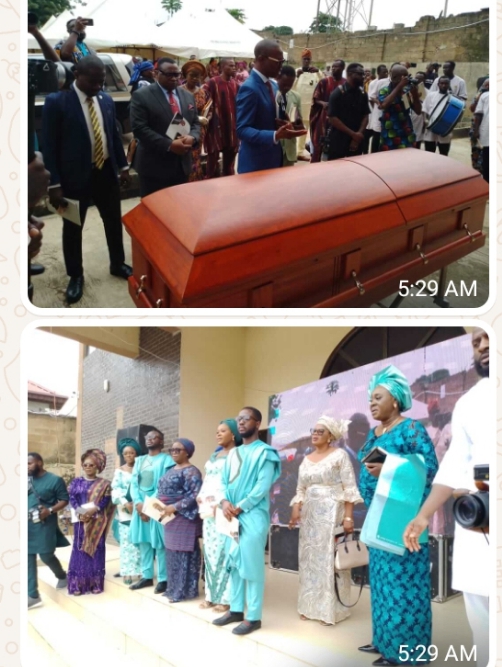
The Pastor of New Reservation Area Baptist Church, Iyaganku, Ibadan, Oyo State, Rev. Kayode Oyedemi, has narrated how late Justice Adegboye Ayinla Gbolagunte of the Oyo State Judiciary knew he was going to die and so had planned his funeral by choosing the cemetery his remains would be buried, and had paid for his vault. He made the revelation during a sermon at the funeral service for the Eruwa, Oyo State born jurist, who died June 24. Quoting from the Book of II Kings 13 and 20; Hebrew 11; as well as II Samuel 12, Dr. Oyedemi said that he had never seen anybody prepare his own funeral as deeply as Justice Gbolagunte did. “It is not unusual for saints to die of sickness from attack. “If prayers can stop death, Justice Gbolagunte would not have died because upon revelation that he would die of the sickness, we were praying, but when the sickness of the beloved is unto death, no amount of prayers can heal the sickness, no matter how perfect one could be in faith.
“The sickness of Lazarus was not unto death, but that of Elisha was unto death. “God knows why he has called Justice Gbolagunte home at this time. “While we were praying and believing that God would spare his life, he had accepted his faith himself. “I remember his last admission to the hospital about two or three days to his death. “Then I asked if he was still holding unto God in faith and he said yes. “Since last year, he had told me that his funeral is to be held in Ibadan here. “He had told me the cemetery. “I have been hearing about it, but I have not seen anybody who planned his funeral so deep as Justice Gbolagunte did. “All the arrangements you see, he had chosen and contacted people you see carrying them out. “He had contacted everybody. “When he paid for the vault, he told me, and he connected me with the person that was in charge of that. “That is to tell you that he was convinced that God said that his time had come. “And that is one of the greatest ways to die. “For you to know when you are going to die helps you to get settled, not just with God, but with every other thing. “He had that privilege. “God told Hezekiah that he would not recover, but he would die. “God said: ‘Set your house in order for you shall die.’ “It is one of the greatest ways to die. “People like that will never miss heaven. “That is the assurance that Hon. Justice Adegboye Gbolagunte has gone to be with Christ.” Addressing the children left behind by the late jurist, Rev. Oyedemi said: “You have a mother with strong faith and a prayerful one. “You have a father with a high level of integrity, who was not corrupt. “You must hold aloft the two qualities of your parents. “If we have many of Justice Gbolagunte in Nigeria, the country would be better. “He stood for integrity. “Public service holders should ruminate on this. “His colleagues should search themselves how they are dispensing justice. “Bad leadership persists when there is bad followership. “In Nigeria, we combine the two. “Are our leaders of today not followers of the past? “How much has their past criticisms helped our Nation now? “Let us ruminate on this.” In attendance at the funeral service were dignitaries from all walks of life, including the Speaker of the Oyo State House of Assembly, Rt. Hon. Debo Ogundoyin; many Judges, serving and retired; Senior Advocates of Nigeria; Nigerian Bar Association executives and members; old secondary school mates of the deceased from Birch Freeman High School, Surulere, Lagos; Baale of Aborerin in Eruwa, High Chief Olaide Ojedapo; friends and relatives of the Gbolagunte family. The 64-year-old son of a former Speaker of the Oyo State House of Assembly, Rt. Hon. Mokolade Gbolagunte, was survived by his wife: Wuraola Ayoola and three children: Oladiran, a Digital Technologist with specialisation in Network Communications; Oladoyin, a lawyer; and Oladotun, also a lawyer. It will be recalled that a Special Valedictory Court Session was held in honour of Justice Gbolagunte on July 22, 2024 at the Oyo state High Court in Ibadan, the Oyo State capital, during the weeklong celebration of his exit. On July 23, at New Estate Baptist Church, Surulere, Lagos, a Commendation Service took place for the deceased, while on July 25, there was a Service of Songs at Jogor Centre in Ibadan.
We use cookies on our website to give you the most relevant experience by remembering your preferences and repeat visits. By clicking “Accept”, you consent to the use of ALL the cookies.
This website uses cookies to improve your experience while you navigate through the website. Out of these, the cookies that are categorized as necessary are stored on your browser as they are essential for the working of basic functionalities of the website. We also use third-party cookies that help us analyze and understand how you use this website. These cookies will be stored in your browser only with your consent. You also have the option to opt-out of these cookies. But opting out of some of these cookies may affect your browsing experience.
Necessary cookies are absolutely essential for the website to function properly. This category only includes cookies that ensures basic functionalities and security features of the website. These cookies do not store any personal information.
Any cookies that may not be particularly necessary for the website to function and is used specifically to collect user personal data via analytics, ads, other embedded contents are termed as non-necessary cookies. It is mandatory to procure user consent prior to running these cookies on your website.




 She said that if there must be a positive change, there must be cooperation among media practitioners.




 “The sickness of Lazarus was not unto death, but that of Elisha was unto death.

At 58, I Have Cause To Thank Allah, Celebrate Being Alive Amidst Ordeals, By Yusuph Olaniyonu
Perhaps I should not be alive. But I am. Despite the odds, I turn 58 today. I am still frail and fragile. But now, I can stand on my feet again, bearing testimony to those sacred words of the Almighty Allah Himself that, “No soul can ever die except by Allah’s leave and at a term appointed (Quran 3: 145).”
It all started on 19 February (2024) when I drove myself into a government hospital in Abuja for an elective surgery. The surgery itself was meant to last for a few minutes and I should return home not later than two days thereafter. That was what I was told. But that was not what happened.
Since that fateful Monday morning, I have gone into and out of the surgical theatre nine times for six major operations and three minor procedures. I have spent six days in the Intensive Care Unit (ICU), surviving on oxygen and relieving myself through catheters. I have become totally dependent on others for the performance of even such personal functions as cleaning myself. I have lost 20 kilogrammes in five months and was reduced to a mere sack of bones. I have lost the use of my limbs and, like a toddler, I had to learn to walk again. I have spent millions of naira and thousands of dollars of my own and other people’s money. I have travelled hundreds of kilometres to find help. I have reached the very bottom of despair itself; and I had made plans for my own burial. But somehow, I am still alive.
I am someone you could describe as a hands-on person, or even a keep-fit buff, careful about what I eat or drink and what I do with my body. Therefore, I seldom had any need for a hospital. However, since my dad died of prostate cancer 23 years ago, the doctor had warned me that male children of prostate cancer victims are predisposed to suffering the same fate. Since my 40th birthday, I had therefore ensured that a comprehensive medical check-up was a part of my annual ritual. In the course of one of those routine check-ups, I was alerted a few years ago of an enlargement of my prostate. Following this discovery, I enrolled in a public medical facility in Abuja and made sure to see the urologist every three months. At one point, I was also advised to also see a nephrologist once in a while.
All these visits, I understood, were merely precautionary. But I was beginning to spend too much time on the waiting line in the hospital than I could afford. Before long, I changed to another hospital closer to my house. Even though it is also a government hospital, it has a private wing that charges higher fees for quicker consultations and service. I thought this arrangement served me better. I was assigned a consultant urologist of my own. And I also saw a nephrologist in the hospital. However, while the nephrologist kept assuring me that everything was fine, the urologist started to raise an alarm. At a point, he told me that if we didn’t act fast, my enlarged prostate might begin to affect my kidney. The only solution, he said, was surgical intervention.
He was the expert, so I yielded to his pressure and agreed to do the surgery. That turned out to be a major mistake. But I only became wiser by way of a horrifying hindsight. My result from the prostate test showed that I was, in fact, in a much better place than several of my friends, who all were surprised that I chose to go under the knife for an ailment that, more often than not, offers a little more than just mere discomfort, as long as it is not cancerous. They were right. The only prostate-related complaint I had was that I urinated twice or thrice at night. I did not have any pains or difficulty in urinating, or any symptom beyond the ordinary. It turned out that all I needed was a slight change in lifestyle, not drinking or eating late into the night and to continue to take the drugs that were prescribed for management purpose, which, by the way, my urologist had asked me to stop taking.
Although it did not mean much to me at the time, but in this hospital, patients do not have access to the results of their laboratory tests. The doctor electronically sends requests to the laboratory and once the patient has made payment, the laboratory will conduct the test and send the results in the same manner back to the doctor. The doctor would access the results on his computer and based on this, make pronouncements on what the patient needs to do next. In my case, the verdict was surgery.
This was why I drove myself to the government hospital on 19 February and spent the night preparing for the surgery the next day. A week before, I had gone through a cystoscopy procedure. That was my first time ever in a hospital surgical theatre. But since the 20th of February, I have been in several theatres, more than an average person would in a single lifetime. It happened that during the first surgery, the surgeons had ruptured my bladder. In panic, they had to abandon the prostate operation that brought me in, hurriedly placed a catheter inside my urethra, and returned me to the hospital ward. It so happened also that the catheter was not properly placed, so urine was not going into the bag. I was returned to the theatre to remedy the situation. When I came out this time around, the urine was reverting to my genitals, which had by now become grotesquely engorged with fluid.
Three trips back to the theatre did not change anything. And this was enough to send everyone into panic. I was wheeled into the ICU, where I passed out and had to be placed on oxygen. At this point, it had become obvious that the medical team had reached its wit’s end. It had lost control. One of them had, in fact, quietly told my family that my chance of survival was 50-50. They were already thinking of moving to the next patient. After all, they had “tried their best.
But then, to paraphrase Shakespeare, heaven has no fury like a woman about to be widowed. My wife, Odunayo, rose to the occasion. She thought that what was needed to save my life at that point were some ‘muscles’ that would compel the doctors to give me proper attention. She told my children, their friends, and my colleague, Akintoba Fatigun, who was already weeping after seeing how helpless I was, to stay strong. She picked up my phone and called my Oga, the Chairman of THISDAY and Arise TV, Mr Nduka Obaigbena, to inform him about my condition. All she needed were calls to people in top places on the need for the hospital management not to abandon me. Mr Obaigbena immediately called the Minister of Health, who in turn called the head of the hospital. He also promptly dispatched one of his top managers, Mr Israel Iwegbu, to move over to the hospital and report back to him.
In no time, I began to depend on my wife to brush my teeth, clean myself in the bathroom, put food in my mouth, perform ablution, and do any chore that involved the use of my right hand. Then my right leg soon followed. It was like something was switching off my limbs one by one. Then at night, the pains descended on my neck and shoulder like a boulder. Sleep became impossible. Turning became a torture. To find a position of relief, that small posture that would grant me a respite from this oppressive pain, no matter how fleeting, became impossible.
Akintoba also called my boss, Dr Abubakar Bukola Saraki, who was then in the United States. The former Senate President immediately directed Akintoba to get some money across to my wife and also promised to speak with the Health minister. My wife also sent an urgent message to my brother, the Senator representing my Senatorial District, Ogun Central, Senator Shuaib Afolabi Salis. The Senator immediately came over to the hospital to meet the Chief Medical Director. With all these influential forces breathing down their neck, the hospital realised that this was one patient they could not afford to trifle with. I was returned to the theatre where they had to open me up – yet again – to properly adjust the catheter and ensure that I hadn’t suffered any internal damage. I ended up spending six days in the ICU and later returned to the private room. In the ICU, the traffic and calibre of people who came to see me surprised the hospital management. One evening, Dr Saraki himself led a very long and powerful delegation to the hospital such that when he said: “Yusuph, get well fast, look at the whole troops turning out to wish you well,” I could not but agree with him. In the same way there were the visits of Senator Salis and his son, Kamal, who was always traveling down from Kaduna to see me. Just as Senator Tokunbo Afikuyomi once led his wife, children, and friends to check up on me.
After two weeks, I was discharged and went home. It was Ramadan. For the first time in over 45 years, I could not participate in the Ramadan fast. While in the hospital, I said my prayers most times lying on the bed. Although I had lost so much weight, it looked as if I was set on my way to recovery. Until something happened that would change everything, kick-starting another wave of anguish, fear and relentless pain.
Audience Survey
It was the second day after Eid-el-Fitri. My son, Oladapo had persuaded me to take a small pack of Lucozade Boost juice on Sallah day, believing this might stimulate my appetite. This was on the 10th of April. The next day, my wife observed that my urine was the same colour of the Lucozade Boost that I had taken the previous day. She felt something was wrong. However, Oladapo and I thought it could be the effect of the Lucozade Boost drink.
For some reason, my wife then brought out her blood pressure monitor to check my ‘vitals’. She found out that though I was hypertensive, my blood pressure was low, while my pulse rate was unduly high. Then, I started having this electric shock sensation once I moved my head back, even a little. She became alarmed and kept on repeating the blood pressure and pulse rate monitoring. At one point, I suggested the machine could have malfunctioned. But when she used it on herself and Oladapo, the figures appeared normal. At about 7 p.m., we all agreed to visit a nearby pharmacy to use their BP monitor to double check, so we wouldn’t raise a false alarm. But we got the same reading from the pharmacy. The alarm was then real.
Immediately, we called a urologist working in another government hospital, who after listening to us promptly declared an emergency. He then directed that we should go to the emergency ward of the public hospital where he works and he would get a consultant to attend to us. We did as he directed. But one hour after, we were still waiting. No one was in sight to attend to us. After a quick deliberation, we decided to go to the private hospital where we were normally registered. It was at the private hospital that the doctor on duty alerted us that I had a septic infection and that I could go into shock anytime. This was the second episode for me. I had suffered from sepsis during my earlier surgical rounds in the hospital. Sepsis is a condition in which the infection-fighting processes turn on the body, causing the organs to malfunction. In other words, my body was beginning to poison itself.
The doctor at the private hospital urged me to hasten to the public hospital where I was recently treated. We called the urologist again. He directed that we report to the Accident and Emergency Ward. We did. Yet again, the doctor that was meant to receive us was nowhere to be found. Several panicked calls to her number, and there was no response. After what seemed like eternity, she suddenly materialised. She had gone to eat, she said, casual and indifferent as nature itself. This time, I was to spend nine days in the hospital.
But at this point, we had lost confidence in my urologist and we had started to make arrangements to find a hospital in Egypt to continue the treatment. One night, my family insisted that I should be discharged, even if against medical advice, so that I could make a scheduled trip to Egypt. My wife already signed the Discharge Against Medical Advice (DAMA) form before Senator Salis phoned me and said we should hold all actions until he arrived, as he had invited a leading expert in urology from one of the universities in Lagos to review my case that same night. The Professor came in with the senator and took us through an hour-long lecture on the issues. He concluded that the case was not beyond what could be handled in the hospital. But “things could have been done differently during the surgery.” He also enlightened us that with sepsis not properly treated, it was doubtful if I could make a five-hour journey in an airplane to Egypt. He had come with a more senior urologist in the same hospital, who had been his student. We all agreed that I would stay if he could guarantee that the more senior surgeon would take over my case and report progress to him and the Senator.
Again, I returned home. This time I even felt better and was confident that my recuperation had started. But it turned out to be the calm before the storm; the biggest storm of all. We found out that as the days went by, I started to lose control of my limbs. As usual, my wife was the first to raise the question one morning. She asked why I staggered each time I tried to walk. I said it could be because I just woke up. I tried to allay her fears, but I could not hide for long. Soon, I was not able to raise my hand. My initial thought was that this was because I had stopped my morning exercise. I then resumed some guided workout sessions where one of my sons and Kamal Salis, my Senator’s son, would guide me through. But instead of any improvement, things continued to degenerate, and they were happening so fast.
In no time, I began to depend on my wife to brush my teeth, clean myself in the bathroom, put food in my mouth, perform ablution, and do any chore that involved the use of my right hand. Then my right leg soon followed. It was like something was switching off my limbs one by one. Then at night, the pains descended on my neck and shoulder like a boulder. Sleep became impossible. Turning became a torture. To find a position of relief, that small posture that would grant me a respite from this oppressive pain, no matter how fleeting, became impossible. All through this ordeal, I had tried to be brave. Now, I could no longer hold back. I cried. The pain was just too much. And it came in the night. Therefore each night approached with terror because I knew what laid in wait for me in the dark. Maybe if I stayed up. I told my wife that perhaps, I should try to sleep in a sitting position. But nothing I tried helped. The name given to this one, this latest harbinger of pains, is cervical spondylosis. But little did we know that it was much worse than that. One Saturday, we decided to go to a private hospital that specialised in orthopaedics. We were told to come back the following week’s Wednesday. But the pain would not relent. Whatever I did, wherever I turned, it flogged me like an errant child. The hospital later called to make a change from Wednesday to Friday. But by then, we had already sought a more urgent alternative. At 9 p.m. that same night, we met the orthopaedic surgeon. He recommended some drugs and a neck collar, which I must now wear on like a shackle. That night, after a long time, I had a strange sleep without pains. But it was like shooing off a wild dog with a stick. It may back off for the moment, but it would come back. By the next day, the pain returned, ferocious, as if angry to be disrupted for one night.
When the orthopaedic surgeon saw the result of the MRI test, he took us to see a neurologist in a private hospital as well. The neurologist explained that some bones had ruptured in my neck, which had disorganised the nerve supply system from the brain down to the limbs. Again, I had to go in for a surgery to restore the functioning of the nerves. The operation was to be carried out on 13 May. While waiting for the appointed date, my colleague, Akintoba Fatigun came to see me.
Before our next appointment with the orthopaedic surgeon, we took the initiative to do an MRI test. But by then, my case had become a desperate emergency. All my limbs have packed up. Throughout these ordeals, I had never missed my prayers and supplications to Allah. But that morning, I could not move even one finger to press the electronic counter or hold the tasbih.
“Is this illness also going to separate me from my God in my last days?” I lamented to my wife. She said it was only temporary and everything would be fine. But I learnt she later went into the bathroom to cry. She is a brave woman. But I am sure by this time, even she would also have started to contemplate the worst.
When the orthopaedic surgeon saw the result of the MRI test, he took us to see a neurologist in a private hospital as well. The neurologist explained that some bones had ruptured in my neck, which had disorganised the nerve supply system from the brain down to the limbs. Again, I had to go in for a surgery to restore the functioning of the nerves. The operation was to be carried out on 13 May. While waiting for the appointed date, my colleague, Akintoba Fatigun came to see me. He thought I was getting better. Many of my friends who were speaking to me on the phone thought the same, because despite all that I had suffered, my voice had remained strong and clear. I told Akintoba that in fact, the situation had gotten worse since the last time he visited and that I was actually waiting for another surgery.
When Akintoba left the house, he went straight to Dr Saraki’s residence and told him of my situation. The former Senate President immediately started to make calls to different hospitals in Saudi Arabia, the UK, and the US. I did not have a valid US visa and we had no time to apply for one. The Saudi hospital, after studying the MRI, later replied that they could not deal with the situation. Then, someone suggested Egypt. Contacts and appointments were made. To enter Egypt, one only needed a valid UK visa to obtain the Egyptian visa at the point of entry. By Monday, 13th May, I was set to travel. Dr Saraki had purchased business class tickets for my wife and I. He also provided money to pay for the surgery and living expenses for a month. A day before my departure, the house was full with several family friends, despite our best efforts to keep the trip as confidential as possible. They were people from different parts of the country and people of different religious persuasions. At that point, I was not Yoruba or Muslim to them. I was just another human being. Even as I lay helplessly in bed, contemplating the motley crowd that had gathered in my room, I wondered if they thought they were saying a final goodbye to me.
It was time to go. My wife and second son, Oladipo, had already packed the bags. Then we realised that there was yet another important challenge. My room was on the second floor. How do I get down and into the car? We could only think of two options. Oladipo would have to carry me on his back and take me downstairs or I would have to crawl down the staircase. But even these two options were fraught with risks. Yes, I had lost so much weight and Dipo is a burly young man, but he is only 23. The thought of having my son carry me on his back because I could not walk was a distinct trauma on its own. But what if he slipped, and we both crashed to the ground? There could only be one outcome. How would the young man forgive himself? But none of these happened. Dipo successfully carried me downstairs and got me safely into the car.
On the way to the airport, I told my wife what my Plan B was, if Oladipo had been unable to carry me, to crawl downstairs. “That would have broken me,” she said. I responded with a joke that I needed her to remain unbroken because a broken man could not depend on a broken woman. In the last five months, she had become my in-house nurse, minder, and caregiver.
Five hours later, we landed in Cairo. My hospital, Neuro Espitalia, is located in a city called 6th of October, which is about an hour’s drive from the Cairo International Airport. I learnt that the city got its name in commemoration of the day one of the Arab-Israeli wars broke out. We were joined at the airport by my third son, Oladepo, who had arranged a two-week leave from his London office and another two weeks to work from the Cairo office of his company. He was to provide an additional hand to me in Egypt for the next one month. Our guide was a Nigerian gentleman called Rabiu Hamza, a PhD student in one of the Egyptian universities. We arrived at the Neuro Espitalia at about midnight on that Monday. For the second time in almost a month, I had another sound sleep. Tuesday was devoted to various laboratory tests and to getting my medical history. On Wednesday morning, I had the surgery, which, as they explained, was to “clean an abscess in the cervical vertebrae, stabilise the cervical vertebrae and expand the neural canal.” I didn’t understand everything, but I just wanted to get well. The surgical operation was led by Professor Ibrahim Lotfy, an elderly but friendly surgeon, and Professor Dalia Rushdi.
After the successful operation, the surgical team decided to culture fragments of bones and tissues extracted from my back to determine what went wrong in the first place. It was an investigation that took days and a lot of blood tests. What they found was, to say the least, shocking. It was described in medical terms as “necrotizing Granulomatous Inflammation Compatible With Tuberculosis of the Vertebrae. No malignancy.” In short, it is called tuberculosis of the vertebrae. This was the stealthy thief that had been stealing my limbs, one by one. But even the surgery could not return everything this disease had stolen from me. I had to recover them myself by re-learning the use of my legs and hands again.
This was when I realised how much grateful humans should be to their creator for even the most simple things we take for granted everyday. I realised that even the mere ability to scratch one’s face when it itches, what we do countless times everyday without even thinking about it, is indeed a big deal. When my face itched, I would need my son or my wife to scratch it. To change my sleeping posture, I would need them. To change the position of my hands, or clean the sputum that come sometimes when I coughed, I needed them to do these and everything else for me.
At the government hospital in which I was almost killed, a night’s stay in the ICU costs ₦150,000. I doubt that many hotels charge that much for a standard room. Yet, patients are still made to pay what they call “utility fees,” calculated by the number of days a patient has spent in the hospital. We are not even talking about the cost of medication and drugs. The same hospital sold Tavanic 500mg, an antibiotic used for the treatment of infections for N42,000, while a pharmacy located only a few metres away from the hospital sold the same drug for N20,000.
At a point I could no longer fold my fingers to form a fist in order to allow nurses take blood samples or fix the cannula for intravenous infusion. Over the past five months, my arms had been covered in needle marks like a dedicated drug user; to administer some injections, to take blood or to fix the cannula for intravenous medication.
A few days after the surgery, I began physiotherapy sessions in the hospital. Several physiotherapists came to work on me. But a particular one stood out for me. His name is Ahmed El-Sanadidy, the man from Alexandria. Even after I left the hospital for a rented apartment close by, we contracted El Sanadidy to continue my rehabilitation therapy. He got paid per session. He was such an effective, devoted, passionate, friendly, hardworking, and creative professional. He was also in hot demand in his hometown, Alexandria, and in the city of the 6th of October. In the early part of our sessions, he would form a protective ring around me with his arms to guard me from falling. He taught me to walk all over again, to climb the stairs, to use my arms, to strengthen my fingers, and to regain some level of physical fitness. I called him ‘my boss’. He was the reason I extended my stay in Egypt to two months. He was making some very good progress with my rehabilitation and I did not want to terminate it abruptly.
But there was yet another challenge. The hospital had tried in vain to get me to go to the toilet. For almost two weeks, even after two sessions of enema, nothing came out. After we moved to the apartment, I thought the privacy of a home would help, but nothing. I would feel pressed to use the toilet and spend time siting and groaning in pain, but nothing would come out. It was later realised that the muscles around my waist had become so weak they could not exert sufficient pressure to push out the waste. This became another source of agonising pain. My stomach felt as solid as if I had been fed concrete cement. This became another major prayer point for me.
“You should be saying ‘Alhamdulilahi Rabbil alaamin’ because we should let our gratitude to God be more than our requests to Him,” my wife said one day as I was petitioning God over the agony of my plumbing problem. It was a test of faith. But it was also a lesson never to forget. One morning, the plumbing problem resolved itself, not in the most dignifying manner. Since then, it has been easier than ever doing my ‘toileting business’. For more than four months, I was carrying a catheter around. At a point, they became two. But now, I am free of both of them.
Now, I am a bit stable. I can walk unaided. At a time I could not even move a finger, but now I can sit down and type this piece on my iPad. I can perform my salat, the ablution, ruku (bowing), and the sujud (prostration), all on my own. There was a time in the past when I had to rely on people to do ablution for me and I had to pray lying down. I could not even turn my head to the left or right. I stared at the ceiling all the time and developed a system that enable me use marks on the POP on the ceiling as counter for my supplications. I have learnt not to take anything for granted and to thank my maker for enabling any physical move that I am able to make.
I have written this piece to celebrate the fact that I am alive, despite my ordeal in the past five months. But I have also written it to share my experience of the Nigerian medical system. Even before I traveled to Egypt, I realised that so much is wrong with our medical system, for which I nearly paid with my life. But my experience in Egyptian hospitals and with Egyptian doctors made me realise this even more. Why do our doctors behave as if they are being forced to be doctors; as if there is no minimum standard to which they must comply; as if they can do anything and get away with it; as if it was enough for them to just claim that they tried their best? The Egyptian hospital was replete with stories of Nigerians who come there to correct surgical operations that had been performed in Nigeria, some from glamorous hospitals in Abuja where they charge exorbitantly.
At the government hospital in which I was almost killed, a night’s stay in the ICU costs ₦150,000. I doubt that many hotels charge that much for a standard room. Yet, patients are still made to pay what they call “utility fees,” calculated by the number of days a patient has spent in the hospital. We are not even talking about the cost of medication and drugs. The same hospital sold Tavanic 500mg, an antibiotic used for the treatment of infections for N42,000, while a pharmacy located only a few metres away from the hospital sold the same drug for N20,000. In Egypt, we bought the drug for 124 Egyptian Pounds which is about N4,092, at the exchange rate of ₦33 to one. How did we find ourselves in a situation where government hospitals have become the most expensive and the most inefficient in Nigeria? Health workers, doctors, nurses, etc., in the private hospitals may not be any better, but at least they appear committed to their jobs. Public health workers in Nigeria behave as if they would rather be somewhere else, as if they are actually doing the patients a favour. The painful truth is that they don’t care whether you live or die. There is work here for everyone – the government, professional bodies and training institutions.
I was lucky to have powerful people who could muscle them. What about the millions of Nigerians who don’t know anybody? If I were in their situation, I would have long been forgotten. Why would a Nigerian need tonnes of money and powerful friends to stand a chance of surviving a medical challenge in our country?
My last words are for those of us whose work demands long sitting hours. We need to be mindful of our sitting postures and be sure to get up intermittently. Please don’t ignore any pain. Regular check up can make a difference between life and death. Today I am alive. I give thanks to the Almighty Allah who has given me a second lease of life out of his infinite mercy, not necessarily because I deserve it. All glory be to Him.
Yusuph Olaniyonu a communications strategist, journalist, lawyer and public affairs analyst, wrote from Abuja.