President Muhammadu Buhari, watching Super Eagle match from his hotel in Addis Ababa, Ethiopia this evening.
President Muhammadu Buhari returned to his hotel room in Addis Ababa where he is attending the African Union (AU) Summit to watch the Super Eagles defeat their Angolan counterparts 2-1 to zoom into the semi-finals of the ongoing African Nations championship in Morocco.
Hardly had the refree blew the whistle to end the match than the President sent message congratulating the victorious Super Eagles on the spectacular 2-1 win against Angola in the CHAN quarter-final match today in Morocco.
Senior Special Assistant to the President on media and publicity, Malam Garba Shehu, in a statement, said that President Buhari returned to his hotel room after a long day of meetings which started at 8:00am and ended at 5:30 pm, to watch the match, adding that the President wished the Eagles “the very best for the upcoming matches.
The Eagle had come from behind to beat Angola 2-1 at a point when Angola players were in festive mood to go away with victory.
However, by a struck of the luck, Nigeria equalized at the injury time, making it possible for the game to dovetail into extra-time.
After a goalless first half, Angola opened scoring in the 56th minutes through Va and held on after normal time before the Eagles equalised.
Okpotu equalized for Nigeria on two minutes of the three minutes added time. It was a deserved goal after the Eagles had mounted pressure on the Angolan defence.
Poor finishes in front of goal had been the Eagles bane. They could have won the match easily if they had taken their chances.
Okechukwu gave Nigeria the victory when he scored the winning goal in the 111th minute of extra-time to put the game beyond the Angolans.
There is no doubt that Nigeria is gradually sliding into a police state going by the stomach-churning advice by the Kano State Commissioner of Police, Mr Rabiu Yusuf, that a former state governor and current senator, Rabiu Kwankwaso, should shelve his scheduled January 30 visit to Kano, his home state. What is going on, for God’s sake, in Kano state? Why have the police, acting in concert with the state governor, Dr Abdullahi Ganduje, decided to declare him more or less a persona non grata in his own state? The police are trying to unconscionably abridge the freedom of movement and civil liberties of Kwankwaso. But as of the time of writing this piece, Kwankwaso has reportedly said the police cannot stop him from going to Kano to peacefully see his constituents. He is very right on that score. The former governor should not be left alone to fight this unconstitutionality. All well-meaning Nigerians must condemn the unsophisticated approach by the state to suppress Kwankwaso and upstage his seemingly robust political structure. Advising the former governor to suspend his planned visit to Kano was patently wrong. It offended the spirit of fair dealing. That piece of advice is bad news which has the potentialities of far-reaching implications for the polity. If the police gambit is allowed to succeed, the state governor can continue to influence or instigate the Police Commissioner to adopt the same strategy over and again to perpetually keep Kwankwaso away from the state. At the moment, there is tension in a vast majority of the states and the police commissioners in those states have not advised or barred representatives of the people or politicians from their states. Since it is an open secret that Kwankwaso, who gave President Muhammadu Buhari a good fight for the presidential ticket of the All Progressives Congress (APC) in the 2014 presidential primary, is nursing a presidential ambition in 2019, the strategy of the chief security officer of the state and the police commissioner may have been orchestrated to terribly hurt Kwankwaso’s political and logistical mobilisation that should naturally begin from his home state. But the government action to unnerve Kwankwaso, to say the least, is an affront on democratic ethos. Popular participation in democratic engagements should neither be under enemy control nor held hostage by a self-imposing police state as it is grotesquely manifesting in Kano. This official disposition is primordial, anachronistic and tendentious in its form, shape and texture as well as counter-productive to the democratic testimonial of the APC-controlled government. How sadly have the police become petty, partial and partisan of the ruling government such that a leader of the ruling party can be subjected to this kind of treatment? But the joke is on the police, the government and the APC: first, that they do not have the capacity or the temperament to accommodate seeming opposition from within their ranks; and, second, that they cannot ensure simple security for Kwankwaso, his supporters and public facilities. By the way, is Kwankwaso going to Kano to organise or lead a violent protest? Certainly not, except agents of the state decide to infiltrate the group of his supporters and try to precipitate violence from within in order to justify the preconceived advice by the police to keep him away; and, for as long as possible. If that is not the case, I do not see anything difficult in the police providing protection for Kwankwanso and the crowd of supporters that would welcome him to Kano. After all, the police have been giving protection to pro-government protest marches. Why have they considered Kwankwaso’s historic visit to Kano a difficult event to handle? If the fear expressed by the police commissioner as to the possibility of disgruntled elements hijacking the visit is real, then what that simply explicates is that the disgruntled elements would certainly not be from the camp or among the supporters of Kwankwaso but from the governor’s camp. It is not a secret that there is no love lost between the two leaders. It therefore will not cost the state government too much to sustain the grounds of “tensed atmosphere” to keep Kwankwaso away from the state. Ganduje is gripped by a morbid fear occasioned by the popularity of his former boss and predecessor in office. Kwankwaso’s political structure in Kano is pervasive and solid. Ganduje’s deputy, Professor Hafiz Abubakar, is a product of that structure. Following the cold war, Ganduje has reportedly sidelined Abubakar. The professor, according to media reports, has said he would dump Ganduje and return to the classroom at the Bayero University at the end of his first term in 2019. The governor is fast losing grips. But he has quickly done a few things in order to preserve his position: alignment with President Muhammadu Buhari in the calculations that he would be able to use that to clinch the party’s ticket and also re-election. He also enlisted in the group of seven governors that stormed Abuja while the 73 Nigerians massacred in Benue by Fulani herdsmen were being buried in Makurdi, to mollycoddle the president to run again for the presidency in 2019. Clinching a second term in office may not be a smooth ride for Ganduje given the nature of Kano politics, which predisposes the people to most of the times diverge from mainstream parties that hold the levers of power in Abuja. Such unpredictable political tenacity to embrace opposition politics has, indeed, defined Kano as the archetypical hotbed of northwest politics. Kwankwaso himself was a victim in 2003 when he was denied re-election by the people who voted for Malam Ibrahim Shekarau on the platform of the All Nigeria Peoples Party (ANPP) instead. This is the historical example, nay reality that Ganduje will have to contend with. There is no doubt that Kwankwaso has become the real issue in Kano politics. As it is, even when he has not made any statements that could be construed to be critical of the APC-led federal government, the fear of his deft political moves has become the beginning of wisdom to the party leadership in the state. Why should they not fear Kwankwaso who, as governor, delivered about two million of Kano votes, even if somewhat controversial, to Buhari in the 2015 presidential election? But the way they are going about trying to tame him is certainly a crying aberration in a democracy. To practically bar Kwankwaso from going to Kano on a home visit is not only jejune but also faute de mieux counter-productive to the APC’s assertion of political accommodation and tolerance.
Ojeifo, editor-in-chief of The Congresswatch magazine, can be reached on: ojwonderngr@yahoo.com[myad]
Governor Aminu Waziri Tambuwal of Sokoto state has virtually pushed 115 reluctant indigenes of the state into the Federal Government Girls’ College in Sokoto to begin academic pursuits. According to information reaching us, the girls are being sponsored by the government of Tambuwal after they were identified by the newly-created Agency for Female Education. Report had it that the governor got worried when he discovered that the number of Sokoto indigenes in the school, located in the state, is less than 30. Confirming the development to reporters in Sokoto, Special Adviser to Governor Aminu Waziri Tambuwal on Girl Child Education, Dr. Amamatu Yusuf, said that the governor acted when it was brought to his attention that there were few Sokoto indigenes in the school. “The Agency for Female Education liaised with the Ministry for Local Government to source for students from the 23 local government areas of the state. We organized an entrance examination for them and the best among them were offered admission. “To lessen the burden on parents, Governor Tambuwal gave approval that all necessary materials needed for fresh students in the College be provided for the new intakes. “We therefore distributed mattresses, school bags, sandals, mosquito nets, blankets, schools wears among others free of charge to support them.” The governor’s adviser confirmed that all the girls were admitted into JSS 1 and 2 and SSS 1 and 2 respectively. “We will continue to monitor the progress of the girls. Even though this admission circle is over, next time, we will also ensure that anywhere there is deficit in the number of our girls in any College in the country, we will fill it up without hesitation.” Governor Tambuwal recently created the Agency to promote and coordinate female education and all issues related to female education from basic to tertiary levels in the state. [myad]
The new chairperson of the African Union (AU) who doubles as President of Rwanda, Paul Kagame has confessed that leaders on the African continent have failed to create a pathway to prosperity for their peoples. He said that over the years, leaders of the continent have busied themselves studying how Asians got industrialized, forgetting that such system was no longer tenable for Africa. Kagame, who spoke today, Sunday while taking over the mantle of leadership of the AU from Alpha Conde, President of Guinea, said that technology has evolved so fast that Africa’s window to follow that strategy is narrowing much more rapidly each day. According to the AU chairperson, the continent is running out of time and efforts must be geared to save Africa from permanent deprivation. “Africa’s defining challenge is to create a pathway to prosperity for our people, especially young people. “Elsewhere, this has been achieved through industrialization but the growth trajectory that transformed Asia is not necessarily any longer a viable option for Africa, simply because we waited too long to act. “Technology has evolved so rapidly in recent years, that Africa’s window to follow that strategy is narrowing much more rapidly than previously understood. We are running out of time and we must act now to save Africa from permanent deprivation.” Kagame stressed that if Africa must take centre stage in up-scaling its development process, it must create a single continental market, integrate infrastructures and infuse technology into national economies. ”Scale is essential, we must create a single continental market, integrate our infrastructure and infuse our economies with technology. “No country or region can manage on its own. We have to be functional and we have to stay together. The financial and institutional reform of the African Union derives all of its urgency from these realities.”[myad]
Nigeria’s foremost business magnate and President of Dangote Group, Alhaji Aliko Dangote, has completed a N1.2 billion structure for running of business school in Bayero University, Kano (BUK). The building which is scheduled for formal handing over to the university management next month, is a state of the art edifice, the first in the Northern part of Nigeria. The President of Dangote Group, said that the structure is part of the efforts to build entrepreneurship in the sub-consciousness of Nigerian through education at the highest level. He said that the present situation in Nigeria necessitated the revisiting school curriculum to reflect the new consciousness of entrepreneurship and manufacturing to encourage the study of business, especially at the second level in the university.
Speaking on the gesture of Dangote, the Dean of Faculty of Dangote Business School, Professor Murtala Sagagi recalled that until Dangote started the project, there was no such Business School in Bayero University, Kano (BUK). “We have an ambition to have a business school and we could not go ahead with the project because there was no befitting structure to accommodate the kind of dream we had but with Dangote coming in about five years ago and that was when the University decided to say this is the time to have the business school.” He said that Kano is the second most vibrant commercial city in the country after Lagos, adding: “we have industries, Banks, different type of businesses, micro, small, medium and large enterprises. “We are having large scale investors from China, Spin and all over the world coming to Kano to make investment and this means the State needs an institution, a kind of faculty, school that can able to develop the capacity not only the management of those organisation but those people who are working in different units or department within the organisation. “Looking at the public sector, we have limited capacity in budget, project management, which has led to things not moving well in the country. With our unique disadvantage here in Northern Nigeria, the South is far ahead in terms of capacity level, for example there are about 20 universities in Ogun State, while in Kano State we have only three Universities and all of them owned by either by the state government or federal government. It is just of recent we are getting private investors to coming in.” Sagagi pointed out that all these show that there is a need for massive capacity building in Management, Finance, Marketing, E-Business, and particularly entrepreneurship and innovation in this part of the country and also for the entire country. “Bayero University has a unique reputation in the whole country and this explains why in the last National Institution Accreditation exercise, BUK became the best University in the Country, not because we have the best of everything but because of the quality of our curriculum, faculty and most importantly the quality of the students. “The Dangote Business School is a great development and we hope that this business school will not only be seen as a Kano business school or Northern business school because I can tell you about 40 per cent of our students are not from Kano and more than 22 per cent of our student are from Southern part of the country.” He called on other eminent Nigerans with wealth to emulate Dangote and contribute to the education advancement of the nation as a way boosting the country’s economic development pointing out that “if Nigeria is blessed with two of Alhaji Dangote, Nigeria will witness unprecedented economic boost in terms of job creation, employment and poverty reduction.” Information had it that Dangote is building a similar business school in the University of Ibadan and would be commissioned anytime soon. The one in BUK has been completed and awaiting commissioning. It is a modern Business School comprising auditoriums, lecture theatres, offices, classes, library, and complete electrical fittings and cooling system, among others[myad]
President Muhammadu Buhari sitting at the AU Submit in Addis Ababa, Ethiopia
President Muhammadu Buhari has drew the attention of his fellow African leaders to the greatest evil corruption represents on the continent. He said that corruption threatens the security, economy and progress of every country on the continent. Speaking today, Sunday when he formally launching the African Anti-Corruption Year 2018 during the Opening Ceremony of the 30th Ordinary Session of the Assembly of Heads of State and Government of the African Union in Addis Ababa, the Ethiopian capital, the President declared: “Corruption is indeed one of the greatest evils of our time. Corruption rewards those who do not play by the rules and also creates a system of distortion and diversion thereby destroying all efforts at constructive, just and fair governance.” Speaking as the Champion of the theme of the 30th AU Summit, namely, “Winning the Fight against Corruption: A Sustainable Path to Africa’s Transformation,” President Buhari expressed gratitude to his African colleagues for entrusting him with such a noble responsibility. He pledged to do his best “to ensure that the anti-corruption agenda will receive the attention it deserves and make the impact we all hope for, during 2018 and beyond.” President Buhari said that Africa has made some significant strides in enacting legal and policy frameworks such as the African Union Convention on Preventing and Combating Corruption (AUCPCC) to address the vice, adding that the desired impact had been lacking. “Fifteen years after the adoption of the African Union Convention, 2018 provides a good starting point to take stock of progress made so far, assess what still needs to be done and devise new strategies to address new corruption challenges.” According to President Buhari, in spite of sustained economic growth on the continent for the past two decades, “public confidence has been eroded by a focus on short-term priorities and payoffs, propelled by corruption, which too often leaves projects uncompleted and promises unfulfilled.” He identified other negative effects of corruption as, posing a real threat to national security; eroding the development of a universal culture of good governance, democratic values, gender equality, human rights, justice and the rule of law. In tackling bribery and corruption, the Nigerian leader said the crucial place of strong institutions cannot be over-emphasised. “A Judiciary which stands firm against arbitrariness and injustice by the executive is a vital pillar in the anti-corruption fight. As leaders, we must build synergy between the Executive, Legislative and Judicial arms of government in order to entrench good governance, transparency and accountability. “Strong institutions are a necessary condition in any society which aims to fight corruption. In building strong national and regional institutions, we must adequately empower our national anti-corruption agencies and insulate them from political influence. We have to encourage increased institutional collaboration between Law Enforcement Agencies and anti-corruption Agencies in order to win this fight.” Justifying further the imperative to defeat the evil which corruption represented, President Buhari said: “It is evident that Corruption has a devastating impact on marginalized communities especially the youth, women and children. Corruption breeds unequal societies, renders vulnerable groups prone to human trafficking, as well as recruitment into armed groups and militia. In effect, corruption deprives our young citizens of opportunities to develop meaningful livelihoods.” He listed his priorities in the campaign against corruption in 2018 to include, organising African Youth Congresses against Corruption “in order to sensitise and engage our youth in the fight against corruption; mobilising AU member states to implement the extant legal framework on corruption; and canvassing for the strengthening of the criminal justice system across Africa through exchange of information and sharing best practices in the enforcement of anti-corruption laws.” The President, who called for the strengthening of the AU Advisory Board on Corruption to make it more proactive, also proposed to enlist the support of parliamentarians, women associations, the media, business community, faith-based groups, the youth, educational institutions and traditional rulers among others in the campaign. He said that Africa loses about 50 billion US dollars annually to corruption, even as he advocated greater efforts in addressing the causal relationship between corruption and illicit financial flows. Buhari drew the attention of his colleagues to what he called “the corrosive” role that tax havens and secret jurisdictions play in concealing ill-gotten assets, saying that the continental body must do more to stop the continuous assault on our economic and financial resources by multinationals in collusion with some of our citizens. He stressed that tackling corrupt acts and greed required a reorientation of attitudes and perceptions, adding: “to win the fight against corruption, we must have a CHANGE of mind set.” He reminded his fellow African leaders that the honourable campaign against corruption will not be an easy task because as “corruption does fight back.” He advised them to remain firm and resolute. The Nigerian leader, who said that he was inspired to champion the campaign against corruption by the commitment, encouragement and support of his colleagues, said: “in Nigeria, we have gone far into the implementation of our CHANGE Agenda, which is primarily aimed at fighting corruption.” President Buhari also reiterated Nigeria’s abiding commitment to the fight against corruption “today, tomorrow and the day after tomorrow.”[myad]
New Director-General for the National Intelligence Agency (NIA), Ahmed Rufai Abubakar has made it clear that he and his wife are full-blown Nigerians even from the same village. Rufai Abubakar, who is reacting to series of allegations by those who questioned his new appointment, said that he never at any time held Chadian nationality and that his only wife hails from Katsina State: “from the same community.” He described the series of allegations against him in social media and main stream media as half-truths, misinformation, and outright falsehood.” The reaction, which contained in a statement by the special adviser to President Muhammadu Buhari on media and publicity, Femi Adesina some of such unfounded stories include that Abubakar had retired from the services of NIA as an Assistant Director, because he failed promotion examinations twice, and had to quit, willy-nilly. The statement recalled other allegations to include claim that he is married to a Moroccan, and so cannot hold such sensitive security position, “while others say he was born and bred in Chad, and he holds dual nationality. All these have been widely disseminated on the social, and some mainstream media. “With the formal assumption of office by Mr Abubakar, it is now necessary to set the facts straight. “The new NIA DG retired from Foreign Service as Deputy Director (not Assistant Director) and three times during his career, had won Merit Award for competence and meritorious service. Failing promotion examination can only exist in the fecund minds of fiction writers. His last position before the new appointment was as Senior Special Assistant to the President on Foreign Affairs/International Affairs where again he quietly proved himself. “Abubakar’s parents hailed from Katsina State, and had settled in Chad at a point in their lifetime. “The new DG did his primary school in Ndjamena (then Fort-Lamy), but returned to Nigeria for his secondary and University education. He never at any time held Chadian nationality. “Mr Abubakar’s only wife hails from Katsina State, indeed, from the same community as the husband. The story of being married to a Moroccan can only be tale by moonlight, concocted by people who love a fib. “The President appointed the new DG because he had worked closely with him in the past two years, and sincerely believes that he would add value to the NIA.”[myad]
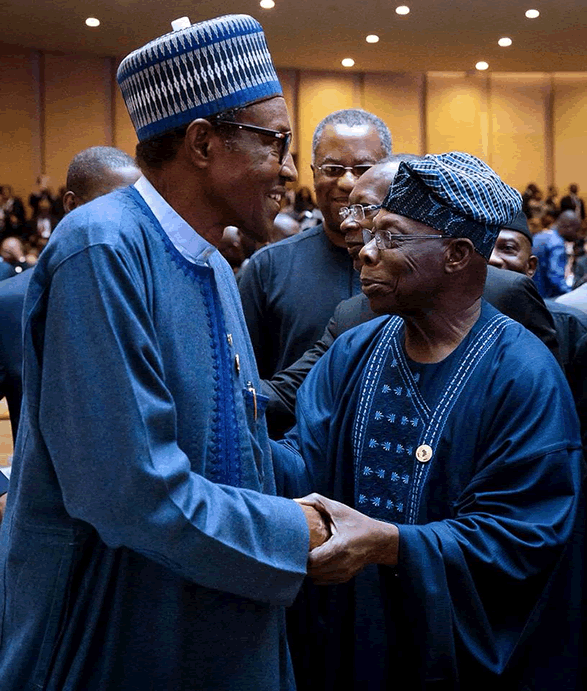
Chief Olusegun Obasanjo meets President Muhammadu Buhari in Addis Ababa, Ethiopia
Former Nigerian President, Olusegun Obasanjo, displayed his usual pleasantness towards anyone he hits silly, when today, Sunday, in Addis Ababa, he looked for President Buhari for a handshake. Eye witness account at the ongoing African Union (AU) Summit in Addis Ababa, Ethiopia, said that Obasanjo had first gone round to exchange pleasantries with other African leaders attending the summit, before looking out for Buhari in the crowd to also have a word with him. The eye witnesses who are journalists covering the Summit, report that the brief meeting of the two leaders raised excitement in the Nelson Mandela Hall with photo journalists busy recording the handshake. The meeting of Buhari – Obasanjo today came, about a week after Obasanjo had released a 13-page statement accusing Buhari of under-performance as President and asking him not seek re-election in 2019. Since then, Nigerians have been queuing behind the two leaders, for and against, thereby creating some kind of political tension in the country.
Nigeria’s Falconets thrashed South Africa 6-0 at the Samuel Ogbemudia Stadium in Benin City today, Saturday to qualify for the 2018 FIFA Under 20 Women’s World Cup in France.
The Falconets went through on a 8-0 aggregate score.
Gift Monday opened scoring for the Falconets after seven minutes with an assist from the outstanding Rashedaat Ajibade.
Ajibade turned scorer in the 21st minute, when she rounded up the South Africa goalkeeper before she found the back of the net.
Five minutes later, Anam Imo made it 3-0 off a rebound, before Ajibade got her brace in the 32nd minute.
Gift Monday then got her own brace on 39 minutes while Anam Imo got her brace in the 73rd minute.
The only blemish on Nigeria’s copy book was the dismissal of goal star, Gift Monday three minutes from time after a second booking for a poor tackle.
The 2018 FIFA U20 World Cup will be played in France in August this year.
Nigeria had reached the final of the tournament twice, in 2012 and 2014. The
Falconets have made nine straight U20 World Cup appearance. [myad]
Chief Olusegun Obasanjo and President Muhammadu Buhari
In a tweet on former President Olusegun Obasanjo’s evangelical press statement of Tuesday, January 23, 2018, calling on President Muhammadu Buhari not to seek re-election in 2019, having spectacularly failed the critical governance test, former Minister of Aviation, Chief Femi Fani-Kayode, who is ill at ease with the Buhari administration, wrote: “Obj has spoken, matter closed.” Whereas I concur that Obasanjo had, indeed, spoken, and forcefully at that like a clap of thunder, I am not sure that the matter has closed.
In fact, the former president has succeeded in pulling the Tiger by the tail and challenging the creature to a battle of wits -whether subtle or obvious. “Ga fili, ga doki”, meaning “see field, see horse” was what Obasanjo said in 1998 when he was asked about his readiness for the presidential contest after he had clinched the presidential ticket of the Peoples Democratic Party (PDP). Buhari may seem to be saying exactly the same thing.
I have a strong feeling that Buhari is very angry at Obasanjo’s open vilification of his government and governance style; and, that he is ready to go the whole hog in a bid to prove a point to Obasanjo. I may not know, as of now, the point Buhari may want to prove and how he intends to prove it, but the one thing I know is that both of them are already locked in a brewing grudge fight. It may be understandable if Buhari feels that he is entitled to a second term in office, whether he performs to Obasanjo’s satisfaction or not. After all, Obasanjo, not being a saint or a perfect administrator, brooked no opposition to secure re-election in 2003 and even attempted constitution amendment that would have provided him with tenure elongation or a third term in office.
Interestingly, both power-loving leaders have the distinction of being retired army generals and war strategists. They are also not new to battles-having both played some commanding roles in the nation’s three-year civil war from 1967-1970. To be sure, political battles are, however, different kettles of tea. They are about wiles or guiles; dissembling or dissimulation; falsehood or dishonesty; undermining or undercutting; betrayal or disloyalty, et al. They are about one entity outfoxing the other.
While Obasanjo is calculating, Buhari is crafty. He has attacked what is most important to Buhari – presidential power – even if he is, perhaps, holding it just for the sake of it. If Buhari recalls the number of times he had unsuccessfully attempted to mount the presidential horse, he would expectedly and naturally be inclined to take on Obasanjo in defence of his prized possession.
The prudent reaction, about twenty four hours later by the Minister of Information, Lai Mohammed, to the former president’s critical deconstruction of Buhari and his presidency should not be misconstrued for cowardice or intimidation. Buhari is, for crying out loud, president and commander-in-chief of the armed forces of the federation. He is probably being reflective before taking a final decision on how to relate with an openly critical Obasanjo.
Therefore, Lai Mohammed’s initial response could just be provisional. I have a hunch that Buhari will fight back anyhow, whether or not he wants to seek re-election in 2019. If he has already made up his mind to throw his hat in the ring, then, that will signify the significant fight-back in defiance of Obasanjo’s pro bono “do not re-contest” advice.
But in fighting back, the deeply-divided nation will be treated to a symphony of sorts in a morbid political conflict that is capable of causing collateral damage to political platforms, tendencies and interests. Such negative effects were the concomitant outcomes of the decision by former president, Dr. Goodluck Jonathan, to seek re-election in 2015 against the advice by Obasanjo and the massive opposition from within and outside the PDP.
By the time the presidential election was conducted and the result was released with Jonathan’s historic acceptance of defeat, it was very clear that the PDP was headed for a troublous future. It was also very clear that many entrenched politicians had been suddenly retired from active politics while a vast majority of budding politicians were compelled to decide whether to stay put in the PDP or redefine their trajectory out of the party.
The PDP experience should serve as a veritable reference point to Buhari and the APC. If Buhari decides to run and he is defeated, for instance, by a PDP candidate or any other party’s candidate, he can rest assured that he and his officials will be made to account for their stewardship. They will be viciously grilled by a new-look Economic and Financial Crimes Commission (EFCC) essentially to expose the double standards of Buhari, the celebrated Mai Gaskiya-the truthful one- as he is wont to be referred to by his ardent followers in the north.
With this possibility, I do not expect that Buhari will not put up a good fight to defend his position. Even if he decides not to run on health grounds, I anticipate he would prop up a popularly acceptable candidate in his stead; otherwise, like Jonathan, he would lead his party into a cul-de-sac. The fact that Obasanjo had spoken has now thrown up indices by which Nigerians and the international community would assess him (Buhari) and his presidency. Can he pass the acceptance test?
Should he or the APC fail to retain power in 2019, the new Sheriffs in town will latch on his evident failings or frailties to further sully his administration and indicate a probatory direction to finally unmask him as a pretender to the virtuous qualities he flaunted or which he dubiously made people to associate him dearly with. For instance, in addition to reinforcing the charges of nepotism, ethnic chauvinism, impunity and mediocrity against him, there may be unequivocal attempts to present facts that do not support Buhari’s claim of being a believer in talakawa (populist) politics as historically and philosophically popularised by the late Aminu Kano and tended to by former governor of old Kaduna State, Alhaji Balarabe Musa.
If Buhari does not want to be fatally deconstructed in a writ large fashion, if he does not want to dance naked too soon after leaving office, then he would have to do the needful by ensuring he covers his tracks and secures his back. He should be honest with himself. If he knows he can no longer muster the capacity to continue the mission to rebuild and redeem a nation that he has unconscionably-whether wittingly or unwittingly- profoundly divided, he will do well, in his own interest, not to present himself for re-election.
The president should be wise enough to dismount the horse, step aside for the best material in the APC to pick the presidential ticket just in case Nigerians would be considerate, forgiving and patient to give the party a second chance. But my fear really is, will Buhari and the APC in either of the two scenarios, commit to a free and fair election as did Jonathan and the PDP? Will Buhari be ready to concede victory to the opposition as did Jonathan even without consulting with his party leadership? Can Buhari be that statesmanlike?
This is the main reason I have said that even though Obasanjo had spoken, just as many Nigerians are doing and will do with their votes on the Election Day, the matter of 2019 election together with the redemption of our nation from the shackles of some cabal has not closed. It cannot close until power is retained or changes hands without the dogs and the baboons being soaked in their own blood.
We use cookies on our website to give you the most relevant experience by remembering your preferences and repeat visits. By clicking “Accept”, you consent to the use of ALL the cookies.
This website uses cookies to improve your experience while you navigate through the website. Out of these, the cookies that are categorized as necessary are stored on your browser as they are essential for the working of basic functionalities of the website. We also use third-party cookies that help us analyze and understand how you use this website. These cookies will be stored in your browser only with your consent. You also have the option to opt-out of these cookies. But opting out of some of these cookies may affect your browsing experience.
Necessary cookies are absolutely essential for the website to function properly. This category only includes cookies that ensures basic functionalities and security features of the website. These cookies do not store any personal information.
Any cookies that may not be particularly necessary for the website to function and is used specifically to collect user personal data via analytics, ads, other embedded contents are termed as non-necessary cookies. It is mandatory to procure user consent prior to running these cookies on your website.



 Nigeria’s foremost business magnate and President of Dangote Group, Alhaji Aliko Dangote, has completed a N1.2 billion structure for running of business school in Bayero University, Kano (BUK).