No fewer than 9,000 Abuja farmers have been registered to participate in the Anchor Borrowers programme of the Central Bank of Nigeria (CBN).
The Acting Secretary in the Agriculture and Rural Development Secretariat of the Federal Capital Territory (FCT) Administration, Dr Musa A. Aliyu who announced this at a news briefing, said that 16 Eillage Extension Agents and 800 farmers from the Area Councils have been trained and will be issued certificates on the day of formal launching in the FCT.
The Anchor Borrowers programme, he explained, is targeted at small holder farmers who are into crops where FCT enjoys comparative advantage like rice and soya beans production.
“In line with the mandate of this sub sector in driving programmes in the agricultural sector, the FCT Agricultural Development Project continued to provide innovative advisory services on global agricultural best fit technologies to about 200,000 farming families. The achievements so far include: The average yield of rice increased from 2.0 metric tons/hectare to 3.5 metric tons per hectare; cassava witnessed upward review from 16 metric tons/hectare to 20 metric tons/hectare.”
Dr Aliyu said the FCT Administration has also strengthened the capacity of 2000 farmers associations by way of training and linkage to agricultural finance.
“The FCT ADP continued to collaborate with the Japan International Cooperation Agency, Competitive Africa Rice Imitative, British America Tobacco Nigeria Foundation, United States Agency for International Development, Food and Agricultural Organization, Federal Ministry of Agriculture and Rural Development, Central Bank of Nigeria, Notore Fertilizer Company, National Association of Nigeria Traders etc.”
The Secretary said that pest management control has helped to curtail the spread of the tomato pest otherwise referred to as “Tuta Absoluta” which affected to farmers in 2016.
On the release of counterpart funding for the World Bank/Fadama III additional financing programme, Dr Aliyu said that FCT Minister approved the release of the counterpart funding for the commencement of the World Bank-assisted Fadama III Additional Financing project.
Already, about 200 farmer groups have been registered to benefit from the project, saying: “the success recorded during implementation of the project informed the decision of government to seek extension of the project period to December 2017, with an additional financing of $200 million which is hinged on ramping up production and development of the value chains for four selected staple crops which are Rice, Sorghum, Cassava and Horticulture (tomato).
“Third National Fadama Development Project Additional Financing (FADAMA III AF) came into effect by 2014 nationally. However, in the Federal Capital Territory (FCT), the project did not take off due to the non-payment of outstanding counterpart fund (part 2011, 2012 and 2013).
“The Honourable Minister of FCT, Malam Muhammad Musa Bello on assumption to the mantle of FCTA leadership immediately saw the need to enable FCT Fadama III AF to come to effect, thus approved the immediate payment of outstanding amounts up to 2013.
“In order to boost fish production, the FCT was selected as one of the 5 states to benefit in the cage fish farming project. The Honourable Minister has already directed the Secretariat to key into the project and ensure that youths and fisher-folk communities are carried along.
“To develop and manage forest resources on a sustainable basis, the FCTA in line with its forest conservation policy, raised 30,000 seedlings of different species of forest trees in Bako Bwari Nurseries and distributed to schools and individuals for planting.” [myad]
Professor Friday Okonofua, Mr. Femi Adesina and Chief Edwin Igbokwe, have joined the board of Council of the Institute of Change Management International.
Professor Okonofua, who is an academician, medical doctor and renowned gynaecologist, is the current Vice Chancellor of the University of Medical Sciences Ondo, Ondo State.
He is coming with a wealth of experience that will significantly rub-off on the fortunes of the Institute.
Femi Adesina is a prominent journalist who is currently Senior Special Assistant to President Muhammadu Buhari on media and publicity while Chief Edwin Igbokwe is a Media consultant and executive chairman of Chuduak Limited and Eagle Graphic Limited.
Also on the board of council of the Institute is Engr Mofoluwaso Adesina who is Executive Director at Cakasa Engineering Services Limited.
Prof Mofoluwaso’s experience cuts across manufacturing and the oil and gas services sector. He is a change management champion and advocate.
The registrar of the Institute, Joseph Anetor said in a statement: “the mandate of the council members is to guide the Institute in its quest to fulfill its cardinal purpose to build skilled and competent change managers across all sectors of the Nigerian economy and fulfill her vision to reach even the smallest organization with the change management philosophy.”
The registrar urged all aspiring career focused professionals, supervisors, managers and leaders of businesses, organizations, institutions, agencies and others to take advantage of the open window for direct membership to register with the institute while it remains open.
Anetor emphasized that Change management is multi-disciplinary in nature and therefore not limited to any specific discipline.
He said that professionals from all disciplines are free to join the network and leverage the opportunity of membership to deepen their change management capabilities. [myad]
The Central Bank of Nigeria (CBN) has boosted Naira again with the injection of $418 million into various segments of the inter-bank Foreign Exchange market on Tuesday, June 13, 2017.
This is coming on the heels of a cumulative $2.2bn boost in the transactions at the Investors’ & Exporters’ (I&E) segment of the market.
Figures obtained from the CBN today, Tuesday, indicate that the retail segment of the market received the highest intervention with a total of $226 million, followed by the wholesale window that received an allocation of $100million.
The Small and Medium Enterprises (SMEs) window received a boost of $50 million while the invisibles segment, comprising Business/Personal Travel Allowances, school tuition, medicals, etc. was allocated the sum of $42 million to meet the demands of customers.
Confirming the figures, the Bank’s spokesman, Isaac Okorafor, also disclosed that the volume of currency trading in the Investors’ & Exporters’ (I&E) FX Window had cumulatively hit heights of $2.2 billion since the CBN introduced it on Friday, April 21, 2017 to boost liquidity in the forex market and ensure timely execution and settlement for eligible transactions.
The spokesman expressed confidence that the interventions will continue to guarantee stability in the market and ensure availability to individuals and business concerns.
It will be recalled that the CBN only on Monday, June 12, 2017, injected the sum of $413.5 million into the inter-bank market in its unrelenting bid to guarantee liquidity in the market as well as shore up the international value of the naira.
A breakdown of Monday’s figures shows that the apex Bank offered the sum of $100 million to authorized dealers in the wholesale window, while the Small and Medium Enterprises (SMEs) window was allocated a total of $28 million. The invisibles segment was allocated the sum of $25.5 million to meet the needs of customers in that sector.
Analysts see the increase in the volume of transactions in the Investors’ & Exporters’ (I&E) segment as a positive sign of the return of confidence in the financial markets as clearly demonstrated by the activities in the stock market.
According to them, the sentiments of investors had strengthened since the CBN established the I&E FX window in April, which they agreed had ensured greater flexibility in forex rate determination. They, however, urged the CBN to continue its march towards the convergence of rates.
Meanwhile, the naira remained stable with a high possibility of further strengthening in the FOREX market on Tuesday, June 13, 2017, exchanging at an average of N363/$1 in the BDC segment of the market. [myad]
Fifty years after the civil war ended, Igbos do not yet feel a sense of belonging, acceptance or safety in the Federation called Nigeria. The sad part is that this belief is shared not just by the generation that witnessed the war and its deadly consequences, but Igbos across all generations, including the millennials who have been socialized into believing that there is a gap between their people and other Nigerians.
Let us not deceive ourselves about certain plain truths. The civil war is perhaps the most remarkable incident in Igbo history in the last century. The pain, the loss, all about it, is deeply imprinted in the Igbo consciousness. Whereas the Igbo nation has shown great resourcefulness since the war, and its people have proven to be enterprising and determined to hold their own in every sphere of life, including outstanding contributions to the making of the Nigerian state, there are Nigerians who still regard and treat the Igbo suspiciously.
Anti-Igbo sentiment may not be so openly expressed, but it is usually something beneath the surface. There are landlords in many parts of Nigeria, for example, who will never rent out their property to an Igbo man. The Igbo tenant is easily stigmatized. I have heard people complain that Igbo tenants are too stubborn or that when you rent a room to an Igbo man, he will end up sub-letting that one room to all kinds of persons from his village, putting pressure on the property’s limited facilities.
Some landlords insist that an Igbo tenant could even start eyeing the property, to buy it off the landlord, or if it is a shop, the Igbo trader would end up renting the entire street, and could turn the street into an Igbo neigbourhood. This stigma has been a source of agony for many Igbos seeking accommodation, particularly in Lagos, but it is of course completely baseless stereotyping. There are good and bad persons from virtually every Nigerian ethnic group.
The stereotyping of the Igbo person can also be found in the political arena. It is assumed by some persons, and such statements have been made to my hearing, that the only reason an Igbo man cannot be President of Nigeria is because every Igbo man sees himself as a potential President, and should the Presidency be zoned to the South East, the struggle for the ticket could result in inter-community strife in Igboland. The name of the group is Igbo, but when other Nigerians want to be mischievous, or perhaps out of ignorance, they refer to Igbos as Ibo, and when you try to correct them, they may insist you don’t seem to understand. It is I-Before-Others (IBO).
Igbos have also been held responsible for all sorts of things, kidnapping, drug trafficking, child trafficking, armed robbery – even when there are criminals from virtually every community in Nigeria. Meanwhile, they are one of the most vertically educated ethnic groups in Nigeria, and the most enterprising in all fields. A friend once said that if you enter any community in Nigeria and you don’t have an Igbo man running a small shop there, or engaged in some other kind of business, then you have no business staying in that community. Igbos are also obviously the most integrated ethnic group in Nigeria, which is why it is ironic that they are also the most vilified.
I wrote what I considered a harmless piece recently in which I referred to the declaration of Biafra in 1967 and quoted excerpts from the Ahiara Declaration. I got a phone call from a friend who declared that I should stop encouraging these “Biafrans”. Nothing I said made sense to him.
“You don’t know those people”, he declared.
“I know people from all parts of Nigeria,” I said.
“You don’t know Igbos. Has there been any problem in this country that you know in which Igbos have not been involved? They have started again, heating up the polity with threats of secession.”
“It is a sign that all is not well with Nigeria,” I retorted.
“Don’t mind them. I don’t think anybody wants to secede. If Igbos really want to secede, you think it is Nnamdi Kanu that will be speaking for them?”
“It takes just one illuminated soul to start a revolution.”
“Don’t bring that line. Everything is not textbook, this man. Just tell those Igbos not to include my people in whatever they are looking for. We are their neighbours. They dragged us into the civil war. This time around, they’ve gone to draw a map, including my people. Biafra does not extend to the South-South. We are just looking at them.”
“Biafra is an idea.”
“I don’t want to hear all these textbook things, I have told you. Which idea? See, most Nigerians do not support Biafra. They think Igbos are just playing games. I’ll send you some other articles written by other Nigerians and you’d see what I am talking about. People are angry that anybody will be talking about secession in 2017! Nigerians are fed up with Igbos and their games. President Jonathan gave them everything but on election day, many of them stayed at home and refused to vote. Now, they are talking secession.”
“But Yorubas are also talking about Oduduwa Republic.”
“The Yoruba are not going anywhere. What they want is restructuring, fiscal federalism. Which Oduduwa Republic?”
“The people of the Middle Belt are also aggrieved.”
“Anybody can be aggrieved. You can’t please Nigerians. And some of these things are political. Obasanjo became President, Niger Delta carried arms; Jonathan got there, Boko Haram kidnapped children, Buhari is there now, and all the ghosts of Biafra are frightening everybody. But these Igbos, tell them they are not going anywhere.”
“I am surprised you are talking like this.”
“What is the matter with those people? They are all over Nigeria. They are even selling land in Lagos. But no outsider is allowed to buy half a plot of land in Igboland. You carry Igbo girl sef, na problem. Go and check your email. I will send you other perspectives on this matter.”
Before long, I received a mail indeed. The fellow had put together a collection of anti-Biafra, anti-Igbo articles which he urged me to read, with the rider that I should pay particular attention to the fact that some of those articles were written by Igbos. I ignored the rider. Some of those articles could have been ghost written. What is clear, however, is that all is not well with Nigeria. We are a country that needs to be rescued from the centripetal forces tearing us apart, and the leading forces today would include, as was the case before now, ethnicity, religion, the politics of hate, and citizen alienation.
If my review of the stereotyping of Igbos in Nigeria and the reported conversation with an Igbo-hater does not fully convey the seriousness of this situation, then the June 6 ultimatum issued to all Igbos living in Northern Nigeria by a coalition of Northern Arewa youth groups should.
A group called the Northern Emancipation Network, comprising 16 Arewa youth groups, has asked all Igbos living anywhere in Northern Nigeria to pack their bags and baggage and be out of the Northern region by October 1, 2017. When the 19 Northern Governors met and dismissed the threat as misguided, the young Arewa Igbo-haters issued a riposte and more or less asked the Governors to shut up. Their message is that since Igbos no longer want to be part of Nigeria, they should get out, because they, Arewa youths, do not want belong to the same political union with Igbos. They are angry that on May 30, the Movement for the Actualization of the Sovereign State of Biafra (MASSOB) and the Indigenous Peoples Organization of Biafra (IPOB) succeeded in shutting down a part of Nigeria to mark the 50th anniversary of the declaration of Biafra.
The arrogance of the Northern youths is insufferable. It speaks to virtually everything that other Nigerians are uncomfortable with about the Fulani North: a born-to-rule, hegemonic tendency. It is an assault on the Nigerian Constitution, to the extent that the Constitution does not grant any individual or group, the right or the power to determine where any Nigerian may live or work or die or acquire property. All Nigerians are equal before the law. The Northern youths, who do not think so, held a meeting, a press conference, and issued statements. The Governor of Kaduna state, Nasir el-Rufai asked the Nigeria Police to arrest them for promoting ethnic hatred. The only response we have had from the Police Headquarters so far, is from one Jimoh Moshood, described as Police Spokesman telling Nigerians that the Arewa youths “are not sitting in the market waiting to be picked up.”
Moshood, if you actually said that, then you should be relieved of your position forthwith. If you are a spokesperson and you have nothing intelligent to say, the best option is to remain silent, otherwise whatever you say will be used against you in the court of public opinion. So, the Nigeria police only arrest people when they go to the market and wait to be arrested? Is that the new police that we now have? The Northern Emancipation Network called Igbos all kinds of names – “unruly, reckless, insatiable, uncultured, confrontational, ungrateful” – and since they issued their ultimatum, the polity has been heated up, ethnic hate has been promoted, the Igbos of Nigeria have been further alienated.
This was how the civil war of 1967-70 started. Nigeria cannot afford another civil war. No country survives two civil wars. Already, Igbos in the North are reportedly relocating back to the South East or elsewhere in Nigeria. Young Nigerians from the North, the East and the South started the civil war. The politics of ethnicity and the rhetoric of hate ignited the fire that consumed the nation for three years. The scars have not healed because 50 years later, the youths of the North and the East are again lighting up the fire of hate. On June 6, the Northern Emancipation Network also asked Northerners in the East, I hope this includes the peripatetic herdsmen, to return to the North!
The Nigerian Government must take this on-going febrile conversation between the North and the East more seriously than it appears to be doing. The security agencies do not have to go to the markets to look for what is not there. When there is a threat to the state, it is their duty to identify the threat and act on it. All persons who are working hard and making provocative statements to cause a national crisis should be monitored and checkmated. With all the difficult challenges facing this country, at this moment, our security alert system should be pushed a notch higher.
If the security agencies fail to act, particularly on the matter of the coalition of Northern youths promoting Igbo hatred, the Federal Government would have committed a grievous sin, likely to be interpreted as aiding and abetting. And there would be persons who will legitimately ask: are we confronted with a hand of Jacob and voice of Esau situation? Who is sponsoring the Arewa youths? Who granted them the permission to use the platform of Arewa House to spew anti-Igbo hate speech? Who is blocking their arrest by the security agencies? What those boys have done is even worse than the threat of secession by Nnamdi Kanu and his supporters.
But the message is clear: Nigeria is not yet a nation. A country where any group or association can threaten to expel another group is not yet a nation. The common enemy is not the secessionists. The common enemies are the political leaders, the tribal demagogues, the political opportunists, the religious bigots, the paid shamanists, who continue to manipulate Nigeria’s destiny to suit their own purposes. There can be no country except the people love the nation and the state. [myad]
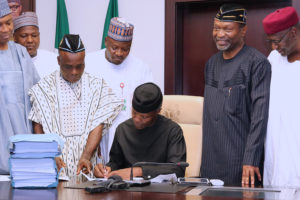
Acting President Yemi Osinbajo, signing the 2017 Appropriation Bill into law at the Aso Rock Presidential Villa, Abuja, today, June 12. He is flanked by the Senate President, Dr Bukola Saraki, House of Reps Speaker, Hon Yakubu Dogara; SSAP to National Assembly, Senator Ita Enang, Minister of Budget, Senator Udoma Udo Udoma and Chief of Staff to the President, Mallam Abba Kyari. [myad]
Acting President Yemi Osinbajo has looked into the crystal ball and predicts that Nigeria is set to fully recover from the economic recession it had ben plunged into for the major part of this yeasr.
According to him: “Our path to progress and abundance is clear. The tools are in place and the resilient, resourceful and hardworking Nigerian people are set to go.”
Professor Osinbajo spoke today, at Aso Rock Presidential Villa, Abuja, shortly after signing the 2017 appropriation bill into law.
His speech is reproduced her:
A few minutes ago, I signed the 2017 Appropriations Bill into law. This is an important milestone in our economic recovery and Growth plan laid in April by President Muhammadu Buhari.
I would like to express my appreciation to the Senate President, the Speaker of the House of Representatives, as well as the entire leadership and members of the National Assembly for completing work on the 2017 Appropriation Bill. And I will return to this point presently.
The process of preparing and processing this Bill was much smoother than the 2016 Appropriations Bill. On the executive side, there were no allegations of errors, or mistakes, and there was a significant improvement in the quality of the preparation, as well as the presentation.
I wish to commend the Ministry of Budget and Planning for such a remarkable improvement over a single budget cycle.
On the side of the National Assembly, I wish to commend the collaborative spirit of the engagements our MDAs had with their various committees, and with the leadership, during the budget defence sessions. There were far fewer reported cases of acrimony, or hostile wrangling this year, than in the past.
From the reports we received, the sessions were generally conducted in a friendly atmosphere. There is no doubt that our democracy is maturing.
However, the final presentation and the signing of the budget has been considerably delayed. This was largely due to disagreements we had about the changes introduced to our 2017 Budget proposals by the National Assembly.
The executive took the view that the changes fundamentally affected some of our priority programmes and would make implementation extremely difficult and in some cases impossible.
I must say that the entire leadership of the National Assembly led by the Senate President and the Speaker, adopted a commendably patriotic and statesmanlike approach to our engagements on resolving these critical issues.
In sum, the engagements yielded acceptable results . The most important being that the leadership of the National Assembly has given us a commitment that the National Assembly will re-instate the budgetary allocations for all the important executive projects, such as the railway standard gauge projects, the Mambilla Power Project, the Second Niger Bridge, the Lagos – Ibadan Expressway etc. which they had reduced to fund some of the new projects they introduced.
This re-instatement will be by way of an application for virement by the Executive which they have agreed will be expeditiously considered and approved by the National Assembly.
It is as a result of that understanding and the outcome of our detailed engagements that we feel able to sign the 2017 Appropriations Bill into law today.
I am also pleased to mention that, in our discussions with the leadership of the National Assembly, we have jointly resolved to return to a predictable January to December fiscal year.
It is a particularly important development because this accords with the financial year of most private sector companies, underscoring the crucial relationship between government and the private sector.
Therefore, on the understanding that we will be submitting the 2018 Budget to the National Assembly by October 2017, the leadership of the National Assembly has committed to working towards the passage of the 2018 Budget into law before the end of 2017. I must, once more, express my appreciation to the leadership of the National Assembly, for the collaborative spirit in which these discussions were conducted.
The 2017 Budget, which I have signed into law today, is christened “Budget of Economic Recovery and Growth” and reflects our commitment to ensure strong linkage between the medium-term Economic Recovery and Growth Plan (ERGP) recently launched by His Excellency, President Muhammadu Buhari and the annual budgets.
It is designed to bring the Nigerian economy out of recession unto a path of sustainable and inclusive growth. The budget has a revenue projection of N5.08 trillion and an aggregate expenditure of N7.44 trillion. The projected fiscal deficit of N2.36 trillion is to be financed largely by borrowing.
Let me assure those who have expressed concern about the growing public debt that we are taking several actions to grow government revenues as well as plug revenue leakages. This is because, notwithstanding the fact that our borrowings are still within sustainability limits, we are determined, in the medium term, to reduce our reliance on borrowings to finance our expenditures.
Details of the budget, as approved by the National Assembly, will be made available by the Honourable Minister of Budget and National Planning.
As you are all aware, our economy is already signaling a gradual recovery as growth is headed towards positive territory. First quarter GDP, at -0.52% compares favourably with -2.06% in the first quarter of 2016.
Inflation is declining – down to 17.24% from 18.74% as at May 2016. Our external reserves are now US$30.28 billion as at June 8, 2017 up from US$26.59 billion as at May 31, 2016.
We are also gradually instilling confidence in our exchange rate regime. This improvement in GDP growth and other macro-economic indicators is largely attributable to our strategic implementation of the 2016 Budget as well as stronger macroeconomic management and policy coordination.
I am confident that the 2017 Budget will deliver positive economic growth and prosperity – one that is self-sustaining and inclusive. In this regard, the 2017 budget will be implemented in line with our Economic Recovery and Growth Plan.
Over the 2017-2020 plan period, we are focusing on five (5) key execution priorities, namely:
*Stabilizing the macroeconomic environment;
*Agriculture and Food security;
*Energy sufficiency in power and petroleum products;
*Improved transportation infrastructure; and
*Industrialization through support for micro, small and medium-scale enterprises (MSMEs).
The 2017 budget includes provisions that reflect these priorities.
To demonstrate our commitment to following through our Economic Recovery and Growth Plan, the 2017 budget allocates over N2 trillion to capital expenditure, principally infrastructure.
For instance, we are committing over N200 billion to improve transport infrastructure such as roads and rail; over N500 billion for investments in works, power, and housing; and N46 billion for Special Economic Zone Projects to be set up in each geopolitical zone.
The signing of the budget today will trigger activities in the domestic economy which will lead to job creation and more opportunities for employment, especially for our youth. And, as I indicated earlier, we will be returning to the National Assembly to seek upward adjustments by way of virements in relation to a number of critical projects which have received inadequate provision in the budget just passed by the National Assembly.
We acknowledge that government alone cannot achieve the overarching goal of delivering inclusive growth; that is why the 2017 budget provides a lot of opportunities for partnerships with the private sector.
To help the private sector thrive, we are determined to create an enabling business environment. We are already recording verifiable progress across several areas ranging from a new Visa-on-Arrival scheme to reforms at our ports and regulatory agencies.
The Online business registration process has reduced time required for business registration from 10 to 2 days. It is expected that the Executive Order on transparency and efficiency in the business environment will make it even easier for investors to get the permits and licenses they require for their businesses.
Pursuant to our commitments to the Open Government Partnership, we recently issued an Executive Order that will promote budget transparency, accountability and efficiency. We want to make the Federal budget work more efficiently for the people.
Thus, beyond the huge provisions for investments in critical infrastructure, we have mandated Government agencies to spend more of their budgets on locally produced goods. This will open more opportunities for job creation with benefits for government in form of tax revenues.
We are also working hard to improve our revenue collection efficiency so that we can achieve our revenue projections. While we are deploying technological tools to enhance collections, the implementation of the Treasury Single Account (TSA) will continue to contribute significantly to improving transparency and accountability over government revenues.
Our fight against corruption is yielding positive results. Some of the recoveries are included in the 2017 Budget which will be expended on identifiable capital projects.
Already, we are beginning to see some improvement in the quality of public expenditure. This is great motivation for us to remain resolute in our fight against corruption so that economic prosperity is enjoyed by all Nigerians.
Let me reiterate that the implementation of our 2017 Budget will bring added impetus to our ongoing economic recovery. We will intensify our economic diversification efforts in our bid to expand opportunities for wealth creation and employment, thereby creating inclusive and sustainable growth.
I have no doubt that by the grace of God, the bleakness of recession is about to witness the uplifting dawn of abundance.
The People’s Republic of China has made a financial donation of Sixty Million Naira to Future Assured, a None Governmental Organisation which is being promoted by Aisha Buhari, qife of President Muhammadu Buhari.
Special Assistant to the President, Dr. Hajo who represented the wife of the President at the event, expressed appreciation for the support and goodwill of the People’s Republic of China, saying the donation will reach its intended beneficiaries.
Dr. Hajo highlighted the effort being made by wife of the President to raise funds to support Internally Displaced Persons in Nigeria as well as refugees and other victims of insurgency across the West African sub region, especially among countries of the Lake Chad Basin. She said the donation will transcend the borders of Nigeria.
Presenting the donation, the Deputy Chief of Mission at the Embassy of the People’s Republic of China, Mr. Lin Jin, said Future Assured has made tremendous impact in promoting the health and well-being of women, children and the vulnerable, and succeeded in making a difference in the lives of these people. This, he said, is worthy of emulation.
“The Embassy pays great attention that its bilateral relationships should benefit people from all walks of life” said Mr. Jin.[myad]
Mr. Jin said Future Assured needs to be supported in order for its activities to reach more beneficiaries.
Highlight of the event was the presentation of the cheque to Dr. Hajo Sani.
Acting President Yemi Osinbajo has lamented that the Nigeria system of justice is under siege, with particular reference to the fight against corruption.
According to him, the vast majority of Nigerians are confused about the system of justice, especially in its response to the stealing of public resources.
“How, for example, does it take so long to prove in court that a man earning a civil servants salary has billions in his bank accounts? The gradual loss of confidence in our administration of justice system is a real threat to social cohesion.”
The acting President made these remarks today, Monday, when he spoke at the opening Session of the Golden Jubilee of the NIgerian Association of Law Teacher with theme- Law, Security and National Development held at Nnamdi Azikiwe University, Awka in , Anambra State.
“Our system of justice is clearly under siege; most of it is self-inflicted – delays by counsel, weak control of proceedings by courts, and corrupt practices, a subject which in and of itself is a matter of serious concern.”
On corruption, Professor Osinbajo said that almost daily, one hears on radio and read on social media how easy it is to jail a man who stole a goat or a phone within months and how difficult it is to prosecute a public officer who has stolen billions of public funds.”
He insisted that Nigerians should redefine the offence of corruption and the approach to its prosecution, “taking into account, its profoundly destructive impact on lives and property. Such an offence is worse than homicide; it is a crime against humanity. The approach of the trials must be time bound.”
Acting President Osinbajo said that many judicial systems more often than not, in serious cases part of the reason why bail is not easily granted is because the trials are time bound and usually not longer than six weeks. Dilatory tactics on the part of lawyers is sternly viewed, adjournments are usually not allowed or if so at great financial and professional cost to the lawyers on either side.
“Today, the most obvious cases of corruption are interminably delayed; indeed the strategy of many defence counsels is delay. In a recent UNODC study, about 43% of judicial officers surveyed reported that the main causes of excessive delay in our courts were “ploy by parties”, “requests for unnecessary adjournments” and “interlocutory applications to protract proceedings” and it was similarly found that most adjournments were caused by the absence of the accused, the defendant, their lawyers or of a witness.
“This suggests that the stakeholders in the justice sector are mostly responsible for the problem of delay in the administration of justice. The delays in our system of justice are becoming a source of derision of our trial system by judges in other jurisdictions.
“In 2014 for example, an English Court of Appeal decision- IPCO (Nigeria) Limited v. Nigerian National Petroleum Corporation [2014] EWHC 576 (Comm), the Court ruled that a pending challenge in a Nigerian court to a US$340 million award should not be a bar to enforcement in London, because the Nigerian proceedings could take “up to a generation” to be resolved. The Court also described the Nigerian judicial system as being bedeviled by “catastrophic” delays.
“We, as law teachers, must ask ourselves whether our legal system can survive and serve its purposes to society without a serious and incisive rethink and reconsideration.
“So, how should the state react to our other security challenges, the Boko Haram terrorist activities in the North East, tensions in the Niger Delta, herdsmen and farmer clashes, and threats of secession and counter threats of forced excision. In addition are the overarching issues of poverty, unemployment and corruption.”
Professor Osinbajo wanted the leaders to recognize that a lot of these agitations center around the alleged failures of the state to create an inclusive society under existing constitutional arrangements, to guarantee the security of lives, livelihoods and liberties by the agencies charged with maintaining law and order and to build trust around the rule of law and the system of administration of justice.” [myad]
“MASSOB had existed for 18 years without violence, but in 2009, I went to London and opened Radio Biafra and handed it over to Nnamdi Kanu as the director. Soon afterwards, politicians hijacked him, and he started working for them.”
These were the words of the leader of the Movement for the Actualisation of the Sovereign State of Biafra (MASSOB), Ralph Uwazurike, when he led a delegation of Igbo leaders from the South East to meet with some youth groups in Kaduna today, Monday.
Uwazurike said that the radio that was meant to educate Igbo people was turned into the source of hate messages, blackmail, intimidation and others.
“The resultant effect was that the northern youths came up to challenge us, to say that they are not happy with the hate messages and the insults they receive from the same radio.
“I am here today to say that the main purpose of floating the organisation called MASSOB was not to cause crisis in Nigeria.
“I assured the late Odumegu Ojukwu when he was alive that there would be no other civil war in Nigeria.
“Because he, Ojukwu was so concerned and wanted some measure of assurance from me that MASSOB would not cause problems in Nigeria and I gave him that assurance.
“And I am today disappointed, that the assurances I gave may not see the light of the day, if certain measures were not taken, and that is why I am here in Arewa House today.”
He assured of the safety of the northerners resident in the South East and urged them to continue with their businesses in the area.
“I am here to assure you northerners that all your people in the South East are safe and nobody will harass them.
“And, I am happy to hear my friend, Major Hamza Al-Mustapha, who assured of the safety of lives and property of Nd’Igbo in Northern region.”
Uwazurike said that the crisis in the country was being manipulated by politicians and urged the youth not to allow themselves to be used.
He said that it is right for any part of the country to seek self determination but that it is wrong to pursue same through violent means.
“Self determination without violence is a fundamental right, we must strive against sowing the seed of discord but do all that will promote peace and justice.
“There is a gap of communication from our leaders which needs to be bridged, hence we are meeting with notable leaders in the north to persuade them that there is no cause for alarm.“
The convener of the meeting,
Major Hamza Al-Mustapha said that the meeting was held in response to the recent quit notice by some Northern groups to Igbos living, in order to douse tension.
Al-Mastapha, who was the former Chief Security Officer to late Head of State, Sani Abacha, said that the youths need to wear their thinking caps, use their brains and refuse to be used in fomenting any form of crisis in the country.
He said that the current events may not be unconnected with external forces wanting to see Nigeria disintegrate.
Al-Mustapha also cautioned the youth against making statements that would further cause tension in the country, in spite of the unpleasant comments from IPOB leader, Nnamdi Kanu.
He appealed to the Kaduna State Government and the Inspector General of Police to withdraw the arrest threat on the youth leaders who issued the Kaduna Declaration.
Angry residents of Abata Nsugbe area in Anambra state who destroyed The God’s Foundation Life Bible Ministry were shocked to discover that it is a shrine.
Information showed that Charms and other diabolical items were found in the supposed church, which was destroyed after the church’s senior pastor allegedly beat his landlady to death for dare to ask him to pay his annual rent.
In a video that has gone viral on social media, the diabolical charms and human skulls were displayed while residents of the area rain curses on the pastor.
A voice was heard saying in Igbo language: “post it on Facebook immediately for the whole world to see.”
The pastor is reported to be on the run.
The state Police Relations Officer, Nkiruka Nwode, confirmed the incidence, saying that the police are already in search of the pastor who called himself “Spiritual man.” [myad]
We use cookies on our website to give you the most relevant experience by remembering your preferences and repeat visits. By clicking “Accept”, you consent to the use of ALL the cookies.
This website uses cookies to improve your experience while you navigate through the website. Out of these, the cookies that are categorized as necessary are stored on your browser as they are essential for the working of basic functionalities of the website. We also use third-party cookies that help us analyze and understand how you use this website. These cookies will be stored in your browser only with your consent. You also have the option to opt-out of these cookies. But opting out of some of these cookies may affect your browsing experience.
Necessary cookies are absolutely essential for the website to function properly. This category only includes cookies that ensures basic functionalities and security features of the website. These cookies do not store any personal information.
Any cookies that may not be particularly necessary for the website to function and is used specifically to collect user personal data via analytics, ads, other embedded contents are termed as non-necessary cookies. It is mandatory to procure user consent prior to running these cookies on your website.