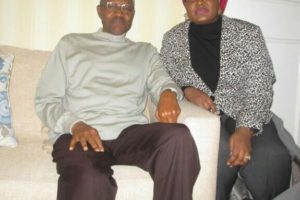
The wife of the President, Aisha Buhari, today, Tuesday departed Nigeria for the United Kingdom to join her husband, President Muhammadu Buhari, who is in London for medical treatment.
Mrs. Buhari travelled through the Nnamdi Azikiwe International Airport, Abuja on Tuesday morning.
Before her departure, she thanked Nigerians for their support and prayers for Mr. Buhari’s quick recovery.
The president left Nigeria for London on May 7, for another round of treatment following his last trip in February.
It is sad that many Nigerians today talk glibly about the possibility of a coup or of military intervention in politics. They make it seem as if this democracy is something we can exchange for something else. We need to be reminded, as we celebrate democracy day 2017, how we got to this very moment, and how precious democracy is to us as a sovereign people. From 1966 to 1999 (with the short break of civilian rule from 1979 – 1983) the military dominated the political landscape in Nigeria. It was eighteen years ago yesterday when our country returned to civilian rule.
The military practically overstayed their welcome. The first military coup in Nigeria was in January 1966, followed by the counter-coup of July 1966, and then the civil war of 1967-70 which turned Nigeria into a military theatre more or less as the Federal forces engaged the Biafran secessionists in a fratricidal war that resulted in the loss of more than a million lives, starvation and the tearing apart of the Nigerian fabric. The military would remain in charge of Nigeria and its affairs for more than 30 years in total, and it is worth remembering that virtually every successful coup was welcome by the people.
It was thought particularly in the 70s that the military had a role to play in many developing countries in Africa to ensure stability and national discipline. The civilians who took over from the colonialists in Nigeria and Ghana, to cite two close examples, proved worse than their predecessors, and hence the usual argument for military intervention was corruption, and the need to keep the country together, and check the excesses of the civilian rulers. Military rule was perhaps closer to what the people had known traditionally and also under the colonialists. Kings or feudalists who did not tolerate any form of opposition, or free expression governed the traditional communities and likewise, the colonial masters were dictators. The military continued in that tradition. In-fighting among the emergent military elite and the competition for power eroded discipline, and resulted over the years in more coups.
To be fair, military intervention in Nigerian politics yielded some positive dividends, and created a leadership cadre, and indeed till date, the influence of the military in Nigerian politics, as seen in the transmutation of many military officers into professional politicians, remains a strong factor in the making and unmaking of Nigeria. But by 1990, with the global wave of democratization, glasnost and perestroika, the collapse of the Berlin wall, and the greater emphasis on human rights, and the rise of civil society, the Nigerian public began to subject the military to greater scrutiny than was hitherto the case.
After a fashion, every military government presented itself as a corrective regime, with the promise to hand over power in a short while to civilians. By 1986, the Babangida administration after a year in office had launched a political transition programme, beginning with the establishment of a 17-man Political Bureau. In 1989, the ban on political activities was lifted. The military junta would later ban these existing political parties and create its own parties, the Social Democratic Party and the National Republican Convention.
This seemingly endless transition programme and increased civil society activism merely drew more attention to the military and its record in the public sphere. The people began to demand an inevitable return to civilian rule. They complained about the human rights abuses of the military, the apparent domination of power by the Northern elite, the marginalization of other groups in Nigeria, and the spread of injustice and inequities.
When a Presidential election was held on June 12, 1993, and the SDP candidate, Chief MKO Abiola won the election- an election that was adjudged to be free and fair, Nigerians felt that the hour of their liberation from military rule had come. But the Babangida administration refused to announce the final results and subsequently, it annulled the election. It was a disastrous moment for the Nigerian military and the administration. It also marked the beginning of a national crisis that dragged on for six years. The Nigerian people were inconsolable. In the course of the crisis, General Ibrahim Babangida had to “step aside”, handing over power to an Interim national Government (ING), which was soon shoved aside by General Abacha. Between 1993 and 1999, Nigeria had three different leaders: Chief Ernest Shonekan, General Sani Abacha and General Abdusalami Abubakar.
The ensuing struggle for democracy was long and momentous. Progressive Nigerians and the civil society turned against the military. The South West declared that it had been robbed. MKO Abiola fought for his mandate. The international community ostracized the Abacha government. Nigeria became a pariah nation. The media was in the forefront of the struggle, and many journalists were jailed, hounded into exile, publishing houses were set ablaze. Anyone who criticized the soldiers was framed for one offence or the other and thrown behind bars.
The progressive forces insisted that the military must go. “Never Again”, the people chorused. There had been no other moment like that in contemporary Nigeria. The martyrs of that people’s revolution were the ones that died, including Chief MKO Abiola who died in Abacha’s detention camp, the many innocent persons who were shot by the military, and every one who suffered one major loss or the other. The heroes were the valiant men and women who stood up for democracy and justice and opposed military tyranny. The villains were the soldiers who trampled upon the people’s rights, and their opportunistic agents in civil society. On May 29, 1999, Nigeria returned to civilian rule. It was the day of our country’s second liberation, liberation from the “years that the locusts ate.”
In the month of June, there would be another historic date for Nigerians, that is June 12, a definite milestone in Nigerian democracy even if the Federal Government has been largely in denial since 1999. MKO Abiola deserves to be honoured post-humously not just selectively by states in the South-West but by the Nigerian Government as a kind of restitution, and by this, I mean a formal declaration, for record purposes, that he was indeed the winner of that June 12, 1993 election.
This brief excursion to the recent past is important because it is so easy to forget. I have met young Nigerians who have never heard of Chief MKO Abiola. In a country where history is no longer taught in schools, that should not be surprising. The Nigerians who were born in 1993 are today out of university, and many of them may never have experienced military rule. They were still children when their parents fought for this democracy. Whoever makes the mistake of even remotely suggesting any form of return to military rule is an enemy of the Nigerian people. Such persons would be taking this country back to 18 years ago and beyond.
Whatever may be the shortcomings of our democracy, this system of government has served the Nigerian people well. We may worry about the form or the shape, or the character of our democracy, the opportunism and imperfections of the professional political class, or the weakness of certain institutions but all told, this is a much better country. The best place for the military is to function under a constitutional order and to discharge its duties as the protector of national sovereignty. Any soldier who is interested in politics should resign his commission, and join a political party, politics being an open field for all categories of persons, including ex-convicts, prostitutes and armed robbers. I find the auto-suggestion of military intervention gross and odious. It is regrettable that those whose duty should never in any shape include scare-mongering were the ones who started that nonsensical discussion in the first place.
For the benefit of those who do not know or who may have forgotten, we once lived in a certain country called Nigeria, ruled by the military, where the rights of citizens meant nothing. The soldiers were our rulers. They were above the laws of the land. The people were their subordinates. They called us “bloody civilians.” The media was not free. Your insistence on free speech could land you in jail. Under the guise of enforcing discipline, the military treated the people as if they were slaves. Everything was done “with immediate effect!”, including the suspension of human rights.
Today, democracy has given the Nigerian people, voice. There is a greater consciousness of the power of the people, as well as the need to hold persons in power accountable. The electoral process is still imperfect, but the people are now supremely confident of their right to choose. But not all our problems have been solved. For example, exactly 50 years ago today, the late Emeka Odumegwu-Ojukwu, hero of the Biafran Revolution, led the people of the Bight of Biafra on a secession move out of Nigeria.
He said: “…you, the people of Eastern Nigeria, Conscious of the Supreme Authority of Almighty God over all mankind, of your duty to yourselves and prosperity; Aware that you can no longer be protected in your lives and in your property by any Government based outside Eastern Nigeria/Believing that you are born free and have certain inalienable rights which can best be protected by yourselves. Unwilling to be unfree partners in any association of a political or economic nature… Now, therefore, I, Lieutenant-Colonel Chukwuemeka Odumegwu-Ojukwu, by virtue of the authority and pursuant to the principles recited above, do hereby solemnly proclaim that the territory and region known as and called Eastern Nigeria together with her Continental Shelf and territorial waters shall henceforth be an independent sovereign state of the name and title of The Republic of Biafra…”
In other words, the people of Eastern Nigeria no longer felt free or protected or respected inside Nigeria. They opted out. In the Ahiara Declaration of 1969, Ojukwu summed it all up as follows: “When the Nigerians violated our basic human rights and liberties, we decided reluctantly but bravely to found our own state, to exercise our inalienable right to self-determination as our only remaining hope for survival as a people.”
The civil war ended on January 12, 1970 but 50 years since the declaration of secession by the people of Eastern Nigeria, Igbos are still protesting about their relationship with the rest of Nigeria. But significantly, they are not the only ones complaining. Farmers are complaining about pastoralists, indigenes about settlers, Christians about Muslims and vice versa, women about men, men about women, youths about the older generation, the people of Southern Kaduna are unhappy, other Northern minorities too, the people of the Niger Delta have been unhappy since the Willink Commission of 1957/58, the other over 400 ethnic nationalities that are not recognized in Section 55 of the 1999 Constitution are also wondering whether they are truly part of this union…Basic human rights and liberties are still being violated.
Nigeria remains a yet unanswered question. Democratic rule may have opened up the space, but our country still suffers from a kind of hang-over. The people are free, but they are today everywhere in chains: politically, economically and ethnically. This is the sad part of our democracy, but the best part are the many lessons that the people are learning about the meaning, the nature and the cost of the choices that they make or that they have made. [myad]
The Central Bank of Nigeria (CBN) has again intervened in the inter-bank market to the tune of $482.6 million which underlined its determination to guard the international value of the naira.
A breakdown of the interventions which were carried out today, Tuesday, indicates that the Retail SMIS was allocated the sum of $285,779,350 while the $100 million was offered in the Wholesale SMIS auction window.
The Small and Medium Enterprises (SMEs) window got an allocation of $52 million, while the invisibles segment, comprising Basic Travel Allowance (BTA), Personal Travel Allowance, medicals and tuition fees, among others, was allocated the sum of $45 million.
The Acting Director, Corporate Communications at the apex bank, Isaac Okorafor, confirmed that the interventions are in line with the Bank’s resolve, echoed by the Governor, Godwin Emefiele, at last week’s briefing of the Monetary Policy Committee (MPC) meeting.
He expressed pleasure that the intervention of the Bank had ensured stability across all segments of the forex market, saying that the Bank’s objective of exchange rate convergence would be achieved soon.
Okorafor reiterated his call to all stakeholders to play their respective roles in ensuring a smooth running of the foreign exchange market for the overall benefit of the economy.
Meanwhile, surveys in Abuja, Lagos, Kano and Port-Harcourt on Tuesday, May 30, 2017, indicated that the dollar traded to the Naira at an average rate of N375/$1. [myad]
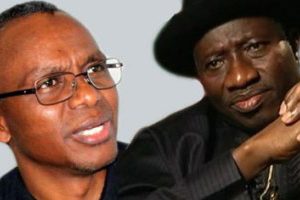
Former Nigeria President, Goodluck Jonathan has said that he gave Mallam Nasiru Ahmed El-Rufai the sum of N200 million as part of his contribution to his campaign for the governorship of Kaduna state which he eventually won.
The former President, who is still bitter about alleged disparaging remarks which Governor El-Rufai made about his government on the issue of ecological fund, insisted that the governor is just being hypocrite.
“He benefited from me when he asked me for money as part of my contribution for his Campaign funds.
“I gave Nasir El-Rufai a whopping sum of N200 million through Nenadi Usman, he should swear by Quran that he never collected money through Mrs. Usman.
“He sent one of his aide whom I learnt is now his political adviser to collect the money.
“If he continues with his LIES against me. I will instruct more about him to be exposed.
Jonathan said that El-Rufai is bitter with him “because I refused to appoint him as a Minister when I took over the Government.
“I still have all his CV & Email correspondence when he was begging me for an appointment and at the same time blasting President Muhammadu Buhari at the tail end of my Government.” [myad]
Minister of Labour and Employment, Senator Chris Ngige has described politics as an investment which Ndigbo made bad outing in the 2015 presidential election.
He stressed that as far 2015 is concerned, Ndigbo made a very bad investment, saying: “we put all our eggs in one basket despite clear signs we shouldn’t.
“We should therefore not allow such ill-advised investment to repeat in subsequent elections.”
Senator Ngige, in a statement by his Special Assistant on media, Nwachukwu Obidiwe, asked his kins men and women to start to strategically positioning themselves for 2019 and avoid a repeat of what happened in 2015.
“Other zones are already strategizing and we must not be caught napping.
“Just as all reasonable politicians in the South East accept that we played bad politics in 2015, we should effectively put it behind us.
“The resilient nature of the Igbo allows no room for self-pity. We have met greater challenges and surmounted them.”
The Labour minister then listed the names of individual Igbo bigwig who has seen the need to join APC, saying: “it is for this reason that I and the APC in the South East have been welcoming our leaders like Chief Jim Nwobodo, Senator Ken Nnamani, Senator Emma Agboti, Senator Nkechi Nwogu, Senator Andy Uba, Chief Chukwuemeka Nwogu- my predecessor in the Ministry of Labour, Professor Onyebuchi Chukwu, former Minister of Health, former Enugu State Governor, Sullivan Chime and host of others people who have seen the need for this.”
He assured South Easterners that he and his mates are working hard to ensure that Igbos do not lose out from the ruling APC administration.
“However, as I said in the interview, the bad investment of the 2105 is not enough to marginalize anybody.
“The present administration of President Muhammadu Buhari does not look in that direction.
“I and other APC leaders in the South East shall continue to make sure that the Igbo is fairly treated.
“Every piece of information is not for the pages of newspapers but I wish to re-assure that we are doing much more than eyes can see to ensure that the South East is not left behind in the distribution of infrastructures.”
He mentioned some projects in Igboland which have benefitted the igbos, citing as an example the going work on all the major federal roads in the South East; Enugu- Onitsha, Enugu- Umuahia-Abia-Port Harcourt, Port Harcourt -Owerri, Oba-Nnewi– Arondizuogu- Okigwe, to mention a few while Julius Berger has been mobilized for the 2nd River Niger Bridge.
He asked: “when last did that happen in the South East?
“There is also the Benin-Onitsha rail line which was not originally in the Jonathan-PDP rail masterplan. We have included that.
“By my pedigree, as the former President General of Aka-Ikenga for eight years, member of Ohaneze Strategic Committee and member, Imeobi Ohaneze, I will advise that our people should cry no more over spilt milk as there is room enough to feed the cow well and get milk in better quantity and quality.
“That is politics for you. A word is enough for the wise,” he added. [myad]
A teacher and a classroom aide at a Georgia middle school were reported to have threw punches and pulled each other’s hair in the presence of minor children while school was in session, over a boyfriend who each of them claimed was hers.
DeKalb Police charged Brittany Randolph-Johnson and Milan Ethridge with disrupting operations at Stone Mountain Middle School in downtown Atlanta and disrupting the peace, Fox 5 Atlanta reported.
The police report says that Randolph-Johnson and Ethridge “engaged in a verbal and physical altercation in the presence of minor children” at the school while school was in session, the station reports.
WGCL-TV quoted a student as saying that Randolph-Johnson and Ethridge were arguing about a male teacher. The teacher and the aide were fired, WSB-TV reported.
“I mean that’s not a good example in front of kids,” parent Valerie Stewart told the station. “That was just bad. It was just bad.”
Students say school officials examined cellphones and made students delete video of the fight, according to the station.
The DeKalb County School District said it was not aware of staff looking through student phones.
Governor Udom Emmanuel of Akwa Ibom State has said that the “clog in the wheel of our progress as a people” has been the spate of blackmails and hate media campaigns by certain opposition elements against his government.
Governor Emmanuel, who spoke during the events to celebrate his second year in office, wondered why people engage in the campaigns of falsehood, hatred and blackmail even two years after election had been won and lost.
Governor Emmanuel appealed to such people to separate politics from patriotism, adding: “instead of being professionals in the profitless business of pulling others down, let us all be experts in the lucrative business of forgiveness.
“This is no time for anger, resentment, bitterness and desire for recrimination against people. Those sentiments can only deaden our spirit and lead to self-inflicted wounds.”
He said that he had come to serve Akwa Ibom people and that he shall not be deterred until he accomplishes his mission.
Governor Emmanuel said that this year’s celebration was an opportunity to celebrate prosperity, report progress and renew the deep and unbridled commitment to the development of the State which he christined: “the land of Promise.”
He attributed the milestones of his administration’s success since 2015 to the spirit of God.
The governor dedicated the gains of the last two years to the people of the state.
“our victory remains your victory and our mandate shall continue to be your mandate, and we remain committed to impacting your lives and bringing meaningful developments that will help change your circumstance.”
Governor Emmanuel who congratulated the president and all Nigerians on the 18 years of democracy in Nigeria after several years of military rule and truncated starts, maintained that it is the collective responsibility of all to make the best out of the opportunity.
“Democratic values, traditions and culture have been embraced and internalized by Nigerians and that’s a great and wonderful thing worthy of celebrating, which is what we are doing today.”
The Governor said that his two years in the saddle have made Akwa Ibom to be a shining example of good governance, saying that without good governance,democracy may not be well appreciated.
“This anniversary is worth celebrating for we have worked to make our people realize that dividends of democracy also exists beyond the literary definition.”
He took time to highlight some of his achievements which have endeared him to the people.
Emmanuel described his as a government that is grounded on result and not merely on applause.
“In just two years, we have built on that foundation of greatness, and defied a tempestuous economic climate to put finishing touches on a marvelous edifice for posterity.”
He looked at what he called “moral rebirth programme” of his government, including the Dakkada philosophy and said: “we encouraged our people to come out of the cocoon of self-pity and burst forth to claim the faith of greatness which God almighty has endowed us all, with.” [myad]
A front-line online newspaper outfit, The Eagle Online, published in Lagos, Nigeria by Premium Eagle Media Limited is back.
The online newspaper took a break a couple of weeks ago to enable it change its host and put in place a new theme, both of which have been fully accomplished.
The Managing Editor of the newspaper, Dotun Oladipo, in a statement, thanked the newspaper’s numerous readers for their understanding and patience.
He assured them that the purpose of going off for a few days is to serve the readers and advertisers better.
Oladipo said that though the site has been upgraded but that there might be still some challenges yet to be noticed by the IT team.
He therefore called on the reading public and cherished advertisers to draw the attention of the management to such challenges to enable the IT team to make The Eagle Online available for easy reach.
“In case you our dear reader encounter any challenge, please do let us know so we may quickly rectify it.”
Oladipo said that the newspaper can be reached via mobile and WhatsApp number 08094000057 and email: info@theeagleonline.com.ng for any complaint.
“The aim of the break is to give our advertisers and readers a whole new experience to make it worth their money and time. Our goal, ultimately is to offer better service.” [myad]
The Embassy of Spain in Nigeria has announced that more Spanish companies in agro business are on their way to Nigeria because of the current efforts at developing agricultural sector. The Embassy’s Chief Economic and Commercial Counsellor, Mr Pablo Segrelles, told the News Agency of Nigeria (NAN) in Lagos that the Spanish companies are ready to offer new technologies to Nigeria. “Spain has leading companies in agricultural development. We are looking at introducing technologies for increasing Nigeria’s agricultural yields. We are happy that Nigeria has realised that her economy has to be diversified. And we know that Nigeria’s agricultural potential is huge. “And with Nigeria now taking the development of her agricultural sector very seriously, Spanish companies believe that this is the moment to invest in Nigeria. “We are going to be more interested in the development of Nigeria’s agribusiness. We want to strengthen our relations with Nigeria in the development of her non-oil sector.” Segrelles expressed optimism that Nigeria’s current agricultural development strides, if sustained, would reposition the nation and Spain’s bilateral trade and economic relations in the next two to three years. The Counsellor said that the companies are prepared to add value to Nigeria’s agricultural products, as well as her food chain, for export and domestic consumption. Segrelles assured of plans by the companies to train and create employment opportunities for more Nigerians in the course of their investment in Nigeria. [myad]
Minister of the Federal Capital Territory Administration (FCTA), Malam Muhammad Musa Bello, has said that his administration has successfully dealt a blow on the endemic land racketeers around the corridors of power.
He said that the land racketeering group that used to operate in Area 11, near the Abuja Geographic Information Systems (AGIS) head office, had suddenly disappeared as a result of the new method his administration adopted.
The minister, who spoke to news men on his score card in the last one-and-half year of his tenure as FCT minister, said that in addressing the mistakes of the past, his administration has been very careful in allocating land, admitting that since coming on board, no land has been allocated.
The minister said that the institutional framework of the FCTA has been strengthened not only to ensure effective service delivery but also maintain institutional memory.
On why he has has not appointed secretaries for the secretariats, the minister said he deliberately allowed the bureaucracy to work so that the management staff would no longer rely on the mentality of having to wait for directives on everything from a minister.
“We decided to strengthen the bureaucracy by allowing the civil servants to work. When ministers come with their political appointees and are gone, there is no institutional memory. That is why we spent a lot of resources on training staff.”
Muhammad Musa Bello promised that his administration would not demolish buildings anyhow, but would rather prefer the global best practice of upgrading and integration where infrastructure would be put in place for the people.
It would be recalled that the Minister was sworn in as the 16th Minister November 11, 2015. [myad]
We use cookies on our website to give you the most relevant experience by remembering your preferences and repeat visits. By clicking “Accept”, you consent to the use of ALL the cookies.
This website uses cookies to improve your experience while you navigate through the website. Out of these, the cookies that are categorized as necessary are stored on your browser as they are essential for the working of basic functionalities of the website. We also use third-party cookies that help us analyze and understand how you use this website. These cookies will be stored in your browser only with your consent. You also have the option to opt-out of these cookies. But opting out of some of these cookies may affect your browsing experience.
Necessary cookies are absolutely essential for the website to function properly. This category only includes cookies that ensures basic functionalities and security features of the website. These cookies do not store any personal information.
Any cookies that may not be particularly necessary for the website to function and is used specifically to collect user personal data via analytics, ads, other embedded contents are termed as non-necessary cookies. It is mandatory to procure user consent prior to running these cookies on your website.