President Muhammadu Buhari has introduced a New Vision for the oil-producing communities of Niger Delta in line with the presentation made by the Pan Niger Delta Forum (PANDEF), directing the increase in the Amnesty programme fund by N35 billion.
A statement today, Saturday by the senior special assistant to Vice President Yemi Osinbajo on media and publicity, Laolu Akande said that the N35 billion is in addition to the N20 billion which the President approved in the 2016 budget, adding that N30 billion was recently released.
The statement said that there is also a planned release of another N5 billion soon adding that as at now, the Amnesty Office has paid up all ex-militants backlog of their stipends up to the end of 2016.
“Subsequently, the President asked his deputy, Vice President Yemi Osinbajo, SAN, to embark on a tour of the region that saw him visiting several oil-producing States in the country.
“Besides the monthly payment of about N65, 000 to N66,000 to the ex-militants, the funds would also go to the provision of reintegration activities under the Amnesty Programme including payment of tuition fees for beneficiaries from Niger Delta who are in post-secondary institutions at home and abroad, payment of in-training & hazard allowances and vocational training costs.
“There are also empowerment schemes and self-help, self-employment support funds, including provision of needed equipments by the Amnesty Office. Equally, the funds would also support the training of pilots, aviation engineers, technicians, and motor vehicles mechanics from the oil-producing communities.
“The Buhari administration reassures the Niger Delta communities of its unalloyed commitment to a faithful implementation of its promises made during the FG interactive engagement visits by the Vice President to different oil-producing communities
“Other promises made during the visits are currently at different stages of effective implementation, including the effective opening of the Maritime University, integration of illegal refiners under the concept of new Modular Refineries, resumption of all abandoned construction projects in the region, the Ogoni Clean-up, and several others.
“For instance, the Maritime University is now on course to be opened before the end of the year as the presidency has already set the process in motion as announced yesterday. Other announcements are to follow as each of the commitments of the FG to the Niger Delta oil-producing communities reach advanced and implementation stages.
“Already there is an inter-ministerial group consisting of all relevant ministries, departments and agencies, MDAs of the FG, with the involvement of relevant State governments led by the Vice President that meets regularly to drive the different initiatives and ensure effective and ongoing implementation.” [myad]
Report just reaching us indicated that Boko Haram insurgents have released 80 out of over 270 they abducted in April 2014 from the Government Girls Secondary School in Chibok, Borno State.
Sources said that the release of the 80 abducted school girls came after further negotiations between the Islamist group and the Muhammadu administration and that those released are currently in Banki town in Borno state awaiting airlift to unknown destination. Only late last week, news filtered in that the Nigerian army had wounded the Boko Haram leader, Abubakar Shekau in an air strike.
One Mathew Abioro and his wife, Precious, have allegedly confessed to Ogun State police command that they have been operating as armed robbers in the state for some time now.
The state Police Public Relations Officer (PPRO), Abimbola Oyeyemi, who paraded the couple, said that they also confessed to be serving as receivers of stolen items.
He said: “the couple were arrested when men of the Federal Special Anti-Robbery Squad (FSARS) received information that some notorious armed robbers who have been terrorizing Abeokuta and Sango axis are planning to carry out another operation consequent upon which their hideout was stormed and the couple was arrested.
“On interrogation, they (the couple) confessed being involved in a series of armed robbery within and outside Abeokuta metropolis. They equally confessed being receivers of stolen motorcycles from other robbery gangs and that they used to sell such motorcycles to Benin Republic and used the proceeds to purchase arms and ammunition which they use for their own operations.”
He the police spokesman said that Officers of (FSARS) were arrested on tip off as they were planning to carry out an operation. He said that a pump action gun, one cut-to-size single-barreled pistol, one cut-to-size double-barreled pistol and four live cartridges were recovered from the suspects. [myad]
There used to be a world class prolific writer, novelist and social reformer through the pen, called James Hadley Chase. Mr. Hadley Chase was so elusive that he bore many names, making it impossible for distance people from him to know which of his names were real and which ones were not.
Indeed, while his birth name was René Lodge Brabazon Raymond, he was well known by his various pseudonyms, including James Hadley Chase, James L. Docherty, Raymond Marshall, R. Raymond, and Ambrose Grant. And so, even his name was a clear reflection of fiction.
So too, was his trade as the world class fiction novelist of his time. As a matter of fact, back in the 60s up to middle 80s, Hadley Chase assailed the reading people of the world, especially students, with loads and loads of fiction novels, as in the same category with James Bond, a world class fiction actor. He started his writing career in 1939 with his first novel: No Orchids for Miss Blandish and another one, The Villain and the Virgin.
Hadley Chase, who died on February 6, 1985, had a way of painting and describing places, people and scenarios with professional fictional gusto, so much that you would not, but loved him. I, in particular, was an avid reader of his novels just when I was at my formative stage (adolescent) and therefore, I naturally developed my mastery of English language through reading his novels which he churned out fortnightly.
And long after Hadley Chase did his part and departed to the great beyond, another of the ilk of Hadley Chase, mainly for ill motive, has emerged. It is, this time, a group or is it a company, going by the name: “Sahara Reporters.”
Sahara Reporters, though leaning on the wall of journalism to practice its trade, has lately came out clearly as fiction writing organization, wrongly parading itself as INVESTIGATIVE news platform!
Apart from melancholically touching and attacking top guys in Nigeria and elsewhere, in the name of courageous journalism, Sahara Reporters has lately turned into a great source of embarrassment to the noble profession and as a noise maker, churning out fictional news about the health status of the Nigerian President, Muhammadu Buhari, to the ridiculous extent of displaying what an average Igbo man calls “too know.”
As a matter of fact, Sahara Reporters has severally came up with analysis and reports on Buhari’s health status so much as if it is the one whose operatives have been the doctors treating the President, to the point that even his wife, Aisha knows not what they know. They even have the temerity of questioning Aisha’s Tweet that her husband’s health is not as bad as people perceived.
When Buhari was in London for the famous medical vacation, Sahara Reporters was at its best, dishing out all sorts of medical jargon, imaginative analysis and pure fiction novels (I mean, news), most, if not all of which could be classified as not even fiction but junks told by idiots that had developed mental disorder and professional whitlow!
The Sahara Reporters came up with wild story that Buhari was infested with all type of dangerous diseases on this earth that would render him incapacitated for the rest of his life. Many people, including professional medical doctors could not even recognize some of the diseases Sahara Reporters listed, and which it said would make the President to remain in London for six months earliest. However, less than two weeks after the Sahara Reporters irresponsible report, Buhari returned to the country, Nigeria and the idiots did not or was not forced to apologize to their die-hard but gullible visitors (readers) in Nigeria.
The latest one of the numerous falsehood Sahara Reporters dished out to gullible Nigerians, hiding under the democratic ethos: Talk is free but Facts are sacred, was about the arrival in Aso Rock, Abuja, Nigeria, of three medical doctors from Britain to treat the President of the disease the hack writer (s) had even identified.
According to Sahara Reporters, the three doctors (all British: two males ad one female) that arrived in Aso Villa on Thursday, May 4, 2017 would treat President Buhari of the ailment of, according to it, chronic disease: “an intestinal disorder, prostate cancer, age-related disorders, including dementia.”
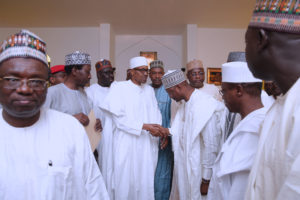
Unfortunately for Sahara Reporters, President Buhari attended Friday (Jum’at) prayer the following day, Friday, looking a little bit improved, after some rest which his doctors insisted he must observe. The President, on arrival looking better, removed his shoes by himself, entered the Mosque and observed two Rakkah: standing to recite verses from Holy Qur’an, bending down to his knees, standing up, prostrating, sitting down, prostrating again and repeating the same thing twice. He also joined in the main congregational prayer after which he shook hands with some dignitaries, cracked some lively jokes with them, smiled, bended down to put on his shoes, got up, walked to the newsmen, greeted them, waved hands to fellow worshippers that offered open prayer for him and walked as normal as he has always been to his residence, about 800 metres from the Mosque. The thought that immediately came to the minds of those whose sensibility were unfortunate assailed by the cooked up news of Sahara Reporters the previous day was, may be the British were waiting for him in his residence to continue with their treatment. Bullshit!
In fact, one would not be surprised if Sahara Reporters comes up with another jaundiced report that President Buhari was given certain drugs to take, just to enable him to go to Jum’at Mosque on Friday, after which he would return to the imported British doctors to continue with his treatment. After all, the same Sahara Reporters questioned the authenticity of the President’s meeting with the Group Managing Director of the Nigeria National Petroleum Corporation (NNPC) and the Attorney General of the Federation on Thursday, saying that such meeting was not recorded in video or covered by newspapers. It also questioned Aisha Buhari’s Tweet that her husband was not as sick as people were being fed by the like of Sahara Reporters.
In mockery of Sahara Reporters, a television cameraman in Aso Villa, today, Saturday, May 5, sent the following words to his WhatsApp group:
“BREAKING NEWS –
“At Last Muhammadu Buhari Hands Over Power to Osinbajo.
“It has been confirmed some minutes ago that the President of the Federal Republic of Nigeria Rtd. Gen. Muhammadu Buhari has handed over power to his Vice, Prof. Yemi Osinbajo about 20 minutes ago at home where the President is currently working from. This decision came after a closed door meeting held by the cabals and chieftains of the APC. According to the media adviser to Buhari, Mr. Femi Adesina, President Buhari handed over his 50,000Mah Power Bank to Osinbajo to enable him charge his phone whose battery is down as a result of lack of electricity in his location….”
When the TV cameraman was attacked for taking this type of joke too far, he simply said that he was reporting for Sahara Reporters and dared anybody who felt aggrieved to go to court or to beat him if they could get him, a rude reference to the elusiveness of Sahara Reporters!!!
Of course, if the TV cameraman had sent the same ‘joke’ to Sahara Reporters, it would have posted it as gospel truth, even quoting the usually reliable source, for to it, anything…anything at all, goes.
What a shame that Sahara Reporters has gradually turned itself into a pathological and terrible liar, barefaced nincompoop and a none repentant derelict that makes itself a shameless laughing stock amongst human and humanity, all in the name of making a name or money or fame or whatever.
Not to worry, this is both the beauty and ugliness of democracy where the good, the bad and the ugly mix up in the market of human being. So, Sahara Reporters has mates, of the same feather, mixing up in the market with those of us that are practicing decent journalism.
The society can kindly tolerate them, but with a lot of care.
That is with realization that Sahara Reporters could be a media section of the Association of the Corruption Fighting Back (ACFB). [myad]
President Muhammadu Buhari, exuding self confidence and good health, today, Friday, at the Friday Jum’at Mosque, inside Aso Rock Presidential Villa, Abuja, threw banters, shared some lively jokes and got many people rolling with laughter.
The President, who before today, was said to be so ill that he could not eat and drink and that he was being fed through tube, even asked after his personal photographer when he emerged from the Mosque after the Jum’at prayer.
The prayer session was attended by his top aides, some ministers including that of the Federal Capital Territory (FCT), Malam Muhammad Musa Bello, Attorney General of the Federation and minister of Justice, Abubakar Malami, some Senators; a Sokoto Prince, Alhaji Shehu Malami; First Republic politician under the National Party of Nigeria (NPN), Ishaku Ibrahim; National Security Adviser (NSA), Major General Babagana Monguno, acting chairman of the Economic and Financial Crime Commission (EFCC), Ibrahim Magu; chairman of the National Hajj Commission of Nigeria (NACON), Barrister Abdullahi Mukhtar and a host of others.
Editor-In-Chief of Greenbarge Reporters was there in the Mosque and gave the following narration of President Buhari’s appearance after so much dangerous speculations in social media:
The President arrived in the Mosque at exactly 1.20 Pm and went straight to observe two supplementary Rakkah (standing to recite from Holy Qur’an, bowing, prostrating and sitting) while the Chief Imam was already delivering his sermon.
Not quite five minutes after his arrival, the chief Imam finished the sermon, offered special prayer for God to grant the President good health, and commenced the two obligatory Rakkah. After terminating the prayer, the President got to his feet at which time many dignitaries had already lined up along the route to the Mosque’s exit, to have a glimpse of him and possibly for handshake.
Buhari took his time shaking hands with some notable elders, including Alhaji Shehu Malami, who the President jokingly complained to: “they say we are old and therefore to them, it is sickness…are we sick? “
There was a thunderous laughter inside the Mosque.
The President went out of the Mosque, bended down and personally put his shoes on one after another as the NSA and others watched him. He got up from the bended position and walked towards where other dignitaries, including the minister of Justice, Abubakar Malami, NAHCON chairman, Barrister Abdullahi Mikhtar and others were waiting to have handshake with him.
Buhari then moved to where journalists, mostly cameramen, were waiting to take shots. As he got to them, he asked after his personal photographer, to which his colleagues answered: “he is not here sir, but Sunday (Aghaeze, the President’s Personal Assistant on photography) is here.”
The cameramen and others around the corridor of the Mosques openly prayed for the President to regain his health fully, to which the President answered: “Amin.”
He stood for a while as the photographers were doing their job and then walked away, heading to his residence (about 800 metres away). [myad]
Federal Government has set up a 5-man inter-agency Committee, headed by the Minister of Education, to coordinate the re-opening of the Maritime University in the Niger Delta region.
This is coming on the heels of the several follow-up actions to the recent Presidential level interactive engagements with the Niger Delta oil producing communities.
A statement by the senior special assistant to Vice President Yemi Osinbajo on media and publicity, Laolu Akande said that the committee has been set up also in clear comformity with the directive by the presidency for the resumption of activities towards the eventual opening of the Nigerian Maritime University before the end of the year, in line with the demands championed by major stakeholders in the region.
The committee has as its members, from the Ministry of Petroleum Resources, National Universities Commission (NUC), Nigerian Maritime Administration and Safety Agency (NIMASA) and Office of the Deputy Governor of Delta State
The statement said that the Committee is charged with finalizing the ongoing processes towards the opening of the Nigeria Maritime University in the 2017/2018 Academic Session.
The Committee will also work collaboratively with the current Principal Officers and the Governing Council of the institution.
“Besides this, and in further demonstrating its unalloyed commitment to a new vision for the Niger Delta, the Buhari Presidency has been working assiduously to evolve a number of robust strategies for key multi-sectoral outcomes and deliverables for the people of the oil-producing communities.
“Some of those include:
a) General guidelines issued by the Federal Government, reaffirming its commitment and outlining its objectives towards the establishment of Modular Refineries in the Niger Delta.
*This includes, the development of the technical criteria for issuing operating licenses that is now in final stages of drafting and would be released soon.
b) A roadmap for addressing regional development challenges is being developed by an inter-agency working group comprising of Ministry of Niger Delta, Niger Delta Development Commission, Ministry of Environment, Ministry of Petroleum Resources and Ministry of Power, Works and Housing. This group is working in partnership with experts seconded by Pan-Niger Delta Forum (PANDEF) and key resource persons financed by a bi-lateral international development partner.”
The statement said that the roadmap will be based on the framework of the 16-point agenda developed by PANDEF and that a strategy for community-based participation in pipeline protection and policing is underway and will be validated with series of engagement processes, collaboratively with PANDEF, oil communities and other communities in the region that play host to the vast network of oil pipelines in the Niger Delta. [myad]
The chairman, chief executive officer of Lee Engineering and Construction Company, Dr. Leemon Ikpea, has stressed the need for Nigeria to take the lead in the development of the offshore technologies in the world.
He wanted stakeholders in the oil and gas sector in the country to rally the government to attain the mileage and ensure that Nigeria remains a leading nation in the development of world-class offshore technologies.
Leemon Ikpea, who spoke to newsmen at the just concluded Offshore Technology Conference (OTC), in Houston Texas, yesterday, Thursday, said that as a major player in the production of oil and gas in the world, Nigeria should be at the vanguard of development of offshore technologies in the world.
“In the last five decades, Nigeria as a nation, has been in the business of oil and gas exploration and we have the resources as a nation to develop and export modern technologies in the sector to other parts of the world.
“At our level, we shouldn’t be talking of petrol (PMS) or kerosene (AGO) scarcity in Nigeria. We should not be talking about Nigeria not been able to fix its refineries. With our experience in the industry, we should be able to beat our chest and tell the developed societies that we can do things big in offshore technologies.”
Leemon kpea who is one of Nigeria’s indigenous fabricator in the oil and gas sector as well as a representative of major offshore technology companies in the world, appealed to the government and stakeholders to come together to “do what the major leaders in the oil and gas sector are doing especially the development of modern offshore equipment and facilities.”
“What is happening in Houston should be happening in Nigeria as a major oil and gas producer in the continent. Nigeria should be leading all other Africa countries in this area. We should be able to standout in the world on the issue of oil and gas.
“We should not just be a seller of crude oil alone, we should strive to manufacture modern technologies in the exploration of oil and gas in the world by putting our local experience to use. We can do it if we are determined and I strongly appeal to the government to give the necessary support to major players in the industry to come together to achieve this feat. It is doable if we are determined.”
The oil and gas expert thanked the Nigeria government for encouraging indigenous companies to thrive in the sector, even as he said that the passage of the Local Content Act was the energy that the government gave to indigenous company to compete in the sector.
“The Local Content Act was a boost for those of us in the sector who are Nigerians but more still need to be done by the government to give indigenous companies the strength so that they can continue to support the government in boosting the economy.
“What the government has done with the Act is to lay the foundation for Nigerians in the sector to build a stronger and better oil and gas industry.
“The government still needs to do more so that we can have enough financial muscles to help in researches and development of modern offshore technologies in the country.”
He congratulated the organizers of the OTC in Houston for the successful hosting the 2017 edition and for also setting the pace in the exhibition of world-class equipment in the oil and gas sector. [myad]
Lagos is a melting pot; a land of promises fulfilled and promises unfulfilled; a land of wide opportunities for some and narrow opportunities others.
I came to Lagos on September 19, 1970, in search of the golden fleece at the University of Lagos. Lagos was three years plus old then. It was one of the 12 states created by General Yakubu Gowon on May 27, 1967. It is the only state in the country today that has escaped the infection of the mad virus of state creation by the military since 1967. No mean achievement.
I find it fitting and proper that the government and people of the state should roll out the red carpet and bring out the royal drums in celebration of its 50th anniversary, which comes up on the 27th of this month. It is, for one, the oldest state in the country today. For another, it is the most populous state in the country. And for still another, it has made such tremendous progress in human, economic and social development that no one can truthfully describe it as old for nothing. Age and continuity have conferred on it the wisdom that has pushed it along its own beaten path. The once dirty, sweltering city is now the welcome face of human progress. It is a miracle.
By the way, I found the golden fleece three years later and headed back home to Benue-Plateau State. I thought I was finished with Lagos. I wasn’t.
I returned to Lagos in August 1984 to co-found Newswatch Communications Limited with Yakubu Mohammed, Dele Giwa and Ray Ekpu. Together we trail-blazed the weekly newsmagazine publishing in Africa with Newswatch magazine. I have not left Lagos since then. I have lived here for 33 years. But I am still not a Lagosian. I am still a stranger.
In my 33 years here, I have seen that a lot of good things began in Lagos. And a lot of bad things began in Lagos too. The city has a fine present and a sordid past.
In my Unilag days, I witnessed a city in eternal struggle with itself. It was both the best and the worst period in its life. The oil boom brought unimaginable wealth to the city. The construction boom made sure that the ports were virtually clogged with ships discharging imported building and other materials that would serve notice on the world that our country had arrived. The cement armada said something of the ambition and the incapacity of a country whose sudden wealth pushed it beyond its managerial and administrative capacity. This became its burden.
I was here when it was not unusual to see corpses on some major and minor streets in the city almost daily. The late iconoclast, Tai Solarin, was once moved to take on the thankless job of getting rid of those corpses the police pretended they did not see.
I was here when Ishola Oyenusi led his gang to rob WAHUM of its workers’ pay. They paid for their daring and became the first set of armed robbers to be publicly executed at the Bar Beach. Oyenusi and his gang made armed robbery a bloody but lucrative enterprise. His pikins are still in the business, firing squad or no firing squad.
I witnessed the build up of the horrendous traffic bottle neck. Its local name of go-slow captured the endurance test that vehicular traffic in the city endured daily. I used to walk from Carter Bridge to the NIIA at Kofo Abayomi in Victoria Island. Civil servant friends of mine left the mainland as early as 4 a.m. on week days to get to their offices by 7.30 a.m. on the island. If they were lucky, they passed through their office doors at 1 p.m.
It was here, since January 1966, that the military learnt to use their guns to effect a change of government and plant themselves in office. Coups, successful or failed, were all hatched and executed here. Failed coup plotters were also executed here. Lagos was a city where the blood flowed.
I have mentioned briefly the underbelly of Lagos, our Lagos. In my 33 years here, I have watched with fascination, the breath-taking progress the state has made in almost all areas of human progress; minus constant light supply by NEPA, of course. I have seen land reclaimed from the sea and the lagoon turned into highbrow business, commercial and residential areas for those that young business reporters call high net worth individuals. Our generation knew them as wealthy men and women.
I have watched the rise of skyscrapers and the road network sporting flyovers. I have watched the single Carter bridge, once the only bridge linking the main land with the island turned into a dual carriageway. I watched the building of Eko Bridge and the Third Mainland bridge. And I have watched as good planning and execution have made go-slow almost history in Lagos.
Lagos is a melting pot; a land of promises fulfilled and promises unfulfilled; a land of wide opportunities for some and narrow opportunities others. The city was the welcome but treacherous face of the oil boom in the seventies. It promised easy life but not everyone of the thousands of Nigerians who poured into the city from their hardscrabble home states could find it. They came every year in search of jobs, a better life and living. After all, this was where the oil boomed. Everyone could hear the boom and everyone could see the boom in the changed upward mobile circumstances of their compatriots.
No, I do not think those who flocked here ever thought the streets of the city were paved with gold. No one would be foolish enough then to pour gold on the narrow and largely unpaved streets of the crowded city. The bright lights of the rich and beautiful city attracted them. The promise of an important city being the seat of the Federal Government and commercial nerve centre of the country beckoned them. They could not resist the allure of the lore. And they poured in their thousands with each of them clutching a big dream to his chest. If you could not make it in Lagos, you could not make it anywhere else.
For some, the city delivered on its promises. They realised their big dreams by securing good and important jobs. Some found and exploited opportunities in private industrial and commercial enterprises. But the city failed some. It could not deliver on its assumed promises. There were no jobs and no decent opportunities for a living. Without these, there was no decent accommodation. Those who could not make it found solace in the backwoods or ghetto called Ajegunle and Maroko. The latter is now history but we must remember it in the context of the narrow opportunities in the paradox of rural-urban drift.
Even Ajegunle and Maroko were beyond the reach of many. They found inhospitable accommodation under bridges and flyovers. I would imagine they put up with the rats, the mosquitoes and other vermin better entitled to their home under the bridges because they reasoned that being in Lagos was the best revenge against the hard life they left behind back home in their states of origin. In any case, condition not being permanent, we have also witnessed the God of miracles working the miracles in the lives of those the rich believed had been forgotten in the hard embrace of poverty and the hard life. No matter. If they could not make it here, there is always a fat chance they could exchange places with their compatriots in Maitama, Ikoyi, Lekki and other sumptuous places up stairs. This life is but a dress rehearsal.
The influx of fellow Nigerians into Lagos in the seventies doubled the problems of the city. It could barely cope with the burgeoning population. They clogged the arteries of its social development. The immediate consequence was insufficient water supply and inadequate housing. Millions of poor people lived in wooden shacks in Ikoyi and Victoria Island. The rich and the poor have never quite been separated.
The first military governor of Lagos State, the towering Brigadier-General Mobolaji Johnson, once described the people pouring into his state as the Dick Whittingtons. The man was frustrated. Dick Whittington was a character in an English folklore. It tells the story of a real life Richard Whittington, a wealthy merchant, who claimed to have escaped from poverty, thanks to his cat. Yep, people poured into Lagos to escape poverty. Thousands, who arrived here with coins jingling in their pockets, got lucky. They became rich from industries or commerce or, what the heck, plain corruption.
Thus, the great thing about Lagos is that many came to the city with small changes in their pockets and the gods of Eko transformed their lives. They found success. They made it. They grew wealthy. Lagos became their success story. Amazing.
No other city in the country has transformed as many lives as Lagos has. And no other state has the luck of Lagos: successor civilian governors of the state do not abandon projects begun by their predecessors. They complete them. Ask former governors Ahmed Tinubu and Babatunde Fashola. Then ask Akinwunmi Ambode, the current governor. Have I just revealed the secret of its success?
The Delta State Governor, Senator Ifeanyi Okowa has commended the Muhammadu Buhari administration for its commitment to addressing the concerns of the Niger Delta people.
He told newsmen shortly after a closed door talks with President Buhari at the Aso Villa, Abuja, that the restoration of peace in Niger Delta had brought a lot of positive results to the oil and gas production.
Governor Okowa said that already, his government is actively working with the federal government on several of the plans, including the opening of the Maritime University.
The Governor said that he was in the Presidential Villa to show gratitude to President Buhari and the federal government, spoke with reporters after a brief call on the Vice President.
This is even as plans have been concluded by the Presidency to conclude the fact-finding tours to the Niger Delta with visits by Vice President Yemi Osinbajo to Cross River and Ondo States.
It would be recalled that under the directive of President Buhari, the Vice President undertook visits to oil producing States in the Niger Delta. During the visits, series of town-hall meetings and consultations were held with a broad spectrum of stakeholders in a confidence building effort. [myad]
The retail segment of the interbank forex market received a huge boost today, Friday, as the Central Bank of Nigeria (CBN) pumped another $388.66 million and sold to authorized dealers in that sector of the market.
The figures were the results of the bids submitted by dealers since Tuesday, May 2.
Confirming the numbers, the Acting Director of the Corporate Communications Department at the CBN, Isaac Okorafor, said that the sum of $87.885 was for spot sales, while $300.8 million was sold as forwards.
Okorafor explained that the forwards were sold into three tenors of 30, 45 and 60 days respectively. According to him, the Bank sold $100.95 as 30-day forwards; $110.48 million as 45-day forwards and $99.37 as 60-day forwards.
He also confirmed that the apex bank had continued with its intervention in the Bureau de Change (BDC) segment of the market to meet the needs of low-end users, adding that it is determined to ensure that it supplies enough forex to genuine customers and in the process sustain liquidity in the market.
The apex bank’s spokesman expressed the hope that the CBN will inch even much closer to its objective of convergence of the rates in the interbank and BDC segments.
It will be recalled that the CBN in the course of the week intervened in the wholesale and invisibles segments of the market with amounts valued at over $346 million to ease access to foreign exchange by different categories of customers. [myad]
We use cookies on our website to give you the most relevant experience by remembering your preferences and repeat visits. By clicking “Accept”, you consent to the use of ALL the cookies.
This website uses cookies to improve your experience while you navigate through the website. Out of these, the cookies that are categorized as necessary are stored on your browser as they are essential for the working of basic functionalities of the website. We also use third-party cookies that help us analyze and understand how you use this website. These cookies will be stored in your browser only with your consent. You also have the option to opt-out of these cookies. But opting out of some of these cookies may affect your browsing experience.
Necessary cookies are absolutely essential for the website to function properly. This category only includes cookies that ensures basic functionalities and security features of the website. These cookies do not store any personal information.
Any cookies that may not be particularly necessary for the website to function and is used specifically to collect user personal data via analytics, ads, other embedded contents are termed as non-necessary cookies. It is mandatory to procure user consent prior to running these cookies on your website.








Lagos, Our Lagos, By Dan Agbese
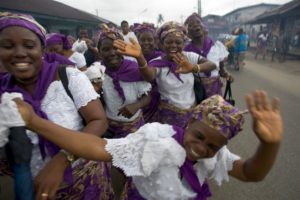
Lagos is a melting pot; a land of promises fulfilled and promises unfulfilled; a land of wide opportunities for some and narrow opportunities others.
I came to Lagos on September 19, 1970, in search of the golden fleece at the University of Lagos. Lagos was three years plus old then. It was one of the 12 states created by General Yakubu Gowon on May 27, 1967. It is the only state in the country today that has escaped the infection of the mad virus of state creation by the military since 1967. No mean achievement.
I find it fitting and proper that the government and people of the state should roll out the red carpet and bring out the royal drums in celebration of its 50th anniversary, which comes up on the 27th of this month. It is, for one, the oldest state in the country today. For another, it is the most populous state in the country. And for still another, it has made such tremendous progress in human, economic and social development that no one can truthfully describe it as old for nothing. Age and continuity have conferred on it the wisdom that has pushed it along its own beaten path. The once dirty, sweltering city is now the welcome face of human progress. It is a miracle.
By the way, I found the golden fleece three years later and headed back home to Benue-Plateau State. I thought I was finished with Lagos. I wasn’t.
I returned to Lagos in August 1984 to co-found Newswatch Communications Limited with Yakubu Mohammed, Dele Giwa and Ray Ekpu. Together we trail-blazed the weekly newsmagazine publishing in Africa with Newswatch magazine. I have not left Lagos since then. I have lived here for 33 years. But I am still not a Lagosian. I am still a stranger.
In my 33 years here, I have seen that a lot of good things began in Lagos. And a lot of bad things began in Lagos too. The city has a fine present and a sordid past.
In my Unilag days, I witnessed a city in eternal struggle with itself. It was both the best and the worst period in its life. The oil boom brought unimaginable wealth to the city. The construction boom made sure that the ports were virtually clogged with ships discharging imported building and other materials that would serve notice on the world that our country had arrived. The cement armada said something of the ambition and the incapacity of a country whose sudden wealth pushed it beyond its managerial and administrative capacity. This became its burden.
I was here when it was not unusual to see corpses on some major and minor streets in the city almost daily. The late iconoclast, Tai Solarin, was once moved to take on the thankless job of getting rid of those corpses the police pretended they did not see.
I was here when Ishola Oyenusi led his gang to rob WAHUM of its workers’ pay. They paid for their daring and became the first set of armed robbers to be publicly executed at the Bar Beach. Oyenusi and his gang made armed robbery a bloody but lucrative enterprise. His pikins are still in the business, firing squad or no firing squad.
I witnessed the build up of the horrendous traffic bottle neck. Its local name of go-slow captured the endurance test that vehicular traffic in the city endured daily. I used to walk from Carter Bridge to the NIIA at Kofo Abayomi in Victoria Island. Civil servant friends of mine left the mainland as early as 4 a.m. on week days to get to their offices by 7.30 a.m. on the island. If they were lucky, they passed through their office doors at 1 p.m.
It was here, since January 1966, that the military learnt to use their guns to effect a change of government and plant themselves in office. Coups, successful or failed, were all hatched and executed here. Failed coup plotters were also executed here. Lagos was a city where the blood flowed.
I have mentioned briefly the underbelly of Lagos, our Lagos. In my 33 years here, I have watched with fascination, the breath-taking progress the state has made in almost all areas of human progress; minus constant light supply by NEPA, of course. I have seen land reclaimed from the sea and the lagoon turned into highbrow business, commercial and residential areas for those that young business reporters call high net worth individuals. Our generation knew them as wealthy men and women.
I have watched the rise of skyscrapers and the road network sporting flyovers. I have watched the single Carter bridge, once the only bridge linking the main land with the island turned into a dual carriageway. I watched the building of Eko Bridge and the Third Mainland bridge. And I have watched as good planning and execution have made go-slow almost history in Lagos.
Lagos is a melting pot; a land of promises fulfilled and promises unfulfilled; a land of wide opportunities for some and narrow opportunities others. The city was the welcome but treacherous face of the oil boom in the seventies. It promised easy life but not everyone of the thousands of Nigerians who poured into the city from their hardscrabble home states could find it. They came every year in search of jobs, a better life and living. After all, this was where the oil boomed. Everyone could hear the boom and everyone could see the boom in the changed upward mobile circumstances of their compatriots.
No, I do not think those who flocked here ever thought the streets of the city were paved with gold. No one would be foolish enough then to pour gold on the narrow and largely unpaved streets of the crowded city. The bright lights of the rich and beautiful city attracted them. The promise of an important city being the seat of the Federal Government and commercial nerve centre of the country beckoned them. They could not resist the allure of the lore. And they poured in their thousands with each of them clutching a big dream to his chest. If you could not make it in Lagos, you could not make it anywhere else.
For some, the city delivered on its promises. They realised their big dreams by securing good and important jobs. Some found and exploited opportunities in private industrial and commercial enterprises. But the city failed some. It could not deliver on its assumed promises. There were no jobs and no decent opportunities for a living. Without these, there was no decent accommodation. Those who could not make it found solace in the backwoods or ghetto called Ajegunle and Maroko. The latter is now history but we must remember it in the context of the narrow opportunities in the paradox of rural-urban drift.
Even Ajegunle and Maroko were beyond the reach of many. They found inhospitable accommodation under bridges and flyovers. I would imagine they put up with the rats, the mosquitoes and other vermin better entitled to their home under the bridges because they reasoned that being in Lagos was the best revenge against the hard life they left behind back home in their states of origin. In any case, condition not being permanent, we have also witnessed the God of miracles working the miracles in the lives of those the rich believed had been forgotten in the hard embrace of poverty and the hard life. No matter. If they could not make it here, there is always a fat chance they could exchange places with their compatriots in Maitama, Ikoyi, Lekki and other sumptuous places up stairs. This life is but a dress rehearsal.
The influx of fellow Nigerians into Lagos in the seventies doubled the problems of the city. It could barely cope with the burgeoning population. They clogged the arteries of its social development. The immediate consequence was insufficient water supply and inadequate housing. Millions of poor people lived in wooden shacks in Ikoyi and Victoria Island. The rich and the poor have never quite been separated.
The first military governor of Lagos State, the towering Brigadier-General Mobolaji Johnson, once described the people pouring into his state as the Dick Whittingtons. The man was frustrated. Dick Whittington was a character in an English folklore. It tells the story of a real life Richard Whittington, a wealthy merchant, who claimed to have escaped from poverty, thanks to his cat. Yep, people poured into Lagos to escape poverty. Thousands, who arrived here with coins jingling in their pockets, got lucky. They became rich from industries or commerce or, what the heck, plain corruption.
Thus, the great thing about Lagos is that many came to the city with small changes in their pockets and the gods of Eko transformed their lives. They found success. They made it. They grew wealthy. Lagos became their success story. Amazing.
No other city in the country has transformed as many lives as Lagos has. And no other state has the luck of Lagos: successor civilian governors of the state do not abandon projects begun by their predecessors. They complete them. Ask former governors Ahmed Tinubu and Babatunde Fashola. Then ask Akinwunmi Ambode, the current governor. Have I just revealed the secret of its success?
Happy birthday to Lagos, our Lagos. [myad]