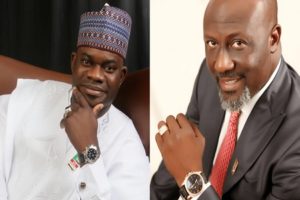
Senator Dino Melaye has accused Governor Yahaya Bello of Kogi State of plot to assassinate him because of what he called his fight for the payment of workers’ salaries and pensioners’ dues.
Senator Melaye, who spoke to women that embarked on peaceful protest in his Aiyetoro-Gbede senatorial district, said that workers and pensioners in Kogi are suffering and dying as a result of non-payment of 15-month salaries and pensions by Governor Yahaya Bello.
“Yahaya Bello collected N20 billion from the Federal Government as bailout fund. Still, he refused to settle workers. He also collected N11 billion from the Paris Club fund. Still, he refused to pay workers and pensioners.
“Children can no longer go to school. Tenants can no longer pay their house rent. Enough is enough, the people of Kogi State are tired of this government.
“The advent of Yahaya Bello as governor and Taofiq Isa as local government administrator in the political history of Kogi State has brought this unfortunate socio-political paradigm shift,” Melaye alleged. [myad]
Former military governor of Kaduna state, retired Colonel Abubakar Dangiwa Umar has advised President Muhammadu Buhari to stop making the current war against corruption a personal affair
Dangiwa, who reacted to the suspension of Babachir David Lawal as the Secretary to the Government of the Federation (SGF) and Ambassador Ayodele Oke as the Director General of the Nigerian Intelligence Agency (NIA) while they are being investigated, said: “for the war to be meaningful and sustainable, it must be elevated beyond a President Buhari personal struggle to a national one.
“There is national unanimity in support of the war against corruption which is expected to be non-discriminatory and waged by a meticulous adherence to the rule of law. For the war to be meaningful and sustainable, it must be elevated beyond a President Buhari personal struggle to a national one.”
While commended President Buhari for the action his government took in respect of Babachir and Oke, he questioned the government’s anti corruption war which he said, appears to be aimed at the neutralization and destruction of the opposition.
“It is over one year since three law courts, including ECOWAS Court granted bail to Col. M.S. Dasuki. The Federal Government has however refused to release him citing the untenable excuse of the grievous nature of his offence. Our extant constitution is quite clear on this issue.
“The Federal Govt. does not have the power to determine which offence is bailable or whether an accused person is deserving of bail. It should therefore obey courts’ decisions and release Colonel Dasuki without any further delay. His unlawful detention, campaign of calumny and pretrial publicity make it impossible for him to receive a fair trial.
“The only explanation one can find for Col. Dasuki’s lengthy detention without trial is that he belongs to the wrong camp. He has also the misfortune of having served as National Security Adviser to the much vilified Nigerian President of Ijaw extraction.
“Colonel Dasuki’s fate is tied to that of his former principal President Goodluck Jonathan; an honourable and patriotic Nigerian who conceded defeat and congratulated the winner of the 2015 Presidential election Gen Muhammadu Buhari even before INEC declared the final results, when he could have held on tenaciously to power as is the norm in many Third World Countries. “This rare act of statesmanship which pulled the country back from the precipice has been rewarded with utmost disrespect and derision by the APC Federal Govt. President Jonathan is the most maligned Nigerian former Head of State.
“Col. Dasuki is paying dearly for his loyal service to this patriot. All well-meaning Nigerians must speak out against his unfair and unlawful treatment. We cannot afford to remain neutral in the face of this monumental injustice. When one Nigerian is unlawfully detained all of us must have the moral consciousness to feel psychologically incarcerated.” [myad]
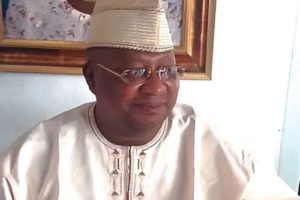
President Muhammadu Buhari has expressed sadness over the death of Senator Isiaka Adeleke who he described as one of the strong supporters of his government’s whistle blower policy. Adeleke died today, Sunday, at the age of 62 at Bikets Hospital in Osogbo, the Osun state capital after suffering a heart attack according to family sources.
In a condolence message, President Buhari said: “Adeleke had always epitomized unbridled patriotism, maturity and experience, especially with his recent interest in the protection of whistle blowers.”
Buhari, who condoled with Osun State Government and members of the National Assembly over the death of Adeleke, said that the deceased had passionately and relentlessly championed the cause of the less privileged and most vulnerable in Nigeria.
He said that Adeleke’s contribution to his state, as first elected governor, and the country will always be remembered by posterity even as he prayed to God to grant the soul of the departed eternal rest, and to comfort the family.
Also, the national leader of the All Progressives Congress (APC), Asiwaju Bola Ahmed Tinubu, described the death of Senator Adeleke as a numbing shock which he said came barely a day after that of Dipo Famakinwa.
Tinubu acknowledged that Senator Adeleke was a grassroots politician with a rich political background and that he was hugely popular in his Osun State, particularly in the three local governments in Ede, his hometown.
“He was a major leader of our party, the APC. His leadership and good counsel were still very much required when death came.
“The late senator and I shared mutual respect and affection. My path and his first crossed during the aborted Third Repubic, in the 1992/93 era, when we both belonged in the defunct Social Democratic Party. He was in the Peoples Democratic Party at the rebirth of democratic dispensation in 1999 but he later joined us in the APC in the build-up to the 2015 election.”
The APC chieftain said that he would remember Adeleke as that charismatic first civilian governor of Osun State who left behind a legacy in the area of education by establishing Ire Polytechnic and College of Education, Esa-Oke, among other laudable things he did during his time.
“Adeleke was with us in Lagos during the colloquium marking my 65th birthday. He also joined us for the inauguration of Aboru-Abesan Link Bridge and adjoining roads constructed by Governor Ambode and opened as part of my 65th birthday anniversary.” [myad]
The political economist, Benjamin Friedman once compared modern Western society to a stable bicycle whose wheels are kept spinning by economic growth. Should that forward-propelling motion slow or cease, the pillars that define our society – democracy, individual liberties, social tolerance and more – would begin to teeter. Our world would become an increasingly ugly place, one defined by a scramble over limited resources and a rejection of anyone outside of our immediate group. Should we find no way to get the wheels back in motion, we’d eventually face total societal collapse.
Such collapses have occurred many times in human history, and no civilisation, no matter how seemingly great, is immune to the vulnerabilities that may lead a society to its end. Regardless of how well things are going in the present moment, the situation can always change. Putting aside species-ending events like an asteroid strike, nuclear winter or deadly pandemic, history tells us that it’s usually a plethora of factors that contribute to collapse. What are they, and which, if any, have already begun to surface? It should come as no surprise that humanity is currently on an unsustainable and uncertain path – but just how close are we to reaching the point of no return?
While it’s impossible to predict the future with certainty, mathematics, science and history can provide hints about the prospects of Western societies for long-term continuation.
Safa Motesharrei, a systems scientist at the University of Maryland, uses computer models to gain a deeper understanding of the mechanisms that can lead to local or global sustainability or collapse. According to findings that Motesharrei and his colleagues published in 2014, there are two factors that matter: ecological strain and economic stratification. The ecological category is the more widely understood and recognised path to potential doom, especially in terms of depletion of natural resources such as groundwater, soil, fisheries and forests – all of which could be worsened by climate change.
Disaster comes when elites push society toward instability and eventual collapse by hoarding huge quantities of wealth and resources
That economic stratification may lead to collapse on its own, on the other hand, came as more of a surprise to Motesharrei and his colleagues. Under this scenario, elites push society toward instability and eventual collapse by hoarding huge quantities of wealth and resources, and leaving little or none for commoners who vastly outnumber them yet support them with labour. Eventually, the working population crashes because the portion of wealth allocated to them is not enough, followed by collapse of the elites due to the absence of labour. The inequalities we see today both within and between countries already point to such disparities. For example, the top 10% of global income earners are responsible for almost as much total greenhouse gas emissions as the bottom 90% combined. Similarly, about half the world’s population lives on less than $3 per day.
For both scenarios, the models define a carrying capacity – a total population level that a given environment’s resources can sustain over the long term. If the carrying capacity is overshot by too much, collapse becomes inevitable. That fate is avoidable, however. “If we make rational choices to reduce factors such as inequality, explosive population growth, the rate at which we deplete natural resources and the rate of pollution – all perfectly doable things – then we can avoid collapse and stabilise onto a sustainable trajectory,” Motesharrei said. “But we cannot wait forever to make those decisions.”
Unfortunately, some experts believe such tough decisions exceed our political and psychological capabilities. “The world will not rise to the occasion of solving the climate problem during this century, simply because it is more expensive in the short term to solve the problem than it is to just keep acting as usual,” says Jorgen Randers, a professor emeritus of climate strategy at the BI Norwegian Business School, and author of 2052: Global Forecast for the Next Forty Years. “The climate problem will get worse and worse and worse because we won’t be able to live up to what we’ve promised to do in the Paris Agreement and elsewhere.”
While we are all in this together, the world’s poorest will feel the effects of collapse first. Indeed, some nations are already serving as canaries in the coal mine for the issues that may eventually pull apart more affluent ones. Syria, for example, enjoyed exceptionally high fertility rates for a time, which fueled rapid population growth. A severe drought in the late 2000s, likely made worse by human-induced climate change, combined with groundwater shortages to cripple agricultural production. That crisis left large numbers of people – especially young men – unemployed, discontent and desperate. Many flooded into urban centres, overwhelming limited resources and services there. Pre-existing ethnic tensions increased, creating fertile grounds for violence and conflict. On top of that, poor governance – including neoliberal policies that eliminated water subsidies in the middle of the drought – tipped the country into civil war in 2011 and sent it careening toward collapse.
Another sign that we’re entering into a danger zone is the increasing occurrence of ‘nonlinearities’, or sudden, unexpected changes in the world’s order
In Syria’s case – as with so many other societal collapses throughout history – it was not one but a plethora of factors that contributed, says Thomas Homer-Dixon, chair of global systems at the Balsillie School of International Affairs in Waterloo, Canada, and author of The Upside of Down. Homer-Dixon calls these combined forces tectonic stresses for the way in which they quietly build up and then abruptly erupt, overloading any stabilising mechanisms that otherwise keep a society in check.
The Syrian case aside, another sign that we’re entering into a danger zone, Homer-Dixon says, is the increasing occurrence of what experts call nonlinearities, or sudden, unexpected changes in the world’s order, such as the 2008 economic crisis, the rise of ISIS, Brexit, or Donald Trump’s election.
The past can also provide hints for how the future might play out. Take, for example, the rise and fall of the Roman Empire. By the end of the 100BC the Romans had spread across the Mediterranean, to the places most easily accessed by sea. They should have stopped there, but things were going well and they felt empowered to expand to new frontiers by land. While transportation by sea was economical, however, transportation across land was slow and expensive. All the while, they were overextending themselves and running up costs. The Empire managed to remain stable in the ensuing centuries, but repercussions for spreading themselves too thin caught up with them in the 3rd Century, which was plagued by civil war and invasions. The Empire tried to maintain its core lands, even as the army ate up its budget and inflation climbed ever higher as the government debased its silver currency to try to cover its mounting expenses. While some scholars cite the beginning of collapse as the year 410, when the invading Visigoths sacked the capital, that dramatic event was made possible by a downward spiral spanning more than a century.
Eventually, Rome could no longer afford to prop up its heightened complexities
According to Joseph Tainter, a professor of environment and society at Utah State University and author of The Collapse of Complex Societies, one of the most important lessons from Rome’s fall is that complexity has a cost. As stated in the laws of thermodynamics, it takes energy to maintain any system in a complex, ordered state – and human society is no exception. By the 3rd Century, Rome was increasingly adding new things – an army double the size, a cavalry, subdivided provinces that each needed their own bureaucracies, courts and defences – just to maintain its status quo and keep from sliding backwards. Eventually, it could no longer afford to prop up those heightened complexities. It was fiscal weakness, not war, that did the Empire in.
So far, modern Western societies have largely been able to postpone similar precipitators of collapse through fossil fuels and industrial technologies – think hydraulic fracturing coming along in 2008, just in time to offset soaring oil prices. Tainter suspects this will not always be the case, however. “Imagine the costs if we have to build a seawall around Manhattan, just to protect against storms and rising tides,” he says. Eventually, investment in complexity as a problem-solving strategy reaches a point of diminishing returns, leading to fiscal weakness and vulnerability to collapse. That is, he says “unless we find a way to pay for the complexity, as our ancestors did when they increasingly ran societies on fossil fuels.”
Also paralleling Rome, Homer-Dixon predicts that Western societies’ collapse will be preceded by a retraction of people and resources back to their core homelands. As poorer nations continue to disintegrate amid conflicts and natural disasters, enormous waves of migrants will stream out of failing regions, seeking refuge in more stable states. Western societies will respond with restrictions and even bans on immigration; multi-billion dollar walls and border-patrolling drones and troops; heightened security on who and what gets in; and more authoritarian, populist styles of governing. “It’s almost an immunological attempt by countries to sustain a periphery and push pressure back,” Homer-Dixon says.
Meanwhile, a widening gap between rich and poor within those already vulnerable Western nations will push society toward further instability from the inside. “By 2050, the US and UK will have evolved into two-class societies where a small elite lives a good life and there is declining well-being for the majority,” Randers says. “What will collapse is equity.”
Whether in the US, UK or elsewhere, the more dissatisfied and afraid people become, Homer-Dixon says, the more of a tendency they have to cling to their in-group identity – whether religious, racial or national. Denial, including of the emerging prospect of societal collapse itself, will be widespread, as will rejection of evidence-based fact. If people admit that problems exist at all, they will assign blame for those problems to everyone outside of their in-group, building up resentment. “You’re setting up the psychological and social prerequisites for mass violence,” Homer-Dixon says. When localised violence finally does break out, or another country or group decides to invade, collapse will be difficult to avoid.
Europe, with its close proximity to Africa, its land bridge to the Middle East and its neighbourly status with more politically volatile nations to the East, will feel these pressures first. The US will likely hold out longer, surrounded as it is by ocean buffers.
As time passes, some empires simply become increasingly inconsequential
On the other hand, Western societies may not meet with a violent, dramatic end. In some cases, civilisations simply fade out of existence – becoming the stuff of history not with a bang but a whimper. The British Empire has been on this path since 1918, Randers says, and other Western nations might go this route as well. As time passes, they will become increasingly inconsequential and, in response to the problems driving their slow fade-out, will also starkly depart from the values they hold dear today. “Western nations are not going to collapse, but the smooth operation and friendly nature of Western society will disappear, because inequity is going to explode,” Randers argues. “Democratic, liberal society will fail, while stronger governments like China will be the winners.”
Some of these forecasts and early warning signs should sound familiar, precisely because they are already underway. While Homer-Dixon is not surprised at the world’s recent turn of events – he predicted some of them in his 2006 book – he didn’t expect these developments to occur before the mid-2020s.
Western civilisation is not a lost cause, however. Using reason and science to guide decisions, paired with extraordinary leadership and exceptional goodwill, human society can progress to higher and higher levels of well-being and development, Homer-Dixon says. Even as we weather the coming stresses of climate change, population growth and dropping energy returns, we can maintain our societies and better them. But that requires resisting the very natural urge, when confronted with such overwhelming pressures, to become less cooperative, less generous and less open to reason. “The question is, how can we manage to preserve some kind of humane world as we make our way through these changes?” Homer-Dixon says. [myad]
The Central Bank of Nigeria (CBN) has made clear to the International Monetary Fund (IMF) that Nigerian government will not kill Nigerians by agreeing to float the country’s local currency, the Naira.
The CBN’s Acting Director, Corporate Communications, Isaac Okorafor, who made this known on the sideline of the ongoing IMF/World Bank Spring Meetings in Washington DC, emphasized that floating Naira and other undesirable economic policies will amount to killing Nigerians.
Okorafor, who was obviously reacting to calls by the IMF for the Naira to be floated, said that it would not make sense for the country to introduce a policy that will ‘kill’ Nigerians.
“If we float the naira and allow speculators and those with corruption money and all the people who create the bubbles to launch into the market, you can yourself imagine the kind of situation we will find ourselves. Our economy has its own peculiarities, and we cannot kill our people in the name of floating the naira.”
Okorafor said that the Nigerian market is extensively liberalized already and that the call for the floating of the naira is unnecessary.
”Yesterday, when Madame Lagarde (IMF boss) was discussing the economy of Egypt, she lamented the devastating inflation that is in that country.
“Egypt has half of our population, Egypt receives about $12 billion in foreign aids and several billions in tourism. We are 180 million people, our infrastructure is so poor and the productive capacity cannot be fast enough to rise to benefit from massive depreciation.
“If you float the naira today, and given the discoveries by security agencies, you’ll discover that our case will be terrible.
“If Egypt today has an inflation rate of almost 31 per cent, remember Angola also has about 36 percent inflation, ours is at 17.26 per cent. [myad]
The Minister of Finance, Kemi Adeosun has said that Nigeria is critically addressing the estimated housing deficit of 17 million units which was brought about by various factors.
Adeosun, who spoke today, when she met with representatives from International Finance Institutions at the World Bank Spring Meetings said: “delivering affordable housing is critical to the delivery of our reform agenda and is one of the key pillars for implementation we have been discussing in Washington this week.
“Nigeria has an estimated housing deficit of 17 million units, and with an estimated increase of 900,000 annually. Some of the reasons for this are clear.
“Interest rates are high for both developers and home buyers, and the tenure of debt remains too short. As a result, we have to find a way to accelerate the provision of affordable homes. That is why we have established the Family Homes Fund.
“We have requested N100 billion in the 2017 budget and for the subsequent three years as part of the Medium Term Expenditure Framework (MTEF), this is seed funding from the government, but this is not solely a public sector scheme, it will be a partnership with the private sector and we are looking to mobilize additional resources from domestic and external sources.
“The Fund will enable us to deliver discounted mortgages for home owners, while also enabling access to attractive funding mechanisms for developers. We are piloting in 6 states and
the results of those pilots will guide long term programme implementation.”
The Minister is conducting a series of meetings on the implementation of some of the critical projects in the Economic Recovery and Growth Plan including meetings on Housing, Water, Power and Food Security.
“Many of these projects are already well advanced and we have had a series of productive meetings in Washington with development partners to advance those projects and hopefully accelerate implementation so we can meet the ambitious but achievable goals we have set ourselves.” [myad]
The Presidential Committee set up by President Muhammadu Buhari to probe certain allegations against the Secretary to the Government of the Federation (SGF), Engineer Babachir Lawal and the Director-General of the National Intelligence Agency (NIA), Ayo Oke has said that it would conduct the robe in close session.
“All its proceedings will however be in closed sessions to avoid speculations, allow for full disclosure and enhance the pace of proceedings.”
A statement by the senior special adviser to Vice President Yemi Osinbajo, who heads the 3-man probe panel, Laolu Akand, said that the panel will invite all relevant officials and private individuals who may be connected to both cases.
“It will also obtain and scrutinize documents that may throw some light on the issues raised in both cases.”
Other members of the probe panel are the Attorney-General and Justice Minister, Abubakar Malami and National Security Adviser, retired Major General Babagana Munguno. The panel was set up to investigate allegations of legal and due process violations made against the SGF and the discovery of large amounts of foreign and local currencies by the Economic and Financial Crimes Commission (EFCC) in a residential apartment in Ikoyi, Lagos.
Laolu Akande assured that the panel which is expected to submit its report to the President at the expiration of the 14-day deadline, “will conduct its work with utmost diligence and without fear or favour.” [myad]
42-year-old mother of four, Mrs. Taiwo Bolumade has narrated how a woman friend of her husband, 45 year old Olajide, once sent him a whatsApp message requesting him to return her pant in his possession.
“A whatsApp message entered with my friend’s picture appearing on the screen begging my husband to return her pant. I showed my husband the message; he confessed that he was having an illegal affair with her that I should forgive him.
“I also went to my friend’s house to confront her for having an illegal affair with my husband. She also begged me that I should not let her husband hear about it and promised to end the relationship with my husband.”
These revelations finally led an Igando Customary Court in Lagos State to terminate the 18-year old marriage.
Apart from proving a point that her husband has been dating her married friend, Taiwo Bolumade also said that her husband was in the habit of threatening to kill her with dangerous weapons at the slightest provocation.
“My husband is used to beating me up using dangerous weapons; recently he threatened to kill me.
“Anytime I received a call, my husband would demand for my cell phone to know if it were a man that called; and if I refused to surrender it to him, he would beat the hell out of me.
“He once attacked me on the bed with a cutlass; threatening to machete me but I escaped by the whiskers.”
The mother of four claimed that her husband had refused to eat food prepared by her in the past three years.
But Olajide denied the allegation of infidelity and accused his wife of having affair with another man, adding: “my wife is having an affair with a man; I had caught them severally behind a transformer where they were always meeting around 11p.m.
“She and her lover arrested me on two occasions, accusing me of always calling her lover’s cell phone and threatening his life, an allegation I knew nothing about.”
Olajide described the mother of his children as “an ingrate,” alleging that he bought two cars for her when his business was booming but when it crashed, she started misbehaving. “In fact, she even invited the police to arrest me claiming I stole her N100,000 of which I am innocent of.”
In his judgment, the President of the Court, Adegboyega Omilola, said: “since both parties had consented to the dissolution of their marriage, this court has no choice than to dissolve the marriage.
“This court, therefore, pronounces the marriage between Mrs Taiwo Bolumade and Mr Olajide Bolumade dissolved today.
“Both parties are no longer husband and wife; they are free to go their separate ways without any hindrances and molestations.” [myad]
A Dana Air aircraft en-route Port Harcourt yesterday, Friday, collided with a bird midair minutes after it took-off from the Murtala Muhammed Airport, Lagos and had to abort the trip by returning quickly to the departing point.
Communications Manager of the airline, Kingsley Ezenwa, confirmed the incident in a statement, adding that the captain took a professional decision by returning to the Lagos airport.
“A bird strike is a collision between a bird and an aircraft that is airborne and as per standard safety procedure which is the hallmark of our operation, our pilot returned to base.
“Our guests have however been put on another aircraft to ensure that their itinerary is not entirely disrupted.
“The aircraft is currently being evaluated by our engineers to determine the effect of the bird strike on its affected engine.”
The manager assured Dana Air’s customers that the airline would continue to give priority to their safety and comfort.
The General Manager, Public Relations, Nigerian Civil Aviation Authority (NCAA), Sam Adurogboye, told NAN that the air return was a precautionary measure to prevent any untoward occurrence.
Adurogboye said that the pilot acted according to Standard and Recommended Practices (SARPs), as such the incidences should not be sensationalized.
“The pilot did the right thing by returning to base.
“The aircraft had already lost one engine as a result of the bird strike and the standard practice is that the pilot should land at the nearest airport.
“Once such incident occurs, it is mandatory for the airline to make a report to the NCAA.”
Adurogboye also restated NCAA’s commitment to the safety and security of Nigeria’s aviation sector.
This is the third incident recorded by the Nigerian aviation sector in the last 72 hours.
An Aero Contractors flight NG316 en-route Lagos, from Port Harcourt, was on Tuesday engulfed in smoke about 20 minutes after take-off, causing panic among the passengers.
Similarly, two aircraft belonging to Air Peace were on Thursday involved in a ground collision at the General Aviation Terminal of the Murtala Mohammed Airport, Lagos.
Nigerian police have announced the rescue of two Turkish men kidnapped earlier this month in the southeast with five suspects arrested.
The police spokesman in Akwa Ibom State, Deputy Superintendent Okechukwu Chukwu, said in a statement that the two Turkish nationals were rescued on April 19 and that there was no casualty.
“No casualty was recorded during their rescue but five suspects were arrested. No ransom was paid, and investigations are ongoing. The Turks have been reunited with their families.”
The pair, who worked for a construction company, were abducted on April 11 in the town of Eket in Akwa Ibom state. [myad]
We use cookies on our website to give you the most relevant experience by remembering your preferences and repeat visits. By clicking “Accept”, you consent to the use of ALL the cookies.
This website uses cookies to improve your experience while you navigate through the website. Out of these, the cookies that are categorized as necessary are stored on your browser as they are essential for the working of basic functionalities of the website. We also use third-party cookies that help us analyze and understand how you use this website. These cookies will be stored in your browser only with your consent. You also have the option to opt-out of these cookies. But opting out of some of these cookies may affect your browsing experience.
Necessary cookies are absolutely essential for the website to function properly. This category only includes cookies that ensures basic functionalities and security features of the website. These cookies do not store any personal information.
Any cookies that may not be particularly necessary for the website to function and is used specifically to collect user personal data via analytics, ads, other embedded contents are termed as non-necessary cookies. It is mandatory to procure user consent prior to running these cookies on your website.






 42-year-old mother of four, Mrs. Taiwo Bolumade has narrated how a woman friend of her husband, 45 year old Olajide, once sent him a whatsApp message requesting him to return her pant in his possession.