The Director General of Nigerian Maritime Administration and Safety Agency (NIMASA), Dr. Dakuku Peterside has been elected as the new Chairman of the Association of African Maritime Administrators (AAMA).
This is one of the decisions reached at the just concluded third conference of the association with the theme: ‘Sustainable Use of Africa’s Oceans and Seas, attended by 34 African countries in Abuja, Nigeria’s capital city.
Chairman of the Local Organizing Committee, Mr. Bashir Jamoh, who addressed media shortly after the event, said that the NIMASA Director General would pilot the affairs of AAMA for a period of one year while South Africa retains the position of secretary.
Peterside, took over from Mr. Sobantu Tilayi, the acting Chief Executive Officer of South African Maritime and Safety Agency (SAMSA), who has been the acting Chair of the association since 2013.
At a closing session, Tilayi, the outgoing Chairman described Peterside as a committed and dedicated technocrat that will, no doubt, take maritime administration to a higher level.
Many other participants expressed optimism in Peterside’s leadership ability to improve on the fortunes of the continent through concerted maritime collaboration that will attract interest of African states through their various Maritime Administrations (MARADs).
Within the last one year, Peterside has been able to improve on inter agency and inter government cooperation in the fight against piracy resulting to a reduction in incidences of piracy and sea robberies.
NIMASA under his watch has broaden the scope of maritime administration in Nigeria with an approval for regional headquarters to be sited in strategic maritime locations in the country including Port Harcourt. [myad]
The Buhari Media Support Group (BMSG) has advised President Muhammadu Buhari to make neighbourhood watch part of the current whistle blower policy that had given the war against corruption the necessary bite.
In a statement today in Abuja, the Group encouraged the government of Buhari to increase the scope of the policy to include neighborhood watch schemes and provide worthy incentives to people who blow the whistle in order to encourage others to join in the vanguard.
The statement, signed by BMSG Protem Coordinator, Hon. Austin Braimoh and Secretary, Chief Cassidy Madueke, called on the National Assembly to fast track the passage of the Whistleblowers Bill.
“once the bill is passed into law, it will provide a legal backbone for the sustainable success of the policy and the protection of whistleblowers.”
It said that the whistle blower policy would serve as an instrument for unearthing public funds that were stolen as well as enhancing the revenue generation profile of the Federal Government, including the enthronement of financial discipline and handling of public funds by government officials and agencies.
“Going by the huge amount of local and foreign currencies that were stolen but found by the EFCC, there is no doubt that the Federal Government has additional funds to implement people-oriented programmes.” [myad]
The Central Bank of Nigeria (CBN) has established a Forex widow for investors and exporters tagged: “Investors’ & Exporters’ FX Window.”
This is coming, today, Friday, two weeks after opening a special Forex window for Small and Medium Enterprises (SMEs) to enable SMEs import eligible finished and semi-finished items.
A circular issued by the CBN today said that the purpose of the window is to boost liquidity in the forex market and ensure timely execution and settlement for eligible transactions.
The circular, signed by the Bank’s Director in charge of Financial Markets, Dr. Alvan Ikoku, listed eligible transactions under the new window to include invisible transactions such as loan repayments, loan interest payments, Dividends/Income Remittances, Capital Repatriation, Management Service Fees and Consultancy fees.
Also on the eligible list are Software subscription fees, Technology Transfer Agreements, Personal Home Remittances and any such other eligible transactions including ‘miscellaneous Payments’ as detailed under Memorandum 15 of the CBN Foreign Exchange Manual.
The circular which explained that the invisible transactions under the window excludes international airlines ticket sales’ remittances, and added that the window covered Bills for Collection and any other trade-related payment obligations, which are at the instance of the customer.
The circular clarified that the permitted invisible transactions and Bills for Collection were eligible to purchase foreign currency sourced from the CBN Forex window limited to Secondary Market Intervention Sales (SMIS) Wholesale (Spot and Forwards) only.
According to the statement, international airlines ticket sales’ remittances shall only be eligible to access the CBN FX window (SMIS-Retail and Wholesale; spot and forwards.
On participants in the new window, the circular disclosed that supply of foreign currency to the window shall be through portfolio investors, exporters, authorized dealers and other parties with foreign currency to exchange to Naira. The CBN, it added, shall also be a market participant at the window to promote liquidity and professional market conduct.
Taking cognizance of the slow progress made by corporates in on-boarding the FMDQ OTC Securities Exchange (FMDQ) Thomson Reuters FX Trading & Auction Systems, the CBN said participants at the new window would trade via telephone until appreciable progress is made with the FX trading systems on-boarding process.
The circular therefore advised authorized dealers to promote market transparency by encouraging their corporate clients to on-board to ensure the activities of the window are operated on the forex trading systems.
To provide price discovery to the market, it said the FMDQ will be charged with polling buying and selling rates and other relevant information from the major participants in the market to provide participants with the requisite price discovery, and the CBN with the indicative market depth until the market migrates to the FX Trading systems.
As part of the operational requirements of the window, the CBN circular said the exchange rates of the transactions in the window shall be as agreed between authorized dealers and their counterparties. It also said that the CBN reserved the right to intervene as a buyer or seller, as it deems fit, in the window, adding that information on transactions between authorized dealers shall be reported to the CBN on a daily basis. [myad]
President Muhammadu Buhari has approved the reconstitution of the Board of Federal Capital Territory Internal Revenue Service (FCT-IRS) with Abdulahi Oteh Attah as Chairman and Chief Executive.
This was contained in a circular signed by the FCT Permanent Secretary, Dr. Babatope Ajakaiye dated April 21, 2017.
Members of the Board are Ahmed Garba, Barrister Hamza Hashim, Saa Godwin Gbue, Edward Adedamola, Mrs. Blessing Ifeyinwa and Ms. Benedicta Atto.
The circular said that this is in addition to the Statutory members of the Board provided for in Section 3(2)(a) of the FCT-IRS Act 2015 which include the following Directors/officials of the FCT Administration which are:-
Director of Treasury – Deputy Chairman
Solicitor-General, Legal Services Secretariat – Member
Director of Land Administration – Member
Director, Administration & Finance (Area Council Services Secretariat) – Member
Co-ordinator, Abuja Infrastructure and Investment Centre – Member
Director, Department of Economic Planning, Research and Statistics – Member
Director of Information & Communications – Member
Minister of the FCT, Malam Muhammad Musa Bello has also approved the redeployment of Barrister Harisu Umar of the FCT Legal Services Secretariat to the FCT-IRS as Secretary to the Board.
The appointment of the Chairman of the Board is however, subject to the confirmation of the National Assembly, in line with the enabling Act. [myad]
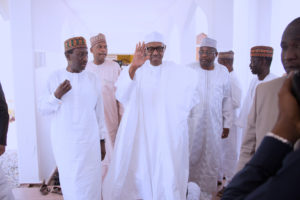
President Muhammadu Buhari joined other Muslims today, Friday, to observe Jum’at prayer at the Aso Villa Jum’at Mosque, Abuja. The President, with the National Security Adviser, retired Major-General Babagana Monguno and the Commander of the Brigade of Guards, Brigadier General M. S Yusuf, waves to the people as he emerged from the Mosque. [myad]
“We are victims of our actions; our destinies are controlled by the cosmic rolls of the dice, the whims of the stars and the vagrant breeze of fortune that blows from the windmills of the gods.”- H.L. Detridge.
The above lines came to mind on Wednesday, April 19, after the Presidency suspended the Secretary to the Government of the Federation (SGF), Mr David Babachir Lawal, from office pending investigation into the allegations of violations of law and due process in the award of contracts under the Presidential Initiative on the North East (PINE).
Within fourteen days from the date of his suspension, the committee headed by the Vice President, Professor Yemi Osinbajo, will investigate the allegations against him and submit a report of its findings and recommendations to President Muhammadu Buhari. The crux of his offence – influencing the award of N220 million grass-cutting contract to his company, Rholavision Engineering Limited, by PINE – is public knowledge.
The propriety or otherwise of the contract award, a fact which was unearthed by the Senator Shehu Sani-led Ad-hoc Committee on the Mounting Humanitarian Crisis in the North East, as well as the recommendations of the committee, which the Senate passed into a resolution that Lawal should be removed from office and prosecuted for abuse of public office, has been a subject of heated debate.
Given the anti-corruption stance of the Buhari administration, the popular expectation was that Lawal would be immediately suspended from office and steps taken to investigate the allegations contained in the report of the Senate to the president, dated December 15, 2016, as the administration has just done. Rather, the President in his January 17, 2017 reply to Senate President, Bukola Saraki, discountenanced the resolution and advanced reasons for his action.
Remarkably, the President faulted the procedures adopted by the Senate as inherently deficient. One of his fundamental arguments was that only three of the nine members of the committee signed the report, which rendered it, prima facie, a minority report “as against a final report which ought to have been presented to the Senate in a Plenary for adoption as a binding and final report before submission to the Presidency given the weight of allegations made in the report.”
Another argument by the President was that the Senate Ad-hoc Committee Interim Report and the votes and proceedings of the Senate have not, in their own right, established that Lawal was ever given an opportunity to appear before the committee to defend himself; ditto Rholavision Engineering Limited, which was linked to him.
Read the President further: “You are invited to note that non-application of the principle of fair hearing by the Senate Ad-hoc Committee is a clear contravention of Section 36 (1) of the 1999 Constitution of the Federal Republic of Nigeria (as amended) and against the principle of rule of law as enunciated in the Nigerian legal system as well as the rules of the National Assembly Committees on handling of public petitions.
“Consequently, I am of the view that barring other considerations that may arise as a result of subsequent investigation of Engineer Lawal by the interim Ad-hoc committee, the current report as presented to the Presidency, in its own right, does not meet the principles of fair hearing and compliance with the Senate Rules for conduct of investigations in matters relating to abuse of office by public officers.
“In the light of the foregoing, I am not able to approve the recommendation to remove and prosecute Engineer Lawal on the basis of the Senate Ad-hoc Committee Report dated 15th December, 2016.” The simple and unambiguous inference from Buhari’s letter, in my own words, is that “I am ready to do the needful – remove and prosecute Lawal – if the conditions precedent, to wit: fair hearing and compliance with the Senate Rules, are met.”
Even though, it is not clear if the Senate Ad-hoc committee undertook further investigation of the matter and consideration of the issues involved, yet Lawal’s scandalous involvement in the contract award, through his company, has been sustained in the public psyche, thus becoming a sore point in the Buhari administration’s anti-graft war.
That the third highest public office holder in the executive branch has been insinuated into such a scandal is an issue that should not be treated lightly let alone when the Senate has entertained and investigated concrete allegations and returned a guilty verdict against him. It, thus, becomes inconceivably suicidal for an administration, whose leader is perceived to have zero tolerance for corruption, to have, so it seems, attempted to sweep the sensitive matter of abusive of office under the carpet.
The administration runs on a tripod of the executive, legislature and judiciary. Nigerians have seen how the executive, which has been accused of protecting its officials who are allegedly corrupt, has taken the anti-corruption battle into the enclaves of the judiciary and the legislature, charging judges and the senate president with breaches of provisions of the law and other extant rules before the courts and tribunal.
Perhaps, a reappraisal of its disposition to the anti-corruption war especially within the executive ambit was at the bottom of the sudden volte-face on the Lawal saga. Perhaps, the administration has realised that it is losing its massive goodwill and floundering in the anti-graft war on account of its seemingly selective prosecution of corruption cases. Perhaps, in the circumstance, it has decided to seize the initiative to do the correct thing even if the Senate has not been able to perfect the modus operandi for Lawal’s indictment.
This is the time to retune the anti-graft war. The Osinbajo-led investigative committee may be the game changer. It is saddled with a historic task, the outcome of which may make or mar the anti-corruption war. But given his pedigree as Senior Advocate of Nigeria (SAN) and pastor, Osinbajo should be guided by the spirit and letters of the law, morality and fear of God in the discharge of this tricky assignment. Corruption, its whiff and tendencies are the foci of investigative attack here and not an individual, his ethnic or religious affiliations, lest people begin to give the exercise a religious undertone.
It is somewhat sardonic and unfortunate that Lawal is the one caught right in the eye of the storm and with his hands in the cookie jar of abuse of public office, hence becoming a victim of his action. It could have been anybody else. Indeed, what has crystallised is nothing but the fall of Babachir Lawal, a denouement of sorts. It would not matter whether or not he survives the inquisition.
By being a subject of executive investigation, he has donned a badge of dishonor as the first occupant of the position of the SGF to be suspended and investigated for alleged abuse of office in the recent annals of Nigeria’s public administration. But more importantly, Lawal’s debacle will prove salutary to Buhari’s anti-corruption war: that the administration does not have sacred cows; and that if the SGF could be suspended and investigated, the ministers, especially the “super” ministers, should not be conceited.
On Sunday, Turks streamed to the polls to vote in a referendum on constitutional amendments which, if passed, would fundamentally alter Turkey’s system of government and essentially institute a dictatorship. In practice, there would be no separation of powers, with the president controlling the judiciary and able to absent himself and his cabinet from any oversight on the part of the legislature.
Initially, the Turkish press reported a lopsided victory in favor of the new government but, as the hours passed, the “Yes” margin of victory narrowed. Even though the official result has yet been announced, President Recep Tayyip Erdogan declared victory.
Put aside for a moment that the state-controlled media would not give significant airtime to opposition and Erdogan’s police force and personal militia harassed and jailed opposition campaigners. Also ignore for a moment that “state of emergency” which gave Erdogan dictatorial rights to jail opponents, tens of thousands of whom are in prison without trial and so had their votes denied.
The problem goes beyond an unfair campaign to outright fraud:
Article 94 of Turkey’s Election Law states that election tabulators cannot count envelopes and votes inside not carrying the official stamp of the election. The rule was enacted to prevent ballot-stuffing. Yet, an hour after the ballot boxes were opened, the High Electoral Council reversed its decision.
Then, in Turkey’s southeast where the Kurdish Peoples’ Democratic Party (HDP) dominates, observers were removed from the balloting room for “security reasons” so only the government-appointed officials in the room counted and tallied results. Fraud in this process alone may have changed the results. This isn’t just theoretical: In Urfa, multiple videos emerged showing ballot stuffing.
The Republican Peoples Party says it is filing objections involving 2.5 million votes. If only one-fifth of that total changes, the final result will change as well.
Erdogan may claim victory, but Turkey is dangerously divided. Those who opposed constitutional amendments affirming Erdogan’s dictatorship will not recognize the legitimacy of Erdogan and his new government. Nor, frankly, should they. The fight may very well turn violent. Any loosening of police repression will result in street clashes. The Kurdish insurgency will redouble as they see themselves disenfranchised. The Turkish military, purged of its top officers and experience, will be unable to counter the Kurds leading to the effective loss of Turkey’s southeast. Then there’s Islamic State terrorism, which Erdogan has been powerless to prevent since he fired and imprisoned his top counterterror technocrats in favor of political sycophants.
Erdogan may believe himself king, but he will likely preside not over a Turkish renaissance, but rather over a bloodbath.
Michael Rubin (@Mrubin1971) is a contributor to the Washington Examiner’s Beltway Confidential blog. He is a resident scholar at the American Enterprise Institute and a former Pentagon official. [myad]
The German’s BND foreign Intelligence Agency has come up with a revelation that the July 15, 2016 military coup attempt in Turkey was staged by part of the country’s military that feared the mass purge by the government of President Recep Tayyip Edorgan.
The German spy agent stressed: “the coup attempt was not initiated by the government. Before July 15, the government had already started a big purge, so part of the military thought they should do a coup quickly before it (the purge) hit them too.”
In a report publish in German magazine, Der Spiegel, the spy agent also said that the Turkish government had failed to convince its operatives that a U.S based Turkish Cleric, Fethullah Gulen was behind the failed coup.
According BND head, Bruno Kahl: “Turkey has tried to convince us of that at every level, but so far, it has not succeeded.”
President Edorgan and the Turkish government had accused Gulen of orchestrating Turkey’s failed coup of July 15 in which more than 240 people were killed when rogue soldiers commandeered tanks, warplanes and helicopters to attack parliament and attempted to overthrow the government.
President Edorgan and Turkish government had tried to convince the United States to extradite Gulen, who denied involvement in the coup attempt.
Speaking during his inauguration as new President of the German Federal Intelligence Agency (BND), at the Chancellery in Berlin, the Germany capital, Bruno Kahl said that Gulen movement was not extremist or terrorist group, explaining: “it is a civil association that aims to provide further religious and secular solutions.” [myad]
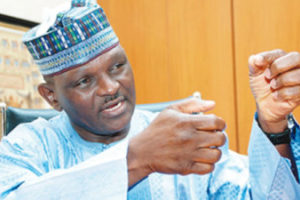
Major Hamza Al-Mustapha, Chief Security Officer to the late military head of State, General Sani Abacha, has floated a new political party, known as Green Party of Nigeria (GPN)..
In a statement announcing the new party today, Thursday, Major Al-Mustapha said: “finally, the real people’s Party has landed. Please give praise to our Creator for rare beautiful gift to the people. The future is GPN and GPN is the Future.” Major Hamza Al-Mustapha, had in 2013 said that he had no ambition to venture into politics or to seek for political position in the country.
Al-Mustapha, who was standing trial for the murder of Kudirat Abiola, was discharged and acquitted by the court of appeal in 2013. [myad]
Minister of the Federal Capital Territory (FCT), Malam Muhammad Musa Bello (right), receives briefings from FCT water board officials when he paid a visit to Pedan Dam in Asokoro District, Abuja, today, Thursday. [myad]
We use cookies on our website to give you the most relevant experience by remembering your preferences and repeat visits. By clicking “Accept”, you consent to the use of ALL the cookies.
This website uses cookies to improve your experience while you navigate through the website. Out of these, the cookies that are categorized as necessary are stored on your browser as they are essential for the working of basic functionalities of the website. We also use third-party cookies that help us analyze and understand how you use this website. These cookies will be stored in your browser only with your consent. You also have the option to opt-out of these cookies. But opting out of some of these cookies may affect your browsing experience.
Necessary cookies are absolutely essential for the website to function properly. This category only includes cookies that ensures basic functionalities and security features of the website. These cookies do not store any personal information.
Any cookies that may not be particularly necessary for the website to function and is used specifically to collect user personal data via analytics, ads, other embedded contents are termed as non-necessary cookies. It is mandatory to procure user consent prior to running these cookies on your website.






Fraud In Turkey’s Referendum And Possibility Of Renewed Violence, By Michael Rubin
On Sunday, Turks streamed to the polls to vote in a referendum on constitutional amendments which, if passed, would fundamentally alter Turkey’s system of government and essentially institute a dictatorship. In practice, there would be no separation of powers, with the president controlling the judiciary and able to absent himself and his cabinet from any oversight on the part of the legislature.
Initially, the Turkish press reported a lopsided victory in favor of the new government but, as the hours passed, the “Yes” margin of victory narrowed. Even though the official result has yet been announced, President Recep Tayyip Erdogan declared victory.
Put aside for a moment that the state-controlled media would not give significant airtime to opposition and Erdogan’s police force and personal militia harassed and jailed opposition campaigners. Also ignore for a moment that “state of emergency” which gave Erdogan dictatorial rights to jail opponents, tens of thousands of whom are in prison without trial and so had their votes denied.
The problem goes beyond an unfair campaign to outright fraud:
Article 94 of Turkey’s Election Law states that election tabulators cannot count envelopes and votes inside not carrying the official stamp of the election. The rule was enacted to prevent ballot-stuffing. Yet, an hour after the ballot boxes were opened, the High Electoral Council reversed its decision.
Then, in Turkey’s southeast where the Kurdish Peoples’ Democratic Party (HDP) dominates, observers were removed from the balloting room for “security reasons” so only the government-appointed officials in the room counted and tallied results. Fraud in this process alone may have changed the results. This isn’t just theoretical: In Urfa, multiple videos emerged showing ballot stuffing.
The Republican Peoples Party says it is filing objections involving 2.5 million votes. If only one-fifth of that total changes, the final result will change as well.
Erdogan may claim victory, but Turkey is dangerously divided. Those who opposed constitutional amendments affirming Erdogan’s dictatorship will not recognize the legitimacy of Erdogan and his new government. Nor, frankly, should they. The fight may very well turn violent. Any loosening of police repression will result in street clashes. The Kurdish insurgency will redouble as they see themselves disenfranchised. The Turkish military, purged of its top officers and experience, will be unable to counter the Kurds leading to the effective loss of Turkey’s southeast. Then there’s Islamic State terrorism, which Erdogan has been powerless to prevent since he fired and imprisoned his top counterterror technocrats in favor of political sycophants.
Erdogan may believe himself king, but he will likely preside not over a Turkish renaissance, but rather over a bloodbath.
Michael Rubin (@Mrubin1971) is a contributor to the Washington Examiner’s Beltway Confidential blog. He is a resident scholar at the American Enterprise Institute and a former Pentagon official. [myad]