

We’re Approaching End Of Economic Hardship, Buhari Assures Nigerians
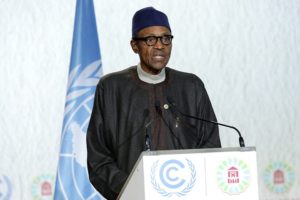
“I want to assure all Nigerians that we are approaching the solution to our economic challenges with the same will and commitment we have demonstrated in the fight against corruption and in the fight against terrorism and militancy.”
President Muhammadu Buhari gave this assurance today, Wednesday when he launched Nigeria’s Economic Recovery and Growth Plan at the Presidential villa, Abuja.
The President, who insisted that his government inherited numerous challenges, said that he is committed to delivering on the three key areas that he promised, adding that they are improving security, tackling corruption and revitalizing the economy.
“Security in the North East and other parts of Nigeria is significantly better today than when we came in. With regards to our fight against corruption, as you all know, our law enforcement agencies are prosecuting very many cases of corruption. Our successes in these two areas are clear for all to see.”
He said that his government is fully aware of the difficult situation Nigeria found itself “and the need to bring positive and enduring change. And we remain committed to our electoral promise to change our way of doing things and to change Nigeria for good.”
President Buhari said that the Economic Recovery and Growth Plan has brought together all the sectoral plans for agriculture and food security, energy and transport infrastructure, industrialization and social investments together in a single document.
“It builds on the Strategic Implementation Plan and sets out an ambitious roadmap to return the economy to growth; and to achieve a 7% growth rate by 2020.
“Our aim simply put, is to optimise local content and empower local businesses. We seek not just to take the Nigerian economy out of recession but to place it on a path of sustained, inclusive and diversified growth.
“We are determined to change Nigeria from an import dependent country to a producing nation. We must become: A nation where we grow what we eat and consume what we produce.We must strive to have a strong Naira and productive economy.
“The Plan I am launching today therefore sets out what we, as Government, are committed to do, to create the enabling environment for business to thrive. The Plan is a national plan, hence the role of State Governments is critical to its success. I therefore wish to appeal to the State Governments to draw inspiration and strategic direction from the Plan to articulate their economic programmes, particularly in the development of the real sector.
“I call on all Nigerians to work with us to ensure we achieve those objectives. The contents of the Plan are already familiar to a broad cross-section of Nigerians because it was developed in consultation with a wide group of stakeholders, including the National Assembly, State Governments, the business community, labour unions, academia, civil society groups and development partners.”
The President commended the ministry of Budget and National Planning for successfully coordinating the Plan’s development even as he also salute the efforts of the Economic Management Team under the leadership of the Vice President for overseeing the drafting of the Plan. [myad]







Importance Of Local Govt Autonomy In Reviving Economy, By Olawale Rasheed
Nigeria is struggling with local poverty and grassroots under-development. Economically, depressed nations face several challenges. Uniquely, economic depression is not of the same dimension across nations. Within each country, the challenges also vary from States to States, and within States, from local government or counties to counties.
Several strategies are therefore employed, depending on the peculiarities of each state and local government. Nonetheless, our people at the grassroots are not finding it easy. Are our states’ chief executives culpable in the current fiscal squeeze and constraining strangulation across the States? My question is not directed at the usual allegations of corruption and mismanagement at state levels. That depends on how you analyze and read the situation.
There is a consensus of sort that tackling local poverty and boosting depressed economy depends on virile local government system. Many analysts think something is wrong with the near death of local governments system in the country. The virtual crippling of council administration has serious consequences for poverty crisis and social palliatives policies of the government. A paralyzed local government accelerates poverty and weakens the capacity of government to contain fallout of recession. As more than 80% of the population lives at the grassroots, the weakening of local government implies deepening distance of government from the people and a worsening state of the grassroots.
There is a feeling that most state governors do not to believe in local government autonomy. Some advance differing theories of federalism which is of course are not supported by federal practices in Germany and the USA. Some eye the local government allocation and assume that pulling local allocations together can allow for centrally planned development plan for all the local governments. So many reasons were postulated. There are merits and demerits in such postulations.
Certain facts need to be clarified. First, each local government differs from the other. There are urban LGAs and rural ones. Each local government is in various stages of developments at infrastructural and other levels. The developmental needs of each LGA differ and a centrally planned development agenda may miss the crucial point of local developmental needs and aspirations.
Two, local people deserve the right to determine what is most pressing of their needs. Deciding for local people from the state capital has the tendency to misrepresent the will and wish of the people. Politicization of developmental choices is largely one of the likely negative outcomes.
There is also a political error in denying the local people the democratic rights to pick their leaders. Democracy at local level has many positive sides. First, a generation of new leaders emerges based on performance such that there is a progression in leadership development from local to state to federal levels. That allows for responsible and experienced leadership emergence and leadership transition in national development
Two, local economy is managed and boosted through elected leadership. In those days, local people don’t bother about happenings at the state capitals. Local contractors exist, handling culverts, rural roads grading and other local grassroots jobs. Over valuation of contracts are not possible and supply chains for the jobs are all locally based. The Governor is saved the headache of sending monies to local leaders as the local economy is thriving and meeting the local minimal needs of the people.
Then, there is a robust competition among local leaders to deliver on good governance. Many council bosses strive hard to execute pro-people projects as they see such as opportunities to showcase their leadership credibility. This they know is a sure way to advance further in their political career.
There is of course the legitimate concern about cost of governance. But a lot of reforms can be put in place to ensure that cost of governance at local level is reduced to the barest minimum. The salary structure can be reformed and the number of elected officials can be pruned down through a legislation of the state assembly. Part of the reform is to ensure that the State Assembly does not turn the local government into a milking point.
My point is that problem facing state chief executives are self inflicted. If you allow local government to freely run, you encounter fewer challenges when it comes to welfare politics. Local issues are tackled by the local government chairmen who are to be policed by anti graft agencies and who are to implement developmental vision relevant to their local governments. This is achievable if we develop implicit confidence in the capacity of our people to do the right thing when saddled with public responsibilities.
It is clear that governmental leaders need not be control- freak as experience has shown that it does not work. Dictating what happens at the local levels distract the Governor from the bigger picture of innovative governance at the state level. Local gossips poison his psyche and he spent more time attending to local issues which should be the preoccupation of elected local government chairmen. Precious time and energy are wasted on petty local subjects.
There is also this fear of free and fair election at local level. Where elections are conducted, many state leaders across party lines yearn for total win of all local governments seats. Eventually winners are more like imposed officials, thereby rubbing them of the needed populist support to drive development and revive the local economy. Because they lack legitimacy, they rely mostly on the Governor who also controls the purse. The consequence is that the purpose of election is defeated as the ‘imposed’ chairmen act more like robots without initiative, ending up compounding the governance burden facing the Governor.
There is a correlation between bad governance and rigged electoral outcome. An elected leader without legitimacy is sure not to owe allegiance to the people whom he knows did not vote for him. The outcome is an ego-driven local leader who acts with impunity as long as he is in the good book of the Governor. Developmental potentials of such local government are locked away and citizens continue to stream to the state capital, seeking for survival that should have been provided at the local level under a robust local government system.
To revive the economy, a robust, virile local government system is a must. And certain conditions may be attached to this. First, the overhead cost should be reduced through alternative engagement, not retrenchment, for excess local government employees. Two, a potent anti corruption arrangement is to be put in place to avoid corrupt tendencies in local administration.
Three, local governments are to enter into business through incorporated companies specializing in products and services in which their local government have comparative advantage. Four, local economy can be boosted when each local government get its allocation and each local leadership is allowed to determine what prioritized projects are best for it. Five, the local contracting class and chambers of commerce need to be actively revived at each local government. Local jobs and contracts should be handled at the local level. This facilitates robust local economy.
In specific terms, local artisan groups across the trade sectors should be enabled to execute local contracts. Six, states should strive to allow local governments to handle areas of their statutory mandates as spelt out in the constitution. This allows the councils to function and build a governance structure to serve the people. Seven, the states should also strive to pay to local government the statutory contribution required from states’ revenues.
Now, many may see the above as impossible. That exactly is why the nation is in a gridlock. We have taken governance away from the people. The people are largely disconnected from authorities because we have deliberately weaken and render impotent local government administration out of control disposition, obsession for local government fund and a very wrong developmental theory of deciding what the people want for them rather than the other way round.
We sit at the state capital and bring a contractor to build local culvert and adjoining roads, killing local contractors and economy. We decide who a caretaker chairman should be instead of allowing people to elect their leaders. We corner all local allocations, making council areas mere salary paying establishment and forcing citizens to stream to the state capitals.
We can get out of recession, depression, poverty and widening unemployment only when we return government to the local people, only when we revive local economy, only when we allow local people to democratically elect their leaders, only when state leaders consider the endless developmental possibilities in an elected, independent, robust local government system.
*Olawale Rasheed of Sahel Media Group sent this piece from Abuja. [myad]