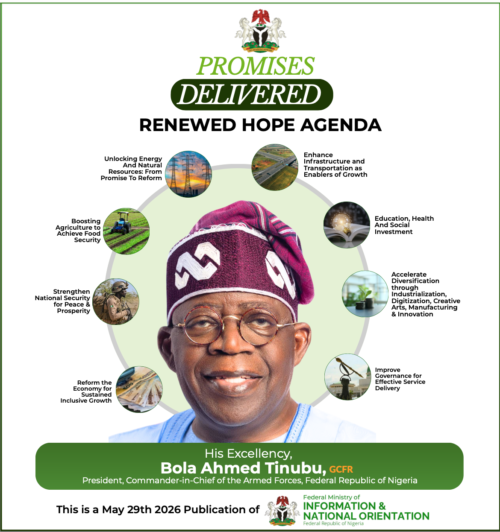
President Muhammadu Buhari has taken a look back at how the national leader of the ruling All Progressives Congress (APC), Asiwaju Bola Ahmed Tinubu built political consensus that led to unseating of an incumbent President in 2015.
He said that Tinubu’s foray into politics “ushered in a better understanding of building consensus to achieve historical feats, like unseating an incumbent government.”
President Buhari, in a message to congratulate Tinubu who was former two-term governor of Lagos State on his 65th birthday, described the celebrant as a great leader.
The President emphasised that Tinubu was able to raise the bar for many political leaders across the country as a two-term governor of Lagos State, who bequeathed a style of leadership that completely altered the landscape of the commercial capital.
Buhari recalled his pleasant and intellectually enriching encounters with “the Jagaban of Borgu Kingdom over the years,” and confirmed that the nation has benefitted a lot from the personal sacrifices, political experience and intellectual foresight of the APC chieftain, and still stands to gain more.
He congratulated the APC leader on behalf of all members of the APC, his political and business associates, his friends and family, describing his 65th birthday as “another milestone” even as he prayed to God to grant the Asiwaju good health, longer life and more wisdom to serve his country and humanity. [myad]
I once wrote about Nigeria’s “children of anger”, but the country seems to have progressed from anger to clinical depression, resulting in a rise not merely in social aggressiveness, but a determination by certain individuals to escape from it all. The percentage of Nigerians seeking escape through suicide nonetheless remains small relative to the size of the population, but the sharp increase in the number and frequency of reported suicides in the last two years alone speaks to a certain dysfunctionality requiring closer inquiry.
Suicide is an act of self-destruction, an escape from the self, an act of self-defeat. Whether the suicide is anomic or fatalistic, due to loss of job, broken relationships, dis-inhibition, economic deprivation, environmental factors, disability or psychosis, it usually arises from an awareness of the inadequacy of the self. What Germans call “weltschmerz”, that is, a discrepancy between personal expectations and the reality of personal space, which for many may result in anger, aggressiveness, a feeling of rejection, isolation, inadequacy and ultimately a revolt against the self.
It is often assumed that poverty is synonymous with this resolve to deconstruct the self but the highest suicide rates are actually found in countries with wealth, and better environment, and all ten of the most popular spots for suicide in the world are in developed countries. What is certain however regardless of the place and time, is that human beings decide to abbreviate their own mortality when they resolve that they can no longer live with the discrepancy between what they are and what they would like to be, or what they have been and what they have suddenly become or what they expect and what happens to them eventually, all of this basically in the context of the imagined stigma, shame, disgrace or disappointment.
What is instructive in our own circumstance, however, is that suicide has always been frowned upon in our society: It is forbidden by law, religion, society and tradition, to the extent that in local communities, persons who commit suicide are not given any decent burial, they are thrown into the evil forest to serve as a deterrence to others, and the affected family is stigmatized. It is for this reason perhaps that suicide cases used to be very few in our land. Besides, Nigerians are known for their optimism and resilience.
We were once described as one of the happiest people on earth, and one Dictionary describes a segment of our population, the Yoruba as the “fun-loving people of the South West part of Nigeria.”
Nigerians love life so much they describe virtually every funeral as a “celebration of life” and every life, including the poorest is advertised in funeral posters as “a life well spent.” The cemetery is seen as a desolate, lonely, outside corner of the social space where no one is in a hurry to go. But all that has changed; or appears to be changing, for in the last two years, suicide seems to have become fashionable among seemingly ordinary folks.
I use the phrase “seemingly ordinary folks” advisedly, because the other kind of suicide that is known to Nigerians remains even surprising, and I refer here to the terrorism, religious fundamentalism-inspired suicide attempts of the likes of Umar Farouk Abdulmutallab and Boko Haram agents. When the news broke in 2009, that the former had been uncovered as a suicide bomber, Nigerians were shocked. The reaction then was that it was impossible for a Nigerian to willingly decide to die for, of all reasons, ideological or religious reasons. We were soon proven wrong when Boko Haram began to deploy both male and female, mature and teenage, suicide bombers who turned Nigeria into an extension of the killing fields of al-Qaeda. This trend continues, with the hope within the larger society, that it is something that would end someday.
What the emerging literature shows is that the conditions for every suicide vary in time and space, but in Nigeria, the reported cases point to too many cases of self-deconstruction on the basis of economic deprivation, loss of status, debt, helplessness. The responsibility of government is to ensure the security and welfare of the people. There has been a great failing in this regard, with the people driven further below their perceived reality, which reinforces the causative principle earlier defined. Some of the recently reported cases are as follows: a man ended it all because he could not give his wife “chop-money”, another woman chose to die because she could not pay off her debts, in one week in Lagos, a doctor, two women and an elderly man chose the Lagoon as their death-spot. With the way the Lagos Lagoon has suddenly become a popular spot for suicide in Nigeria, it may well in due course, become one of the most popular suicide spots in the world.
It is noteworthy, if I must say so, that the ten most popular suicide spots on earth are associated with the sea, and bridges, with perhaps the sole exception of the Aokigahara Forest-Mount Fuji in Japan where suicide rate is as high as 100 per year. The Japanese may tolerate suicide and consider it supernatural, but here in Nigeria, it is a growing trend that should be discouraged. Some priests have said the Lagos Lagoon is angry and that is why it has been attracting persons to jump into it: if indeed whatever spirit that controls the Lagoon is hungry, the Oba of Lagos and his chiefs should hurry up and feed that spirit with whatever it eats. I assume that this would be a more useful venture than the partisan declaration by the Oba of Lagos that nobody should contest against the incumbent Lagos State Governor in 2019! But how about the other unreported causes of suicide, far away from the Lagoon? This is where the dilemma lies and where our constructive social theory, and the admissibility of every piece of evidence, empirical and customary, meets a brick-wall.
As a country, society and government, we would always have to deal with deviant behaviour, into which category suicide – the ultimate act of violence and rebellion against self and society falls in this particular context, what is crucial is society’s level of preparedness to reduce the scope and range. In Nigeria, we are not prepared at all. When people fall into depression in other countries, they visit counselors and psychiatrists. In Nigeria, a prominent leader once dismissed psychology as a useless course that should be removed from the curriculum. Graduates of psychology end up doing something else, or they end up offering pro bono counseling on social media like my in-law, Joro Olumofin, but with people dying for no just reasons and jumping into the river or hanging themselves or killing their spouses and family members, this is a country in urgent need of professional counselors. Psychiatry is another relevant discipline that has been utterly neglected.
I once gave a keynote address at the Psychiatric Hospital, Aro in Abeokuta and I was again Keynote Speaker at the 100th anniversary of Psychiatry in Nigeria. Nothing has changed since then. We don’t have enough psychiatric doctors or hospitals in Nigeria. The few psychiatric hospitals are poorly funded, psychiatric doctors are poorly treated, the discipline is disregarded, and yet this is a country of psychotic cases at all levels, the more serious cases are in government, making decisions that create more problems of bipolar disorder in the larger society. Nigeria is a victim, like many other developing countries, of a one-sided embrace of globalization and its gains and evils. People watch TV and they are socialized into a new form of thinking that is disconnected with local values and culture. They become anti-heroes in the process. Suicide or attempted suicide has not fetched any one or any family any kind of honour in our society.
Given this sociology, greater attention needs to be paid to the increasing incidence of suicide, in the North and the South particularly, with the most vulnerable states properly identified and strategic intervention measures put in place. A preliminary observation indicates that the most affected persons in the North are radical Islamic extremists used as pawns by the Boko Haram, while in the 10 most affected states in the South, the cause is basically existential. This observation is based on reported cases, but with the increasing frequency, it is safe to hazard a guess that there are many more unreported cases, which may provide additional or different sociological conclusions.
Whatever the case may be, this rise of despair in the country needs to be managed. Suicide prevention hotlines have been announced, but the thought of suicide should be discouraged in the first place, through better governance, opportunities for professional counseling, and better management of mental health. Most Nigerians don’t even know who to go to, or talk to when they are depressed! And if they know, they don’t want their private secrets to be known. When the suicide succeeds or fails, the relatives are in need of help: they will need counseling, to deal with the frustration and the shame.
I believe that suicide-related problems can be fixed. The challenge is to convert the people’s pessimism into optimism through people-centred governance and to deliver the much-expected, much-trumpeted change in their circumstances. Disappointment leads to frustration, to anger, to despondency, to losses, to despair and ultimately to self-destruction for the weak-hearted. But suicide is not a solution. And to those who doubt this, Teebliz, Tiwa Savage’s husband is a living testimony. Not too long ago, he wanted to jump into the Lagoon. He said his wife, the award- winning singer, had disappointed him. He accused her of many better-unmentioned-again-thing s. He could not take it anymore and he wanted to self-destruct.
His suicide attempt was more or less televised, because it was everywhere on social media – it is not every suicide that is so televised- eventually he was prevented from taking the plunge, and he raved and ranted afterwards and then went quiet. Months later, he has been shown taking photographs with the same woman for whom he wanted to play a Romeo without a Juliet. In their most recent outings, they have been shown with their son, Jamil who looks like his father’s twin, and last weekend, the boy had his Christening at a church in Lekki. Teebliz has been pictured bonding with his son and beaming with fatherly pride.
If he had jumped into the Lagoon when he wanted to do so, he would have been long dead and forgotten. But Teebliz looks much happier now, and deep within him, he must be grateful to the persons who did not allow him to jump. He must be particularly happy seeing his son growing up into a fine young kid. There is nothing in this life that cannot be fixed and there lies the futility of suicide. [myad]
Borno State government has announced that it would mark the fall of Sambisa forest to the Nigerian soldiers every December 22. It said that the day would be declared Sambisa Memorial Day, with public holiday even as it plans to build a museum for the study of the Sambisa phenomenon.
According to the state governor, Kashim Shettima, the Memorial Day would be held every year in honour of the victims of Boko Haram insurgents, celebrate the victory recorded by the Nigerian Military and the remembrance of fallen soldiers and volunteers who sacrificed their lives fighting Boko Haram since 2009 in different parts of Borno State.
The governor, who spoke at the opening of the Nigerian Army Small Arms Championship today, Monday, inside the Sambisa Forest at the said that December 22 has been chosen for the annual public holiday because it was on December 22, 2016 that the Nigerian Armed Forces took over the Sambisa Forest from Boko Haram insurgents after a tough battle.
Shettima also announced his plans to seek partnership with the Federal Ministry of Defence and the Federal Ministry of Information and Culture to collaborate in building a National Museum and Research institution in Borno State that would collate all de-classified information, materials recovered by the military in relation to the fight against the insurgents to document history of insurgents, their victims, fallen soldiers and relevant materials in order to preserve lessons learnt from the crisis and to attract local and foreign tourists.
“The Borno State Government will from this year, begin to declare the 22nd December of every year, as SAMBISA MEMORIAL DAY. This day, which will be marked as public holiday in Borno State is for the purpose of celebrating the strength and victory of our armed forces; for the purpose of remembering victims of the Boko Haram insurgency and the families they left behind. It will also be for the purpose of remembering members of the Nigerian Armed Forces and Volunteers who gave their lives in the course of fighting the Boko Haram in Borno State. “The fall of Sambisa is both symbolic and memorable and this is why as a Government, we are taking steps to preserve the history behind the fall of Sambisa Forest and to spectacularly document the roles played by everyone from the Commander In Chief, our service chiefs, commanders of troops and our soldiers.
“Very soon, the Borno State Government will respectfully request for partnership with the Federal Ministry of Defence and the Federal Ministry of Information and Culture towards working together to construct a National Museum that we might call SAMBISA FALL & INTERNATIONAL RESEARCH CENTRE, for the purpose of documenting all de-classified information, to preserve valuable materials recovered by the military in relation to the fight against Boko Haram insurgency and to document history of the crisis from the days of the Taliban to Boko Haram.
“Importantly also, our aim is to document responses by successive political and military leadership and the eventual fall of Sambisa Forest under the administration of President Muhammadu Buhari. We hope that such a Museum will become a global custodian of information and valuable materials on issues relating to the Boko Haram and the role played by the Nigerian Military and multi national forces.
“We will propose that the museum should have A HALL OF FALLEN HEROES which should bear names and pictures of notable officers and men of the Nigerian Army, Air Force, Navy, Police, DSS, all para-military agencies, the civilian JTF and hunters who paid the supreme price in helping to free us from the Boko Haram.
“We will also propose that the Museum should have a HALL OF FAME to document the patriotic contributions of leaders like President Muhammadu Buhari, our current service chiefs, past and present military and other security heads and commanders of troops who meritoriously served within and outside the northeast in the fight against the Boko Haram.
“We will propose that the Museum should have a MEMORIAL HALL that would permanently bear names of notable civilians killed by insurgents. The whole idea is to preserve history so that we keep memories alive, so that we remember and salute our heroes and most importantly, for us and the future generation to learn from the unfortunate Boko Haram experience.”
The Governor paid tribute to the armed forces for their successes in suppressing the Boko Haram noting the people of Borno State will remain indebted to all those who made contributions to addressing the Boko Haram crisis and its effects.
The Minister of Defence, General Mansur Mohammed Dan Ali, represented President Muhammadu Buhari at the opening of the Championship.
The Chief of Army Staff, Lieutenant General Tukur Buratai hosted the event while National Assembly members dealing with the armed forces were also at the Sambisa Forest to mark the event.
There were ceremonial shooting by the Minister of Defence, Chief of Army Staff and National Assembly members who all wore military camouflages. [myad]
Compliance Task Force set up by the Comptroller-General of the Nigeria Customs Service (NCS), retired Colonel Hameed Ali, has impounded 223 vehicles, 13 of which belong to a senator in Kano state.
The Task Force Zonal Commander, Bala Dole told News Agency of Nigeria (NAN) in an interview in Kano today, Monday, that among the vehicles seized from the senator, whose name he would not make public; are 12 Toyota Hilux and one Land Cruiser Jeep.
Bala Dole said that the 13 vehicles were trailed from Maigatari in Jigawa state, following an intelligence report, indicating that they were smuggled into Nigeria via land borders.
“Based on the intelligence report, the vehicles were 30 in number but we were able to trail 13 of them 12 of which were hidden in the senator’s compound. We sealed the house and retrieved the vehicles and they are now in our custody.”
There are three senators currently representing Kano State. They are Rabiu Musa Kwankwaso, Kano central; Barau Jibrin, Kano North and Kabiru Ibrahim Gaya, Kano South. All are under the platform of the All Progressives Congress (APC).
The task force also seized other items, including foodstuff worth N269.5 million in Kano and Jigawa states within eight months.
The items included 9,757 bags of rice, 2,916 of foreign supergetti, 2,770 cartons of foreign vegetable oil and 999 cartons of macaroni.
Others items seized are 889 veils of second hand clothes, 50 used school bags, 110 cartons of new foreign shoes, 956 bags of mosquito coil and six fairly used cars.
“The total value of the seizure made by the task force since it was established in July 2016, excluding the 13 Senator’s vehicles, is N269.5 million. We are yet to determine the cost of the 13 vehicles belonging to the Senator.”
Amidst rising tensions and crises among Nigeria’s Christians and Muslims, the need for the promotion of peace and harmony was the central focus of an interfaith summit that culminated into the adoption of a constitution for the establishment of the Interfaith Dialogue Forum for Peace (IDFP).
Held from January 26-27, 2017 in Abuja, the two-day conference was organised by the Vienna-based KAICIID International Dialogue Centre that serves as a facilitator in Nigeria with the key focus of strengthening social cohesion, particularly among Christians and Muslims in the country. KAICIID is also engaged in coordinating efforts aimed at conflict resolution and reconciliation in Nigeria and other countries of the world.
With the formation of the IDFP to promote dialogue among adherents of various religions in the country, the dream for peaceful dialogue is set to be achieved, with both Christianity and Islam having equal representation in the forum. With the resolve of both groups to implement strategies towards peaceful co-existence among religious faithful, the tension and crises may have taken a backseat in the country.
The two-day conference, organised by KAICIID, came to a successful close with the formal adoption of a draft constitution for Nigeria IDFP and the inauguration of its elected Executive Secretariat to coordinate the Forum’s activities. The formation of the Forum was the highlight of the Coordinate to Achieve 2 conference (CtA2) that focussed on ‘Inclusive and Sustainable Interreligious Dialogue in Nigeria,’ as a follow-up to the first meeting (CtA1) which took place in September 2016 in Abuja. At CtA1 conference, participants had developed an action plan to promote dialogue as a prerequisite for peace and development, and lay the ground for the establishment of an interfaith dialogue platform in the country.
In a bid to further its objectives of realising interfaith unity among Nigerians, the success of the September 2016 summit, which was hinged on the need to establish a dialogue forum, led to the convening of the second conference aimed at consolidating the vision of interreligious dialogue in the country. It is on the basis of broadening the frontiers for interreligious harmony that KAICIID, with local partners in Nigeria, Interfaith Mediation Centre (IMC) and The Kukah Centre, staged a second conference on the theme: ‘Coordinate to Achieve 2-Inclusive and Sustainable Interreligious Dialogue in Nigeria.’
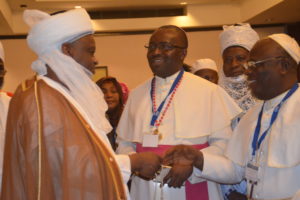
Speaking at the opening ceremony, the Sultan of Sokoto, Alhaji Sa’ad Abubakar III, called on the Federal Government to spare no efforts in bringing hate preachers to books, arguing, “We cannot be preaching one thing and be doing another. Agreeing to talk is not the issue, what we need is to implement what is agreed. We must tell ourselves the truth irrespective of the religious divide we find ourselves. Those who don’t want peace are out to cause trouble. We must rally round the government to assist them deal with the enemies of peace in this country. Those who are encouraging violence are not following the true teaching of Christianity and Islam.”
Calling on Nigeria’s religious leaders to shun violence, the Sultan declared that considering the respect and authority enjoined by religious leaders, both Muslim and Christian leaders should be in the forefront of promoting peace through respect for one another.
The Sultan commended KAICIID for its immense support for promoting religious harmony in Nigeria, stressing, “I commend KAICIID for its support and other religious leaders who are working hard to achieve peace in our country. All religions preach peace and all Nigerian Muslims are desirous of the peace and stability of our country Nigeria. He tasked the IDFP to commence the process of formal registration and to also reach out to prominent persons who may contribute to achieve the IDFP’s goals, stressing, “I am ever willing to be of support to IDFP and its organs in order to open closed doors.”
Expressing hope that the strategies for the promotion of peace shall be implemented by the IDFP, the monarch reminded the participants that the best of strategies would remain ineffective unless put into practice. He, therefore, tasked the IDFP Secretariat to rise up to the challenge and promote peaceful co-existence among Nigeria’s religious groups. Speaking at the formal launching of the IDFP, the Prelate of Methodist Church, Bishop Samuel Chukwuemeka Uche, lauded the idea behind the setting up of the IDFP. He said the formation of the Forum in Nigeria represents a milestone in the nation’s march for realising peace and harmony among Muslims and Christians.
The President of the Christian Association of Nigeria (CAN), Rev Samson Ayokunle, who was represented at the occasion by Bishop Steven Adegbite, stressed on the need for peace, adding that nothing should be considered too great to be done for peace. He warned people that are engaged in killings in the name of religion to stop, as “no one has the power to take life but God.” He promised to collaborate with the Sultan to promote peace and understanding among Christians and Muslims in the country.
The Bishop of Sokoto, Rev. (Dr) Matthew Hassan Kukah, stressed the need for genuine peace, just as he called on religious leaders to preach peace to their congregations at all times. He identified inter-religious visits as a strong measure in encouraging unity among adherents of the major religions in Nigeria. As preachers, Bishop Kukah added, clerics are well positioned to promote peace and harmony among their followers.
KAICIID’s Head of Delegation, Abderrahman El-Yessa, commended the fruitful interaction demonstrated during the two-day summit, just as he called on the nation’s leaders to rise up and stave off further violence. According to him, “The world is watching Nigeria. There are many challenges here in Nigeria, but with the willingness of the religious leaders to work together for peace and dialogue towards a more cohesive society, there is hope. KAICIID will continue to work hand in hand with the Nigerian stakeholders to promote peace and social cohesion in Nigeria and other parts of Africa.”
Considering the level of tensions and crises that have trailed relations among Nigeria’s adherents of the two major religions, the birth of the IDFP is a clear demonstration of commitment by KAICIID and its local partners in deepening understanding among religious and cultural barriers. There is no doubt that with KAICIID’s determination to foist an era of mutual trust among religious groups that are distrustful of one another, the barriers against killings and violence in the name of religion may have become a thing of the past.
Reef, a media professional, wrote this piece from Abuja, and can be reached on simonreef927@gmail.com. [myad]
The Presidency has made it clear that at no time President Muhammadu Buhari was involved in any form of certificate scandal as being insinuated in some quarters.
Senior Special Assistant to the President on media and publicity, Malam Garba Shehu, in a statement reacting to the Sunday Punch newspaper where the President was featured among prominent Nigerians the paper alleges have certificate scandals, stressed that the president was not in the category of Nigerian leaders with questionable certificates.
He enjoined the Punch editors to update their records to avoid making this repeated mistake.
The statement read: “In reaction to your cover story this morning Sunday, March 26,2017, we wish to emphatically state that President Muhammadu Buhari does not fit into your categorisation of leaders with certificate scandals because he bears none that is on available records.
“In the course of the contest for the office of the President in 2015, a number of wild, untrue and malicious allegations were made against him in order to stop him from contesting for the office in the election.
“The issue of certificates was raised against him but the campaign successfully dealt with the allegations by providing evidence that not only was he qualified to run, he had a far higher academic qualification than is required by the constitution. As a result, he went on to run for the office and eventually won.
“Since the purpose of the challenge was primarily to stop him from being a candidate in that election, the challengers either voluntarily withdrew or abandoned the cases soon after he won and all of them were subsequently struck off by the courts.’’
The presidential aide therefore maintained that president had no certificate case hanging on his neck.
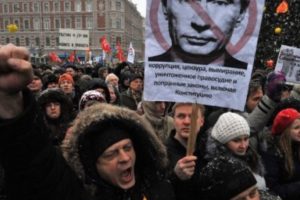
Thousands of Russians, today, Monday, took to the streets of Moscow and other cities in the biggest anti-government protests.
Reports reaching us said that in Moscow, police arrested hundreds of demonstrators, including prominent Russian opposition leader and anti-corruption activist, Alexei Navalny, who orchestrated the uprising. On Monday, officials announced that Navalny will serve a 15-day jail term, saying that he disobeyed police.
Eye witnesses said that crowds gathered to protest government corruption, with many people calling for Prime Minister, Dmitry Medvedev’s resignation.
Navalny had called for nationwide protests after publishing an investigation earlier this month alleging mass corruption charges against Medvedev, whose large fortune far exceeded his position’s salary.
At least 500 demonstrators were arrested in Moscow, reporter Charles Maynes tells NPR, among the tens of thousands who turned out nationwide. It was learnt that the protests came despite warnings from authorities that protesters would face fines and arrest for taking part in the illegal protest.
“There were reports of 2,000 people showing up in Novosibirsk in Siberia, we had 10,000 in St. Petersburg, the estimates here in Moscow are about 20,000,” he says.
A total of 17 employees with Navalny’s Anti-Corruption Foundation, were arrested, the foundation’s director and press secretary Roman Rubanov tells Reuters. The AP cites sporadic scuffles, most notably, “a gray-haired man whom police dragged along the pavement.”
Russian state media, meanwhile, mostly ignored the day’s events, save for earlier cursory coverage, and no comments have been reported from top Russian politicians.
A reporter, Charles Maynes said in Moscow:”Under laws passed in the wake of anti-government protests in 2011, Russians must request protests be sanctioned by the government or face imprisonment and fines.
“Police report over 600 were detained over the rallies — but human rights groups say the number is higher.”
As for the Kremlin’s reaction, presidential spokesman, Dmitry Peskov said the protests were “instigated” by organizers and were carried out by misguided people.
“We cannot respect those who deliberately misled underage minors promising them some payment in return for participating in an unauthorized protest, thereby exposing them to danger,” Peskov said, according to state-run news agency Tass.
Navalny saw little of the protest he organized. Maynes says “Riot police detained the opposition leader as soon as he arrived in downtown Moscow, with Navalny supporters briefly attempting to pry open the police van that held him,” in the capital’s iconic Pushkin Square.
Following critism of the Trump administration’s silence on Sunday’s crack down, the State Department condemned the arrests by evening, calling the move “an affront to core democratic values.” Spokesman Mark Toner said “the United States will monitor this situation, and we call on the government of Russia to immediately release all peaceful protesters,” adding that Washington was “troubled” to hear of the arrest of Russian opposition figure Alexei Navalny.
Sunday amounts to “the biggest show of defiance since the 2011-2012 wave of demonstrations that rattled the Kremlin and led to harsh new laws aimed at suppressing dissent,” says the AP. At the time, President Vladimir Putin accused then Secretary of State Hillary Clinton of inciting the protests.
Navalny is also credited with instigating those demonstrations, when he first rose as an anti-Kremlin threat through his blog and social media. As NPR’s Lucia Kim reported, “he called on Russians to go out on the street and protest voter fraud in the parliamentary elections.”
A fierce Putin critic, Navalny plans to run for president next year, when Putin’s term ends. Putin is expected to run for a fourth term.
But last month, Navalny was found guilty of embezzlement in a case he claims is politically charged to disqualify him from running for president.
Though the candidate is essentially barred from state media coverage, as reporter Charles Maynes says, his heavy internet presence appears to be helping him use his anti-corruption message to expand his base, and attract younger crowds.
“Navalny has united people who think the same; that people don’t agree with the authorities is obvious from what is going on in the country today,” 19-year-old Anna Ivanova told the AP at the Moscow demonstration. “I am a bit scared.” [myad]
Eye specialist, Dr. Mudasar Ahmed, checks an eye patient at Ahmadiyya Muslim Hospital, Kano, during a free eye treatment programme organized by the Hospital and an organization known as Hum. [myad]
The Vice Chancellor of Ahmadu Bello University (ABU), Zaria, in Kaduna state, Professor Ibrahim Garba has confirmed that the Senator representing Kogi West Senatorial District, Dino Melaye actually graduated from Ahmadu Bello University.
Professor Ibrahim Garba told the Senate Committee on Ethics, Privileges and Public Petitions that Senator Melaye graduated from the university as Jonah Daniel Melaye with a Third Class in BA Geography.
Melaye, who later, on oath, insisted that he actually graduated from the institution, tendered series of documents to buttress his position, even as he said that he has also sworn affidavit as to conflicts in his names.
“Distinguished Senators, I have sworn affidavit to my name which reads, Daniel Jonah Melaye to Dino Melaye, because Jonah is actually my father’s name.”
He added: “because I have become popular with Dino over times, I have decided to bear Dino Melaye and you could see that my admission to study Masters degree bears Dino Melaye.”
Meanwhile, Senator Matthew Urhoghide noted that they could see statement of results with an affidavit and not the purported original degree from ABU.
In response, Dino said, he was yet to collect his original certificate, adding that collection of certificates is usually at any body’s convenience.
He revealed that he was ready to collect the original certificate within the week. [myad]
The President General of Ohanaeze Ndigbo, John Nnia Nwodo, has asked his fellow Igbo people to put less emphasis on the Ibgo Presidency and concentrate on thr restructuring of Nigeria.
Nwodo who spoke at a dinner organized in his honour by Old Sigmites, Lagos chapter, a club founded in 1950 at the University of Ibadan, insisted that the agitation for Igbo Presidency is not an issue.
“The agitation for Igbo presidency in 2019 is a non-issue as far as I am concerned. As the president of Ohanaeze Ndigbo, I am apolitical, I am not a member of any political party.
“This is an issue for political parties; it has nothing to do with me. The issue of power rotation among regions is not new, it is somehow aligned with the doctrine of federal character which is in our constitution.
“No party has called for nomination. I don’t think agitation for Igbo presidency is important now; what Nigerians are asking for is restructuring of the country to be a true federation. It cannot continue to be a federation in name, the political lexicography for federation is an independent federal unit.
“The moment you have independent federal unit, being state or regions and they have control over the resources they produce, they will contribute on agreed proportion to the Federation. The question of who is president and where he comes from will die down. It is going to be a matter of who is competent.
“MASSOB and IPOB organisations, no matter how divided they appear in public, are basically motivated by the same sense of outrage and bitterness. Our young men and women can no longer tolerate a second class status in their own country,” he said. [myad]
We use cookies on our website to give you the most relevant experience by remembering your preferences and repeat visits. By clicking “Accept”, you consent to the use of ALL the cookies.
This website uses cookies to improve your experience while you navigate through the website. Out of these, the cookies that are categorized as necessary are stored on your browser as they are essential for the working of basic functionalities of the website. We also use third-party cookies that help us analyze and understand how you use this website. These cookies will be stored in your browser only with your consent. You also have the option to opt-out of these cookies. But opting out of some of these cookies may affect your browsing experience.
Necessary cookies are absolutely essential for the website to function properly. This category only includes cookies that ensures basic functionalities and security features of the website. These cookies do not store any personal information.
Any cookies that may not be particularly necessary for the website to function and is used specifically to collect user personal data via analytics, ads, other embedded contents are termed as non-necessary cookies. It is mandatory to procure user consent prior to running these cookies on your website.