Vice President Yemi Osinbajo has assured the 21 Chibok school girls who were released by their captors, the dreaded members of Boko Haram that they would be taken good care of until their parents turn up to take them away.
He also assured them that the government would give them all the necessary attention, including their health, education, employment and other welfare packages.
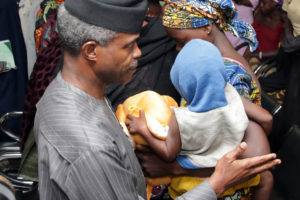
Professor Osinbajo, who received the girls today, Thursday in the Presidential Villa, Abuja, along with his wife and information minister, Alhaji Lai Mohammed among others, offered special prayers for them.
The transcript of the Vice President’s welcome speech is reproduced here:
“First, let me say, we must praise the Almighty God for bringing you back after so many months.
Before I say anything further let’s just say a word of prayer together.
Let us pray.
Our Father in Heaven, we bless your name, we thank you because there is no one like you, thank you for being so good to us, thank you Almighty Father for these ladies.
Father, even as you have brought them back, we pray that you replenish, resuscitate them, and revitalize them with good health so that they can be more successful and happier than they were ever before.
We pray that all of these girls that you have taken care of even while they were in captivity, I pray that you will continue to take care of them.
I pray that you will uphold them, let it be well with them. We pray for those who are still in captivity that all of them will be returned to us. In Jesus mighty name we pray, Amen.
Welcome back girls!
I am sure you know that the whole country has been waiting for you to come back, all these many months, the whole country has been waiting that one day we will see you again and we are very happy to see you back!
We are going to bring your parents, your parents will be coming here to join you.
You can’t immediately be taken out of here because we need to be sure that you are in very good health.
I am sure are going to be very well taken care of. We have provided very good accommodation for you where you will stay where you will sleep and your parents will come and meet you there also.
We are also going to see to it that everything that you require going forward, perhaps your education, those who need to go back to school, those who need to find employment, we are going to make that we make all the provisions for you.
The Federal Government is very committed. The president in particular, has asked me to tell you, how excited he is. When you were away, he kept saying that if it were his daughter he wouldn’t even know what to do.
So we are all very excited that you are here. We are all happy that God has preserved your lives and brought you back.
We know that very soon all will be well and I am sure that when you meet with your parents they will be very excited to meet you.
We have already contacted them, they know where you are, and very soon they will be joining you here. So we are all looking forward to how you are going to settle in very nicely. The doctors have all the kinds of treatment that you will need, so you are all welcome back and we are all very excited to see.” [myad]
The Minister of Finance, Mrs. Kemi Adeosun has challenged accounting officers in government institutions to be alive to their responsibilities and that they will be held responsible for any infractions in public spending. “I want to remind you that being accounting officers is not just a promotion or a title. It is actually a huge responsibility and we are going to be taking it seriously. You are accountable where public funds are spent and we are building systems to ensure that everybody that is in charge of public budget is held accountable.” The Minister spoke today, Thursday, at a workshop on Cost Management on Overhead Expenditure for Permanent Secretaries, Chief Executive Officers of Departments and Agencies, in Abuja. The Efficiency Unit, under the Federal Ministry of Finance, organized the workshop. Adeosun vowed that government is determined to plug all loopholes which are currently encouraging revenue losses, adding that in a bid to make state-owned enterprises productive and accountable, the Office of the Accountant-general of the Federation is working on a new template to determine what are allowed or disallowed expenses for state-owned enterprises. She stressed that government is creating headroom to invest in capital projects even as she insisted that measures have been taken to control recurrent expenditure, especially overheads, a drive which she said necessitated the creation of the Efficiency Unit by the Presidency in 2015. “We will also be improving the level of disclosure, which is even when transactions are done. We noticed funds are really leaking through a loose framework. At the moment, the Accountant General of the Federation is working on a new template to determine what are allowable or unallowable expenses for state-owned enterprises. “There will be a requirement for certain transactions to be disclosed in the audited financial statements of state-owned enterprises, so that there will be transparency around certain areas where clearly money is leaking.” Giving the details of the new plan, the Minister said: “the days when cost to income ratios of 99.9 percent was the norm are over. We have secured technical support from IMF with the state-owned enterprises template.” The Minister lamented a situation whereby state-owned enterprises from other countries come to bid for contracts in Nigeria, whereas some of the home-based ones are not that productive in terms of income generation. “We have observed that many state-owned enterprises in other countries actually come to Nigeria to bid for contracts. Many of the Chinese companies, are actually state owned, why will Nigeria’s state owned enterprises be cost centres? That is no longer acceptable and we are going to correct it. The results we are looking for, as the Head of Service has said, are an entrepreneurial and innovative public service that will serve Nigeria and form the foundation for our future and collective well being.” Adeosun put emphasis on elimination of waste which he said should be taken as a national duty by every public officer. “Every amount that we save by controlling overheads is being redirected to investment in power, in roads, in rail and in housing and those investments will revive our economy, create jobs, and reduce the cost of living for Nigerians. “I want to urge you, please don’t just sign. When it comes to public money, yes is an answer. No, is an answer. Why is an answer. Convince me is also a valid answer. I urge you to be your own auditor. Be circumspect, be curious. In fact, be suspicious because we will hold you accountable for whatever happens while you are doing your work.” [myad]
A group known as Buhari Media Support Group (BMSG), has commended President Muhammadu Buhari for going extra mile by engaging in negotiations with Boko Haram insurgents for the purpose of releasing the Chibok School Girls. Twenty one of such girls, kidnapped in April 2014, were let off the hooks by the insurgents today, Thursday. In a statement signed by its Chairman, Malam Muhammad Labo and Secretary, Cassidy Madueke in Abuja, the group described the “cheering news” as a clear evidence of President Buhari’s pragmatic approach to resolving national challenges. It stressed that the President has, by this singular act, excited the Nigerian masses by sacrificing the universal doctrine of no negotiation with terrorists for empathy. We specially thank the President for this, even as we acknowledge the efforts of other mediators in the negotiated release of the Chibok girls. “While congratulating the parents of the released girls, in particular, and Nigerians on the cheery news of the release of the girls, the BMSG observes that the President should be appreciated for subjecting the dictates of sovereignty that limit negotiation of any sorts with terrorists, officially, to the empathy of parenthood and the soft emotions of a father.” The group said that the manner in which the President has been handling the issue of Chibok Girls has enhanced the confidence of Nigerians in his ability to match his word with action. “Under 16 months in government, President Buhari has degraded the once dreaded Boko Haram terrorists off Nigerian territory and reduced the once seeming protracted rebellion into a whimper, treacherously seeking out soft targets to register a diminished presence.” [myad]
The Nigeria National Petroleum Corporation (NNPC) is preparing a full exploration of crude oil in both Bauchi and Gombe states and has already mobilized some of its equipment to the States. The group Managing Director of the Corporation, Dr. Maikanti Baru, told new men in a chat at the Abubakar Tafawa Balewa International Airport, Bauchi he was already sensitizing the people in the states for the anticipated exploration of oil. He called on the the people in the two states not to panic when they see the movement of the equipment into the states. “We are here to signal to the good people of Bauchi and Gombe states of our intention and efforts to mobilize our equipment back to Gongola Basin. “Our intention is to start 3D seismic acquisition which covers as much as possible the basin in terms of exploring hydrocarbon in the North East. “Of course, our activities in the Chad Basin will also be re-activated as soon as we get the clear sign.” Dr. Baru said that seismic crew from the NNPC would move about farmlands or be drilling boreholes where Geo-polls and drawing seismic lines were marked in various areas. The NNPC boss said that earlier prospects conducted in the two states were credible, especially in one of the wells in Yankari Games Reserves. “Our intent now is to probe with more definitive seismic data that will ensure we cover as much as possible.” [myad]
A Nigerian writer and journalist, Abubakar Adam Ibrahim, has emerged as the winner of the 2016 Prize for literature. The Advisory Board of the Nigeria Prize for Literature, sponsored by Nigeria LNG Limited (NLNG) announced the name of Abubakar Ibrahim after a nine-month long process of adjudication. The Prize is awarded with cash prize of $100, 000.
The announcement was made by the Chairman of the Advisory Board for the prize, Emeritus Professor Ayo Banjo at a press conference in Lagos.
Ibrahim’s novel, Season of Crimson Blossoms emerged winner from among 172 other entries received for the competition.
According to Professor Ayo Banjo: “it was a strong field this year. The shortlisted entries were very strong and the Board had no difficulty in accepting the recommendation of the panel of judges, considering the subject matter and competent manner in which Ibrahim demonstrated the execution of his work.”
Reacting to the verdict, the General Manager, External Relations at NLNG, Kudo Eresia-Eke, said: “it has been a very rigorous process and we are very happy that at the end of the day, both the International Consultant and the Panel of Judges came to an alignment. We are very proud of the quality of entries received.
“Let me reiterate very clearly that we will continue to support integrity and excellence, which are some of the pillars we have built NLNG’s success as a company on.”
The Nigeria Prize for Literature was reached by a panel of judges, led by Professor Dan Izevbaye, a well-respected literary critic and professor of Literature in English; Professor Asabe Usman Kabir, professor of Oral and African Literatures at Usmanu Danfodiyo University, Sokoto and Professor Isidore Diala, first winner of The Nigeria Prize for Literary Criticism and professor of African literature in the Department of English, Imo State University, Owerri.
The international consultant, Professor Kojo Senanu of the University of Legion, is an internationally acclaimed scholar. The panel had, through the Advisory Board, released a shortlist of eleven in July 2016 and later, a shortlist of three in September 2016.
The three shortlisted entries, in alphabetic order, were Born on a Tuesday (Elnathan John), Night Dancer (Chika Unigwe) and Season of Crimson Blossoms (Abubakar Adam Ibrahim).
Members of the Advisory Board for the Literature Prize, besides Professor Banjo, two-time Vice-Chancellor of Nigeria’s premier university, University of Ibadan, are Prof. Jerry Agada, former Minister of State for Education, former President of the Association of Nigerian Authors, and Professor Emeritus Ben Elugbe, former President of the Nigerian Academy of Letters and president of the West-African Linguistic Society (2004-2013). The winning Author, who was born in Jos, holds a BA in Mass Communication from the University of Jos. His debut short story collection The Whispering Trees was longlisted for the inaugural Etisalat Prize for Literature in 2014, with the title story shortlisted for the Caine Prize for African Writing. Ibrahim has won the BBC African Performance Prize and the ANA Plateau/Amatu Braide Prize for Prose.
He is a Gabriel Garcia Marquez Fellow (2013), a Civitella Ranieri Fellow (2015) and was included in the Africa anthology of the most promising sub-Saharan African writers under the age of 40. He was a mentor on the 2013 Writivism programme and judged the Writivism Short Story Prize in 2014.
His first novel, Season of Crimson Blossoms, was published in 2015 by Parrésia Publishers in Nigeria and by Cassava Republic Press in the UK (2016). Season of Crimson Blossoms was shortlisted in September 2016 for the NLNG Nigeria Prize for Literature, Africa’s largest literary prize.
It was announced on 12 October 2016 that Ibrahim was the winner of the $100,000 prize. Ibrahim is the recipient of the 2016 Goethe-Institute & Sylt Foundation African Writer’s Residency Award which he will take up at the Sylt Foundation´s headquarters in 2017. Ibrahim is the Arts Editor of the Daily Trust newspaper, and lives in Abuja, Nigeria.
Abubakar Ibrahim grew up wanting to tell stories by any means possible, including self-drawn comics. Eventually he started writing and published his debut short story collection, The Whispering Trees (Parresia Publishers, Lagos, 2012) to critical acclaim. It was longlisted for the inaugural Etisalat Prize for Literature and shortlisted for the Caine Prize for African Writing.
Abubakar has won the BBC African Performance Playwriting Competition in 2007, the Amatu Braide Prize for Prose in 2008 and is a 2013 Gabriel Garcia Marquez Fellow and a 2015 Civitella Ranieri Fellow. He is included in the Hay Festival’s Africa 39 List of the 39 most promising African Writers under the age of 40. Season of Crimson Blossoms is his first novel.
His other Published works
Season of Crimson Blossoms (Nigeria: Parresia Publishers, 2015; UK: Cassava Republic Press, 2016)
“Painted Love” in Valentine’s Day Anthology 2015 (Ankara Press), 2015)
The Whispering Trees (Parresia Publishers, 2012;)
“Lily in the Moonlight” in The Gonjon Pin and Other Stories (New Internationalist, 2014)
“Echoes of Mirth” in Africa39: New Writing from Africa South of the Sahara (London: Bloomsbury, 2014)
“The Sunbird with a Broken Wing” (Cecile’s Writers Magazine, 2014)
“Night Calls” in Daughters of Eve and Other New Short Stories from Nigeria (CCC Press, 2010). [myad]
Conceived in September 2015, with the foreword written by Lt. General Theophilus Yakubu Danjuma (rtd) in July this year, “Muhammadu Buhari: The Challenges of Leadership in Nigeria”, probably took about six months for John N. Paden to write. And, I am sorry to say, this is a rather unserious literary work. Aside the fact that you don’t write the biography of a man like President Muhammadu Buhari within so short a period, this effort is, to put it mildly, very poor.
However, to the extent that it was authorized not only by Mr. Mamman Daura, “a senior adviser of Buhari”, as the author described him, but also by the president himself, then we have to take the account seriously. Therefore, since it is almost like the president telling his own story, those who have problems with the narrative should know where to direct their anger. In fact, Paden made it clear that “this book is based largely on public sources, but has benefited enormously from the full cooperation of President Buhari himself”.
What that means in effect is that the president must have read the manuscript and approved of the entire account before its publication. That, for me, is where the problem lies because if he read the manuscript and approved of the content, President Buhari has done incalculable damage to himself. Since most people, including those who are up in arms against the author, have probably not read the book, let me help them by reproducing the portion that riles the All Progressives Congress (APC) national Leader, Asiwaju Bola Ahmed Tinubu:
“The APC nominating convention was held in Lagos later in December, in a stadium that could hold the eight thousand local-level delegates. Buhari was overwhelmingly nominated—by nearly 90 percent of the delegates—in large part because delegates saw him as their best hope for change. Kwankwaso was a distant second, followed by Abubakar. The next decision for the convention was who to select as the party’s vice presidential nominee. With Buhari coming from the North West zone, the vice presidency had been ceded to the South West.
“Tinubu, former governor of Lagos State and the political ‘godfather’ of the South West zone, felt he should be the vice presidential candidate. His protege and the popular governor of Lagos State, Babatunde Fashola, was also a possible candidate. Both Tinubu and Fashola were Muslims, which complicated the national balance. A third candidate, Yemi Osinbajo, had been attorney general of Lagos State and was a senior professor and a Christian pastor. When these three names were forwarded to Buhari, he chose Osinbajo, despite enormous pressure from Tinubu….”
That is what Paden wrote which is now causing problem and I can also attest to the fact that it is a grossly inaccurate account because that was not what happened. But before I continue, let me point out a few other fallacies in the book that contains so many gaffes. The author says Buhari won the APC primaries by a margin of 90 percent. A simple Google would confirm the president actually won the December 2014 presidential primaries of the APC with 57 percent of the votes. Then Paden says: “President Jonathan had signed a pledge in 2011 to run for only one term”. I am sure if we ask the author to produce such a document he cannot; because it doesn’t exist.
However, what worries me is the fact that because the book is authorized by the president and has also been written by a renowned American scholar, it is most likely to be a reference point for researchers on Nigeria who will believe what is written therein. That is why it is a disservice to our country.
Perhaps the most egregious claim in the book is this statement: “Despite some last-minute interruptions by Jonathan supporters at INEC headquarters, plus rumours of a takeover by military and security forces to prevent violence, (INEC chairman, Prof. Attahiru) Jega announced the result that Buhari had won….Faced with these results, would Jonathan concede, or challenge the results in courts, where his influence was strong? Several former African heads of state, who had monitored the election for the African Union, held private meetings with Jonathan. They insisted, for the sake of democracy in Africa, that he accept the results. In addition, there was considerable international pressure on Jonathan, including by the Archbishop of Canterbury and western diplomats…”
This is a pure work of fiction that had no semblance to what happened and is most unfair to President Goodluck Jonathan. The concession and the telephone call to Buhari were done before INEC announced the result many hours later. While my book will deal with what happened between April 28 and May 31 (because it is an area on which I have spoken extensively to many of the principal actors), I don’t think President Buhari read what he is marketing because if he did, I doubt if he would also discredit himself in his own book.
In an interview published in the July edition of Azu Ishiekwene’s magazine, ‘The Interview’, President Buhari, in explaining why he was toppled by General Ibrahim Babangida in December 1993, said: “I learnt that Aliyu Gusau, who was in charge of intelligence, took import licence from the ministry of commerce which was in charge of supplies and gave it to Alhaji Mai Deribe. It was worth N100,000, a lot of money at that time. I confronted them and took the case to the Army council in a memo…I wanted Gusau punished.”
However, in Buhari’s book, this is how the author, who happens to be close to members of the Northern establishment, reframed the issue: “Later, General Aliyu Gusau, who had been director of military intelligence under (President Shehu) Shagari and had been brought back in that position by the Buhari team, would argue that Buhari’s coup had been funded by practices such as the sale of import licenses by senior military officers—although this was unknown to Buhari himself at the time.”
The implication of what Paden wrote is that the money Buhari was complaining about was actually used to stage the coup that brought him to power! To be sure, only one chapter, the eighth one, titled “The challenges of electing a new president”, was devoted to the 2015 election and of the 16 pages, four are devoted to a rehash of a New York Times article. What that means is that the book is really not about Buhari’s ascension to power as president. But several questions beg for answers: Why would a president who has spent only about one and a half years in power be interested in writing the story of his stewardship? What exactly is the purpose of this book that was hastily put together and betrays an abysmal lack of rigour? And assuming he wants his story told, why would the president choose someone who lives thousands of miles away from the Nigerian reality?
The trouble with Parden’s book on Buhari is typical of what is generally wrong with the current administration: an embarrassing lack of attention to details and painstaking authenticity. In a way, the blithe that bedevils this book may be the same devil that smuggled paragraphs of President Barack Obama’s speech into that of our president at the launch of ‘the change begins with me’. In all, it is a matter of grave concern that a president haunted by serious issues of governance would inflict Paden’s lazy narrative on himself and our country.
Following allegations of corruption, there was a massive arrest of Judges in Indonesia in May this year. But it was not a big public issue, essentially because the country has a history of dealing with such cases. For instance, in July 2014, Indonesia’s anti-corruption court sentenced the former head of the country’s Constitutional Court, Akil Mochtar, to life imprisonment for bribery and money laundering. Mochtar was found guilty of accepting more than US $3.37 million in bribes to tamper with the results of no fewer than 10 local elections while serving as head judge; and with laundering more than US $15.2 million from 2002 until his arrest in October 2013.
Interestingly, in the same October 2013 that the Indonesian top Judge was ending his career in bribe-taking, police in Colombia swooped on two judges and nine judicial officers. While Judge Francisco Javier Borbón was accused of accepting a bribe of US$2,600 to change the sentence of a man convicted of embezzlement from home detention to parole, a second judge, Ricardo Rodriguez, was accused of negotiating freedom for criminals also in exchange for bribe. In the United States, Senior District Judge Jack T. Camp was in 2010 arrested for allegedly using cocaine, marijuana and other illegal drugs with an Atlanta stripper. In January 2013, nine traffic court judges in Philadelphia were also arrested on charges of conspiracy to commit wire and mail fraud, perjury, making false statements to the FBI and aiding and abetting.
There is hardly any country in the world where Judges are not under serious scrutiny. In February last year, Bosnia’s State Investigative and Protection Agency arrested Azra Miletic, a judge of the Appeal Department of the Court of Bosnia and Herzegovina, for allegedly taking a bribe. In September 2012, Giancarlo Giusti, an Italian anti-mafia judge bagged a four-year imprisonment for accepting luxury hotel stays and the services of Eastern European call girls – all paid for by the mafia. Described by the prosecutor as being “obsessed with sex”, Giusti was found guilty of receiving 70,000 Euros in cash and kind (including what was described as “notte di amore”—nights of passion in the arms of prostitutes) from the ‘Ndrangheta mafia of Calabria.
While many judges have been arrested, tried and convicted for corruption in Bulgaria, the 2010 coordinated action against a municipal judge, Slavcho Petkov, should teach our authorities some lessons about sting operations. A convicted thief had been told the price of his freedom by the corrupt judge but the convict could only make part payment with a pledge to settle the balance later. Following a tip off, the police were monitoring the negotiations and had supplied the bribe money in marked bills. The judge was picked up at 11pm on 20th October 2010 inside a parked vehicle, as he was handed the loot!
The cases in India were similar. In September last year, two lower court judges were arrested on charges of taking money to settle cases, having been caught on camera negotiating the bribe. Five months earlier in April, following another sting operation, the Anti-Corruption Bureau arrested a judicial officer at a railway station while accepting a bribe from an advocate seeking job as a public notary.
In an August 2012 verdict which upheld the compulsory retirement of a District and Sessions Judge, the Indian Supreme Court ruled that the standard of conduct expected of a judge is much higher than that of an ordinary person. The said judge was working with a lawmaker to expunge some adverse court records, a conduct described as “most reprehensible” by the Indian Supreme Court which stated: “His conduct has tarnished the image of the judiciary and he disentitled himself from continuation in judicial service on that count alone. A judge, like Caesar’s wife, must be above suspicion. The credibility of the judicial system is dependent upon the judges who man it. For a democracy to thrive, every judge must discharge his judicial functions with integrity, impartiality and intellectual honesty.”
What the foregoing says quite clearly is that while judges are accorded the utmost of respect in the discharge of their onerous responsibility, those among them who cross the boundaries of legality are also usually treated like common felons in most countries. And to the extent that the judicial arm of government has been marred by several allegations of corruption in our country, it is no surprise that many people would hail the current exercise that puts a spotlight on the conduct of judges.
For a long time in Nigeria, there has been this notion that once you wear the robe of a Judge, you are above reproach no matter how notorious you are. It is almost as if we have conferred on our Judges immunity to commit all manner of egregious infractions. Not anymore. That for me is the import of the “shock therapy” applied last week by the State Security Service (SSS). All those cash-and-carry Judges (and interestingly, Nigerians actually know many of them) who trade in spurious injunctions would by now know that the market is over and that there are consequences for their actions. That is good for the health of our society.
Before I continue, let me reiterate, as readers of this column will attest, that I am always protective of the judiciary. That is despite the fact that if you reside in Abuja, easily the global headquarters of rumour mongering, you cannot but hear disturbing tales about some of our judges. In our country today, many politicians not only have their personal lawyers, they also have their personal judges. Yet, my main point has always been that except the authorities can isolate, investigate and bring to justice these ignoble characters, we should not destroy the entire institution with allegations not backed by credible evidence. As bad as the situation may seem, many of our judges are actually honest people who are being sullied by the antics of a few bad eggs, some of whom may have handled high-profile political cases.
It is therefore for that reason I feel very worried about the manner in which the State Security Service (SSS) went about its assignment as well as what could become an undue politicization of the entire process, if care is not taken. Midnight arrests and the kind of brigandage reported in Port Harcourt were unnecessary. These judges could have been formally invited for interrogation and if they failed to report, they could have been quietly picked up in their courts. And it doesn’t help that some of the judges involved have had issues with the SSS that is fast assuming a notorious reputation for lawlessness in the discharge of its duties.
We must make it clear that at all times, and in all circumstances, agents of state should never behave like licensed thugs. I subscribe to the position of the much respected Professor Fidelis Oditah, QC, SAN, that “the manner of the arrests and attempted abduction represents the height of impunity and breakdown of law and order” and that the rule of law must prevail. In the examples I cited above, there was no recourse to the use of brute force; due process of the law was applied in dealing with the crooked judges and the same could have been done here.
Therefore, I will like to admonish the media to be careful in the kind of information they dish out, especially about people who may not be able to defend themselves in the public space. It would be very wrong to damage the reputation of these judges on the basis of hearsay from “anonymous” sources. They deserve to be given fair hearing and that can only happen if they are not pronounced guilty even before a court trial where evidence should be presented to prove the cases against them. But that is not to say that there is no value in what the SSS has done.
President Muhammadu Buhari came to office with a promise to fight corruption and this may very well be a defining moment for him, essentially because the fight against graft is impossible in an environment where judges are on the take. That is why the president has to be firm, fair and even-handed in the manner in which this matter is handled and the communication of the efforts must be strategic because propaganda, which seems to be the default mode of this administration, will be counter-productive. And the trial of the judges must be prompt in order to posit an antithesis to what is currently wrong with our system while sending a signal that when Nigerians go to court to seek equity, they will no longer be frustrated by the antics of some corrupt judges.
However, to the extent that many people can read between the lines about the fact that the SSS investigations arose from tribunal cases that did not go the way of the ruling party, efforts must also be made to ensure that the pro-APC crooked judges, and there are quite a few of them, are not spared. That is the only way the current arrest and trial of judges on allegations that border on abuse of office can signal a serious commitment to institutional reform by the Buhari presidency rather than another partisan agenda to deal with the opposition.
Meanwhile, I have read the misgivings of the Chief Justice of Nigeria (CJN); the interventions by the Nigerian Bar Association (NBA) leadership and the first reaction by the National Judicial Commission (NJC). But, I am sorry to say, they are part of the problem because they failed to deal with the rot. Where notorious judges have been identified in the past, all the NJC ever did was to recommend them for retirement, no matter the level of the complicity of those judges in criminal matters. That is not the way a self-respecting institution that is meant to be at the epicenter of justice in our country should treat those among them who violate the law they expect others to uphold.
In a recent report titled “Go home and sin no more: Corrupt judges escaping from justice in Nigeria”, SERAP disclosed that no fewer than 64 judges were disciplined between 2009 and 2014 for corrupt practices. “During this period, the NJC concluded at least 105 cases of alleged corruption allegations/misconduct against judges”, said SERAP executive director, Mr. Adetokunbo Mumuni who argued that not handing over such Judges for prosecution “has left a destructive gap in judicial accountability in Nigeria, and resulted in other agencies of government with no mandate, expertise and experience in the field, getting involved in the efforts to combat judicial corruption.”
It is sad that it has to come to this but by using “esprit de corps” to shield crooked judges from being treated like the criminals that they are, the NJC, and to a large extent, many of our senior lawyers, have unwittingly helped to damage the institution. While I understand the point being made about the judiciary being a separate (and very important) arm of government that needs protection, I take solace in the words of a former Indian Chief Justice that “in the hierarchy of values, judicial integrity is above judicial independence.”
I decided that night that I had had enough of Kenny’s erratic behaviour and we needed counseling. I waited for him to come home the next morning but he never showed up. I called him around noon when I was getting worried but he did not pick my call. I got a text shortly after saying, ”I am quite surprised you are looking for me. Don’t worry, I am fine. Don’t let me distract you from God”. I decided it was time to seek counsel from my pastor’s wife. As I sat down with Mummy as we normally call her that evening after a word of prayer and recounted the full story of our challenges from the beginning of the fasting period. I was quite hopeful that I will get solutions on the next step to take. Mummy looked at me and shook her head as I showed her the last text I got from Kenny from my phone. ”Sister Lola, what does the Bible say about our parents and honour?” ”Honour your father and mother, that your days might be long” I quickly replied wondering why we were talking about my parents when it was my marriage that needed healing. ”Do you remember when you came to me and decided you wanted to marry this young man who was barely a baby in the lord. I warned you to look for giants in the spirit. If you had honoured my words, surely the days of your marriage would have been long”, she said with obvious annoyance. ”I am sorry mummy, I love my husband and I think he loves God too” ”He loves God? You are still defending his actions? A man that cannot agree with you in prayer? That will not deny his body to feed his spirit? She asked me. ”I am sorry ma” I quickly said. Mummy was known for her short temper and I did not want to get on her bad side. ”Anyway the deed has been done. We need to find a way forward. You see the devil is not resting. He is obviously seeking to devour your marriage. Remember the scripture in Ephesians 6: 12 says, we wrestle not against flesh and blood but against principalities, against powers and against the rulers of the darkness of this world. The battle is not with your husband. It is a fight in the spirit”. ”Okay ma” I said. ”The devil knows this fast is going to liberate your marriage and he wants to stop it at all cost. The flesh will be satisfied eventually but you need to be spiritually fortified first. So make sure you complete it in total consecration to God”. ”Okay ma. What do I now do about his refusal to come home ma?” ”Oh don’t worry Lola, he will come home. He is like the prodigal son, he will surely return. Let us pray my dear”. By the time I left my pastor’s house after about two hours of prayer. I felt stronger and better. Kenny was just over reacting and I was definitely on the right course. I just needed to keep praying and not let my faith be shaken. When I got home and met Kenny relaxing in the sitting room, it confirmed to me that everything mummy said was correct since he returned like she had prophesied. As the days passed things got more estranged. Kenny stopped going to our church and demanded I move to this new church he found. Of course I vehemently refused. It is important to be grounded and not church belly-hopping. I got daily text motivations from my mummy in the lord and that just encouraged me. Finally the last day of the 100 days came and it was announced in church that couples should endeavour to attend together since there was going to be an all night prayer. I begged and pleaded with Kenny but he adamantly refused. I went to church alone that night and prayed every prayer possible. My joy knew no bounds the next morning because I knew that all the fight I had been having with Kenny was finally going to be over. I was going to make sure we had as much sex as he wanted later that night. It has been a week since I finished fasting and Kenny has still not spent a single night in the house. Every morning he came home to dress for work and didn’t come home till the next morning. Every morning I met him at the door begging and cajoling but it was always the same. He totally ignored me, walked past into the guest room and walked back out once he was done changing cloths and having his bath. Not one word was ever said in acknowledgment. I began to think I probably should have compromised during the 100 days. I did not expect him to take it this far. I did not even know what plausible solution I could execute. I knew sex was a big deal to men but it was always painful for me anyway so I was never all excited about it. On our wedding night, when Kenny deflowered me, I thought I was only going to feel the pain for less than a week but it has been six months and every single intimacy we have had was laced with very uncomfortable pain. Chauvinist as Kenny was, he felt I was just making a mountain out of a molehill and sex could not be as painful as I was making it to be. Truth was if not for the sake of procreation I was comfortable not having sex ever. The hype is definitely more than the experience. I finally decided that maybe some physical solution was needed since the spiritual was not solving Kenny and I’s problem. I went to Google that afternoon as I got home from work and searched ” how to stop painful sex”. As soon as I finished reading of different positions to do to ease the pain and how the pain was coming from my mind. I made a few decisions on making sure sex became enjoyable. Next, I Googled, ”how to seduce your husband and I felt so uncomfortable with the sheer number of unholy things I discovered. I decided to take a bold step and put some things I found to practice to ensure Kenny finally stayed home for the night. As alien as it felt, I typed some steamy texts I found online to Kenny at one hour interval each, ”I am burning with desire for you honey” When I did not get any response an hour later, I sent another one I found online, ”I can’t focus, all I can think about is what you will do to me if you were here with me” Still no response, I sent this 30 minutes later, ”You taught me how to make love, tonight I will show you how much I have learnt” I got a response after this saying, ”Please I am in a meeting with the board” I was so happy I literally jumped up from my seat. This was the only statement Kenny had sent to me in a week and I decided to send more. ”Just thinking about you inside of me…” He responded immediately, ”Stop this rubbish Omolola” I decided I had had enough of Google and composed one text message of my own. ”Please come home and stay tonight. I accept I was wrong. I want to make it right and make it up to you. Please give me a chance, I love you baby”. He responded simply with, ”Okay” I was so happy and I quickly jumped up from the couch and drove to the supermarket. I bought a new matching lingerie, a foot massage kit and also full body massage oil. I had read on Google that massaging the foot and body could do wonders in pointing in the right direction. I also bought a lubricator. Google had taught me so much. I immediately rushed home after and prepared fried rice with plantain and peppered chicken for Kenny. By 8pm, I was finally done and ready for him to walk in. I sat on the sofa in my lingerie and the table was already set. I tried calling Kenny but his phone was off so I waited. I must have slept off on the sofa because the sound of the door being opened woke me up the next morning at about 7am. Kenny never showed up last night. He walked in and paused for a minute staring at me before walking past as usual to the guest room. I sat down in frustration and cried so hard. I was still crying when he left the door.
On Saturday morning when Kenny walked into the house, I had decided enough was enough and I was not going to pay for my sins forever. He had no right whatsoever to keep sleeping outside the house under the guise of anger. I was already waiting for him and as soon as he stepped in, I just blew up, ”Where do you think you are coming from oga?” I shouted. He looked at me like I had suddenly grown two heads and to my surprise he replied, ”Sunrise hotel”. ”Is that where you have been staying?” I asked unsure. Not expecting him to answer in the first place. ”Yes I got a room there” he answered and looked at me, ”Is that all? he asked. ”No, that is not all Kenny and don’t make me feel stupid. You have been sleeping outside for the past three weeks and now I am questioning you, you’re acting ignorant” I was truly bewildered. ”Madam, you asked me where I have been and I answered you. How am I acting ignorant?” ”Kenny, once again, I am sorry”. ”Okay I have heard. Just to be clear though, what exactly are you sorry for?” ”Well, I am sorry for depriving you of sex and fasting without your agreement. I am sorry for being inconsiderate of your feelings. Please can we just go back to how we were?” ”Okay, I have heard you” he said with a straight face. ”Kenny, please now. What else do you want me to say or do?” ”Lola I said I have heard. Please don’t stress me. I want to ride around the estate on my bicycle for a while. Is that okay?” ”Okay, that is fine. Do you promise to stay at home from today?” I asked ”Yes, I will. So can I go change and head out now?” I nodded and got out of his way and he immediately went to the room and changed into his riding outfit. He always looked so handsome in his tights and t-shirt whenever he wanted to exercise and watching him come out of the bedroom, I went to give him a hug half expecting him to turn me away but he gave me a very lingering hug and left soon afterwards. I was so giddy from the obvious reconciliation, I decided to cook something nice for his breakfast when he returned. A little over thirty minutes later, I got the call that changed my life forever. With tears in my eyes not knowing what to expect, I grabbed my car keys and rushed out of the house to the hospital address I had been given. I still could not believe my ears that Kenny had been in an accident. He just left home barely 30 minutes earlier. The caller was unable to give details of the severity of the accident or what happened. As I drove out and met with traffic, I tried calling his number back to get more details but it was switched off. I contemplated calling family and friends but I decided to know the status of his health before calling anybody. ”Oh Lord, help me. You said we shall not die God, please keep my husband. I will not be a widow in my youth oh lord.” Words of prayer failed me. I did not even know how to pray. Almost an hour later, I finally drove into the hospital compound and ran inside with deep fear, not knowing what to expect. About Eight hours after, I finally sat in the office of the doctor to get a detailed explanation on Kenny’s condition. All I had been told as I waited was that he was alive and he had been taken in for ultrasound and later for surgery. The nurses refused to tell me the severity of the accident and I had brought hell down screaming and shouting. Eventually, I called my sister-in-law who came to wait with me and was able to calm me down. I had to leave the hospital briefly to use the cash machine and make some monetary deposits but aside from that I had been unable to drink even a drop of water. ”Mrs. Ayorinde, thank you so much for your patience” the doctor started, but I quickly cut him short ”Sir, please just go straight to the point, how is he? What happened? What was the surgery for? Is he okay? Did the surgery go well?” ”Madam, I will answer all your questions but I need you to relax a bit” ”Okay, please go on” I said. ”Your husband is fine and the surgery was successful. He suffered from testicular trauma as a result of the force of his testicles on the bicycle when the accident occurred” ”Jesus Christ!!!!! see trouble.. What do you mean testicular trauma? He doesn’t have testicles again? How are we supposed to have children now? Haaaaaaa Kenny will kill me”. ”Please relax and let’s not jump the gun here. I didn’t say he doesn’t have testicles again. There was just some rupture and dislocation as well and that is why we had to do an immediate surgery. It has been successfully fixed now and we are hopeful that there should be no cause for infertility in the nearest future. Of course, we will advise that he stays off sexual activity for a while until he is properly healed to avoid him developing hernia. He should be fine within a week.” ”Okay doctor, thank you so much. So when will we be discharged”. ”I will want to just observe him overnight to be sure he is okay. He should be able to go home tomorrow”. We eventually got home the next day after staying in the hospital all night. His sister left us in the hospital later in the evening after confirming that Kenny was okay. Kenny was withdrawn and quiet and it felt like the cycle had started again. It was still surreal that it was just yesterday morning we agreed to call a truce and it felt like that did not even happen. ”Darling are you okay? I asked after he had settled down on the bed” ”Lola, no I am not okay. You know what? I regret marrying you. I don’t feel like the man that found a wife and found a good thing because it’s like your sole purpose is to cause me sorrow and sadness”. My mouth was agape. I just did not understand the reason for such anonymity. ”You know when I decided to marry you I had a plan. I knew what I wanted. I wanted a woman who will love me and make me happy. I wanted a life of joy and happiness. I wanted to build fun memories of just the two of us even outside the kids but I have not had any of that with you. It’s from one problem to another. We have been married for just 9 months and already I am tired” ”Kenny, why will you say all these to me? Why? What exactly have I done to destroy your so called happiness so much?” ”Immediately after the wedding, it took about 2 weeks for you to even calm down enough to let me deflower you. As soon as that was over, you got fixated about pregnancy making sex totally boring. When I was talking to you about just enjoying each other and having fun, all you did was lie down there missionary style claiming that is the best way to get pregnant. After five months of that, you went into your so called fasting period and now because of all the frustration you have put me through, I went to ride my bicycle just to vent and got into an accident? Did you know it was because I was thinking about you that I lost concentration? And to crown it all, it’s like the devil was trying to crack a joke, testicular trauma? I am tired madam” I sat there in silence not knowing what to say and after a while I just got angry. ”How dare you Kenny? How can you blame me for your sadness or so called unhappiness? I wake up daily praying for you and this is how you repay me? Was it not when you married me your business went from struggling and started excelling and you dare insult me? I wont let the devil use you more than he already has. This conversation is over. Do whatever you want”. I stood up from his side and walked out of the bedroom with deep confusion in my heart. For the first time I wondered if it would not have been better I kept quiet.
Governor Nasir el-Rufai of Kaduna State has presented a budget proposal of N215.9 billion for the 2017 fiscal year to the state House of Assembly. Governor el-Rufai said that a total of N130.3 billion, representing 60 per cent of the budget, was for capital expenditure, while N85.5 billion, representing 40 per cent of the estimate, was for recurrent expenditure. He said that the opening balance for the 2017 budget stands at N15.8 billion, while N15.2 billion would be realized from Internally Generated Revenue and N34.9 billion from statutory allocation. The governor said that N9.4 billion would be generated from Value Added Tax and N6.6 billion from internal loans and credit and N55.9 billion loan from external sources. El-Rufa’i told the lawmakers that the government expects to generate N35.3 billion as internal grants and another N7.1 billion grant from external sources. The governor explained that the budget would largely focuss on completing Zaria water project, massive rebuilding and equipping of schools, as well as rehabilitation, maintenance and rebuilding of township roads. He said that the government would also commence the first phase of Kaduna Light Rail project to link Rigachikun with Refinery, and provide infrastructure in mining sites and rural areas. El-Rufa’i added that the administration would during the year; create “a green economic zone, an Agro-Industrial Park along Abuja road”. On agriculture, the governor said the focus would be on the expansion of post-harvest price support for farmers and the Anchor Borrowers Programme which targets six crops the state has comparative advantage. The governor said that in 2017, the administration would convert the Doka Hospital located on Kaduna-Abuja Expressway into a Trauma Centre and implement an Emergency Nutrition Intervention Programme to reduce malnutrition and hunger. “We presented the draft estimates for discussion through consultations with the private sector, civil society and, finally to the general public, at a town hall meeting. “The outcome of these consultations convinced us that we had to be even bolder in proposing an expansionary budget in these difficult economic times. “We are convinced that the pursuit of economic recovery is a pressing mandate.” Receiving the budget, the Speaker, Aminu Shagali, said the House would fast track the passage of the document. Shagali commended the state government for initiating laudable policies that would move the state forward. He said that the administration has demonstrated the capacity to make Kaduna great gain, adding that the legislature would support it to promote security, peace and unity in the state. [myad]
The Nigeria Union of Journalists (NUJ), Lagos State Council is set to mark the 30th anniversary of the assassination of renowned journalist, Dele Giwa, with a colloquium in Lagos on October 19, 2016. Giwa, the pioneer Editor-in-Chief of NewsWatch magazine, was killed via a parcel bomb at his Ikeja, Lagos residence on October 19, 1986. According to a statement by the Chairman and Assistant Secretary of Lagos NUJ, Deji Elumoye and Alfred Odifa respectively, late Giwa is being remembered 30 years after his gruesome murder for what he stood for as a through bred professional journalist. The colloquium, with the theme: “Safety of Journalists and Culture of Impunity in Africa,” the release said, being put together in partnership with the Dele Giwa Foundation, will hold at Multipurpose Hall of Radio Lagos/Eko FM, Agidingbi Road in Ikeja by 10am, with social critic and rights activist, Femi Falana, as Guest Speaker. Those to discuss Falana’s paper at the event to be chaired by former President of the NUJ and Chairman, House of Representatives Committee on Internally Displaced Persons, Hon. Sani Zorro, include the Commissioner of Police, Lagos State, Fatai Owoseni; the President of Tell Communications Limited Nosa Igiebor; and the President of the Nigerian Guild of Editors, Funke Egbemode. Other discussants are the Deputy Managing Director of ThisDay Newspapers, Kayode Komolafe; 2nd Vice President of the Nigerian Bar Association, Monday Ubani; and the Managing Director of The Sun Newspapers, Eric Osagie. The statement further said the Executive Secretary of the Dele Giwa Foundation, Richard Akinnola, will deliver a keynote address, while Special Guests of Honour at the occasion include Senate President, Dr. Abubakar Bukola Saraki; Governor Akinwunmi Ambode of Lagos State; Speaker of the Lagos State House of Assembly, Hon. Mudashiru Obasa; and the three Senators representing Lagos State in the National Assembly – Senators Adeola Solomon, Oluremi Tinubu and Gbenga Ashafa. [myad]
We use cookies on our website to give you the most relevant experience by remembering your preferences and repeat visits. By clicking “Accept”, you consent to the use of ALL the cookies.
This website uses cookies to improve your experience while you navigate through the website. Out of these, the cookies that are categorized as necessary are stored on your browser as they are essential for the working of basic functionalities of the website. We also use third-party cookies that help us analyze and understand how you use this website. These cookies will be stored in your browser only with your consent. You also have the option to opt-out of these cookies. But opting out of some of these cookies may affect your browsing experience.
Necessary cookies are absolutely essential for the website to function properly. This category only includes cookies that ensures basic functionalities and security features of the website. These cookies do not store any personal information.
Any cookies that may not be particularly necessary for the website to function and is used specifically to collect user personal data via analytics, ads, other embedded contents are termed as non-necessary cookies. It is mandatory to procure user consent prior to running these cookies on your website.



 A group known as Buhari Media Support Group (BMSG), has commended President Muhammadu Buhari for going extra mile by engaging in negotiations with Boko Haram insurgents for the purpose of releasing the Chibok School Girls. Twenty one of such girls, kidnapped in April 2014, were let off the hooks by the insurgents today, Thursday.




Arrest Of The Untouchables, By Segun Adeniyi
Following allegations of corruption, there was a massive arrest of Judges in Indonesia in May this year. But it was not a big public issue, essentially because the country has a history of dealing with such cases. For instance, in July 2014, Indonesia’s anti-corruption court sentenced the former head of the country’s Constitutional Court, Akil Mochtar, to life imprisonment for bribery and money laundering. Mochtar was found guilty of accepting more than US $3.37 million in bribes to tamper with the results of no fewer than 10 local elections while serving as head judge; and with laundering more than US $15.2 million from 2002 until his arrest in October 2013.
Interestingly, in the same October 2013 that the Indonesian top Judge was ending his career in bribe-taking, police in Colombia swooped on two judges and nine judicial officers. While Judge Francisco Javier Borbón was accused of accepting a bribe of US$2,600 to change the sentence of a man convicted of embezzlement from home detention to parole, a second judge, Ricardo Rodriguez, was accused of negotiating freedom for criminals also in exchange for bribe. In the United States, Senior District Judge Jack T. Camp was in 2010 arrested for allegedly using cocaine, marijuana and other illegal drugs with an Atlanta stripper. In January 2013, nine traffic court judges in Philadelphia were also arrested on charges of conspiracy to commit wire and mail fraud, perjury, making false statements to the FBI and aiding and abetting.
There is hardly any country in the world where Judges are not under serious scrutiny. In February last year, Bosnia’s State Investigative and Protection Agency arrested Azra Miletic, a judge of the Appeal Department of the Court of Bosnia and Herzegovina, for allegedly taking a bribe. In September 2012, Giancarlo Giusti, an Italian anti-mafia judge bagged a four-year imprisonment for accepting luxury hotel stays and the services of Eastern European call girls – all paid for by the mafia. Described by the prosecutor as being “obsessed with sex”, Giusti was found guilty of receiving 70,000 Euros in cash and kind (including what was described as “notte di amore”—nights of passion in the arms of prostitutes) from the ‘Ndrangheta mafia of Calabria.
While many judges have been arrested, tried and convicted for corruption in Bulgaria, the 2010 coordinated action against a municipal judge, Slavcho Petkov, should teach our authorities some lessons about sting operations. A convicted thief had been told the price of his freedom by the corrupt judge but the convict could only make part payment with a pledge to settle the balance later. Following a tip off, the police were monitoring the negotiations and had supplied the bribe money in marked bills. The judge was picked up at 11pm on 20th October 2010 inside a parked vehicle, as he was handed the loot!
The cases in India were similar. In September last year, two lower court judges were arrested on charges of taking money to settle cases, having been caught on camera negotiating the bribe. Five months earlier in April, following another sting operation, the Anti-Corruption Bureau arrested a judicial officer at a railway station while accepting a bribe from an advocate seeking job as a public notary.
In an August 2012 verdict which upheld the compulsory retirement of a District and Sessions Judge, the Indian Supreme Court ruled that the standard of conduct expected of a judge is much higher than that of an ordinary person. The said judge was working with a lawmaker to expunge some adverse court records, a conduct described as “most reprehensible” by the Indian Supreme Court which stated: “His conduct has tarnished the image of the judiciary and he disentitled himself from continuation in judicial service on that count alone. A judge, like Caesar’s wife, must be above suspicion. The credibility of the judicial system is dependent upon the judges who man it. For a democracy to thrive, every judge must discharge his judicial functions with integrity, impartiality and intellectual honesty.”
What the foregoing says quite clearly is that while judges are accorded the utmost of respect in the discharge of their onerous responsibility, those among them who cross the boundaries of legality are also usually treated like common felons in most countries. And to the extent that the judicial arm of government has been marred by several allegations of corruption in our country, it is no surprise that many people would hail the current exercise that puts a spotlight on the conduct of judges.
For a long time in Nigeria, there has been this notion that once you wear the robe of a Judge, you are above reproach no matter how notorious you are. It is almost as if we have conferred on our Judges immunity to commit all manner of egregious infractions. Not anymore. That for me is the import of the “shock therapy” applied last week by the State Security Service (SSS). All those cash-and-carry Judges (and interestingly, Nigerians actually know many of them) who trade in spurious injunctions would by now know that the market is over and that there are consequences for their actions. That is good for the health of our society.
Before I continue, let me reiterate, as readers of this column will attest, that I am always protective of the judiciary. That is despite the fact that if you reside in Abuja, easily the global headquarters of rumour mongering, you cannot but hear disturbing tales about some of our judges. In our country today, many politicians not only have their personal lawyers, they also have their personal judges. Yet, my main point has always been that except the authorities can isolate, investigate and bring to justice these ignoble characters, we should not destroy the entire institution with allegations not backed by credible evidence. As bad as the situation may seem, many of our judges are actually honest people who are being sullied by the antics of a few bad eggs, some of whom may have handled high-profile political cases.
It is therefore for that reason I feel very worried about the manner in which the State Security Service (SSS) went about its assignment as well as what could become an undue politicization of the entire process, if care is not taken. Midnight arrests and the kind of brigandage reported in Port Harcourt were unnecessary. These judges could have been formally invited for interrogation and if they failed to report, they could have been quietly picked up in their courts. And it doesn’t help that some of the judges involved have had issues with the SSS that is fast assuming a notorious reputation for lawlessness in the discharge of its duties.
We must make it clear that at all times, and in all circumstances, agents of state should never behave like licensed thugs. I subscribe to the position of the much respected Professor Fidelis Oditah, QC, SAN, that “the manner of the arrests and attempted abduction represents the height of impunity and breakdown of law and order” and that the rule of law must prevail. In the examples I cited above, there was no recourse to the use of brute force; due process of the law was applied in dealing with the crooked judges and the same could have been done here.
Therefore, I will like to admonish the media to be careful in the kind of information they dish out, especially about people who may not be able to defend themselves in the public space. It would be very wrong to damage the reputation of these judges on the basis of hearsay from “anonymous” sources. They deserve to be given fair hearing and that can only happen if they are not pronounced guilty even before a court trial where evidence should be presented to prove the cases against them. But that is not to say that there is no value in what the SSS has done.
President Muhammadu Buhari came to office with a promise to fight corruption and this may very well be a defining moment for him, essentially because the fight against graft is impossible in an environment where judges are on the take. That is why the president has to be firm, fair and even-handed in the manner in which this matter is handled and the communication of the efforts must be strategic because propaganda, which seems to be the default mode of this administration, will be counter-productive. And the trial of the judges must be prompt in order to posit an antithesis to what is currently wrong with our system while sending a signal that when Nigerians go to court to seek equity, they will no longer be frustrated by the antics of some corrupt judges.
However, to the extent that many people can read between the lines about the fact that the SSS investigations arose from tribunal cases that did not go the way of the ruling party, efforts must also be made to ensure that the pro-APC crooked judges, and there are quite a few of them, are not spared. That is the only way the current arrest and trial of judges on allegations that border on abuse of office can signal a serious commitment to institutional reform by the Buhari presidency rather than another partisan agenda to deal with the opposition.
Meanwhile, I have read the misgivings of the Chief Justice of Nigeria (CJN); the interventions by the Nigerian Bar Association (NBA) leadership and the first reaction by the National Judicial Commission (NJC). But, I am sorry to say, they are part of the problem because they failed to deal with the rot. Where notorious judges have been identified in the past, all the NJC ever did was to recommend them for retirement, no matter the level of the complicity of those judges in criminal matters. That is not the way a self-respecting institution that is meant to be at the epicenter of justice in our country should treat those among them who violate the law they expect others to uphold.
In a recent report titled “Go home and sin no more: Corrupt judges escaping from justice in Nigeria”, SERAP disclosed that no fewer than 64 judges were disciplined between 2009 and 2014 for corrupt practices. “During this period, the NJC concluded at least 105 cases of alleged corruption allegations/misconduct against judges”, said SERAP executive director, Mr. Adetokunbo Mumuni who argued that not handing over such Judges for prosecution “has left a destructive gap in judicial accountability in Nigeria, and resulted in other agencies of government with no mandate, expertise and experience in the field, getting involved in the efforts to combat judicial corruption.”
It is sad that it has to come to this but by using “esprit de corps” to shield crooked judges from being treated like the criminals that they are, the NJC, and to a large extent, many of our senior lawyers, have unwittingly helped to damage the institution. While I understand the point being made about the judiciary being a separate (and very important) arm of government that needs protection, I take solace in the words of a former Indian Chief Justice that “in the hierarchy of values, judicial integrity is above judicial independence.”
Source: THISDAY. [myad]