President Muhammadu Buhari has told potential investors that he is determined to make Nigeria the most attractive country in the world to invest. He said that his government has already embarked on significant economic reforms to realize that goal.
The President spoke today at a large gathering of political and business leaders from the United States, Africa and other regions of the world at the Second United States-Africa Business Forum in the New York. It was organized by the United States Department of Commerce and Bloomberg Philanthropies.
The Nigerian leader said that the Presidential Enabling Business Environment Council (PEBEC), headed by Vice-President Yemi Osinbajo, will soon come out with wide-ranging business environment reforms on ports, visa-on arrival, improving the speed and efficiency of land titling and business registration.
Some fiscal incentives he noted, include, up to 5 years tax holiday for activities classified as “pioneer;” tax-free operations; no restrictions on expatriate quotas in Free Trade Zones; and a low VAT regime of 5 per cent. We intend to make Nigeria one of the most attractive places to do business.”
President Buhari said that his administration will continue to strengthen government institutions in order to address the concerns of investors and ease investments in the Nigerian economy.
“We are weaning ourselves from a historical dependence on crude oil, diversifying our economy, and putting it on the path of sustainable and inclusive growth. To this end, we have embarked on policies aimed at establishing an open, rules-based and market-oriented economy. We will continue to actively engage with the private sector at the highest levels to listen to your concerns and to assure you of our commitment to creating enabling policies in which your businesses can survive and thrive.”
President Buhari called on the participants to take advantage of this Forum to establish and strengthen business relationships, share valuable experience and collaborate for mutual benefits.
The President, who said that enormous potential exists for foreign investment and for the local economy, listed sectors which have barely been exploited to include Nigeria’s 180-million population and abundance of labour; arable land; forest waters; oil and gas; solid minerals; livestock and huge tourist potential.
“These are no doubt challenging times for the Nigerian economy. But let me use this opportunity to boldly affirm our conviction that there is no crisis without an accompanying opportunity. In our case, we see Nigeria’s ongoing economic challenges – occasioned mainly by the fall in oil prices – as an opportunity to set the economy firmly on the path of true diversification, sustainable economic growth and shared prosperity.”
The President said that the reform measures taken by his administration since inception in 2015 have started yielding good fruits especially in the areas of security, anti-corruption and revamping the economy.
He said the priority investment sectors for his administration now are improving infrastructure, industrial productivity, agriculture, mining and digital economy where “young Nigerians are increasingly demonstrating that they have the talent and the passion to leverage.”
On United States-Nigeria business relations, he announced the commencement of the US-Nigeria Commercial and Investment Dialogue with a focus on the infrastructure, agriculture, digital economy, investment and regulatory reform to be jointly led by the Nigerian Minister of Industry, Trade and Investment and his US counterpart.
President Buhari said after this Business Forum, he looked forward to increased trade and investment flows between Nigeria and the United States. [myad]
Two United States experts on African affairs, Dr. Carl LeVan and Mr. Matthew T. Page, are expected to present the seventh Atiku Center Lecture at the American University of Nigeria in Yola. They are authorities whose views on Nigeria are highly sought.
A statement from the American University of Nigeria said that the lecturers will speak on “Improving U.S. Anticorruption Policy in Nigeria,” the subject of a recent brief authored by Mr. Page, who is a former International Affairs Fellow with the Council on Foreign Relations. He is the coauthor of another seminal book, Nigeria: What Everyone Needs to Know, due to be released next year from Oxford University Press.
The statement said that Mr. Page has deployed his in-depth knowledge of African and Nigerian affairs to the benefit of the intelligence community, senior policymakers, and the U.S. Marine Corps.
Inaugurated in 2014, the Atiku Center for Leadership, Entrepreneurship and Development coordinates and drives the AUN mission as a development university. The Center, named after the University’s founder and former Nigerian Vice President, His Excellency AtikuAbubakar, is tasked with identifying and coordinating AUN’s development projects. Through the lecture series, it generates fresh ideas and perspectives and thus sets the agenda on development issues.
An Assistant Professor in the School of International Service at American University, Washington DC, Dr.LeVan has taught courses on African politics, comparative political institutions, and political theory at the undergraduate, Master’s, and doctorate levels.
In 2015, he published Dictators and Democracy in African Development: the Political Economy of Good Governance in Nigeria. In 2000, LeVan was the first director of the National Democratic Institute’s legislative training program in Abuja. Later he was a Visiting Fulbright Lecturer at the University of Ibadan, teaching a course on comparative federalism.
As the debate rages on the way forward for Nigeria, the American University of Nigeria, via the Atiku Center, is taking the lead in finding practical development solutions in the Northeast region and Nigeria.
That was even as the University’s President and members of the Adamawa Peace Initiative (API) recently met with members of the U.S. Congress and government officials to discuss the precarious situation in Nigeria’s northeast.
The delegation was in Washington, DC last week at the invitation of members of the House of Representatives Black Caucus, including Sheila Jackson Lee, Karen Bass and Frederica Wilson. University and API officials also met with Congressman Steve Chabot.
The University’s President Margee Ensign said that while members of Congress are well aware of the Chibok girls kidnapped by Boko Haram terrorists, there is less awareness about the immediate and long-term humanitarian and other needs of the region, especially food security. “We came to Washington to share the story of people who have suffered a lot and will need help from the international community to rebuild their lives,” Ensign said.
“The people we met are very interested in the model and the programs we’ve developed to feed displaced people, promote food security, prevent young people from joining radical groups, and educating out of school children.”
Congresswoman Bass welcomed the group telling them one of the main reasons she serves in Congress is to help Africa, especially Nigeria, thrive. Americans, she said, tend to see a continent when they think about Africa, not individual countries that have very different needs and contributions to make.
An official representing the main U.S. development assistance agency praised the work of the University, saying that what has been accomplished is “magical.” He said his agency is especially pleased with the support provided to a University pilot program that teaches reading and writing to more than 20,000 out-of-school children using tablet computers and radio broadcasts.
The U.S. government has so far provided more humanitarian assistance to Nigeria than any other country.
Dr. Ensign was interviewed about the visit by National Public Radio. She was also asked to brief staff members of both U.S. presidential candidates as they prepare their positions on U.S. foreign policy.
Joining Dr. Ensign in Washington were AUN-API members Imam Dauda Muhammad Bello,TuraiAishatuAbdulkadir and Bishop Stephen Ransom—all from Yola, Adamawa state. In addition to private meetings, the delegation made a formal public presentation, which included members of Congress and former ambassador to Nigeria John Campbell, who praised Nigerians’ energy and entrepreneurial spirit. “Despite the current challenges,” he said, “the long-term odds are in Nigeria’s favor.” [myad]
The Central Bank of Nigeria (CBN) Monetary Policy Committee has announced that it had assessed the relevant risks and concluded that the economy has continued to face elevated risks on both price and output fronts.
It said that given its primary mandate and considering the limitations of its instruments with respect to output, it has chosen to retain the current stance of policy, saying that conscious of the need to allow this and other measures like the foreign exchange market reforms to work through fully, it had decided to retain all the monetary policy instruments at their current levels.
These were contained in a communiqué it issued today after its meeting on September 19 and 20, 2016, amidst persistently subdued global and domestic economic and financial environments.
The full content of the communiqué is reproduced here:
Central Bank of Nigeria Communique No 109 of the Monetary Policy Committee Meeting of Monday and Tuesday 19th and 20th September 2016
The Monetary Policy Committee met on 19th and 20th September 2016, amidst persistently subdued global and domestic economic and financial environments. The Committee thoroughly assessed the global and domestic macroeconomic and financial developments and risks to the domestic economy up to September 2016, and the outlook for the last quarter of the year. In attendance were 10 out of 12 members.
International Economic Developments
The Committee acknowledged the tepid growth performance of global output, arising from legacy factors, the June 23rd Brexit vote as well as contagion from emerging markets’ weak demand and contracting productivity. Whereas growth appears to be slowly recovering in advanced economies, especially the United States, the outlook remains fraught with uncertainty as long-term government bonds have nosedived to multi-year lows on expectations of loose monetary policy from advanced economies and the continued sub-optimal performance of the Euro Area, Japan and China. Consequently, the IMF had in July 2016, further downgraded its baseline forecast for global growth to 3.1 per cent from 3.2 in April. The World Bank in its June 2016 Report on Global Economic Prospects showed even less optimism with a global output growth projection of 2.4 per cent for 2016 from the 2.9 per cent in January. The subdued global growth prospects is traced to persistently weak fundamentals, mainly in emerging markets and developing economies (EMDEs), mostly due to soft commodity prices, diminished investment, contracting trade, weak demand and rising inflation. Volatility in global financial markets appeared to have subsided in the second quarter of the year, after a wild ride following the UK Brexit vote, and against the backdrop of less likely US rate hike expectations and some stability in the crude oil market.
The United States (US) economy firmed up at a seasonally-adjusted annualized rate of 1.1 per cent in Q2 2016, although with a downward adjustment of 0.1 per cent from the first estimate of 1.2 per cent. It, however, still represents a noticeable improvement compared with the 0.8 per cent growth recorded in Q1 2016. The improved performance of the economy was attributed to increased private consumption spending, a robust labor market and increased exports, even as retail sales and manufacturing output declined.
Japan’s economy expanded at a seasonally adjusted annualized rate of 0.2 per cent in Q2 2016 compared with 1.7 per cent in Q1 of 2016, against the backdrop of weak wage growth and an external sector that is undermined by a strong yen. Fearing that monetary policy may be approaching its limits, the government on 2nd August, approved a fiscal stimulus of ¥13.5 trillion (US$132 billion) in a spirited attempt to jumpstart the economy, even as the Bank of Japan (BOJ) dismissed market speculation that it was planning to stop its monthly monetary stimulus program of ¥6.7 trillion ($69.07 billion). The massive fiscal and monetary stimuli are, however, yet to have the desired impact.
Real GDP in the Euro area expanded by 0.3 per cent, a significant decline compared with the 0.6 per cent recorded in Q1 2016. Downside risks from the Brexit vote seems to have dissipated with no attendant major economic shock to the zone’s economy thus far. As such, many of the conditions that had driven the recovery remained in place, suggesting that Q3 growth may continue in the direction of the second quarter.
Following its September 8th, 2016 meeting, the Governing Council of the European Central Bank resolved to leave its key interest rates on the main refinancing operations, the marginal lending facility and the deposit facility unchanged at 0.00, 0.25 and -0.40 per cent, respectively. The Council also reaffirmed its commitment to sustain the monthly asset purchases of €80 billion (US$90.4 billion) until end of March 2017 or until a sustained adjustment is seen on the path of inflation, towards the 2.0 per cent policy target.
The Bank of England (BoE), at its August 4th meeting, and in attempts to further blunt the aftershocks of the Brexit vote, decided to cut its benchmark interest rate for the first time since 2009, by 25 basis points from 0.5 per cent to 0.25 per cent, the lowest ever in the Bank’s history. The Committee voted to increase its monthly assets purchase program financed through the issuance of reserves by another ₤60 billion (US$80.4 billion) from ₤375 billion (US$502.5 billion) to ₤435 billion (US$582.9 billion). Furthermore, the BoE revived its financial crises-era U.K. government bond buying program financed through the issuance of reserves, up to ₤10 billion ($13.4 billion), in effort to stimulate the economy and steer inflation towards its 2.0 per cent target.
While major EMDEs continue to be constrained by low capital inflow, the intractable macroeconomic environment faced in 2015 and through to the first half of this year is gradually abating. The prospects for near term full economic and financial recovery in the EMDEs remain subdued, with the IMF (WEO July 2016 Update) projected growth rate forecast for this group of countries at 4.1 per cent, a downward review from 4.3 projected in April. However, the resumption of growth is expected to be powered by rising credits and a surge in government spending.
The potential alliance between OPEC and non-OPEC members like Russia, to reduce quota, in the face of disruptions to production in Nigeria, Libya and Iraq, have aided relative stability in the crude oil market. Globally, general price levels remained tapered due to sustained low oil and other commodity prices. In the advanced economies, despite the uncertainties arising from the UK referendum, accommodative monetary policy stance of the region’s central Banks, negative interest rate in Japan and elsewhere, as well as various fiscal stimuli, global inflation has remained suppressed. As deviations in macroeconomic fundamentals in the advanced economies and the EMDEs widen, monetary policy could continue to diverge between the two in the short to medium term.
Domestic Economic and Financial Developments
Output
Data released by the National Bureau of Statistics (NBS) in August indicated that the economy had slipped into recession following another contraction in Q2, 2016. The August 2016 data showed domestic output in Q2, 2016 contracted by 2.06 per cent. This represented a decline of 1.70 percentage points in output from the -0.36 per cent recorded in Q1, and 4.41 percentage points lower than the 2.35 per cent growth in the corresponding period of 2015. The non-oil sector contracted by 0.38 per cent, compared with the 0.18 per cent contraction in the preceding quarter. Agriculture; Other Services; Education; Arts, Entertainment & Recreation; and Information & Communication, grew by 4.53, 4.32, 2.88, 1.80 and 1.35 per cent, respectively.
The shocks associated with energy shortages and price hikes, scarcity of foreign exchange and depressed consumer demand, among others, apparently proved to be more damaging than expected. Recognizing that the conditions which precipitated the current economic downturn were not essentially sensitive to monetary policy interventions, the MPC again renewed its call for urgent complementary fiscal policies to resuscitate production and engineer aggregate consumption. In particular, members underscored the imperatives of diversification of the economy away from oil into agriculture, manufacturing and services as well as more efforts towards payment of salaries and arrears of public sector employees particularly in states and local governments to stimulate aggregate consumption, as part of the overall fiscal policy menu kit. On the supply side, efforts must be intensified at increased capital expenditure to redress infrastructural deficits, improve the business environment and spur growth.
Prices
The Committee noted that headline inflation (year-on-year) rose again in August to 17.6 per cent, from 17.1 per cent in July 2016, thus maintaining the upward trend since January 2016. The increase in headline inflation in August reflected increases in both food and core components of inflation. Core and food inflation have increased from 16.93 and 15.80 per cent in July to 17.2 and 16.43 per cent, respectively, in August 2016.
The Committee nonetheless, noted that the month-on-month evolution of consumer price inflation has been less phenomenal. The headline inflation index rose by 1.0 per cent in August from 1.3 per cent in July, 1.7 per cent in June; and 2.8 per cent in May 2016. Similarly, the core index has been increasing at a decreasing rate since May when it rose by 2.7 per cent. It moderated to 0.85 per cent in August from 1.22 per cent in July and 1.83 per cent in June. The same pattern of moderation is seen in the food (month-on-month) index which rose by 1.2 per cent in August from 1.21 per cent in July, 1.4 per cent in June and 2.6 per cent in May.
The MPC further noted that the pressure on consumer prices continues to be associated with reform-related legacy and structural factors including high costs of electricity, transport, production inputs, as well as higher prices of both domestic and imported food products. The MPC expects that with the onset of the harvest season, the restrictive stance of policy as well as the flexible FX regime, prices will begin to taper in the fourth quarter.
Monetary, Credit and Financial Markets Developments
Broad money supply (M2) grew by 8.08 per cent in August, 2016, compared with the July level of 10.75 per cent. When annualized, M2 grew by 12.12 per cent in August 2016 above the growth benchmark of 10.98 per cent for 2016. Net domestic credit (NDC) grew by 20.09 per cent in the same period, annualized at 30.14 per cent. At this rate, the growth rate of NDC was above the provisional benchmark of 17.94 per cent for 2016. The development in NDC, essentially reflected the relative growth in credit to the private sector of 21.07 per cent in the month, annualized to 31.61 per cent. Credit to government grew by 1.99 per cent in August 2016, which annualized to a growth of 3.0 per cent compared with the growth benchmark of 13.28 per cent. The growth in M2 was traced to exchange rate effect following the depreciation of naira in the second quarter of the year.
Money market interest rates reflected liquidity conditions in the economy. Average inter-bank call rate, which stood at 15.00 per cent on 8th July 2016, closed at 30.00 per cent on August 26, 2016. Between July 8th and 26th August 2016, interbank call rate averaged 24.95 per cent. The rates increased to 50.0 per cent on July 15, 2016. The sharp increase was attributed to the drop in net liquidity during the period.
The Committee noted a decline in the equities segment of the capital market as the All-Share Index (ASI) fell by 3.51 per cent from 28,733.90 on July 18, 2016, to 27,725.40 on September 15, 2016. Similarly, Market Capitalization (MC) declined by 3.55 per cent from N9.87 trillion to 9.52 trillion during the same period. In addition, relative to end-December 2015, the capital market indices fell by 20.06 per cent and 3.35 per cent, respectively, reflecting the slowdown in the economy. Overall, the capital market did not show vulnerabilities to domestic and external sector developments.
External Sector Developments
The average naira exchange rate weakened at the inter-bank segment of the foreign exchange market during the review period. The exchange rate at the interbank market opened at N285.25/US$ and closed at N305.90/US$, with a daily average of N302.87/US$ between July 1st and August 26, 2016. The Committee observed that total foreign exchange inflows through the CBN increased by 89.14 per cent, from US$1,092.21 million recorded in July to US$2,065.79 million in August 2016. This increase was due mainly to receipts of foreign flows within the month. Total outflows, however, decreased by 4.57 per cent from US$2,728.12 million to US$2,603.35 during the same period. In direct efforts to deepen the foreign exchange market and stabilize the financial markets generally, a number of policy instruments were deployed since the last MPC meeting, including an increase in the benchmark interest rate. Complementary administrative measures were also taken towards achieving this goal, among which was the directive to IMTOs to sell forex directly to Bureau de Change Operators, in order to improve liquidity in that segment of the foreign exchange market. While challenges remained, the Committee expressed optimism that with the crystallization of current policy measures, noticeable improvements should be observed in the financial markets.
The Committee’s Considerations
The Committee acknowledged the weak macroeconomic performance and the challenges confronting the economy, but noted that the MPC had consistently called attention to the implications of the absence of robust fiscal policy to complement monetary policy in the past. The Committee also assessed the impact of its decision to tighten the stance of monetary policy by raising the MPR in July 2016. At the time, the Committee understood the complexity of the challenges facing the economy and the difficulty of arriving at an optimal policy mix to address rising inflation and economic contraction, simultaneously. The Committee also recognized that monetary policy had been substantially burdened since 2009 and had been stretched. The Committee noted that new capital flows into the economy, approximately US$1 billion, had come in since July, while month-on-month inflation has declined continuously since May 2016. Against this background, members reemphasized the need to prioritize the use of monetary policy instruments in dealing essentially with stability issues around key prices (consumer prices and exchange rate) as prerequisites for growth.
The MPC noted that stagflation is indeed a very difficult economic condition with no quick fixes: having been imposed by supply shocks as well as fiscal and current account (twin) deficits. Consequently, the policy framework must be reengineered urgently to provide a lever for reversing the negative growth trend. While the imperative for ensuring financial system stability remains, the MPC reiterated the fact that monetary policy alone cannot move the economy out of stagflation.
The MPC considered the numerous analysis and calls for rates reduction but came to the conclusion that the greatest challenge to the economy today remains incomplete fiscal reforms which raise costs, risks and uncertainty. The calls came mainly from the believe that reducing interest rates will spur credit growth, not only in the private sector but also by the public sector, which will help provide liquidity to stimulate consumption and investment spending. The Committee was of the view that in the past, the MPC had cut rates to achieve the above objectives; but found that rather than deploy the available liquidity to provide credit to agriculture and manufacturing sectors, the rate cuts provided opportunities for lending to traders who deployed the same liquidity in putting pressure on the foreign exchange market which had limited supply, thus pushing up the exchange rate.
With respect to providing opportunity to the public sector to borrow at lower rates to boost consumption and investment spending, the Committee agreed that while it was expected to stimulate growth through aggressive spending, doing so without corresponding efforts to boost industrial output by taking actions to deepen foreign exchange supply for raw materials will not help reduce unemployment nor would it boost industrial capacities. The Committee was also of the view that consumer demand for goods which will be boosted through increased spending may indeed be chasing too few goods which may further exacerbate the already heightened inflationary conditions. The urgency of a monetary-fiscal policy retreat along with trade and budgetary policy, to design a comprehensive intervention mechanism is long overdue.
The Bank has since 2009 expanded its balance sheet to bail out the financial system and support growth initiatives in the economy. While stimulating economic growth and creating a congenial investment climate always is and remains essentially the realm of fiscal policy; monetary policy in all cases only comes in to support sound fiscal policy. Nevertheless, the Bank has and shall continued to deploy its development finance interventions to complement the overall effort of fiscal policy towards reinvigorating the economy. The interest rate decisions of the Bank are, therefore, anchored on sound judgment, fundamentals and compelling arguments for such policy interventions.
The Committee also feels that there was the need to continue to encourage the inflow of foreign capital into the economy by continuing to put in place incentives to gain the confidence of players in this segment of the foreign exchange market. Consequently the Committee considers that loosening monetary policy now is not advisable as real interest rates are negative, pressure exists on the foreign exchange market while inflation is trending upwards.
The Committee noted the positive response of the deposit money banks (DMBs) to the Bank’s call for increased credit to the private sector between July and August. As the growth in the monetary aggregates spiked above their provisional benchmarks, headline inflation continued its upward trajectory in August 2016, and now close to twice the size of the upper limit of the policy reference band. Supply side factors including energy and utility prices, transportation and input costs, have continued to add to consumer price pressures. Members emphasized that improved fiscal activities, especially, the active implementation of the 2016 Federal Budget, and payment of salaries by states and local governments, will go a long way in contributing to economic recovery. In the same direction, the Committee urged the fiscal authorities to consider tax incentives as a stimulus on both supply and demand sides of economic activities
Outlook
The data available to the Committee and forecasts of key variables suggest that the outlook for inflation in the medium term appears benign. First, month-on-month inflation has since May 2016 turned the curve; second, harvests have started to kick-in for most agricultural produce and should contribute to dampening consumer prices in the months ahead; and third, the current stance of monetary policy is expected to continue to help lock-in expectations of inflation which, has started to improve with the gradual return of stability in the foreign exchange market. In this light, the MPC believes that as inflows improve, the naira exchange rate should further stabilize. Overall, the major pressure points remain the challenges in the oil sector (production and prices), output contraction, and other financial system vulnerabilities as well as foreign exchange shortage.
The Committee’s Decisions
The Committee assessed the relevant risks, and concluded that the economy continues to face elevated risks on both price and output fronts. However, given its primary mandate and considering the limitations of its instruments with respect to output, the Committee elected to retain the current stance of policy. Conscious of the need to allow this and other measures like the foreign exchange market reforms to work through fully, the Committee decided to retain all the monetary policy instruments at their current levels.
In summary, all 10 MPC members voted to:
Retain the MPR at 14.00 per cent;
Retain the CRR at 22.5 per cent;
Retain the Liquidity Ratio at 30.00 per cent; and
Retain the Asymmetric Window at +200 and -500 basis points around the MPR
The All Progressives Congress (APC) in Ekiti State has described Governor Ayodele Fayose and the party he belongs to, the Peoples Democratic Party, as the nation’s greatest problems. The APC said that the governor’s lawless public conducts are a threat to democracy and by extension the nation’s economic development, while the PDP prepared the ground for an atmosphere of insecurity that is scaring investors from Nigeria. Reacting to Fayose’s accusation describing President Muhammadu Buhari as Nigeria’s problem, the APC Publicity Secretary in Ekiti State, Taiwo Olatunbosun, said in statement in Ado-Ekiti that instead of describing the President as the nation’s problem, Fayose had proved conclusively that he and his party represented a bad advertisement for the practice of democracy, which is the precursor to good governance that encourages in-flow of foreign investments. Olatunbosun said the governor’s records in the nation’s practice of democracy cast a blot on Nigeria’s integrity as a democracy hub where economic development thrived on the observance of the rule of law and transparent conduct of government business. He said: “During his first term between 2003 and 2006, all international development agencies operating in Ekiti State, including the World Bank and British DFID, relocated from Ekiti when the agencies could no longer cope with the opaque manner Fayose was conducting government’s business in relation to the agencies’ partnership with his administration.” Olatunbosun added that Fayose “improved on his lawless conduct” shortly before he was sworn in on October 16, 2014 when he allegedly invaded the court to stop delivery of judgment on his perjury case, attacking the judges with thugs and tearing their coats while court records in the Chief Judge’s office were torn into shreds after beating his secretary “blue and black” and windows and doors of the court were destroyed. He explained that this incident resonated around the world, sending wrong signal that Nigeria was a country where lawlessness thrived with the culprits going scot-free. He said: “Again, Fayose’s name rang around the world when he masterminded the greatest electoral fraud in history, mobilising the military for treason to menace the opposition, compromising INEC by illegally obtaining its sensitive materials and drawing on nation’s defence vote to manipulate his election in what is Nigeria’s greatest electoral blues known as Ekitigate.” Olatunbosun also explained that PDP bred insecurity that was scaring investors from Nigeria when it deliberately neglected to fight Boko Haram while the funds for weapons to fight the insurgents was shared by PDP leaders, including the governor, who allegedly got more than N2 billion to run his election, including spending it to allegedly purchase choice properties that the Economic and Financial Crimes Commission had since seized. He noted that it is on record that world leaders, including American Secretary of State, John Kerry, recently praised Buhari in his anti-corruption war, adding that while the President was convincing the world leaders that he could change their perception of Nigeria as a corrupt country, the image that PDP had created for the country was a major challenge that the country was still battling. “Ngozi Okonjo-Iweala recently told the world that the administration of President Goodluck Jonathan frittered a heavy foreign reserves built by Presidents Olusegun Obasanjo and Umar Musa Yar’Adua while he failed to save for the rainy days despite the huge oil receipts within six years but instead resorted to borrowing foreign and local loans to pay salaries while obligations to contractors were ignored, thus piling up the nation’s debts that are disincentive to the in-flow of foreign investments.” Olatunbosun added that the governor is always edgy anytime the Federal Government applied the law to deal with suspects in alleged frauds that had stunted the nation’s growth and development. “Fayose is criticising the President again because more illicit wealth of his associates in the looting of Nigeria is being exposed. “The latest in the line of his associates named in alleged fraud is Mrs Patience Jonathan, who once described Fayose as his ‘young husband’ at a campaign rally. “We are equally aware that Fayose is jittery that EFCC may soon quiz him for using state funds to pay lawyers defending Mrs Patience Jonathan whose accounts were recently frozen by the EFCC. “The greatest fear that always rattles the ‘fearless’ Fayose is whenever a looter is uncovered by the Federal Government because he knows what is coming for him after the EFCC traced billions of illegal funds to his frozen accounts. “If today Buhari drops his anti-corruption war, Fayose will throw a lavish party to celebrate an open cheque to Ekiti treasury.” [myad]
Vice President Yemi Osinbajo has insisted that well meaning Nigerians need to stand up and collectively fight corruption because of the enormous damage it had done to the nation’s economy.
Osinbajo, who spoke today, Tuesday, while receiving a delegation of the University of Lagos Alumni Association that paid him a courtesy call at the Presidential Villa said: “We’ve watched corruption fighting back, some people even said bring back corruption, but not the man on the street.
“No economy can tolerate the level of corruption seen in Nigeria without consequences. Look at the Northeast, while a war is going, Nigerian lives being lost, some local governments had been taken over, and yet people cannot account for $15B meant for security equipment purchases.
“The corruption has been so much. Look at the sheer amount of money stolen and decisions taken that fuels corruption, decisions taken just with the sole aim of cornering national resources.”
He said that the Buhari administration’s approach to the fight against corruption, adding: “we are not sitting down focussing on it, all we do is to empower the relevant agencies EFCC and co to do their jobs. Our main focus is the national economy.”
“What catches our attention is the kind of discoveries we get and hear of daily.”
He observed that Nigeria is still blessed with honest people and that as a nation, it is important to pay serious attention to issues of integrity.
“I can say is one that is completely focussed on dealing with issues that concerns this country. I work every day with the President so I can say so. He is totally focussed on how to make this country a better place to live.”
The UNILAG Alumni Association was led by Dr. Sunny Kuku who noted the group’s support for the Buhari administration, expressing readiness to assist in any way necessary. He said the members of the Alumni Association were proud that one of them rose to the high office of the Vice President. Prof. Osinbajo said he was glad to receive the group in his office and grateful to be honored with the Distinguished Alumni Award. [myad]
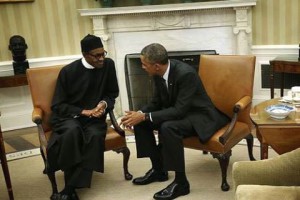
President Muhammadu Buhari has assured Barack Obama, the American President that Nigeria is making steady progress towards resolving the problem in the Niger Delta region which has led to economic sabotage on a grand scale.
During a bilateral meeting on the sidelines of the 71st edition of the UN General Assembly, holding in New York, President Buhari disclosed: “We are making definite progress on how many factions of the militant groups exist, their leadership and operational basis, and we have equally sought the cooperation of the oil majors. In a short while, I believe the issues would be resolved.”
While thanking America for help rendered in the area of security through provision of armaments, training for Nigerian troops, and sharing of intelligence, which has led to the degradation of Boko Haram in the North East, President Buhari said the country was open to support in combating the humanitarian crisis currently ravaging the region.
The President said the farming season was good this year, with the prospect of good harvest, and “Nigeria is on the road to food self-sufficiency soon. We shall be able to feed ourselves, and utilize the billions of dollars spent on importing food on other productive areas.”
President Buhari reiterated that his administration came to power on the tripod promises of security, battle against corruption, and revamping of the economy, stressing that there would be no let-up in fulfilling those electoral promises. He wished President Obama a happy retirement, as he winds down gradually on his tenure in office.
Responding, the American President described President Buhari as a man of “integrity and honesty,” saying: “We have confidence in your leadership. There are some difficulties you face, but this administration is willing to assist in the short time we have left. You have made real progress in defeating the brutal organization called Boko Haram, and that was achieved because of your leadership.” President Obama offered a hand of fellowship to Nigeria “in the final and comprehensive defeat of Boko Haram, resolution of the Niger Delta crisis, which would help ramp up oil production and increase revenue, resolving the humanitarian crisis in the North East, recovering stolen money, and revamping the economy.”
Describing Nigeria as a big and important country in sub-Saharan Africa, the American President said his country looked forward to a framework for sustained partnership between the two nations. [myad]
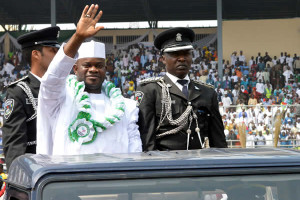
Alhaji Yahaya Bello has been confirmed by the Supreme Court of Nigeria as the duly elected governor of Kogi state.
In a unanimous judgment, the apex court dismissed the appeal filed by Hon. James Faleke, the running mate to late Abubakar Audu, the initial candidate of the All Progressives Congress (APC), and a former Governor of the State, Captain Idris Wada, who was also the candidate of the Peoples Democratic Party for the election. The court said it will give reasons for its judgment on September 30, 2016. [myad]
The opposition Peoples Democratic Party (PDP) is back as one family, a member of the Senator Ahmed Makarfi’s National Caretaker Committee, Senator Ben Obi, has announced. Senator Obi spoke with newsmen ahead of a joint press conference billed to be addressed by Senator Ali Modu Sheriff and Makarfi. Obi, who was flanked by another PDP chieftain from Sheriff’s camp, Dr. Cairo Ojougboh, said both leaders have reconciled and would now set up a joint committee with the support of stakeholders. He said: “We have decided to issue a joint statement. As we speak today, the PDP is back as one family. The two leaders will address you gentlemen of the press. “They will constitute a joint committee with the support of all relevant organs of the party.” [myad]
President Muhammadu Buhari has made it clear that the anti-corruption campaign of his administration and the economic programme of diversification will significantly address the lack of job opportunities and deprivation that make Nigerian youths vulnerable to recruitment by human traffickers.
The President said this at the meeting on Modern Slavery, hosted by the Prime Minister of United Kingdom, Theresa May on the margins of the 71st Session of the United Nations General Assembly (UNGA71), at the residence of the United Kingdom Permanent Representative to the UN.
“We are also investing more on infrastructure development, education and health for our people. When the results of our efforts become manifest the attraction of seeking greener pastures abroad will lesson.”
President Buhari commended the British Prime Minister for drawing the attention of the international community to such a serious matter to coincide with a time that the global focus is on migration and refugee crisis.
He therefore called for practical and innovative measures “to address all the modern day human tragedies.”
The President noted that “more worrisome is the fact that human trafficking and modern day slavery has created a dangerous political economy of their own. In consequence, this international criminality is defined by the activities of human traffickers that lure unsuspecting victims into forced labour, inhuman treatment, money laundering and prostitution.”
He said Nigeria “is ready and willing to partner with other countries and international organizations to confront this phenomenon. We have a strong commitment to combating the menace of modern slavery, and will redouble our efforts to prohibit human trafficking, while providing succour to its hapless victims.”
President Buhari assured his audience “to count on the support of Nigeria in dealing with this evil, which constitutes an unacceptable stain on human dignity and conscience in the 21st century.”
On measures taken by the country against the evil practice, he said the National Agency for the Prohibition of Trafficking in Persons (NAPTIP) and the Nigeria Immigration Service have taken steps to establish a joint operational Working Group to combat human trafficking and smuggling of migrants from the country.
“We are aware of the challenge for Nigeria, but our resolve to combat it is strong and unshakable,” the President declared.
President Buhari was accompanied to the high-level meeting by Geoffrey Onyeama and Lt-Gen. Abdulrahman Danbazzau (rtd), the Ministers of Foreign Affairs and Interior respectively. [myad]
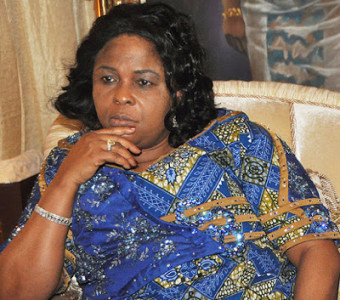
Wife of the former President, Dame Patience Jonathan
Dame Patience Jonathan, wife to the immediate past President, Goodluck Ebele Jonathan, has described the Economic and Financial Crimes Commission (EFCC) as a big thief for freezing her accounts with Skye Bank, containing more than $15million in all.
According to a letter written by her lawyers, FirstLaw Solicitors, to Ibrahim Magu, the EFCC Chairman, Dame Patience said it would be counter-productive if she is arrested and prosecuted based on suspicion.
She asked the EFCC to de-freeze her accounts within 14 days with a public apology otherwise she would file an action at the African Commission on Human and Peoples Rights at The Gambia demanding five billion naira in exemplary and punitive damages.
Dame Patience has been mentioned in an EFCC investigation regarding alleged money laundering though four companies whose Directors are the domestic workers of Waripamowei Dudafa, Jonathan’s Special Adviser on domestic affairs.
The Full Statement
By virtue of the Fundamental Rights (Enforcement Procedure) Rules 2009, we are Solicitors to HER EXCELLENCY, MRS. PATIENCE IBIFAKA GOODLUCK JONATHAN, the wife to the immediate past President of the Federal Republic of Nigeria, HIS EXCELLENCY, DR. GOODLUCK EBELE JONATHAN, GCFR. We shall hereinafter, refer to Mrs. Patience Goodluck Jonathan as “OUR CLIENT.”
Our Client is a respected senior citizen of international repute, a retired Permanent Secretary and the immediate past First Lady of the Federal Republic of Nigeria. Our Client is a law-abiding citizen who has never or at all been the subject of any criminal and/or financial investigation, whether at home or abroad. Accordingly, she has not been found guilty of any criminal conduct throughout a sparkling public service career spanning over 35 years.
During the 5 years our Client served as First Lady of the Federal Republic of Nigeria between May, 2010 and May, 2015; she was the Initiator/Founder of the A. ARUERA WOMEN FOUNDATION as well as the WOMEN FOR CHANGE INITIATIVE; both of which Non-Governmental Organizations (NGOs) substantially contributed to the 35 per cent affirmative action for women in the country. Our Client is the recipient of numerous local and international awards in recognition of her untiring commitment towards uplifting the living standard of women, children and the aged in Nigeria.
Sir, it is against this sterling and meritorious background of our Client that we most respectfully, write to draw your attention to the numerous breaches of the 1999 Constitution (as amended) and the African Charter on Human and Peoples Rights (Ratification and Enforcement) Act 2004 committed by the Economic and Financial Crimes Commission (EFCC) in cause of the Commission’s illegal and unlawful investigation of our Client for alleged money laundering. These investigations have reportedly led to the freeze of our Client’s accounts and led to untold consequences to our Client’s health and wellbeing.
Firstly, the EFCC must realize that the ECONOMIC AND FINANCIAL CRIMES COMMISSION (ESTABLISHMENT) ACT 2004 is inferior in content and quality to both the 1999 CONSTITUTION OF THE FEDERAL REPUBLIC OF NIGERIA (AS AMENDED) and THE AFRICAN CHARTER ON HUMAN AND PEOPLES RIGHTS 2004.
To that extent, it is trite law that, where there is a conflict or an inconsistency between the EFCC ACT, on the one hand; and the combined provisions of the 1999 Constitution (as amended) and the African Charter on Human and Peoples Rights 2004, on the other hand; the extant provisions of the 1999 Constitution (as amended) and the African Charter on Human and Peoples Rights 2004 must necessarily prevail to the extent of the said inconsistency.
However, we note, with regret, that in the current matter involving the curious and bizarre investigation of our esteemed Client, the EFCC under your watch has not only undermined the 1999 Constitution (as amended) and the African Charter on Human and Peoples Rights; the Commission has actually conducted itself in a most desperate, despicable and arrogant manner. This is rather unfortunate.
Sir, one of the cardinal principles enshrined in both Nigerian and African jurisprudence, is that of the presumption of innocence which is guaranteed to all citizens, including our Client.
Consequently, the SPECIAL POWERS of the Commission as defined by SECTION 7(1) & (2) of the EFCC ACT 2004 to, among others, “cause investigations to be conducted into the properties of any person if it appears to the Commission that the person’s life style and extent of the properties are not justified by his source of income,” is inconsistent with and contrary to the mandatory requirement of SECTION 36(6)(a) & (b) of the 1999 Constitution (as amended), which states thus:
“Every person who is charged with a criminal offence shall be entitled to – (a) be informed promptly in the language that he understands and in detail of the nature of the offence; (b) be given adequate time and facilities for the preparation of his defence;”
The necessary implication or import of SECTION 36(6)(a) & (b) of the 1999 Constitution (as amended) is that the EFCC’s so-called power to arbitrarily and unlawfully investigate our esteemed Client and thereby, freeze her accounts with total sum in excess of FIFTEEN MILLION US DOLLARS which are domiciled with SKYE BANK PLC is NOT ABSOLUTE.
Sir, it is our Client’s brief that there is no formal criminal complaint of economic and financial crime as defined by the EFCC ACT 2004 written by any person or institution against her which warranted the EFCC to freeze her accounts.
It is also our Client’s brief that the EFCC failed to obtain a Court Order as required by SECTION 34 of the EFCC ACT before her accounts were frozen.
It is our Client’s further brief that, up until the writing of this Open Letter, she has not received any formal invitation to appear before the Commission for questioning; whereas her accounts domiciled with SKYE BANK PLC have since been frozen by the Commission without recourse to her.
Sir, the argument put forward by the Commission in the public domain that, “investigations are ongoing…Mrs. Patience Jonathan shall be invited in due course,” are not only vexatious and provocative. They constitute an outright violation and rape of the fundamental right to fair hearing and ownership of property as guaranteed to our Client by the 1999 Constitution (as amended) and the African Charter on Human and Peoples Rights 2004.
Indeed, SECTION 36(6)(a) & (b) of the 1999 Constitution (as amended), contains or laid down a sequence or pattern of commencement of investigation which MUST BE FOLLOWED STRICTLY, to wit:
Persons charged with a criminal offence must be informed in the language they understand and in detail of the nature of the offence;
Such persons must be given adequate time and facilities for the preparation of their defence; etc
Sir, instead of strict compliance with the above pattern, as laid down by SECTION 36(6)(a) & (b) of the 1999 Constitution (as amended), the EFCC went after our Client’s money by ordering a freeze of her accounts. With all due respect, the EFCC is a BIG THIEF!
We are very much aware of numerous instances where EFCC used strong-arm tactics to dispossess hard working Nigerians of their legitimately earned money; only to turn around to brazenly and shamelessly loot the recovered loot. This is one of such unfortunate instances. Clearly, it is a failed politically-motivated attempt by the EFCC to steal our Client’s money using the cover of the present political climate.
We are sufficiently convinced that prebendal politics of the sort that smears the image and reputation of former public office holders, together with that of members of their families – which automatically, distracts from governance and slows down the nation’s pace of development – is one of the major reasons for the persistent and unrelenting politically-motivated attacks on our Client who is extremely popular with Nigerian women, children and the aged.
We have rightly observed that each time a new Government was sworn into office, political jobbers such as the EFCC promptly mobilized themselves to throw mud, blackmail and/or otherwise label members of the immediate past Government; all in a desperate bid to accomplish or satisfy narrow and base political interests to the detriment of the entire country. This disturbing familiar pattern of unjustifiable, bankrupt and hollow harassment of the nation’s former leaders is deplorable.
Our Client has unfortunately, come under the vice grip and stranglehold of the cabal of political jobbers who would not allow her concentrate on her private life in retirement. Ironically, our Client’s most virulent critics and traducers come from the human rights community in Nigeria which benefited immensely from her husband’s fairly commendable human rights record, while he served as President.
Notably, we recall that the Freedom of Information Act 2015 was signed into law by former President Goodluck Jonathan. The Criminal Justice Administration Law 2015 was also signed into law by the former President. Needless to say, these extant laws have strengthened Nigeria’s civil society to act effectively as the nation’s “fourth arm of government.”
For the avoidance of doubt, it shall be counter-productive and inimical to the public interest if the Attorney General of the Federation and/or the EFCC heeded the irresponsible calls to commence the arrest and prosecution of our Client based on suspicion. If they did otherwise, they shall be violating the extant provision of SECTION 174(3) of the 1999 Constitution (as amended) which clearly prohibits criminal proceedings that were not in the public interest. Besides, suspicion; no matter how strong it may seem; cannot ground a conviction.
We hereby categorically and emphatically state that, HER EXCELLENCY, MRS. PATIENCE IBIFAKA GOODLUCK JONATHAN SHOULD BE LEFT ALONE!
Furthermore, there is no established legal or political precedent for what the EFCC is currently doing to our Client. How many former First Ladies in Nigeria have received the Patience Goodluck Jonathan Treatment (PGJT) to have warranted the EFCC to engage in the effrontery to freeze our Client’s accounts and subject her to public opprobrium, ridicule and disgrace? This nonsense must stop forthwith!
Consequently, we urge the EFCC to de-freeze our Client’s accounts WITHIN 14 DAYSfrom today, September 18, 2016 and tender a public apology to our Client.
TAKE NOTICE; AND NOTICE IS HEREBY GIVEN that if the EFCC fails, refuses and/or neglects to comply accordingly, we shall file an action at the AFRICAN COMMISSION ON HUMAN AND PEOPLES RIGHTS at The Gambia demanding FIVE BILLION NAIRA in exemplary and punitive damages.
Yours faithfully,
FOR: FIRST LAW SOLICITORS (Legal Practitioners) TIMIPA JENKINS OKPONIPERE, ESQ. Senior Partner. [myad]
We use cookies on our website to give you the most relevant experience by remembering your preferences and repeat visits. By clicking “Accept”, you consent to the use of ALL the cookies.
This website uses cookies to improve your experience while you navigate through the website. Out of these, the cookies that are categorized as necessary are stored on your browser as they are essential for the working of basic functionalities of the website. We also use third-party cookies that help us analyze and understand how you use this website. These cookies will be stored in your browser only with your consent. You also have the option to opt-out of these cookies. But opting out of some of these cookies may affect your browsing experience.
Necessary cookies are absolutely essential for the website to function properly. This category only includes cookies that ensures basic functionalities and security features of the website. These cookies do not store any personal information.
Any cookies that may not be particularly necessary for the website to function and is used specifically to collect user personal data via analytics, ads, other embedded contents are termed as non-necessary cookies. It is mandatory to procure user consent prior to running these cookies on your website.