Mobil Producing Nigeria Unlimited has laid off 182 regular and 103 contract staff members in Akwa Ibom State between June and August 1. A dependable source who preferred anonymity told the News Agency of Nigeria on Friday in Ibeno that those affected were at its administrative block at Qua Iboe Terminal, Ibeno. The source said: “The company had long paid their contract staff before laying them off. “Yesterday, when I went to ExxonMobil, the person I went to see at the maintenance office was also sacked. “He was among the three contract staff disengaged yesterday at Qua Iboe Terminal and more staff members will be retrenched by September.” A sacked ExxonMobil staff member, Okon Ibanga, said the sack had caused hardship for him in view of the economic crisis in the country. Ibanga said the company was preparing the entitlements of the sacked workers to ameliorate their sufferings. Ibanga alleged that the retrenchment was politicised as majority of those affected were from Akwa Ibom and Cross River States. Responding, the Media and Communication Manager at ExxonMobil, Ogechukwu Udeagha, confirmed the development. Udeagha said the company had adjusted its business in response to the challenge in the export system. “Our response to your inquiry is that we have adjusted our business in response to the challenge in the export system, which necessitated curtail of production,” Udeagha said. He noted that ExxonMobil’s operations would be reviewed on an ongoing basis. NAN. [myad]
An amalgamation of youth groups in Taraba state under the auspices of PDP 100 percent loyalists have thrown their weight behind Mr. Emmanuel Bello for the position of the National Publicity Secretary of the Peoples Democratic Party (PDP). The group said that Bello, who was the former commissioner of information in the state, possess the needed qualities for the position. In a statement, the leader of the group, Hon. Dennis Shima said: “we are delighted to endorse the candidature of Hon Emmanuel Bello for the position of the National Publicity Secretary of our great party. We note with deep humility that Emmanuel Bello, while he held similar roles in Taraba state performed creditably well, displaying high level loyalty to the party and his principal. As an accomplished journalist, it is our belief that Bello comes to the contest with sterling qualities of a news man who has also worked in government cycles where he was first a special adviser on Media and twice a commissioner of information. He has also been prepared by his principled stand at the most trying period of the state’s history where he became famous for stubbornly standing by ailing former Governor Danbaba Suntai. This was at the time it was easier to compromise loyalty.” It would be recalled that the Makarfi-led PDP has zoned the position of National Publicity Secretary to the North Central even as the party said viable candidates can still contest positions, irrespective of the zoning formula. Emmanuel Bello, a former editor with leadership newspaper among other newspapers, has not officially declare for the position yet. A source close to him said that the 45 year old former commissioner is currently consulting with stakeholders in the state. [myad]
Virginia Thrasher, a 19-year-old college student from Virginia, has emerged as the first gold medalist in the ongoing Rio Olympics. She won the 10-meter air rifle competition on Saturday morning.
Thrasher set an Olympic recording, beating China’s Du Li 208.0-207.0. At West Virginia, Thrasher became the first freshman rifle shooter to win individual titles in air and smallbore while leading WVU to their fourth-straight NCAA title.
“Smallbore” refers to rifles that are small-caliber, but not fired by air, which is certainly a thing we all knew and did not just look up.
Thrasher grew up in Northern Virginia and hadn’t fired a gun until five years ago. Three years ago, according to the Washington Post, she was the 45th-ranked junior shooter in the country and wasn’t a popular medal pick before the competition. Now she’s the best in the world.
Also, her nickname is “Ginny.”
Meanwhile a bomb alert at the Beach Volleyball Arena in Copacabana had, early on Saturday, sparked an evacuation and the deployment of bomb disposal robots, while Maracanã Stadium hosted the opening ceremony of the Rio Olympics.
The military and armed police cordoned off a section of Avenida Atlantica, a major sea side avenue in Rio de Janeiro bordering Copacabana beach where the Game’s Beach Volleyball Arena is situated, at around 8:40pm local time on Friday.
Bomb disposal teams were deployed over two suspicious bags around 10 minutes later, the Telegraph reports. Explosives robots were also brought in and the items were later found to be safe.
The bomb alert came after thousands of anti-government protestors marched along the waterfront seemingly in support of ousted President Dilma Rousseff.
Michel Temer, a 75-year-old law professor, became acting president after the Senate voted in favour of launching an impeachment trial against Ms Rousseff, suspending her.
Posters at the protests, translated, read: “‘Out Temer! The people should decide.” A bin with a spray-painted stencil had the words “stop coup in Brazil” written on it.”
The pre-ceremony protest followed violent demonstrations on Thursday that marred the Olympic torch’s arrival in the Brazilian city. [myad]
The above headline came from The FCPA Blog, one of the anti-corruption international blogs I subscribed to for news and commentaries. I became curious to go through the write-up authored by Caveni Wong. He discussed something so intriguing that normally passes as part of our behavioural traits but never taken serious – CHEATING – as an integral form of CORRUPTION.
Here are excerpts from the article: “It is an uncomfortable thought, but given certain circumstances, most of us would cheat. Ron Carucci just wrote about how easily one can cross the line in Forbes article that featured a conversation with Richard Bistrong. The cheating often involves people who don’t even realize that they are crossing the line.
“Studies have repeatedly shown that most people cheat when asked to self-report their own performance on a task if it means a higher pay-out. But they only cheat a little bit, enough to gain a little extra benefit, but not so much that they’d feel bad about themselves.
“That’s consistent with what I observed early in my career. Lunch among a few colleagues would somehow become a “client” meal, in which actual client names would be scribbled on a receipt and submitted for reimbursement. A colleague admitted he often embellished expenses. A $45; a $25 dinner into $40 — a practice my colleague said he learnt from watching others.
“These small transgressions tended to be committed by those I considered to be good work ethic. Those employees didn’t know they had crossed the line. Their actions were just part of the informal culture. And that’s the insidious nature of minor cheating that goes unchecked. It slowly builds up a culture that can eventually set the stage for more serious violations.”
This is the crux of the matter. Corruption has so eaten deep into the fabric of everything in our lives- be it social, political and economic –a malaise that is presently driving Nigeria’s economy to its worst recession in history. Then, who is to blame? I draw strength from John 8, where Jesus Christ exonerated and rescued a woman allegedly caught in adulterous act from accusers who were ready to stone her to death. Jesus simply stooped down, and scribbled something on the ground and asked a thunderbolt of a question: “He that is without sin among you, let him first cast a stone at her.”
That question pricked their consciences. One by one, they moved away. What a timeless lesson for all. Today, many of us are shouting corruption at the rooftops. At most major fora, the thrust of discussion is corruption but in our subconscious minds, are we not guilty one way or another? Do we not cheat and cut corners in our inter-personal dealings- be it at home, at work and businesses? How many of us can vouch that if appointed into higher public office will not cheat? Just look around you, and tell me if corruption is not staring at you.
Seriously, I believe that instead of mouthing corruption at every public discourse, let us start a serious re awakening of anti- corruption crusade, starting from ourselves, home and neighbours. Our children,today, have lost every value of integrity through the mind-boggling revelations of looters of the national treasury being hyped by the media on daily basis. These looters are not aliens. They are not ghosts. They are people at our backyards and homes.
It is not too late to start fighting the monster from self. Man’s insatiable greed for primitive acquisition is so alarming that you keep wondering whether he will ever leave this Mother Earth. When you look at the crazy acquisitions, one discovers that most of them are products of cheating. Then, where do we draw the line between cheating and corruption? There is a very thin line between them. In fact, they are birds of the same feather.
In writing this article, I sought the perspectives of some of my friends and I got them talking. One of them, Mr. Femi Adefemiwa, said: “What a sound argument! There is no collective guilt but individual guilt. By nature, every human being is selfish and perhaps self-centred. The deprived background which a significant number of us experienced, and the undue societal expectations from us, have created some primordial tendencies in us, e.g. primitive acquisition. To make matters worse, justice in our land is always to the higher bidder. So, an innocuous combination of these ills has put us where we are today. But we have to start somewhere. Cleaning the mess must not be by academic exercise. Whether we are all guilty or not, we just have to draw a line and start from somewhere. And perhaps we have started.”
Another contributor from the United States of America, who identified himself simply as Tolu, wrote: “Your Food For Thought is direct and challenging indeed. It is the type of introspection that will help us not to be hypocrites. It is like admitting categorically that I have never sinned. I admit that I’m not pious enough to admit that I’m free from the taint of moral and character flaws. As human, I still need to recognize the society’s decadence and my personal contribution to such moral bankruptcy. The challenge of the conundrum is knowing how to maintain a balance between transparency in my conducts and standing against blatant disregard for the rule of law and sense of decency by the people in power.”
Similarly, another friend, Fisan Bankale, loved the Food For Thought “because it energized my thoughts in the direction of how to get people to own up to their contribution. Let me share a thought here. A man or family whose son or daughter was given a job at CBN or FIRS would go to church or mosque to thank God. But that job is a proceed from a corrupt act because the job was through an abuse of due process. The late Yar’adua publicly acknowledged that the election that brought him to power was riddled with fraud. Such open acknowledgement of wrong doing is what everyone should subscribe to.”
The Peoples Democratic Party (PDP) may be heading to another major crisis as it has reportedly zoned the position of the national chairmanship to the South West, thereby technically knocking out Chief Raymond Dokpesi, who has been campaigning for the position in many parts of the country. Chief Dokpeai has already reacted to the development, describing it as unfortunate, adding that it is a repeat of the same mistake that led the party to where it is today. A statement by his media aide, Omor Bazuaye, quoted him as saying: “leaders of the South met and decided to micro-zone to the South West. These are the same things we did that brought the party to its knees. “I have come here pleading and begging that if I become National Chairman it is me and you that would be chairman. I have been on the road in the last eight days, moving from armlet to armlet, soliciting for support, asking, pleading and begging the people to vote for me. “They have received us well, warmed up strongly to our brand of populist democracy, which has returned power to choose their leaders to the people and it’s in the true spirit of our motto: ‘Power to the people.” Dokpesi said that he has been emboldened by the massive support from the people and would be holding on to their words as he goes for the challenge in Port Harcourt, adding: “it is this assurances that I’ll hold on to as I transverse the length and breadth of the country.” Dokpesi called on citizens to join in a campaign that is “bound to change the face of politics forever in the country.” [myad]
Four times winner of Olympic gold medal, Serena Williams has said that she loves her body and would never change anything about it.
Williams who was reacting to ridicule from people who said, despite her incredible figures, she still has a strong frame, said: “I love my body, and I would never change anything about it.
“I’m not asking you to like my body. I’m just asking you to let me be me. Because I’m going to influence a girl who does look like me, and I want her to feel good about herself.”
The Top ranking Tennis women’s player who appeared on the cover of Self magazine said that she adhered to a strict diet that did not allow her to eat wheat or sugar in the course of her fight to stay at the top of the Women’s Tennis Association rankings, a spot she’s held for over 170 weeks.
“I got super disciplined this time, for the first time in a while,” she said.
Williams will be journeying to Rio to hopefully win her 5th Olympic gold medal.
Speaking about Beyoncé who had invited her to twerk it out in the “Sorry” video, Williams said: “I was nervous. But Beyoncé was impressed. I was like, ‘Well, you told me to dance like no one was looking!’” [myad]
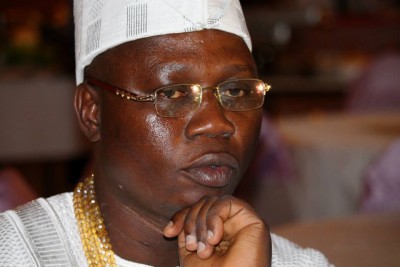
The National Coordinator of the Oodua People’s Congress (OPC), Otunba Gani Adams, has described the recent invasion of Yorubaland by the Niger Delta militants and killing of innocent people as “a big slap on our race.”
Angry Adams has therefore given a marching order to members of the Congress to resist such invasion whenever it occurred again.
The OPC chief, wo spoke during the 2016 edition of the annual Ifa Festival, organized by the Olokun Festival Foundation, which took place in Abule-Ado area of Amuwo Odofin Local Government of Lagos State, described the invasion of the South West by militants as “one too many”.
He told the crowd at the occasion that the OPC had, some weeks before the deployment, made some sacrificial offering as a result of the invasion by the Niger Delta militants.
The OPC chief said that the decision to appease the gods in Yorubaland was taken during a National Coordinating Council meeting of the group in Akute area of Ogun State.
“I told the coordinators to make some sacrificial offerings in all their local governments and by the next meeting; over 75 per cent of them had done the offering.
“It was not up to a week after that when President Muhammadu Buhari deployed the military to the place. One thing actually led to the deployment of the soldiers. Even if the Federal Government had not deployed the military men, our men would have confronted them. Our men in Isawo battled with the Niger Delta militants and facilitated the release of two abducted people in the community.”
Adams also directed members of the OPC to go out in full force and challenge the militants.
“We are committed, we are determined and we are resolute. We can no longer wait for the government and allow people to terrorize Yoruba land.”
Adams described Ifa as the Lord’s solution to whatever problem that may confront mankind and urged people to seek knowledge from Ifa.
“Orunmila is the grand priest of Ifa divination and he was always consulted before, during and after problems. People in those days consulted Orunmila, who in turn used Opele and Opon Ifa to seek knowledge from Olodumare. It is not until when a man gets problems that he consults. Ifa offers solution to mankind to prevent thorns that may appear in the course of one’s life. A good example of what Ifa can do is the computer. It can even do far beyond the computer.”
Adams advised traditional rulers to look inward and appreciate the Ifa priest in their domains and seek solutions to problems that are confronting not just their towns but also other towns and the country as a whole.
The Guest Speaker at the event, Chief Lekan Ajorotutu, described Ifa as the encyclopedia of human existence and an essential to human life.
At the event were Prince Owolabi Oduyebo, the Baale of Ateere; Chief Ifagbenro Atunfagbonbiada, the Araba of Ebute Ikorodu; Chief Rasak Oladosu, Special Assistant on Communication to Governor Olusegun Mimiko of Ondo State; Ambassador Yomi Fashlanso; Chief Femi Davies; Chief L.A. Adeola, the Baba Sango of Ijoraland; Chief Afolabi Hassan, member OPU executive, India; Chief Victor Adewale, Deputy Coordinator of OPU, Europe; Prince Olawale Ayinla, Treasurer, OPU worldwide, and others. [myad]
Youths in the Northern part of Nigeria, under the umbrella of Arewa Youth Integrity Forum (AYIF) has demanded the Ekiti state governor, Ayo Fayose to immediately apologize to Mrs. Aisha Buhari, the wife of President Muhammadu Buhari whom he had earlier accused being a fugitive from justice in the United States of America over the Halliburton scandal.
Addressing journalists in Abujaon Friday, AYIF national president, Comrade Abubakar Ibrahim said that the visit by the President’s wife to the United States of America recently is a further proof that Fayose lied in his claim about her.
“We pointed out this visit because of its significance to what had transpired earlier when Ekiti State Governor, Ayo Fayose came up with his tales by moonlight in which he vigorously tried to mislead the public with claims that Mrs. Buhari was a fugitive from justice in the US over the Halliburton scandal. Various persons that set the records straight that the wife of the President was not the same ‘Aisha Buhari’ mentioned in the court documents were ridiculed and bad mouthed.
“May we remind Fayose that Mrs. Buhari was not the one who was recorded in a hotel suite conspiring with others to breach the Electoral Law? The first family did not tell him to engage in money laundry involving billions of naira ferried from one airport to another. It was not Mr. President that made the lodgement of proceed of crime into the Ekiti state governor’s bank account. It was not northerners that made Fayose to be richer than Ekiti state neither were we responsible for his inability to sell his family to pay salaries to workers’ whose money he has diverted into his personal account.”
The youth leader said that Mrs. Buhari’s visit to the United States has confirmed that Fayose wasn’t telling the truth, “we are calling on him to apologize to the first family, and Nigerian women.”
Ibrahim said that Fayose should rather focus his energy to explain his misrule to Ekiti people when his tenure expires.
“We see the vintage Fayose, upon realising that his lies have been found out, desperately looking for a way to distract the nation by calling attention to the handbag Mrs Buhari was holding in one of the pictures from the US. This obvious attempt to trivialize the issue with the woman’s bag is a new low for Fayose even by his own standards.
“Our expectations are that beginning with Ekiti state at the end of Fayose’s tenure the electorates would insist that psychiatric evaluation and a consequent certificate of mental competence would be requisite for all the candidates seeking elections.”
The youths called on Mrs. Aisha Buhari not to relent on her life changing activities and should rather increase the tempo upon her return from the United States. [myad]
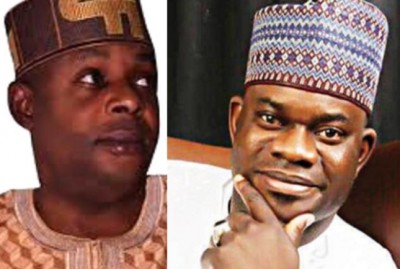
The Kogi State Governor, Yahaya Bello, has again asked James Faleke, who challenged his election at both electoral tribunal and appeal court but lost, to join him in moving the state forward, instead of constantly finding ways of disrupting the progress of the state.
Governor Yahaya Bello, who spoke to news men shortly after he observed Friday Jum’at prayer along with President Muhammadu Buhari at the Presidential Villa, Abuja, asked Faleke and other political opponents to allow peace reign in the state.
The governor who described his victory at the court of appeal against Faleke as divine ruling by God said: “I have extended olive branch to my opponents on several occasions and at this time, I am extending it again to my brother, Hon. James Faleke, to come and let us join hands together to lift Kogi State.
“The state was in a big mess at the time we came on board. He should join hands with me to save the state from the claws of those who had held it down over the years.”
The governor asked Kogi people to expect development, prosperity and good governance all the way from his government.
“Remember, I am on a divine mission and I will do nothing less than to continue to develop the state and to curb corruption, waste and mismanagement and to put the state on developmental map.
“I thank God for making this possible. The judgment is a confirmation of divine ruling by God. I thank the judiciary, I thank my party, I thank the people of Kogi State and indeed all Nigerians.”
Appeal Court sitting in Abuja on Thursday, also dismissed an appeal filed by former Kogi State governor, Idris Wada, challenging the decision of the state election tribunal which upheld Bello’s victory in last year’s governorship election. [myad]
A Karimo Upper Area Court in the Federal Capital Territory (FCT) has sentenced a 33 year old technician, Tosin Adeyemi to two weeks imprisonment for attempting to steal from a handbag in Church.
The convict, of Gwagwa Village, Abuja, was sentenced on a lone-count charge of attempting to commit offence.
The judge, Mohammed Abubakar, however, gave the convict an option of N3, 000 fine, even as he warned him to desist from involvement in crime, especially in worship places. The judge also ordered that the handbag be returned to the owner.
The News Agency of Nigeria (NAN), however, reports that the convict was whisked away to Kuje Prisons when he could not pay the fine.
The police First Information Report (FIR) said that one Johnson Mbanirusi of Mountain of Fire Ministry, Utako District, Abuja, reported the matter at the Utako Police Station.
According to the prosecuting counsel, David Kafancha, the convict intentionally went to the Utako branch of the Mountain of Fire Ministry to steal.
David Kafancha said that the convict had on Tuesday pretended to be a worshipper, but he was apprehended and handed over to the police while trying to steal from the handbag.
The prosecutor said that the convict admitted committing the offence during police investigation and interrogation.
David Kafancha said the offence contravened Section 95 of the Penal Code.
After the convict pleaded guilty and prayed for leniency, the prosecutor urged the court to invoke Section 347 of the Administration of Criminal Justices Act, 2015 on summary trial. [myad]
We use cookies on our website to give you the most relevant experience by remembering your preferences and repeat visits. By clicking “Accept”, you consent to the use of ALL the cookies.
This website uses cookies to improve your experience while you navigate through the website. Out of these, the cookies that are categorized as necessary are stored on your browser as they are essential for the working of basic functionalities of the website. We also use third-party cookies that help us analyze and understand how you use this website. These cookies will be stored in your browser only with your consent. You also have the option to opt-out of these cookies. But opting out of some of these cookies may affect your browsing experience.
Necessary cookies are absolutely essential for the website to function properly. This category only includes cookies that ensures basic functionalities and security features of the website. These cookies do not store any personal information.
Any cookies that may not be particularly necessary for the website to function and is used specifically to collect user personal data via analytics, ads, other embedded contents are termed as non-necessary cookies. It is mandatory to procure user consent prior to running these cookies on your website.



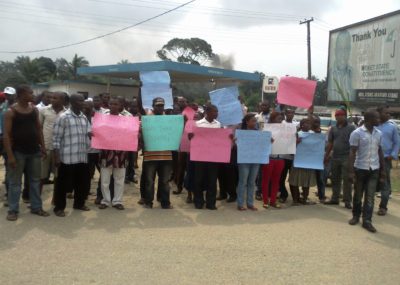 Mobil Producing Nigeria Unlimited has laid off 182 regular and 103 contract staff members in Akwa Ibom State between June and August 1.
 An amalgamation of youth groups in Taraba state under the auspices of PDP 100 percent loyalists have thrown their weight behind Mr. Emmanuel Bello for the position of the National Publicity Secretary of the Peoples Democratic Party (PDP).






Corruption: Who Cheats? Most Of Us, By Folu Olamiti
The above headline came from The FCPA Blog, one of the anti-corruption international blogs I subscribed to for news and commentaries. I became curious to go through the write-up authored by Caveni Wong. He discussed something so intriguing that normally passes as part of our behavioural traits but never taken serious – CHEATING – as an integral form of CORRUPTION.
Here are excerpts from the article: “It is an uncomfortable thought, but given certain circumstances, most of us would cheat. Ron Carucci just wrote about how easily one can cross the line in Forbes article that featured a conversation with Richard Bistrong. The cheating often involves people who don’t even realize that they are crossing the line.
“Studies have repeatedly shown that most people cheat when asked to self-report their own performance on a task if it means a higher pay-out. But they only cheat a little bit, enough to gain a little extra benefit, but not so much that they’d feel bad about themselves.
“That’s consistent with what I observed early in my career. Lunch among a few colleagues would somehow become a “client” meal, in which actual client names would be scribbled on a receipt and submitted for reimbursement. A colleague admitted he often embellished expenses. A $45; a $25 dinner into $40 — a practice my colleague said he learnt from watching others.
“These small transgressions tended to be committed by those I considered to be good work ethic. Those employees didn’t know they had crossed the line. Their actions were just part of the informal culture. And that’s the insidious nature of minor cheating that goes unchecked. It slowly builds up a culture that can eventually set the stage for more serious violations.”
This is the crux of the matter. Corruption has so eaten deep into the fabric of everything in our lives- be it social, political and economic –a malaise that is presently driving Nigeria’s economy to its worst recession in history. Then, who is to blame? I draw strength from John 8, where Jesus Christ exonerated and rescued a woman allegedly caught in adulterous act from accusers who were ready to stone her to death. Jesus simply stooped down, and scribbled something on the ground and asked a thunderbolt of a question: “He that is without sin among you, let him first cast a stone at her.”
That question pricked their consciences. One by one, they moved away. What a timeless lesson for all. Today, many of us are shouting corruption at the rooftops. At most major fora, the thrust of discussion is corruption but in our subconscious minds, are we not guilty one way or another? Do we not cheat and cut corners in our inter-personal dealings- be it at home, at work and businesses? How many of us can vouch that if appointed into higher public office will not cheat? Just look around you, and tell me if corruption is not staring at you.
Seriously, I believe that instead of mouthing corruption at every public discourse, let us start a serious re awakening of anti- corruption crusade, starting from ourselves, home and neighbours. Our children,today, have lost every value of integrity through the mind-boggling revelations of looters of the national treasury being hyped by the media on daily basis. These looters are not aliens. They are not ghosts. They are people at our backyards and homes.
It is not too late to start fighting the monster from self. Man’s insatiable greed for primitive acquisition is so alarming that you keep wondering whether he will ever leave this Mother Earth. When you look at the crazy acquisitions, one discovers that most of them are products of cheating. Then, where do we draw the line between cheating and corruption? There is a very thin line between them. In fact, they are birds of the same feather.
In writing this article, I sought the perspectives of some of my friends and I got them talking. One of them, Mr. Femi Adefemiwa, said: “What a sound argument! There is no collective guilt but individual guilt. By nature, every human being is selfish and perhaps self-centred. The deprived background which a significant number of us experienced, and the undue societal expectations from us, have created some primordial tendencies in us, e.g. primitive acquisition. To make matters worse, justice in our land is always to the higher bidder. So, an innocuous combination of these ills has put us where we are today. But we have to start somewhere. Cleaning the mess must not be by academic exercise. Whether we are all guilty or not, we just have to draw a line and start from somewhere. And perhaps we have started.”
Another contributor from the United States of America, who identified himself simply as Tolu, wrote: “Your Food For Thought is direct and challenging indeed. It is the type of introspection that will help us not to be hypocrites. It is like admitting categorically that I have never sinned. I admit that I’m not pious enough to admit that I’m free from the taint of moral and character flaws. As human, I still need to recognize the society’s decadence and my personal contribution to such moral bankruptcy. The challenge of the conundrum is knowing how to maintain a balance between transparency in my conducts and standing against blatant disregard for the rule of law and sense of decency by the people in power.”
Similarly, another friend, Fisan Bankale, loved the Food For Thought “because it energized my thoughts in the direction of how to get people to own up to their contribution. Let me share a thought here. A man or family whose son or daughter was given a job at CBN or FIRS would go to church or mosque to thank God. But that job is a proceed from a corrupt act because the job was through an abuse of due process. The late Yar’adua publicly acknowledged that the election that brought him to power was riddled with fraud. Such open acknowledgement of wrong doing is what everyone should subscribe to.”
Olamiti is a Media Consultant. [myad]