Home Blog Page 1839

Voting In Nigeria Elections: Hope Rises For Nigerians In Diaspora

DiasporaThe Independent National Electoral Commission (INEC) has been put on the fast lane to introduce what has been called ‘Out of Country Voting” into its electoral process to avoid disenfranchisement of qualified Nigerians abroad.

This was one of the many recommendations made by Operations and Logistics Officers of the Commission following a one-week workshop and brainstorming at the Westown Hotels, Ikeja, Lagos. The workshop had its theme as “Developing Effective Electoral Operations.”

The Commission said that the Out of Country Voting should be predicated on the creation of a data base for Nigerians in Diaspora, provision of a legal framework, eligible criteria, a logistics framework, conduct of pilot schemes and the acquisition of necessary platforms and gadgets for its implementation.

It said that since procurement and timeous deployment of election materials are crucial to the conduct of free, fair and credible elections, some sections of the Electoral Act such as Section 78 should be amended to further extend from six (6) months to two hundred and forty (240) days to facilitate production of ballot papers and procure other materials necessary for the conduct of elections. Towards this end, the Commission should begin procurement of materials for the 2019 General Elections in 2017.

Other recommendations were that the Commission should also embark on general renovation, upgrade and expansion of existing stores. It should further, in addition to existing zonal stores, construct stores in all the states to facilitate seamless, and timely deployment of election materials across the country.

These were some of the many recommendations made by Operations and Logistics Officers of the Commission following a one-week workshop and brainstorming at the Westown Hotels, Ikeja, Lagos. The workshop which theme was “Developing Effective Electoral Operations” also recommended as follows:

  • While acknowledging the impact of technology on our electoral processes and the tremendous value it has added to them, there should be further perfection of our Electronic Voters’ Register and improvement in the functionality of the Smart Card Reader (SCR). Also, Electronic (e)-Voting should be introduced but after due pilot projects.
  • The Commission should review and firm up its MoU with the Nigerian Union of Road Transport Workers (NURTW). It should involve the Federal Road Safety Commission (FRSC) to ensure compliance, standardization and sanctions. By the same token, the Commission should extend the sourcing of vehicles to NARTO, RTEAN and other federal government agencies such as the National Youth Service Corps (NYSC), National Population Commission (NPC), National Identity Card Management Commission (NIMC), Nigerian Postal Services (NIPOST), Tertiary Institutions etc. In addition, the Commission should explore the prospect of collaborating with the Nigerian Army, Navy, Airforce and Police on the provision of transportation for areas with difficult terrains and which are violence-prone.
  • To make INEC staff proficient, especially in the use of modern technology deployed, they should be trained and certified on all electoral devices. In the meantime ICT technical staff should be trained continuously to bring them up to speed with all trends. Also, alternative power sources to all electoral devices such as PowerBanks, SolarPanels, Inverters etc should be provided as back up.
  • Registration Area Centre (RACs) and Super RACs played crucial roles in the timely deployment of staff and materials and the success of the 2015 General Elections. Of late, however, these Centres have been targeted and attacked. There is the need therefore to fortify them by deploying not less than twelve armed security personnel per each RAC/Super RAC.
  • Reverse Logistics is crucial to elections yet it is not being properly implemented. Henceforth, an official, particularly the SPO, should be charged with this responsibility and one of the three security personnel assigned to a PU should be mandated to accompany the SPO in retrieving/returning election officials. A review of the role of Poll Officials as it concerns Reverse Logistics should be reflected in the Election Training Manual.
  • Operations, Logistics and Stores officers should be professionalized, trained and certified. The same should obtain for Electoral Officers (E.O.s). This should enable these aforementioned officers to be promoted to GL 17 without prejudice to any officer on Grade Level 17 occupying the office of Administrative Secretary.
  • For effectiveness and coherence, two departments – Operations and Logistics; and Voter Education, Publicity, Gender and Civil Society Liaison should be revisited by the Commission. A department of Logistics and Transport should be created while Publicity and Civil Society Organisation should be excised from VEPGCSO.
  • The Commission should, ahead of the 2019 General Elections, set up an Interdepartmental Committee on the creation of Polling Units. The Committee should be given a clear mandate to develop modalities/criteria for the creation of the PUs.
  • The Commission should procure utility vehicles for the 774 LGAs across the country. The utility vehicles which should be procured between 1st quarter, 2017-1st quarter 2018, should be fitted with tracking devices. Also, the Commission should procure additional trucks for its operations. Ten trucks, with two fitted with cranes should be procured for head quarters while two trucks are procured for each of the states and FCT. One of the trucks for each of the states and FCT should be fitted with a crane.
  • That in view of the increasing inconclusiveness of elections, the Commission should review the guidelines and regulations for elections. [myad]
Ex EFCC Boss To Fayose: You Lied; Aisha In Jefferson’s Bribery Not Aisha Buhari

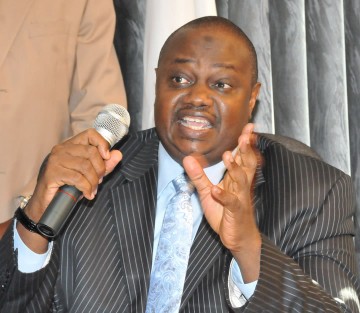
LamordeA former Chairman of the Economic and Financial Crimes Commission, Ibrahim Lamorde, has said the Aisha Buhari mention in the bribery scandal involving a United States of America Congressman, Williams Jefferson, is not President Muhammadu Buhari’s wife.
Lamorde, in an interview with PREMIUM TIMES on Tuesday, said as one of those involved in the case when he was in the EFCC, he could authoritatively confirm that the Aisha was not Buhari’s wife.
“I can tell you authoritatively that the Aisha Buhari named in that case is not President Buhari’s wife.
“It is another Aisha Buhari entirely.
“I was the Director of Operations at the EFCC at the time so I know about the case very well.
“I can tell you that it is not her (President Buhari’s wife).
“That much we established.”
The issue came to the fore again on Monday after the EFCC froze the private account of the Ekiti State Governor, Ayo Fayose, over investigation being conducted into the funding of the 2014 governorship campaign in Ekiti State.
Fayose had after leaving the bank accused the EFCC and President Buhari of witch hunting.
He said Buhari himself was not a saint and alluded to the Jefferson scandal.
He equally accused Buhari, in a statement issued later, of having an estate in Abuja.
The Aisha Buhari in the Jefferson scandal was said to have aided the transfer of $170,000 to Jefferson. [myad]

Presidency To Gov Fayose: You Are Hopelessly Confused, Need Prayers

Garba Shehu
Garba Shehu

The Presidency has dismissed as laughable the desperate attempt by Governor Ayo Fayose of Ekiti State to link President Buhari’s wife Aisha to US Congressman William Jefferson’s bribery scandal for which the American lawmaker was convicted in 2009.
Reacting to Fayose’s allegations in a press statement, the Senior Special Assistant to the President on Media and Publicity, Malam Garba Shehu, said ordinarily the presidency would have ignored Fayose because he is a man “childishly obsessed with the desire to grab the headlines and insulting people at will because of his incurably boorish instincts.”
Malam Garba explained however that the presidency chose to respond on this occasion for the sake of innocent Nigerians who might be misled by Fayose’s shameless and blatant distortion of facts.
He said ignoring Fayose carries the risk of giving traction and credibility to outright and brazen falsehoods inconsistent with the status of anybody that calls himself a Governor or leader.
According to Shehu, Aisha had no direct, indirect or the remotest connection with William Jefferson’s corruption scandal in the United States.
He challenged Fayose to tell Nigerians if the so-called Aisha whose pictures he proudly, but ignorantly shared, was the same Aisha married to President Muhammadu Buhari, or if the Aisha of his idle imagination had any relationship by blood or any relationship in whatever form, with President Buhari’s wife.
Shehu also challenged Fayose to produce evidence from the records of investigation and subsequent trial of Jefferson to prove that Buhari’s wife Aisha was in anyway linked to that scandal. He explained that common names alone are  not enough to automatically link innocent people to crimes or scandals, especially in an era of identity thieves.
He further challenged Fayose to show proof when and where Aisha Buhari was invited for interrogation in connection with Congressman William Jefferson’s bribery scandal, let alone indicted for a crime locally or abroad.
According to the Presidential Media Aide, free speech does not entitle Governor Fayose to falsely accuse innocent people of crimes they knew nothing about.
He warned Fayose that Aisha Buhari is entitled to protect her reputation from being recklessly maligned, adding that political opposition is not a licence to attack people’s reputation brazenly without legal consequences. [myad]

The Charge Against Ex NNPC Boss Is Not For Money Laundering – Source

NNPC GMD YAKUBUA Former Group Managing Director of the Nigeria National Petroleum Corporation, Engineer Andrew Yakubu, has not been charged for money laundering as reported in the media.
Rather, Yakubu is being dragged before the court on a one count charge of abetting the commission of money laundering.
A source who is in the know said: “Information obtained from the charge papers filed by the Economic and Financial Crimes Commission at the Federal High Court, before Justice Binta Nyako, is that he is being charged on a one count charged bordering on abetting the commission of money laundering and not for money laundering.”
It is related to a well known alleged money laundering case involving Jide Omokore, the owner of Atlantic Energy Drilling Concept, and former Minister of Petroleum, Diezani Allison-Madueke, which has been in the media since 2014.
The case in question will be coming up for hearing on July 4, 2016 at the Federal High Court, Abuja.
“We would like to appeal to our friends in the media to please always verify information of this nature before going to the press,” the source stated further. [myad]

Immunity Cannot Stop Us From Investigating Suspicious Account – EFCC

Wilson UwujarenThe Economic and Financial Crimes Commission (EFCC ) has made it clear that immunity for governors or deputy governor of a state cannot stop it from investigating suspicious account that belongs to such officer.

Justifying the freezing of the account of the Ekiti State governor, Ayo Fayose on Monday, the EFCC said that it has the right under the law therefore to freeze the account of Governor Ayo Fayose despite the immunity he enjoys from prosecution.
The Commission said Fayose’s immunity does not extend to any suspicious account he runs being frozen.
The spokesman of the Commission, Wilson Uwujaren, who spoke in an interview, said that the EFCC has the right to investigate any governor, whose account is being used to move funds.

“Immunity does not prevent EFCC from investigating suspicious accounts of those enjoying immunity, and Fayose cannot be an exception.” [myad]

EFCC Has No Power To Freeze Bank Account Of Sitting Governor – Rights Activist

Comrade AdeniyiA prominent human rights activist and Executive Chairman, Centre for Human Rights and Social Justice (CHRSJ), Comrade Adeniyi, Alimi Sualiman has said that the Economic and Financial Crimes Commission (EFCC) has no constitutional right to freeze the personal account of Ekiti State governor, Mr. Peter Ayodele Fayose

Sulaiman who doubles as Chairman, Civil Societies Coalition for the Emancipation of Osun State (CSCEOS), in a statement, said that Section 308 of the amended 1999 Constitution of the
Federal Republic of Nigeria has covered the sitting President/Vice-President and  Governor/ Deputy- Governor  from criminal offences, saying that the action of the anti-graft agency was
political witch-hunt  of opponent of President Buhari.
The activist said that the Supreme Court of Nigeria has cleared air on the section 308 in the case of Gani Fawehinmi vs. IGP & Ors over Bola  Ahmed Tinubu Chicagogate forgery saga in (2002) 7 NWLR (pt 767)
pg 606 where it contended that the immunity did not cover any Executive President/ Vice-President and Executive Governor /Deputy-Governor from investigation but covering them from any
prosecution, stressing that EFCC has gone beyond their boundary on this matter.
CHRSJ Chief who described the action of EFCC as illegal, anathema, abomination, unconstitutional, undemocractic, evil, ungodly, satanic and crime against God and humanity, asked the EFCC to tender
unreserved public apology to Governor Ayodele Fayose over the trauma they(EFCC)  made him to pass through in the last 48 hours.
He stressed that many governors, including Fayose, were not saint as all of them have soiled their hands with public funds in one way or the other, noting that if EFCC has criminal offence against Fayose,
they should have worked on their intelligent gathering of information and got all the documents relating to the matter which they would have kept it till the end of his tenure and place such an account under
secret watch in order to get any accomplice who was not covered by immunity.
“The Economic and Financial Crimes Commission (EFCC) should be apolitical in their functions. In a civilized society like ours, this development does not portray the anti-graft agency well as a respecter of law of the land. The EFCC should not take order from President Muhamadu Buhari in the cause of performing its constitutional duties because President Buhari as a former Military despotic leader, no democratic grammar in his lexicon. It is understanding that EFCC Act in section  26 -34 gave EFCC power to arrest a suspect and his Bank Account should be also frozen for any financial crime but the 1999 Constitution as amended in section 308 covered Executives position from prosecution for criminal offence.
“This is the reason why Late Legal luminary and Senior Advocate of Nigeria (SAN), Chief Gani Fawehinmi  was calling  for the total over hauling of the 1999 Constitution to checkmate the criminal activities
in high places of the country .”
The rights activist advised the EFCC to adhere strictly to the due process of law in their actions and inactions and not the rule of might because Nigeria was not in Banana nation where anybody or organization of government could do as they like, calling for immediate de-freezing of Fayose’s
Zenith bank account in question by the anti-graft agency. [myad]

Buhari’s Sugar-Coated Pill Takes Anti-Graft War To The States, By Garba Shehu,

Garba-Shehu
Garba-Shehu

The recent agreement between the federal and state governments to implement a Fiscal Sustainability Plan, FSP marks a new level in President Muhammadu Buhari’s  ambitions to cure the Government at federal and state levels of their corruption ills.

Before now, observers had noted the existence of a gap between what the administration is doing at the center and the business-as-usual going on in the states, without regard to the political party in power.

President Buhari campaigned on a platform of good governance and zero tolerance for corruption, promising to reign in the massive malfeasance in the the three tiers of the government in the country’s ecosystem. His victory at the polls is largely owed to his anti-corruption stance.

In twelve months of the new government, there is not a single whiff of corruption scandal from the administration. Which is unlike the past when the occurrence of fraud or scams was a weekly and sometimes a daily affair.

While he has waged this war, the like of which had never been seen before against corruption at the center yielding enormous successes in this  period, corruption allegations continue to dominate the headlines in many of the states.

Now, it is clear, the government in Abuja is determined to redefine the relationship between the center and the states by bringing systemic reforms to curb corruption at all levels.

This is something the President had foretold in his inaugural address when he stormed into power on May 29th,2015.

Hear what he said:

“Elsewhere relations between Abuja and the States have to be clarified if we are to serve the country better. Constitutionally there are limits to powers of each of the three tiers of government but that should not mean the Federal Government should fold its arms and close its eyes to what is going on in the states and local governments. Not least the operations of the Local Government Joint Account. While the Federal Government cannot interfere in the details of its operations it will ensure that the gross corruption at the local level is checked. As far as the constitution allows me I will try to ensure that there is responsible and accountable governance at all levels of government in the country. For I will not have kept my own trust with the Nigerian people if I allow others abuse theirs under my watch.”

While he got on with his own part, fighting corruption most vigorously than ever witnessed,he clearly wasn’t content with his achievements for which he is getting richly-deserved accolades.

While it appeared to the impatient critic that the President was in a fix as to what to do, it seems clear by now that he merely waited in the lurch for the notoriously corrupt state administrations.

When he took office, he found out the two-thirds of the states, 27 precisely were in salary arrears. The new president considered this a national emergency and he promptly released funds  from the Central Bank to bail them out all.

Some of the accounts that trailed the spending of the bailout funds are, to say the least, quite unsavory.

President Buhari bided his time. Now that salary arrears have accumulated one more time and the states are back again asking for more money, he is saying to them that there is no more free ride for anyone.

The Nigerian Governors Forum, acting on a vision of their own or in somewhat anticipation of the President’s mind set up a committee chaired by the extremely brilliant governor of Kaduna State, Nasir El-Rufai which provided the framework for a new bailout scheme.

Based on it, a grand plan was put together imposing new and stringent requirements for states accessing a N90 Billion Naira loans.

So far, as disclosed at the end of the last National Economic Council,NEC meeting by the Governor of Akwa Ibom state Godswill Akpabio, only five states have qualified to access the new facility.

The Minister of Finance, Kemi Adeosun who introduced the measures as part of a broader push for increased transparency and war against corruption was quoted extensively by The Nation as saying that “governors unanimously approved the plan; the commissioners (of finance) endorsed the plan; they know it is going to involve a lot of hard work in some cases.”

What are the states required to do to draw from the loan?

Minister Adeosun itemized some of the conditions: “they have to clean out their ghost workers, set up efficiency units, reduce their recurrent expenditure, publish their accounts and also publish their budgets.”

She went on to highlight five strategic objectives as the price governors and their states will have to pay if they want their states are to reduce corruption and be fiscally sustainable.

These five objectives are the improvement of accountability and transparency; increasing public revenue;rationalizing public expenditure; improving public financial management and having a sustainable debt management profile.

The specific conditions for accessing the new loans include:

Publishing audited annual financial statements within nine months of financial year end; publishing state budget online annually; introduction and compliance with International Public Sector Accounting Standards (IPSAS); quarterly online publication of budget performance; setting up realistic and achievable targets to improve Internally Generated Revenue, IGR and the implementation of the Treasury Single Account,TSA.

More of the set conditions include quarterly reconciliation meetings between the federal and state governments on VAT, PAYE taxes and other accounts as well as the sharing of databases among them on companies in their domains; setting limits on personnel expenditure vis-a-vis capital spending; biometric capture of employees on payroll; introduction of continuous internal audit and, the hardest of all, the federal government wants the states to strive to attain credit rating!

This, without gain sayings, is a tall order but as it is everywhere, tackling corruption in Nigeria is a massively herculean task, but not one that is insurmountable.

The generous dose of support for the policy options for decreasing the heist by the states is one such reason for optimism. By generally accepting to support the anti-corruption reforms enunciated by Abuja, states of the federation have sent a powerful message to the international community that corruption is equally a concern for them. Prospective investors have worried all the times they sought to get into the Nigerian markets that corruption played into their evaluation and assessment and it badly hurts. All must therefore be on the same page. Failure to tackle corruption,as the President has repeatedly warned, is having serious consequences for the nation’s development and its existence as an entity. “We kill corruption or corruption kill us,” says the President. And it is easy to see how this can happen: unfettered corruption can diminish the faith of ordinary citizens in the rule of law which leads to failure of democracy as a system of government, and in turn the failure of states.

It is with a view to waging a very successful war that government is showing a willingness to work with all stakeholders; with all anti -corruption forces including civil society, political parties, states and local governments. This is the only way it can work.

It may have taken some time for the federally financed anti-corruption spotlight to shine on the states, given how terribly wrong things had been in the past but the real shame of it is in the fact that citizens aren’t still demanding accountability in their states.

Now that federal and state governments have unveiled a borrowing plan richly spiced and flavored with anti-corruption substance, it is hoped that the patently induced-hurdles will force reluctant states into line.

The Ministry of Finance for their part should do all it can to ensure that the barriers to entry are not lowered for anyone, party member or not.

Garb Shehu is Senior Special Assistant to the President on Media and Publicity. [myad]

The Constitutional Validity of Freezing Governor Fayose’s Bank Account, Inibehe Effiong

Effiong the lawyerMonday 20th June 2016, the Governor of Ekiti State, Ayodele Peter Fayose, alerted the nation that his personal bank account domiciled with Zenith Bank of Nigeria Plc has been frozen by the Economic and Financial Crimes Commission (EFCC). Mr. Fayose excoriated the anti-graft agency and the Federal Government of Nigeria for taking such “illegal” and “criminal” action without reference or regard to the immunity clause in the Constitution which protects him during the currency and subsistence of his tenure as the Executive Governor of Ekiti State.

In his response, the Spokesman for the EFCC, Wilson Uwujaren told Vanguard Newspaper that the anti-graft agency has the right to investigate any governor whose account is being used to move funds. “Immunity does not prevent EFCC from investigating suspicious accounts of those enjoying immunity, and Fayose cannot be an exception, “Mr. Uwujaren said.

Before delving into the substance of this legal controversy, it should be noted from the beginning that this essay is strictly aimed at dissecting the constitutionality or otherwise of the freezing of the bank account of a sitting governor by the EFCC. The temptation to meddle into any alleged, conceivable or ostensible political undertone in the matter will be resisted. I also need to caution that this piece requires patience and clarity of thoughts, devoid of emotions and sentiments for proper digestion and comprehension. The issue at stake deserves a detailed examination.
In resolving this controversy, I have formulated two relevant questions or issues for determination, namely:
1. Whether the EFCC have the powers under the law to freeze the bank account(s) of persons who are under criminal investigation by the commission?
2. Whether a sitting governor of a State in Nigeria can be investigated for alleged crimes, and his bank account(s) frozen by the EFCC in the course or under the pretext of criminal investigation?
The answer to issue 1 supra (above) is found in the Economic and Financial Crimes Commission (Establishment) Act 2004 (subsequently referred to as the EFCC Act). In recognition of the serious nature of economic and financial crimes, the National Assembly vested the EFCC with far reaching powers to enable the Commission to discharge its mandate of ridding the country of corruption. Among the powers conferred on the Commission as part of its general investigative powers, is the power to freeze the bank account of persons who are subject of an investigation by the commission.
Specifically, Section 34 (1) of the EFCC Act with the heading: “Freezing order on banks or other, other financial institutions”, provides as follows:
“Notwithstanding anything contained in any other enactment or law, the Chairman of the Commission or any officer authorised by him may, if satisfied that the money in the account of a person is made through the commission of an offence under this Act and or any of the enactments specified under section 7 (2) (a)-(f) of this Act, apply to the Court ex-parte for power to issue an order as specified in Form B of the Schedule to this Act, addressed to the manager of the bank or any person in control of the financial institution or designated non-financial institution where the account is or believed by him to be or the head office of the bank, other financial institution or designated non-financial institution to freeze the account.”
The above provision is self-explanatory. For emphasis, I will elucidate on two principles arising from the provision.
Firstly, the EFCC Chairman or any other officer of the commission authorised by him can order any financial institution (including Zenith Bank of Nigeria Plc where Governor Fayose’s account is domiciled) to freeze any account with money which he is satisfied is made through the commission of an offence under the EFCC Act, the Money Laundering (Prohibition) Act, etc. Satisfaction within the contemplation of this section is entirely a matter of opinion which may be formed based on the existence of certain facts and circumstances that are within the knowledge of the chairman of the commission. The Act has not set out any condition that should guide the chairman in determining which account to freeze. In other words, it is a matter of discretion whether any account should be frozen or not. All that is required of the chairman is for him to be satisfied that the money in the account is a product of crime and corruption.
The second principle that deserves reiteration is that before the chairman of the commission can order a financial institution to freeze any account, he must first apply to the Court ex-parte (without the attendance of the owner of the account or the financial institution in court) for power to issue the order. Simply put, an application to the court for power to freeze an account and the granting of same, are conditions precedent to the issuance of an order to freeze under Section 34 (1) of the EFCC Act. At the risk of repetition, I submit that the EFCC has no power to order any financial institution or designated non-financial institution to freeze any account without obtaining the consent of the Court.
On issue 2, so much has been said about the immunity clause enshrined in Section 308 of the Constitution of the Federal Republic of Nigeria 1999 (as amended) (subsequently referred to as the Constitution). For ease of comprehension, the said provisions are reproduced verbatim below:
308. (1) Notwithstanding anything to the contrary in this Constitution, but subject to subsection (2) of this section –
(a) no civil or criminal proceedings shall be instituted or continued against a person to whom this section applies during his period of office;
(b) a person to whom this section applies shall not be arrested or imprisoned during that period either in pursuance of the process of any court or otherwise; and
(c) no process of any court requiring or compelling the appearance of a person to whom this section applies, shall be applied for or issued:
Provided that in ascertaining whether any period of limitation has expired for the purposes of any proceedings against a person to whom this section applies, no account shall be taken of his period of office.
(2) The provisions of subsection (1) of this section shall not apply to civil proceedings against a person to whom this section applies in his official capacity or to civil or criminal proceedings in which such a person is only a nominal party.
(3) This section applies to a person holding the office of President or Vice President, Governor or Deputy Governor; and the reference in this section to “period of office” is a reference to the period during which the person holding such office is required to perform the functions of the office.
In view of the above constitutional provisions, can Mr. Fayose be investigated by the EFCC for the commission of an offence under the EFCC Act, the Money Laundering (Prohibition) Act or any other law that is within the investigative or prosecutorial authority of the commission while he is still the governor of Ekiti State?
This question was answered emphatically in the affirmative by the Supreme Court of Nigeria in the celebrated case of Fawehinmi v. Inspector General of Police (2002) 7 NWLR (Pt.767) 606. The brief facts were that the late renowned human rights lawyer, Chief Gani Fawehinmi SAM SAN, by a letter dated 21st September, 1999 brought a criminal complaint against the former governor of Lagos State, Senator Bola Ahmed Tinubu, alleging grave criminal infractions and asked the police to investigate the allegations. Following the refusal by the police to accede to his request, Chief Gani filed an originating summons on the 7th of October, 1999 at the Federal High Court, Lagos wherein he sought among others, an order of mandamus compelling the Inspector General of Police, the Commissioner of Police Lagos State and the Nigeria Police Force (respondents) to investigate his allegations. The suit was dismissed by the Federal High Court following a preliminary objection by the respondents on the ground that by virtue of the immunity provisions of Section 308 of the Constitution, Tinubu who had assumed office as the governor of Lagos State could not be investigated on the said allegations.
Dissatisfied, the appellant challenged the judgment at the Court of Appeal. In its judgment, the Appeal Court held that Section 308 of the Constitution does not protect a governor and the other persons covered by it from criminal investigation. However, an order of mandamus was refused. Still dissatisfied, Gani approached the Supreme Court on the issue of mandamus. The respondents (the police) on their part filed a cross-appeal on the part of the judgment of the Court of Appeal, which declared that immunity does not cover investigation.
Delivering the leading judgment of the seven-man panel of the Supreme Court on Friday 10th day of May, 2002 on whether a governor can be investigated, Justice S.O. Uwaifo, J.S.C (as he then was), held inter alia:
“That a person protected under section 308 of the 1999 constitution, going by its provisions, can be investigated by the police for an alleged crime or offence is, in my view, beyond dispute. To hold otherwise is to create a monstrous situation whose manifestation may not be fully appreciated until illustrated. I shall give three possible instances. Suppose it is alleged that a Governor, in the course of driving his personal car, recklessly ran over a man, killing him; he sends the car to a workshop for the repairs of the dented or damaged part or parts. Or that he used a pistol to shoot a man dead and threw the gun into a nearby bush. OR THAT HE STOLE PUBLIC MONEY AND KEPT IT IN A PARTICULAR BANK or used it to acquire property. Now, if the police became aware, could it be suggested in an open and democratic societ like ours that they would be precluded by section 308 from investigating to know the identity of the man killed, the cause of death from autopsy report, the owner of the car taken to the workshop and if there is any evidence from the inspection of the car that it hit an object recently, more particularly a human being; or to take steps to recover the gun and test for ballistic evidence; and generally to take statements from eye witnesses of either incident of killing. OR TO FIND OUT (IF POSSIBLE) ABOUT THE MONEY LODGED IN THE BANK or for acquiring property, AND TO GET PARTICULARS OF THE ACCOUNT AND THE SOURCE OF THE MONEY; or of the property acquired? The police clearly have a duty under section 4 of the Police Act to do all they can to investigate and preserve whatever evidence is available. The evidence or some aspect of it may be the type which might be lost forever if not preserved while it is available…” (Emphasis mine).
In the instant case, does the freezing of the account of Governor Fayose fall within the investigative powers of the EFCC or is it illegal as declared by Fayose?
The Supreme Court had correctly stated the position in Fawehinmi’s case supra that “criminal proceedings” as envisaged by Section 308 (1) (a) of the Constitution will only arise when a charge is brought. In rejecting the respondents’ argument that investigation was part of criminal proceedings, the Apex Court cited with approval the decision in the American case of Post v. United States (1896) 161. U.S. 583; 16 Court Reporter, page 611 at 613, in which it was held –
“Criminal proceedings cannot be said to be brought or instituted until a formal charge is openly made against the accused, either by indictment presented or information filed in court or at the least, by complaint before a magistrate…”
Since investigating a governor is permissible, does an application to the court for power to freeze the account of a governor under Section 34 (1) of the EFCC Act violate Section 308 (1) (c) of the Constitution which states that “no process of any court requiring or compelling the appearance of a person to whom this section applies, shall be applied for or issued”?
The answer is indisputably in the negative (it is “Capital No”). This is because the law expressly states that the application should be made in the absence of the owner of the account, that is, ex-parte. If the EFCC seeks to freeze the account of a governor, there will be no process requiring or compelling the attendance of the governor since same is ex-parte and not on notice. Therefore, Section 308 (1) (c) is neither applicable nor violated in any way.
Freezing of accounts serves principally two purposes. First, by freezing a suspect’s account, the commission prevents the suspect from accessing, operating and drawing money from the account which may ultimately be forfeited to the government if the suspect is eventually prosecuted and convicted. Immunity clause cannot prevent the EFCC from securing and preserving monies found in the account of a governor provided the Chairman of the EFCC is satisfied that the money is proceeds of crime. Second, the money is frozen for preservation and use as evidence during a trial.
From the foregoing, it is clear that there is no provision in Section 308 of the Constitution that is offended by the freezing of the account of a governor. There is no argument about the fact that freezing of bank accounts of persons who are under criminal investigation is merely an interim, precautionary and necessary step preparatory to arraignment and prosecution. Interestingly, an illustration was given by Justice Uwaifo J.S.C. (as he then was) in Fawehinmi’s case of an instance where it is alleged that a governor “STOLE PUBLIC MONEY AND KEPT IT IN A PARTICULAR BANK”. His Lordship in his prophetic wisdom rightly stated that a “monstrous situation” will be created if the police (in this case the EFCC) is unable “TO FIND OUT (IF POSSIBLE) ABOUT THE MONEY LODGED IN THE BANK” or “AND TO GET PARTICULARS OF THE ACCOUNT AND THE SOURCE OF THE MONEY”.
According to an online newspaper, Sahara Reporters, “Sources at Nigeria’s premier anti-corruption agency, the Economic and Financial Crimes Commission (EFCC) have revealed that a personal account at the Zenith Bank of Nigeria of Ekiti State Governor, Ayodele Fayose, was frozen in connection with over N1.2billion he took in 2014 from the disgraced National Security Adviser (NSA), Sambo Dasuki, to prosecute his re-election as governor.” If this was the basis upon which the EFCC Chairman became satisfied that the money in Fayose’s bank account is/was made through the commission of an offence under the EFCC Act or other applicable laws, nobody could question him, except the court.
Governor Fayose has not been invited for interrogation by the EFCC; he has not been arrested or imprisoned; no criminal proceedings has been commenced against him, and clearly no process of a court requiring or compelling his attendance in court has been issued or applied for. These are the only things and actions that Section 308 of the Constitution forbids. The Supreme Court in Fawehinmi’s case supra declared that a governor can be investigated in any manner, provided it does not lead to any these limited situations. The Apex Court emphasised that these limited situations must not be extended under the guise of liberal interpretation of the Constitution.
The question then is? Has any of the protections given to Governor Fayose by Section 308 of the Constitution been taken away by the EFCC?
The answer is NO.
However, the EFCC must exhibit an order of the Court that empowered it to freeze Fayose’s account. In the absence of such authorisation, the action is illegal, ultra vires, oppressive, undemocratic, null and void and of no effect whatsoever. If the condition precedent was not complied with, the account should be de-freezed immediately without delay with an apology to the governor. Fayose has the right to seek legal redress in the absence of an order of the court. In the case of Mobil v. LASEPA (2003) 104 LRCN 240, the Supreme Court held that failure to comply with a condition precedent is fatal and renders an action a nullity.
One does not need to be a lawyer to know that law enforcement agencies, including the EFCC, in the course of an investigation of crime usually and are legally empowered to take possession of material evidence. Freezing of a suspect’s bank account is undoubtedly an integral part of the investigation process and procedure. If it were not so, Section 34 (1) of the EFCC Act would only be invokable when a charge or information has been filed. I submit however that the Court has the supervisory jurisdiction to examine, review and or revoke any freezing order issued by the EFCC chairman depending on the circumstances and the justice of each case. The order itself it interim in nature and not absolute or perpetual.
As a postscript, I further submit that any reference to the immunity clause in Section 308 of the Constitution that is outside the limited protection in the express provisions of that section is legally indefensible and baseless. The President, Vice President, Governors and Deputy Governors only enjoy limited immunity. There is nothing dictatorial, “illegal” or “criminal” in investigating a governor for alleged offences.
Let it be known that immunity is not a license to commit crimes or engage in wanton corruption. Section 308 of the Constitution only offers limited protection. It was never the intention of the framers of the 1999 Constitution for the clause to be exploited as a weapon for impunity, executive lawlessness, and self-enrichment.

Inibehe Effiong is a Legal Practitioner and Rights Defenders (COHRD). He can be reached at inibehe.effiong@gmail.com.  [myad]

Confusion: Court Summons Senate President, Deputy; Senate Summons Attorney-General

Justice minister AbubakarThe Senate and the Attorney-General of the Federation appear to be having a running battle with the Senate over the Federal Government’s forgery suit relating to the Senate Standing Rules against the Senate President, Dr. Bukola Saraki and his deputy, Ike Ekweremadu as well as others.

While a Federal High Court, Abuja has ordered that a summons on the two leaders of the Senate should be served on them by placing the summons paper on the board of the senate, the Senate itself has directed the Attorney General of the Federation and Minister of Justice, Abubakar Malami, to appear before its Committee within 48 hours.
The suit is, in the main, against the President of the Senate and the Deputy President of the Senate.

The accused persons were initially to be arraigned in court on Tuesday but could not continue due to the fact that they could not served the court summons properly thereby leading to the postponement of the case to next week.
The Judge, Justice Yusuf Halilu fixed the date after ordering substituted service of the charges on the defendants.‎ He granted orders for the pasting of the charges against Saraki and Ekweremadu on the National Assembly notice board. Senator Saraki and Ekweremadu, as well as the former clerk of the National Assembly, Salishu Maikasuwa, and the Deputy Acting Clerk of the National Assembly, Ben Efeturi, are being charged for forgery of the Senate Standing Rules.
and the Senators, on Tuesday, said that if the rules were described as being fake, then all correspondence of President Muhammadu Buhari to National Assembly is fake, adding that the rules was used to confirm Ministers and pass the 2016 National budget.
Moving the motion to summon Malami, Senator Dino Melaye said: “We must make it clear here to the individuals in the Executive arm and party leadership behind these plots not to mistake the maturity and hand of co-operation being extended to the Presidency by the legislature as a sign of weakness.
“The National Assembly bent backwards to accommodate various infractions and inefficiencies in pursuit of inter-arms co-operation and national interest.
“We did not follow up the various infractions because we believe there are bigger issues which the government has to attend to in order to ensure that every Nigerian has food on his table and live comfortably in a secure environment.
“We know that the country is actually in a state of economic emergency and all hands must be on deck. [myad]

Youth Corpers Construct Borehole In Abuja

nyscmembersMembers of the National Youth Service Corps (NYSC) have constructed a borehole at
Damgbam village, along the Airport Road; Abuja.

The construction was said to be part of their Community Development efforts which the fresh university graduates have undertaken. The borehole was launched by the minister of the Federal Capital Territory (FCT), Malam Muhammad Musa Bello.

Launching the borehole, the minister, who spoke through the FCT Permanent
Secretary, Dr. Babatope Ajakaiye, said that he would soon launch a Community Development Scheme.
“We in the FCT are preparing to launch what we call Community Development Programme. Very soon, we are going to have community development committees at the ward level, at the state level and at the Area Council level. Our aim is to encourage communities to
engage in community development projects such as the project we are
commissioning today.”
“Any community can come together, initiate a project, and seek our assistance. This is how communities all over the World develop. I want to encourage communities in the FCT where there is no water, where there are no basic facilities to also encourage government by initiating projects that are useful to their communities.”
He said that because of dwindling financial situation in the country today, the Government will not be able to do everything and that is why the FCT Administration appreciates this kind of community project.
The Minister said that it is a thing of joy that young people are coming forward to design projects for the benefit of the residents of the FCT; adding, “we are particularly grateful for this water project because as it is often said, water is life.
“I very deeply appreciate the fact that the young people are looking at these areas of needs and seeing what to do about it. The decision by the monthly sanitation group of this NYSC
batch to go into this project is very commendable. We are very happy with them and we appreciate them.
“I am most excited because the corps members sourced for fund to execute this project independent of government. I remember that when they visited my office to solicit for funds, I told them that if you really want to help humanity, don’t come to government to look for the
money.

“Go among yourselves and source for the money, and I’m happy today to see that they have done exactly that. With determination, they have been able to achieve this and we are sincerely happy with them.”
The Minister advised the corps members deployed across the nation to always carry the attitude of giving back to the society, instead of depending on what they will get from government.
Speaking earlier, the President of the Monday Environmental Sanitation Community Development Service Group, Carl Nwankolo explained that the project would benefit over 2,000 villagers of Damgbam community.
He praised the leadership of FCT Administration and the Federal Ministry of Water resources for the steady support to see the project come to fruition. [myad]

Advertisement ADVERTORIAL
WP2Social Auto Publish Powered By : XYZScripts.com

