The Peoples Democratic Party (PDP) has effectively been flushed out of the Federa Capital Territory (FCT) in the recently concluded Council elections for the six area councils.
The chairmanship of the six councils have now been shared by the All Progressives Congress (APC) which won in five councils while the All Progressive Grand Alliance (APGA) held on to one.
The PDP, which was the dominant party at the councils, controlling at least five of the six councils, lost at all the six area councils where the election was eventually conducted.
The Independent National Electoral Commission (INEC) had earlier announced the result of two other area councils on Sunday, a day after the election was conducted.
Ibrahim Adamu Candido of APC won in AMAC with 27, 482 votes, Abdullahi Galadima won in Kuje with 15, 175 votes while Joseph Shazih won in Kwali Area Council with 15, 309 votes. The party’s candidates also won in Bwari and Abaji Area Councils.
However, APGA’s candidate, Adamu Mustapha was declared chairman-elect of Gwagwalada Area council with 15, 950 votes. He defeated the candidate of APC, Abubakar Jubril who got 14,569 votes.
Senate Minority Whip, Senator Philip Aduda, who represented FCT in the Senate on the platform of PDP, alleged sabotage against the party. He alleged that there were reports of sabotage against his party.
“We know that there are lots of sabotages that are being put in place so that there are delay so that where we have strongholds we might not have the opportunity and all that.” [myad]
A former Secretary of the Peoples Democratic Party (PDP) in Ekiti State, Dr. Tope Aluko, has described how the leadership of the party plotted the rigging of June 21, 2014 governorship election inside a hotel seven days before the poll.
Aluko alleged that the hotel belonged to a top state government official (name withheld), and that sensitive materials such as ballot papers and result sheets were delivered to PDP chieftains by the Independent National Electoral Commission (INEC) at the hotel.
He claimed that the Governor Ayodele Fayose’s administration had received the refund of the N5.2 billion spent on the Ado-Ifaki federal highway by the administration of ex-governor Kayode Fayemi.
The state government has, however, continued to deny receiving the refund.
Aluko who spoke to news men claimed that the electoral materials were delivered through the Akure Airport, adding that INEC ballot papers were forged and result sheets filled by some PDP members, which gave the party an edge long before voters went to the polls.
Aluko explained that the operatives of the Department of State Services led by a female officer stormed the hotel and arrested the PDP members perfecting the rigging but that they were released within three hours, following the intervention of the then President Goodluck Jonathan-led Federal Government.
He disclosed that a lorry conveying some of the electoral materials delivered through the Akure Airport was the one intercepted by soldiers led by the recently retired Brig.-Gen. Aliyu Momoh.
According to him, the materials were later released after the officers received an ‘order from above’.
The former PDP chieftain alleged that the N5.2bn refund had been diverted to the Ado Ekiti flyover project, following an investigation conducted by the Department of State Services, the police and the Economic and Financial Crimes Commission.
“Ask him (Fayose) why did the former Commissioner for Works, Kayode Oso, run away? The Commissioner for Finance, Toyin Ojo, told his interrogators about the finances of the state, including the N5.2bn refunded on the Ado-Ifaki Road project carried out by Fayemi.
“You will recall that Fayose had earlier denied receiving the N5.2bn refund but the revelation by Ojo while in custody now made him (Fayose) to divert the money for a flyover construction because Ojo told them that Oso was in a better position to explain the refund collected on road.”
Aluko said the Attorney General and Commissioner for Justice, Owoseni Ajayi, was liable for his alleged role in an attack on the Ekiti State High Court – to prevent the delivery of a ruling on a perjury case involving Fayose.
“I pity Owoseni Ajayi who is saying that I should be prosecuted because he (Owoseni) was the one who placed a call to Fayose to organise a mob to disrupt the delivery of a ruling by Justice Olusegun Ogunyemi.
“Owoseni told Fayose on the phone that should the judge deliver the ruling on the perjury case, it would go against him (Fayose) and his planned inauguration would be in jeopardy.”
Aluko said he did not fall out with Fayose when he was not made the Chief of Staff, saying he fell out with the governor because he had derailed from delivering the dividends of democracy to the masses.
“Fayose told me that Ekiti people are easy to deceive because by the time you buy them ‘ponmo’ and ‘booli’, you have stolen their hearts. It was there that our crisis started, the issue of Chief of Staff was secondary.”
But the Special Assistant to the Governor on Public Communications and New Media, Lere Olayinka, said Aluko should be disregarded.
“Is he an official of the Federal Ministry of Works? Is he an official of the Federal Government? Anybody making such an allegation should come with proof.” [myad]
The Chairman of the Presidential Advisory Committee against Corruption, Professor Itse Sagay (SAN), and human rights lawyer, Mr. Femi Falana (SAN), have described as a recipe for promoting corruption, the move by the Senate to amend the law setting up the Code of Conduct Bureau and the Code of Conduct Tribunal, with a view to whittling down the agencies’ powers.
The Senior Advocates of Nigeria said the commencement of the amendment of the Act, establishing the CCB and CCT by the Senate, had exposed the intention of the country’s legislators to encourage corrupt practices and shield corrupt leaders from prosecution.
This was even as the Senate, had on Thursday, passed for second reading, a bill for to amend the CCB and Tribunal Act barely 48 hours after its presentation by the sponsor, Senator Peter Nwaoboshi, (Peoples Democratic Party, Delta North), on the floor of the upper chamber.
It has also set Tuesday next week to begin deliberation on another bill meant to amend the Administration of Criminal Justice Act that will remove the powers of the CCT to try criminal cases. Both bills were presented on the floor of the upper chamber and read for the first time on Tuesday.
Some observers wondered if the rush to pass the bill to amend the CCB Act was not a ploy by the red chamber to frustrate the current trial of the Senate President, Bukola Saraki, at the CCT.
The Senate President is facing criminal prosecution for alleged false and anticipatory asset declaration during his tenure as the Kwara State governor between 2003 and 2011.
Saraki had instituted serial suits at the Federal High Court in Abuja, where he had challenged the constitution of the CCT to try his case.
Professor Sagay said the move by the senators had exposed the level of lack of moral integrity on the part of the members of the red chamber.
“It’s a surprise to me, because I really don’t know that our mentality has degenerated to such a level of self-service that the people, who were sent to the National Assembly to make laws for the benefit of all Nigerians, have started a process that will allow a complete crisis; an Act that corruption cannot be prosecuted.
“To me, this is the highest level of shameless misconduct by the generality of the members of the red chamber. Obviously, there is no limit to the level of disgusting things they can do.”
Falana, in his reaction, described the proposed amendment of the CCB/T Act and the ACJ Act as an ill wind that would blow no good to those behind it.
He said that the proposed amendment amounted to a conflict of interest because it was being proposed because of one man.
He, however, pointed out that even if the amendment succeeded, by virtue of the provisions of the constitution, it would not have a retroactive effect, adding that it would not have any effect on cases already pending in court.
“Any amendment of the law under the constitution cannot and will not have retrospective effect. The amendment will not have any effect on pending cases in court.
“The excuse being advanced for the devilish agenda is jejune because the CCT, whose members are screened for appointment by the Senate, cannot be said to be under the office of the Secretary to the Government of the Federation.
“The proposed amendment also amounts to a conflict of interest because you cannot, because of one man, amend the law of the land. It will amount to an exercise in futility.” [myad]
National publicity secretary of the Peoples Democratic Party (PDP), Chief Olisa Metuh has said that the party would soon amend its constitution to open up Presidential contest to all Nigerians, ahead of 2019 elections.
Metuh, who spoke today, Friday in Abuja while welcoming a former National Chairman of Ghana’s former ruling party, New Patriotic Party, Mr. Peter Manu stressed that the party is hoping to allow members at all levels to have their input in who would be flag bearers of the party in all elections in the country.
According to him, the era when the party would organize a national convention to elect its presidential candidate was over.
Metuh said that this option would be adopted by his party, adding that there would be no secret voting during the primaries.
He said that the proposal to amend the constitution of the party had been prepared and would be tabled at the next national convention which comes up on May 21.
Apart from this, he said, state chapters of the party had been served copies of the proposed amendment with a view to have their input. He said the proposal would be tabled before the National Executive Committee as well.
“We intend to elect our presidential candidate starting from Ward level. We are going to apply Option A4 in electing our presidential candidate.
“It is not going to be restricted to presidential primaries alone, but others like governorship, senatorial, House of Representatives and all, everybody would be elected from the ward level.
“People would have to queue behind the candidates of their choice. This proposed amendment (to the constitution) had been sent to the state chapters of our party in line with our desire to have peoples opinion.
“We are going to change our system so that our presidential candidate would be voted by all our party members in the country.
“It would be done at the ward level, we would no longer elect presidential candidate at the national convention. It would now be for every party member to vote for whoever would be our presidential candidate.
“Whoever would vie for our presidential ticket, would have to tour the entire country before he can be elected. This is part of the reform we are coming up with.
“Basically, this would be the last convention where we would have people to be elected at the national convention. We are taking the party back to the Nigerian people. ”
He said that the party didn’t prepare for opposition which it suddenly found itself in 2015 after being in power for 16 years.
Metuh said the loss of power had made some members of the party to defect to the APC, with the defectors citing different reasons.
“We are going into opposition, something we are not used to. PDP has been in government and had been very pampered. But today, we are in opposition.
“We want to make our own amendment and make reforms. In doing that reform, we have our national convention coming up next month, and we would be making some constitutional changes.
“But we do have our challenges. This is the first time we are witnessing the change of guards and we have a lot of our people defecting to the ruling party. In Ghana, you people are much more stable in term of party politics.
“In Nigeria, people defect for various reasons. Some people defect because they are hungry, some defect because they say that they are not well treated.
“While others defect because they want to be part of the cake from the ruling government or the party in power. Whereas, others also defect because they are afraid of prosecution in the belief that once they belong to the ruling party, they are safe from all manner of embarrassments.”
Earlier, Manu had told Metuh how his party made reforms after it lost power in Ghana.
He said that he was sad that the then opposition party in his country was referring to his party as being corrupt due to the way it conducted its primaries.
Manu said this was the reason why he led the reforms that changed the fortune of the party.
“When we lost election, there was the need to review and make amends and these amendments led to some critical reforms in the party structure and organisation.
“We realised for example, that the modus operandi of how our presidential candidate was elected had a hand in why we lost the general election. There were as many as 17 presidential candidates.
“When the then president, John Kufor, was given the party ticket and at that time about 17 presidential candidates were running for votes from a mere 3,500 delegates.
“So, it was money, money, money until the day of congress. And we realised that the opposition party, which is now in government, used that against us and cast spell on us as being corrupt, that we were throwing money at the people.
“So, the first thing I did as the national chairman of the party was to expand the delegates system to cover all the the structures of the party. So, the party structure was reorganized to start from the polling unit level where five member executives were elected.” [myad]
During the Jonathan administration, an outspoken opposition spokesperson had argued that Nigeria was on auto-pilot, a phrase that was gleefully even if ignorantly echoed by an excitable opposition crowd. Deeper reflection should have made it clear even to the unthinking that there is no way any country can ever be on auto-pilot, for there are many levels of governance, all working together and cross-influencing each other to determine the structure of inputs and outcomes in society. To say that a country is on auto-pilot is to assume wrongly that the only centre of governance that exists is the official corridor, whereas governance is far more complex. The question should be asked, now as then: who is governing Nigeria? Who is running the country? Why do we blame government alone for our woes, whereas we share a collective responsibility, and some of the worst violators of the public space are not even in public office?
The President of the country is easily the target of every criticism. This is perhaps understandable to the extent that what we have in Nigeria is the perfect equivalent of an Imperial Presidency. Whoever is President of Nigeria wields the powers of life and death, depending on how he uses those enormous powers attached to his office by the Constitution, convention and expectations. Nigeria’s President not only governs, he rules. The kind of President that emerges at any particular time can determine the fortunes of the country. It helps if the President is driven by a commitment to make a difference, but the challenge is that every President invariably becomes a prisoner.
He has the loneliest job in the land, because he is soon taken hostage by officials and various interests, struggling to exercise aspects of Presidential power vicariously. And these officials do it right to the minutest detail: they are the ones who tell the President that he is best thing ever since the invention of toothpaste. They are the ones who will convince him as to every little detail of governance: who to meet, where to travel to, and who to suspect or suspend. The President exercises power, the officials and the partisans in the corridors exercise influence. But when things go wrong, it is the President that gets the blame. He is reminded that the buck stops at his desk.
We should begin to worry about these dangerous officials in the system, particularly within the public service, the reckless mind readers who exploit the system for their own ends, and who walk free when the President gets all the blame. To govern properly, every government not only needs a good man at the top, but good officials who will serve the country. We are not there yet. The same civil servants who superintended over the omissions of the past 16 years are the ones still going up and down today, and it is why something has changed but nothing has changed. The reality is terrifying.
The officials at the state levels are no different, from the Governor down to the local government chairman and their staff. They hardly get as much criticism as the folks in Abuja, but they are busy every day governing Nigeria, and doing so very badly too. Local government chairmen and their officials do almost nothing. The Governors also try to act as if they are Imperial Majesties. The emphasis on ceremony rather than actual performance is the bane of governance in Nigeria. Every one seems to be obsessed with ceremony and privileges.
A friend sent me a picture he took with the Mayor of London inside a train, in the midst of ordinary citizens and asked if that would ever happen in Nigeria. The Mayor had no bodyguards. He was on his own. In the Netherlands, the Prime Minister is a part-time lecturer in one of the local colleges. Nigerian pubic officials are often too busy to have time for normal life. Even if they want to live normally, the system also makes it impossible. We need people in government living normal lives. Leaders need not be afraid of the people they govern. They must identify with them. There is too much royalty in government circles in Nigeria. No matter how well-intentioned you may be, once you find yourself in their midst, you will soon start acting and sounding like one, because it is the only language that is spoken in those corridors.
Elsewhere, ideas govern countries. People become leaders on the basis of ideas and they govern with ideas. That is why the average voter in Europe or North America knows that what he votes for is what he is likely to get. Clearly in the on-going Presidential nomination process in the United States, every voter knows the difference between Bernie Sanders and Hillary Clinton on the Democratic side and between Ted Cruz and Donald Trump on the Republican side. Such differences are often blurry in Nigeria: our politics is driven by partisan interests; a primordial desperation for power, not ideas. It is also why Nigerian politicians can belong to five different political parties and movements within a decade.
Even when men of ideas show up in the political arena, they are quickly reminded that they are not politicians and do not understand politics. Gross anti-intellectualism is a major problem that Nigeria would have to address at some stage. Some of the administrations in the past who had brainy men and women of ideas in strategic positions ended up not using them. They were either frustrated, caged, co-opted or forced to adapt or shown the door. The question is often asked: why don’t such people walk away? The answer that is well known in official corridors is this: doing so may be a form of suicide. Once inside, you are not allowed to walk out on the Federal Government of Nigeria, and if you must, not on your own terms. So, governance fails even at that level of values: that other important element that governs progressive nations.
Partisan interests are major factors in the governance process. These seem to be the dominant factor in Nigeria, but again, they are irresponsibly deployed. The crowd of political parties, religious groups, traditional rulers, ethnic and community associations, professional associations, pastors, priests, traditional rulers, imams and alfas, shamanists, native doctors, soothsayers and traditional healers: they all govern. They wield enormous influence. But they have never helped Nigeria and they are not helping. All the people in public offices have strong links to all these other governors of Nigeria, but what kind of morality do they discuss? Those with partisan interests, including even promoters of Non-Governmental groups (NGOs) all have one interest at heart: power and relevance.
The same priests who saw grand visions for the PDP and its members over a 16-year period are still in business seeing visions and making predictions. Those who claim to be so powerful they can make the lame walk and the blind see have not deemed it necessary to step forward to help the NNPC turn water into petrol. If any of these miracle-delivering pastors can just turn the Lagos Lagoon alone into a river of petrol, all Nigerians will become believers, but that won’t happen because they are committed to a different version of the gospel. As for the political parties: they are all in disarray.
The private sector also governs Nigeria. But what is the quality of governance in the corporate sector? The Nigerian corporate elite is arrogant. They claim that they create jobs so the country may prosper, but they are, in reality, a rent-seeking class. They survive on government patronage, access to the Villa and its satellites, and claims of indispensability. But without government, most private sector organizations will be in distress. The withdrawal of public funds into a Treasury Single Account is a case in point. And with President Muhammadu Buhari not readily available to the eye-service wing of the Nigerian private sector, former sycophants in the corridors are clandestinely resorting to sabotage and blackmail. A responsible private sector has a duty in society: to build society, not to donate money to politicians during elections and seek patronage thereafter. And if it must co-operate with government, it must be for much nobler reasons in the public interest.
The military are still governing Nigeria too. They may be in the background, but their exit 16 years ago, has not quite translated into a loss of influence or presence. In the early years of their de-centering, many of them chose to join politics and replace their uniforms with traditional attires. Their original argument is that if other professionals can join politics, then a soldier should not be excluded. They failed to add that the military class in politics in Africa has shown a tendency to exercise proprietorial rights and powers, which delimit the democratic project. In Nigeria such powers and rights have been exercised consistently and mostly by, happily for us, a gerontocratic class, whose impact, I believe, will be determined by the effluxion of time.
And it is like this: the President that emerged in 1999 was a soldier: the received opinion was that only such a strong man could stabilize the country. His successor was the brother of another old soldier; he and his Deputy were personal chosen by the departing President. He died in office, but for his Deputy to succeed him, it helped a lot that he was also a favourite of the General who chose his own successors. When this protégé fell out with the General, in retrospect now, a miscalculation, the General turned Godfather swore to remove him from office. And it happened. In 2015, another former soldier and strong man, had to be brought back to office and power. When anything goes wrong, a class of old Generals are the ones who step forward to protect and guide the country. The only saving grace is that they do not yet have a successor–class of similarly influential men with military pedigree. But when their time passes, would there be equally strong civilians who can act as protectors of the nation?
The media governs too. But the media in Nigeria today is heavily politicized, compromised and a victim of internal censorship occasioned by hubris. Can the media still save Nigeria? It is in the same pit as the Nigerian voter, foreign interests, the legislature and the judiciary. But when there is positive change at all of these centres of power and influence, only then will there be change, movement and motion, and a new Nigeria. [myad]
A Non-Governmental Organization, Jacco’s Charity International (JCI) has given an award to the Kogi state governor, Alhaji Yahaya Adoza Bello for his philanthropy.
Giving the award to him in his office in Lokoja today, the President of the NGO, Jordi Frank, said that the award was in recognition of Bello’s humanitarian services, adding: “we actually did a research on you sir and we discovered you help a lot of helpless children, orphans in the endangered female African child. “Your Excellency, we want to say a big thank you for helping the less privileged kids and also this scholarship programmes you are doing for the undergraduate students within the country and also internationally. “With your philanthropic acts and the humanitarian deeds, you have been endeared to our organisation. “You are indeed one of a kind.” Frank said her organization was engaged in providing succour to impoverished and homeless children in local communities in the country and beyond. She noted that there were millions of children across the country that were neither cared for nor have opportunities for personal fulfilment in life. According to her, such children live in the dirtiest and most dangerous parts of cities and towns, including abandoned buildings. She said the helpless children also live under bridges and around refuse dumps which they scavenge for food. Frank said she founded JACCO’s Charity International in 2012 to give shelter and other forms of support to the affected children, adding that over 300 of them had so far been touched.
Receiving the award, governor Yahaya Bello said: “It is a very wonderful gesture and I really appreciate that you recognise the little we are doing in the state. Actually, we met the state in the shambles. This is a change government. “We are really out to take our destinies in our hands and put the state on the path of development. “We have done the little we have to do. So far so good. “The challenges are high, but we believe we can overcome it. We are determined to make sure that our state is on a path of development and we will continue to do it with this encouragement and recognition that you are giving to us. It is really going to boost us and then we promise to do more.” NAN. [myad]
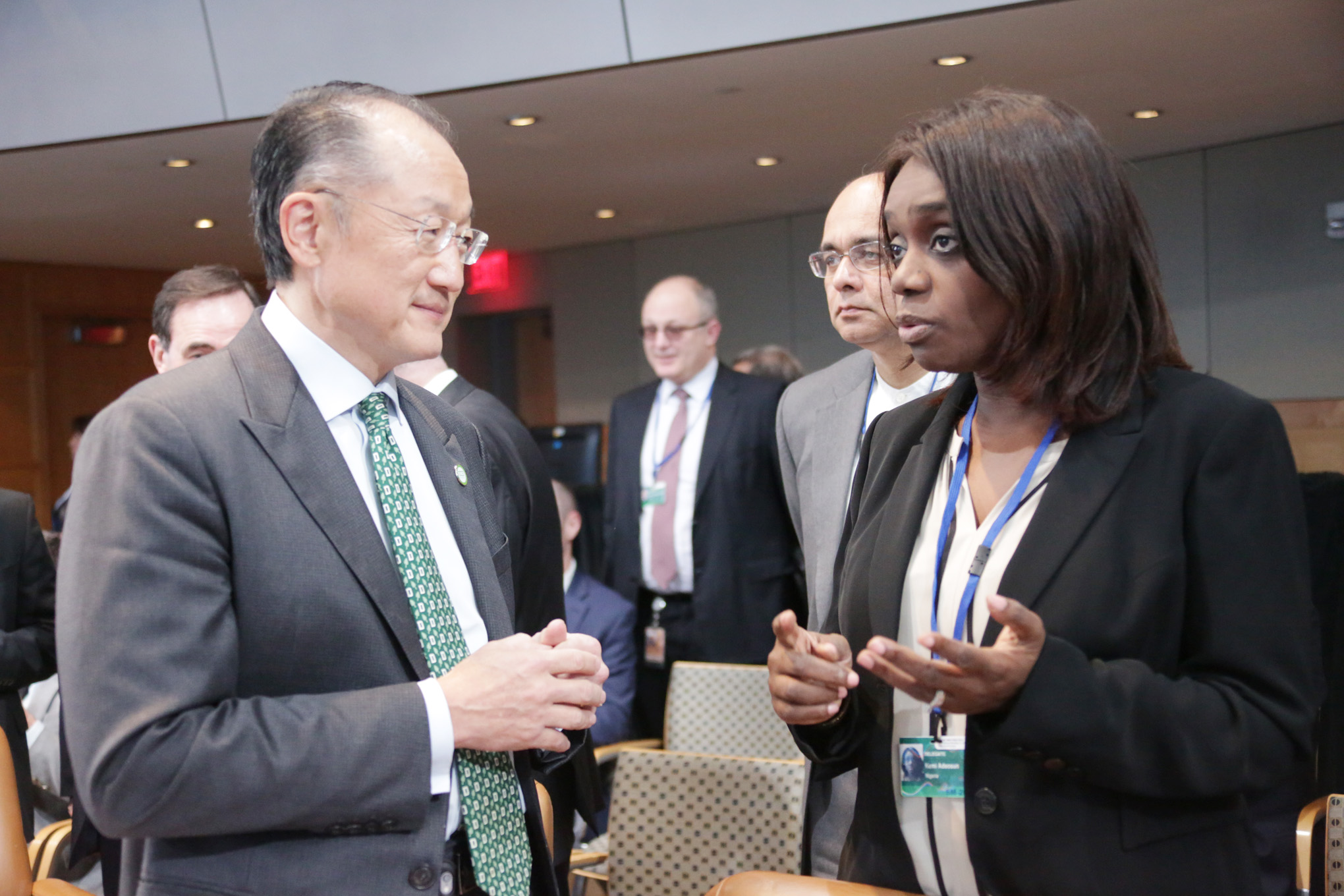
Nigeria’s Finance Minister, Kemi Adeosun discusses heart-to-heart with the World Bank President, Dr Jim Yong Kim at the G 24 Ministers meeting at the 2016 Spring meeting of the WorldBank/IMF in Washington DC today, April 14, 2016. [myad]
What has unfolded in the politics of Gwagwalada Area Council of the Federal Capital Territory (FCT) may look very insignificant to people who are interested only in larger political environment. To other people, the Gwagwalada political tango represents the small thing that gives a bigger lesson. It may even surprise many and disturb others. It was like turning the world on its head, or it was like one of the wonders of the world. It indeed, represents a classic case of political and personal vengeance, vendetta, superiority, muscle-flexing, and above all, it was a case of killing the vulture, even though not good for human consumption, but simply to throw it away. As a matter of fact, it looked and sounded strange to hear that All Progressives Grand Alliance (APGA) won the chairmanship of the Council in the main and rerun elections conducted by the Independent National Electoral Commission (INEC), in a place like Gwagwalada where All Progressives Congress (APC) holds sway at all times. How did APGA do it? A story was repeatedly told in whispers about how the newly defeated APC incumbent chairman and chairmanship candidate, Jibril Abubakar Giri committed hara-kiri; an unforgivable offence against his predecessor and benefactor, Alhaji Zakari Angulu Dobi. Information had it that it was Angulu who put him there in the first place. Abubakar was said to be the deputy to Angulu, who served two-term tenure as chairman of the Council. Angulu was said to have so trusted Abubakar so much that he did not find anything wrong, indeed, he felt comfortable putting Abubakar up to succeed him. That was even as information filtered in that Abubakar, his trusted second-in-command was having affairs with his (Angulu’s) wife while they were still together. Angulu was said to have always regarded those who were peddling such ‘rumour’ as enemies that wanted to create friction between him and his deputy. Angulu, who is believed to be a confirmed god-father of Gwagwalada politics stood solidly behind Abubakar and saw him through to electoral success. It was when Abubakar won the election as chairman that he showed his real colour: he was said to have cajoled Angulu’s wife (with whom he had been having secret affairs) to divorce him after which he moved swiftly to marry her fully. He left Angulu gasping for air! It was when Abubakar finally married his wife after the divorce that Angulu recalled the rumour which he had always brushed aside, even when it was too late to do anything. Angulu, who went on to win the House of Representatives election on the platform of APC to represent FCT South, laid in waiting for the second-term attempt of his erstwhile friend who “took” his wife away from him. And so when the April 9 Council election came, it was a pay-day time. At the risk of being branded anti-party person, Angulu threw his support behind the least expected candidate, the APGA’s Adamu Mustapha Danze. The sitting chairman was said to have tried to manipulate the electoral process in his own favour as a result of which the first ballot of the FCT Area Council election, held on April 9, was declared inconclusive by the INEC, even though it was APGA candidate that had taken the lead. And when the rerun was conducted on April 13, the APGA candidate still topped the chart. For Angulu, yes, there might be nothing to jubilate about helping the candidate of another party to win the election, but he had proved to the incumbent, his erstwhile friend that the hand that put food into someone’s mouth can also remove the food. It is like killing the vulture even though it is not for eating, but so as to throw it away. The Gwagwalada political muscle-flexing may look insignificant against the background of the larger political map of Nigeria, but the reality of it is widespread. It is indeed, a reminder of the immorality that has defined most of the nation’s politicians, vis-avis their wives or the women within. The fight for supremacy on the political turf between the god-father and the god-son had, time immemorial, resulted in bloody nose, like it happened in Gwagwalada. The fight has always taken the form of the control of the spoils of office, personal and political worth but the end result had always left deep scars and created deep-seated enmity. That is the political dimension which Nigerian political system has brought forth. But to think of wife snatching as part of it! [myad]
Budding Nigerian writer, Modupe Ojuolape Kuti, is the winner in the Flash Fiction category of the 2015 Etisalat Prize for Literature. The category is part of the Etisalat Prize for literature, a platform to recognize and encourage unpublished writers across the Continent. Kuti emerged as the winner for her short story ‘Gone’ at the awards ceremony for the 2015 Etisalat Prize for Literature held in Lagos. Her entry was one of over 1,000 entries from which 50 met the judging criteria and were shortlisted for the voting process. She was rewarded with £1,000 cash prize and an iPhone 6. Two other Nigerians, John Chidi and Jacqueline Uche Agweh, came second and third for their stories: “Invincible” and “Madness in Degrees.” They were also rewarded with £500 each and a high end device. The Chief Executive Officer of Etisalat Nigeria, Matthew Willsher, said the Flash fiction category was created to meet the needs of the fast paced world, therein providing a glimpse into the creative minds of unpublished writers. Wills her said: “We are delighted again to celebrate the richness and strength of African literature. The Etisalat Prize for Literature embodies this year’s theme, ‘Representing the Diversity of African Voices’. Diversity has always been a huge source of innovation. Africa’s cultural diversity is increasingly recognized as a central part of the African collective identity.” The star prize for the 2015 edition of the Etisalat Prize for Literature was won by Democratic Republic of Congo’s Fiston Mwanza Mujila for his book, Tram 83, a book originally written in French, and translated into English by Roland Glasser. He received a £15,000 cheque, an engraved Montblanc Meisterstück and an Iphone 6s. He will also attend the Etisalat Fellowship, worth £13,000, at the prestigious University of East Anglia, United Kingdom, under the mentorship of Professor Giles Foden. [myad]
“I believe that by this time next year we will be celebrating the release and not anniversary of their abduction. This was the remarks by the Deputy President of the Senate, Ike Ekweremadu, who presided over the Senate today where Senator Dino Melaye and three others presented a motion on the condition of the Chibok girls who were abducted on April 14, 2014. Ekweremadu described the abduction of the girls as disturbing, adding that Nigerians and the international community were asking when the girls would be rescued. “I am happy we are talking about it to ensure that this national embarrassment is brought to an end.” He however blamed the police system in the country for the abduction of the girls, adding: “one reason this could happen is because of inadequate policing. This does not happen in U.S. or UK. We must begin to think about doing something. “ Until we do something about the nature of police in the country, there is the possibility for it to happen in other places.” The Senate which later summoned the National Security Adviser (NSA) and security chiefs to appear before it and brief it on efforts to rescue the Chibok girls, called on Nigerians to continue to pray for the release of the girls. It also called on the Federal Government to take over the rebuilding of the school to alleviate the sufferings of students. The Senate expressed sympathy for the parents of the girls, Chibok community and Nigerians over the incident. Presenting the motion, Senator Melaye said that besides the propaganda videos created by the Islamist militant group, none of the girls had been seen since their abduction. He said that apart from the fact that some of the girls were yet to be rescued, the school where they were abducted was still unattended to. The Senator said that the abduction of the girls had greatly affected the image of the country in the international community. “It is a harrowing feeling knowing that these girls are still under the mercy of such a violent group. “I can only imagine the state of mind of the parents, guardians and relatives of the missing girls. “I am concerned that the abduction has become a myth and their whereabouts an enigma. “These girls have dreams and aspirations and in the eyes of God and the laws of man, they have every right to pursue such dreams. “We cannot succeed as a government until those girls are released.” Contributing to the motion, senator Shehu Sani decried the levity with which issues affecting the poor were treated in the country. He said that measures would have been put in place to rescue the girls if they were from rich homes. “There is a class nature to abduction in Nigeria; when the rich are abducted it takes few weeks to get them back. Why must it take two years to get the Chibok girls back? “When the Federal Government is ready, I have a strategy and advice to give, a freelance journalist offered to get these girls out and we have not done anything. “ Visiting Chibok and talking too much while the girls are in captivity will not help the situation. If we are not careful we will move from anniversary to anniversary.” Sani called on government to continue to use force and explore the possibility of dialogue for the release of the girls. He added that their abduction had dented the image of the country in the fight against terrorism. The Minority Leader, Senator Godswill Akpabio, commended the Federal Government for measures put in place so far to rescue the girls. He also commended Melaye for the motion, saying that “by moving this motion today it clearly shows the concern the lawmaker has for the girls.” Akpabio asked the government to intensify effort to rescue the girls, adding: “for us to succeed as a nation, we must bring these girls back.” Senator Rose Okoh expressed concern over the condition of the girls, saying that they may have been violated and some may have died. “If at this time we are still telling the world that we have no answer, it seems that there is something amiss. “We need to wake up from the lethargy with which we have treated this issue,’’ she said. Okoh called on the Federal Government to do more to rescue the girls and other girls who had been abducted by the Boko Haram terrorists.” This was even as Senator Ben Bruce who was opposed to the payment of ransom for the release of the girls, advised security agencies to continue with other alternatives for their rescue. He said that the insurgents may use such ransom to procure arms and continue with their despicable activities. “I do not accept paying them to release the girls because they will use the money to buy more arms.” [myad]
We use cookies on our website to give you the most relevant experience by remembering your preferences and repeat visits. By clicking “Accept”, you consent to the use of ALL the cookies.
This website uses cookies to improve your experience while you navigate through the website. Out of these, the cookies that are categorized as necessary are stored on your browser as they are essential for the working of basic functionalities of the website. We also use third-party cookies that help us analyze and understand how you use this website. These cookies will be stored in your browser only with your consent. You also have the option to opt-out of these cookies. But opting out of some of these cookies may affect your browsing experience.
Necessary cookies are absolutely essential for the website to function properly. This category only includes cookies that ensures basic functionalities and security features of the website. These cookies do not store any personal information.
Any cookies that may not be particularly necessary for the website to function and is used specifically to collect user personal data via analytics, ads, other embedded contents are termed as non-necessary cookies. It is mandatory to procure user consent prior to running these cookies on your website.


 The Peoples Democratic Party (PDP) has effectively been flushed out of the Federa Capital Territory (FCT) in the recently concluded Council elections for the six area councils.