Governor Ayodele Fayose is now jittery as the people who perpetuated the fraud that characterized the election that brought him into power are now facing the consequences of their action.
Two senior army officers, Brigadier General Aliyu Momoh and the former spokesman of the Nigerian Army, Brigadier General Olajide Laleye, as well as other officers, indicted in the conduct of the elections have just been fired. They were found guilty by the Military Council that tried them.
This is even as Governor Fayose has expressed fear that he is the target of President Muhammadu Buhari’s administration for his unrelenting criticism of the President’s policies. He added that the realisation made him to be cautious of his dealings in office.
“I have started the construction of a flyover in Ado/Ikere Road for N5.7bn. I have also invited the Economic and Financial Crimes Commission to be part of it, because I know I am a target of the current administration.
“You may not like my face or my style. But take the message and leave the messenger. If they have anything against me, they would have published it I know. I prepare for my defence. I am fully prepared.
“Criticising the President should not make me an enemy. We will sue the government. We learnt this from Asiwaju Bola Tinubu. He is always in court either by proxy or direct. You cannot keep arresting my principal officers and members of my state House of Assembly.”
It was learnt that the retirement of the senior officers was in connection with the recommendations of the panel set up by the Army authorities to look into allegations of professional misconduct against military personnel in the conduct of the June 14, 2014 governorship poll in Ekiti State and the 2015 general elections.
The panel was also directed to investigate the roles played by the military officers who participated in the August, 2014 governorship election in Osun State.
After the results of the Ekiti governorship election was released, where Fayose, who contested on the platform of the Peoples Democratic Party (PDP) was declared the winner, there were allegations that the Army personnel deployed in the state, led by Momoh, played active roles in an alleged rigging of the poll.
An officer of the Nigerian Army, Captain Sagir Koli, who participated in the supervision of the poll, had leaked an audio recording of a meeting, featuring Fayose, Momoh, former Minister of State for Defence, Musliu Obanikoro; former Minister of Police Affairs, Mr. Jelili Adesiyan and the PDP governorship candidate in Osun State, Senator Iyiola Omisore, among others, where the alleged rigging was hatched.
The individuals had denied the rigging allegations.
It was learnt that the Army council met in February to consider the recommendations of the panel, set up by the Chief of Army Staff, Lt.-Gen. Tukur Buratai, to investigate allegations of professional misconduct against its personnel in the last elections.
The Board of Inquiry, led by the General Officer Commanding, 1 Division of the Nigerian Army, Kaduna, Maj. Gen. Adeniyi Oyebade, indicted some officers and recommended various degrees of sanctions for them in a report submitted to the Army chief on January 11, 2016.
The Oyebade-led panel recommended the compulsory
retirement of two officers from the Army, three others for loss of command and one for prosecution for receiving financial gratification.
The panel recommended 15 officers to be put on the watch list and nine officers for investigation by the Economic and Financial Crimes Commission.
Also, the panel said that six officers should face an audit panel and 62 officers (mostly of the rank of Major and below) should be given Letters of Displeasure and to appear before their respective GOCs for counseling.
Oyebade had said 23 officers, over 100 soldiers and 62 civilians appeared before the panel which was constituted on
October 20, 2015 “to investigate the alleged unprofessional and unethical conduct of some Nigerian Army personnel in Ekiti and Osun states’ governorship election in 2014 as well as in any other state in Nigeria, where other allegations of misconduct were made during the 2015 general elections.”
Part of the committee’s terms of reference include: “to review the involvement of the Nigerian Army formations/units and its personnel in elections and other duties in aid of civil authority.”
The Army authorities had said the investigation was
designed “to prevent future unprofessional conduct by officers and men in the performance of their constitutional roles while
strengthening Nigerian Army’s support to democratic values and structures.” [myad]
In a move aimed at curtailing the activities of black market operators and others benefiting from people’s misery, the Commandant General of Nigeria Security & Civil Defence Corps ( NSCDC) Alhaji Abdullahi Gana Muhammadu, has ordered a 24-hour surveillance of petrol stations by the Officers of the corps.
Gana Muhammadu, in a statement today, said that his officers would be assigned to petrol stations across the country in order to carry out the directive.
Gana who met with the Minister of State for Petroleum Resources, Mr. Ibe Kachikwu at NNPC tower Abuja, handed down the order as the widespread fuel scarcity in the country continues to bite hard.
This is even as the government has outlawed selling of petrol on roadsides and directed the NSCDC official to arrest and prosecute offenders.
Speaking to news men on the development, the Commandant General said that before the latest direct NSCDC had carried out 24-hour surveillance on oil terminals where crude oil is being loaded and on the rigs where drilling operations take place.
He said 2,800 officers have been deployed in Abuja metropolis to easy the operation of NNPC and also officers of the corps have also been deployed in the same vein in states like, Delta, Edo, Lagos, Ogun, Osun and Oyo state. [myad]
The Peoples Democratic Party (PDP), has began the preparation to its National Convention with the setting up of four special committees.
Part of the preparations for the Convention is also the move for the overall rebuilding and repositioning of the party.
The committees were set up today by the party’s National Chairman, Sen. (Dr.) Ali Modu-Sheriff in line with the decision of the National Executive Committee (NEC) of the party.
A statement by the party’s National Publicity Secretary, Olisa Metuh said listed the committees as the National Convention Committee, Reconciliation Committee, Zoning Committee and the Finance Committee.
The National Convention Committee has Rivers State Governor Nyesom Wike as Chairman, Taraba state Governor Dairus Ishiaku as Deputy Chairman and the Governor of Ebonyi State, Governor Engr. Dave Umahi as Secretary.
Similarly, the Reconciliation Committee has Bayelsa State Governor Seriake Dickson as Chairman and Senator Ibrahim Mantu as Deputy Chairman while the Finance Committee has Gombe State Governor Ibrahim Dankwambo as Chairman and Senator Godswill Akpabio as Deputy Chairman.
Metuh said that the Zoning Committee has Akwa-Ibom State Governor Emmanuel Udom as Chairman and Barr. Kelechi Igwe as Secretary.
He said that all the committees will be inaugurated by the National Chairman on Tuesday, April 5, 2016 at the national secretariat of the party at 2pm prompt. [myad]
Vice President, Professor Yemi Osinbajo, has advocated continuity in governance which he described as an antidote for political stability in the West African subregion. He said that such continuity is an important element in the fight against Boko Haram and insurgency.
Osinbajo who spoke in Niamey, capital of the Republic of Niger at the inauguration of President Issoufou Mahamadou for a second term in office, the Vice President said the re-election of the Nigerien leader is significant for the subregional coalition against insurgents and terrorists.
“As you know, Niger is an important partner, and also an important ally in the war against terrorism and we are good neighbours.”
Professor Osinbajo said that Mahamadou’s investiture has great significance because first Nigeria understands President Issoufou well.
“He is an old hand and Nigeria has worked well with him as a partner. So, his re-election brings continuity and is good for the fight against Boko Haram and the insurgency in general.”
Professor Yemi Osinbajo who represented President Muhammadu Buhari at the ceremony in Niger Republic said that Nigeria holds the Nigerien President in high esteem adding that “he is an old friend of President Buhari who is abroad attending the nuclear security summit in Washington, USA, which is why he could not attend this event.”
He said that the Nigerien President’s inauguration is also an opportunity to honour a strong ally and to reinforce all our important diplomatic and military ties.
In his inauguration address after he was sworn-in at the ceremony, President Mahamadou noted that current worries regarding insecurity is global, transcending boundaries.
He restated Niger’s renewed commitment to join forces with Nigeria and other neighbours to fight insurgency at the sub regional level.
The Nigerien President explained that defeating Boko Haram has several benefits particularly for economic integration in the region stating that it ‘ will facilitate trade between Niger and Nigeria’.
About fifty two countries witnessed the ceremony including nine West African presidents.
There were also several Nigerian dignitaries at the occasion including the APC National leader, Asiwaju Bola Ahmed Tinubu, and several governors especially from the Northern States. [myad]
The Nigerian National Petroleum Corporation (NNPC) has lost N24 billion operational deficit as at February 2016, a far cry from its loss of N3.55 billion in January of the same year.
According to the state oil firm’s Monthly Financial and Operations Report for February 2016, released at the weekend, the deficit in operations is a big setback for the NNPC, which is in a restructuring process that is targeted at catapulting the Corporation to profitability.
It is gathered that the NNPC has not made profit in the past 16 years. The Corporation in the report blamed the huge deficit in the month of February to production shut-in occasioned by vandalism of the Forcados Export Line.
“This situation denied NPDC (a subsidiary of NNPC) the opportunity to earn revenue from crude oil sales of about 20billion,” it said. [myad]
The Minister of Solid Minerals Development, Kayode Fayemi, has given assurance that President Muhammadu Buhari is determined to make Ajaokuta Steel project work.
President Muhammadu Buhari’s administration, he emphasized, is committed to ensuring that the Ajaokuta Steel company works, in order to boost the country’s technological development.
“This will also help us in the areas of arms and ammunitions. And the defence industry will also benefit from this when we get it right.”
Fayemi spoke as a guest lecturer at the National Defence College, Abuja.
The minister said that part of his tasks as minister in charge of solid minerals development is to sign explosives permits for use in quarries and mining sites and that it is important to also track their use as part of efforts to curtail activities of insurgent groups and violent crimes in the country.
He said that there should be a technological approach to tracking the use of explosives by those who sought and obtained permit for its use so that it does not end up in the hands of those who would use it for criminal purposes.
He disclosed that part of the efforts of the ministry is to also educate security agents on how to identify these minerals.
“Many of them do not recognise these minerals. So, in most cases they do not know the value of what the person is taking out illegally.
“so we are partnering with security agencies, the customs, immigration, police, civil defence, to assist us.
“Once we get the regulatory frame work right and create a conducive environment for investment to thrive, we shall witness huge investment in the sector, create wealth and employment opportunities.” [myad]
President Robert Mugabe has denied allegation that he fell into sleep during a Press conference he held together with Japanese Prime Minister Shinzo Abe in Tokyo, Japan, this week.
And the government warned some media houses to stop publishing what it called falsehoods that are disrespectful of the person of the President.
Addressing news men in Harare, Information, Media and Broadcasting Services Minister Dr. Christopher Mushohwe said such kind of gutter journalism should be restricted to social media.
“While Government remains committed to an agreed cordial working relationship with the media, my Ministry, as the arm of Government responsible for both the sector and as its spokesperson, would want to appeal and caution against (the) continuous, unwarranted, disrespectful and unprofessional onslaught on the person of the Head of State and Government and Commander-in-Chief of the Zimbabwe Defence Forces, His Excellency the President, Cde R.G. Mugabe.
“Government has followed with disgust a concocted malicious story that has been playing on the social media platform and on the Internet this week which suggested that His Excellency the President Cde R.G. Mugabe, had “slept” on the job during a joint Press briefing with Japanese Prime Minister, Mr Shinzo Abe, in Tokyo, Japan, this week.
“President Mugabe was on his feet as Mr. Abe delivered his statement to the Press. Watching the said video clip, even at close range, one could see President Mugabe nodding his head in response to the message being delivered by the Japanese Prime Minister.
“That is why we were never bothered to try and dignify the malicious innuendo that the President was dosing off with a rebuttal.
“Any sane person watching that video clip would dismiss the propaganda story with the contempt it deserves.”
Dr. Mushohwe added: “We have been forced as Government to react today (yesterday) to this malicious video story, disgusted by one of our own local tabloids, which saw it fit to attack the person of His Excellency the President in this cruel fashion by publishing the spiteful story, which they themselves know to be blatantly false.
“It is clear to us that whether it was an April fools’ prank or unintended, either way, the motive was to injure and damage the reputation of our President in a big way, which is very shameful because it flies in the face of our national values and culture. We do not expect this kind of unprofessional behaviour and wilful misconduct from our journalists.
“This kind of gutter journalism resides on the social media platforms and should not be allowed in the mainstream media.”
Dr. Mushohwe said the mainstream media is bound by professional ethics, and fellow journalists should condemn their colleagues for bringing their profession into disrepute.
Said Dr. Mushohwe: “As Government, while we uphold freedom of expression and media freedom, we strongly believe in the derogations that our Constitution prescribes in respect of these rights.
“Chapter Four of our Constitution which focuses on the Bill of Rights states in Part Two, Section 61, paragraph five that: ‘freedom of expression and freedom of the media exclude incitement of violence, advocacy of hatred or hate speech, malicious injury to a person’s reputation or dignity or malicious or unwarranted breach of a person’s right to privacy’.” [myad]
Pensioners Rights and Protection Alliance (PPRA) has kicked against the haste with which the minister of finance, Mrs. Kemi Adeosun suspended the Director-General of the Pension Transition Arrangement Department (PTAD), Mrs. Nellie Mayshak.
The pension group, represented by the Executive Secretary, Sule Adams labelled the suspension as “a witch-hunt.”
In a statement in Abuja wondered that the suspension was carried out without first carrying out a discreet and forensic investigation into the alleged fraud.
“The suspension of Mrs. Nellie Mayshak came to us as a rude shock not because she is above such disciplinary action, but because we find the process leading to it as gravely flawed and undeserving of a Nigerian who had worked hard since the establishment of PTAD to put smiles on the faces of us, Nigerian pensioners.
“It is an open secret that Nigerian pensioners have borne the brunt of the pervasive corruption in the Nigerian society more than any other group after toiling all through their productive years; PTAD and by extension, Mrs. Nellie Mayshak came to reverse the situation after similar interventionist agencies contributed in worsening the situation in the past.”
The group insisted that the allegations are spurious and unfounded based on the knowledge of the workings of PTAD, adding that all pensioners’ salaries are paid through the Central Bank of Nigeria to beneficiary’s accounts using the Integrated Financial Management Information System (GIFMIS).
The group said that such payments are tracked through the banks to ensure that every pensioner receives their entitlement immediately they are paid, stressing that it is a known fact that PTAD prepares and submits monthly payroll of pensioners to the office of the Accountant General of the Federation in addition to issuing of payment instruction to the same office which is as adjunct of the federal ministry of finance.
The group therefore wondered why the ministry could now turn around abruptly to deny the agency if there isn’t much to the suspension order than meets the ordinary eye, even as it restate the need for the president to go deeply into the matter.
The group said that PTAD had saved tens of billions of Naira for the nation through the elimination of over 4,500 ghost pensioners and of recent saved another N7billion in five months that otherwise would have disappeared into the pockets of insurance companies and underwriters.
The group said that PTAD has a list of 120 pension fraudsters which it had submitted to the Independent Corrupt Practices Commission (ICPC) for investigations even as it challenged the public to cross check these assertions from the Federal Ministry of finance and the ICPC respectively.
“It is therefore preposterous to say that the Director General padded the payroll when she has been in the forefront of those fighting against such group.”
The group which said that it would sit back and watch pension administration in Nigeria returned to the dogs, disproved the widely reported allegations that the Director General was drawing a whopping salary of N60 million every month, saying that Mrs. Nellie Mayshak earns a little over N3million a month which was duly approved for the office by the National Salaries, Income and Wages Commission and which it said is about the least among its contemporaries in the public financial agencies such as CBN, FIRS, ICPC, PENCOM, NSITF and PPRA earn.
“How can any civil servant allocate salary to his or herself if it is not an attempt to smear the woman by the endemic cabal of fraudsters whom she had fought relentlessly to remove their hands from the till of hapless pensioners?” [myad]
The Rivers State Chapter of the All Progressives Congress (APC) has rejected the results of the rerun election conducted in the state on March 19.
The party said that what took place in the State on March 19 was not the expected rerun State and National Assembly elections but the mere allocation of votes to the ruling party in the State, the Peoples Democratic Party (PDP), by the Independent National Electoral Commission (INEC) to avoid being killed by Wike and his gang of killers.
In a statement, the APC State Chairman, Dr. Davies Ibiamu Ikanya, said the party had outrightly rejected the results so far announced by INEC.
He said that the total cancellation of the process and the holding of fresh rerun polls would be acceptable to it.
“We wish to put on record our total and uncompromising rejection of the results of the March 19, 2016 rerun elections so far announced by INEC as these do not in any way reflect the current political realities on ground in Rivers State. These results, which indicate a mysterious landslide victory for PDP, were allocated to the ruling party in the State following unrelenting threats by Governor Nyesom Wike to the effect that anybody coming to conduct any election that would not favour PDP should first write their wills before coming to the State. The effect of these threats and their practical demonstration as seen in how people were burnt, beheaded and buried alive during the rerun elections can clearly be seen in the shameful manner INEC is awarding victory to PDP.”
The Rivers APC said that there was nothing different between what happened on March 19, 2016 and during the widely discredited elections of March 28 and April 11, 2015 that was cancelled by the courts, which also ordered the rerun elections. It said that this was not a coincidence considering that the apparatus used for both elections were basically the same.
“From the Police leadership to most of the INEC officials and INEC ad-hoc staff, the characters that organised the 2015 general elections were the same characters that organised the March 19, 2016 rerun elections and it will be foolhardy to expect any different result. All these characters were set up by the former disgraced PDP administration rejected by Nigerians during the 2015 polls.”
The Rivers APC berated Governor Wike for claiming that APC is not in a position to win an election in the State, and for accusing Minister of Transportation, Rt. Hon. Rotimi Amaechi, of sponsoring violence to remain politically relevant. “Everyone knows that Wike is the one who has been sponsoring violence in Rivers State and not Amaechi,” the party said, adding: “If Amaechi did not employ violence as Governor of Rivers State to stop Wike from succeeding him in 2015, is it now that he is far away in Abuja as a Minister of the Federal Republic of Nigeria that he would do so? Rather than the vain attempt to drag his name into the mud, Amaechi should be commended for not encouraging APC members to retaliate the wanton killing of its members by PDP, which would have turned Rivers State into another Somalia. [myad]
“Ha, my brother. Thanks for being observant. I have been trekking.”
“Trekking?”
“I went to buy fuel at that fuel station by the Estate gate. I had to abandon the car there. On my way back home, I could not find okada or any other form of transportation.”
“No wonder you are sweating.”
“All the tricyclists and the okada people claim they have no fuel.”
“It is good for you big men to have a taste of what poor people go through. This fuel scarcity is an effective leveler. It is no respecter of persons.”
“I can’t wait for April 7 to come.”
“What’s special about April 7?”
“That’s the day we are told this scarcity will end, and there will be no more scarcity of petroleum products.”
“You mean a government official actually made such a promise?”
“Yes”
“Then, that official still has a lot to learn. In this kind of matter, you must never give a deadline because you never know. Nigerians will record the date, pretend to be optimistic and wait for you. If you don’t deliver on the said date, you will be branded an incompetent liar!”
“Really?”
“Trust me. Never set a deadline. Never say things such as we will put an end to the Boko Haram menace by June ending. We will deliver 10, 000 MW of electricity by December, and there will be fuel across the country by so-so-and-so date?”
“But I think April 7 is a sure date”
“I like your optimism. You mean by April 7, the pipeline vandals would have stopped stealing?”
“Some concerned Nigerians, particularly Pastors, I understand have been helping the Federal Government to appeal to vandals. They have been telling the vandals that it is not a good thing to steal petrol that belongs to all of us.”
“You want to stop oil theft and pipeline vandalism by preaching? Does anyone know who the vandals are?”
“You know we are a religious nation. When everything fails, we preach. I won’t be surprised to hear that any pipeline vandal who repents will be recommended for a National Honour!”
“In that case, what are you still doing here? You too should become a pipeline vandal, repent and get honoured. Or you don’t want a national honour?”
“Actually, I’d rather ask the vandals to give me fuel from their private depots, so I won’t have to face the stress of looking for fuel.”
“But I thought we were depending on the importation of refined petroleum products. Where are the major marketers?”
“They are there, but they say they can’t help because market forces are now obeying command-and-control, centralized orders which are not good for business.”
“I know. I know. The climate has changed. There is no more free money to share in the name of subsidy. Let the marketers continue to grumble. You know, sometimes I actually feel that if the NNPC can quickly get its acts together and Nigerians can endure a little, this may actually be our opportunity to free Nigerians from the threat of oil marketers.”
“What threat? The marketers are doing business. If the refineries work and fuel supply across the country is well managed, we should not be in this situation. If you frustrate the marketers, whose crime is that they feed off state inefficiency, and you have no alternative in place, this is what you get. The issue is also one of ideological confusion between capitalism and socialism.”
“It is a shame that at a time the international price of crude oil is dropping, Nigerians are having to pay an arm and a leg to get fuel. Right now, a litre of fuel is about N250”.
“It’s more. That is if you get it to buy.”
“Wait a moment. You are panting. What’s that wheezing sound? You may need to see a doctor.”
“I can’t remember when last I trekked.”
“Fuel scarcity is good for you then?”
“How can this suffering be good for anybody? Do you know how many families are now treating heat rash? Not to talk of hundreds of Nigerians who have died looking for fuel?”
“Just see a doctor. If you trek for about 1,000 metres and you are now looking like you want to pass out, then for you fuel scarcity is a major help. If you didn’t have to look for fuel, you’d be dying slowly and you may never know. I think every big man should in fact go look for fuel and trek a little, and listen to the people on the street. Good exercise.”
“You must be joking”
“Well, as it is, it is the poor who are benefitting from the crisis. Many lower class Nigerians now trek to work. They can’t afford the high cost of transportation, so they just hit the road with their feet.”
“You must be kidding me”.
“Two days ago, I saw a long stretch of trekkers, returning from work, moving from Victoria Island to the Mainland, looking like they have accepted their fate.”
“Too much trekking can kill.”
“Looks like that former Minister who once recommended that Nigerians should use the bicycle is about to be vindicated at last. The bicycle will be our best bet under the circumstances.”
“Stop being funny. Families will use the bicycle to take children to school? Or Madam will go to the market riding a bicycle?”
“Nigerians must learn to embrace change. Our problem is that we don’t always see the good sides of everything. Are you aware that this fuel scarcity crisis has created many jobs?”
“You mean it has resulted in many job losses. With the rise in the cost of goods and services, many companies have had to lay off staff. If you spend half of your profit on generating electricity and buying fuel at cut-throat rates, you’d have sooner or later to cut costs. The first casualties are the workers. Even big companies can no longer pay salaries. Small and medium scale enterprises are folding up.”
“In your estate?”
“What do you mean in my estate?”
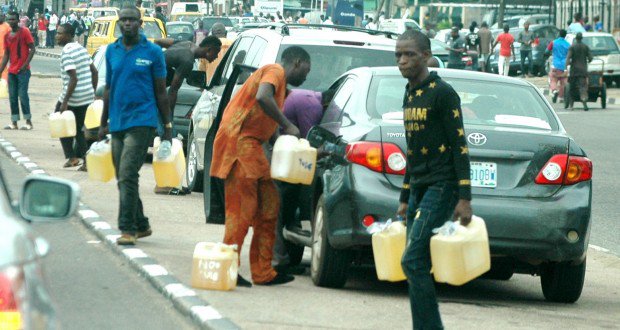
“Because you see in this life, when some people are crying, some people are smiling. All those boys selling black market fuel in jerry cans by the roadside, I hear they are praying that there should always be fuel scarcity. Many of them are now multi-millionaires.”
“Profiting from other people’s agony. Is that your understanding of how a proper economy works?”
“I am an optimist. Those boys selling fuel are very happy. If there is regular supply of fuel tomorrow, they wont’ be happy.”
“Please stop this cynicism.”
“Cynicism? Look, if this thing continues beyond April 7, don’t be surprised if you see me by the roadside also hawking fuel in jerry cans. I will add some swag to my own; organize the jerry cans nicely and put up a visible sign-board with the inscription: NNPC Mega Station! I have been making enquiries.”
“Your mates are aspiring to own fuel stations, become major marketers, or even own oil fields, your ambition is to sell fuel in jerry cans.”
“Some of those boys selling fuel in jerry cans are university graduates. I did my research. You do yours.”
“You are exaggerating”
“No, I am not. You mean you have not seen Ph.D holders in this country who are working as drivers or running pepper soup joints or selling pure water? You better change your mentality. My friend, try and change.”
“It is not that bad, please.”
“Okay. Are you aware that many graduates are ready to join the Nigeria Police as constables? And they will be glad to be posted to checkpoints where they can check vehicle particulars, and the pockets of motorists.”
“Pockets?”
“Yes. Why do you think there has been such a massive rush for jobs in the Nigeria Police. The Police recently placed an advert asking for applications. The two websites for online application crashed within 4 hours.”
“Wonderful.”
“They are looking for just 10, 000 new recruits. They received more than 8, 000 applications within one hour. If the portals did not crash, there would have been over a million applications.”
“Na wa o”
“Na wa ya o. We really need a miracle to happen.”
“No fuel. No electricity. No rainfall, either, as if God is holding on to the rains. Everywhere is so hot. I hardly sleep at night.”
“I still think you should see the doctor. And luckily for you, you may not have to pay the hospital.”
“How do you mean?”
“The Minister of Health has just directed all teaching hospitals and government-owned hospitals to treat patients free of charge.”
“Indigent patients or every patient?”
“We are all indigent, my friend.”
“But I don’t know why you take the Minister serious. You and I know he is just talking. No hospital will listen to him. And by the way, is he in a position to give such directives to state-owned hospitals? Even the ones owned by the Federal Government, do they have enough funds to embark on free healthcare? Government officials just must talk.”
“You can’t say that until you find out.”
“No. I don’t need to find out. I know.”
“Just take care of your health. I don’t want it said that you slumped while looking for fuel.”
“I’ll be fine”.
“Nigeria too will be fine. You remember that baby girl who was shown looking malnourished, and emaciated four months ago. Adacheka. And the boy now called Hope who was found in Akwa Ibom, left for dead, emaciated and sickly, in January. When I see the pictures of both children and how they have been saved, I think of our country, Nigeria. Miracles still happen.”
“I don’t believe in miracles any more.”
“Why not? Nigeria will soon start operating on nuclear energy level.”
“Really? People look for miracles when they are desperate or losing hope. In football, for example, Nigerians are looking for miracles right now. The Super Eagles have disappointed the nation. Indigenous coaches have failed us. From Stephen Keshi, to Austin Eguavoen, Samson Siasia and Sunday Oliseh, no hits, back to back, all na failure.”
“You don’t become a successful coach and manager just because you once captained a team. You need technical skills. You need the right people.”
We use cookies on our website to give you the most relevant experience by remembering your preferences and repeat visits. By clicking “Accept”, you consent to the use of ALL the cookies.
This website uses cookies to improve your experience while you navigate through the website. Out of these, the cookies that are categorized as necessary are stored on your browser as they are essential for the working of basic functionalities of the website. We also use third-party cookies that help us analyze and understand how you use this website. These cookies will be stored in your browser only with your consent. You also have the option to opt-out of these cookies. But opting out of some of these cookies may affect your browsing experience.
Necessary cookies are absolutely essential for the website to function properly. This category only includes cookies that ensures basic functionalities and security features of the website. These cookies do not store any personal information.
Any cookies that may not be particularly necessary for the website to function and is used specifically to collect user personal data via analytics, ads, other embedded contents are termed as non-necessary cookies. It is mandatory to procure user consent prior to running these cookies on your website.









A Country In Search Of A Miracle, By Reuben Abati
“You look tired”
“Ha, my brother. Thanks for being observant. I have been trekking.”
“Trekking?”
“I went to buy fuel at that fuel station by the Estate gate. I had to abandon the car there. On my way back home, I could not find okada or any other form of transportation.”
“No wonder you are sweating.”
“All the tricyclists and the okada people claim they have no fuel.”
“It is good for you big men to have a taste of what poor people go through. This fuel scarcity is an effective leveler. It is no respecter of persons.”
“I can’t wait for April 7 to come.”
“What’s special about April 7?”
“That’s the day we are told this scarcity will end, and there will be no more scarcity of petroleum products.”
“You mean a government official actually made such a promise?”
“Yes”
“Then, that official still has a lot to learn. In this kind of matter, you must never give a deadline because you never know. Nigerians will record the date, pretend to be optimistic and wait for you. If you don’t deliver on the said date, you will be branded an incompetent liar!”
“Really?”
“Trust me. Never set a deadline. Never say things such as we will put an end to the Boko Haram menace by June ending. We will deliver 10, 000 MW of electricity by December, and there will be fuel across the country by so-so-and-so date?”
“But I think April 7 is a sure date”
“I like your optimism. You mean by April 7, the pipeline vandals would have stopped stealing?”
“Some concerned Nigerians, particularly Pastors, I understand have been helping the Federal Government to appeal to vandals. They have been telling the vandals that it is not a good thing to steal petrol that belongs to all of us.”
“You want to stop oil theft and pipeline vandalism by preaching? Does anyone know who the vandals are?”
“You know we are a religious nation. When everything fails, we preach. I won’t be surprised to hear that any pipeline vandal who repents will be recommended for a National Honour!”
“In that case, what are you still doing here? You too should become a pipeline vandal, repent and get honoured. Or you don’t want a national honour?”
“Actually, I’d rather ask the vandals to give me fuel from their private depots, so I won’t have to face the stress of looking for fuel.”
“But I thought we were depending on the importation of refined petroleum products. Where are the major marketers?”
“They are there, but they say they can’t help because market forces are now obeying command-and-control, centralized orders which are not good for business.”
“I know. I know. The climate has changed. There is no more free money to share in the name of subsidy. Let the marketers continue to grumble. You know, sometimes I actually feel that if the NNPC can quickly get its acts together and Nigerians can endure a little, this may actually be our opportunity to free Nigerians from the threat of oil marketers.”
“What threat? The marketers are doing business. If the refineries work and fuel supply across the country is well managed, we should not be in this situation. If you frustrate the marketers, whose crime is that they feed off state inefficiency, and you have no alternative in place, this is what you get. The issue is also one of ideological confusion between capitalism and socialism.”
“It is a shame that at a time the international price of crude oil is dropping, Nigerians are having to pay an arm and a leg to get fuel. Right now, a litre of fuel is about N250”.
“It’s more. That is if you get it to buy.”
“Wait a moment. You are panting. What’s that wheezing sound? You may need to see a doctor.”
“I can’t remember when last I trekked.”
“Fuel scarcity is good for you then?”
“How can this suffering be good for anybody? Do you know how many families are now treating heat rash? Not to talk of hundreds of Nigerians who have died looking for fuel?”
“Just see a doctor. If you trek for about 1,000 metres and you are now looking like you want to pass out, then for you fuel scarcity is a major help. If you didn’t have to look for fuel, you’d be dying slowly and you may never know. I think every big man should in fact go look for fuel and trek a little, and listen to the people on the street. Good exercise.”
“You must be joking”
“Well, as it is, it is the poor who are benefitting from the crisis. Many lower class Nigerians now trek to work. They can’t afford the high cost of transportation, so they just hit the road with their feet.”
“You must be kidding me”.
“Two days ago, I saw a long stretch of trekkers, returning from work, moving from Victoria Island to the Mainland, looking like they have accepted their fate.”
“Too much trekking can kill.”
“Looks like that former Minister who once recommended that Nigerians should use the bicycle is about to be vindicated at last. The bicycle will be our best bet under the circumstances.”
“Stop being funny. Families will use the bicycle to take children to school? Or Madam will go to the market riding a bicycle?”
“Nigerians must learn to embrace change. Our problem is that we don’t always see the good sides of everything. Are you aware that this fuel scarcity crisis has created many jobs?”
“You mean it has resulted in many job losses. With the rise in the cost of goods and services, many companies have had to lay off staff. If you spend half of your profit on generating electricity and buying fuel at cut-throat rates, you’d have sooner or later to cut costs. The first casualties are the workers. Even big companies can no longer pay salaries. Small and medium scale enterprises are folding up.”
“In your estate?”
“What do you mean in my estate?”
“Because you see in this life, when some people are crying, some people are smiling. All those boys selling black market fuel in jerry cans by the roadside, I hear they are praying that there should always be fuel scarcity. Many of them are now multi-millionaires.”
“Profiting from other people’s agony. Is that your understanding of how a proper economy works?”
“I am an optimist. Those boys selling fuel are very happy. If there is regular supply of fuel tomorrow, they wont’ be happy.”
“Please stop this cynicism.”
“Cynicism? Look, if this thing continues beyond April 7, don’t be surprised if you see me by the roadside also hawking fuel in jerry cans. I will add some swag to my own; organize the jerry cans nicely and put up a visible sign-board with the inscription: NNPC Mega Station! I have been making enquiries.”
“Your mates are aspiring to own fuel stations, become major marketers, or even own oil fields, your ambition is to sell fuel in jerry cans.”
“Some of those boys selling fuel in jerry cans are university graduates. I did my research. You do yours.”
“You are exaggerating”
“No, I am not. You mean you have not seen Ph.D holders in this country who are working as drivers or running pepper soup joints or selling pure water? You better change your mentality. My friend, try and change.”
“It is not that bad, please.”
“Okay. Are you aware that many graduates are ready to join the Nigeria Police as constables? And they will be glad to be posted to checkpoints where they can check vehicle particulars, and the pockets of motorists.”
“Pockets?”
“Yes. Why do you think there has been such a massive rush for jobs in the Nigeria Police. The Police recently placed an advert asking for applications. The two websites for online application crashed within 4 hours.”
“Wonderful.”
“They are looking for just 10, 000 new recruits. They received more than 8, 000 applications within one hour. If the portals did not crash, there would have been over a million applications.”
“Na wa o”
“Na wa ya o. We really need a miracle to happen.”
“No fuel. No electricity. No rainfall, either, as if God is holding on to the rains. Everywhere is so hot. I hardly sleep at night.”
“I still think you should see the doctor. And luckily for you, you may not have to pay the hospital.”
“How do you mean?”
“The Minister of Health has just directed all teaching hospitals and government-owned hospitals to treat patients free of charge.”
“Indigent patients or every patient?”
“We are all indigent, my friend.”
“But I don’t know why you take the Minister serious. You and I know he is just talking. No hospital will listen to him. And by the way, is he in a position to give such directives to state-owned hospitals? Even the ones owned by the Federal Government, do they have enough funds to embark on free healthcare? Government officials just must talk.”
“You can’t say that until you find out.”
“No. I don’t need to find out. I know.”
“Just take care of your health. I don’t want it said that you slumped while looking for fuel.”
“I’ll be fine”.
“Nigeria too will be fine. You remember that baby girl who was shown looking malnourished, and emaciated four months ago. Adacheka. And the boy now called Hope who was found in Akwa Ibom, left for dead, emaciated and sickly, in January. When I see the pictures of both children and how they have been saved, I think of our country, Nigeria. Miracles still happen.”
“I don’t believe in miracles any more.”
“Why not? Nigeria will soon start operating on nuclear energy level.”
“Really? People look for miracles when they are desperate or losing hope. In football, for example, Nigerians are looking for miracles right now. The Super Eagles have disappointed the nation. Indigenous coaches have failed us. From Stephen Keshi, to Austin Eguavoen, Samson Siasia and Sunday Oliseh, no hits, back to back, all na failure.”
“You don’t become a successful coach and manager just because you once captained a team. You need technical skills. You need the right people.”
“That-is-the-point!” [myad]