Home Blog Page 1933

Learning Life And Stories From Chinua Achebe, A Master, By Okey Ndibe
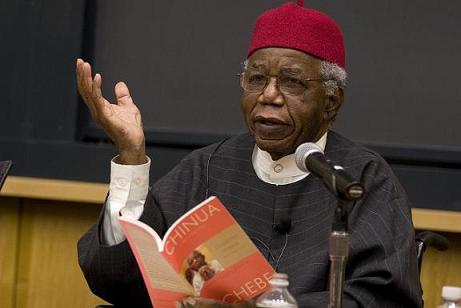
Chinua Achebe
Chinua Achebe

The literary world lost one of its truly illustrious stars when Chinua Achebe passed on March 21, 2013. Yet Mr. Achebe, whose works included the inimitable Things Fall Apart and the even grander Arrow of God, was one of the most approachable men I ever met.

I had the rare honor and luck of being close to the revered Achebe for some thirty years. In that time, he was an inspiration, model, beacon of moral clarity and intellectual integrity as well as my teacher in the best, broadest sense of that word.

My first meeting with Achebe was fortuitous in a way a master storyteller like him might have imagined. It was in 1983, and the now defunct African Concord magazine had just offered me my first job as a professional journalist. My first major assignment was to interview Achebe at his office then at the Institute of African Studies at the University of Nigeria, Nsukka. The encounter taught me something about the man’s genial and generous nature—and the depth of his humanity. I will get to that first encounter later, but must recall a more recent memory.

Seven years ago, I drove from my home in central Connecticut to the quiescent country precincts of Annandale-on-Hudson to visit Chinua Achebe, who then held a prestigious endowed professorial chair at Bard College and whose novel Things Fall Apart was enjoying a cheery 50th anniversary.

Achebe’s self-effacing, soft-spoken personality was always in ironic contrast with the exuberant celebration that had erupted around his first – and most widely read and translated – novel. I was in his home to coax him to look back on 50 years of his book’s extraordinary journey. Achebe disclosed that I was one of perhaps more than a hundred interviewers he’d hosted that year. Even so, I dared convince myself that there was something special about my interview with him.

I had interviewed Achebe several times in the past – first in 1983, when I was a rookie correspondent for the now defunct African Concord, the last time in 1987, shortly after the publication of his latest novel, Anthills of the Savannah. That first interview set a mood for my relationship with the author. Quite simply, he saved my career.

I met Achebe by sheer serendipity. It was 1983 and I had just graduated from college. Visiting Ogidi, his hometown, to see my girlfriend at the time, I raved and raved about Achebe and Things Fall Apart. The young woman listened for a while, a bemused smile creasing her cheeks. Then she said: “Achebe is my uncle. His house is a short walk away. And he happens to be home this weekend. Do you want to visit him?”

The Achebe I met in his country home personified grace. I still remember that he served us biscuits and chilled Coca Cola. He regarded me with penetrating eyes as I gushed about his novels, his short stories, his essays, even reciting favorite lines I had memorized from years of devoted reading. I told him I had just got a job with the Concord and would be honored to interview him. He gave me his telephone number at Nsukka, the university town where he lived and ran the Institute of African Studies. A week later I flew to Lagos, reported for work, and told the weekly magazine’s editor that I had Achebe’s telephone number – and a standing commitment that he would give me an interview. The elated editor dispatched me to do that interview, my first major assignment at the publication.
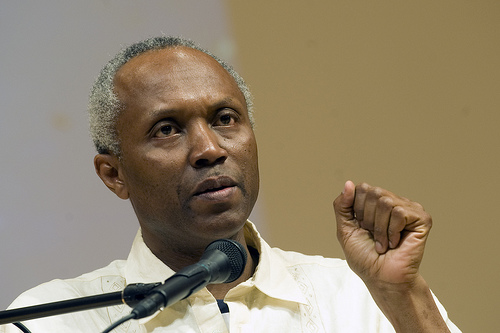
okey ndibe 2Achebe and I retreated to his book-lined office at the institute. The air in the office seemed flavored with the scent of books stretching and heaving. Five minutes into the interview I paused and rewound the tape. The recording sounded fine and our interview continued for another two hours. Afterwards Achebe told me it was one of the most exhaustive interviews he’d ever done. I took leave of him and, heady with excitement, took a cab to the local bus stop where I paid the fare for a bus headed for Enugu – the state capital where I had booked a hotel.

That evening several of my friends gathered in my hotel room. They asked questions about Achebe, and then said they wanted to hear his voice. Happy to oblige them, I fetched the tape recorder and pressed its play button. We waited – not a word! I put in two other tapes, the same futile result. How was I going to explain this mishap to my editor who had scheduled the interview as a forthcoming cover?

I phoned Achebe’s home in panic. In a desperate tone I begged that he let me return the next day for a short retake. “Thirty minutes – even twenty – would do,” I pleaded. I half-expected him to scold me for lack of professional fastidiousness and hang up, leaving me to stew in my distress. Instead he calmly explained that he had commitments for the next day. If I could return the day after, he’d be delighted to grant me another interview. And he gave me permission to make the next session as elaborate as the first.

Two days later we were back in his office for my second chance. This time I paused every few minutes to check on the equipment. I stretched the interview to an hour-and-a-half before guilt – mixed with gratitude – compelled me to stop. It was not as exhaustive as the first outing, nor did it have the spontaneity of our first interview, but it gave me – and the readers of the magazine – a prized harvest. My friends got a chance to savor Achebe’s voice, with its mix of faint lisps and accentuated locutions.

That interview happened thirty years ago. It had been followed by several other encounters with Achebe, but it still stands out in my mind. I had admired the man from a distance, in awe of his extraordinary powers as a writer. After he saved my career, I was inspired by his uncommon generosity.

I was so impressed by Achebe’s example that I became something of a lifelong student of his work, my PhD dissertation focusing partly on his deployment of history and memory in his writing.

In 2009, Brown University lured Achebe away from Bard College, scoring a major transfer of intellectual assets. At the Ivy League Brown, Achebe assumed the chair of the David and Marianna Fisher University Professor of Africana Studies and Literary Arts. With his blessing, Brown University also invited me to take up a visiting appointment.

Achebe was a widely honored and highly decorated writer, winning some of the most prestigious literary prizes, including the Man Booker for the sustained excellence of his oeuvre. In 2010, he was awarded the Gish Prize, established in 1994 as a bequest of two sisters, Dorothy and Lillian. The $300,000 prize is bestowed each year on “a man or woman who has made an outstanding contribution to the beauty of the world and to mankind’s enjoyment and understanding of life.”

The sentiment behind that prize sums up, for me, the essence of Achebe the man, writer and citizen. He strove in his own quiet, stubborn way to make the world more beautiful. I was blessed to have known him at close quarters, ennobled by his extraordinary example as a writer and human, and ever indebted for the opportunity to learn at his feet. [myad]

Federation Account Suffers Loss Of $45.90 million, As 3 Tiers Share N345.095 Billion For February

Kemi Adeosun 1The Nigerin government has suffered another loss of revenue loss of $45.90 million as a result of drop in average price of crude oil from $39.04 in December 2015 to $29.02 in January, 2016 even as the federal, state and local governments, today, shared a total of N345.095 billion as federal allocation for the month of February.
A communique issued by the Federation Accounts Allocation Committee and signed by the Accountant General of the Federation, Ahmed Idris, indicated that the Gross Revenue of N270.499 billion received for the month of February is lower than the N290.961 billion received the previous month by N20.462 billion.
The communiqué indicated that oil production increased slightly between December 2015 and January 2016 despite explosions at Escravos Terminal, Force Majeure declared at Brass Terminal, Shut-in and Shut-down of pipelines at other Terminals for repairs and maintenance.
Also, a substantial drop in income was recorded from Oil and Gas Royalty, Companies Income Tax and import Duty.
Consequently, the distributable Statutory Revenue for the month is N270.499 billion even as the sum of N6.330 billion was refunded by the Nigerian National Petroleum Corporation (NNPC) to the Federal Government.
There is exchange gain of N3.485 billion, which was included in the amount for distribution.
The value added tax VAT realized, N64.781 billion, was also included for distribution.
Based on the foregoing, the total revenue distributable for the current month inclusive of VAT is N345.095 billion.
The details of the statutory revenue distributed for the month of February is as follows: Federal Government received N127.200 billion (52.68 per cent), States received N64. 518 billion (26.72 per cent); Local Government Councils received N49.740 billion (20.60 per cent), while the Oil Producing States received N22.780 billion as 13 per cent derivation revenue.
Furthermore, for the month of February, 2016, the gross revenue available from the Value Added Tax was N64.781 billion as against N69.719 billion distributed in the preceding month, which is a decrease of N4.938 billion.
The breakdown of the Value Added Tax distribution for the month is as follows: Federal Government received N9.329 billion (15 per cent), States secured N31.095 billion (50 per cent) and Local Government Councils got N21.767 billion (35 per cent). [myad]

Fall-Out Of NEC Retreat: Presidency, 36 Governors Set Targets For Self-Sufficiency In Food Production

????????????????????????????????????

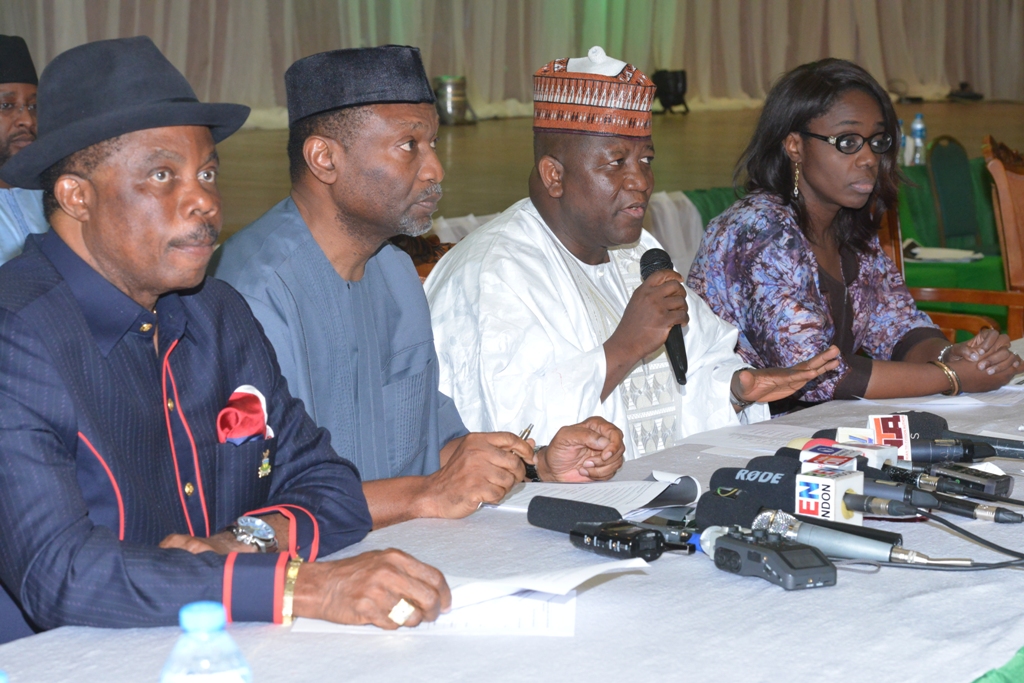
The National Economic Council (NEC), made of the governors of the 36 states of the federation, other national economic stakeholders, rose from a two-day retreat on economy with resolve to work together to tackle the economic challenges facing the nation, part of which was the setting up of targets for self-sufficiency in food production.

The NEC, presided over by Vice President Yemi Osinbajo, at the retreat, also set up two committees: Implementation Monitoring Committee, headed by the minister of state for budget and national planning, Hajiya Zainab Ahmed and the Implementation Steering Committee headed by Vice President Osinbajo.

In a communiqué read to news men shortly after the end of the retreat, the governors of Zamfara state, Abdulaziz Abubakar and Anambra state, Willie Obiano; the ministers of Budget and national planning, Udoma Udo Udoma and Finance, Kemi Adeosun, said that participants have resolved to religiously implement the contents of the resolutions.

Participants said that a national target for self-sufficiency has been set for identified crops that would be monitored.

The nation, by the resolution, is expected to attain self-sufficiency in tomato paste by the end of this year, while by 2018, it should be sufficient in rice production and by 2019, the country should have attained self-sufficiency in wheat.

The communiqué advised the Federal and State Governments to roll out agricultural extension services nationwide and that the Commodity Exchanges should be established for price regulation and avoidance of losses due to lack of markets.

It said that the Abuja Commodity Exchange should be revitalized, adding that the National Agricultural Land Development Authority (NALDA) should be re-established

“Federal Government should develop an Agriculture Implementation plan whereby State Governments are encouraged to identify at least two crops in which they have comparative advantage. States should open up of rural/feeder roads to facilitate transportation of agricultural produce to be supported by the Federal Government

“The Federal and State Governments should establish minimum price guarantee for farm produce. The Federal Government should provide immediate funding to upscale efforts of Agricultural Institutes of Research and Development across Nigeria

“State Governments should also be encouraged to fund research and development in agriculture through technical colleges, universities and research institutions.”

Other highlights of the retreat as they contained in the communiqués are as follows:

  1. Agreement reached for concerted and consistent efforts to diversify revenue sources
  2. Expand compliance on VAT, adopting a gradual plan for rate increase
  3. Increase expenditure through borrowing, which should be invested in infrastructure
  4. Federal and State Governments to focus on fiscal responsibility as a critical element in macro-economic balance
  5. Increase investment  in infrastructure through public private partnership (PPP)

6.Develop financial inclusion strategies to cater for the poor and vulnerable population

  1. Maintain a minimum level of capital expenditure of 30% in the budget

Agriculture

  1. The Federal Government to re-position Bank of Agriculture to enhance its capacity to finance agriculture.
  2. Funding for Agricultural sector is considered critical and sources of intervention funding from the Central Bank of Nigeria should be considered
  3. A single digit interest rate for agricultural loans should be considered while duties and taxes for Agricultural products and equipment should be waived
  4. Develop strategic partnerships between Federal and State government. Each State should make specific commitments to crops in which it has comparative advantage and request Federal Government intervention
  5. National targets for self-sufficiency should be set for identified crops, which should be monitored. Tomato paste – 2016, Rice – 2018, Wheat – 2019
  6. The Federal and State Governments should roll out agricultural extension services nationwide
  7. The Commodity Exchanges should be established for price regulation and avoidance of losses due to lack of markets. The Abuja Commodity Exchange should be revitalised
  8. The National Agricultural Land Development Authority (NALDA) should be re-established
  9. Federal Government should develop an Agriculture Implementation plan whereby State Governments are encouraged to identify at least two crops in which they have comparative advantage
  10. States should open up of rural/feeder roads to facilitate transportation of agricultural produce to be supported by the Federal Government

11.The Federal and State Governments should establish minimum price guarantee for farm produce

12.The Federal Government should provide immediate funding to upscale efforts of Agricultural Institutes of Research and Development across Nigeria

  1. State Governments should also be encouraged to fund research and development in agriculture through technical colleges, universities and research institutions

Solid Minerals

  1. Ministry of Solid Minerals Development to complete and present the solid minerals development roadmap. This framework should address issues of illegal miner, licenses, taxes and royalties by 31stMarch 2016
  2. Federal government to engage with state government on the roadmap and agree any amendment that may be required by 30thJune 2016
  3. Initiate relevant legislative changes that maybe necessitated by the agreed roadmap by 31stJuly 2016
  4. Conclude the revalidation/recertification of all mining leases by 30thSeptember 2016
  5. Agree with states and local government on respective responsibilities for developing feeder roads and other critical infrastructure for solid minerals development
  6. Federal Government and States to set deadlines to achieve self-sufficiency in Bitumen/Asphalt and tiles (to discourage/stop importation)
  7. Make and communicate final decisions on operationalization of Ajaokuta steel plant by 30thJune 2016
  8. Establishment of joint committee to address issues of data on quantity and quality of minerals exploited and exported
  9. Setting up of mining cadastral zonal offices for proximity to States for the purpose of issuing licenses and easy monitoring by States
  10. Discourage use of wood for cooking by promoting use of coal briquettes
  11. Guarantee access to finance solid minerals development via intervention funds and private sector capital
  12. Block revenue leakages in the sector through effective monitoring of activities in the mining sector
  13. Organize artisanal/small-scale miners as a mechanism for reducing illegal mining and Establish Mines Surveillance Taskforce by September 2016

Investment, Industrialization and Enabling Monetary policies

1.Ministry of Industry, Trade & Investment (MITI) to develop a matrix of actions to be taken by Federal and State Governments towards achieving the targeted improvements in Ease of Doing Business ranking by 30th April 2016

  1. Present an incentive scheme for States taking actions towards improvement of the investment climate in their States including  grants by 30thSeptember 2016
  2. Forge strong links between the Nigeria Investment Promotion Commission (NIPC) and the State Investment Promotion Agencies
  3. States to collaborate more actively on regional basis on investments and industrialization
  4. The Federal Government should work with the States and other stakeholders to create an enabling environment for trade and investment through the implementation of the Nigerian Industrial Revolution Plan (NIRP) to encourage industrialization
  5. Make environment conducive for the Micro, Small & Medium Enterprises to create jobs for the unemployed and undertake deliberate policies to create access to funds
  6. State and Federal Governments must emphasize the patronage of “Made in Nigeria” products. “Import competition” rather than “import substitution” should be emphasized
  7. Governors to set up task forces to monitor implementation of trade/ investment policies and strengthen planning institutions by linking federal and sub-national planning; in this regard, a monthly meeting between the Minister of Budget & National Planning and State Commissioners for planning will be institutionalized
  8. States to set up one-stop shop for investors where they do not currently exist to attract investment and improve on IGR Safeguard competitive market economy
  9. Promote regional cooperation on investment and industrialization
  10. Implement institutional and structural reforms as a way of improving the efficacy of monetary policy including greater consultation with the National Economic Council
  11. Predictability and consistency of the Central Bank of Nigeria’s communication to key stakeholders is required to manage expectations
  12. The Central Bank of Nigeria should carry the States along in some of their reforms in areas of SMEs and Agricultural funding initiatives
  13. Long-term development goals should anchor policy decisions
  14. Effective regulation & supervision to improve confidence in the soundness and stability of the banking system

Infrastructure and Services

1.Develop infrastructure delivery plan considering current financial capabilities driven principally by the goal of improvement of the quality of life for the populace

2.Develop financing model for infrastructure projects

  1. Integrate training and job creation components in infrastructure projects
  2. Implement empowerment and entrepreneurship policies to foster inclusive growth

Investing in our people

  1. Federal and State Governments to work collaboratively to ensure sustainability of the school feeding and other social protection programmes
  2. Cooperation from the States’ Ministries of Education and State Universal Basic Education Board (SUBEBs) for the Teacher Corp program
  3. Provide logistics support on the proposed upgrade of 75 existing National Directorate of Employment (NDE) facilities (across the various States) to Empowerment Centers
  4. Cooperation and coordination with the States on their specific job creation efforts
  5. State Government support on identified needs such as infrastructure and/or space for innovation hubs
  6. State Government support for artisan training, scoping and support for existing artisan cultures, use of existing training facilities
  7. Institutionalize a single register as a platform for targeting the authentic poorest and vulnerable for safety net programs; for government, donor agency, organizations or individuals
  8. Creating a delivery mechanism that ensures efficient, consistent timely and direct payments in the remotest parts of the country
  9. Boost productivity and financial inclusion for the poorest and most vulnerable

Revenue Generation and Fiscal Stability

  1. There is need for deliberate effort to generate relevant data on the respective economies of the states and the nation generally in order to drive revenue generation
  2. FIRS and SIRS need to invest in relevant technology to support efforts to improve tax collection
  3. There is a need to develop incentive schemes for federal and state revenue generating agencies
  4. FIRS and SIRS need to actively collaborate on initiatives to improve tax collection, including joint audits of major corporate tax payers
  5. All state governments are encouraged to establish efficiency units to review/enhance the quality of expenditure as well as plug revenue leakages
  6. Focus on property and consumption taxes will help in improving revenues in a fair manner
  7. Tax-payer education should be intensified to expand the tax base and avoid political back-lash from intensifying tax collection
  8. State Government are encouraged to rationalise number of Ministers, Commissioners and Permanent Secretaries
  9. Cost control measures should be identified and implemented on an ongoing basis; in this regard various examples from Nigeria and other countries are recommended

Survival of States and Beyond

  1. Strengthen States Peer Review Mechanism under auspices of the Governors Forum and the National Economic Council (NEC) to promote sharing of good practices between the Federal and States Governments

NEC RETREAT – IMPLEMENTATION STEERING COMMITTEE FORMED:

  • To oversee the work of the implementation committee
  • To provide appropriate steers to the Implementation Monitoring Committee to ensure that the resolutions agreed at the retreat are duly followed up

HE Prof. Yemi Osinbajo

Vice President and Chairman of NEC

Chairman

HE Abdulaziz Y. Abubakar

Chairman, Nigeria Governors Forum and Governor of Zamfara State

Member

HE Adams Oshiomhole

Governor of Edo State

Member

HE Abdulfatah Ahmed

Governor of Kwara State

Member

HE Rauf Aregbesola

Governor of Osun State

Member

HE David Umahi

Governor of Ebonyi State

Member

HE Badaru Abubakar

Governor of Jigawa State

Member

HE Mohammed Abubakar

Governor of Bauchi State

Member

Sen. Udoma Udo Udoma

Hon. Minister of Budget and National Planning

Member

Mrs. Kemi Adeosun

Hon. Minister of Finance

Member

Dr. Okechukwu Enelama

Hon. Minister of Industry, Trade and Investment

Member

Chief Audu Ogbe

Hon. Minister of Agriculture

Member

Dr. Kayode Fayemi

Hon. Minister of Solid Minerals

Member

Mr. Babatunde Fashola

Hon. Minister of Works, Power and Housing

Member

Mrs. Nana F Mede

Permanent Secretary, Ministry of Budget and National Planning

Secretary

NEC RETREAT – IMPLEMENTATION MONITORING COMMITTEE FORMED

  • To follow up the implementation of the resolutions of the retreat
  • To receive steers from the Steering Committee regarding the follow up of the implementation
  • To provide progress reports to the Steering Committee on the implementation

NAME

DESIGNATION 

ROLE

Mrs Zainab S. Ahmed

Hon. Minister of State, Budget and National Planning

Chairman

Mrs Yosola Akinbi

Senior Technical Adviser to the Vice President on the National Economic Council

Member

Mr. L.O.T. Shittu

DG, Nigeria Governors Forum

Member

Mr. David Olofu

Commissioner for Finance and Planning, Benue State

Member

Mr. Mohammed Kauji

Commissioner for Finance and Economic Planning, Borno State

Member

Dr. E.A. Onwiodokif

Comm. for Economic Planning, Akwa Ibom State

Member

Mrs. Aisha M. Bello

Comm. for Budget and Planning, Kano State

Member

Mrs. Aderenle Adesina

Commissioner for Budget and Planning, Ogun State

Member

Mr. Mark Okoye

Special Adviser, Economic Planning and Budget, Anambra State

Member

Mr. Tunde Lawal

Director, Macroeconomic Analysis Department, Fed. Min. BNP

Member

Mr. Kayode Obasa

Director, Economic Growth, FMBNP

Member

Mr. A.B. Saadu

Director, Special Duties

Member. [myad]


Gov. Okowa Draws Buhari’s Attention To Potential Of Ogidigben Gas Project Stabilizing Economy

Okowa of Delta stateGovernor of Delta State, Dr. Ifeanyi Okowa has appealed to President Muhammadu Buhari to expedite action on the proposed $16 billion Gas Revolution Industrial City at Ogidigben to help boost the economy and job creation drive of the government.

The ground breaking ceremony of the project was done by former President Goodluck Jonathan in 2015.

Speaking on the sideline of the just concluded National Economic Council (NEC) retreat, for the 36 states governors and other relevant agencies of government, at the Presidential Villa, Abuja today, Okowa said the project if eventually implemented would be vital to stabilizing the nation’s economic  and contribute to the prosperity of the Nigeria.

The governor, who expressed gratitude to the Federal Government for considering the state for the citing of the multi-billion dollars project said  “I hope that we are able to take advantage of it at the moment” adding that “if we do that, it will create thousands of jobs, there is no doubt about it beyond the fact that it will add a lot to the economy of this country”.

Okowa stated that due to the importance the state government placed on the project, he meet with President Buhari on assumption of office and the current minister of petroleum Dr. Ibe Kachikwu and other relevant organs of government disclosing that “the last I was told was that they were supposed to have a meeting towards the end of February to take decisions as to what next to do, they have not briefed me now how far they have gone”.

The project, which is public sector driven has attracted several multinational companies in the agro-allied, banking, power, oil and gas and maritime sectors.

The Delta State Government, under the arrangement is expected to provide all the land need for the construction of the project while the private sector participants are expected to provide the funding for the effective takeoff of the project.

The Nigeria Export Processing Zone Authority (NEPZA) and the Nigeria Ports Authority (NPA) are expected to play key roles in the project implementation. [myad]


Ebony Governor Angry With Contractors, Says They Abandoned 99 Percent Of Projects

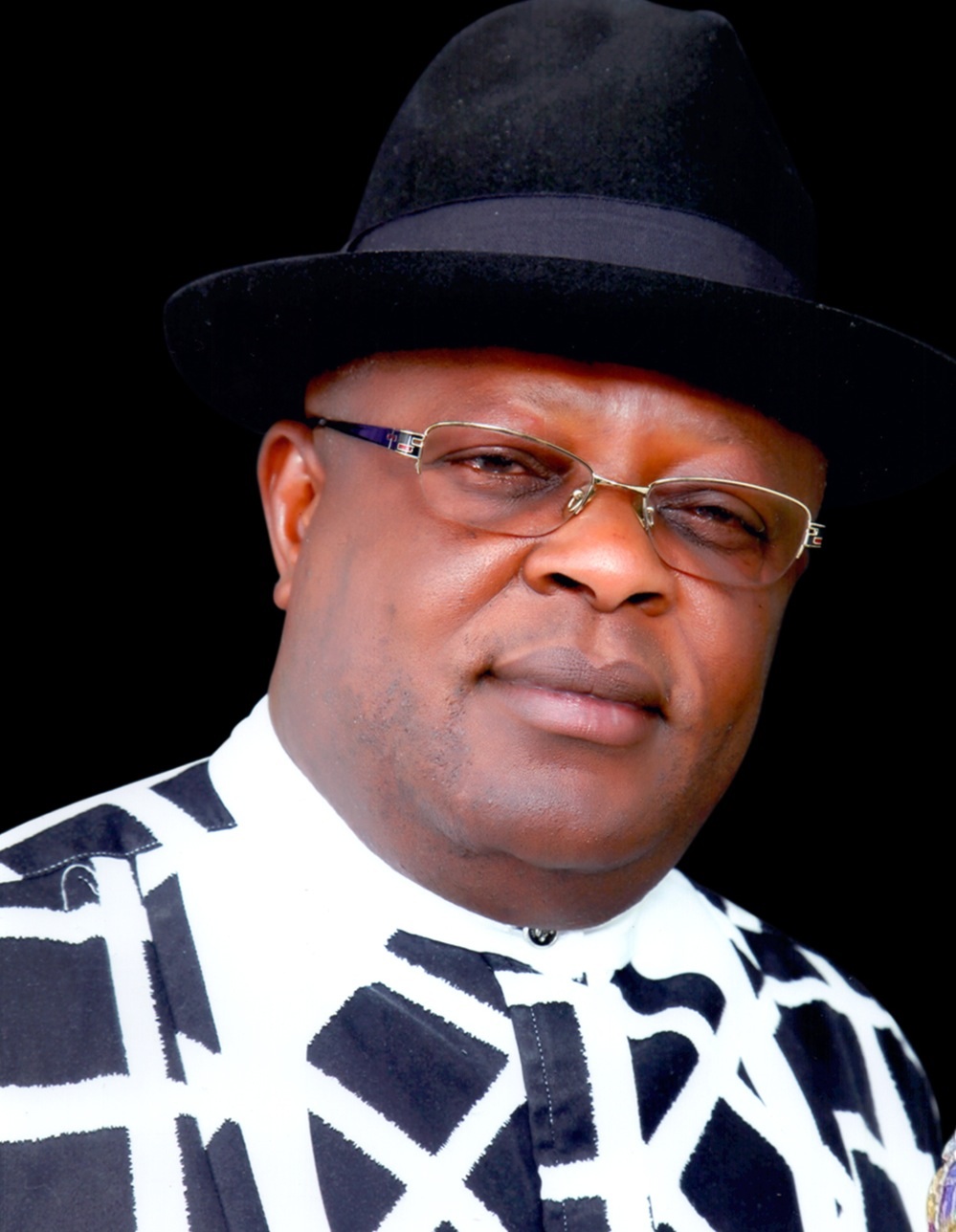
Ebonyi Gov OmahiGovernor David Umahi of Ebonyi State is angry with contractors handling various projects in the state, accusing them of abandoning over 99 percent of the projects after collecting huge sums of money.

He indeed, vowed that he would recover all money paid to such contractors who got almost all the jobs that were offered to them by the immediate past administration.

Umahi spoke while receiving interim report of the Dave Nwachukwu-led Market Development Committee  in Abakaliki on Monday.

According to the governor, the contractors had ignored several invitations for joint measurements with the ministries in charge of their contracts and warned  that the   government would take all necessary steps within the ambits of the law to ensure that they complied.
“A lot of the state fund is in the hands of the contractors. We invited one of the contractors or a number of them to come for   joint measurements but they are not complying and when that is not possible, whatever joint measurement done by the supervising ministry stand.
“And again, certification is cumulative and so we have the right and powers to ask contractors to be on site. I am very shocked that 99  per cent of the projects we inherited from the past administration are not goin on and none of the contractors has  told us why they are not on site. We made efforts to find out but they are not responding.
“So we are going to take steps, if they are not listening to us, they must listen to the Constitution of the Federal Republic of Nigeria and very soon, we will consult   the Constitution to take further steps to ensure that the investments of our state are not allowed to be wasted.
“But one thing is very certain,no man will run away with the fund of Ebonyi State no matter the number of lawyers he assembles to tackle the state.”

Umahi, who lamented that   99% of jobs  he  inherited from the past administration had been abandoned by contractors without reason, said he would use constitutional means to  bring them back to site or recover  the state’s  fund already paid to them.
“But one thing is certain,no man will run away with the fund of Ebonyi State,no matter the number of lawyers assembled   by them  to tackle the state.”

Other reports presented to the governor during the occasion were that of higher education and Ikwo College of Education by their committee chairmen, Professor Chigozie Ogbu and Chief Fidelis Nwankwo.
On  the report of petitions written by some members of  staff of the Ikwo  College of Education against  their Provost,  Prof. Omebe, the governor directed the immediate dis-engagement of the 83  persons illegally recruited as workers.

“Let me say that all the employment that were made without due process should be disengaged immediately,before we visit the institution.

“So they must be disengaged. Due process must be followed before we even look at this(interim) document. And it is in the interest of the Provost that that is done before the end of this week.”

He warned that his administration would   not accept recruitment that did not reflect the geographical spread of the 13 local government areas of the state. [myad]

The Smell Of Trivia, By Garba Shehu

Garba Shehu newA good number of the reactions to President Muhammadu Buhari’s announcement that Nigeria has joined the Islamic Coalition Against Terrorism, show quite clearly that many Nigerians do not fully understand the president’s motives for this decision.  With the rise of the Boko Haram Terrorist group of the past few years, Nigeria faces a threat such as no other in its entire history and existence.  Desperate times require desperate, unusual, measures.

The girls in Gwoza who were raped by militants do not care where the help comes from as far as they will eventually be able to move about freely without fear of being kidnapped and used as sex slaves.  The mothers in Bama whose sons were slaughtered before their eyes do not worry whether Boko Haram is defeated by a Christian or Muslim coalition.  The hundreds of thousands in IDP camps are concerned simply about when they can safely return to their homes and resume their normal lives.  For these ones most hard hit by the Boko Haram terrorists, whether the help they so desperately need comes from the United States of America or from Saudi Arabia does not matter.

One of the main thrusts of President Buhari’s campaign was the war on terror.  He promised that his administration would bring an end to Boko Haram, and set about doing just that as soon as he was elected, travelling to different countries and meeting with various heads of state to discuss the way forward on the issue.  At the time, no Nigerian worried that President Buhari was seeking help from the West.  No one worried about the ideology of those willing and able to help our country to defeat terror.  Nigerians were simply united with their President in a determination to bring Boko Haram to an end so that our brothers and sisters in the northeast can resume their normal lives.

It is on account of these people and their desperate situation, and on the basis of national interest only, that President Buhari accepted the offer, with both hands, of assistance from G7 countries at the commencement of his administration. Religion was not a consideration then. It is also not a consideration now that he has made the decision to embrace help in fighting terror from the Middle-East. The safety of Nigerians and the total annihilation of Boko Haram is of more importance than the unfounded worries of Nigeria’s so-called Islamisation.

Those efforts by President Buhari led to several gains, including the technical defeat of Boko Haram by the end of 2015 as he had promised during the election campaigns.  Once again, our Commander-in-Chief has sought help where he believes our country will benefit and the religious affiliation or ideology of our benefactors should not be the paramount consideration.  It is simply one of those cases where the enemies of our enemy has become our enemy. The enemy of terrorists all around the globe is our friend.

The fears that our country’s membership in this coalition will draw Islamic State, ISIS’s attention to Nigeria are too late.  As the President has repeatedly maintained, it is Boko Haram that proclaimed allegiance to ISIS, thereby dragging us into the global terrorism network. By pledging allegiance to ISIS, the terrorists already drew the international terror group’s attention to this part of the world.  ISIS proudly and openly accepted this proclamation of allegiance.  They have their sights set on us already.

Terrorism is heathen and knows no religion. It can only be defeated by the unity of entire humanity. Criticism of the membership of this alliance only shows our disarray and a lack of unity against terror and will only make the terrorists happy. The fears of so-called Islamisation are strange and unfounded, and meant only to feed the fear and suspicions existing among Nigerians.

With a precedent as shown above, it will be unkind and uncharitable of anyone to accuse President Buhari of executing deception. In an unusually harsh commentary, this country’s most respected newspaper The Punch on Sunday  succeeded in exactly doing this. Read this:

“The presidency’s doublespeak on Nigeria’s membership of the Saudi Arabia-led anti-terror Islamic coalition is unfortunate in the extreme. In the beginning, an aide to the president on media and publicity issued a statement to the effect that the president had declined Nigeria’s membership of the coalition and therefore did not attend its meeting while on a diplomatic visit to Saudi Arabia.

But barely two weeks after, President Muhammadu Buhari himself confirmed Nigeria’s membership of the coalition in an interview with a foreign television station, Al- Jazeera. Buhari, who never tabled such a sensitive matter before the National Assembly, said there are terrorists in Nigeria who have claimed to be Muslims. So, according to the him, “We are part of it because we have got terrorists in Nigeria who claim that they are Islamic. So, if there is an Islamic coalition to fight terrorism, Nigeria will be part of it because we are casualties of Islamic terrorism.

“This explanation is simplistic, to say the least and does not do any good to expected political astuteness of President Buhari. In the main, membership of any such coalition is unacceptable for it offends the sensibilities of Nigerians in their diverse inclinations and should be reversed.”

Sensibilities offended? Can anyone face the more than two million unhoused, mostly Muslim refugees displaced by terror now being fed, almost exclusively by Christian charities that it is offensive them, or that it matters to them who, between Christians and Muslims is supplying the next meal? The one who raised a tent over their heads?

Let me say that the presidential aide in question is no other than myself. Although I write statements emanating from the Presidency, I don’t choose what headline writers will use to caption those stories.

To that extent, it is untrue of anyone to say the President had ab initio rejected a membership of the coalition against terror.

What the President said, to paraphrase him, was that “we may not be with you, but we will support you in every possible way we can.” This does not presuppose rejection. Even if it was one, nothing says that a government cannot move or adjust its position based on new, superior facts as we individuals do in our daily lives.

That some of the criticism against the President is coming from opposition Senators is even more absurd, showing a  lack of judgement and discrimination- or even worse.

It holds up a mirror to the PDP’s cluelessness and total absence of strategy to defeat Boko Haram terrorism. The party’s projection of itself as better than the APC in this regard is hobbled by their own record of indecision and serial abdication on Chibok girls as disclosed by Ambassador Packock and greed, corruption and a general incapacity to drive the anti terror war.

A set of politicians who failed to confront or attack terrorism while in power have no right to challenge President Buhari’s hounding of them. To global acclaim. Trivia smells. There is a need for a new fragrance in the air.

Garba Shehu is Senior Special Assitant to the President onMedia and Publicity. [myad]

2016 Federal Budget May Be Ready Early Next Week, As It’s Been Laid Before Senate

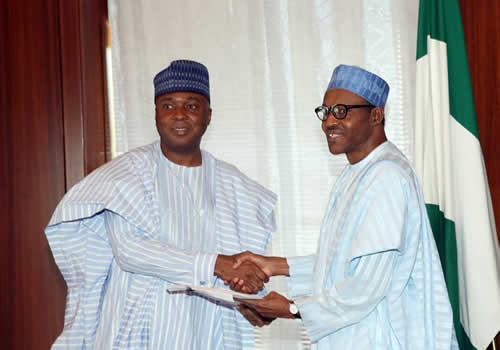
Senate President, Bukola Saraki and President Muhammad Buhari

There are indications that the long awaited federal government budget might be ready for the Presidential assent early next week.

This followed the report on the budget which was laid today before the Senate by the chairman of the  Committee on Appropriation, Senator Danjuma Goje.
Laying the report, Senator Danjuma Goje, said that the unnecessary controversies on the budget have come to an.
After the laying of the report, the Senate adjourned the plenary session in honour of Hon.‎ Musa Baba Onwana, the lawmaker representing Nasarawa/Toto Federal Constituency of Nasarawa State, who died last week‎. [myad]

Debt Service To Revenue Ratios: Matters Arising, By Collins Nweze

DMO Boss Abraham

Nigeria expects to spend 35.32 per cent of its revenues servicing debt this year, up from 28.1 per cent for both federal and state governments in 2015, the Debt Management Office (DMO) has said.

The two-year debt service ratios released by the debt office showed that of the N6.32 trillion combined revenues for state and federal governments in 2015, only 28.1 per cent went to debt service in 2015. However, the figure will rise marginally to 35.32 per cent of the N3.85 trillion revenue for the Federal Government alone, this year.

These figures by the debt office have put to rest claims by the Islamic Development Bank (IDB) that the country spends about 80 per cent of its revenue to service debt.

The IDB Country Representative in Nigeria, Mumammed Kiliaki, ranked Nigeria among the countries using the largest percentage of its revenue to service foreign debts. He declared that Nigeria spent 80 per cent of her revenue on debt servicing.

Kiliaki, who spoke during an interaction with Senate Committee on Local and Foreign Debts, headed by Senator Shehu Sani, said the development was responsible for the bleeding of the economy.

He said though Nigeria’s debts to Gross Domestic Product (GDP) ratio is low at 17 per cent, adding that the resources being used to pay the debts were enormous. He said for Nigeria not to get itself suffocated by such huge debt servicing profile, there was the urgent need for the country to expand the scope of its resources through diversification of the economy.

Nigeria’s total debt increased to N12.60 trillion ($65.42 billion) as of December 2015, up from N11.2 trillion in 2014, the DMO announced. In a statement on its website, the DMO said foreign bonds and loans stood at $10.7 billion or N2.1 trillion at the end of December, equivalent to about 16 per cent of total debt and up from $9.71 billion at the end of 2014.

It also disclosed that domestic debt rose to N8.83 trillion last year, up from N7.9 trillion in 2014. DMO added that domestic debt of states stood at N1.65 trillion or $9.85 billion. The DMO’s statement comes on the heels of announcement by the African Development Bank (AfDB) that Nigeria had requested for a loan of $1 billion to help fund its budget deficit for 2016 fiscal year.

The Federal Government has said it is planning to borrow as much as $5 billion to help fund the expected deficit of N3 trillion in 2016, which is up from an initial N2.2 trillion estimate.

Minister of Finance, Mrs. Kemi Adeosun, disclosed that Nigeria held talks with the World Bank and was considering options to borrow from the AfDB and China Exim Bank.

Adeosun said about $4 billion might come from international institutions and the balance from Eurobonds.

In December, President Muhammadu Buhari presented a N6.08 trillion budget for the year to the National Assembly, an increase from N4.4 trillion for 2015, which the government hopes will help tackle an economic crisis triggered by the plunge in oil prices.

However, the DMO Director-General, Dr. Abraham Nwankwo, insisted that the country’s public debt-to-GDP remained sustainable despite the slump in crude oil prices. According to him, while other countries base their borrowing on debt- GDP ratio of 56 per cent, Nigeria will not exceed 19.39 per cent until 2017.

He said: “Our debt continues to be sustainable, despite all these volatilities in the international capital market and the collapse of oil prices. However, it does not mean that Nigeria should go and sleep, and hope that providence will continue to provide for them.”

He noted that the country has abundant resources in agriculture, solid minerals, Information Communications Technology (ICT), among others, that offer ample opportunity for diversification of the economy to boost revenue.

It will be recalled that during her visit to the country last month, the Managing Director of the International Monetary Fund (IMF), Christine Lagarde, said given the determination and resilience so far displayed by Buhari and his team, Nigeria does not need any loan from the Fund.

She stated that though Nigeria did not need IMF loan, fiscal discipline was needed for the country to be sustainable.

Data from the DMO showed that the total external debt service payment for the year 2004 was $1.75 billion compared to $1.81 billion in 2003, reflecting a decrease of $0.054 billion or 3.01 per cent. The external debt service payments of $1.75 billion comprised of principal repayments of $1.17 billion, and interest payments and commitment charges of $0.589 billion.

Payments to the Paris Club creditors took the lion’s share amounting to $0.994 billion or 56.67 per cent. $0.487 billion or 27.77 per cent was paid to multilateral institutions, $0.090 billion or 5.14 per cent to London Club, $0.171 billion or 9.76 per cent to the Promissory Note holders and $0.012 billion or 0.66 per cent to non-Paris Club Bilateral creditors.

“The $1.75 billion debt service paid in 2004 is actually well below the debt service due for the year of $2.99 billion. This arises from the fact that Nigeria has not fully serviced its Paris Club debts, as an amount of $2.23 billion was due while only $0.99 billion was paid. The shortfall transforms into arrears and attracts severe penalty interest. This very process has contributed to the explosion in Nigeria’s external debt stock over the years,” the debt office said.

A report by FBN Quest, an investment and research firm, said the DMO’s monthly auction of FGN bonds last Wednesday raised its target of N100 billion from the sale of three issues including a new 20-year benchmark. The total bid of N262 billion was highest since July 2014 when the DMO launched a new long bond.

The firm explained that the figure was no coincidence since the Pension Fund Administrators (PFAs) have a healthy appetite for long-term assets to match their liabilities. The prevailing abundance of liquidity, it said, would equally have fuelled demand. The DMO can also be pleased with the downward monthly trend in marginal rates.

The cut-off point of 12.40 per cent for the new March 2036 compares with that of 12.15 per cent for the previous benchmark (the July 2034).

The FBN Quest explained that since inflation has picked up by three percentage points in the intervening period and since offshore interest has evaporated, the DMO should be pleased with the new effective coupon on the instrument.

It demanded that the 2016 budget should be approved well before the next auction, which would give the DMO a better platform for its issuance calendar for June, this year. The Federal Government’s budget proposals project net domestic issuance this year of N950 billion. The onus falls upon the DMO since the CBN’s sale of treasury bills is likely to remain flat.

In 2004, the DMO made plans to build on the success of the first FGN Bonds floatation that were first issued in 2003. The DMO embarked on the arrangements to commence the issuance of bonds on a regular basis in small tranches that the market could accommodate.

The DMO commenced the smoothening and restructuring of the Treasury Bills in 2004. The restructuring entailed extending the maturities of the existing Treasury Bills by issuing tenors of six, 12, 24, and 36 months, to refinance part of the existing 91-day Treasury Bills.

The Nigerian Bond market remained undeveloped, particularly the secondary market for government securities and the DMO put in place a framework for the development of a vibrant secondary market.

The DMO was established on October 4, 2000 to centrally co-ordinate the management of Nigeria’s debt, which was hitherto being done by a myriad of establishments in an unco-ordinated fashion. This diffused debt management strategy led to inefficiencies.

It was expected that the coming of DMO would lead to good debt management practices that make positive impact on economic growth and national development, particularly in reducing debt stock and cost of public debt servicing in a manner that saves resources for investment in poverty reduction programmes.

The body is also expected to prudently raise financing to fund government deficits at affordable costs and manageable risks in the medium and long term; achieve positive impact on overall macro-economic management, including monetary and fiscal policies; avoid debt crisis and achieving an orderly growth and development of the national economy.

Lagos IGR example

CBN data for 2014 revealed that internally generated revenue (IGR) provided 21.8 per cent of the total revenue of the 36 states and the Federal Capital Territory, compared with 15.3 per cent the previous year.

Aggregate IGR grew by 37 per cent to N801 billion from N586 billion in 2013. Again, Lagos emerged as the leading state achieving an IGR/total revenue ratio of 67 per cent while Ogun, Rivers and Anambra managed 40 per cent, 32 per cent and 31 per cent respectively.

The report said given that the oil price has been on the slide since mid-2014, states have no choice but to reduce their dependence on the oil-driven monthly distributions from the Federation Account Allocation Committee (FAAC) by bolstering their IGR.

Collins Nweze is with The Nation newspaper. [myad]


Terror Attacks: Nigeria Stands In Solidarity With Belgium’s Day Of Pain, Trauma – Buhari

Belgium terror attacksPresident Muhammadu Buhari has assured the leadership of Belgium that Nigeria stands in solidarity with that country in its hours of pains and trauma, following the terror attacks at the Brussels airport and the Metro today, during which about 34 people died and 105 sustained various degrees of injuries.

In a statement by the special adviser to the President on media and publicity, Femi Adesina, Buhari condemned what he called the atrocious terrorist attacks on the Zaventem Airport and Maalbeek Metro Station in Brussels earlier today.

The President sympathized with Prime Minister Charles Michel and Belgians over the loss of lives and other national valuables even as he assured the Prime Minister and the people of Belgium that having suffered the horror and anguish of incessant terrorist attacks over several years, Nigeria stands in full solidarity with them on this day of national pain and trauma.

“President Buhari believes that the appalling attack on Brussels reinforces the need  for greater international cooperation to effectively confront and destroy global terrorism and its perpetrators.

“The President assures the global community that under his leadership, Nigeria will continue to work with other countries of the world to ensure that terrorism  never triumphs over free, peaceful and law-abiding nations and people of the world.”

Meanwhile, the Islamic State (ISIS) has claimed responsibility for brutal attacks that brought blood and chaos to this capital city’s airport and downtown metro stop today, killing dozens of people, wounding many others even as a manhunt was underway for at least one suspected surviving attacker.

Belgium’s federal prosecutor said two deadly explosions tore through the departures hall at Brussels Airport in nearby Zaventem. A short time later, a third blast brought mayhem and death to the Maelbeek metro station, near European Union institutions in central Brussels, prosecutor Frederic Van Leeuw said.

“We were fearing terrorist attacks and that has now happened,” Belgian Prime Minister Charles Michel said.

Federal health officials said the airport attack killed at least 11 people and injured 81. Brussels Mayor Yvan Majeur put the subway death toll at 20, with more than 100 wounded there. Belgian public broadcaster RTBF reported a total of 34 dead, but that number could not be immediately verified.

The Islamic State claimed responsibility for the attacks in a statement to the Amaq news agency.

“Islamic State fighters opened fire inside Zaventem airport before several of them detonated their explosive belts,” the statement said. A “martyrdom bomber detonated his explosive belt in the Maelbeek metro station,” it added.

The attack came four days after the arrest of Salah Abdelslam, a suspect in November’s Paris attacks who was apprehended in Brussels after a four-month manhunt. After the arrest, authorities said Abdeslam had been planning another attack, and had a large network of associates. Still, authorities said it was too soon in the investigation to tie Wednesday’s horror to the Paris terror strike.

Belgium raised the terror threat to its maximum level as security teams swept neighborhoods for collaborators. The prosecutor’s office released a photo taken from an airport security camera showing possible suspects before the blasts, and a manhunt was underway for one of them.

An explosive device containing nails, “chemical products” and an Islamic State flag were found during a house search in the Brussels neighborhood of Shaerbeek, the Associated Press reported.

Public transportation was shut down, the airport closed and residents were warned to stay home for hours. Non-essential staff were evacuated from Belgium’s power plants in Doel and Tihange as a precaution, the plants’ French operator, Engie, told Reuters news service.

By late Tuesday, some trains stations were reopening to long lines as people began emerging from their homes. Authorities said the airport would remain closed through Wednesday.

President Obama, speaking in Havana on the third day of a Latin American tour, said the U.S stands with Belgium and that the attack is “yet another reminder that the world must unite, we must be together regardless of nationality or race or faith, in fighting against the scourge of terrorism.”

Authorities in Los Angeles, New York, Washington, Boston and elsewhere across the nation tightened security at transit hubs and tourist sites. There were no indications of specific threats against U.S. targets, authorities said. [myad]

Rivers: When 2 Captains In Same Ship Sail In Opposite Directions, By Israel Ebije

Ebije IsraelThe bestiality, foolery, buffoonery that has characterized the actions of Governor Nyesom Wike and Minister of Transport, Rotimi Chibuike Amaechi in the Rivers State re-run is simply a contest of ego measurement. The womb of destruction in that state is therefore a function of the delusionary objectives of the two gladiators, which sadly is not people based but selfish, vindictive and asinine.
As usual, the human collateral damage cannot be avoided. The slow but growing turnover of human lives for“mere” re-run only shows how desperate politicians can be and how gullible some electorates can go on errands for their paymasters. While the innocent or sometime apolitical victims are taken in their prime, followers of these two ego-measuring gladiators must realize that they are the puns in some macabre political chess game.
Interestingly, this is the first time in the past 17 years Rivers State will be divided along party lines. The state has always been a one party state with uniformity of votes once candidates are selected by an established godfather. It is even believed that despite the irregularities, human carnage that has marred elections in the state since 2015 general election to the re-run, it is adjudged the best when measured against actual votes cast and the decision of the people to ensure that their votes are counted.
Nigerians however have conflicting views in the Rivers debacle. Some blame it on Buhari, some on the ruling party the All Progressives Congress, some on one or all the gladiators, some on the Independent National Electoral Commission, some on the Peoples Democratic Party. While every Nigerian has the right to place blames wherever, it is important to exclude the president out of the entire fiasco if the crisis in Rivers state must avoid the trappings of wailing, wailers and hailing, hailers.
What makes the battle ground in Rivers state a deadly razor edge dance is the quantum of firearms, propensity to spill blood and level of competence of the two gladiators in manipulating results during elections. We must not for one second forget that Amaechi and Wike have student, lecturer relationship from an institution established on impunity. Their core subject is political brigandage, criminal rascality with electives in killing, maiming and arson.
INEC has played it well in the volatile elections in Rivers State. Declaring results of some areas inconclusive was indeed in the best interest of all. Reading the results as they came in was indeed bravery of the highest order. INEC has refused to shift result in favor of a political party of their choice, hence allowing all the stakeholders to slog it out in supplementary. In the not too distant past, the PDP government would have done differently.
Nobody is calling on the ruling party to awaken the monster of denying Nigerians their votes, and that is the reason why those chiding INEC must see the good in each instance elections are declared inconclusive. After all, INEC isn’t responsible for the unnecessary violence that usually characterizes the “do-or-die” election mantra of Nigerian politicians.
For Amaechi and Wike, this election is indeed worth dying for. As earlier mentioned, ego is a prime motivating factor. But protection of political interest is also another factor. For Amaechi, getting all the NASS members on his leash will help diminish the political influence and sometime affluence of the incumbent governor. For Wike, he has to protect his territory. He must prevent a single APC politician from getting to the coveted legislative position. he is aware of the repercussion once his party the PDP loses out of the on going saber-rattling.
With the “looming” supplementary, there is no telling what would happen to the hapless Rivers people and the hired political thugs. With the amount of weapons in the hands of the wrong people in that state, it is indeed expected that supplementary for eight (8) local governments might be the match that would ignite cyclical killings in that state. The worst violence is that which exists between people in a defined social political environment. They know themselves and can predict themselves, hence guerrilla attacks, kidnappings will become a trend.
Buhari might just be the solution to the dance of desperation going on between Amaechi and Wike. Once the two gladiators are charged with liability of any unruly conduct along party lines, they will adjust a bit. For now, they act like untamed horses charging in different directions trying to claim political territory with human lives as bargaining chip.
A clarion call goes to youths of Rivers states, nah, Nigeria youths. It is time Nigerian youths understand that they are not mere tools in the hands of politicians. It is time they realize they are future of Nigeria’s human capital. Their paymasters have rubbed them of education, denied them of social amenities, only to present them with stipends barely enough to buy them more than a meal.
It is time for Nigerian youths to understand that while they fight for their self-based political masters, children of these prebendal politicians are taking up juicy jobs, groomed to take over from their parents. While the circle for the politicians is an emerging monarchical democracy where fathers bequeath the political assets to their children and children, children, the thugs used for violence are programmed as expendables and their children left in despondency only to toe the lines of their fathers.
The carnage in Rivers state must stop. Humanity has stooped like a beast devouring every ounce of civility. Nigeria has transcended beyond this type of politicking. Humanity is far more superior to bestiality. While every other factor is consistent with the high rate of madness in that place, this is the time we must stand up against politics of violence, politics of bitterness.
. Ebije can be reached via: ebijeo5@gmail.com or @ebijeisrael.com. [myad]


Advertisement ADVERTORIAL
WP2Social Auto Publish Powered By : XYZScripts.com