There is today in Nigeria an entire generation of Nigerian-passport wielding men and women who do not actually know, to borrow Achebe’s words that indeed “there was once a country”. These children born in a season of austerity, and raised during the years that the locusts ate, have become angry citizens. They are angry because they live in a country that makes them feel less worthy than the human standard. The only Nigeria that they know is a country that makes them feel ashamed of their own origins. Many of them have enjoyed the privilege of foreign education and exposure to some of the best traditions in other parts of the world, but when they return to their own country, right from the airport, the snow of failure and inefficiency strikes them in the face, leaving them with no option but to wonder quo vadis Nigeria? It is the same question that their parents asked and the tragedy is that their own children except something else happens, are likely to ask exactly this same old and vexed question.
The angst of this young generation is made worse when they are told that Nigeria was not always like this. In their late 20s to thirties, these children have only known that Nigeria where fuel scarcity is a fact of daily life, and part of the mechanism of survival is to know how to draw fuel with your mouth, or negotiate black market purchase of fuel, while lugging jerry cans, either at the fuel station or a roadside corner where you cannot be sure of the quality of fuel- all of that in a country that is the world’s sixth largest producer of crude oil. These children have only known a country where the roads are bad, services are sub-standard, people are mean, criminality is rife, and electricity is available once in a blue moon.
What they know is a country where the pastors and malams are better known for lying, swearing, cheating, calling the name of God in vain. In their Nigeria, public and private officials are lazy, and unproductive, they just want to reap, and they have sucked the country so dry, her glands are wasted, flat, going South and no more presentable, the balloon has suffered a blow out, even the blind can see that this is so. These angry children are no longer proud of the green passport; because the Constitution allows dual citizenship, they’d rather grab the citizenship of another country, and remain linked to Nigeria only by blood, and that is the case because they have parents who would not want them to de-link completely, but if they don’t, their own children and their own children after them, are already being lost to countries where things work, where the basic necessities of life are taken for granted and where the future is not a distant, unknown, and impossible destination.
The anger and the nonchalance of this generation of Nigerians is the pain and the agony of an older generation that knew a different country before all things went kaput and Nigeria became a byword for the unhinged, the dark, the ugly and the regrettable. Our generation and the generation before us knew a different country. And because that is so, memory is an affliction, a source of torment, nostalgia and regret, more so as that distant past now seems so unattainable not because distance often makes the past look better, but because in Nigeria, the past is sorrily idyllic. Those who lived in that other country and are still alive could not have forgotten so soon, because to forget something that important is to self-deny, it is to pretend, it is to abuse, it is in all, an act of pitiable abnegation.
How could we have forgotten? How can anyone possibly forget? That this was once a country where Nigerians felt at home in virtually any part of the country. Igbos lived peacefully in the North, and Fulani herdsmen were at peace with other Nigerians, and there was no issue with the planting of yams or the grazing of cattle. In this same country, Southerners lived for decades in the North, acquired property and spoke the language of their hosts. We grew up knowing Baba Kaduna, Daddy Kano, Mama Kafanchan, Uncle Porta, just as persons from the East and the South South contested for elective positions in the West and won. There was a civil war yes, and things began to change but even after the war, it was never this bad. Nigerians from the South still went on national assignment in the North, Christians and Muslims tried to live together in peace, but today, things have fallen apart.
There is no open civil war, but this country is at war on all fronts, the worst fronts being the ethnic, the religious and the political, and these post-civil war children just can’t understand why the generations of their fathers and grandmothers can’t run an efficient country. They have been taught in school that every nation has problems, but leadership is about managing those problems and building a happy nation. They hear about the big names of Nigerian history, the statesmen who fought for independence, the Amazons who defended the place of women in national decision making processes, the accomplished scientists, the literati and cultural workers, but the historical figures who have made the biggest impression on them are the ones who ruined the nation with their acts of omission and commission.
In this same country, the Naira used to be at par with the pound and was for many years stronger than the dollar. So strong was the Naira that many Nigerians, including the lower middle class could afford to travel to London on Friday evening, attend a party in London on Saturday, attend church service on Sunday, check out one or two mistresses in paid-for flats in different parts of London, and return to Nigeria early enough on Monday morning to be able to go to work. All that was no big deal. Everyone in London knew the Nigerians. They were the biggest spenders and they threw the best parties. There was Nigeria Airways; owned and operated by the Nigerian government and it was one of the best airlines in Africa. Its pilots were rated among the best in the world. Its safety record was superb. And it was affordable. It was the pride of the nation. Within the country, Nigeria Airways was also efficient. A trip from Lagos to Calabar in those days was just N44! Students enjoyed rebates too.
In this same country, once upon a time, public transportation was impressive. In Lagos for example, the public transportation system was almost exactly a version of what they have in London. This may sound like something being made up to the younger generation, but it is nothing but the truth. The railway system worked too, and one of the most prestigious jobs was to be a railway staff. That same Nigerian Railway Corporation that is now a parody of its former self, used to link up the entire country and it helped to build cities and villages, as the various major train stations became commercial centres. Today, railway transportation looks like something we are trying to reinvent.
Once upon a time in this same country, those who sent their children abroad did so majorly out of choice, not necessity, because Nigerian schools were among the best in the continent and the world. Teachers from different parts of the world, the best and the brightest, sought employment in Nigerian schools. The Naira was strong, investors -both commercial and intellectual – trooped to this country in droves and they enriched us in many ways. The schools were well-equipped; they attracted students and teachers based on their reputation.
Parents sent their own children to their alma mater out of loyalty, and regard for tradition. That pattern of grandfather, father and son attending the same secondary school seems to have ended; the public schools in Nigeria have failed, the missionary schools of old have been destroyed by hostile government take-over, back in the hands of the missions, the destruction is yet to be fully corrected. The younger generation reflects on all this: mostly products of private schools, they can’t understand why a country that still prides itself as the giant of Africa cannot run a decent education system or provide jobs for the products of its school system.
In this same county, we used to have industrial estates. In Lagos, Apapa, Ikeja and Isolo were industrial estates. In Kaduna, Jos, and Enugu, manufacturing companies created jobs and wealth. We had uncles and aunties who used to do shifts in many factories and this country produced things: from refrigerators to bulbs to vehicles to metals to books, to textiles to shoes. Sad: many of those factories have become churches! In those days, if you went into a bookshop, you could not miss the mint-fresh smell of the books on display. I miss that smell. There are fewer bookstores today and the books no longer smell the same, because by the time they are imported and passed through dirty containers and the hands of thieving handlers, the books lose their soul.
Once upon a time in this same country, there was so much hope about tomorrow. Salaries were paid as and when due. State governments offered students bursaries and scholarships. School was attractive because the teachers were dedicated and they were smart. At the university level, the government provided subsidized tuition and feeding; the rooms were kept clean by staff, the libraries were well-stocked; there was light and water and town-gown relationship was just fine. In the larger society, the present regime of no water, no fuel, no electricity was unheard of. You may have heard of the British standard, there was in fact at a time, the Nigerian standard, and this was the standard that other Africans looked up to. This same country dominated the continent, morally, intellectually and culturally. Financially too: so rich was Nigeria that a former Head of State reportedly boasted that our problem was not money but how to spend it!
But, sorry, we lost it all. And the rains began to beat us. The victims are the younger ones who have not known any other country but this new one. The danger is: they may never know how to make a difference when they inherit this poisoned chalice called Nigeria. [myad]
President Muhammadu Buhari has said that Chief Felix Ibru, the the first civilian governor of Delta State, who died yesterday loved a fulfilled life, even as he takes off to Malabo tomorrow to talk on security matters along the Gulf of Guinea. A separate statements by special adviser to the President on media and publicity, Femi Adesina quoted the President as expressing shock and sadness over the death of Chief Felix Ibru. “President Buhari urges all who mourn Chief Ibru to take solace in the awareness of his very fulfilled life of great accomplishments and give thanks to God Almighty for the indelible legacies which the late governor has left behind for his heirs and successors to build on.” He remembered late Ibru as a leader of many communities, including the Urhobo Progressive Union as its President-General for many years. The President said that he joined Ibru family, the people of Delta State and Chief Ibru’s friends and associates across Nigeria to mourn “the late governor and distinguished senator who made remarkable contributions to the progress and development of Nigeria during his long career as an illustrious architect, businessman, politician, community leader and philanthropist.” He prayed tto God to receive Chief Ibru’s soul and grant him eternal rest. This is even as President Buhari is scheduled to engage in talks with President Obiang Nguema Mbasogo of Equatorial Guinea on further measures to protect the people and resources of the Niger Delta and Gulf of Guinea. The visit to Malabo, by President Buhari is essentially the continuation of the efforts of the Nigerian government to achieve greater security of lives, resources and investments in all parts of Nigeria and its sub-region. The conclusion and signing of an agreement by Nigeria and Equatorial Guinea for the establishment of a combined maritime policing and security patrol committee on Tuesday is expected to be the major outcome of President Buhari’s talks with his host. President Buhari and President Mbasogo are also expected to discuss and agree on other collaborative measures to combat crimes such as piracy, crude oil theft, attacks on oil rigs, arms smuggling and human trafficking in the Gulf of Guinea. Both leaders will also confer on the rescheduling of the joint summit of the Economic Community of West African States and the Economic Community of Central African States on additional cooperative measures to curb terrorism and violent extremism in West and Central Africa. The summit was to have been hosted by Equatorial Guinea last year but was postponed because of Nigeria’s general elections. In accordance with the main focus and agenda of the trip, President Buhari will be accompanied by the Minister of Defence, retired Brigadier General Mansur Dan-Ali, the National Security Adviser, retired Major General Babagana Monguno and other senior security officials. He is scheduled to return to Abuja on Tuesday. Meanwhile, President Buhari has sent a congratulatory message to the National President of the Pentecostal Fellowship of Nigeria and General Superintendent of the Gospel Light International Ministries, Rev. Dr. Felix Omobude, on the occasion of his 70th birthday anniversary coming up tomorrow, March 14. Buhari acknowledged the vision, charisma and strength of character which have seen Dr. Omobude dutifully fulfilling his pastoral calling over the years, as demonstrated in his love for a united and prosperous Nigeria. The President also commended his invaluable contribution to nation building and development through his teachings and exemplary leadership, which continue to inspire many of his followers and admirers to work hard and improve their communities. Buhari used the opportunity of the celebration of this important milestone in Dr. Omobude’s extraordinary achievements to remind religious leaders and all those in positions of public trust of their shared responsibility in the fight against corruption and other ills confronting the society. The President prayed that Omobude will enjoy more years of health and fulfillment in his service to God and humanity. [myad]
Former governor of Rivers State and current minister of Transportation, Rotimi Chibuike Amaechi opened fire on his predecessor, Governor Nyeson Wike, saying that he is so desperate that he could sell his mother for money.
Speaking in an interview on a radio station in Rivers, which was tweeted live via Rivers State watch, Amaechi said that he is ready for Wike in the rerun national and state assembly election on March 19.
“Nyesom Wike is here to steal money; he was my chief of staff. We will chase Wike’s boys out of the water, now we have Dakuku Peterside as DG NIMASA. People still want me back as governor. I will be here till the March 19 re-run election; let’s see what Wike can do. Let’s face it man to man.
“If you see the money stolen by Nyesom Wike in the ministry of education, you will be shocked. Every day you wake up to find out that Wike has killed somebody. Wike has collected N50 billion; what has it done with the money?”
“By this time when I was sworn in, I was already commissioning projects. Wike is so desperate that he can sell his mother. On the day of the re-run, I am ready for Wike, they should come out with their guns, we are ready for them.” [myad]
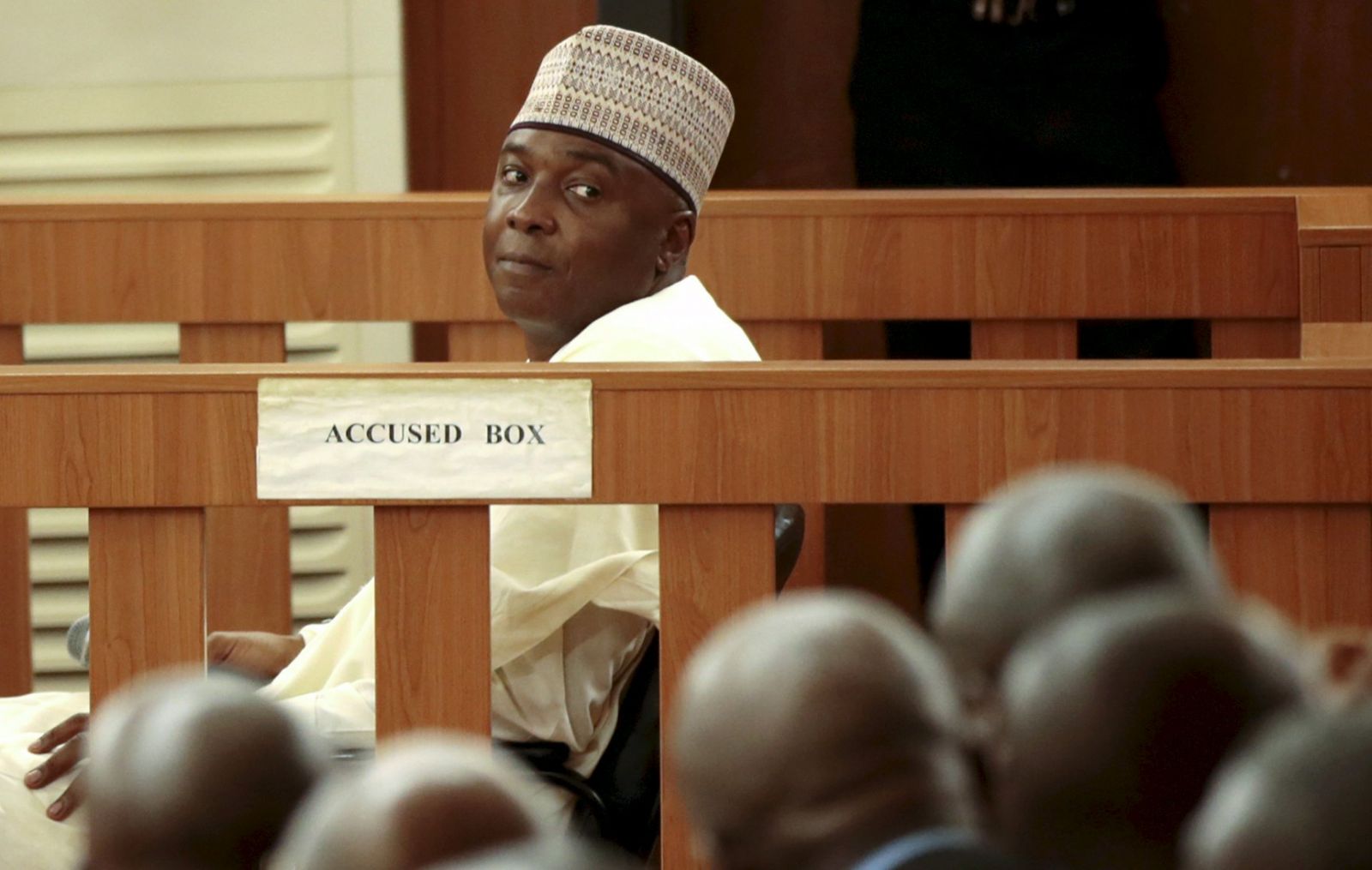
The Senate President, Dr. Bukola Saraki has argued that the charges against him by the Code of Conduct Bureau at the Code of Conduct Tribunal are not in the interest of justice, but politically motivated. He said, in a fresh move to halt the trial, that the charges were filed in violation of due process as well as his right to fair hearing. He said that the charges could not be valid since they were filed in the name of the Attorney-General of the Federation even as he complained that he was denied fair hearing as neither the CCB nor the Attorney-General of the Federation confronted him with any infraction in the four assets declaration forms. He argued that he declared his assets first on assuming office as Governor of Kwara State in 2003 and on completing his term in 2011 and that he subsequently made another asset declaration and submitted the form to the CCB upon his reelection in 2007 and on ending his second term in 2011. He said that had he been informed of any inconsistencies in his asset declaration forms, he would have corrected them. “I am not aware of any petitions challenging my declarations, and the bureau (CCB) has never drawn my attention to any. I would promptly have corrected or explained (the reason for) any alleged discrepancies or inconsistencies in my asset declaration had my attention been drawn to them.” Senator Saraki prays in the application for an “order quashing and/or striking out the charges contained in Charge No: CCT/ABJ/01/2015 by the complainant/respondent against the applicant. “An order pursuant to Paragraph 1 above, discharging the defendant/applicant herein.” In an affidavit, which he personally deposed to in support of his fresh application seeking the quashing of the charges against him at the CCT and discharging him of the alleged offences, the Senate President said: “the facts relating to these matters are no longer fresh in my memory quite apart from the fact that I have lost many of my records pertaining to them.” Saraki’s fresh application, which was dated and filed on March 4, 2016, seeks to halt his trial that had been validated by the Supreme Court through its judgement delivered on February 5, 2016. He was arraigned on 13 counts of false asset declaration before the CCT on September 22, 2015. A seven-man panel of the Supreme Court, led by the Chief Justice of Nigeria, Justice Mahmud Mohammed, had in its judgement, dismissed Saraki’s objection to his trial. The apex court, in the said judgement, affirmed the competence of the 13 counts filed against him and the jurisdiction of the tribunal to hear the case. In the charges instituted by the Federal Government, Saraki was accused of making false asset declaration in his forms submitted to the Code of Conduct Bureau on assuming office and leaving during his two terms as Governor of Kwara State between 2003 and 2011. The Senate President, who was said to have submitted four asset declaration forms, allegedly “corruptly acquired many properties while in office as Governor of Kwara State, but failed to declare some of them in the said forms earlier filled and submitted.” He also allegedly made an anticipatory declaration of assets upon his assumption of office as governor, which he later acquired. Saraki was also accused of sending money abroad for the purchase of property in London and maintaining an account outside Nigeria while serving as governor. Meanwhile, his new lead counsel, Kanu Agabi (SAN), who led five other Senior Advocates of Nigeria and about 60 other lawyers, is also challenging the jurisdiction of the tribunal to entertain the case against his client. The lead prosecuting counsel, Mr. Rotimi Jacobs (SAN) has however described the motion as “a deliberate attempt to stop the trial from going on. “The defendant (Saraki) keeps saying that there is no case against him and that he is being persecuted; why doesn’t he let the trial start so that the whole world can see the persecution?” [myad]
Islamic Development Bank (IDB) is worried that out of 50 nations of the world experiencing fragile economy, 24 members of the Organisation of Islamic Countries (OIC) are worse hit. The President of IDB, Dr. Ahmad Mohamed Ali who expressed this worry said: “our member countries are in a real danger of being left behind. Currently, 24 of the 50 most fragile countries are OIC member countries.” The IDB President spoke today at a high level meeting at the headquarters of IDB in Jeddah, Kingdom of Saudi Arabia, under the umbrella of IDB President’s Advisory Panel (PAP). President’s Advisory Panel is an advisory body of global experts that work with the IDB President to provide independent advice on the overall strategy of the IDB, as well as give input into the policy direction of the Bank for the benefit of member countries. The theme for the panel this year is: “Digital Development for Resilience.” Opening the PAP meeting, Dr. Ahmad Mohamed Ali feared that fragility is threatening the world economy now. “Fragility threatens human development. We therefore have to find innovative means to address fragility by increasing levels of resilience in our communities.” He said that IDB is interested in creating awareness on the potential role of Islamic finance for fragile communities which leading global experts also said would provide a key solution to fragile economies in Islamic Development Bank’s (IDB) member countries and beyond. In his remarks, former President of Turkey, Dr. Abdullah Gul commended IDB in its effort to use Islamic Finance to address the challenges outlined in the Sustainable Development Goals (SDGs), which includes fragility. He suggested to IDB to help member countries to achieve digital development by sharing experiences and providing financing, citing the example of a good practice from the Republic of Turkey where the use of e-government (i.e. e-visa services) served 30 million visitors in the last three years. Dr. Abdullah Gul said: “we have not fully exploited the industrial revolution, but we can still take advantage of the digital wave.” In his intervention during the panel discussion, Nobel Laureate, Professor Muhammad Yunus said that the leading technology firms in the world are using technology for profit making and asked IDB to work with member countries to use digital technology and Islamic micro-finance as a social driver, so that people will create jobs by themselves. Professor Abbas Mirakhor, former Executive Director and Dean of the Executive Board of International Monetary Fund (IMF), encouraged IDB to work with member countries to address fragility through a policy framework that will integrate Islamic finance in national budgets. On his part, Dr. Jobarah Al-Suraisry, former KSA Minister of Transportation called for the establishment of a “Digital Fund” in order to address the imbalance between the developed and developing countries. In her contribution, Madam Bintou Sanogoh, former Minister of Finance of Burkina Faso said that digital development can help low income countries to become middle income “if we can improve connectivity. Members of the President’s Advisory Panel who attended the event today are Dr. Abdullah Gul who id the immediate past President of Turkey, former Prime Minister, Deputy Prime Minister, and one time Foreign Minister of the Turkish Republic; Dr Jobarah Al-Suraisry who is former Saudi Arabia’s Minister of Transportation, former Vice Minister of Finance & Economy; Madam Aïcha Bah Diallo who was former Minister of education in Guinea-Conakry, and was a Chair of the Network Education for All in Africa. She is an advisor to the Director General of UNESCO, and a member of IDB women Advisory Panel. There were also Madam Bintou Sanogoh who was former Minister of Finance in Burkina Faso, and the country’s Governor at the IMF/World Bank, and was formally a Vice Governor of the African Development Bank; Dr. Jacques Diouf who was former Director General, Food & Agricultural Organisation (FAO), and former Secretary-General of the Central Bank of West Africa as well as Mr. Abdul Aziz Al-Zaabi who is a member of UAE Federal National Council, former CEO & GM of Real Estate Bank, and an Ex-Director of Arab Insurance Bank. Dr. Ishrat Husain, a former Governor, State Bank of Pakistan, Dean and Director of the Institute of Adminsitration, and Chairman National Commission of Government Reform and Professor Abbas Mirakhor, first holder of INCIEF Chair of Islamic Finance, former Executive Director and Dean of the Executive Board of International Monetary Fund (IMF) as well as Professor Muhammad Yunus, a Nobel Laureate and founder Grameen Bank, a pioneer in microcredit scheme, and Chancellor of Glasgow Caledonian University and Abdellatif Jouahri, Governor of the Central Bank of Morocco, former Chairman of Bank Al-Magrib, and Director Arab British Commercial Bank are also members. [myad]
Minister of Finance, Kemi Adeosun is worried over what she called consistent drop in revenue collected by Nigeria Customs Service. The minister, who spoke during a one-day inspection of Customs facilities at the Nnamdi Azikiwe International Airport, Abuja, also faulted the absence of modern container scanning equipment at the nation’s airports, seaports and land borders. According to Kemi Adeosun, one of the major means of detecting contraband goods at these borders is through the deployment of container scanners. She attributed the lacklustre performance over the year by the Customs to the use of outdated equipment even as she promised to upgrade the equipment for the purpose of Increasing efficiency Adeosun, who was accompanied by the Comptroller General of Customs, retired Colonel Hammed Alli, reiterated the determination of the current administration to boost revenue through the provision of enabling tools and equipment that will aid the various revenue agencies. According to her, the use of obsolete equipment negatively impacts revenue collected by the agency and promotes inefficiency. This was even as Colonel Alli said that the equipment needed for the nation’s international airports would cost N20 Billion. He said the Customs Command will soon meet with the minister to discuss the funding requirement of Customs in detail and expressed confidence that with the support of the minister, the problem will soon be over. [myad]
Republican Presidential hopeful in the American 2016 Presidential election, Donald Trump was attacked today in Ohio even as the grand rally in Chicago has been postponed.
Report reaching us indicated that Secret Service agents had to join Donald Trump on stage during his rally in Ohio, only a day after he canceled an event over safety concerns.
Shortly after mocking a protester who was being escorted out of the event in Dayton, Ohio, four Secret Service agents jumped onto the stage and surrounded Trump as someone appeared to be trying to reach the stage.
“I was ready for him, but it’s much easier if the cops do it, don’t we agree?” Trump said to the cheering crowd.
Trump earlier told the crowd the protests that forced him to postpone a rally in Chicago on Friday was a “planned attack” that “came out of nowhere.”
Trump said more than 25,000 people were registered for the rally at University of Illinois at Chicago Pavilion Friday. Protests quickly broke out among some of those in attendance as they waited for Trump to speak.
“They were pouring into the arena,” Trump said. “All of a sudden, a planned attack just came out of nowhere.”
Trump said the protests were “very professionally done” and placed some blame on Vermont Senator Bernie Sanders, saying some of the protesters were his supporters.
“Sanders should really get up and say to his people, ‘stop,'” he said.
Sanders defended his supporters while speaking in Chicago on Saturday.
“What our supporters are responding to is a candidate who has in fact in many ways encouraged violence,” he said.
Trump said he hadn’t wanted to cancel the Chicago event but did so over safety concerns.
“We dealt with law enforcement at every level,” Trump said. “It was determined that if we go in, it could cause really bad, bad vibes.”
The Chicago Police Department said it had sufficient officers to handle any issues at the rally. Interim Chicago Police Superintendent John Escalante said the Trump campaign hadn’t consulted with the department before calling off the event.
The clashes between protesters and his supporters, which Trump called “disgraceful,” led to five arrests and two police officers being injured.
Earlier in the day, Trump blamed “thugs” who denied him his First Amendment rights at the rally.
Before Trump spoke in Dayton on Saturday, Ohio Governor John Kasich said the real estate mogul had created a “toxic environment.”
“There is no place for this,” he said. “There is no place for a national leader to prey on the fears of the people who live in our country.”
Florida Senator Marco Rubio sounded frustrated when asked if he would support Trump if he was the party’s presidential nominee.
“I don’t know,” he said. “I already talked about the fact that [Hillary] Clinton will be terrible for this country the fact that you are even asking me that question — I intend to support the Republican nominee, but it’s getting harder every day.”
Trump has courted criticism for remarks appearing to encourage violence against the protesters who have increasingly been disrupting his rallies. In St. Louis on Friday, he mocked those who interrupted his speech and were removed by police, telling them to “go get a job” and one to “go back to mommy.”
“These are people that are destroying our country,” he said at the time, adding, “You know part of the problem and part of the reason it takes so long is no one wants to hurt each other anymore and they’re being politically correct the way they take them out so it takes a little longer.”
After his rally in Chicago was called off, Trump told Fox News the protesters there weren’t directing their anger at him.
“This has a lot to do with jobs,” Trump said. “It has a lot to do with the incompetent running of a country.” [myad]
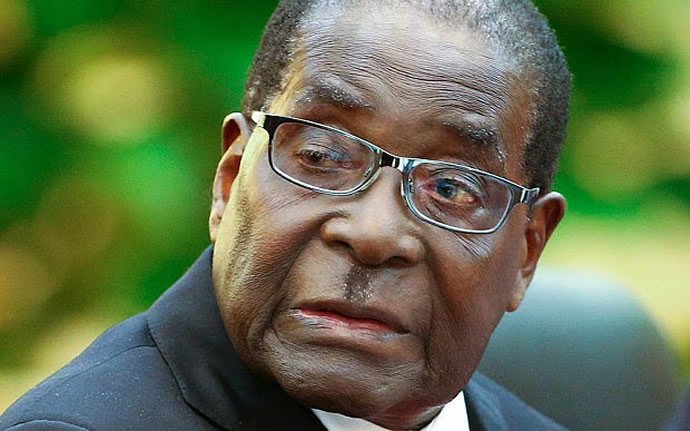
The whereabouts of Zimbabwe’s President Robert Mugabe are currently a mystery as concern is growing in Zimbabwe after a 92 year-old man was reported missing after claiming on Monday he was traveling to India. The missing person’s name: Robert Mugabe.
The veteran Zimbabwean leader, who has been in power for 36 years and is the world’s oldest serving head of state, was reported to have left the country on Monday to attend the World Culture Festival in New Delhi, which kicks off in the Indian capital on Friday.
Since then, however, his whereabouts have become something of a mystery. Mugabe canceled his visit to the festival on Wednesday; with his spokesman George Charamba citing “substantial inadequacies in protocol and security arrangements” and saying that Mugabe would return home in “a couple of days.”
Yet the president does not appear to have returned to Zimbabwe, with speculation that Mugabe may have traveled to Singapore, where he is reported to have previously received medical treatment.
U.S. diplomatic cables leaked by Wikileaks in 2011 claimed that Mugabe was suffering from prostate cancer, though it is not known whether the president still suffers from the disease.
Zimbabwe’s higher education Jonathan Moyo took to Twitter to defend the president’s cancellation of the trip but only added to the mystery by indicating that, while Mugabe did not go to India, he was not in Zimbabwe either. [myad]
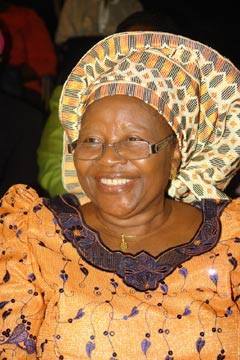
If someone tells me to live with him (former President Olusegun Obasanjo) and promises me a room full of money, I would decline.
These were the words of Oluremi Obasanjo, the first wife of the first wife of former President Olusegun Obasanjo, who is a mother of six. She spoke in an interview at her Lagos residence on her life and ordeal as a former first lady.
Below are excerpts from the interview:
You once wrote an autobiography, detailing your life with former President Olusegun Obasanjo. In that book, you described him in unflattering terms. What went wrong in your marriage?
I had to remove a lot of things on the advice of the publishers because they were very bad. I decided to speak out again because I want the world to know the kind of person that Obasanjo is. Up until now, a lot of people do not know that Obasanjo is not a normal father, or a family man. Some people say that it is because he is a soldier, but I know so many soldiers who fought the war and I see how well they take care of their families. So the fact that he is a soldier is not an excuse. He has been very brutish and selfish from the beginning. He has the belief that because his children bear his name, which means they have taken something from him and he has done them a favour. If any of his children does well, he would tell people that it is because of him that the child is doing well.
But that is usually the case in this part of the world…(cuts in)
I do not have any problem if a father takes pride in the fact that his child is doing well. But it is not right when you do not give that child any credit for striving to succeed. Everything should not only be about you. He believes that any of his children that does well did so because of him and not their own efforts. That is a very selfish way of thinking.
Are you implying that he did not take part in the children’s upbringing, especially as regards their education?
He claims that whatever his children are today, they owe it to him, because he believes that none of his children can be intelligent without him. The house where he lives now was designed and supervised by my son, Dr Segun Obasanjo, and what he gave him was less than one tenth of his professional fees. When people asked him why he did that, he said that he was the one that trained Segun in school; therefore he deserved what he was paid. I would want the world to ask Obasanjo if he knew how any of my children went to nursery school. They should ask him if he cared when they were in primary and secondary school.
Nigerians should ask him how many times he ever visited them throughout their schooling years and ask him how much he paid for their tuition. Even the Segun he is talking about, ask him how much he paid for his tuition at Ahmadu Bello University, ABU, Zaria. After my children finished their first degrees, I could not afford to send them abroad for their second degrees because it was too expensive. Because of that, they all had to take up jobs to enable them to pay for their schooling abroad. When Iyabo, my first daughter got admission abroad for her second degree, she sent her father a list of the financial requirements for her school, but he cut the required amount into two and was only able to give half of it. Obasanjo gleefully paid school fees for his relatives’ children, but found it difficult to take care of his own kids.
Are you saying in clear terms that Obasanjo did not play any roles in the education of his children?
He played some roles, but that he did it as if he was doing his children a favour. He did not see taking care of the kids as his duty. Before he was able to do anything for his children, I would have gone to Ota to inform him that his children’s fees needed to be taken care of. Most times, when I went, he would angrily tell me that he did not have any money and I would leave. When Segun won two awards in his school, because he graduated with a first class, I told Obasanjo about it and asked whether he would come for his convocation, but he told me he didn’t have the time. I then told him to fund my trip to Zaria so that I could attend, and he told me to go, that he would refund the money. But when I came back and asked him for it, he told me off and said I could go to hell.
What made Obasanjo behave that way to you and the kids? Is it that you had issues with him and he decided to take it out on your children, or is it just his nature?
I have never had it easy with him. Life with him was very tough and unbearable, but I had to endure because of my six children. I remember he wrote a book entitled My Command, and he acknowledged me in the book as having stood by him, keeping the home front. When he was launching the book in Ibadan, the late Chief Bola Ige, who had read the acknowledgement, asked him why the woman who he said stood by him and kept the home front was not standing by his side at the launch. Bola Ige said this because it was the late Stella that was with him at that launch. No woman can live well with Obasanjo, and even the late Stella people are talking about was always beaten by him while they were in Aso Rock. I couldn’t live with him anymore, and as it is, if someone tells me to live with him and promises me a room full of money, I would decline.
At what stage in your marriage did you start noticing these traits that you talk about, because for you to have accepted his marriage proposal, something must have attracted him to you?
I have always been a very quiet person and I was nicknamed ‘gentle’, so I believe that it was what made him want to marry me, because he felt that he could control me. In the first seven years of our marriage, I did whatever he told me to do without asking questions. If he told me to sit at a place without speaking to anyone, I would do it without asking questions. But as the years went by, I realized that whatever he tells you to do is usually for his own selfish interest and benefit and I stopped being foolish. He can never tell you to do anything that would serve your own interest. I continued living with him hoping that things would get better, but rather than improve, things got worse. Before his tenure as head of state ended, we were already separated. I was living in Ikoyi, while he was living in Dodan Baracks, because he felt I was not good enough to be at his side as head of state.
After his tenure, he told me that we should relocate from Lagos to Abeokuta, but I didn’t want it. Already, I wanted a final separation, and I saw his desire for relocation as a good opportunity for me to stay far away from him. When I refused, one of his friends who was a doctor asked him why he was begging me to go to Abeokuta with him. He then advised Obasanjo to take any of the women who had children for him. So he took the late Stella and one other woman called Mabel to Abeokuta because they each had a child for him. So both of them lived there with him, and he took them around to wherever he went. Stella later outshined Mabel to become the first lady. [myad]
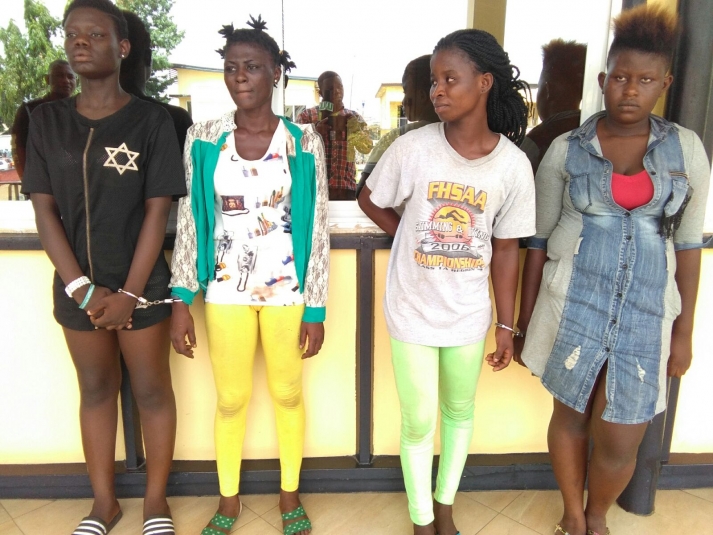
Police in Kumasi, Ghana have broken off four member female armed robbery gang and arrested them shortly after they allegedly robbed a taxi driver of what he earned in the day.
Three of the gang members were said to have been picked up by police in the metropolis after police interrogation smoked out their location from the first member, who was arrested just after the robbery.
The four have been identified as Agnes Darkoaa, a.k.a Maame Yaa or Last Killer, Ernestina Amponsah a.k.a. Akosua Frimpomaa, Mavis Addo a.k.a. Maame Konadu and Sally Sarpong a.k.a. Maame Serwaa. The four are reported to have robbed the taxi driver in Kumasi Wednesday night.
According to the police the suspects at about 11:30pm on Wednesday hired the taxi driver, Kwadwo Obeng who was in charge of a Toyota Echo Taxi cab with registration number AW 6005-12. They hired him from Asafo roundabout and asked him to take them to Afful Nkwanta in Kumasi. At Afful Nkwanta, the driver was re-directed to New Oxford International School behind Anwiam Clinic near the NDC Regional Office where Agnes Darkoaa who was in the front passenger seat pulled a knife. She was said to have turned off the engine, removed the ignition key and ordered the driver to surrender all valuables on him including cash sales.
The three accomplices were said to have assisted in ransacking the pockets of the victim and robbed him of an unspecified amount of daily sales and a Huawei mobile phone. The driver was said to have raised an alarm and a three male congregational members ran after the then fleeing female robbers and managed to arrest Sally Sarpong.
A police patrol team led by the investigator on duty later traced the three accomplices to Ahinsan Methodist Church area also in Kumasi in another taxi escaping and they were subsequently rounded up. A search on them led to the retrieval of GhȻ88 apart from GhȻ57 retrieved from Sally Sarpong, summing up a total cash exhibit of G GhȻ145.
The Huawei cellphone and a Samsung T-Mobile phone suspected to have been stolen were also retrieved from the suspects. [myad]
We use cookies on our website to give you the most relevant experience by remembering your preferences and repeat visits. By clicking “Accept”, you consent to the use of ALL the cookies.
This website uses cookies to improve your experience while you navigate through the website. Out of these, the cookies that are categorized as necessary are stored on your browser as they are essential for the working of basic functionalities of the website. We also use third-party cookies that help us analyze and understand how you use this website. These cookies will be stored in your browser only with your consent. You also have the option to opt-out of these cookies. But opting out of some of these cookies may affect your browsing experience.
Necessary cookies are absolutely essential for the website to function properly. This category only includes cookies that ensures basic functionalities and security features of the website. These cookies do not store any personal information.
Any cookies that may not be particularly necessary for the website to function and is used specifically to collect user personal data via analytics, ads, other embedded contents are termed as non-necessary cookies. It is mandatory to procure user consent prior to running these cookies on your website.







In This Same Country…By Reuben Abati
There is today in Nigeria an entire generation of Nigerian-passport wielding men and women who do not actually know, to borrow Achebe’s words that indeed “there was once a country”. These children born in a season of austerity, and raised during the years that the locusts ate, have become angry citizens. They are angry because they live in a country that makes them feel less worthy than the human standard. The only Nigeria that they know is a country that makes them feel ashamed of their own origins. Many of them have enjoyed the privilege of foreign education and exposure to some of the best traditions in other parts of the world, but when they return to their own country, right from the airport, the snow of failure and inefficiency strikes them in the face, leaving them with no option but to wonder quo vadis Nigeria? It is the same question that their parents asked and the tragedy is that their own children except something else happens, are likely to ask exactly this same old and vexed question.
The angst of this young generation is made worse when they are told that Nigeria was not always like this. In their late 20s to thirties, these children have only known that Nigeria where fuel scarcity is a fact of daily life, and part of the mechanism of survival is to know how to draw fuel with your mouth, or negotiate black market purchase of fuel, while lugging jerry cans, either at the fuel station or a roadside corner where you cannot be sure of the quality of fuel- all of that in a country that is the world’s sixth largest producer of crude oil. These children have only known a country where the roads are bad, services are sub-standard, people are mean, criminality is rife, and electricity is available once in a blue moon.
What they know is a country where the pastors and malams are better known for lying, swearing, cheating, calling the name of God in vain. In their Nigeria, public and private officials are lazy, and unproductive, they just want to reap, and they have sucked the country so dry, her glands are wasted, flat, going South and no more presentable, the balloon has suffered a blow out, even the blind can see that this is so. These angry children are no longer proud of the green passport; because the Constitution allows dual citizenship, they’d rather grab the citizenship of another country, and remain linked to Nigeria only by blood, and that is the case because they have parents who would not want them to de-link completely, but if they don’t, their own children and their own children after them, are already being lost to countries where things work, where the basic necessities of life are taken for granted and where the future is not a distant, unknown, and impossible destination.
The anger and the nonchalance of this generation of Nigerians is the pain and the agony of an older generation that knew a different country before all things went kaput and Nigeria became a byword for the unhinged, the dark, the ugly and the regrettable. Our generation and the generation before us knew a different country. And because that is so, memory is an affliction, a source of torment, nostalgia and regret, more so as that distant past now seems so unattainable not because distance often makes the past look better, but because in Nigeria, the past is sorrily idyllic. Those who lived in that other country and are still alive could not have forgotten so soon, because to forget something that important is to self-deny, it is to pretend, it is to abuse, it is in all, an act of pitiable abnegation.
How could we have forgotten? How can anyone possibly forget? That this was once a country where Nigerians felt at home in virtually any part of the country. Igbos lived peacefully in the North, and Fulani herdsmen were at peace with other Nigerians, and there was no issue with the planting of yams or the grazing of cattle. In this same country, Southerners lived for decades in the North, acquired property and spoke the language of their hosts. We grew up knowing Baba Kaduna, Daddy Kano, Mama Kafanchan, Uncle Porta, just as persons from the East and the South South contested for elective positions in the West and won. There was a civil war yes, and things began to change but even after the war, it was never this bad. Nigerians from the South still went on national assignment in the North, Christians and Muslims tried to live together in peace, but today, things have fallen apart.
There is no open civil war, but this country is at war on all fronts, the worst fronts being the ethnic, the religious and the political, and these post-civil war children just can’t understand why the generations of their fathers and grandmothers can’t run an efficient country. They have been taught in school that every nation has problems, but leadership is about managing those problems and building a happy nation. They hear about the big names of Nigerian history, the statesmen who fought for independence, the Amazons who defended the place of women in national decision making processes, the accomplished scientists, the literati and cultural workers, but the historical figures who have made the biggest impression on them are the ones who ruined the nation with their acts of omission and commission.
In this same country, the Naira used to be at par with the pound and was for many years stronger than the dollar. So strong was the Naira that many Nigerians, including the lower middle class could afford to travel to London on Friday evening, attend a party in London on Saturday, attend church service on Sunday, check out one or two mistresses in paid-for flats in different parts of London, and return to Nigeria early enough on Monday morning to be able to go to work. All that was no big deal. Everyone in London knew the Nigerians. They were the biggest spenders and they threw the best parties. There was Nigeria Airways; owned and operated by the Nigerian government and it was one of the best airlines in Africa. Its pilots were rated among the best in the world. Its safety record was superb. And it was affordable. It was the pride of the nation. Within the country, Nigeria Airways was also efficient. A trip from Lagos to Calabar in those days was just N44! Students enjoyed rebates too.
In this same country, once upon a time, public transportation was impressive. In Lagos for example, the public transportation system was almost exactly a version of what they have in London. This may sound like something being made up to the younger generation, but it is nothing but the truth. The railway system worked too, and one of the most prestigious jobs was to be a railway staff. That same Nigerian Railway Corporation that is now a parody of its former self, used to link up the entire country and it helped to build cities and villages, as the various major train stations became commercial centres. Today, railway transportation looks like something we are trying to reinvent.
Once upon a time in this same country, those who sent their children abroad did so majorly out of choice, not necessity, because Nigerian schools were among the best in the continent and the world. Teachers from different parts of the world, the best and the brightest, sought employment in Nigerian schools. The Naira was strong, investors -both commercial and intellectual – trooped to this country in droves and they enriched us in many ways. The schools were well-equipped; they attracted students and teachers based on their reputation.
Parents sent their own children to their alma mater out of loyalty, and regard for tradition. That pattern of grandfather, father and son attending the same secondary school seems to have ended; the public schools in Nigeria have failed, the missionary schools of old have been destroyed by hostile government take-over, back in the hands of the missions, the destruction is yet to be fully corrected. The younger generation reflects on all this: mostly products of private schools, they can’t understand why a country that still prides itself as the giant of Africa cannot run a decent education system or provide jobs for the products of its school system.
In this same county, we used to have industrial estates. In Lagos, Apapa, Ikeja and Isolo were industrial estates. In Kaduna, Jos, and Enugu, manufacturing companies created jobs and wealth. We had uncles and aunties who used to do shifts in many factories and this country produced things: from refrigerators to bulbs to vehicles to metals to books, to textiles to shoes. Sad: many of those factories have become churches! In those days, if you went into a bookshop, you could not miss the mint-fresh smell of the books on display. I miss that smell. There are fewer bookstores today and the books no longer smell the same, because by the time they are imported and passed through dirty containers and the hands of thieving handlers, the books lose their soul.
Once upon a time in this same country, there was so much hope about tomorrow. Salaries were paid as and when due. State governments offered students bursaries and scholarships. School was attractive because the teachers were dedicated and they were smart. At the university level, the government provided subsidized tuition and feeding; the rooms were kept clean by staff, the libraries were well-stocked; there was light and water and town-gown relationship was just fine. In the larger society, the present regime of no water, no fuel, no electricity was unheard of. You may have heard of the British standard, there was in fact at a time, the Nigerian standard, and this was the standard that other Africans looked up to. This same country dominated the continent, morally, intellectually and culturally. Financially too: so rich was Nigeria that a former Head of State reportedly boasted that our problem was not money but how to spend it!
But, sorry, we lost it all. And the rains began to beat us. The victims are the younger ones who have not known any other country but this new one. The danger is: they may never know how to make a difference when they inherit this poisoned chalice called Nigeria. [myad]