President Muhammadu Buhari today in Makkah, Saudi Arabia performed lesser hajj (Umrah). The News Agency of Nigeria reports that the President, who arrived in Makkah via Jeddah from Madinah at about 1.20am (local time) today, proceeded to the Holy Mosque, Ka’abah, for the performance of the Umrah. During the Umrah, some of the annual pilgrimage rites are performed. The President, who wore the Ihram, performed the Tawaf (walking seven times around the Ka’aba) and Sa’i (running between the hills of Safa and Marwa) and said the two-Raka’a prayer in line with the pilgrimage rites. Buhari performed the lesser Hajj along with the Governors of Zamfara state, Abdulaziz Yari; Borno state, Kashim Shettima; Osun state, Rauf Aregbesola; Katsina state, Aminu Masari; and Ibikunle Amosun of Ogun state. Others who performed the Umrah in the Grand Ka’aba with the President were the National Security Adviser, retired Major General Babagana Monguno; some traditional rulers, including the Emir of Kano, Malam Sanusi Lamido Sanusi, and Oba of Lagos, Alhaji Rilwan Akiolu as well as some Islamic leaders and prominent businessmen, including Alhaji Isa Funtua and Chief Wale Tinubu. Speaking on the spiritual journey of the President, Yari commended Buhari for choosing to come and personally pray for peace and prosperity of Nigeria. He maintained that God Almighty would always accept the wishes and prayer of those in position of leadership. On his part, Sanusi described the performance of Umrah by Buhari as a personal spiritual journey for him. “As you well know, Makkah is the holiest city in Islam and the Ka’aba is the holiest Mosque and also the Mosque of the Prophet in Madinah. “The visit to Makkah and Madinah is actually a personal spiritual journey for the President and he used the opportunity to pray for the country.” [myad]
Wife of President Muhammadu Buhari of Nigeria, Mrs. Aisha Muhammadu Buhari, today in South Korea, commissioned a new vessel of the Nigeria Liquefied Natural Gas (LNG) company which is expected to join in the fleet of the organization.
The vessel, Named ‘LNG Abuja 11’ is billed for the fleet of the NLNG and specifically for Bonny Gas Company, a subsidiary of the NLNG Ltd. It was built by Samsung and Hyundai Heavy Industries of South Korea.
The vessel was built with local content that earned Nigeria vast export revenue. A good number of Nigerian youths were part of the Crew in it.
Nigeria produces 22 million tons of LNG per annum and sold to North America and Europe by ships.
While performing the “naming ceremony” of the new vessel, Mrs. Buhari said that the acquisition of the new vessel was an additional impetus to the growth of export related businesses that will improve revenue generation for Nigeria, adding. “more than $10 million dollars was generated from the export of quality Nigerian materials to Korean shipyards”
According to Aisha Buhari expressed confidence that despite challenges in the global energy sector, Nigeria and south Korea will continue to occupy important positions with respect to international energy security and development.
She confessed that Nigeria is undergoing a process of change for improved quality of life of the people which has made it necessary for government to provide avenues for businesses to achieve their full potentials, adding: “I stand by this principle because that is how great countries like south Korea were built.”
The wife of the President commended the NLNG for the new stride even as she said that there was nothing that made her proud than the knowledge that Nigerians and Nigerian companies actively participated and benefited directly from the construction of the new vessel. [myad]
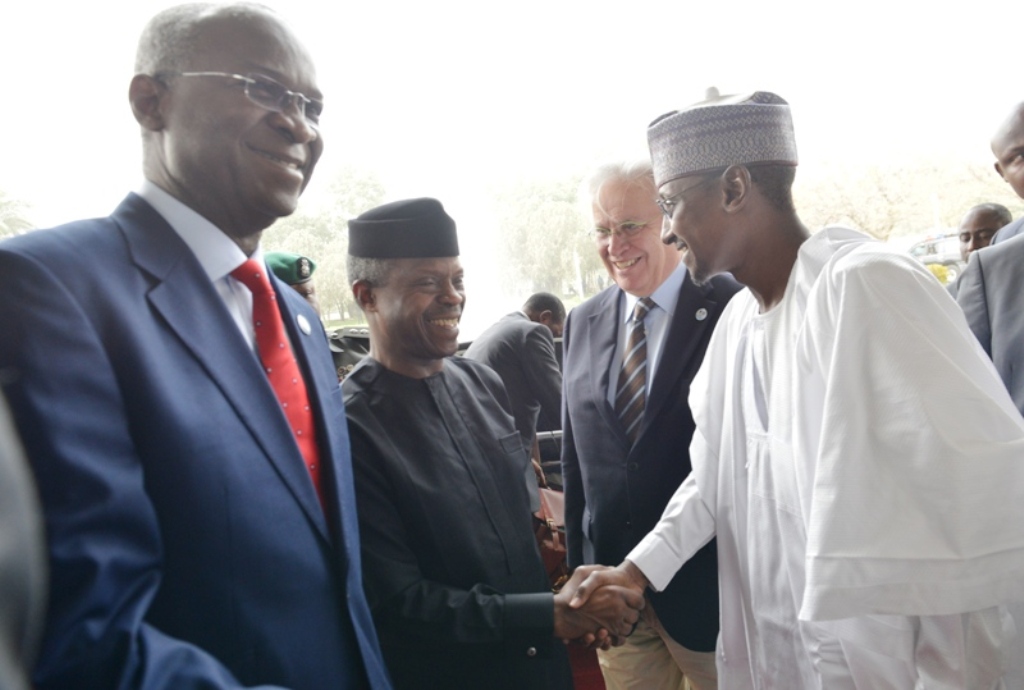
Minister of the Federal Capital Territory (FCT), Malam Muhammad Musa Bello welcoming Vice President Yemi Osinbajo to the Habitat III Africa Regional Meeting, at the International Conference Centre in Abuja as minister of Power, Works and Housing, Babatunde Raji Fashola looks on with interest. [myad]
President Muhammadu Buhari has called on African nations to stand up in unison and speak with one voice in global issues. He also wants Africa to change the story of cities and settlement from one of chaos and slum to one of positive planning, tranquillity and environmental sustainability. The President who spoke today at the opening ceremony of the Africa Regional Meeting on Habitat III, at the International Conference Centre in Abuja through Vice President Yemi Osinbajo, said that Nigeria is happy with a common African position on urbanisation. He said that such position took into account the joint efforts of the countries involved over the last decade. President Buhari observed that the African Regional Meeting with the theme: ‘African Priorities For The New Urban Agenda’ and organised by the United Nations Conference on Housing and Sustainable Urban Development (Habitat III) is timely for Africa to pursue a new urban agenda which addresses some of its peculiar challenges. He said that the kind of urbanisation which Africa should have must accordingly take place in a manner that simultaneously promotes growth and social inclusion, adding that despite having the fastest rate of urbanisation in the world at over 4.5 per cent a year, Africa is yet to be on a sustainable path to achieving these twin objectives of economic growth and social inclusion. The President took a look at the root causes of current urbanisation challenges in Africa, and said: “Africa is one of the continents with some of the high rates of inequalities in the world, fuelled by high population growth, unequal access to healthcare, education, opportunities for income and decent life.” According to him, the increasing number of slums in Africa is a depressing manifestation of these inequalities, saying: “these challenges are related to poor planning, policy gaps and policy inadequacies, budgetary inadequacies. Poor planning of urban areas that can be attributable to limited capacities, insufficient resources and outdated data.” Buhari said that the prevailing dehumanising state of Africa’s urban settlements has led to migration at a time of resource constraints which has resulted in population explosion and shortage of houses that has pushed people living in cities to build houses in places which make them vulnerable to natural disasters; causing significant economic and social risks. The President noted that forced migration caused by terrorists’ attacks has led to secondary towns, especially in the Sahel zone being pressured to accommodate citizens who flee their villages and homesteads and has also caused loss of lives, destruction of properties and even insecurity and poverty. He said that Nigeria, faced with its own challenges in this area, “is deploying substantial human and material resources to address the situation, while appreciating the support of partners at home and abroad that are collaborating with the Federal Government.” President Buhari counselled that despite the constraints of resources, “we should not expect that our core resources to propel our development should come from our development partners, no matter how benign.” He urged other African countries to emulate Nigeria and Ghana that have committed resources to support the Urban Agenda under the UN HabitatAgenda towards accelerating the process of the continent’s urbanisation drive. Earlier in his remarks, the Secretary-General, UN Conference on Housing and Sustainable Urban Development, Dr. Joan Clos said that the primary objective of the regional meeting is to provide Africa the opportunity to address challenges it’s facing in the urban centres. This was even as the Nigeria Minister of Power, Works and Housing who is also the Chairperson of the Africa Regional Meeting, Babatunde Raji Fashola praised the renaissance of African delegates’ response to the challenges of urbanisation. He asked them to utilize the commonality of purpose to identify the peculiarities of human settlement across the continent. The Minister further advised the delegates to develop common strategies on how to manage the challenge of urbanisation and to explore the opportunities latent in the global challenges. Other speakers at the opening session include the minister of the Federal Capital Territory (FCT), Malam Muhammad Musa Bello; Commissioner for Political Affairs, African Union Commission, Dr. Aisha L. Abdullahi; Chadian Minister of Lands, Urbanism and Habitat, Mbogo Ngabo Seli and the Senegalese Minister of Urban Renewal Housing and Living Conditions, Diene Farba Sarr. [myad]
Only 86 staff in various departments were able to survive the mass purge of staff by THISDAY Media Group/ARISE TV Networks, which came after what the chairman and Editor-In-Chief, Nduka Obaigbina called spot check at the Lagos office of the company.
The chairman, in a memo dated February 23rd, copies of which were distributed to Eniola Bello, Kayode Komolafe, Emmanuel Efeni, Ijeoma Nwogwugwu, Tokunbo Adedoja and Shaka Momodu, said that those whose names did not appear on the list as prepared should not regard themselves henceforth as staff of the company.
Obaigbena said: “Those not on the list below cease to be staff of the company except they show with documentary evidence why they were not, and have not been at work. Editorial Staff have to show work with proof of stories filed and published tonight. Therefore, only those listed below will be on the next payroll. If not listed, please conclude your disengagement process with the Admin department. “A. Account Department: 1. Akiemughu Ezekiel 2. Olurebi Abiola Yusuf 3. Kasali Ganiyu 4. Arole Olawale 5.Alex Egberughe 6. Sambo Mohammed 7. Ngboken Odonzi 8. Sunday Adofu 9. Charles Afambu 10. Dibiagwu Uchenna 11. Amao K. Abisola 12. Raufiu Shina 13. Ariori Kamilu 14. Peter Iwegbu 15. Olufemi Aborowa.
“R. MANAGEMENT. 1. Eniola Bello 2. Kayode Komolafe 3. Ijeoma Nwogwugwu.” Obaigbena further directed some staff of the Accounts Department to “prepare a new payroll another month based on the list below. “We will try and pay up current month plus one month arrears every month at least.” [myad]
The Chief of Army Staff, Lieutenant General Tukur Buratai has said that the military has been able to achieve two out of the three taskes President Muhammadu Buhari gave them when he was sworn-in in May last year.
“We were given three major tasks and we have made efforts toward achieving two. The first task is to defeat Boko Haram and I want to tell you that as at today, Boko Haram has been defeated. When I say defeat, it doesn’t necessarily mean that there won’t be hitches here and there.”
Buratai spoke in Maiduguri, the Borno State capital, at a meeting with Borno Elders Forum as part of measures adopted to consolidate on the gains recorded in counter-insurgency operation. The meeting was held at the Military Command and Control Centre in Maiduguri. The Army chief said: “we have entered the mop up stage of our operation,” adding that the mop up phase would facilitate the release of those held captive by the insurgents, including the Chibok girls. According to Buratai, the second part of the first task is to rescue those who are held hostage at some marked locations by the insurgents. Buratai said that the second major task in the military’s North East operation was to facilitate the restoration of normalcy in affected areas and provision of relief materials to displaced persons. He said the military had aided civil authorities in the return of displaced persons from Bama, Gwoza and other communities. “The second task is to support the civil authorities in caring and protecting the Internally Displaced Persons and to help the civil authorities in restoring normalcy and rebuilding those areas that have been liberated. “It has already commenced in places like Bama, Gamboru Ngala, Baga, Mongonu and most of those areas are deserted because they are afraid that they could be attacked. “So, we will embark on confidence building to encourage them to come back by assisting the civil authorities.” Buratai said that some challenges initially encountered in the course of operation had been addressed, stressing that the operation was progressing according to projections. Buratai acknowledged the support of the elders and appealed to them and the entire Borno State people to be patient with the military, particularly on measures initiated to tackle the insurgents. He said that measures such as the closure of markets and curfews were all taken to address gaps observed in the military operation. The Chairman of the Borno Elders Forum, Ambassador Gaji Galtimari, appreciated the efforts of the military in containing the menace of insurgency in the north-east. Galtimari said the military had succeeded in decimating the insurgents to the extent that the regular bomb and gun attacks were limited in parts of the region, assuring the military that Borno State elders were in support of measures adopted by the military in finally ending the menace of Boko Haram veen as he pledged to do more to support the military. “For the past few months, there has been no issue of bombs except in few cases and around villages surrounding Maiduguri. “Let me state on behalf of the elders that the indebtedness you people have put on us will only be compensated by the Almighty God. “We pray that God will help you to complete the work that Borno will return to what it was before the coming of Boko Haram.” [myad]
Aide De Camp (ADC) to former President Goodluck Jonathan, Colonel Ojogbane Adegbe, has dragged the Economic and Financial Crimes Commission (EFCC) to court to challenge his alleged detention.
Colonel Adegbe, in the suit filed at the Federal High Court by his counsel, Ogwu Onoja (SAN), is claiming N100 million damages for his detention which violated his fundamental rights.
Onoja asked the court to declare that his client’s arrest and continued detention by EFCC since February 11 was unconstitutional and violated his right to personal liberty guaranteed by the 1999 Constitution.
He asked the court to make an order directing the EFCC to immediately release the applicant from unlawful detention.
Onoja argued that the arrest and detention of Adegbe by the EFCC violated his right to personal liberty and freedom of movement guaranteed by Section 35 and 41 of the 1999 Constitution.
The applicant’s counsel contended that EFCC’s action violated Articles 5,6 and 12 of the African Charter on Human and Peoples’ Rights.
The case has been fixed for February 26 for hearing. [myad]
This piece is neither motivated by the ardent love and deep seated passion I have for Maman Taraba nor it is by my curiosity to write on Taraba politics that is characterized by rascality, religious bigotry, money politics and the desperation of a few cabals who would stop at nothing to remain in power.
I am motivated to write this piece for three reasons: the political decency exhibited by the only woman who would have emerged as the first elected female governor in the event where the cabals were also decent democrats; the predicament that befalls any decent politician like her in a society where decent politicking is considered political miscalculation and cowardice and the murky waters of political godfatherism that has bedeviled the political landscape in the country.
Senator Aisha Jummai Al-Hassan fondly called Maman Taraba by her fans started active politics in 2010, contested senatorial position and was sworn in as Senator representing Taraba Northern constituency. Since she assumes politics in the state, her love and identification with the common man have catapulted her popularity and acceptance among the masses.
Though a member of the Peoples Democratic Party (PDP), a party that impoverished Nigerians for 16 years of misrule, systemic corruption and disgusting political indecency, Maman Taraba defy all odds to be identified with such characteristics. She adopted, nurtured and played people’s oriented politics, decentralized her campaign strategies and gave listenership ears to the need of the common folks.
In the whole of Taraba state, without fear of any contradiction, no politician has contributed personally in the areas of empowerment like her. She did not only train women and youths, but also empowered them on different kind of businesses like tailoring, trained and empowered women and youths with more than a thousand computers, tricycles, motorcycles and other different kinds of businesses and all these were done in thousands.
Her political exuberance gave her the audacity to stand alone and defied the urge of repressive politicians who wanted to make her their subservient political agent who would represent their interest against that of the masses whom she found reason to treasure.
Maman Taraba stood firm, informed by her resilience and dogged political moves to embrace the masses, she established one of the most decent political movements devoid of political gangsterism. Her campaigns were mostly focused on issues that have direct bearing on the masses rather than attacking personalities.
Her refusal to be a political god-daughter to the desperados, her insistence on people’s oriented politics as confined in the character of a true democrat exposed her as a helpless political prey that is socially excluded from the crop of “the cabals”.
The true democratic characters exhibited by the trained lawyer turned democrat could not go down well with the cabals who saw that their tyranny would be brought to an end in the event that she is elected as a substantive Governor. And so from the time she emerged as the APC governorship candidate to the time she was “defeated” in the Supreme Court, Maman Taraba was hacked down by the cabals using all available means within their reach. Many factors were manipulated that lead to the predicament of this decent politician.
As I noted earlier, religion is one of the factors that was manipulated and subsequently became an Achilles hill against her. Although, as evident in the outcome of the election, Mama has wide popularity even among Christians, but some misinformed ones were convinced that a muslim governor in the state will work against them and favour their muslim “enemies”, therefore nemesis will befall them in the event such is allowed.
Money politics was used to hoodwink people in the political struggle in the state. Since Mama refused to be sponsored by some vested interest and political godfathers, she was left alone to fight her battle with only the support of the downtrodden whose voices are not heard in an indecent political arena that is at play in Nigeria and Taraba in particular.
Money was not only used to hire thugs, alter the decision of some election officials, subvert the right of the people to exercise their franchise and make damning destructions, but there were also allegations that some judges and lawyers were bribed with millions of naira to suppress justice against her.
All these boiled to the fact that the few cabals who saw that there would be a great “danger” that portends them, and that it will not be “business as usual” if Aisha Alhassan is sworn in as governor have indeed proven their worth in stopping at nothing to deny her the opportunity.
Many questions will be bagging for answers in the midst of the above controversies. For instance, what would be the future of Taraba politics in the light of the above factors? How far would this administration of President Muhammadu Buhari go in shaping politics in the state and to whose favour? What would be the future of Maman Taraba as far as governorship race in state is?
An intelligent projection will postulate that she will remain active in the state politics; and the present administration known for its justice and change mantra may not fold it arms and allow injustice prevail at the expense of the masses.
Her current position as a Minister, her continued popularity among the masses, support from academics, technocrats, civil servants, well wishers and writers including yours faithfully will wait patiently for 2019 to join yet another political battle that will presumably turn the tide of things in the state and secure a place for Maman Taraba in the state and upturn the predicament of a decent politician like her.
Haruna Mohammed Salisu writes from Bauchi. He could be reached at 08063180608 or harunababale@gmail.com. [myad]
The Senate has directed the Central Bank of Nigeria (CBN) to terminate its contract with Systemspecs, the company providing e-payment platform for the operation of Treasury Single Account (TSA), for the Nigerian government. This was even as the company responded almost immediately that there was no basis for such termination.
Following a motion by Dino Melaye (APC-Kogi State), the Senate had, last year, constituted an adhoc committee headed by John Enoh (PDP-Cross River State) to investigate allegations that the TSA was being mismanaged and that Systemspecs was making excessive gains off the country.
Melaye alleged that Systemspecs charged the government one percent for each transaction, thereby making N2.5 billion after mopping up N25 Billion transferred to the treasury.
The report of the investigative committee was presented today, Wednesday.
Enoh said his committee confirmed that Systemspecs charged a one-percent fee on every transaction on its platform.
However, Systemspecs Managing Director and Chief Executive Officer, John Obaro swiftly responded by saying that those who are opposed to the TSA might include those who have been benefitting from the old pre-TSA order, competitors who lost out in the selection process, un-informed or under-informed commentators, etc.
“In it all, we have always been and will remain fully committed to the full resolution of any issue surrounding the commercial component of our contract in the overall larger national interest.” Obaro stressed that the company is committed to indigenous technology for national transformation, adding that over the past few months, the company has been inundated with enormous goodwill messages from home and abroad in respect of its successful record in the indigenous software development space over the past 24 years and especially as it relates to its involvement in the government TSA project since 2011. “On another hand, we have also had to contend with a barrage of questions on the nature of our involvement with the FGN TSA project and the associated commercial terms, arising from the Senate enquiry. “It is fulfilling to note that the Senate report did not accuse Remita of under-delivering on the substance of the contract and that our efforts are recognised as having played a significant role in the life of the nation when it mattered and that the disagreement has only been on the commercial terms of our contract. The Senate Committee further recommended that SystemSpecs’ efforts should be rewarded – albeit on a scale which is quite debatable. “Since inception over 24 years, we have chosen to be guided by sound ethical principles and have walked away from many transactions we believe can challenge the standards we have set for ourselves. This is attestable to by the numerous multi-national, indigenous public and private sector organisations and individuals we have been privileged to work with over the years. “On the FGN TSA project (which many people did not give a chance of success, by the way), we have been careful to respect the terms of our contracts and many times gone beyond the call of duty to ensure the immediate and long-term success of the initiative. We are glad and proud that we have delivered. “For emphasis, we wish to state that the TSA project goes beyond revenue collections and extends to payments, accounting information exchange and update, full real-time integration with GIFMIS, integration with the national financial services ecosystem enabling payers across multiple platforms, 24/7 user support for 50,000 FGN TSA users of Remita platform, among others. “It may also be instructive to note that while many things seem to have been muddled up in the public domain for different reasons; e-collections schemes anywhere in the world are a product of negotiations based on scope and complexity of tasks involved. “The subsisting 1% charge eventually agreed by the CBN, banks and ourselves at the commencement of the project was considered a good starting point which could be reviewed based on emerging realities. This much is a clear and integral part of our contracts with the CBN. “On a last note, we thank the Senate for its avowed commitment to preserving the national interest, the government for entrusting such a significant national IT project to an indigenous firm, and numerous Nigerians who continue to objectively analyse issues and encourage us particularly during these times.” [myad]
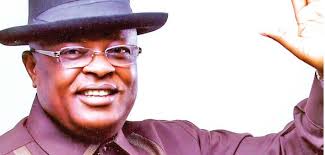
The United States Agency for International Development (USAID) has donated medical equipment worth over N47 million to Ebonyi state government towards the prevention of diseases and avoidable deaths of women and children. Handing over the equipment to Governor David Umahi at the Government House in Abakaliki, the Deputy Director of USAID Mission in Nigeria, Aler Grubbs, said the equipment were for the National Fistula Centre, Abakaliki and 70 Primary Health Care centres in the state. Grubbs said that USAID had trained 450 directors and nurses from Ebonyi State to provide maternal and ante-natal healthcare to women and children, adding that the state is among the 11 which the agency is partnering in Nigeria for the treatment, rehabilitation and prevention of Vasico Vagina Fistula (VVF). Umahi, represented by his deputy, Dr. Kelechi Igwe, commended USAID for its committed partnership with the state government in the development of the state, especially in the education and health sectors. He expressed his confidence that with the donation, medical tourism from the state would reduce, stressing that the country had qualified medical personnel who rank among the best in the world. He assured the agency that the government would ensure that the equipment were judiciously used. In his remark, the Commissioner for Health, Dr. Daniel Umezurike, said that the donation would be a boost to the government’s effort to reposition the primary health care centres for quality health care delivery. [myad]
We use cookies on our website to give you the most relevant experience by remembering your preferences and repeat visits. By clicking “Accept”, you consent to the use of ALL the cookies.
This website uses cookies to improve your experience while you navigate through the website. Out of these, the cookies that are categorized as necessary are stored on your browser as they are essential for the working of basic functionalities of the website. We also use third-party cookies that help us analyze and understand how you use this website. These cookies will be stored in your browser only with your consent. You also have the option to opt-out of these cookies. But opting out of some of these cookies may affect your browsing experience.
Necessary cookies are absolutely essential for the website to function properly. This category only includes cookies that ensures basic functionalities and security features of the website. These cookies do not store any personal information.
Any cookies that may not be particularly necessary for the website to function and is used specifically to collect user personal data via analytics, ads, other embedded contents are termed as non-necessary cookies. It is mandatory to procure user consent prior to running these cookies on your website.



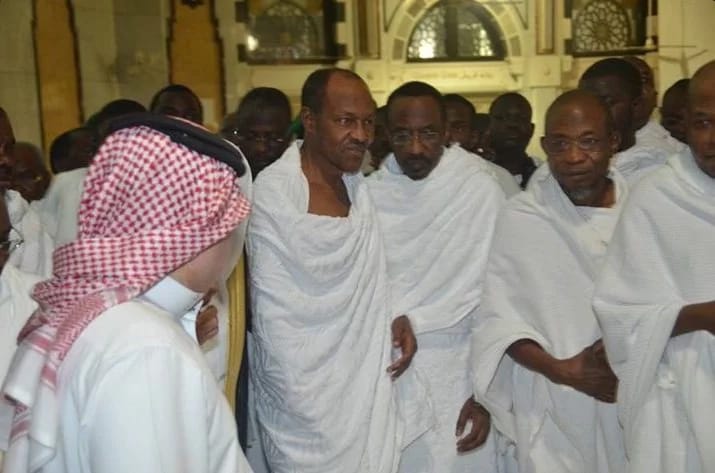 President Muhammadu Buhari today in Makkah, Saudi Arabia performed lesser hajj (Umrah).






Maman Taraba: The Predicament Of A Decent politician, By Haruna Mohammed Salisu
I am motivated to write this piece for three reasons: the political decency exhibited by the only woman who would have emerged as the first elected female governor in the event where the cabals were also decent democrats; the predicament that befalls any decent politician like her in a society where decent politicking is considered political miscalculation and cowardice and the murky waters of political godfatherism that has bedeviled the political landscape in the country.
Senator Aisha Jummai Al-Hassan fondly called Maman Taraba by her fans started active politics in 2010, contested senatorial position and was sworn in as Senator representing Taraba Northern constituency. Since she assumes politics in the state, her love and identification with the common man have catapulted her popularity and acceptance among the masses.
Though a member of the Peoples Democratic Party (PDP), a party that impoverished Nigerians for 16 years of misrule, systemic corruption and disgusting political indecency, Maman Taraba defy all odds to be identified with such characteristics. She adopted, nurtured and played people’s oriented politics, decentralized her campaign strategies and gave listenership ears to the need of the common folks.
In the whole of Taraba state, without fear of any contradiction, no politician has contributed personally in the areas of empowerment like her. She did not only train women and youths, but also empowered them on different kind of businesses like tailoring, trained and empowered women and youths with more than a thousand computers, tricycles, motorcycles and other different kinds of businesses and all these were done in thousands.
Her political exuberance gave her the audacity to stand alone and defied the urge of repressive politicians who wanted to make her their subservient political agent who would represent their interest against that of the masses whom she found reason to treasure.
Maman Taraba stood firm, informed by her resilience and dogged political moves to embrace the masses, she established one of the most decent political movements devoid of political gangsterism. Her campaigns were mostly focused on issues that have direct bearing on the masses rather than attacking personalities.
Her refusal to be a political god-daughter to the desperados, her insistence on people’s oriented politics as confined in the character of a true democrat exposed her as a helpless political prey that is socially excluded from the crop of “the cabals”.
The true democratic characters exhibited by the trained lawyer turned democrat could not go down well with the cabals who saw that their tyranny would be brought to an end in the event that she is elected as a substantive Governor. And so from the time she emerged as the APC governorship candidate to the time she was “defeated” in the Supreme Court, Maman Taraba was hacked down by the cabals using all available means within their reach. Many factors were manipulated that lead to the predicament of this decent politician.
As I noted earlier, religion is one of the factors that was manipulated and subsequently became an Achilles hill against her. Although, as evident in the outcome of the election, Mama has wide popularity even among Christians, but some misinformed ones were convinced that a muslim governor in the state will work against them and favour their muslim “enemies”, therefore nemesis will befall them in the event such is allowed.
Money politics was used to hoodwink people in the political struggle in the state. Since Mama refused to be sponsored by some vested interest and political godfathers, she was left alone to fight her battle with only the support of the downtrodden whose voices are not heard in an indecent political arena that is at play in Nigeria and Taraba in particular.
Money was not only used to hire thugs, alter the decision of some election officials, subvert the right of the people to exercise their franchise and make damning destructions, but there were also allegations that some judges and lawyers were bribed with millions of naira to suppress justice against her.
All these boiled to the fact that the few cabals who saw that there would be a great “danger” that portends them, and that it will not be “business as usual” if Aisha Alhassan is sworn in as governor have indeed proven their worth in stopping at nothing to deny her the opportunity.
Many questions will be bagging for answers in the midst of the above controversies. For instance, what would be the future of Taraba politics in the light of the above factors? How far would this administration of President Muhammadu Buhari go in shaping politics in the state and to whose favour? What would be the future of Maman Taraba as far as governorship race in state is?
An intelligent projection will postulate that she will remain active in the state politics; and the present administration known for its justice and change mantra may not fold it arms and allow injustice prevail at the expense of the masses.
Her current position as a Minister, her continued popularity among the masses, support from academics, technocrats, civil servants, well wishers and writers including yours faithfully will wait patiently for 2019 to join yet another political battle that will presumably turn the tide of things in the state and secure a place for Maman Taraba in the state and upturn the predicament of a decent politician like her.
Haruna Mohammed Salisu writes from Bauchi. He could be reached at 08063180608 or harunababale@gmail.com. [myad]