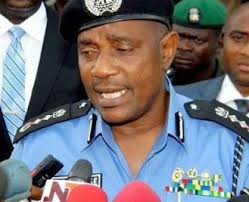
Candidate of All Progressives Congress (APC) in the February 20 senatorial rerun election in Benue South Senatorial District, Comrade Daniel Onjeh has alleged that his opponent, Senator David Mark of the Peoples Democratic Party (PDP) is turning the area into a theatre of war.
In a statement, Onjeh’s campaign organization alleged that the supporters of the former president of the Senate have already imported militants into Otukpo ahead of the poll. The Director Media and Publicity of the Onjeh Campaign Organization who signed the statement said: “David Mark’s militants arrived Otukpo last night and are being lodged in an hotel owned by David Mark’s son. “Mark is currently hosting the first batch of the Niger Delta militants who arrived from Asaba, Delta State. The second batch moving from Bayelsa State are currently camped at Uturu, Abia state on their way to Otukpo. “The importation of the Militants shows the desperation of Mark and the opposition PDP towards the re-run election, It’s more glaring that Mark has lost grip of his people hence he’s resulting to war situation. We believe in the credibility of our security agencies and their capacity to avert the impending mass murder planted by Mark. “We hereby call on President Muhammadu Buhari, the Inspector General of Police and other security outfits in the country to immediately come to the aid of the Idoma – Igede Nation before we are completely wipe out by David Mark’s Militants. “The people of Benue South should be allowed to choose their senator as it’s evident that democracy is of the people.” [myad]
The Federal Court of Appeal, Yola Division in Adamawa State has described the impeachment of the former Governor Murtala Nyako of Adamawa State, Murtala Nyako as high level of impunity, recklessness, rascality and a constituted gross of legislative powers by the Adamawa State House of Assembly. Nullifying the impeachment, months after t was carried out, a five-member panel of judges led by Justice Jumai Hannatu Sankey unanimous agreed that the removal of Nyako was to achieve orchestrated, premeditated and selfish motives. They said that the impeachment of the former governor was a misuse of the powers and privileges of the legislature, thus declaring the impeachment as null, void and of no effect. Justice Tunde Awotoye, while delivering the judgment, said that the respondents took laws into their hands as they flagrantly abused the constitution of the Federal Republic of Nigeria to meet their whimsical and selfish desires. Sankey, in her lead judgment, said that the court as the last arbiter would not fold its arms and watch impunity being entrenched in the country, adding that the decision of the House of Assembly to ignore the constitutional provision of personal service of impeachment notice on Nyako was a misnomer to the constitution, which must be uprooted. The court ordered that Nyako be accorded all rights of the office of the governor of Adamawa State throughout his legally recognized period in office even as the court struck out his plea to be returned as governor of the state, saying that his tenure as governor had elapsed. Nyako was impeached by the Adamawa State House of Assembly on July 16, 2014 following allegations of gross misconduct leveled against him by the House of Assembly. [myad]
Nigeria minister of Health, Professor Isaac Adewole has issued travelling warning to Nigerians to countries that are currently battling Zika disease which he said has no cure for now.
“I advice all Nigerians, particularly pregnant women, to avoid travelling to countries infected by this virus in these periods. If however, you are to visit any country where Zika virus is now being actively transmitted, you are advised to protect yourselves from mosquito bites.”
Professor Adewole, in a statement in Abuja, emphasized: “pregnant women considering travel to affected areas may wish to consult their health-care provider prior to travel and after return. They should also practice personal and household steps to prevent mosquito, including putting mosquito repellant on their clothes and skin, wear long sleeves and pants, and sleep underneath mosquito nets at night, where possible.”
The minister said that though the mosquitoes bearing the deadly Zika virus exist in Nigeria but that 40 per cent of Nigeria adults and 25 per cent of Nigerian children have antibodies to Zika virus.
“Nigerian scientists working in Western Nigeria in 1954 discovered Zika virus in Nigeria. Further studies in the years 1975 to 1979 showed that 40 per cent of Nigeria adults and 25 per cent of Nigerian children have antibodies to Zika virus, meaning they are protected against this virus. “Despite the fact that some Nigerians are immune to the Zika virus infection as demonstrated by previous studies, it is important and advisable that Nigerians should be careful and protect themselves from mosquito bites. “There is no vaccine for Zika virus, and no cure other than rest, plenty of fluids and perhaps over-the-counter medication to reduce fevers, aches and pains as previously mentioned. This, therefore, means that prevention is most effective means of preventing transmission. The minister advised Nigerians to protect themselves by using mosquito nets always even as he called on Nigerians to remain calm, vigilant and report any suspected case to the nearest health facility. [myad]
Former Senate President, Senator David Mark has made it clear that he will not sit by and allow his opponent in the February 20, 2016 Benue South rerun election, Daniel Onjeh launch unnecessary personal attack on him.
“The continued inflammatory statements, innuendo, abuse and poor conduct of Onjeh and his campaign team ahead of the rerun election is clearly unbecoming of someone aspiring to lead.”
In a statement on behalf of Senator Mark, his campaign organization asked the National Chairman of the All Progressive Congress (APC) Chief John Oyegun to call Onjeh and his campaign team to order.
Director of Media and Publicity, Dr. Adakole Elijah who signed the statement stressed: “We believe very strongly that this is another APC plot to cover its antics. We cannot fall for it. We cannot be part of this crude mentality. We demand an immediate retraction and unreserved apology forthwith.”
The statement warned that David Mark campaign team will employ all legal, legitimate means to bring Onjeh and his team to justice, adding: “we make bold to state unequivocally that we have maintained the highest level of decorum and restraint in spite of the unwarranted provocation since the campaign started.
“It is, therefore, instructive to remind Chief Oyegun that as a man who comes from the great Benin Kingdom, the custodian of African rich cultural heritage, where respect for elders is a grand norm, he cannot be endorsing Onjeh’s ceaseless insult on our Principal.
“The APC does not need to attack our principal. This is election. All they need do is to tell the people what they have done or want to do. Senator Mark cannot be the APC agenda. We have an array of what we have done for the people. We cannot join issues with them.
“Our people have now seen the difference between what our principal stands for and what the APC wants to do in Benue South. They have seen how Senator Mark influences human capital development, attracting a university to Benue South, multi Billion naira Otobi water dam to address the water and electricity problems in the area, the legendary Oweto/Loko bridge to facilitate movement of goods and services as well as annual scholarship to students under David Mark scholarship Foundation among others. These are verifiable facts.
“We do not need a resort to self help to win elections. Our people are now convinced that external forces cannot determine their destiny. They know that Senator Mark represents Idoma dreams. They have decided once again to vote for Senator Mark.
“We also need to remind Security operatives to be on the alert as the APC in Benue state is perfecting plan to unleash mayhem on Benue south during and after the elections.
“Credible information reaching us indicates that the APC is said to be sewing camouflage army and police uniforms for thugs during the election.
“But what they must know by now is that our people have resolved to take their destiny in their hands. And no amount of intimidation or external forces can change their resolve to vote for Senator a Mark.
“A forthright ago, the Benue state PDP Chairman, Dr. Emmanuel Agbo alerted the security operatives of the grand design by the APC to sew fake Army uniforms for thugs to use during the election. The matter is being investigated.” [myad]
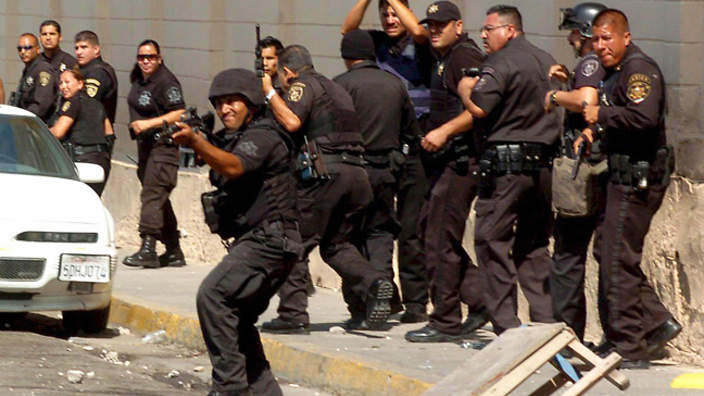
No fewer than 52 people have died and 12 others sustained various degrees of injury in a riot at the Topo Chico prison in Monterrey, Mexico yesterday. This is coming just a week to the visit to Mexico of Pope Francis, especially to prison in the nearby Ciudad Juarez.
The violent riot and a fire in the Monterrey prison was confirmed by Nuevo Leon governor Jaime Rodriguez.
The fight reportedly began between two members of different factions; one led by a member of the notorious Zetas drug cartel. Authorities believe the fire might have been initiated as a distraction to attempt an escape, but assure that no inmates fled the prison’s facilities.
The Civil Police Force and the Mexican Army reportedly controlled the incident, after being sent to surround the prison and contain the damages inside.
It was learnt that after the news broke, hundreds of family members rushed to the gates of Topo Chico demanding information about their loved ones who were still inside.
“I want to know that my daughter is OK. She is in the infirmary. There are children in there,” one woman said.
So far authorities have not confirmed if this will change the Pontiff’s agenda. [myad]
Teachers are the most important persons in anyone’s life. Teachers teach us everything that we know. They inspire us. They leave their imprints, almost like genetic imprints in our lives, and those imprints survive forever. They come in different shapes. The teachers in the classrooms, the ones we meet in our life-long journey of searching and probing. The ones who cross our paths and leave indelible marks.
Even more importantly, the ones that do not carry dusters and chalks but whose lives redefine ours, changing us for better, for real. They write and we read their words and thoughts, or we even just hear about them and their works, and we are recruited as disciples for as long as we live. They could be formal teachers or village elders, raconteurs, musicians, dancers, grandmothers and grandfathers or writers and scientists, but they change us all the same, because the truth is that as we grow, we contend with a multiplicity of influences, and we get influenced, re-born, re-made.
All teachers inspire us with words, with methods, with what they say and what they do, and in the process, they help the world to forge ahead, they extend traditions and thoughts, and even if they never get the rewards that they deserve, they remain unforgettable all the same because teaching is one of the most divine of all professions. This then is a tribute to all teachers, all those illuminated souls who give, and nurture, so that others may grow. What has triggered these ruminations is the report of the death in the United Kingdom, this week, of Carol Dawes, a Jamaican-Nigerian mother, teacher, scholar and great influencer, at 84. Nigerian students of the dramatic arts in the 80s and 90s will remember Mama Dawes fondly, particularly her students and colleagues at the Universities of Port Harcourt, Ife and Calabar, and indeed everyone who was privileged to encounter her.
We never know initially, and we may never really know, but we end up knowing as human beings sooner or later, that life is a journey and that every encounter is a potential opportunity for learning, and that teachers are part of that graph. I have, speaking for myself, been through many journeys and like every one else I am a product of many inputs. I started my own journey with a woman called Iya Ayi, who took me from my parents at a tender age of two, and turned me into a rote-learning machine of alphabets and multiplications and everything else by the age of four. The fable as told was that I was so smart she had to tell my parents that I was ripe enough to go to formal school. There was probably some misjudgment there because today, I am still struggling to prove that I am actually smart. Many years later, I indeed recall the day I was taken to school and I kept failing the test, that old test of asking the child to put his hand across his head, to touch his ear.
If you could do that successfully, you were good enough to start school, but if your hand kept falling short, you’d be asked to go back home. It was Mrs Adewale’s class, Duro’s mother, and after every trial, my hand just could not touch my ear. My father had to confess that I was actually under-aged, but he insisted that I was good enough based on Iya Ayi’s recommendations. A quick test was arranged. The purpose was to make me compete with other children in the class. Two different tests, I was told, and I ended up beating the other students, the ones who had in fact spent some time in the class. That was how I started school. I don’t want to report that for the first few years of primary school life, I used to pee in my pants or waste too much time before telling the teacher I needed to go to the toilet often creating an embarrassing situation, but I was tolerated because I could get all the questions right, and lead the class.
Iya Ayi, when I see her these days, looks really elderly and tired, but she could teach me the alphabets at that time and was the instrument that got me going. Once school started, my elder brother, Alexander took over and I was never allowed to have peace. As young as I was, I was forced to learn the difference between various figures of speech and to differentiate between gerund and whatever. Every growing day was a punishment. Between my elder brother and my father, Temidire Coaching Class at Oke Bode got added to the bill, and there was a back up, Etiko Gambia Class. I was not allowed to breathe. I was forced to learn whatever was possible. Watching television was a sin. Football was meant for specially supervised occasions, and only with known children. Etiko Gambia was even a boxer.
The real teachers in every home, I am trying to say, are the parents, the patriarchs and the matriarchs, and as it happens it is God that decides what is best: the children of some of the most prominent people in Nigeria have ended up as charlatans, the children of nobodies have sat on the most important seats in the land. What makes the difference is the luck factor, perhaps, but life as we have seen is even far more than the luck factor. There is something extra and it is the teachers, the encounters we make in and out of our classrooms that make all the difference, the people who surround us, whose breath, whose inputs into our lives define us, the manner of our preparation. Teachers make the person. They create the universe into which we step and which we build into a personal whole.
One of them in my space just died. Mama Dawes we called her. She was a for many years a teacher at the University of Port Harcourt teaching Creative Arts alongside Ola Rotimi and others who turned the Crab Theatre into one of the most fertile, gestating grounds for many Nigerians who in later life would become star operators in the media, in advertising, political communication, public relations, drama and so on. Students of the performative arts across Nigeria knew Mama Dawes. Her students talked about her. Her colleagues respected her. In those days, every student of the dramatic arts had the opportunity of being taught by foreign experts who came to the country and willingly helped to nurture a Nigerian tradition, from Geoffrey Axworthy to Martin Banham, David Cook, to Dexter and Dani Lyndersay to Orwell Johnson, all the way down.
Mama Dawes soon showed up in my life as one of the readers and assessors of my postgraduate research. My MA thesis was sent to her and Professor Michael O’Neill then of the University of Dublin for independent assessment. Both of them came back with the verdict that the research was good enough to be awarded a Ph.D. Professor O’Neill told my supervisor, the late Professor Dapo Adelugba that he was willing to accept me as a Post-Doctoral Student almost immediately at the University of Dublin. We started processing the applications. But that didn’t go through.
This was in the days of serious minded teachers, and these ones were really serious minded. Professor Femi Osofisan, then Head of Department, and Adelugba were not the best of friends, but they always co-operated when it came to ensuring that every student got the best training possible under their care. They conspired with the external and internal examiners to push me through many extra miles, and get me onto the Ph.D programme. I was like a guinea pig. I discovered in the long run that even the Professors who had been asked to examine my MA thesis were part of the conspiracy. The day I saw the final report for the first time, signed by Professors Adelugba, Osofisan, Dan Izevbaye and Akanji Nasiru, I wept, surprised that these “wicked teachers” didn’t mean any harm after all! On Mama Dawes, here is an instructive obituary written by Dani Lyndersay who, along with another Nigerian legend, Dexter Lyndersay, was my teacher, much earlier, at the University of Calabar:
Carroll Dawes, legendary theatre director, scholar and teacher, who is generally recognised as one of the most influential and innovative theatre directors Jamaica has produced, died early on Monday [08.02.16] (on the eve of her 84th birthday) at her home in London, England, after a long illness. Her daughter, Gwyneth Dawes, was by her side. One of the early directors of studies at the Jamaica School of Drama, Dawes oversaw the building of the School of Drama at its present location, produced its first curriculum, and formed its first student company, the National Festival Theatre of Jamaica.
“A highly celebrated director of what are often cited as definitive stagings of some of the world’s greatest plays (from Shakespeare to Ibsen to Brecht) seen in Jamaica, Dawes directed critically acclaimed productions of plays by, among others, Derek Walcott, Dennis Scott, and Wole Soyinka. She left Jamaica in 1977 and relocated to Nigeria, where she taught at several universities, including Ibadan, Ile-Ife, and Calabar. She retired in 1992 and settled in England, where she lived until her passing. Dawes was born Carroll Cecily Morrison on February 3, 1932, in Hopewell, Hanover, to Cleveland Morrison, an education officer and former vice-president of the Jamaica Union of Teachers (now Jamaica Teachers’ Association), and Vivienne Maud Morrison, a teacher.
After completing her education at the St Hilda’s Diocesan High School in 1950, she won a scholarship to the newly formed University College of the West Indies. In 1955, she married Jamaican poet and novelist Neville Dawes, and the two had a daughter, Gwyneth, before their divorce in 1957. Dawes would go on to secure her Master of Fine Arts in Directing and her Doctor of Fine Arts in Theatre History at the Yale School of Drama in 1971, and even before this, had built an enviable reputation as one of the most innovative and gifted theatre artistes in Jamaica from 1950 onwards. In 1980, she was the recipient of the Institute of Jamaica’s Centenary Medal in Theatre Arts…”
It is a pity they don’t quite make teachers like that anymore. Her likes in various disciplines deserve to be identified and honoured by the Nigerian government or the various institutions they were associated with. There are so many of them, who returned to Africa to make a difference, and whose stories still need to be properly told. Mama Dawes will be greatly missed. Thank you, great teacher. May your soul find peace in the path of eternal illumination. [myad]
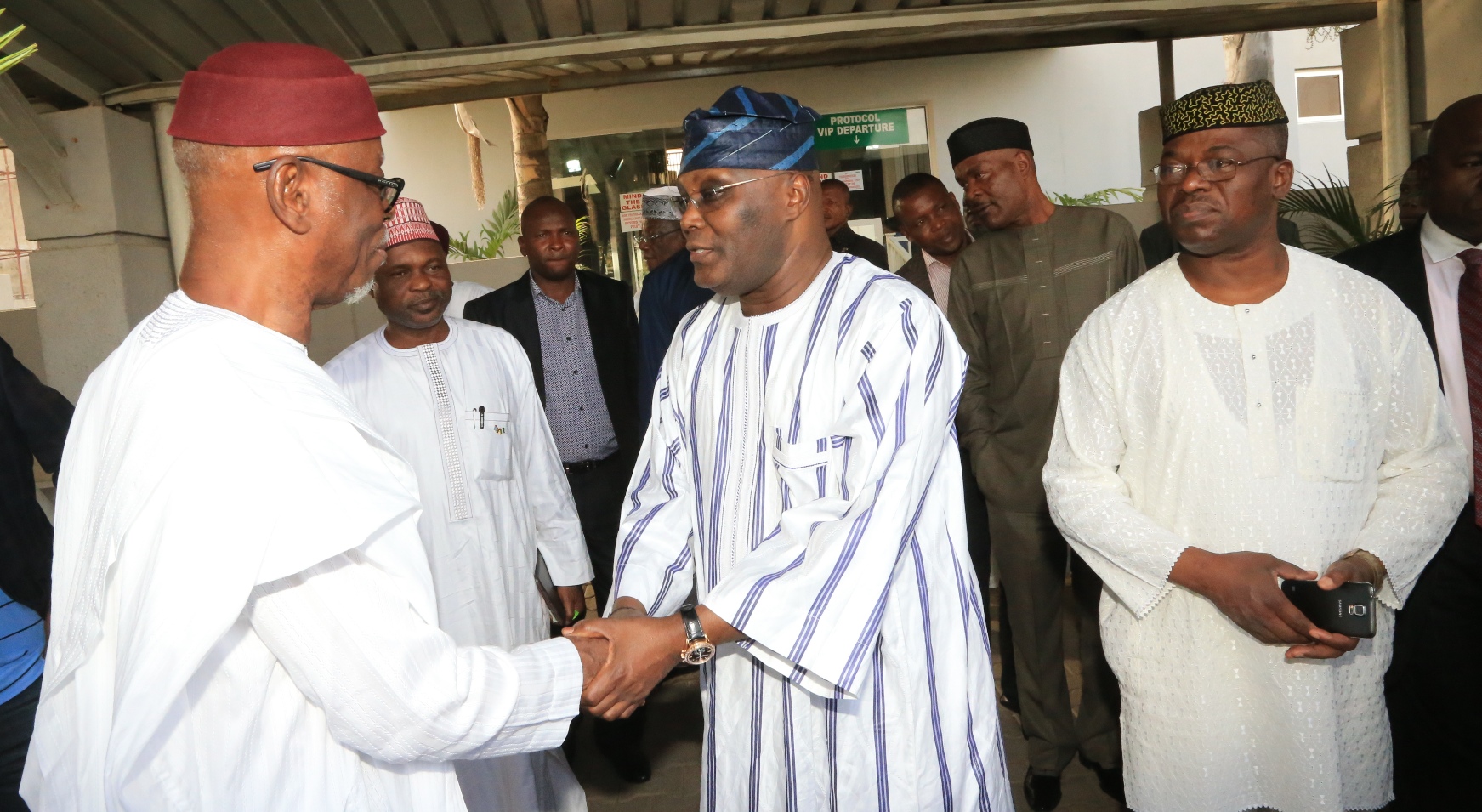
Former Vice President and chieftain of the All Progressives Congress (APC), Atiku Abubakar and National Chairman of the party, Chief John Odigie Oyegun on their arrival from different destinations at Nnamdi Azikiwe International Airport, Abuja. [myad]
The Nigeria judiciary has hit back at critics who recently made disparaging comments on the Supreme Court judgment especially on the governorship elections’ appeal from some states.
The Chief Justice of Nigeria (CJN), Mahmud Mohammed, kick-started the bashing of the critics of the judicial officers. He referred to those who accused the judicial officers of corruption as being inconsiderate and ignorant of how the judiciary operates.
Justice Mohammed, who is retiring from the judiciary after 38 years of service at a special valedictory session held in his honour said that such criticisms are made without due considerations of the law and the system of government in the country.
He said that the judiciary is duty bound to act and would continue to act in accordance with the dictates of the law as it stands and not as its critics would want it to be.
Also, , the President of the Nigerian Bar Association (NBA), Augustine Alegeh (SAN) condemned in strong terms, the criticism of the Nigerian judiciary.
The NBA President described the act as “a deliberate attempt to disparage the judiciary.” [myad]
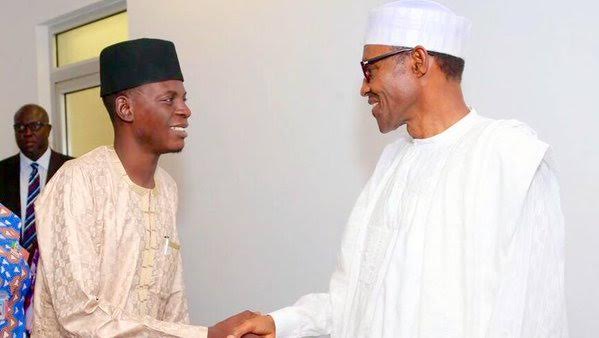
President Muhammadu Buhari has appointed Bashir Ahmad as his Personal Assistant on social media, including online newspapers.
The 24-year-old Muhammadu is an indigene of Kano state who until his appointment today, was the Online Editor (Hausa) for Leadership Newspaper. He graduated from Bayero University Kano(BUK) in 2013, with Bachelor of Arts in Mass Communications.
He worked as an online editor and reporter at Rariya Hausa Newspaper, before joining Leadership as an online editor.
Until his appointment, Bashir also worked as the personal assistant on new media to Sam Nda-Isaiah, the publisher of Leadership, who contested the primary election of the All Progressives Congress (APC) along President Buhari for the 2015 general election.
He later served at the Buhari Support Organization (BSO) prior to the presidential elections.
The new presidential aide will oversee Buhari’s communication on social media and related platforms. [myad]
The Wife of the President, Hajiya Aisha Muhammadu Buhari has made it clear that she is proud to be a Nigerian in view of the integrated nature of families.
“I am proud to be a Nigerian seeing how fellow Nigerians are diligently working to provide care for the sick and less privileged gives me a lot of joy and hope. I wish this kind of Primary HealthCare Centre I have seen today in Dutse can be replicated throughout Nigeria”. Aisha Buhari, spoke through Mrs. Dolapo Osinbajo, wife of Vice President Yemi Osinbajo today when the FCT Minister, Malam Muhammad Musa Bello led her and the Wife of visiting German President, Danielle Schadt on a facility tour of the Primary HealthCare Centre in Dutse-Makaranta, a suburb of Abuja city.
The President’s wife described Nigeria as a family-focused family country where children and mothers are at the centre even as she commended the FCT Administration for establishing such a befitting healthcare centre for the rural dwellers.
She asked state governments across the country to take step towards replicating such facilities in their various localities to improve the health standard of the people. Also speaking, the Wife of the German President, Danielle Schadt confessed that she has personal attachment to healthcare facilities, particularly for children and women. Mrs. Schadt said that she is proud of Nigeria for standing up firm and eradicating polio from the country.
She asserted: “the health of the children and mothers remain the future of any country.” According to her, the Primary Healthcare facility is one of the bases of building up a strong society and therefore encouraged the government to continue in this direction. Welcoming guests, the FCT Minister, Malam Muhammad Musa Bello who was represented at the occasion by the FCT Permanent Secretary, Dr. Babatope Ajakaiye, said that the FCT Administration has done a lot for the health and well being of the children and mothers especially in its school feeding programme. The Minister announced that FCT Administration would soon commence drastic work on all Primary Healthcare Centres across the Territory, emphasizing that healthcare provision remains the focus of his Administration. He assured that the FCT Administration would do more to improve the quality of healthcare of children and mothers and that it had over 215 Primary Health Care facilities across the Territory. Muhammad Bello used the occasion to call on the traditional rulers, community and religious leaders to continue to sensitize their wards to come out en-masse and take advantage of the Primary HealthCare facilities provided by the FCT Administration in their localities. [myad]
We use cookies on our website to give you the most relevant experience by remembering your preferences and repeat visits. By clicking “Accept”, you consent to the use of ALL the cookies.
This website uses cookies to improve your experience while you navigate through the website. Out of these, the cookies that are categorized as necessary are stored on your browser as they are essential for the working of basic functionalities of the website. We also use third-party cookies that help us analyze and understand how you use this website. These cookies will be stored in your browser only with your consent. You also have the option to opt-out of these cookies. But opting out of some of these cookies may affect your browsing experience.
Necessary cookies are absolutely essential for the website to function properly. This category only includes cookies that ensures basic functionalities and security features of the website. These cookies do not store any personal information.
Any cookies that may not be particularly necessary for the website to function and is used specifically to collect user personal data via analytics, ads, other embedded contents are termed as non-necessary cookies. It is mandatory to procure user consent prior to running these cookies on your website.



 Candidate of All Progressives Congress (APC) in the February 20 senatorial rerun election in Benue South Senatorial District, Comrade Daniel Onjeh has alleged that his opponent, Senator David Mark of the Peoples Democratic Party (PDP) is turning the area into a theatre of war.





A Story Around Mama Dawes, By Reuben Abati
Teachers are the most important persons in anyone’s life. Teachers teach us everything that we know. They inspire us. They leave their imprints, almost like genetic imprints in our lives, and those imprints survive forever. They come in different shapes. The teachers in the classrooms, the ones we meet in our life-long journey of searching and probing. The ones who cross our paths and leave indelible marks.
Even more importantly, the ones that do not carry dusters and chalks but whose lives redefine ours, changing us for better, for real. They write and we read their words and thoughts, or we even just hear about them and their works, and we are recruited as disciples for as long as we live. They could be formal teachers or village elders, raconteurs, musicians, dancers, grandmothers and grandfathers or writers and scientists, but they change us all the same, because the truth is that as we grow, we contend with a multiplicity of influences, and we get influenced, re-born, re-made.
All teachers inspire us with words, with methods, with what they say and what they do, and in the process, they help the world to forge ahead, they extend traditions and thoughts, and even if they never get the rewards that they deserve, they remain unforgettable all the same because teaching is one of the most divine of all professions. This then is a tribute to all teachers, all those illuminated souls who give, and nurture, so that others may grow. What has triggered these ruminations is the report of the death in the United Kingdom, this week, of Carol Dawes, a Jamaican-Nigerian mother, teacher, scholar and great influencer, at 84. Nigerian students of the dramatic arts in the 80s and 90s will remember Mama Dawes fondly, particularly her students and colleagues at the Universities of Port Harcourt, Ife and Calabar, and indeed everyone who was privileged to encounter her.
We never know initially, and we may never really know, but we end up knowing as human beings sooner or later, that life is a journey and that every encounter is a potential opportunity for learning, and that teachers are part of that graph. I have, speaking for myself, been through many journeys and like every one else I am a product of many inputs. I started my own journey with a woman called Iya Ayi, who took me from my parents at a tender age of two, and turned me into a rote-learning machine of alphabets and multiplications and everything else by the age of four. The fable as told was that I was so smart she had to tell my parents that I was ripe enough to go to formal school. There was probably some misjudgment there because today, I am still struggling to prove that I am actually smart. Many years later, I indeed recall the day I was taken to school and I kept failing the test, that old test of asking the child to put his hand across his head, to touch his ear.
If you could do that successfully, you were good enough to start school, but if your hand kept falling short, you’d be asked to go back home. It was Mrs Adewale’s class, Duro’s mother, and after every trial, my hand just could not touch my ear. My father had to confess that I was actually under-aged, but he insisted that I was good enough based on Iya Ayi’s recommendations. A quick test was arranged. The purpose was to make me compete with other children in the class. Two different tests, I was told, and I ended up beating the other students, the ones who had in fact spent some time in the class. That was how I started school. I don’t want to report that for the first few years of primary school life, I used to pee in my pants or waste too much time before telling the teacher I needed to go to the toilet often creating an embarrassing situation, but I was tolerated because I could get all the questions right, and lead the class.
Iya Ayi, when I see her these days, looks really elderly and tired, but she could teach me the alphabets at that time and was the instrument that got me going. Once school started, my elder brother, Alexander took over and I was never allowed to have peace. As young as I was, I was forced to learn the difference between various figures of speech and to differentiate between gerund and whatever. Every growing day was a punishment. Between my elder brother and my father, Temidire Coaching Class at Oke Bode got added to the bill, and there was a back up, Etiko Gambia Class. I was not allowed to breathe. I was forced to learn whatever was possible. Watching television was a sin. Football was meant for specially supervised occasions, and only with known children. Etiko Gambia was even a boxer.
The real teachers in every home, I am trying to say, are the parents, the patriarchs and the matriarchs, and as it happens it is God that decides what is best: the children of some of the most prominent people in Nigeria have ended up as charlatans, the children of nobodies have sat on the most important seats in the land. What makes the difference is the luck factor, perhaps, but life as we have seen is even far more than the luck factor. There is something extra and it is the teachers, the encounters we make in and out of our classrooms that make all the difference, the people who surround us, whose breath, whose inputs into our lives define us, the manner of our preparation. Teachers make the person. They create the universe into which we step and which we build into a personal whole.
One of them in my space just died. Mama Dawes we called her. She was a for many years a teacher at the University of Port Harcourt teaching Creative Arts alongside Ola Rotimi and others who turned the Crab Theatre into one of the most fertile, gestating grounds for many Nigerians who in later life would become star operators in the media, in advertising, political communication, public relations, drama and so on. Students of the performative arts across Nigeria knew Mama Dawes. Her students talked about her. Her colleagues respected her. In those days, every student of the dramatic arts had the opportunity of being taught by foreign experts who came to the country and willingly helped to nurture a Nigerian tradition, from Geoffrey Axworthy to Martin Banham, David Cook, to Dexter and Dani Lyndersay to Orwell Johnson, all the way down.
Mama Dawes soon showed up in my life as one of the readers and assessors of my postgraduate research. My MA thesis was sent to her and Professor Michael O’Neill then of the University of Dublin for independent assessment. Both of them came back with the verdict that the research was good enough to be awarded a Ph.D. Professor O’Neill told my supervisor, the late Professor Dapo Adelugba that he was willing to accept me as a Post-Doctoral Student almost immediately at the University of Dublin. We started processing the applications. But that didn’t go through.
This was in the days of serious minded teachers, and these ones were really serious minded. Professor Femi Osofisan, then Head of Department, and Adelugba were not the best of friends, but they always co-operated when it came to ensuring that every student got the best training possible under their care. They conspired with the external and internal examiners to push me through many extra miles, and get me onto the Ph.D programme. I was like a guinea pig. I discovered in the long run that even the Professors who had been asked to examine my MA thesis were part of the conspiracy. The day I saw the final report for the first time, signed by Professors Adelugba, Osofisan, Dan Izevbaye and Akanji Nasiru, I wept, surprised that these “wicked teachers” didn’t mean any harm after all! On Mama Dawes, here is an instructive obituary written by Dani Lyndersay who, along with another Nigerian legend, Dexter Lyndersay, was my teacher, much earlier, at the University of Calabar:
Carroll Dawes, legendary theatre director, scholar and teacher, who is generally recognised as one of the most influential and innovative theatre directors Jamaica has produced, died early on Monday [08.02.16] (on the eve of her 84th birthday) at her home in London, England, after a long illness. Her daughter, Gwyneth Dawes, was by her side. One of the early directors of studies at the Jamaica School of Drama, Dawes oversaw the building of the School of Drama at its present location, produced its first curriculum, and formed its first student company, the National Festival Theatre of Jamaica.
“A highly celebrated director of what are often cited as definitive stagings of some of the world’s greatest plays (from Shakespeare to Ibsen to Brecht) seen in Jamaica, Dawes directed critically acclaimed productions of plays by, among others, Derek Walcott, Dennis Scott, and Wole Soyinka. She left Jamaica in 1977 and relocated to Nigeria, where she taught at several universities, including Ibadan, Ile-Ife, and Calabar. She retired in 1992 and settled in England, where she lived until her passing. Dawes was born Carroll Cecily Morrison on February 3, 1932, in Hopewell, Hanover, to Cleveland Morrison, an education officer and former vice-president of the Jamaica Union of Teachers (now Jamaica Teachers’ Association), and Vivienne Maud Morrison, a teacher.
After completing her education at the St Hilda’s Diocesan High School in 1950, she won a scholarship to the newly formed University College of the West Indies. In 1955, she married Jamaican poet and novelist Neville Dawes, and the two had a daughter, Gwyneth, before their divorce in 1957. Dawes would go on to secure her Master of Fine Arts in Directing and her Doctor of Fine Arts in Theatre History at the Yale School of Drama in 1971, and even before this, had built an enviable reputation as one of the most innovative and gifted theatre artistes in Jamaica from 1950 onwards. In 1980, she was the recipient of the Institute of Jamaica’s Centenary Medal in Theatre Arts…”
It is a pity they don’t quite make teachers like that anymore. Her likes in various disciplines deserve to be identified and honoured by the Nigerian government or the various institutions they were associated with. There are so many of them, who returned to Africa to make a difference, and whose stories still need to be properly told. Mama Dawes will be greatly missed. Thank you, great teacher. May your soul find peace in the path of eternal illumination. [myad]