Home Blog Page 1991

Why We Must Not Fail The War On Corruption, Lai Mohammed Tells Online Publishers

Lai Mohammed 2Minister of Information and Culture, Alhaji Lai Mohammed has made it clear that the current war against corruption being waged by President Muhammadu Buhari must not fail.

He told members of the Guild of Corporate Online Publishers (GOCOP) in Lagos today that the current war against corruption “is not Buhari’s war. This is not APC’s war. This is Nigeria’s war and failure is not an option.”
Lai Mohammed who said he had earlier met with other stakeholders in the information dissemination outfits across the country emphasized that if the corruption is not fought to a stand-still “nothing, not even the 2016 budget, will succeed. As President Muhammadu Buhari has aptly said, if we do not kill corruption, corruption will kill us. President Buhari is leading the war against corruption right from the front, and we implore all Nigerians to support him. We appeal to you, online publishers, to support this war by ensuring that Nigerians are well informed about the evils of corruption.”

Part of the speech he delivered at the meeting goes thus:

On Thursday, that is yesterday, I met with Newspaper Columnists and today it is the turn of Online Publishers.
Gentlemen, you occupy a very unique place in the new information architecture called the
New Media, or the Social Media if you like. You serve the news hot and fresh, and as it breaks. In other words, unlike in the past when we all had to wait for the next day to pick up the newspapers, or to wait for the next radio and television broadcast, in order to keep abreast of the latest news, your own publications are always available, always fresh with the news, pictures of events, cartoons, illustrations, etc.  Some of you even deliver the news to us via emails, meaning we don’t even have to visit your websites to get the latest information. While this provides a good opportunity for people to keep up with the news, it also demands a lot of responsibility from you to ensure the accuracy of your facts and figures. I can say that most of you have acquitted yourselves creditably, and I congratulate you.
Since it is relatively easier to set up an online publication, compared to the establishment of traditional newspapers, and because of the citizens’ increasing hunger for information, the number of online publications has increased astronomically in recent times. In fact, some traditional newspapers and other publications have jettisoned the old format and are now exclusively publishing online. The growth of the online publications is a healthy development.
Let me assure you all that the Federal Government has no intention whatsoever to regulate online publications. We believe that you, the publishers, are responsible enough to self-regulate in order to ensure your continued survival. If the online publications suffer credibility problems, they stand the risk of losing the confidence of their audience and the advertisers who provide the lifeblood for the publications’ survival. On the other hand, if they maintain their credibility, their survival guaranteed. In other words, credibility is at the very core of your survival. My hunch is that we will see more growth in the number of online publications in the days ahead, but only the credible ones will continue to enjoy patronage – either from the readers or from the advertisers.
On our part, as a government, it is in our interest that online publications continue to grow in leaps and bounds, This is because the more the number of such online publications, the easier it becomes to bridge the information gap between the government and the governed, and the easier it becomes for the government to carry the citizens along in the formulation and implementation of policies that touch on their lives. Let me assure you that we will do our own bit to ensure your survival, especially by ensuring that online publications are also given a chunk of available advertisements. All we ask for, in return, is that you provide accurate information to the people, and avoid sensationalism and partisanship.
May I use this opportunity to thank you all for the generous play you have been giving to our press releases and pictures in your various publications. This has gone a long way in ensuring a free flow of information from the government to the people, and also in deepening national discourse.
Gentlemen, we are also using this platform to seek your cooperation with us to ensure the success of the various campaigns that we have launched or are planning to launch. The National Security Awareness Campaign, aimed at rallying the support of Nigerians for the war on terror, is ongoing. Also, the National Sensitization Campaign against Corruption was formally launched in Abuja on Monday, and it is aimed at rallying Nigerians against the canker-worm of corruption which has eaten deep into the fabric of our society. We are also preparing to launch a National Re-orientation Campaign, which is tagged ‘CHANGE BEGINS WITH ME’, to achieve a paradigm shift in the way we do things. At the heart of this campaign is the belief that the change you all yearn for begins with you!
Talking about the war against corruption, you are very much aware that this is one of the cardinal programmes of the Buhari Administration. Some have said the government is dwelling too much on the war against corruption to the detriment of other areas of governance. Our response to that is that indeed, there is nothing like dwelling too much on this war, which is a war of survival for our nation. The situation is grim, very grim indeed, as far as corruption is concerned. That is why the Federal Government is embarking on this sensitization Campaign Our approach is not to vilify anyone but to use facts and figures to give Nigerians a sense of the cost of corruption.
When the money meant to construct roads are embezzled or misappropriated, the end results are that the roads are not built and the people suffer and even die in avoidable road accidents. When the money meant for education is looted, we are unable to provide quality education for our children. When the money meant to fight terrorism is looted or diverted for prayers, publicity, purchase of land for maritime university or simply to rally support for a political party, soldiers die needlessly, hordes of widows emerge and people are pushed from their communities to IDP camps. These, in stark reality, are the costs of corruption. We must give a face to corruption and stop talking about it in the abstract. Nigerians must know that when they celebrate corrupt people, they are celebrating their own deprivations, the denial of the dividends of democracy and the endemic poverty in our society.
It is not an accident that whereas our national budget has grown from just over 900 billion Naira in 1999 to over 6 trillion Naira in 2016, poverty has also grown almost in direct proportion. The simple reason is that appropriated funds have ended up in the pockets of a few. Our disclosure on Monday, that 55 people are alleged to have stolen 1.34 trillion Naira of public funds between 2006 and 2013 have elicited strong reactions. But those figures are real, and those involved are currently before the courts. They know themselves, even if some of them have chosen to play to the gallery, as they are wont to do. The details, including the names of those involved, the prosecutors, the specific charges and the amount allegedly stolen by the individuals, are in the public domain for anyone who cares to search for them.
In announcing the figures last Monday, we did say that if we could get back into the system just one third of the allegedly stolen funds, we would be able to construct 635 kilometres of dual-carriage roads, educate 3,974 children from primary to tertiary level at the cost of 25.24 million per child, build 20,062 units of 2-bedroom housing units, build one ultra modern hospital in each of the 36 states of the Federation and build 183 schools. These figures were not concocted. They were arrived at, using World Bank rates and costs. They represent the costs of corruption.
In pursuance of our new strategy of putting emphasis on the cost of corruption, let me give you more to chew on today. Let us do a comparative analysis of the number of Dasukigate beneficiaries and amount they collected from the office of the National Security Adviser in 2015 on one hand, and the list of projects and amount across the nation in the Zonal Intervention project of 2015 appropriation act.
Whereas the sum of 51.829 billion Naira was appropriated for 1,278 projects in the Zonal Intervention Projects for 2015, a total of 21 individuals and companies benefited from the Dasukigate to the tune of 54.659 billion Naira as we know so far. The implication, therefore, is that the amount received by 21 individuals and companies is more than the 2015 Zonal Intervention Project budget by 2.829 billion Naira! Furthermore, the value of what beneficiaries of Dasukigate contributed to development is zero, compared to how the lives of Nigerians would have been transformed, poverty reduced and livelihoods improved by the Zonal Intervention Projects which – as we have shown – would have cost 2.829 billion Naira less than Dasukigate. This is another huge cost of corruption. For those who will want to know the source of our information, I say the data on the 2015 budget and zonal intervention appropriations can be found on the National Budget Office website.
Gentlemen, this is the stark reality about the level of corruption we face in our country today. Nothing, not even the 2016 budget, will succeed if we do not tackle corruption. As President Muhammadu Buhari has aptly said, if we do not kill corruption, corruption will kill us. President Buhari is leading the war against corruption right from the front, and we implore all Nigerians to support him. We appeal to you, online publishers, to support this war by ensuring that Nigerians are well informed about the evils of corruption. This is not Buhari’s war. This is not APC’s war. This is Nigeria’s war and failure is not an option.
Once again, I thank you all for honouring our invitation. I will now take your questions.
. Being a speech by the Minister of Information and Culture, Alhaji Lai Mohammed, at his meeting with Online Publishers in Lagos on January 22, 2016.
Why we won’t gag the social media, by Lai Mohammed
Good morning gentlemen, and thank you for honouring our invitation to this meeting, which is in continuation of my consultation with key stakeholders in the Information and Culture sector. Since assuming office last November, I have met with a number of stakeholders including the Broadcasting Organization of Nigeria, Nigeria Union of Journalists, Nigerian Guild of Editors, Nigerian Association of Women Journalists, Radio, Television and Theatre Arts Workers Union as well as Civil Society Organizations (CSOs). The meetings are aimed at ensuring that all stakeholders are carried along in the formulation and implementation of relevant policies, and to also bridge the information gap between the government and the people. On Thursday, that is yesterday, I met with Newspaper Columnists and today it is the turn of Online Publishers.
Gentlemen, you occupy a very unique place in the new information architecture called the
New Media, or the Social Media if you like. You serve the news hot and fresh, and as it breaks. In other words, unlike in the past when we all had to wait for the next day to pick up the newspapers, or to wait for the next radio and television broadcast, in order to keep abreast of the latest news, your own publications are always available, always fresh wih the news, pictures of events, cartoons, illustrations, etc.  Some of you even deliver the news to us via emails, meaning we don’t even have to visit your websites to get the latest information. While this provides a good opportunity for people to keep up with the news, it also demands a lot of responsibility from you to ensure the accuracy of your facts and figures. I can say that most of you have acquitted yourselves creditably, and I congratulate you.
Since it is relatively easier to set up an online publication, compared to the establishment of traditional newspapers, and because of the citizens’ increasing hunger for information, the number of online publications has increased astronomically in recent times. In fact, some traditional newspapers and other publications have jettisoned the old format and are now exclusively publishing online. The growth of the online publications is a healthy development.
Let me assure you all that the Federal Government has no intention whatsoever to regulate online publications. We believe that you, the publishers, are responsible enough to self-regulate in order to ensure your continued survival. If the online publications suffer credibility problems, they stand the risk of losing the confidence of their audience and the advertisers who provide the lifeblood for the publications’ survival. On the other hand, if they maintain their credibility, their survival guaranteed. In other words, credibility is at the very core of your survival. My hunch is that we will see more growth in the number of online publications in the days ahead, but only the credible ones will continue to enjoy patronage – either from the readers or from the advertisers.
On our part, as a government, it is in our interest that online publications continue to grow in leaps and bounds, This is because the more the number of such online publications, the easier it becomes to bridge the information gap between the government and the governed, and the easier it becomes for the government to carry the citizens along in the formulation and implementation of policies that touch on their lives. Let me assure you that we will do our own bit to ensure your survival, especially by ensuring that online publications are also given a chunk of available advertisements. All we ask for, in return, is that you provide accurate information to the people, and avoid sensationalism and partisanship.
May I use this opportunity to thank you all for the generous play you have been giving to our press releases and pictures in your various publications. This has gone a long way in ensuring a free flow of information from the government to the people, and also in deepening national discourse.
Gentlemen, we are also using this platform to seek your cooperation with us to ensure the success of the various campaigns that we have launched or are planning to launch. The National Security Awareness Campaign, aimed at rallying the support of Nigerians for the war on terror, is ongoing. Also, the National Sensitization Campaign against Corruption was formally launched in Abuja on Monday, and it is aimed at rallying Nigerians against the cankerworm of corruption which has eaten deep into the fabric of our society. We are also preparing to launch a National Re-orientation Campaign, which is tagged ‘CHANGE BEGINS WITH ME’, to achieve a paradigm shift in the way we do things. At the heart of this campaign is the belief that the change you all yearn for begins with you!
Talking about the war against corruption, you are very much aware that this is one of the cardinal programmes of the Buhari Administration. Some have said the government is dwelling too much on the war against corruption to the detriment of other areas of governance. Our response to that is that indeed, there is nothing like dwelling too much on this war, which is a war of survival for our nation. The situation is grim, very grim indeed, as far as corruption is concerned. That is why the Federal Government is embarking on this sensitization Campaign Our approach is not to vilify anyone but to use facts and figures to give Nigerians a sense of the cost of corruption.
When the money meant to construct roads are embezzled or misappropriated, the end results are that the roads are not built and the people suffer and even die in avoidable road accidents. When the money meant for education is looted, we are unable to provide quality education for our children. When the money meant to fight terrorism is looted or diverted for prayers, publicity, purchase of land for maritime university or simply to rally support for a political party, soldiers die needlessly, hordes of widows emerge and people are pushed from their communities to IDP camps. These, in stark reality, are the costs of corruption. We must give a face to corruption and stop talking about it in the abstract. Nigerians must know that when they celebrate corrupt people, they are celebrating their own deprivations, the denial of the dividends of democracy and the endemic poverty in our society.
It is not an accident that whereas our national budget has grown from just over 900 billion Naira in 1999 to over 6 trillion Naira in 2016, poverty has also grown almost in direct proportion. The simple reason is that appropriated funds have ended up in the pockets of a few. Our disclosure on Monday, that 55 people are alleged to have stolen 1.34 trillion Naira of public funds between 2006 and 2013 have elicited strong reactions. But those figures are real, and those involved are currently before the courts. They know themselves, even if some of them have chosen to play to the gallery, as they are wont to do. The details, including the names of those involved, the prosecutors, the specific charges and the amount allegedly stolen by the indivuduals, are in the public domain for anyone who cares to search for them.
In announcing the figures last Monday, we did say that if we could get back into the system just one third of the allegedly stolen funds, we would be able to construct 635 kilometres of dual-carriage roads, educate 3,974 children from primary to tertiary level at the cost of 25.24 million per child, build 20,062 units of 2-bedroom housing units, build one ultra modern hospital in each of the 36 states of the Federation and build 183 schools. These figures were not concocted. They were arrived at, using World Bank rates and costs. They represent the costs of corruption.
In pursuance of our new strategy of putting emphasis on the cost of corruption, let me give you more to chew on today. Let us do a comparative analysis of the number of Dasukigate beneficiaries and amount they collected from the office of the National Security Adviser in 2015 on one hand, and the list of projects and amount across the nation in the Zonal Intervention project of 2015 appropriation act.
Whereas the sum of 51.829 billion Naira was appropriated for 1,278 projects in the Zonal Intervention Projects for 2015, a total of 21 individuals and companies benefited from the Dasukigate to the tune of 54.659 billion Naira as we know so far. The implication, therefore, is that the amount received by 21 individuals and companies is more than the 2015 Zonal Intervention Project budget by 2.829 billion Naira! Furthermore, the value of what beneficiaries of Dasukigate contributed to development is zero, compared to how the lives of Nigerians would have been transformed, poverty reduced and livelihoods improved by the Zonal Intervention Projects which – as we have shown – would have cost 2.829 billion Naira less than Dasukigate. This is another huge cost of corruption. For those who will want to know the source of our information, I say the data on the 2015 budget and zonal intervention appropriations can be found on the National Budget Office website.
Gentlemen, this is the stark reality about the level of corruption we face in our country today. Nothing, not even the 2016 budget, will succeed if we do not tackle corruption. As President Muhammadu Buhari has aptly said, if we do not kill corruption, corruption will kill us. President Buhari is leading the war against corruption right from the front, and we implore all Nigerians to support him. We appeal to you, online publishers, to support this war by ensuring that Nigerians are well informed about the evils of corruption. This is not Buhari’s war. This is not APC’s war. This is Nigeria’s war and failure is not an option.
Once again, I thank you all for honouring our invitation. [myad]

Buhari And Challenge Of Anti-Graft War, By Chukwudi Enekwechi

Buhari 1Until recently when former Military Governor of Kaduna State and a close political ally of President Muhammadu Buhari, Colonel Jafaru Isa (rtd), was arrested by the Economic and Financial Crimes Commission for alleged corruption, the Peoples Democratic Party had made it appear as if the administration’s anti-graft war centred around their own members. They spawned the idea that the war was meant to decimate the immediate past ruling party in the country.
As the war begins to widen, the anti-graft body has also just started the investigation of former Comptroller General of the Nigeria Customs Service, Alhaji Abdullahi Inde Dikko. For the avoidance of doubt, Dikko is of the same Katsina State origin like President Buhari.
Therefore, everyone is now left in no doubt that there is no tinge of nepotism or witch-hunt in the war against corruption. President Buhari has also used every available opportunity to reassure the nation that the fight against corruption will be holistic and bereft of any tendencies not in tandem with our constitution.
He has also pledged total commitment to the rule of law and not aimed at any particular individual, group, tribe or religion. Most Nigerians harboured no doubt about President Buhari’s good intentions to rid Nigeria’s landscape of the monster which continues to undermine the very fabric of societal growth.
Unfortunately, past administrations paid lip service to eradicating corruption, until President Buhari came into the saddle. With a track record of abhorrence for corrupt practices, Buhari had since his foray into public life hinged the poverty and unemployment prevalent in the land to the crass corruption pervading national life.
When he formally joined partisan politics, he had identified corruption, security and economy as the areas we must address frontally if we are to extricate the nation from the stranglehold of underdevelopment.
Over the next twelve years, he anchored his quest for presidency on the need to evolve a political system that will be shorn of primitive accumulation of wealth at the expense of the suffering masses. He continually advocated that our national wealth should cease to be siphoned by people in positions of authority. Unfortunately, this message did not sink in until recently when Nigerians bestowed upon him the sacred mandate to govern Nigeria.
Having emerged president, his administration is beginning to unearth the monumental sleaze that characterised the activities of government under the previous administration. In doing that, he has incurred the wrath of the opposition, even though misplaced which now is imputing witch-hunt in the fight against corruption. It is however a case of crying wolf where none exists considering that people are being picked up for the sins they have committed against the fatherland.
Is it not strange that at a time in our history when families were being dislocated, and many people killed on account of Boko Haram’s terrorists’ activities that certain individuals in positions of authority were diverting funds meant to contain the same menace? Certainly this is the highest level of insensitivity on the part of those being accused, more so when human lives were involved? This can be likened to a case of Nero making merry while Rome burned.
It is indeed a thing of joy that we have Buhari as Nigeria’s president today, or how could we have survived another four years of PDP’s misrule, and corruption-ridden government. It is sad that while millions of Nigerians wallow in abject poverty, want and penury, a few individuals were busy siphoning and sharing the national treasury at our own expense.
With the lamentations across the land over poverty, unemployment, power outages, bad roads, is it not only reasonable that we put a stop to the monumental sleaze? Rather than vilify Mr. President for waging a relentless war against corruption, we should join hands with him to eradicate it, or else it will jeopardise all efforts aimed at developing the nation for the good of all.
It is therefore curious that while the anti-graft war is ongoing, the sing-song of PDP and its cohorts has been to malign the person of Mr. President who has severally stated his avowed commitment to the rule of law and due process. This commitment is amply demonstrated in his neutrality in the day to day running of different government institutions such as EFCC, ICPC among others.
Furthermore, he had implored past public officials not to fear him as a person, but to fear the consequences of their past actions. Now, crime all over the world is a punishable offence, and it is not statue-barred. Therefore, PDP and its surrogates should desist from misleading Nigerians on the motive of Mr. President in fighting corruption to a standstill in Nigeria.
His decision to rid the country of corruption is not self-serving, as all Nigerians will be the ultimate beneficiary of the anti-graft war. President Buhari’s Spartan lifestyle, even while in the military is legendary, and no amount of attention diversion by PDP will hoodwink Nigerians into believing otherwise.
As Nigerians await more revelations on corrupt practices in the past administration, it is only expected that Mr. President and indeed the anti-graft agencies be given maximum cooperation by all Nigerians to discharge their onerous task. Unless we all embrace the fight against graft as a collective effort, we run the risk of exacerbating and worsening our economic woes which have been compounded with the global fall in oil prices. As a people, we have been inundated daily by the negative effects of corruption, and some of these include the beggars on our streets, dysfunctional hospitals and schools, infrastructural deficit among other problems. Now, the Buhari administration has undertaken to clean the Augean stable and this decision on the part of the president is novel and deserves the support of all and sundry.
It is really disheartening the level of impunity in terms of handling public funds in the preceding administration as the #Dasukigate revelations are now showing. A whopping $2.1Billion which was shared among friends and associates could have gone a long way to fix some major federal roads like Enugu-Onitsha, Enugu-Port Harcourt, railways, power and other public utilities, but unfortunately those in authority chose to embark on a bazaar of some sorts. In the process, they only rehabilitated some old politicians, friends and relations.
To rescue the country, President Buhari has relentlessly fought a battle to stop the monster known as corruption from endangering our existence as a country, and the benefits are numerous for our country. For instance, the multifaceted problems confronting Nigeria can be fixed if corruption is eliminated and all Nigerians will benefit immensely.
Therefore, all hands must be on deck for the fight against corruption to yield the desired result and no attempt should be made to blame the president, as he has always maintained that people had rather fear the consequences of their past actions, and not him as a person. This is what the rule of law is all about, and there ought not to be any misconceptions about his intentions.
. Enekwechi, an Abuja-based journalist and politician, writes from kwechis19@yahoo.com. [myad]


As Faleke Rejects Kogi Deputy Governorship, Lagos Rejects Him

Faleke 2Running mate to late Prince Abubakar Audu who was Kogi state governorship candidate of All Progressives Congress (APC) in the November 21 election, James Abiodun Faleke is now at a political cross road.
While he had bluntly refused to accept his party’s position that he should be sworn-in next Wednesday, January 27, as Deputy Governor to Alhaji Yahaya Bello who was picked to replace late Audu, a Peoples Democratic Party (PDP) candidate who contested the House of Representatives election for Ikeja federal constituency 1, Lagos state, Olakunle Okunola, has gone to court demanding that he should be sacked immediately from the National Assembly for alleged “double representative.”
In a suit marked FHC/L/CS/1680/15, Okunola is challenging the nomination of James Abiodun Faleke, by All Progressives Congress (APC), as its candidate for the House of Representatives election of March 28, 2015, representing the Ikeja Federal Constituency 1 of Lagos State.
Okunola is also challenging Faleke’ nomination by the APC, as deputy governorship candidate for the November 21, 2015, gubernatorial election of Kogi State, under the Ekinrin Ade Ward of Ijumu Local Government Area, Kogi state which he considers as a “violation of the law.”
Okunola is seeking an order of the court compelling Faleke to vacate his seat as a member of the House of Representatives, representing Ikeja Federal Constituency 1, forthwith from the date of the transfer of his membership and data by INEC from Lagos state to Kogi state.
He has requested for an order of perpetual injunction restraining the Independent National Electoral Commission (INEC) from any further reversal or transfer of Faleke’s voting and membership data from Ekinrin-Ade Ward in Ijumu LGA of Kogi state to the Ikeja Federal Constituency 1 of Lagos state.
Meanwhile, James Faleke has insisted that he would not be deputy to the governor-elect, Yahaya Bello. [myad]

I Have Come To Green Abuja – FCT Minister, Muhammad Bello

????????????????????????????????????

Minister of the Federal Capital Territory (FCT), Malam Muhammad Musa Bello has expressed the desire of his Administration to make Abuja a green city to reduce the effects of global climate change.
The Minister gave this indication today when he received the Minister and Minister of State, Federal Ministry of Environment who paid him a working visit in his office at Area 11, Garki I District, Abuja.
Muhammad Bello said that his Administration would leverage on the robust partnership with the Federal Ministry of Environment to make Abuja a model green city.
According to him, the 8,000 square kilometers of the Federal Capital Territory provides a large platform for the Federal Ministry of Environment to implement its greening initiative.
He said that there is the need for additional collaboration between the ministries to fast track sewer and solid waste management in the FCT.
Musa Bello said that the FCT Administration is exploring the possibility of establishing a biogas plant at Wupa Sewer Treatment plant.
“We intend to put a mechanism in place for solid waste separation for power generation and agricultural inputs.”
“The FCT Administration has realized that a large part of the Territory is a good forest but has been abused through felling of trees and therefore called on the Minister of Environment to see what they can do in arresting the damage done so far.”
The Minister remarked that Abuja represents the whole of Nigeria, hence the need to raise it to an international level.
Muhammad Bello reiterated that all policy initiatives of the Federal Ministry of Environment could have an expression in the Federal Capital Territory.
Responding, the Minister of Environment, Mrs. Amina Mohammed said that her vision for Abuja is that of a city of now and the future, which would be a model for other Nigerian cities.
The Minister said that her Ministry is working assiduously to tackle climate change, especially in weather patterns and rising sea levels in the country.
Mrs. Mohammed said that she is excited to use Abuja as a model for ECOWAS sub-region even as he advised the FCT Minister to look into the possibility of using electric vehicles under the FCT Transportation modules as a pilot scheme to curtail the rising level of air pollution from vehicular emissions.
The meeting was attended by the Minister of State, Federal Ministry of Environment, Alhaji Ibrahim Usman Jibril; FCT Permanent Secretary, Dr. Babatope Ajakaiye and some top government functionaries in the FCT Administration.  [myad]

2 Poultry Farms In Kuje Lose Over I Million Chickens To Bird Flu

Bird FluTwo poultry farms in Chibiri, Kuje Area Council of the Nigeria’s Federal Capital Territory (FCT) have lost a total of 1.1 million fowls and other birds as a result of bird flu attack.
They are Dansarki Poultry farm owned by a serving senator, Senator Maina Ma’aji Lawal and Premium Poultry Farm, owned by the chairman Board of Directors of the Sovereign Wealth Fund, Alhaji Mahey Rasheed.
The cost of the birds affected by the virus was said to be in the neighbourhood of N200 Million.
Information reaching us showed that while the Premium Farm lost a total of 750,000 assorted birds, Dansarki Farm lost about 350,000.
It was gathered that on noticing the attack of the bird flu, the two farms quickly disposed the chickens that were affected even as they distributed the ones that were yet to be affected, free to the people in the neighbourhood.

This is even as Kano State Government has announced the killing of over 120,000 birds since the outbreak of bird flu resurfaced in the state two weeks ago.
Dr. Shehu Bawa, the Director of Veterinary Services in the state Ministry of Agriculture and Natural Resources, said in an interview with the News Agency of Nigeria in Kano today that the birds were killed in 29 infected poultry farms across the state.
“As I am talking to you now, 29 farms were depopulated, while 11 samples have been sent to the National Veterinary Research Institute for confirmation.”
He said that his Department, in collaboration with the officials of the Poultry Farmers Association of Nigeria, would continue to sensitize farmers on the need to ensure a clean environment.
Bawa called on farmers who had yet to register with the ministry and the association to do so in their own interest.
“Any farmer who fails to abide by the order should have himself or herself to blame as he would not be considered for any compensation or support.”
The director, however, appealed to the Federal Government to assist the affected farmers to alleviate their sufferings.
The state government had last week released N3 million for the procurement of disinfectants to clean the affected farms. [myad]

Scammers Are Targeting Banks Directly In 2015, Expert Warned

Bolanle Omotoso“As you may be aware about two years ago the CBN mandated the entire banking industry to have anti-skimming devices against those who were skimming customers’ card and siphoning bank customer’s money. That was targeted at protecting the Bank customers; this has been achieved to a very large extent, as directed by the apex bank then. However, now that the CBN has taken the food from the mouth of the criminals, they will look for other means to eat, so we have seen ahead and discovered that the next crime the criminals will be committing is to take the attack directly to the banks. In the nearest future, the banks will be experiencing so many attacks, especially as it concerns the customers’ data and money. The criminals will be taking the money directly from the banks and not from the customers. For instance, there are situations already happening in Europe and some part of America, this started at Eastern Europe, whereby the ATMs would be dispensing cash without anybody inserting a card or its PIN. We are approaching some discerning banks, telling them the need to protect their ATM and other self service terminals. We are urging the banks not to wait till they see the attacks in Nigeria, before they will begin to protect their terminals, some of them are already responding. We hope to launch some of these products so that we can prevent banks from suffering some of these losses already suffered by Banks outside Nigeria. We also want to make the banks comply with some security standards, because digital crimes are a moving target, for the fact that you were secured yesterday doesn’t mean you are good for business today. So, we are expanding our service offerings from recovery to saving our customers’ data and to protecting the banks’ e-Channels business related transactions.”

Chief Executive officer (CEO) of Data Recovery Specialist Limited, Mr. Bolanle Omotosho, gave these details warning in an interview with ITPulse’s Martin Ekpeke. Excerpts:

Tell us briefly about Data Recovery and how you go about it?

Let me give a scientific definition of data recovery and then we go ahead to break it down. It can be defined as a scientific means of recovering seemingly lost information asset from digital storage devices. Seemingly lost in the sense that the information you think had been lost is actually not lost. What we do as a business is to assist organizations or individuals to recover a seemingly lost information asset from digital storage devices. The data is not lost unless we say so! That is our slogan.

How do you prevent data lost? Secondly, don’t you think cloud computing is gradually taking over your business?

One of the ways to prevent a data lost situation is to have a back up. You can have your physical back up in your office or keep it off-site. You can equally keep the information online as a data repository managed by a third party called service providers. Now, let’s talk about the cloud computing; it’s called cloud because you don’t see where your data is stored physically. The Internet is used to upload the data to the servers, which are outside your domain. That’s why it is called the cloud. Let me also inform you that when the Internet sends the information to the cloud, it goes to some peoples’ servers; nobody sends data into the sky. So, Cloud Computing is just a literary language, but because you don’t need to go to where the server is before accessing your information, it is then called cloud.

Apart from recovering lost data, don’t you think there is a need to consult with your client on proactive means for business continuity?

Yes! We do both reactive recovery and proactive data lost prevention services. Each time a customer comes to us, we always advise them of the need to be proactive. We did a serious recovery for a bank recently and they asked if there is no way we can prevent such incidents from happening, we told them we can help them set up a data loss prevention solution, such that, even if you suffer a data loss situation, the client would be able to recover it without calling us. It’s difficult to have a 100% data loss prevention solution, but what matters is the return time to operation, such that when a data loss happens, you would be able to return to work almost immediately. So, the essence of having a data loss prevention solution is to reduce your return to work time.

Can you say what you are doing is in compliance with privacy laws, because how do you confirm that the information you want to recover truly belongs to the person that has brought it to you?

We are an information security firm, and we understand what it means to protect privacy and confidentiality of information assets. Now, one of our policies is that when somebody brings in a device for data recovery, the person must give us a signed agreement showing the device actually belongs to him; and is being authorized to do the recovery on behalf of himself or the employer. We have terms and conditions that we operate with; one of such is that if a system has a password and you want us to remove the password, you must get an affidavit from the court to confirm that you truly own the device.

Can you mention any track record and success story?

We have a huge track record and success stories, but there would be no need to mention names to prevent negative interpretations that may be given to same. Meanwhile, there have been serious cases that we have been able to resolve; one of such was a case of a very big consulting firm, whose critical information assets were locked up in a hard drive of a laptop as a result of encryption, but we were able to decrypt the information asset after our normal diagnosis. There was also a government agency, who had taken information and images about houses and landscape in a particular state in the South-West Nigeria, but all of a sudden, the server where the information was stored crashed and became inaccessible. They called us and we were able to recover all the information for them within four days. We have also recovered critical information assets for several banks in the country. So, we have handled some landmark cases, even for the federal government, an agency in the Presidency was once our client.

What does the proliferation of Data Center mean for Nigeria?

What it will mean for Nigeria is that, over time, there will be a cost reduction on the part of business owners, who are required to have a Data Centre. Mind you, it’s not everybody that can afford a Data Center, but all the banks that you know have a disaster recovery center somewhere else as mandated by the Central Bank of Nigeria. I believe that as technology continues to evolve, and as data gets lighter on a daily basis, people will begin to subscribe to those Data Centre inasmuch as their privacy and confidentiality can be guaranteed.

What are the aspirations for this year 2016?

We intend to bring some partnership and innovative solutions to the market.

Any last word?

What I will add is that on a daily basis, frauds are being committed. At Data Recovery Specialist Limited, we have skills and solutions to mount on the network of an organization for the control unit to be monitoring to see who is trying to make some malicious transactions. We have solutions to discover already committed digital crimes; we also have a solution to detect crimes that are already being planned before they are executed. We also offer training services for corporate organization. And again, because prevention is cheaper and faster than cure, any organisation whose operations absolutely depend on systems must be ready to protect same and as well ensure the personnel are part of the protection chain simply because, unknowingly, a large number of crimes are committed and of course preventable, had it been the personnel knows the implications or his responsibilities at protecting the organisation he works with. [myad]

Digital Technology To Rake In $100 Trillion For Society, Business In 2025, By Oliver Cann

Oliver CannThe “combined value” to society and industry of the digitization that is already occurring in every industry could generate upwards of $100 trillion over the next 10 years, with society set to gain more than business. However, this transformation also brings with it risk, according to new research by the World Economic Forum.
With digitization affecting every industry and creating new ways of capturing and creating value, the research, which is part of the Forum’s Digital Transformation of Industries (DTI) project, focuses on the “combinatorial” effects of digital technologies – mobile, cloud, artificial intelligence, sensors and analytics, among others.
Examples of societal value generated by digitization include mass adoption of autonomous vehicles and usage-based car insurance, which could save up to 1 million lives a year worldwide by 2025. In the electricity sector, a cumulative reduction in carbon emissions worth $867 billion by 2025 could be achieved through the adoption of digital technologies, principally through smarter asset planning.
The pace of innovation can be illustrated by the fact that, while it used to take Fortune 500 companies an average of 20 years to reach a billion-dollar valuation; digital start-ups are reaching the same milestone in just four years. The research suggests that, once limitations preventing the mass-market commercialization of enabling technologies such as battery storage and wireless charging are overcome, the pace of change could accelerate.
However, the digital transformation of industries comes with risks attached that will require careful management by all stakeholder groups. One such risk is inequality, which could be exacerbated if access to digital skills is not made available to all. Another is trust, which has been eroded by growing concerns over data privacy and security. This will only be overcome with improved norms of ethical behaviour.
When it comes to business, benefits are by no means guaranteed. Conservative corporate cultures and short-termism combine, for example, to discourage many businesses from taking radical steps to disrupt their own industry by embracing new technologies. One example is electricity distribution, where few utilities have actively embarked on cannibalizing their legacy businesses by offering subsidized renewable technologies such as solar. This represents a missed opportunity, according to the DTI research – produced in collaboration with Accenture – as the pace and scale of societal gains from digital could be greater if driven by the innovation of incumbents than by the disruption introduced by new entrants
“Society and the environment stand to gain the greatest share of the rewards from digitization through improvements to welfare, health and other means. To capitalize fully, however, policy-makers must put in place an agile regulatory environment and incentive mechanisms that unlock investment, while businesses must fully embrace sustainable business practices. There is a win win for business and society if we can look beyond immediate commercial gain in favour of long term value creation,” said Mark Spelman, Co-Head, Future of the Internet Initiative, World Economic Forum.
“This in-depth industry analysis proves that there can be no business strategy today without digital strategy. Being digital means being ready to go beyond technology investments to embrace wider organizational and cultural change,” said Mark Knickrehm, Group Chief Executive, Accenture Strategy, Accenture, USA.

“To succeed, business leaders must be able to balance existing capabilities with big-bet investments in entirely new digital business models. And they must be prepared to take risks with partners across industry borders,” he said.
The DTI initiative serves as the focal point for new opportunities and themes arising from digitization. It has been informed by over 230 expert interviews from business, government and academia and engagement with more than 100 of the Forum’s Partner organizations.

About the Digital Transformation of Industries project
In 2015, the DTI project had two areas of focus. It developed detailed perspectives on the impact of digital technologies across six sectors – automotive, consumer industries, electricity, health, logistics and media – to identify key digital drivers and trends, outline industry-specific opportunities and risks, and calculate the sector-specific value-at-stake for business and society. The project also identified common digital patterns across industries and investigated key questions about them. The four cross-industry themes identified were Digital Consumption, Digital Enterprise, Societal Implications and Platform Governance.
In 2016, the initiative will focus on the impact of digital transformation on an additional 10 industries, further deep-dives into industries from this year’s project, and examine a number of cross-industry topics such as platform governance, societal impact, and policy and regulation.

Muslim Group Curses Treasury Looters: God Will Punish Them

Ahmaddiyya Muslim GroupThe Ahmadiyya Muslim Jama’at has cursed treasury looters and warned that if they do not return the money they stole from the nation’s treasury, God will punish them.

The group whose members commenced activities to mark its 100 years of existence in Nigeria and 127 years of the group’s establishment in the world, spoke against the background of the ongoing trial of many Nigerians over the $2.1 Billion meant to procure arms for the nation’s soldiers fighting Boko Haram in the North East.

The Head of the group in Nigeria, Mashuud Fashola, who addressed news men in Lagos further warned those he called “self centered Nigerians” who plundered the nation’s resources of the wrath of God, if they did not return the stolen commonwealth.

“When the United States said Nigeria government was not sincere in fighting insurgents then, we thought they didn’t want to help but with the Dasuki arms-gate saga, it shows they know what they were talking about.”

Fashola expressed appreciation to God for the growth of the Islamic organization in Nigeria since 1916 when it was introduced in the country.

The Missionary in Charge, Ahmadiyyah Muslim, Abdul-Khalique Sahib, prayed for peaceful coexistence in Nigeria and the current efforts to combat the Lassa fever epidemic. [myad]

Drama In Ibadan As 2 Ruling Houses Fight Over Who Ascends Stool Of Olubadan

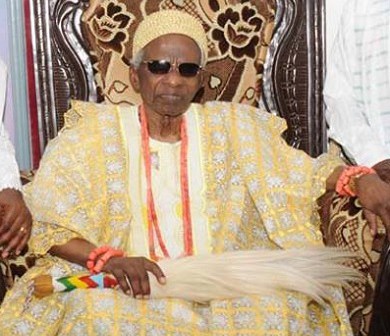
Late OlubadanWith the demise on Tuesday, of the 101 year old Oba Samuel Odugade, the Olubadan of Ibadan for 80 years, a stage is set for a fight between two royal Houses over who ascend the throne.

While the head of Seriki family has asked the Olubadan-in-Council to install Chief Adebayo Oyediji as the new Olubadan, the Balogun Olubadan House is insisting that it is its turn to present High Chief Saliu Adetunji for the throne, arguing that it is kin consonance with Ibadan succession system.

Oyediji, 89, had argued that the Olubadan-in-Council would be flouting a 1989 ruling of the Supreme Court, which granted him the right to become the next king of Ibadan after Oba Odugade’s reign if it crowned 87-year-old Adetunji as the new Ibadan king.
He had said: “I am the next to be installed (the) Olubadan and not Adetunji.”
According to him the last Otun Seriki, Chief Adisa Akinloye, was denied the opportunity to become the Olubadan before he died in 2007 and that the Seriki family was the third line in the Olubadan succession system.
Oyediji said he was already in court to ensure that the Supreme Court judgment, which was in his family’s favour, is obeyed.
Speaking on behalf of the Olubadan-in-Council, however, the Ashipa Balogun Olubadan of Ibadanland, High Chief Abimbola Ajibola, said the Seriki line was not recognized in the city’s succession plan to the kingship and therefore had no right to become the Olubadan.
Ajibola, who spoke after a meeting of the high chiefs at the Monatan home of the late Olubadan, debunked Oyediji’s claim that there was a Supreme Court ruling that qualified him as the next king of the ancient city.
“It is undisputed that the next Olubadan is High Chief Saliu Adetunji; that is the only authentic Olubadan-in-waiting, any other one is a counterfeit.”
Ajibola pointed out that no court ruling would set aside or supersede the Olubadan succession system and that the law, as spelt out, must always be respected.
He added that apart from the Olubadan-in-Council, no one could declare himself as the Olubadan.
“In this (our) institution, we have two lines that are recognized by law (to occupy the throne of the Olubadan). We have the Otun Olubadan line and the Balogun line; that is all. There is no third line.
“Nobody is competent to say that he wants to be the Olubadan. No one can appoint himself; so, the man (Oyediji) cannot put himself there. We are not aware of any judgment that he is claiming because at the moment, there is nothing like a Seriki line.”
Ajibola explained that the situation outlined in the 1959 Ekerin Balogun of Ibadan Chieftaincy Declaration and the vacancies created by the death of the Balogun Olubadan, High Chief Sulaimon Omiyale, and the Otun Olubadan, High Chief Omowale Kuye, last year, was not the same.
“Even the 1959 Declaration law says that if there are two vacant positions in one line (not two lines as it happened in the case of Omiyale, who was from the Balogun line, and Kuye, who was from the Otun Olubadan line), the Seriki will produce someone to come in.
“No other judgment can overrule that law. Even though two deaths occurred in succession last year in the two lines, the vacancies were filled by the Olubadan before his death. There is no more vacancy. So, where will the Seriki line come in?
“There is no Seriki now because the only Seriki we knew was Adisa Akinloye and he is dead. How can someone now say that he is the head of Seriki line and entitled to become the Olubadan? Who will sign his declaration?”
Ajibola said that Governor Abiola Ajimobi is aware of the existing law, which favours Adetunji as the next Olubadan and that only the kingmakers (Olubadan-in-Council) had the right to recommend a candidate to the governor.
“All the Olubadan-in-Council members will sign a document for anyone who is picked to become the Olubadan. The governor will not listen to the Seriki’s claim because as the kingmakers in Ibadan, anyone that the Olubadan-in-Council presents will be accepted.
“Those who claim to be in Seriki line have never had any meeting with us and they have never been promoted by the Olubadan. They should have asked the late Olubadan to promote them before he died. They did not do what is right at the appropriate time.
“The news about someone else saying he is entitled to the throne is fake, it is not true. The only competent person from that line (Seriki) is dead.
“The man called Adebayo Oyediji, who wants to be the Olubadan now, is only the Osi Seriki in that line. He should have applied to the late Olubadan to be promoted before he began arguing.
“He is not competent and nobody will present him to the governor because he will not listen. He (governor) knows the right thing because he is aware of the existing structure and chieftaincy system. We (Olubadan-in-Council) do not recognize him (Oyediji).”
The President-General of the Central Council of Ibadan Indigenes, Chief Wole Akinwande, said the history of succession in the city should be respected.
“In the history of Ibadanland, no Seriki has ever become Olubadan and if you go by the history, there is nothing to fight about. The law court is there and Seriki has gone to court. As far as the history goes, which is my own personal opinion, Seriki is not in line to become the Olubadan.”
Oyediji was, however, unfazed by the position of the kingmakers, as he insisted that he would pursue his case in the court, saying that he would not join the council in an argument over who would become the next Olubadan, even as he sadi that he preferred to wait for the court to decide the matter.
“I invite them to join me in court when judgment will be delivered over the matter. I don’t want to talk about their decision.” [myad]

$2.1 Billion Arms Scandal: I’m Ashamed Of Myself – Olu Falae

Olu Falae
Olu Falae

Former secretary to the Federal government, Olu Falae has s‎aid that he is ashamed to e linked to the alleged $2.1 billion meant for the procurement of arms for the nation’s soldiers that are fighting Boko Haram insurgents in the North East but allegedly diverted by the former National Security Adviser (NSA), Sambo Dasuki for different purposes.

Falae, who is the national leader of the Social Democratic Party (SDP), speaking at a meeting of his party in Abuja, said that judging from his pedigree and stand against corruption in the past, it was really unfair to assume that he collected the said N100 million from the former NSA.

He however, explained that the N100 million was the money given to the SDP by the then ruling party, the People’s Democratic Party (PDP) which he insisted was meant to assist the party (PDP) in campaigning.

He said that the fact that he was the national leader of the party does not mean that he was given the money for his personal use but that the PDP and the SDP agreed to work together.

Since the PDP had money, he argued, it made donations to smaller party to assist in campaigning for its candidates.

Meanwhile, members of the SDP has passed a vote of confidence on Falae and urged him to continue with his leadership of the party as they were solidly behind him. [myad]

Advertisement ADVERTORIAL
WP2Social Auto Publish Powered By : XYZScripts.com