The Aliko Dangote foundation and Bill & Melinda Gates foundation announced a combined commitment of $100 million, (about N30 billion) over the next five years (2016-2020) towards ending undernutrition in Nigeria. This commitment is expected to improve the lives of at least five million families by 2020. The new commitment was announced today by Aliko Dangote and Bill Gates at a joint press conference in Abuja, Nigeria. This is against the background of the fact that despite rapid economic growth, Nigeria is home to the highest number of stunted children in Africa and the second highest globally. It has been confirmed that almost one in five Nigerian children is acutely malnourished and more than one in three children suffer from stunting. With its vital role in child health, growth and cognitive development, better nutrition will be essential to unleashing the potential of Nigeria’s next generation. According to Bill Gates: “nutrition is one of the highest impact investments we can make in Nigeria’s future growth and prosperity. We know that well-nourished children are more likely to grow up to be healthy, fend off preventable diseases, achieve more in school and even earn higher income as adults. “This partnership builds on our foundation’s strong commitment to Nigeria – one of several countries where we are working closely with the government, the private sector and civil society to improve health and development outcomes.” In a joint statement, the two foundations said they will begin a joint planning process to determine the details of the partnership. The Programs will include community-based approaches and proven interventions linked to behaviour change, fortification of staple foods with essential micronutrients, the community management of acute malnutrition and investments in the local production of nutritious foods. A key objective will be improving the livelihoods of households by supporting nutrition-sensitive agricultural programs that can increase family income, improve diets and empower women and youth. The two foundations also welcomed the increased political attention to undernutrition in Nigeria and noted that leadership will be critical to future progress. Aliko Dangote said: “in the spirit of our new partnership, we encourage even more deliberate and significant commitments from the Government of Nigeria at all levels to step up investments in nutrition. It is time to make strategic investments in interventions to eliminate malnutrition in Nigeria. This will be achieved through a massive scale-up of interventions, matched with effective coordination of efforts and innovative sustainable solutions. We have to ensure that children who are already malnourished receive help and are prevented from dying while we improve the conditions that led to them being malnourished in the first place.” [myad]
When an old man swears to do something or not to do anything, wise people around would simply take heed. And so when 73-year old President Muhammadu Buhari swore, at his maiden media chat a fortnight ago, that he would retrieve all the money meant for Nigeria and Nigerians from those who looted it from the treasury, wise people around ought to have taken heed. Even before he publicly swore, his body language, in addition to his famous inauguration declaration of ‘I’m for everybody and I’m for no body’ ought to have sent clear message to the past treasury looters that their days of glorious looting-without qualms are gone. The President body language also sent a clear message to the leadership of anti graft angencies that they should retrieve the loot from the looters wherever they were, whoever they were and at whatever cost. Nigerians seem to have under-rated the enormity of the scandal that had ruled this country for a long time under the past leaderships, and equally, the determination of the Buhari government to bring the few cliques who have milked the country to the point of bleeding to book. Indeed, it is not unexpected that in the real fight (not the former political grandstanding) against corruption, and of course, the treasury looters, a few elements who were either beneficiaries of the loot or affiliates of the looters through blood relation or political parties, would make noise, citing human rights violation, insensitivity on the part of the government and all such innuendos, but the issue still boils down to the cornering of the nation’s resources by few powerful and ruthless ones. As a matter of fact, the leadership of the anti graft agencies, especially the Economic and Financial Crime Commission (EFCC) would not need to be given any form of verbal or written command from the President to go with the Presidential rhythm by being ruthless in the drive to recover the loots from those who were entrusted with public funds but abused the trust. Of course, it doesn’t appear as if the aim of the government or the anti graft agencies is the pleasure of molesting, disgracing and denigrading the treasury looters and their sundry allies; as even EFCC had earlier begged them to quietly return the money that passed through their hands, to the treasury. They were given enough time and option to save themselves from the embarrassment that could be visited on them if they thought that the war against corruption has any resemblance to the ones that was fought by the past leaders. The message actually, is that Buhari is after the recovery of the money stolen and or distributed illegally to political, religious, traditional, women, youth and other leaders for the purpose such money was not meant. If I were part of those who benefited from the master-distributed, retired Colonel Sambo Dasuki, I would not wait until EFCC come calling. I would do what the former Kaduna state military governor, retired Colonel Jafaru Isa did: bring out and hand over whatever is remain from what Dasuki gave me and hand it over to the anti corruption soldiers – EFCC, with a promise to refund whatever is remaining. I would not bother myself trying to explain the rational, the reason, the mode and even the point at which the money was given to me, or try to organize some ignorant or tribal war-lords or even political hangers-on to stage a fight back on my behalf, knowing very well that after all such side shows, and after going through some kind of public disgrace and show of empty bravado, I would still be made to cough out the money. I would not want the government and its anti graft agencies to twist my two hands to my back, even when I’m crying and shedding tears of blood, to collect it from me. Why would Metuhs, the Falayes the Yakasais, the Yugudas, the Obaigbenas, the Dokpesis and their likes want to escape the reality? That because they are what they are, Buhari and his government should just apologise to them and allow them to eat our money and smile to sleep? What kind of adults are these? [myad]
It is a common knowledge that any government without credible opposition is open to dictatorship and abuse of power. Recently, there was an array of hope for Nigeria. For all intents and purposes, Nigerians had witnessed a formidable opposition activity by the time for the 2015 elections. But that is no longer the case. The current main opposition party, the Peoples Democratic Party of Nigeria (PDP), has turned out to be too corrupt and too sick to play a leading role. So far, President Muhammadu Buhari is doing a commendable job grabbing the corrupt PDP henchmen one after the other. Yet, the attitude of the culprits once they are granted bail is not funny at all. Instead of standing firm to defend themselves and the cause of the opposition, these PDP leaders are usually befallen with one form of acute sickness or another. To rub in the ploy, the sick looters typically opt for treatment abroad while the masses are saddled with poor medical facilities at home. Interestingly, the ardent supporters of the former ruling party still see hope. They believe the party will soon usher in some credible leaders in the crucible of a party convention, whenever that might be. But don’t hold your breath. Of course, PDP still boasts of fairly untainted figures like Ken Nnamani, Nuhu Ribadu, Donald Duke, Segun Mimiko, Ibrahim Dankwambo, Ibrahim Shekarau, and so on. Alas, the Peoples Democratic Party of Nigeria is not ready to entrust its future on any novice in the primitive accumulation of wealth. The dilemma, therefore, is that virtually all its anointed leaders with deep pocket—from the north, east, and west—wear loud beads of corruption around their necks. Take a look at the lineup below. Namadi Sambo: In a normal clime, the mild-mannered former Vice President would be the shoe-in to the leadership vacuum. However, he is yet to recover from an overseas medical treatment resulting possibly from the new wave of sickness common with PDP chieftains being fingered for abuse of office. Moreover, Sambo cannot feign ignorance to the monumental corruption that rocked the National Economic Council while he was at the helm. Enter the man of the hour, son of a former Sultan, and the former National Security Adviser, Sambo Dasuki who has been in dire need of foreign medical treatment in midst of dizzying criminal charges. Dasuki had exhibited a measure of political shrewdness when he stormed the London Think-Tank Chatham House to make a case for the postponement of Nigeria’s 2015 elections. But it is clear that his was a fall before the rise. The Sokoto prince will forever be remembered for freebooting $2.1 billion defense funds budgeted to save human lives—now referred to as Dasukigate. The case of the recent PDP Chairmen does not exude hope. Haliru Mohammed Bello, for one, has become a permanent fixture in the contemporary discussion of corruption in Nigeria. Currently confined to a hospital bed but indicted in connection to the Dasukigate, Bello is the same character thrust into the position of Defense Minister during the Goodluck era despite being embroiled in the infamous £8.6 billion Siemens bribery scandal. Similarly, though he is been out of the public scene since stepping down after failing to account for N12 billion party funds, Nigerians will never forget how Adamu Mua’zu ascended the top party post in the face of pending allegations for stealing N19.8 billion from Bauchi State coffers. Even more, not only is the former governor rumoured sick somewhere, Mua’zu remains an integral quotient in cracking the various Dasukigate equations. Sule Lamido is a well-nurtured party stalwart then widely seen as the heir apparent to 2019 PDP presidential ticket. Sadly, the ex-governor and son are now awaiting trial for plundering Jigawa State treasury. The plight of the past Chairman of Northern Governors Forum, Muazu Babangida Aliyu, is equally sad. Not long ago all roads pointed to Aliyu’s Minna residence, but that was then. Today, the erstwhile “Chief Servant” of Niger State is mired in N2.9 billion fraud charges at the Economic and Financial Crimes Commission (EFCC). The timbers of the 7th Legislature, particularly former Senate President David Mark, Deputy Senate President Ike Ekweremadu, and former Deputy Speaker Emeka Ihedioha are pondering what could have been. They were well groomed as the picture perfect babyface of the opposition with every resource in tow. However, not surprisingly, the trio has suddenly grown too old and too impotent due to a raging fear of imminent probes into the billions budgeted for Constitutional Review and Constituency Projects from the year 2007 to 2015. Ordinarily, PDP could have explored Senator Godswill Akpabio, the official opposition leader in the Legislature, but the former governor has become dumbstruck out of the blue after an encounter with the EFCC for allegedly carting away N108 billion from Akwa Ibom State treasury. That brings us to Olisa Metuh, a man of cerebral pedigree, then packaged as a fearless patriot in his role as the PDP National Publicity Secretary. Regrettably, the party has just found out the hard way: Promoting Metuh as its official mouthpiece is akin to bursting the Pandora’s Box in a public square. Lo and behold, the credibility of the Nnenwi High Chief is deep down the tubes at the spur of the moment after failing to make sense of how and why a portion of the Dasuki corrupt largesse landed in his individual business bank account. The most brazen is the spectacle of Governor Peter Ayodele Fayose of Ekiti State grandstanding as a self-appointed “Leader of Nigeria’s Opposition.” A man of voluble tidings, Fayose is the shameless fugitive ex-governor previously impeached for corruption but drafted back by his party to recapture the seat by any means necessary. Ultimately, he is rattled by the anti-corruption war and has been roaming the political space inciting the public with all manners of innuendo against the ruling party, as if PDP had shared the stolen billions among the poor masses. But Nigerians have become wiser. We are well aware that the commotion is nothing but the wailing of a highbinder awaiting serious time for his involvement in the N1.3 billion poultry scandal plus 2014 Ekiti election fraud. It will be a gross disservice to the reading audience if this exposé is to conclude without a special attention on Femi Fani-Kayode. Quite frankly, at the chagrin of friends, I was overjoyed when the former minister was acquitted of money laundering charges. Though always traducing, Fani-Kayode’s kind of verbal opposition is not totally bad for the polity. At least, his bombastic style has entertainment value—a radio station away from a poor man’s Rush Limbaugh. The issue with this one, though, is that new revelations from the Dasukigate have shown that the constant bravado is not only to blind the gullible masses but also to fan the embers of crises in anticipation of looming indictments over new graft allegations. This whole picture portends a troubling future for Nigeria. Although President Buhari has recorded a measurable success thus far, he is far from sainthood. Like in any human undertaking, excesses abound. Very unfortunately, however one views it; and no matter the line of argument; it is clear that the PDP brand is hopelessly banal—too corrupt, too sick, and too witless to checkmate the party in power. Even if the PDP is to succeed in its dream of a makeover, the ensuing leadership will always be dismissed, and justifiably so, as an appendage to an unrepentant corrupt cabal. The posterity beckons on patriotic minds within the different opposition camps, therefore, to unite towards the path to a true democratic culture. Instead of the maddening rush to the ruling party, it is time to explore a new opposition party that is steadily alert to expose the weakness of the APC central government and credible enough to offer alternative solutions. [myad]
President Muhammadu Buhari spent the first three days of this week visiting the United Arab Emirates, UAE, the first by a Nigerian leader since the establishment of diplomatic relations between the two states in the early 80s.
The high-level visit to the world’s second largest Arab economy marked an indication of the strengthening of relations between this country and Middle-East after many years this being in the back burner.
As part of his visit, President Buhari held talks with the effective head of the government, His Highness Sheikh Muhammad Bin Zayad Al-Nahyan, the Crown Prince of Abu Dhabi and Deputy Commander-in-Chief of the UAE armed forces. Apart from the bilateral talks at which critical issues such as trade, investment, security, war against corruption and energy were discussed, the President participated in the World Future Energy Summit, itself dominated by climate change and energy issues. The visit was also packed with a wide range of business meetings with business leaders in the UAE to attract investments leading to jobs creation and the larger goal of economic development in Nigeria.
On Tuesday before his departure home, the President addressed a group of African Ambassadors, had a session with Nigerian professionals before meeting a larger group made up of members of the Nigerian Community in the UAE.
At the meeting with the Nigerians in that country, President gave a resounding off-the -cuff speech in which he addressed the major issues of security, trade, war against corruption, challenges in foreign exchange transfers as part of the larger issues affecting the economy and as to be expected, employment and opportunities for diasporas back at home.
When he ended his speech, the highly impacted audience members rose to their feet to give him a standing ovation.
The high point of the President’s visit was the signing of a wide range of agreements. These agreements are the first by the Buhari administration since it came into office and are on the threshold of the major policies of government, namely security, economy and corruption.
It is noteworthy that in the nearly-thirty years of the existing relations between Nigeria and the UAE, only three Memoranda of Understanding, MOUs were signed at various times in the past. This was the first time an agreement was signed and it is historically important that there were six of such agreements put on the table from the start. Four of these are agreements on Mutual Legal Assistance, MLA and the balance of two, relating to trade and investment.
The one that immediately caught public attention is the agreement on criminal matters to facilitate ” the widest measure of Mutual Legal Assistance” to improve the effectiveness of both countries in the investigation and prosecution of crime, and the confiscation of criminal proceeds.
Under this agreement, proceeds of crime were defined to include “any assets derived or realized, directly and indirectly, by any person as a result of criminal conduct or the value of any asset, “asset” itself defined as ” money and all kinds of moveable or immovable or tangible or intangible property, and include any interest on such property.”
With this milestone agreement, it is expected that stolen assets such as the ones by a high-profile banker who was jailed by the EFCC a few years ago, estimated in billions of Naira in real estate and shares held in Dubai may be returned to Nigeria. Now, there is a legal basis to ask for the return of such assets.
The second MLA on criminal matters, which is equally expected to bolster President Muhammadu Buhari’s war against corruption is the agreement on extradition between the two states.
By this, each of the states has agreed to “extradite to the other,” upon request and subject to the provisions of the agreement “any person who is found in the territory of the Requested Party(say UAE) and is wanted in the Requesting Party (say Nigeria) for any prosecution or trial or execution of a sentence in respect of an extraditable offense committed within the jurisdiction of the Requesting Party.”
The agreement defines extraditable offenses as those that are punishable under the laws of both countries by a term of imprisonment of not less than two years “or by a more severe penalty.”
The third MLA is to facilitate the rehabilitation and reintegration of sentenced persons into society through giving them the opportunity to serve their sentence in their own countries.
The last of the four Mutual Legal Agreements deals with civil and commercial matters.
By this, each of the two states shall grant each other support in the service of summons and other judicial documents or processes; taking of evidence and in the execution of decrees, settlements and arbitral awards.
It is important to note that this agreement will apply to any civil or commercial matter before or after the signing of this agreement.
The two other agreements are for the reciprocal promotion and protection of investments and for the avoidance of double taxation. These ones were drawn to intensify economic cooperation between Nigeria and the UAE and to create conditions conducive to investments by nationals and companies of both countries.
These last two agreements are critical to the success of the economic side of the visit.
The Crown Prince and some of the business leaders the President met had shown an effusive determination to place investments in Nigeria. However, by their investment tradition, the UAE does not invest in a country with which they don’t have a protection agreement. This is what was just signed.
With an eye on UAE’s outsized Sovereign Wealth Fund, officially put at USD 800 billion (but unofficially at over three trillion Dollars), Nigerian officials are eager to start work on the expansion of economic cooperation between the two states.
On the security front, President Buhari and the Crown Prince discussed a range of regional and global issues. The UAE has agreed to assist Nigeria in the war against Boko Haram terrorism and in the rehabilitation of the damaged, North-East subregion of the country. They are sending an assessment team of the Emirates Red Crescent to the affected areas to find out precisely what is most needed for that country’s intervention.
A two-man, high-level committee was set up by the two countries to coordinate the incoming support for the North-East. The contact person for Nigeria is General Babagana Munguno, the National Security Adviser. His UAE counterpart is the Group CEO of the conglomerate Mubadalah. The two would be meeting every three months to review progress in this effort.
While both countries left off to further scrutinize the signed agreements in case there are areas to be amended, there is also the indication that a number of other agreements are in the pipeline to strengthen security and economic cooperation between the two. The country which parades two of the world’s most successful airlines, the Emirates and Etihad is interested in assisting Nigeria restart a national airline.
Another of these upcoming agreements will lead to the opening of the UAE market for Nigerian exports. The one being worked on security cooperation is to bind the ministries of interior to information sharing to fight corruption and terrorism.
The two leaders also emphasized their cooperation on climate change and energy issues. By this, it is expected that the UAE will key into the President’s plan to boost access to electricity by tapping into the abundant renewable energy resources available to this country. The UAE has built a whole city that relies on solar energy that is reportedly carbon-free. Climate change is a major topic of concern to President Muhammadu Buhari.
Another line of discussion between the two states will feature plans on the regeneration of the Lake Chad, to reduce poverty in the region and cut African emigration to Europe.
In the assessment of officials on both sides, the visit scored big on issues of security, environment, trade and investment and the war against corruption.
The President was accompanied on the delegation by the NSA and the ministers of Finance, Justice, Foreign Affairs, Trade and Investment, Environment, State Minister Petroleum and that of Works, Power and Housing.
Garba Shehu is Senior Special Assistant to the President on Media and Publicity. [myad]
One of the major things that worries Africa’s political and economic leaders about the so-called fourth industrial and indeed, disruptive revolutions in industry, energy, trade and education is that they won’t be fast or big enough to keep up with growing demand for them. This point was recently made clare by the President of the African Development Bank (AfDB), Abidjan, Akinwumi Adesina Ayodeji when he said: “more than a century after Edison invented the light bulb, half of Africa is still in the dark.” He went on to add: “we talk about the Fourth Industrial Revolution, but it all starts with the need for electricity, which is like blood in the system. If we don’t have it, we can’t live.” With 645 million Africans deprived of electricity, schools, hospitals and homes suffer. Some 600,000 women are said to be dying each year from inhaling the smoke of cooking with wood or dung. To secure universal access by 2025, African heads of state have launched a new deal on energy, focused on power, potential and partnership. Revolutionary partnership may take several forms. One is with industrial firms and foreign direct investment. Revolutions are public-sector-enabled, but private-sector-led. One of the most disruptive revolutions of the past decade came through mobile phone technology, now said to be in the hands of 700 million Africans. “ICT is coming naturally into the whole continent,” said Hans Vestberg, President and Chief Executive Officer of Ericsson, Sweden. “Broadband and cloud is coming into Africa. Almost all Africans will have smartphone five years from now. Think about what that can do for governance,” he said. A second partnership is relationships with overseas nations. With excess labour and industrial capacity, and slowing growth, China looks towards Africa for new opportunities, which African countries seek to exploit. “The strategic platform between China and Africa is the best I’ve ever known,” said Hailemariam Dessalegn, Prime Minister of Ethiopia. “But emerging economies like China and India are no longer more competitive in labour, and it is the turn of Africa now,” he added. A third revolutionary partnership involves expanding regional commerce, currently only accounting for 11% of trade. Yet, falling global commodity prices elevate the risk of overseas exports, and open an opportunity to add value and reduce volatility through enhanced supply chain within the continent. “We know that, if we traded more goods among ourselves, we would have a lot of gains,” said Paul Kgame, President of Rwanda. “We don’t have to wait for these changes, but can easily compensate for what we’re losing overseas by concentrating on what is very close to us and what we can do among ourselves,” he said. This tied into the fourth revolutionary partnership: with rural citizens and, in particular, women. Through every industrial revolution, people need to eat, and Africa holds 65 percent of the arable land left in the world. To process raw agricultural products like cocoa within the continent, Africa’s leaders can invest in farms as a business, half of which are run by women. By helping women link their products to markets, some $300 million in loans can leverage $3 billion in new potential. Over 2,500 leaders from business, government, international organizations, civil society, academia, media and the arts are participating in the 46th World Economic Forum Annual Meeting in Davos-Klosters, Switzerland which began on January and ending on Saturday, 23. Taking a formative role in shaping the discussion at the Annual Meeting 2016 as the Co-Chairs are: Mary Barra, Chairman and Chief Executive Officer, General Motors, USA; Sharan Burrow, General Secretary, International Trade Union Confederation (ITUC), Brussels; Satya Nadella, Chief Executive Officer, Microsoft Corporation, USA; Hiroaki Nakanishi, Chairman and Chief Executive Officer, Hitachi, Japan; Tidjane Thiam, Chief Executive Officer, Credit Suisse, Switzerland; and Amira Yahyaoui, Founder and Chair, Al Bawsala, Tunisia. [myad]
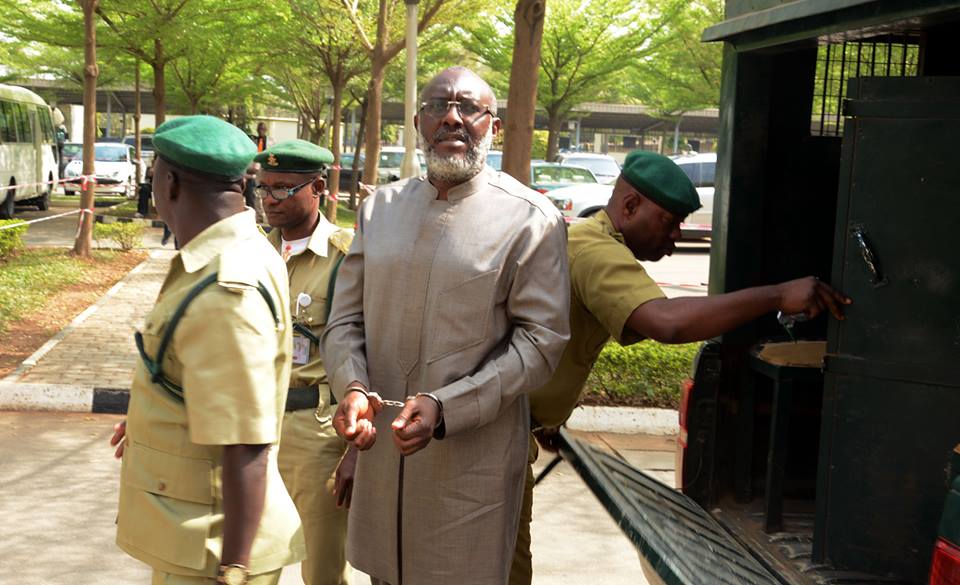
National Publicity Secretary of the People’s Democratic Party (PDP), Olisa Metuh is getting deeper into trouble with the authorities of the Economic and Financial Crime Commission (EFCC), which today, raised a fresh charge on him in court for alleged attempt to destroy a confessional statement he had earlier made to its operatives.
The new charge came less than 48 hours after the Federal High Court, Abuja, granted him bail over a seven-count charge of corruption and money laundering.
The EFCC operatives today, drove the embattled spokesman of the largest party in Africa into the premises of the Federal Capital Territory High Court, preparatory to slamming fresh charges on him.
He was led to the court today also in handcuffs, though the handcuffs were removed shortly before he taken before Justice Ishaq Bello.
Count one of the charge contains allegation of destruction of a statement he had made at the commission, to prevent it from being produced, while count two of the charge is an allegation of mischief, which are punishable under section 327 of the Penal Code Act.
After pleading not guilty to the said charges, counsel to the EFCC, Sylvanus Tahir, asked for more time to allow his team present witnesses and evidence in support of the allegations against the politician.
Justice Bello, who is the chief judge of the FCT High Court, said that the EFCC must produce three witnesses during the next sitting, without fail, adding that it was needless to have the case brought before him if it was already ongoing at a Federal High Court.
But EFCC counsel, Mr. Sylvanus, explained that the new charges, filed on January 18, were not the same as those currently being heard at the Federal High Court.
The matter was adjourned till January 25, for hearing of an application for bail, while information would be relayed later on whether or not the substantive suit would be heard tomorrow.
Mr. Metuh was also asked to return to Kuje Prison.
It would be recalled that t he EFCC had on January 12 accused Metuh of tearing off a confessional statement he made to its operatives, indicating it would charge him separately for attempting to destroy a major evidence in the case against him.
“The tearing of statement is tantamount to willful destruction of government property and it is a serious offence,” the official had told this newspaper at the time. “Also the fact that he obstructed operatives from performing their job is also a criminal offence. We will explore the possibility of filling a separate charge against him at the Federal Capital Territory High Court.”
In the original case for which he is standing trial at the Federal High Court, Metuh is facing a seven-count charge of corruption. He is accused of receiving N400 million from former National Security Adviser (NSA), retired Sambo Dasuki. The amount is part of the allegedly diverted sum of $2.1 billion meant for the purchase of arms.
Justice Okon Abang had, Tuesday this week, granted him bail. [myad]
Kogi state governor-elect under the All Progressive Congress (APC), Alhaji Yahaya Bello is yet to get a substantive deputy with whom he would be sworn into office come January 27, just a week from today.
This is coming on the heels of the continued refusal of the party’s choice, James Faleke for the position. Faleke has even gone to court to stop the swearing-in, claiming that he is the rightful person to be sworn-in as governor following the death of Prince Abubabakr Audu to who he was running mate in the last governorship election in the state.
The tenure of Governor Idris Wada of the People’s Democratic Party (PDP) will effectively expire next Wednesday, the same day Yahaya Bello will be sworn-in. But the governor elect and his party, the APC in the state are said to be at cross road on who to chose as the deputy governor should Faleke fails to turn up to be sworn-in as deputy governor.
It is not immediately known if it is in the constitution that a governor can to be sworn in without a deputy.
Meanwhile, no fewer than six people are said to be lobbying to be appointed as deputy governor to Yahaya Bello. They include Chief Clarence Olafemi, the former Speaker and acting governor in 2008 who hails from Mopa, the home town of the outgoing deputy governor, Yomi Awoniyi. Mopa in the Western senatorial district has produced two deputy governors; Justina Abanida, a former commissioner for Justice who hails from Egbe also in the Western senatorial district of the state.
There are also Dr. Kole Bamisaiye, a staff in the National Assembly who hails from Ekirin-ade, the home town of Faleke and one Barrister Tokunbo Asubiojo from Ife -Ijumu as well as one Kayode Olomo from Ponyan in Yagba East.
However, information had it that Yahaya Bello and the APC may have finally settled for Simon Achuba, a former deputy speaker in the House of Assembly who hails from Ibaji local government area of the state. Achuba was before now a member of PDP who was said to have worked seriously for Governor Wada at the last year governorship election. [myad]
President Muhammadu Buhari has doled out various sums of money to victorious Nigerian athletes and footballers at different international competitions, including the 1985 Golden Eaglets’ squad that clinched the maiden edition of the FIFA Under-17 World Championship. The President, who hosted the athletes and their officials today at the Banquet Hall of the Presidential Aso Villa, said that he considered it a special privilege from God that he is alive to fulfill his promise in 1985 to reward the winners of the maiden edition of the FIFA Under-17 World Championship. The President expressed sadness however that a member of the 1985 Golden Eaglets, Kingsley Aikhionbare, was not around to partake in the fulfillment of his promise which he made exactly 30 years ago. Aikhionbare died in London in 1996. Buhari ordered a one-minute silence in his honour. The President said that the reason for the 30 years delay in rewarding the Golden Eaglets had to do with the fact that leadership at the state level had changed hands so many times under different dispensations and political parties and yet it was these state governments that were supposed to implement most of the pledges to the players and officials. “In line with our belief that the labour of our heroes past shall never be in vain, we will be saying thank you to our 1985 Golden Eaglets’ players and officials by using the Federal Ministry of Youth and Sports template for rewarding outstanding athletes.” He praised athletes and officials for their consistency in doing the nation proud at various international competitions, adding that Nigerian athletes, despite prevailing challenges, have always proven to the rest of the world that the Nigerian spirit is indomitable. The President appreciated the determination, willpower and penchant for success being witnessed in the sports sector in recent times even as he advised the managers of this sector to keep up the momentum. “I wish to assure you that the Federal Government of Nigeria would not relent in its efforts to ensure that our sportsmen and women continue to excel in international competitions. I am particularly concerned about our participation at the forthcoming Rio 2016 Olympic Games. We must not allow a repetition of the unsavoury experience at the London 2012 Olympics where Nigerian athletes failed to make it to the podium. “This Administration’s policy of “change” must reflect in the way we do things either as individuals or institutions. We must strive to be prudent in the way we manage our time, financial and material resources to ensure victory at the next Olympics. We must aim for optimal performance at all international competitions. “As you are all aware, the financial resources of our nation have been dwindling since last year. Hence what we are offering you today is not payment or compensation for winning laurels for your country, rather, it is a token of appreciation for your efforts and patriotism while competing for your fatherland. “In this connection, I have the honour, on behalf of the Government and sports loving Nigerians to announce the following as token of our appreciation to our sports ambassadors:
2015 World Wrestling Championship
Beneficiaries
Amount
Wrestler (Bronze Medallists)
N1,200,000.00
Coaches
N6,000,000.00
FIBA 2015 Male Afro-Basketball Champion, D’Tigers
Beneficiaries
Amount
Players (Gold Medallists)
N600,000.00
Coaches
N600,000.00
Team Officials
N250,000.00
2015 FIBA Africa Under 16 Female Championships
Beneficiaries
Amount
Players (Silver Medallists)
N400,000.00
Coaches
N400,000.00
Team Officials
N150,000.00
2015 IPC Asian Open International Powerlifting Championship
Beneficiaries
Amount
Gold Medallists
N600,000.00
Silver Medallists
N450,000.00
Coaches
N450,000.00
Team Officials
N250,000.00
World English Language Scrabble Champion
Beneficiaries
Amount
Player (Gold Medallist)
N1,500,000.00
Coach
N1,200,000.00
Team secretary
N450,000.00
WBC Silver Cruiser Weight Title
Beneficiary
Amount
Winner (Title Holder)
N1,500,000.00
2015 CAF Under 23 Cup Of Nations Champions
Beneficiaries
Amount
Players (Gold Medallists)
N500,000.00
Head Coach
N500,000.00
Assistant Coaches
N300,000.00
Other Team Officials
N300,000.00
2015 FIFA Under 17 Male Football Champions
Beneficiaries
Amount
Players (Gold Medallists)
N1,200,000.00
Head Coach
N900,000.00
Assistant Coaches
N600,000.00
Team Secretary
N300,000.00
Medical Team
N300,000.00
Other Officials
N200,000.00
1985 FIFA Under 17 Male Football Champions
Beneficiaries
Amount
Players (Gold Medallists)
N2,000,000.00
Coaches
N1,500,000.00
Late Aikhionbare’s Next of Kin should collect his money on behalf of his family.” [myad]
In the aftermath of the attack on a hotel in Burkina Faso on Friday, just as in the attack on a luxury hotel in Mali in November, photographs of the killers showed some of them to be boys in their early teens. After the Nov. 20, 2015, attack in Bamako, the Malian capital, which Al Qaeda in the Islamic Maghreb (AQIM) and its offshoot al-Mourabitoun said they carried out, an image on Mali state television showed two young men alleged to be the “authors” of the incident that killed at least 22 people, mostly foreign nationals. Then, last Friday, the same AQIM group unleashed another batch of young militants on Burkina Faso’s popular Splendid Hotel and a neighboring cafe in the capital, Ouagadougou, killing 30 people including eight Burkinabes, six Canadians, three Ukrainians, three French and an American. On Monday, the jihadists published photographs of three adolescent men said to have carried out the Ouagadougou attacks. They wore military uniforms, held Kalashnikovs, and were given the names Battar al-Ansari, Abu Muhammad al-Buqali al-Ansari and Ahmed al-Fulani al-Ansari. The jihadists released no further details, but al-Ansari is a nom de guerre that usually designates somebody from northern Mali. The name might equally have been used to indicate where the “brigade” is based or originates from. Two of the adolescent men in the photographs were black and another was fairskinned, suggesting he might be from an Arab or Tuareg group. The various Islamist factions in Mali—where these young jihadists certainly have roots—are notorious for recruiting adolescent soldiers into their ranks and forcing them to commit acts of violence. One such young militant was Seydou, who is now 15 years old. The teenager was weeks shy of his 14th birthday when he joined al-Qaeda-backed militants fighting to take control of northern Mali. He had been handed to the jihadists by his parents. Men working for the militants told Seydou’s mother and father that the government was giving out monies to families who agreed to send their children to Quran schools to receive an Islamic education. The militants paid money to Seydou’s parents, which the boy said was in hundreds of thousands of CFA francs (equivalent to a few hundred U.S. dollars). Thus, by his account, they were deceived into handing their only son to a terrorist group. In fact, hundreds if not thousands of Malian children have been sold to armed groups by family members or school officials in exchange for money. In other cases, the children themselves may have been lured in by money and the appeal of “fighting for God,” especially after indoctrination in religious schools. Girls often are bought or abducted to become the wives of combatants. In 2013, the United Nations added Mali to its child soldiers list of shame. Since more than 50 percent of Mali’s 15.8 million people are children, there is a large pool from which to recruit. The country’s jihadists also take advantage of a common tradition in west Africa, where parents and guardians, mostly in rural Muslim areas, send their children away to the far cities for an Islamic education, particularly if they can’t afford to pay for school fees or provide meals. Seydou used to carry an AK-47 during his time with the militants who have terrorized northern Mali since 2012. Now he sleeps rough, living in Senegal as one of thousands of children who ply the streets of the country begging for food and money. I met Seydou when he was walking with a bowl in his hand in search of alms, along with a couple of teenage boys in one of Dakar’s bustling neighborhoods. I was told by my contact in Dakar that I would find children trafficked from neighboring Mali, Guinea and Guinea-Bissau at the city’s “downtown,” and there, indeed, I met dozens of children at different locations, and spent hours speaking to those who had a story to tell. Seydou is one of tens of thousands of talibés—from Arabic word for pupil (a local variant of the word taliban, used in Afghanistan). They are sent up to hundreds of kilometers away from home to gain religious instruction at the classrooms or “daaras” (madrassas) where a Quranic teacher or “marabout” traditionally instructs the children on how to read the Quran. Seydou led me to a quiet space far enough away that other passersby won’t hear the stories he would tell. I was able to get an interpreter as the boy spoke in the local Wolof language, which he had learned on the street. When he began to speak, I could sense the fear in him. Seydou said he had just returned from playing football with his friends in Mali when he saw his parents sitting outside their family house with two strange men. “My father didn’t even let me enter the house when he asked me to follow the men that will take me to my new Quranic teacher,” he said. “I didn’t argue. It was my dream to learn the Quran, so I hurried to follow him.” In addition to the money his parents got, Seydou was told he could earn 15,000 francs (about $30) a day for himself and 100,000 francs ($200) a month for his family. In a region stricken by poverty, that was a massive sum, especially for a boy his age. But the story changed once he was taken from his home. Seydou and other recruits were taken to a two-week-long training session at a camp in Mali’s vast desert, where they learned the rudiments of shooting. The jihadists gave Seydou a new name. “Abu Bakr.” “They said we had to learn how to protect ourselves and our brothers and sisters before learning anything else,” he recalled. “We didn’t have a choice. Once money has been paid on your head, you have no voice.” Across northern Mali, jihadists have bought over 1,000 children from rural communities devastated by poverty and hunger. Although the conflict in the country began in early 2012, it was not until 2013 that the act of recruiting child soldiers by militants became public knowledge. Seydou, who joined up with Mali’s northern jihadists in 2014, said some fighters were also recruited from the south of the country where militant groups became active last year, and from neighboring Burkina Faso and Niger. All through his time as a militant, Seydou said he only played supporting roles behind the front line, and denies killing anyone or committing any rights abuses, but he admits receiving money occasionally from the jihadists, especially after running errands. Mali’s jihadists, particularly the group known as MUJAO, fund themselves through kidnappings and lucrative trafficking activities and can afford to pay well. Seydou said the militants gave children military training and religious indoctrination, and that his instructors were Arabs, but he didn’t know under which name the group operated. Child soldiers are being used by all the armed groups operating in Mali’s northern region, but the Islamist groups, Ansar Dine, AQIM and now al-Mourabitoun have been among the most prominent recruiters. “They showed us different types of weapons and how to use them in case of attack,” he said. “Our instructors told us that when we shoot at the enemy, it wasn’t us doing so, but our Creator.” Many of Seydou’s childhood friends have left their homes and are now working for Mali’s militants in the north of the country. A greater number are motivated by money, but Seydou said they are a few who are not moved by the bonuses, rather “they want to work for God. “Our instructors kept telling us that death is sweeter when it is for God,” he said. “Because of what they often said, many children were just waiting for the jihad.” Trained children are used to staff checkpoints, conduct foot patrols, guard prisoners, prepare food for senior militants and implement the punishment prescribed by sharia law. When Seydou was asked to attack the Timbuktu jail, which would have seen him earn additional cash, he declined, and instead found a way to escape while on an attack mission with members of the group in Timbuktu. “I didn’t want to be a fighter, I wanted to get an Islamic education,” he said. “I ran away because I didn’t have the heart to kill or punish anyone.” Seydou was scared of returning to his parents, as he feared the militants would trace him to his home. Instead, he decided search for a marabout, who he will work for, while also receiving Quran lessons. The boy walked through the wilderness for hours before arriving at Timbuktu’s main town, and meeting a marabout, who pushed him to another Quran teacher in the south, in what was the beginning of his long journey to his current abode. Seydou had no idea he had become a victim of Mali’s thriving child trafficking trade. Even if he knew what was going on, the prospect of realizing his long-held dream of getting a Quranic education was far more appealing to him than ending up in a militant’s camp. From Mali he was taken to Bafata in Guinea-Bissau, and then farther east in the country to Gabu, where he worked on a cotton field for a brief period before crossing the border into Senegal. On getting to Senegal, he was passed to another marabout in the southwestern city of Ziguinchor, and later moved to another marabout in Dakar where he learned the Quran and the local vernacular, Wolof. A 2015 Trafficking in Persons Report published by the U.S. Department of State indicates that Malian children are transported to Senegal and Guinea for forced labor in gold mines and to Cote d’Ivoire for forced labor on cotton and cocoa farms. In Senegal for instance, there is a thriving culture of street begging and forced labor, and the country’s porous borders makes it relatively easy for children to be trafficked into the country. Another State Department report on trafficking revealed that Senegal is a source, transit, and destination country for children and women who are subjected to forced labor and sex trafficking. Not long ago, the government discovered that thousands of children who do not speak Wolof were being smuggled into Senegal from neighboring countries by people impersonating marabouts, and using the kids to beg for their personal gain. The government then announced the repatriation of all non-Senegalese talibés and banned child begging on the streets and all daaras throughout the country. But conflicts at the time in neighboring Mali and Guinea Bissau, and pressure from the Islamic community, forced President Macky Sall to rescind the expulsion order. Now, thousands of children like Seydou are made to face the prospect of lives as beggars or as modern day slaves. “Even though I survive through begging, I have found peace in Dakar,” Seydou said. “At least here I wouldn’t have to kill anyone.”
Philip Obaji Jr. is the founder of 1 GAME, an advocacy and campaigning organization that fights for the right to education for disadvantaged children in Nigeria, especially in northeastern Nigeria, where Boko Haram forbids western education. [myad]
Pope Francis has offered advised to leaders across the world on how to create jobs for the millions to contain the negative effects of the emerging fourth Industrial Revolution.
“Clearly there is a need to create new models of doing business that, while promoting the development of advanced technologies, are also capable of using them to create dignified work for all.” Pope Francis addressed participants today at the World Economic Forum Annual Meeting, holding in Davos, Switzerland. The message was read by Cardinal Peter Turkson, President of the Pontifical Council for Justice and Peace.
The Pontiff urged leaders “not to forget the poor” and to see the creation of jobs as an essential part of leaders’ service to the common good alongside producing wealth and improving the world. “The present moment offers the world a precious opportunity to guide and govern the transformations associated with the Fourth Industrial Revolution in a way that builds inclusive societies. However, it brings diminished opportunities for employment that also brings with it a responsibility among leaders to create jobs, tackle inequality and help solve society’s complex crisis,” said Pope Francis in his message. The Pope encouraged leaders to seize the opportunities that the Fourth Industrial Revolution presents even as he said that the World Economic Forum can become a platform for the defence and protection of creation and for the achievement of a progress which is healthier, more human, more social and more integral. [myad]
We use cookies on our website to give you the most relevant experience by remembering your preferences and repeat visits. By clicking “Accept”, you consent to the use of ALL the cookies.
This website uses cookies to improve your experience while you navigate through the website. Out of these, the cookies that are categorized as necessary are stored on your browser as they are essential for the working of basic functionalities of the website. We also use third-party cookies that help us analyze and understand how you use this website. These cookies will be stored in your browser only with your consent. You also have the option to opt-out of these cookies. But opting out of some of these cookies may affect your browsing experience.
Necessary cookies are absolutely essential for the website to function properly. This category only includes cookies that ensures basic functionalities and security features of the website. These cookies do not store any personal information.
Any cookies that may not be particularly necessary for the website to function and is used specifically to collect user personal data via analytics, ads, other embedded contents are termed as non-necessary cookies. It is mandatory to procure user consent prior to running these cookies on your website.


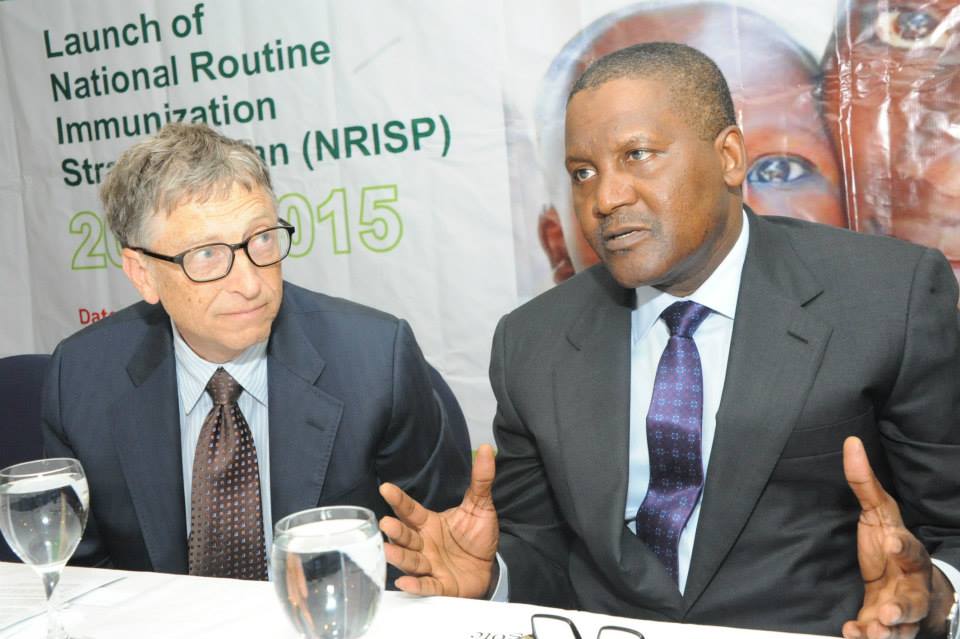 The Aliko Dangote foundation and Bill & Melinda Gates foundation announced a combined commitment of $100 million, (about N30 billion) over the next five years (2016-2020) towards ending undernutrition in Nigeria.







PDP Too Corrupt, Too Sick to Lead the Opposition, By SKC Ogbonnia
For all intents and purposes, Nigerians had witnessed a formidable opposition activity by the time for the 2015 elections. But that is no longer the case. The current main opposition party, the Peoples Democratic Party of Nigeria (PDP), has turned out to be too corrupt and too sick to play a leading role.
So far, President Muhammadu Buhari is doing a commendable job grabbing the corrupt PDP henchmen one after the other. Yet, the attitude of the culprits once they are granted bail is not funny at all. Instead of standing firm to defend themselves and the cause of the opposition, these PDP leaders are usually befallen with one form of acute sickness or another.
To rub in the ploy, the sick looters typically opt for treatment abroad while the masses are saddled with poor medical facilities at home.
Interestingly, the ardent supporters of the former ruling party still see hope. They believe the party will soon usher in some credible leaders in the crucible of a party convention, whenever that might be.
But don’t hold your breath. Of course, PDP still boasts of fairly untainted figures like Ken Nnamani, Nuhu Ribadu, Donald Duke, Segun Mimiko, Ibrahim Dankwambo, Ibrahim Shekarau, and so on. Alas, the Peoples Democratic Party of Nigeria is not ready to entrust its future on any novice in the primitive accumulation of wealth.
The dilemma, therefore, is that virtually all its anointed leaders with deep pocket—from the north, east, and west—wear loud beads of corruption around their necks. Take a look at the lineup below.
Namadi Sambo: In a normal clime, the mild-mannered former Vice President would be the shoe-in to the leadership vacuum. However, he is yet to recover from an overseas medical treatment resulting possibly from the new wave of sickness common with PDP chieftains being fingered for abuse of office. Moreover, Sambo cannot feign ignorance to the monumental corruption that rocked the National Economic Council while he was at the helm.
Enter the man of the hour, son of a former Sultan, and the former National Security Adviser, Sambo Dasuki who has been in dire need of foreign medical treatment in midst of dizzying criminal charges. Dasuki had exhibited a measure of political shrewdness when he stormed the London Think-Tank Chatham House to make a case for the postponement of
Nigeria’s 2015 elections. But it is clear that his was a fall before the rise.
The Sokoto prince will forever be remembered for freebooting $2.1 billion defense funds budgeted to save human lives—now referred to as Dasukigate.
The case of the recent PDP Chairmen does not exude hope. Haliru Mohammed Bello, for one, has become a permanent fixture in the contemporary discussion of corruption in Nigeria. Currently confined to a hospital bed but indicted in connection to the Dasukigate, Bello is the same character thrust into the position of Defense Minister during the Goodluck era despite being embroiled in the infamous £8.6 billion Siemens bribery scandal. Similarly, though he is been out of the public scene since stepping down after failing to account for N12 billion party funds, Nigerians will never forget how Adamu Mua’zu ascended the top party post in the face of pending allegations for stealing N19.8 billion from Bauchi State coffers. Even more, not only is the former governor rumoured sick somewhere, Mua’zu remains an integral quotient in cracking the various Dasukigate equations.
Sule Lamido is a well-nurtured party stalwart then widely seen as the heir apparent to 2019 PDP presidential ticket. Sadly, the ex-governor and son are now awaiting trial for plundering Jigawa State treasury. The plight of the past Chairman of Northern Governors Forum, Muazu Babangida Aliyu, is equally sad. Not long ago all roads pointed to Aliyu’s Minna residence, but that was then. Today, the erstwhile “Chief Servant” of Niger State is mired in N2.9 billion fraud charges at the Economic and Financial Crimes Commission (EFCC).
The timbers of the 7th Legislature, particularly former Senate President David Mark, Deputy Senate President Ike Ekweremadu, and former Deputy Speaker Emeka Ihedioha are pondering what could have been. They were well groomed as the picture perfect babyface of the opposition with every resource in tow. However, not surprisingly, the trio has suddenly grown too old and too impotent due to a raging fear of imminent probes into the billions budgeted for Constitutional Review and Constituency Projects from the year 2007 to 2015. Ordinarily, PDP could have explored Senator Godswill Akpabio, the official opposition leader in the Legislature, but the former governor has become dumbstruck out of the blue after an encounter with the EFCC for allegedly carting away N108 billion from Akwa Ibom State
treasury.
That brings us to Olisa Metuh, a man of cerebral pedigree, then packaged as a fearless patriot in his role as the PDP National Publicity Secretary. Regrettably, the party has just found out the hard way: Promoting Metuh as its official mouthpiece is akin to bursting the Pandora’s Box in a public square. Lo and behold, the credibility of the Nnenwi High Chief is deep down the tubes at the spur of the moment after failing to make sense of how and why a portion of the Dasuki corrupt largesse landed in his individual business bank account.
The most brazen is the spectacle of Governor Peter Ayodele Fayose of Ekiti State grandstanding as a self-appointed “Leader of Nigeria’s Opposition.”
A man of voluble tidings, Fayose is the shameless fugitive ex-governor previously impeached for corruption but drafted back by his party to recapture the seat by any means necessary. Ultimately, he is rattled by the anti-corruption war and has been roaming the political space inciting the public with all manners of innuendo against the ruling party, as if PDP had shared the stolen billions among the poor masses.
But Nigerians have become wiser. We are well aware that the commotion is nothing but the wailing of a highbinder awaiting serious time for his involvement in the N1.3 billion poultry scandal plus 2014 Ekiti election fraud.
It will be a gross disservice to the reading audience if this exposé is to conclude without a special attention on Femi Fani-Kayode. Quite frankly, at the chagrin of friends, I was overjoyed when the former minister was acquitted of money laundering charges. Though always traducing, Fani-Kayode’s kind of verbal opposition is not totally bad for the polity. At least, his bombastic style has entertainment value—a radio station away from a poor man’s Rush Limbaugh.
The issue with this one, though, is that new revelations from the Dasukigate have shown that the constant bravado is not only to blind the gullible masses but also to fan the embers of crises in anticipation of looming indictments over new graft allegations.
This whole picture portends a troubling future for Nigeria. Although President Buhari has recorded a measurable success thus far, he is far from sainthood. Like in any human undertaking, excesses abound. Very unfortunately, however one views it; and no matter the line of argument; it is clear that the PDP brand is hopelessly banal—too corrupt, too sick, and too witless to checkmate the party in power.
Even if the PDP is to succeed in its dream of a makeover, the ensuing leadership will always be dismissed, and justifiably so, as an appendage to an unrepentant corrupt cabal. The posterity beckons on patriotic minds within the different opposition camps, therefore, to unite towards the path to a true democratic culture. Instead of the maddening rush to the ruling party, it is time to explore a new opposition party that is steadily alert to expose the weakness of the APC central government and credible enough to offer alternative solutions. [myad]