The fourth edition of the African Nations Championship, the biennial international football championship has been scheduled to kick off in Rwanda on Saturday. The tournament is being organized by the Confederation of African Football (CAF) for players in local national leagues. This year’s competition will begin on January 16 and end February 7, it will feature 16 teams. Rwanda qualified automatically as hosts, while the remaining 15 spots were determined by the qualifying rounds, which took place from June to October 2015. Defending champions, Libya, did not qualify. The opening match will feature Group A teams, as Rwanda takes on Cote d’Ivoire and Gabon plays against Morocco. Other fixtures are as follows:
Group A January 20 Rwanda vs Gabon: Morocco vs Cote d’Ivoire:
January 24 Morocco vs Rwanda Cote d’Ivoire vs Gabon
Group B January 17 DR Congo vs Ethiopia Angola vs Cameroon
January 21 DR Congo vs Angola Cameroon vs Ethiopia
January 25 Cameroon vs DR Congo Ethiopia vs Angola
Group C January 18 Tunisia vs Guinea Nigeria vs Niger
January 22 Tunisia vs Nigeria Niger vs Guinea
January 26 Niger vs Tunisia Guinea vs Nigeria
Group D January 19 Zimbabwe vs Zambia Mali vs Uganda
January 23 Zimbabwe vs Mali Uganda vs Zambia
January 27 Uganda vs Zimbabwe Zambia vs Mali. [myad]
Presidents, the world over, are known to rely on the services and friendship of dependable allies, party members and even family members outside the defined and regular cabinet appointees throughout their tenure. It does not matter whether that president is Barrack Obama or Vladimir Putin, or even any of the African presidents. As a matter of fact, it was reported most recently in the media that an inner ring of President Muhammadu Buhari’s circle of friends has started digging in and influencing all the appointments made so far by him. Like it or not, that is how the presidency works, especially in a democracy. And that was how the presidency of Goodluck Jonathan operated until he was voted out of power in 2015.
And discussing the Jonathan Presidency, one of the few people who stuck close to him come rain and shine was Chief Tony Anenih. Of course, it is trite to say that Anenih’s name is one that rings bell in Nigerian politics. As a former minister of works in the Obasanjo presidency and, later, Chairman of Board of Trustees (BoT) of the Peoples Democratic Party (PDP), Anenih had come to symbolise the tenacity of the PDP and its unequal ability to rejig and bounce back from one crisis after another to a stronger party until its final defeat last year.
It is all too clear for any casual observer to see that the defeat of Jonathan could have come much earlier than the 2015 general elections but for people like Anenih. The succession politics from the late President Umaru Yar’ Adua to Jonathan, more than anything, defined the character of the Jonathan presidency and later its defeat in 2015 and this would be in spite of rather than because of people like Anenih. Make no mistakes about it, Anenih was perhaps the most loyal and dependable ally of former President Jonathan. This was probably why he was entrusted with assignments that involved fund disbursements to political allies. Besides, he never ceased to put his national political network and reputation to stabilise the Jonathan presidency by winning more friends, supporters and loyalists to Jonathan. Not only did he commit his time, he spent his own money to carry out assignments for the President even when those have been rightly mobilised for the action simply pocketed the money.
It is perhaps too easy to assume that Anenih was ferociously supporting Jonathan for his own selfish, political and any other pecuniary interests. Yet the truth remains that Anenih felt a moral burden to help the president succeed. First, as a statesman and party leader, it behoved Anenih to help steady the hands of Jonathan with the right advice in the interest of the Nigerian nation. Second as the politician with perhaps the highest profile from the South-south region, and with a President from the same region for the first time in the country’s history, Anenih could not have done other than provide the strongest support for Jonathan. Even when Jonathan lost the 2015 presidential election, Anenih volunteered to resign from his BoT position to allow the former president to assume it and find a strong platform to engage in national politics.
Although it is easier for the Nigerian politician lacking in principles to always run to where it is cooking as many PDP leaders of yesterday are doing now by defecting to the ruling All Progressives Congress (APC), Anenih can look back with satisfaction and dignity at his contributions, loyalty, support and service to the Nigerian state through the Jonathan Presidency. As an elder statesman, he has nothing to be ashamed of because there is no record that he abused his rare privilege as a confidant and ally of the former president. When Jonathan needed fearless Nigerians to speak the truth to his party members in 2010 that the zoning principle in the PDP could not override the Constitution of the country, Anenih found his voice and used his experience and vast political network to pass that message. And when it became clear that the president was wrongly handling the issue of the break-away “New –PDP” group, Anenih did not mince words in telling Jonathan the truth that he needed to listen to the aggrieved group and mend fences with them. Of course, this drew the anger of the many sycophantic and tragic “advisers” making their living by singing to the ears of the former president, the lyrics he wanted to hear. They did not wait to pour out all manner of invectives on their party’s BoT chairman. Strangely, many of those who goaded Jonathan on to the wrong path then have now jumped out of the apparently “sinking” PDP ship into the now “thriving” APC fold. More will still jump out.
In a country where the president is so powerful to make and unmake, whether in terms of power politics, business and policies, anyone who has the ears of the president easily lends himself/herself to both creeping and outright envy. If Anenih thought that everybody was cool with his chummy relationship with the former president, then the events of the past few days must have cleared any doubt in his mind. His name has been circulating in the media as one of the recipients of the alleged Dasuki $2.1 billion arms budget scam. In fact, the EFCC said it confirmed payment of N260 million from the Office of the former National Security Adviser into his account. In spite of the fact that Anenih quickly wrote to the EFCC clarifying how he was merely running errands for the former president, he is being wrongfully clobbered daily in the media as part of the people who stole from the Federal Government. In Anenih’s letter to the EFCC, he detailed how the former president instructed him on trust to deliver specified amount of money to some known politicians, including Alhaji Tanko Yakassai, Chief Olu Falae and Senator Rashidi Ladoja- for some political ends. And it is on record that none of the people Anenih mentioned refuted his story. Indeed they have all acknowledged that they received the said money from Anenih. Now the question is, if the NSA was directed by President Jonathan to pay some money to Anenih for specified presidential assignments that he had carried out, how on earth was Anenih to know if the money was drawn from the arms budget meant for fighting Boko Haram or from any other source for that matter?
The fact that Anenih willingly furnished the EFCC, upon its request, with the truth clearly shows his honest intentions. I do not know anybody, including those now trying Anenih in the media and attempting to drag his name and reputation to the mud, who will be summoned by President Buhari and given a sensitive assignment on trust, who will turn the President down or ask the president how he would fund it or where the money to fund the assignment would come from. Perhaps Tony Anenih has overstayed in Nigerian politics and some agents have taken it upon themselves to retire him willy-nilly. Maybe some people in his home-state are getting apprehensive of his never-waning influence in Edo politics, especially as a governorship election nears and are willing to throw everything to discredit him. Maybe Anenih is simply paying the price of being too loyal to a president who was too weak as to be defeated by small decisions of governance he could not take!
Ojo, public affairs commentator, lives in Ketu Alapere, Lagos. [myad]
The Economic and Financial Crimes Commission (EFCC) has opened a can of warm for the embattled national publicity secretary of the Peoples Democratic Party (PDP), Olisa Metuh, especially as regard the N400 Million he allegedly received from the former National Security Adviser (NSA), retired Colonel Sambo Dasuki for nothing.
One of the seven count charges read to Metuh before Justice Okon Abang of the Federal High Court sitting in Abuja was: “That you, Olisa Metuh and Destra Investments Limited on or before the 24th November, 2014 in Abuja within the Jurisdiction of this Honourable court took possession of the sum N400,000,000 (Four Hundred Million Naira) only, paid into the account of DESTRA INVESTMENTS LIMITED with DIAMOND BANK Plc account number: 0040437573 from the account of the National Security Adviser with the Central Bank of Nigeria without contract award when you reasonably ought to have known that the said sum formed part of the proceeds of an unlawful activity of Col. Mohammed Sambo Dasuki (rtd), the then National Security Adviser (to wit; criminal breach of trust and corruption) and thereby committed an offence contrary to Section 15(2), (d) of the Money Laundering (Prohibition) Act, 2011 as amended in 2012 and punishable under Section 15(3) of the same Act.” However, Metuh pleaded not guilty when the charges were read to him.
The court adjourned the case to January 19, 2016 for the hearing of arguments on the bail application even as the judge ordered that Metuh be remanded in prison custody. [myad]
Former Editor of Thisday Newspaper, Paul Ibe has asked the Court of Appeal sitting in Abuja to compel the Publisher of the newspaper, Nduka Obiagbena, to pay him N19.7 million judgment debt. Ibe made the claim in a motion filed before the appellate court, a copy of which was made available to newsmen today. In the motion, Ibe alleged that Obiagbena and his Leaders and Company Limited were deliberately frustrating the payment of the money awarded in his favour by the National Industrial Court of Nigeria (NICN), Abuja. The NICN had in a judgment delivered on February 18, 2014, awarded the N19.7 million being claims of unpaid salaries and terminal benefits due to Ibe, against Obiagbena and his company. The trial court had at the instance of the judgment creditor (Ibe) granted an order nisi (not absolute) to annex the said sum of N19.7 million in accounts of Obiagbena and his companies with four banks. The banks referred to as Garnishee Respondents were Access Bank Plc, First City Monument Bank Plc, Guarantee Trust Bank Plc and Zenith Bank Plc. The court had ruled: “That the said sum of N19.7 million sitting in the judgment debtors accounts domiciled with the Garnishees aforementioned and the sum of N200,000 being the cost of the Garnishee proceedings be attached to this Court forthwith. “The Court further directs the four Garnishees to appear in court on May 7, 2015 to show cause why this Order Nisi should not be made absolute upon each of them for payment of the judgment creditor.” Ibe said that following the orders of the NICN, the respondents filed a Notice of Appeal dated April 30, 2015, which effectively put a stay on further action on the garnishee proceedings. He, however, alleged that upon transmitting the records of proceeding to the Court of Appeal, the appellants (Obiagbena and his company) abandoned the case. Ibe deposed in an affidavit attached to the motion: “The appellants have neglected to file their brief of argument several months after transmission of the appeal. “It is a fact that appellants are required by law to file their brief of argument within 45 days after transmission of records, which they have failed to do. “The appellants neither sought nor obtained leave of this court not that of the trial court before filing the appeal.” Ibe contended that the appeal “is frivolous and a deliberate attempt to continue to deny him the fruits of the judgment got at the trial court”. Ibe urged the court to dismiss the appeal and order Obiagbena and his company to pay him the said sum. On the facts of the case, Ibe said he was engaged by the respondents in May 1996 and rose by way of promotion to become the Editor of Thisday newspaper. He said that in 1998, he was transferred to South Africa as the Bureau Chief of the newspaper. Ibe said while he was in South Africa for 19 months running the affairs of the newspaper, his employers failed to provide residential and office accommodation and perks of office. “After completion of my job schedule in South Africa, I returned to Nigeria in 2000, feeling dissatisfied and gave them notice of my intention to resign. “The defendants rejected my resignation and gave an approval for a sabbatical leave. “In 2002, I was reabsorbed as an Assistant Editor with the understanding that I will be appointed Director. “Within 12 years duration of my employment, my tax and pension deductions and terminal benefits statutorily due to me were not paid.” The Court of Appeal is yet to fix a date for the hearing of the motion. [myad]
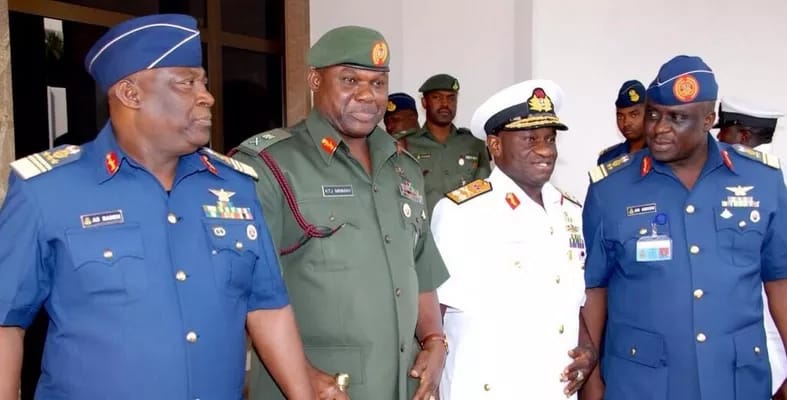
President Muhammadu Buhari has formally directed the Economic and Financial Crime Commission (EFCC) to carry out further investigation into what he called “the misconduct” established against service chiefs under his predecessor, ex President Goodluck Jonathan and other retired and serving officers of the Nigerian Air Force and Nigerian Army. The officers are (1) Air Chief Marshal AS Badeh (Rtd) (2) Air Marshal MD Umar (Rtd) (3) Air Marshal AN Amosu (Rtd) (4) Maj-Gen. ER Chioba (Rtd) (5) AVM IA Balogun (Rtd) (6) AVM AG Tsakr (Rtd) (7) AVM AG Idowu (Rtd) (8) AVM AM Mamu (9) AVM OT Oguntoyinbo (10) AVM T Omenyi (11) AVM JB Adigun (12) AVM RA Ojuawo (13) AVM JA Kayode-Beckley (12) Air Cdre SA Yushau (Rtd) (13) Air Cdre AO Ogunjobi (14) Air Cdre GMD Gwani (15) Air Cdre SO Makinde (16) Air Cdre AY Lassa (16) Col N Ashinze (17) Lt Col. MS Dasuki (Rtd) The President also wanted the EFCC to investigate the following companies in respect of the same arms deal. They are: (1) Messrs Societe D’ Equipments Internationaux (2) Himma Aboubakar (3) Aeronautical Engineering and Technical Services Limited (4) Messrs Syrius Technologies (5) Dr Theresa A. Ittu (6) Sky Experts Nig Ltd (7) Omenyi Ifeanyi Tony (8) Huzee Nig Ltd (9) GAT Techno Dynamics Ltd (10) Gbujie Peter Obie (11) Onuri Samuel Ugochukwu (12) Spacewebs Interservices Ltd (13) Oguntoyinbo Tayo (14) Oguntoyinbo Funmi. (15) Delfina Oil and Gas Ltd (16) Chief Jacobs Bola (17) Mono Marine Corporation Nig Ltd (18) Geonel Intergrated Services Ltd (20) Sachi Felicia (20) Mudaki Polycarp (21) Wolfgang Reinl. This is even as EFCC has sealed off a duplex at Wuse II, Abuja, believed to be a property belonging to the former Chief of Staff, General Alex Badeh. EFCC wrote on the wall of the property “under investigation.” A statement by the senior special assistant to the President on media and publicity, Mallam Graba Shehu Quoted President Buhari as saying that the directive to the EFCC has been issued based on the recommendation of the committee established to audit the procurement of arms and equipment in the Armed Forces and Defence sector from 2007 to 2015. The companies are to be investigated on the basis of the submission of the audit committee’s second interim report. President Buhari directed the EFCC to investigate the roles of the officers in the respective companies and their directors in fundamental breaches associated with the procurements by the Office of the National Security Adviser (ONSA) and the Nigerian Air Force (NAF). 21)Wolfgang Reinl. Part of the statement reads: “The breaches identified by the Audit Committee include non-specification of procurement costs, absence of contract agreements, award of contracts beyond authorised thresholds, transfer of public funds for unidentified purposes and general non-adherence to provisions of the Public Procurement Act. Furthermore, the procurement processes were arbitrarily carried out and generally characterized by irregularities and fraud. In many cases, the procured items failed to meet the purposes they were procured for, especially the counter insurgency efforts in the North East. A major procurement activity undertaken by ONSA for NAF was that concerning the contracts awarded to Societe D’ Equipment Internationaux (SEI) Nig Ltd. Between January 2014 and February 2015, NAF awarded 10 contracts totalling Nine Hundred and Thirty Million, Five Hundred Thousand, Six Hundred and Ninety US Dollars ($930,500,690.00) to SEI Nig Ltd. Letters of award and End User Certificates for all the contracts issued by NAF and ONSA respectively did not reflect the contract sums. Rather, these were only found in the vendor’s invoices, all dated 19 March 2015. Additionally, some of the award letters contained misleading delivery dates suggesting fraudulent intent in the award process. The observed discrepancies are in clear contravention of extant procurement regulations. The SEI contracts included procurement of two used Mi-24V Helicopters instead of the recommended Mi-35M series at the cost of One Hundred and Thirty Six Million, Nine Hundred and Forty Four Thousand US Dollars ($136,944,000.00). However, it was confirmed that the helicopters were excessively priced and not operationally air worthy at the time of delivery. A brand new unit of such helicopters goes for about Thirty Million US Dollars ($30m). Furthermore, the helicopters were delivered without rotor blades and upgrade accessories. Additionally, the helicopters were undergoing upgrade while being deployed for operation in the North East without proper documentation. It was further established that as at date, only one of the helicopters is in service while the other crashed and claimed the lives of two NAF personnel. The Committee established that ONSA also funded the procurement of 4 used Alpha-Jets for the NAF at the cost of Seven Million, One Hundred and Eighty Thousand US Dollars ($7,180,000.00). However, it was confirmed that only 2 of the Alpha-Jet aircraft were ferried to Nigeria after cannibalization of engines from NAF fleet. This is contrary to the written assertion of the former Chief of Air Staff, Air Marshal AN Amosu to the former NSA that all the 4 procured Alpha-Jets aircraft were delivered to the NAF. The non-militarisation of the Alpha-Jets made them unsuitable for deployment to the North East and they are currently deployed only for training at NAF Kainji. Furthermore, the procurement of the Alpha-Jets was contrary to the recommendation of the assessment team. The Committee found that the conduct of Air Marshal Amosu was deliberately misleading and unpatriotic. The contract for the procurement of 36D6 Low Level Air Defence Radar for the NAF was awarded to GAT Techno Dynamics Ltd in April 2014 at the cost of Thirty Three Million US Dollars ($33m) and was funded by ONSA. The Committee established that the radars were excessively priced as a complete set of such radars (comprising 6 radars including the Control Centre) goes for Six Million US Dollars ($6m) averagely. The Committee observed that the radars were delivered without the vital component of Identification Friend or Foe (IFF) that distinguishes between own and adversary aircraft, which has significantly degraded the operational capabilities of the NAF in the North East. It was further observed that the sum of Three Million, Three Hundred Thousand US Dollars ($3.3m) was fraudulently included in the contract agreement as VAT and With Holding Tax and subsequently paid into the bank accounts of Spacewebs Interservices Ltd and Delfina Oil and Gas Ltd. The Committee further established that Two Million US Dollars ($2m) from the proceeds was transferred to Mono Marine Corporation Nig Ltd, which is jointly owned by principal characters in this deal. The Committee opined that the infractions of extant regulations by these companies were clearly intended to defraud. It was established that between September 2009 and May 2015, the NAF expended about Fifteen Billion Naira (N15bn) on the maintenance of its Alpha-Jets, C-130H aircraft and Mi-24V/35P helicopters. Out of this amount, Four Billion, Four Hundred and Two Million, Six Hundred and Eighty Seven Thousand, Five Hundred and Sixty Nine Naira, Forty One Kobo (N4,402,687,569.41) was paid out for contracts not executed. It was also observed that in carrying out these maintenance activities, contracts worth over Two Billion, Five Hundred Million Naira (N2.5bn) were awarded to Syrius Technologies, a Ukrainian company that was not registered in Nigeria. Regrettably, in spite of these expenditures, the status of NAF fleet remained operationally appalling as only 3 Alpha-Jets, 2 C-130H and one each of Mi-24V and Mi-35P were serviceable as at 28 May 15. In October 2013, NAF awarded contracts to DICON for the supply of weapons and ammunition at the cost of Five Hundred and Ninety Nine Million, One Hundred and Eighteen Thousand Naira (N599,118,000.00). However, only 2 of the 7 items contracted were delivered to NAF while the outstanding 5 items remained undelivered despite repeated requests to DICON. The Committee also found that the delivered ammunition were about 40 years old, thereby casting doubts on their shelf life. The failure of DICON to fully execute the contract and the delivery of aged ammunition diminished the capacity of the NAF in North East operation. The Committe uncovered insider dealings by military officers in procurement activities undertaken by ONSA and the NAF. The officers were found to have misused or abused their offices for personal gains by influencing award of contracts to private companies in which they have substantial interests. For instance, an officer serving in the ONSA used his office to secure 2 contracts for his company, Geonel Integrated Services Ltd, for the protection of 20 Dams and Presidential Air Fleet security at the cost of Six Billion, Two Hundred and Fifty Million Naira (N6,250,000,000.00) and Five Million US Dollars ($5m) respectively. Furthermore, some NAF officers used their companies to collect VAT and With Holding Tax that were never remitted to FIRS while another officer was found to have cross transferred about Five Hundred Million Naira (N500m) between a NAF company, Aeronautical Engineering and Technical Services Limited, SkyExperts Nig Ltd and Huzee Nig Ltd, companies in which he had personal interests. It would be recalled that in its First Interim Report, the Committee on Audit of Defence Equipment established that the sum of Six Hundred and Forty Three Billion Naira (N643bn) and Two Billion, One Hundred Million US Dollars ($2.1bn) interventions were received for defence procurements by DHQ and the Services between 2007 and 2015. In continuation of its assignment, the Committee has so far established that the nation spent about Twenty Nine Billion Naira (N29bn) and Two Billion US Dollars ($2bn) on NAF procurement activities alone.”
The National Publicity Secretary of the Peoples Democratic Party (PDP), Olisa Metuh, has been sent to Kuje Prisons over the $2.1 billion arms scam.
Justice Abang Okon of a Federal High Court sitting in Abuja said Metuh should be remanded in the prison upon his arraignment today.
Before his arraignment, Metuh had been in the custody of the Economic and Financial Crimes Commission, which is prosecuting him for collecting N400 million out of the $2.1 billion meant for the purchase of arms and ammunition to fight the Boko Haram insurgency.
Justice Okon said Metuh should be remanded in Kuje Prisons until January 19 when the case would be heard.
He is accused of having received N400 million out of the $2.1 billion meant for the purchase of arms from a former National Security Adviser, retired Colonel Sambo Dasuki. [myad]
The Supreme Court has upheld the election of Governor Samuel Ortom of Benue State. He was the candidate of the All Progressives Congress (APC) in the April 11 2015 governorship election held in the state.
Delivering judgment today, Justice Sylvester Ngwuta dismissed the appeal brought by Terhemen Tazoor, the People’s Democratic Party (PDP) candidate in the April 11, 2015 governorship election.
Tazoor had approached the Supreme Court seeking to reverse the judgment of Benue State Governorship Election Petition and the Court of Appeal, Makurdi Division, which had both held that Ortom was validly elected as governor.
He had contended that that Ortom was not validly elected as governor because he was not an APC member at the time he emerged the party’s governorship candidate.
Tazoor and the PDP had, therefore, urged the Supreme Court to set aside the concurrent judgments of the courts below which had dismissed his petition for lacking in merit.
The apex court is the final court in the governorship tussle between the two candidates, thereby putting paid to Tazoor’s governorship ambition. [myad]
January 15 every year is Nigeria’s Armed Forces Remembrance Day: wreaths are laid, statements are made, soldiers, government officials and the Nigerian Legion attend parades, pigeons symbolizing peace are released, a dinner is organized for widows of fallen soldiers and there is so much talk about death and dying for one’s country all in honour of Nigerian soldiers who have had to die so that Nigeria may live. In terms of context however, what is also celebrated is the surrender of the secessionist Biafran forces to the Nigerian government on January 15, 1970, a throw back to the country’s three years of civil war.
This is downplayed just as government similarly conveniently ignores the fact that January 15 is also the date of the first coup d’etat in our country. It is 50 years today since that incident. And it is most unlikely that the Federal Government will devote much attention to that particular aspect of our history. But even if they don’t, the families of those who fell to the bullet on January 15, 1966 will certainly remember. It is a day that should be specially remembered by all Nigerians and students of history because that was when things finally fell apart and the rains began to beat our roofs. On this day in 1966, four Igbo military officers and one Yoruba, five Majors in all, led by 29-year old Major Kaduna Nzeogwu struck in Kaduna, Lagos, and Ibadan, as they sought to take over Nigeria by revolutionary means in a bloody coup d’etat.
Nzeogwu told his compatriots: “Our enemies are the political profiteers, the swindlers, the men in high and low places that seek bribes and demand 10 per cent; those that keep the country divided permanently so that they can remain in office as ministers or VIPs at least, the tribalists, the nepotists, those that make the country look big for nothing before international circles, those that have corrupted our society and put the Nigerian calendar back by their words and deeds. Like good soldiers we are not promising anything miraculous or spectacular.
“But what we do promise every law abiding citizen is freedom from fear and all forms of oppression, freedom from general inefficiency and freedom to live and strive in every field of human endeavor, both nationally and internationally. We promise that you will no more be ashamed to say that you are a Nigerian…”
Opinion is radically divided, North and South, as to whether the January 15 putschists were heroes or villains. What can be said is that Nzeogwu’s revolutionary statement was a pointed summary of widespread discontent with post-independence realities in the First Republic. When Nigeria became independent on October 1, 1960, there was so much optimism about the future. On November 16, 1960, when Dr Nnamdi Azikiwe assumed office as Governor-General of the Federation, he proclaimed: “the past is gone, with all its bitterness and rancor and recriminations.” But the past did not go anywhere. Instead, it caught up with the present, and ruined the future, with all “its bitterness and rancor and recriminations”.
At no time did the British colonialists make any effort to run Nigeria as a single nation, if anything, they sowed the seeds of discord as has been admitted by a colonial officer, Harold Smith who confessed that Nigeria was deliberately rigged to fail as an independent country. This much was evident during the years and events leading up to independence, particularly the Constitutional Conferences, 1950 -1958, and the elections, 1951-1959. The political parties of the time – the AG, NPC, NCNC, NNDP, NEPU, UMBC and even the smaller parties were all ethnic-based, promoting either sectarian or sectional interests.
The political elites were all ethnic gladiators, motivated by prejudices. They fought not for Nigeria, but for power and their kinsmen’s interests. In effect, the people of the South did not feel comfortable with the people of the North whom they considered “feudalistic and backward.” The Northerners in return did not trust anybody from the South. They resented the growing presence of Easterners in their region and the attempt by Southerners to dominate the Northern Public Service. Regional competition was fierce and when any region felt uncomfortable, there were threats of secession. In 1953, in fact, the West threatened to secede from Nigeria. That same year, a clash between Igbos and the Hausa/Fulani in the North left over 30 people dead. By 1958, Sir Ahmadu Bello had boasted that the North will dominate the entire Nigeria. The minorities also began to express their concerns about being dominated by the majorities and they actively set up platforms to give themselves a voice in the Nigerian Federation.
This was the setting at independence in 1960. The country’s leaders posed for photographs but the recent past was fully embedded in their consciousness. It didn’t take long before the past caught up with the present. The British who used to mediate and act as a stabilizing lever had begun to disengage. The field was left open for all the recriminations of the past to take centre stage and they did. Everything in the First Republic became a problem. The new leaders could not organize themselves politically without rancor and violence, or a resort to ethnic prejudices. They fought over derivation formula, census, elections, positions in government at the Federal and regional levels. In 1962, the Western region practically slipped into crisis resulting in the declaration of a state of emergency by the Balewa Government.
The victims were the Nigerian people. They watched as the new political elite became rich, how they gave positions to their kith and kin, how government became a centre of corruption, nepotism, inefficiency and mediocrity. Whatever traces of integration and trust that may have existed began to disappear. This was the Nigeria of Chinua Achebe’s No Longer at Ease and A Man of the People. The people expected independence to bring quality change but it left them worse off than they were under the British.
This of course inspired youth radicalism with groups like the Dynamic Party led by Dr Chike Obi, the NCNC Youth Association led by Mokwugo Okoye, the Nigerian Youth Congress led by Dr Tunji Otegbeye, and the National Union of Nigerian Students (NUNS) beginning to query the country’s democratic prospects. Concerns were expressed about the usefulness of Westminster parliamentary democracy and whether it would not have been better for the country to adopt socialism, a masses-oriented system. It was also the age of Pan-Africanism. It was also around this period that African intellectuals began to ponder the possibility of having benevolent dictatorships to give post-colonial Africa, the stability it needed.
But the idea of dictatorship did not quite gain grounds in Nigeria. When there was a coup in Sudan in 1958, and Togo in 1963, the reaction in Nigeria on both occasions was that it would never happen here. But it did happen, 50 years ago today. By the time the coup failed and ended, what was left, fairly or unfairly, was its ethnic colouration and bias. The key plotters except one were all Igbos. The people who were targeted in the main theatres of operation: Kaduna, Lagos and Ibadan were all non-Igbos. Only one Igbo life was reportedly lost: Col Arthur Unegbe, and that was because he could not be trusted. The received impression is that the coup failed on the platforms of irredentism, its selectiveness and one-sidedness, even if some of the other ranks under Nzeogwu’s command in Kaduna were actually Northerners and other Nigerians.
Senior officers, like Brigadier Zakari Maimalari and Brig. Samuel Ademulegun, were killed by younger officers who were well-known to them. Prime Minister Tafawa Balewa’s body was dumped somewhere along the Lagos-Abeokuta road. The Premier of the Northern Region, Sir Ahmadu Bello was killed along with his wife, driver, and security assistant. Chief SLA Akintola, Premier of the Western Region was gunned down in his bedroom. Minister of Finance, Chief Festus Okotie-Eboh also lost his life.
Others included Col. Ralph Shodeinde, Col Kur Muhammed, Lt Col. Abogo Lagerma, Lt Col. James Pam, PC Yohanna Garkawa, PC Haga Lai, Lance Corporal Musa Nimzo, Sgt. Daramola Oyegoke, PC Akpan Anduka and Ahmed Ben Musa. And when it was all over, Dr Nnamdi Azikiwe was conveniently, and most suspiciously, away on a cruise in the Caribbean. An Igbo man, Nwafor Orizu, the acting President handed over power to another Igbo man, General Thomas Aguiyi-Ironsi.
Although a highly qualified officer, Ironsi didn’t stand a chance. He had been instrumental to making the coup fail, and had tried to promote Northern officers after the January coup, but he was, all the same, accused of treating the coup plotters with kid gloves, and of trying to impose Igbo hegemony on Nigeria. The January 15 coup brought all extant suspicions to the fore; by May, there were reports of Igbos being killed by Northerners and cries of likely secession by the North.
On July 29, 1966, young Northern military officers, responding to widespread anti-Igbo sentiments in their region over the January coup and objections to Ironsi’s Unification Decree, staged a counter-coup. Led by Lt. Col. Murtala Muhammad, they had among them a few South Westerners and minorities. They removed the Ironsi government from office, killed him and Brig. Adekunle Fajuyi, his host, and thereafter took over power. This rise of the North will last for decades in one form or the other. Many of those young officers have remained at the centre of Nigerian politics ever since.
But the significant point is that the inherited “bitterness and rancor and recriminations” have not gone away. They caused the civil war of 1967-70. They are also the reason why 50 years later, Igbos still feel alienated and the minorities are claiming that they are under assault from majority-domination. All the cleavages of old have remained active made worse by religious conflict, greed and heightened elite incompetence.
“There was once a country,” Achebe said. But unfortunately, there is still no nation, no freedom from fear, oppression, erosion of democratic norms of fair play, distrust of the political elite, rising expectations, corruption, inefficiency, incompetence, vengeance and blood-letting. May be economic prosperity and justice for all is the answer. But when will that happen? Nigeria’s story being a story of ifs and wherefores: after more than ten coups since January 15, 1966, and so many endless recriminations, we can only perhaps hope that sustained democratic rule will in the long run, provide us the necessary opportunities to make amends. [myad]
Egbe Omo Oduduwa has read through Pastor Tunde Bakare’s “Roadmap to a successful change” wherein he canvassed Jonathan conference Report as such a roadmap. Given the importance of the issue, especially at this time when another round of Constitutional Review is in the offing, we are of the opinion that Pastor Bakare’s justification must be interrogated hence this intervention. His reasons are condensed as follows: (1) “That promise of true federalism is contained in Article 14 of the Nigerian Charter for National Reconciliation and Integration, which was unanimously adopted and signed by the delegates to the 2014 National Conference, including myself, as the basis of our union. The APC Manifesto and the report of the 2014 National Conference are a tag team in waiting, not a thesis and antithesis”. (2) “That report may have been produced under a PDP government but it is not a PDP document. It is a Nigerian people’s document. All the delegates to the 2014 National Conference, East, West, North, and South endorsed the report without a single vote on any issue”. (3) “Just as this government adopted the Integrated Personnel and Payroll Information System, IPPIS, the Government Integrated Financial Management Information System, GIFMIS, and the Treasury Single Account, TSA1, which were conceived by the Goodluck Jonathan administration, the Buhari-led government should embrace the report of the 2014 National Conference.” (4) “The need for diversification also brings to the fore the question of viability of states in relation to the need for economies of scale. Can the states, as presently constituted, maximize their endowments even if more power were to be devolved to them?” These reasons cannot pass muster more so when the Conference report is not the only available option. While it is true that the Conference report is not a PDP Document, it is also true that it is NOT a “Nigerian People’s document” as Pastor Bakare would want us to believe; otherwise, the Jonathan Administration, as the enabler of the document’s coming into being would also be said to be a “Nigerian People’s government”; which, if so stated, would mean it no longer enjoys Nigerian people’s confidence by virtue of its electoral defeat, hence the newly elected Government is not bound by the circumstances of the former, especially when the Conference report formed part of Jonathan’s and PDP’s campaign at least in Yorubaland where the party was also heavily defeated. The process of selecting delegates to the Conference did not pass the minimum requirement for representation; not only did the Federal government itself handpick most of the delegates, other delegates came on board not being subjected to any form of peoples’ review which would lead a Yoruba nominee, Chief Segun Osoba, to declare that he came to the Conference NOT as a Yoruba but as a Nigerian, which brings the question: who did he represent? Pastor Bakare then merged the APC’s Manifesto with Jonathan Conference Report by saying “The APC Manifesto and the report of the 2014 National Conference are a tag team in waiting, not a thesis and antithesis”; yet he cannot be further from the truth; for the recommendations in the report are the exact opposite of Federalism thus making them a thesis and antithesis, unless he is telling us that APC’s definition of Federalism in its Manifesto is similar to those in the report, which, were it to be so, would mean that the APC itself had no idea of what Federalism is. Of course, we know this is not the case, for as early as 2011, the then ACN, now a major part of the APC, had submitted a memo to Jonathan precisely on this issue; and the current Attorney General, as a member of the CPC, another founding member party of the APC, is in favor of Regionalism and Devolution of powers. Besides, other Documents exist, produced by Nigerian peoples; for example, the PRONACO Document as well as previous Conferences’ documents, aside from existing ethno-National Documents, like the Yoruba Agenda or the Draft Yoruba Constitution, unless Pastor Bakare is telling us that Ethno-Nationalities are not Nigerians or that government enablement is the only condition for their being considered People’s document. To all intents and purposes, therefore, the Jonathan conference document, being only one of such documents, can only be placed alongside other documents and a Referendum fashioned out from them for the People to accept or reject. To align the promise of True Federalism in an article in the Conference Report with the promise of same in the APC Manifesto is to beg the question. The Jonathan Government as the convener of the Conference provided an opportunity to deliberate on an agenda; it is only fair to also allow the APC to come out with its own deliberations on True Federalism, via either a Conference or any other methodology where its own Report on True Federalism may as well be totally different from what the Jonathan Conference recommended. To deny the Buhari Administration this opportunity is to deny the People themselves. Would this be a waste of resources and time? Obviously not; for there was a reason why not only the APC but also quite a sizable number of Nigerians did not participate in the conference, a reason why the selection of delegates was restricted; in a similar manner, the APC and the Buhari Administration should be given an option of convening their own Conference, unless they are unwilling to do so, while those who were unable to participate in that conference, mainly for being left out of the process, should also be given an opportunity for such deliberations, at which point, the Buhari Administration would only be required to set up a time frame during which any Conference(s) may be organized and recommendations made. To advocate embracing “the report of the 2014 National Conference” by the Buhari Administration because some of the Jonathan’s Administration policies were embraced failed to differentiate between bureaucratic and political necessities; not only are the embraced policies a function of a thoroughly vetted bureaucratic measure, the conference report is political in nature such that the acquiescence of the people is necessary for its realization hence the need for a Conference. Furthermore, following Pastor Bakare’s logic would be tantamount to saying that the Buhari Administration has no purpose of its own and should simply have embedded the Jonathan Administration within itself, all translating into why an election should have ever been held in the first instance. Pastor Bakare’s conclusion as to the viability of current states in “relation to the need for economies of scale” is at complete variance with the report he’s promoting, where increasing the number of unviable states from the present 36 to 54, all depending on allocation from the center, was a prime recommendation. Other recommendations are anchored on the same “allocation” process which is the source of all of Nigeria’s problems, with states depending almost entirely on federal allocations to pay their workers’ salaries. Furthermore, an additional responsibility for these states to have their own “state police” was included, to be funded from received allocations when the number of states are increased to 54 and the revenue allocation will have minimal or no change from the existing allocation structure which translates into such state police being underfunded and unable to achieve its maximum potential in terms of training and professional advancement. Once a state police is under the control of the sole Inspector-General who is responsible only to the President, such arrangement is no different than the one that says that the federal government should fund exploitation of mineral resources in states, without any consideration for the centrality of fiscal federalism to a federal system with integrity. In spite of all of these, any decision on the allocation process was deferred and subjected to a “technical committee” to be set up at some future date. Where then is any “economies of scale” in all these, such that if it did not exist while the conference recommended it, how will it come about if it is implemented? It is thus obvious that a surreptitious attempt is being made by participants of that Conference to impose its Report and we call on the Buhari Administration and the APC itself to reject this attempt. For a thorough resolution of the problem of Nigeria however, more so when the National Assembly is embarking on another exercise and the economic conundrum facing the country can only be resolved by a fundamental rethink on the nature of the Nigerian State, and having had several exercises before now with nothing to show for them, Egbe Omo Oduduwa says the answer lies in each of the Peoples, constituted either as units by themselves or in “zones”, and who are the direct victims of the present structure, taking the initiative and presenting their own recommendations subjected to a YES or NO Referendum in their various territories, more so when the partisan political terrain is in favor of such an exercise, with political homogeneity in almost all of the “zones”. That is the only way to properly address this recurring issue while simultaneously solving the perennial convening of Conferences by every administration; it can then be confidently stated that the People have spoken.
Taraba women under the aegis of Taraba Women For Democracy Network have expressed sympathy for the parents and guardians of over 200 female students of the Government Girls Secondary School, Chibok in Borno state, abducted by members of Boko Haram on April 14, 2014, for the trauma they are still going through. A statement today quoted the conveners of the group, Asabe Jonathan, Amina Danboyi and Catherine Adi-Adebayo as pledging their prayers and continuous support in this time of needs of the Chibok grils’ parents. The group apologized on behalf of the minister of women affairs, Hajiya Aisha Alhassan, who they alleged to have embarrassed them when they went to see President Muhammadu Buhari at the Presidential Villa yesterday. The group also expressed surprise that President Buhari told the parents that the Chibok girls saga didn’t happen under him but his predecessor and that no one should blame him. “We were also aghast when the President announced that the girls’ whereabouts are unknown. Because when under the last regime, General Alex Badeh said he knows where the girls are, we were hopeful. Now the hope has been crushed.” Members of the association stressed that they feel the pains of Chibok parents in full. [myad]
We use cookies on our website to give you the most relevant experience by remembering your preferences and repeat visits. By clicking “Accept”, you consent to the use of ALL the cookies.
This website uses cookies to improve your experience while you navigate through the website. Out of these, the cookies that are categorized as necessary are stored on your browser as they are essential for the working of basic functionalities of the website. We also use third-party cookies that help us analyze and understand how you use this website. These cookies will be stored in your browser only with your consent. You also have the option to opt-out of these cookies. But opting out of some of these cookies may affect your browsing experience.
Necessary cookies are absolutely essential for the website to function properly. This category only includes cookies that ensures basic functionalities and security features of the website. These cookies do not store any personal information.
Any cookies that may not be particularly necessary for the website to function and is used specifically to collect user personal data via analytics, ads, other embedded contents are termed as non-necessary cookies. It is mandatory to procure user consent prior to running these cookies on your website.


 The fourth edition of the African Nations Championship, the biennial international football championship has been scheduled to kick off in Rwanda on Saturday.



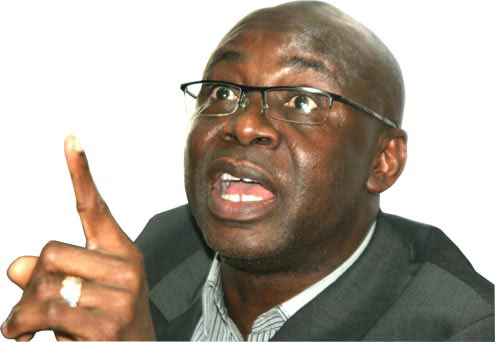


Is Anenih Paying The Price For Loyalty? By Kayode Ojo
And discussing the Jonathan Presidency, one of the few people who stuck close to him come rain and shine was Chief Tony Anenih. Of course, it is trite to say that Anenih’s name is one that rings bell in Nigerian politics. As a former minister of works in the Obasanjo presidency and, later, Chairman of Board of Trustees (BoT) of the Peoples Democratic Party (PDP), Anenih had come to symbolise the tenacity of the PDP and its unequal ability to rejig and bounce back from one crisis after another to a stronger party until its final defeat last year.
It is all too clear for any casual observer to see that the defeat of Jonathan could have come much earlier than the 2015 general elections but for people like Anenih. The succession politics from the late President Umaru Yar’ Adua to Jonathan, more than anything, defined the character of the Jonathan presidency and later its defeat in 2015 and this would be in spite of rather than because of people like Anenih. Make no mistakes about it, Anenih was perhaps the most loyal and dependable ally of former President Jonathan. This was probably why he was entrusted with assignments that involved fund disbursements to political allies. Besides, he never ceased to put his national political network and reputation to stabilise the Jonathan presidency by winning more friends, supporters and loyalists to Jonathan. Not only did he commit his time, he spent his own money to carry out assignments for the President even when those have been rightly mobilised for the action simply pocketed the money.
It is perhaps too easy to assume that Anenih was ferociously supporting Jonathan for his own selfish, political and any other pecuniary interests. Yet the truth remains that Anenih felt a moral burden to help the president succeed. First, as a statesman and party leader, it behoved Anenih to help steady the hands of Jonathan with the right advice in the interest of the Nigerian nation. Second as the politician with perhaps the highest profile from the South-south region, and with a President from the same region for the first time in the country’s history, Anenih could not have done other than provide the strongest support for Jonathan. Even when Jonathan lost the 2015 presidential election, Anenih volunteered to resign from his BoT position to allow the former president to assume it and find a strong platform to engage in national politics.
Although it is easier for the Nigerian politician lacking in principles to always run to where it is cooking as many PDP leaders of yesterday are doing now by defecting to the ruling All Progressives Congress (APC), Anenih can look back with satisfaction and dignity at his contributions, loyalty, support and service to the Nigerian state through the Jonathan Presidency. As an elder statesman, he has nothing to be ashamed of because there is no record that he abused his rare privilege as a confidant and ally of the former president. When Jonathan needed fearless Nigerians to speak the truth to his party members in 2010 that the zoning principle in the PDP could not override the Constitution of the country, Anenih found his voice and used his experience and vast political network to pass that message. And when it became clear that the president was wrongly handling the issue of the break-away “New –PDP” group, Anenih did not mince words in telling Jonathan the truth that he needed to listen to the aggrieved group and mend fences with them. Of course, this drew the anger of the many sycophantic and tragic “advisers” making their living by singing to the ears of the former president, the lyrics he wanted to hear. They did not wait to pour out all manner of invectives on their party’s BoT chairman. Strangely, many of those who goaded Jonathan on to the wrong path then have now jumped out of the apparently “sinking” PDP ship into the now “thriving” APC fold. More will still jump out.
In a country where the president is so powerful to make and unmake, whether in terms of power politics, business and policies, anyone who has the ears of the president easily lends himself/herself to both creeping and outright envy. If Anenih thought that everybody was cool with his chummy relationship with the former president, then the events of the past few days must have cleared any doubt in his mind. His name has been circulating in the media as one of the recipients of the alleged Dasuki $2.1 billion arms budget scam. In fact, the EFCC said it confirmed payment of N260 million from the Office of the former National Security Adviser into his account. In spite of the fact that Anenih quickly wrote to the EFCC clarifying how he was merely running errands for the former president, he is being wrongfully clobbered daily in the media as part of the people who stole from the Federal Government. In Anenih’s letter to the EFCC, he detailed how the former president instructed him on trust to deliver specified amount of money to some known politicians, including Alhaji Tanko Yakassai, Chief Olu Falae and Senator Rashidi Ladoja- for some political ends. And it is on record that none of the people Anenih mentioned refuted his story. Indeed they have all acknowledged that they received the said money from Anenih. Now the question is, if the NSA was directed by President Jonathan to pay some money to Anenih for specified presidential assignments that he had carried out, how on earth was Anenih to know if the money was drawn from the arms budget meant for fighting Boko Haram or from any other source for that matter?
The fact that Anenih willingly furnished the EFCC, upon its request, with the truth clearly shows his honest intentions. I do not know anybody, including those now trying Anenih in the media and attempting to drag his name and reputation to the mud, who will be summoned by President Buhari and given a sensitive assignment on trust, who will turn the President down or ask the president how he would fund it or where the money to fund the assignment would come from. Perhaps Tony Anenih has overstayed in Nigerian politics and some agents have taken it upon themselves to retire him willy-nilly. Maybe some people in his home-state are getting apprehensive of his never-waning influence in Edo politics, especially as a governorship election nears and are willing to throw everything to discredit him. Maybe Anenih is simply paying the price of being too loyal to a president who was too weak as to be defeated by small decisions of governance he could not take!
Ojo, public affairs commentator, lives in Ketu Alapere, Lagos. [myad]