


EFCC Gives Those Who Shared In Arms Deal Scam Soft-Landing
 Economic and Financial Crime Commission (EFCC) has given all those who shared in the allegedly diverted $2.1billion arms deal scam a soft-landing proposal, asking them to return what they got before it is too late.
This was even as the commission confirmed that the former military administrator of Kaduna State, General Lawal Jafaru Isa, who was arrested late last week, has refunded 60 per cent of the money he allegedly collected from the Office of the National Security Adviser (ONSA).
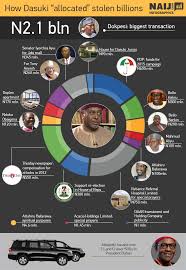
Some of the beneficiaries of the cash include the following:
Former governors Peter Odili (N100m)
Rashidi Ladoja (N100m)
Attahiru Bafarawa(N100m) Mahmud Aliyu Shinkafi (N100m) Jim Nwobodo (N500m)
Chief Tony Anenih (N260m)
Ex-PDP National Chairman Ahmadu Ali (N100m)
Chief Bode George (N100m/ $30,000)
Yerima Abdullahi (N100m)
Chief Olu Falae (N100m)
Tanko Yakassai (N63m)
Gen. Bello Sarkin Yaki (N200m) Raymond Dokpesi, Iyorchia Ayu’s company(N345m)
BAM Properties (N300m) Dalhatu Investment Limited(N1.5b)
Ex-PDP National Chairman Mohammed Bello Haliru, Abba Mohammed, Sagir Attahiru, serving and former members of the House of Representatives (over N600 million)
Former Chairman of the House of Representatives on Security and Intelligence, Bello Matawalle (N300m)
ACACIA Holdings(N600m)
Bashir Yuguda (N1,950,000)
Many other companies.
EFCC insisted that all those implicated so far must refund the “illegal disbursement” of cash to them or face trial.
“We have conducted a thorough investigation and we have retrieved some of the memos sent to ex-President Goodluck Jonathan by the former National Security Adviser; none of them indicated that the cash should be for political purposes.
“There was never a memo for cash advance for political matters like campaign or election.
“We have also traced some of these funds directly to the accounts of these bigwigs or their proxy companies.
“Having gone far, we are asking them to return these funds or else, we will go after them any moment from now. I think they should respect themselves and make urgent refund.
“In the alternative, we will arrest them and arraign them in court to defend such strange allocations.
“We will retrieve every kobo given out from ONSA. It is insufficient to say somebody gave me this money. Once we trace undeserved public funds into your account or phony and proxy companies, we will ask for refund.”
Regarding the interrogation of Gen. Isa, EFCC said: “He admitted collecting money from ONSA and he has refunded 60 per cent of the sum credited to him. I think it should be about N100 million.
“Isa is the only person who has so far refunded money among the political figures who collected funds from ONSA. We have granted him bail to allow him time to source for the balance.”
On the detention of the National Publicity Secretary of PDP, it said: “So far, Metuh has admitted the transfer of N400 million by ONSA into a company in which he has substantial interest.
“It is left to him to justify why he deserved such benefit from arms cash. We are still questioning him on other remittances into the company’s account. We are also demanding how he will refund the cash.
“Contrary to the noise outside, we did our homework very well. Anybody we bring to the EFCC this time around, we used to make sure that we have established a case against him.
“So, we don’t invite or arrest on frivolous basis. We do thorough investigation this time around.” [myad]







To Catch A Thief… Sam Omatseye
So we saw Sambo Dasuki, bright-eyed but subdued, in his dark-hued danshiki walk voicelessly out of the court, flanked by lawyers and associates. We wonder what roils inside his billion-dollar soul. He has said little. He has neither denied the flurry of statements from so-called miscreants who famously crackled out of his office with choice dollars. Neither has he defended himself.
Like a ram on sacrifice day, his face only reflects a muted melancholy. In dazed stupor, the ram keeps mum before the ominous eyes of butchers, the ferocious glitter of knives, the bowl awaiting its entrails and offal, the platform on which its neck will squish under the descending blade, the innocent giggle of children drooling for a happy meal.Of course, a small dug hole that indicates that burial is not an option except for the waste and blood that will rush out of the buxom flesh when the sullen ceremony of cutting and slashing is over.
All of the butchery represents the people, who have already made judgments on Dasuki. But that is the majority opinion, but not the majority opinion of the law. Two majorities? By law, majority opinion is the opinion of a few people on the bench. It reflects the superciliousness of lawyers and judges that they equate their narrow standpoint with the viewpoint of all of us.
President Muhammadu Buhari must be privately moaning this. He believes the guys stole. They broke the law. They farted on our holy of holies. They danced on the grave of our fighting men. They adorned themselves for that. Everybody knows it is wrong. So, why are they surprised when they are not allowed on the streets, but away in outer darkness, the key thrown away somewhere in the marshes of Bayelsa?
With his septuagenarian laugh and martial eyeballs, Buhari is still not a temperament for 2016. He is a romantic of the 1980’s. In the presidential chat, the ramrod man of still winsome mien sparked fire in the eye when he reminded the questioners that somebody took N40 billion from the Central Bank, that the IDPs are groaning, that a man call El Zakzaky with his rambunctious men defied the army, and a good government is not supposed to sit idle and watch impunity like a Nollywood show.
A deep chasm lay between the questioners and the former general. For him, it was a case of good versus evil. That made him into a sort of messianic force. The others thought good began with law and you could not be right with mere appeal to might like Greek philosopher Meno. If they invoked law, Buhari echoed law and order.
Yet those who want law believe also that the good ought to be punished. The irony is that the law, as Thoreau famously said, never made anyone a whit more just. So, there. Kanu, by common consent, railed against the law. The Shiites have no right to deny anyone the right to move. Those who stole our money must account.
But this is a democracy, and one of the lies of democracy is that majority always wins. This is one of those test cases of majority in a coma. Buhari’s war on corruption is a noble cause. But by defying the courts, it is a case of impunity chasing impunity. Two wrongs, where is the right?
The real problem is that the war against corruption is not a movement. For now, it is still Buhari’s war. He is cheered, but from afar. It is a war of one for all, but the one is lonely. In a democracy, a sense of consensus can help drive the battle. It happens in what political scientists and sociologists call corporatism.
That implies that all institutions instinctively work as one to pursue a collective interest. Liberal thinkers suspect such ideas because they bear the seed of tyranny. John Stuart Mill in his famous book, On Liberty, calls it the “Tyranny of the majority,” but Marxists wear it as an epaulette of honour.
It has happened many times where a shared value or set of values is enshrined into the spirit of the law. But Buhari lacks the charisma, the strategy and even energy of moral suasion to spark such firelight of fervour across the land. If he had it, he would not have to disobey the judges.
The bench would understand that thieves and miscreants have no place on the streets and they will find the law to keep them under lock and key. Gani Fawehinmi once told me in his chambers that, “if there is a case between a rich man and a poor man, I will find the law for the poor man.” It was a statement of values.
The United States had a movement in the Progressives Era at the turn of the 20th century. With the big corporations running rampant with men like Rockefeller, Vanderbilt, Carnegie, etc, a spirit bubbled in the country to checkmate the acquisitive excesses of capitalism. Journalists, courts, businessmen, churches and a cadre of politicians were caught in this redemptive aura. The most famous member was Theodore Roosevelt who became president, one of their best ever. The movement succeeded.
The danger is the possibility of a slide into dictatorship. Mussolini, Franco, etc exploited it. They did not triumph. French philosopher Rousseau designated it as “collective will” or “general will.” Mills objected and craved individual sovereignty.
But both men, while denying it, agree that unfettered individuality and state-backed totalitarian control will destroy society. As Machiavelli – no lover of freedom – noted, “where everyone is free, no one is free.” French philosopher Michel Foucault noted test cases in his book, Madness and Civilisation, and concluded that inside freedom creeps subtle malignancies of tyranny.
Buhari will have to look for the laws to help him. Or exercise patience. The civil society and media also need to isolate such judges as moral pariahs. They may know the law. But they might not know justice. Law is meaningless without justice. The individual is important. We cannot pursue the law without a Dasuki, or a Kanu or an El-Zakzaky knowing that the law took its full course.
That is the essence of liberalism and the strength of democracy. Sophocles’ The ban play, Antigone, pursued the subject of individual right and state right. There was a famous line that “under the cover of darkness” the people support Antigone against the king. Zulu Sofola’s Wedlock of the Gods pursues the conflict of the individual and collective will.
In his column, my former teacher Biodun Jeyifo (Happy 70th Birthday, by the way) reflected on a law now in the cooler to fast-track corruption cases, a thing Femi Falana has also harped upon. It is the measure of Buhari’s advisers that the legal framework for this battle was not put in place before launching the warfare.
Not even the emotional framework is ready. Part of the problem is that Buhari is part soldier, part democrat, but the soldier has failed to part ways with the past. It’s a schizophrenic tension. He can learn from Churchill, De Gaulle, Eisenhower, etc who sloughed off their martial coats.
If, for instance, Buhari steps down today, there is not a structure, not even a whiff of it, to point to the debris of his legacy. Not yet. He can start now. [myad]