

Save The Planet From Extinction, Buhari Appeals To World Leaders
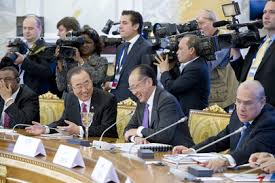
Nigerian leader, President Muhammadu Buhari has made a string appeal to the world leaders to save the planet from extinction by designing what he called binding resolutions for sustainable development.
President Buhari spoke today at the Conference of Parties 21 (COP21) which began today in Paris, France.
Buhari wanted the Conference to make Paris a global landmark in the history of climate change negotiations, even as he advised that nations must scale up their commitment to ensure a successful outcome and contribute to transforming the world through sustainable development.
“Like many countries, Nigeria continues to witness the adverse effects of climate change in all its ramifications. Presently, we are reeling under the challenges of climate change as the frequency and intensity of extreme events like floods and drought are on the increase.
“These challenges have resulted in the destruction of many economic and social structures and more worryingly, threatening our national food production and security.
“The magnitude of insurgency Nigeria is facing cannot be completely explained away without taking cognizance of the threat of climate change. Without a doubt,
“Climate change is threatening not only the sustainable development of our social and economic activities but also the totality of human existence in our country as in other parts of the world.
“At the sub-regional level, we are saddled with the challenge of the drying up of the Lake Chad Basin, which is resulting in the total wipe out of livelihoods of many communities surrounding this trans-boundary natural resource.
“Regrettably, the world is leaving behind millions of people who depend on the Lake for their survival. The Government of Nigeria welcomes the Lake Chad Development and Climate Resilience Plan, and the Lake Chad Basin Commission and international partners for designing this climate-based Plan.
“In all, the experience of countries sharing the Lake Chad further illustrates the mutual challenge we face today and which must be collectively addressed without further delay.”
President Buhari lamented the inadequacies of existing climate change treaties, protocols and conventions, saying tht for the potential of Paris Agreement on Climate Change to be meaningful, achieve its objectives and eventually become universal in nature and scope, it must draw extensively on the principles of common but differentiated responsibilities and respective capabilities.
“Indeed, for the Agreement to be durable, it must recognize not only the emission right but also the survival rights of the citizens of developing countries. “The inadequacies of the existing climate change treaties, the Conventions and its Protocol, constitute the driving force propelling Parties to reach another climate change agreement as the main outcome of this Conference of Parties.
“Nigeria appreciates the efforts and demonstration of flexibilities of all in the run up of discussions since Durban towards evolving the new global climate regime. Yet, we are very concerned at the pace of progress made so far.
“This is more important, since the negotiation continues to go back and forth without necessarily addressing the interests and concerns of the developing countries in general and African countries in particular.
“In this regard, Nigeria strongly believes that the agreement we reach here in Paris must equitably address climate change mitigation and adaptation activities in terms of the means of implementation with emphasis on adequate financing, technology transfer and capacity development.
“It is our fervent hope that these implementation modalities will be explicitly enshrined in the Agreement.”
President Buhari gave Nigeria’s target on cutting greenhouse emissions, which was arrived at after extensive consultations with stakeholders by up to 45 percent by the year 2030.
“On our part in Nigeria, we undertook an extensive and participatory process of multi-level consultations with a cross section of stakeholders within the different tiers of government towards determining our national contributions to global mitigation reduction.
“Based on national considerations, Nigeria intends to attain the mitigation reduction objective of 20 per cent unconditional and 45 per cent conditional below the Business as Usual level of Greenhouse Gas (GHG) emissions by 2030.
“It is our expectation that this nationally-determined ambitious target given our national circumstances and developmental requirements will eventually pass the green test.”
Buhari reiterated that the Paris Agreement must be legally binding, all-encompassing and sustainable for it to be universally applicable, result-oriented and in all, effective.
“The Agreement we reach here must also be a fair, multilateral and rules-based regime guided by science with an overall aim of ensuring the right to equitable access of every country of the world to sustainable development.”
The conference is being attended by about 150 world leaders. [myad]





Buhari’s Trips Are Not For Fun, By Garba Shehu.
I have been amused, reading a number of jokes concerning the frequency of the President, Muhammadu Buhari’s foreign trips.
Questions have been raised about why so many visits, and what are the benefits Nigeria is getting?
I will make it clear from the beginning that the critic is entitled to his and her opinion and nothing said here is intended to silence him or her.
Criticism goes with the territory and as it is often said in a wisecrack, if you don’t like the heat, get out of the kitchen.
President Muhammadu Buhari came into office under the mantra of change. While Nigerians are yearning for change, you need someone who will set up the infrastructure, both at home and abroad for it. President Buhari is busy doing that.
The change is manifest in where he visits and what he does.
In the delegations accompanying him abroad, President Buhari has slashed the numbers, bringing them down to a tolerable or the bearable minimum.
He went to the United Nations General Assembly in September with an unbelievable 32 officials in his delegation. These included his cook, his doctor and luggage officer.
His predecessor in office went to the same meeting with 150 officials and family members the year before.
Wherever they are given government accommodation and feeding, members of President Buhari’s entourage receive reduced allowances, thereby saving the government some money.
In public diplomacy, experts say that it is better conducted through face-to-face interaction than through third parties. This is even moreso at the level of heads of state. To do by it by proxy is to miss the effect of fostering strong interpersonal relations between leaders, by which nations benefit.
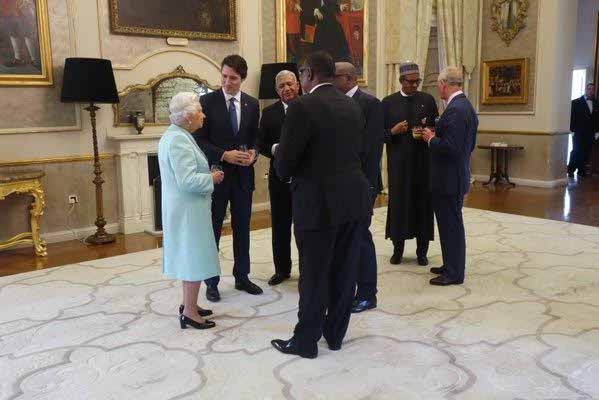
President Buhari has so far visited Germany, South Africa, USA, Niger, Tchad, Cameroon, Benin, Ghana, South Africa, India, Iran and Malta, where we are presently for the Commonwealth Summit. Mostly, these were due to either the United Nations, EU, African Union or energy and security-related summits. They were mostly undertaken to attend specific meetings, not State Visits. Looking at these assignments, the trips are inescapable for the President. What would Nigerians say of their leader when see the array of world leaders assemble, as they would shortly be doing discussing climate change in Paris on Monday and their own President is missing from the table?
Those of us who were around under Abacha read all the taunts about him being a sit-at-home leader. Abacha was despised for not representing his country abroad.
President Buhari’s foreign visits have been marked by punishing schedules. They are always business-like and results-oriented.
All trips have been marked by tight schedules. Meeting after meeting, happening back-to-back morning, afternoon and evening. The President has had to travel overnight for some of these meetings.
The visit by any president to another country is the highest act in international relations.
It sends out a message that that county is important to the visitor.
It is not like your usual vacation abroad. Official discussions involving political leaders, the military, the diplomats and at times, business people are held at multi- track levels. In foreign policy you stand on a quick sand of events and you slip up if take a rest or lose focus. Governments also know that their achievements at home will be meaningless if they cannot project them abroad. Who or where are the foreign investors,whose hand you are seeking if you can’t travel meet them? Will they come if they don’t know about the country? President Buhari demonstrated a keen understanding of these when in the first week of his taking the office, he brought together foreign policy and all three cardinal objectives of his administration-security,economy and war on corruption- by embarking on visits to neighboring countries.
In our recent history, much of the West had ignored Nigeria under the corrupt PDP administration for many years, which warranted the country’s tilt towards some Asian countries.
As a consequence, this country has suffered past isolation of various types, including the denial of access to the arms-purchase market.
As a member of the then Standing Committee of the Nigerian Guild of Editors, I remember being in a delegation that visited the Aso Rock Villa, to beg the government at that time not the execute the writer and activist, Ken Saro-Wiwa.
At the meeting with the Number Two man in that government, Major-General Oladipo Diya, he announced to everyone’s shock and disbelief that Ken had been executed. “Honestly,” he muted, “I think he has been executed about two days ago.”
What followed that pronouncement was a global outrage.
The then Foreign Affairs Minister, Arch. Tom Ikimi representing Nigeria at the Commonwealth meeting in New Zealand, shattered the feelings of the leaders of those countries when he announced to them that he had not been briefed about the executions and begged for time to talk to the leaders back in Nigeria.
Nigeria faced an imminent expulsion from the group and would have been so sacked but for the intervention of the then President of South Africa, late Nelson Mandela.
In place of this extreme form of sanction, a suspension and and a barrage of sanctions followed and remained in place until an appreciable remorse was was shown and progress made towards the return to democracy by Nigeria.
Throughout that period of time, it was difficult being a Nigerian in the international space.
As council members of the UN Human Rights Commission, Africans would caucus in Geneva without us Nigerians. Like lepers, we were shunned wherever we showed up.
I mentioned this short narrative to illustrate two things: one, for a country to do the right things all the time and two, you don’t know the joy being a part of international gatherings until you suffer the pain of exclusion from them.
Short of begging the world, there was nothing that the Abacha government didn’t do to be taken back into the Commonwealth.
And it is against this background that I felt the need to pen this opinion in the hope of bringing better understanding to fellow countrymen and women on the current subject matter.
There is no reason to be angry with anyone criticizing President Buhari for traveling abroad. In politics, even if President Buhari were to bring with him a suitcase full of cash and a pot gold each time he returned from a trip, someone will criticize him, saying that the journey is wasteful.
The PDP will kick, knowing that they got 16 years and did nothing with it. Those who didn’t do much during their term of governance will find it instructive to fault whatever the President is doing.
If President Buhari is successful as a leader, the PDP will be history.
My own point here is that he is doing a great job and the fruits are here, and many more will soon come. He is working to strengthen diplomatic relations, trade and the security of our nation. He holds serious meetings with serious investors and has fetched us investments in the range of billions of US Dollars.
Now, countries such as France, UK, The U.S are supporting Nigeria with intelligence, weapons and training for our military against Boko Haram and the economic saboteurs in the Delta region.
President Buhari will definitely make Nigeria great,what the PDP fooled us for 16 years.
All heads of countries around the world now take Nigeria seriously. His foreign trips are for business, security of the country and bilateral contacts- contacts that get actualized by follow-ups and the love and support a leader enjoys at home and abroad.
Today the world is in a warm embrace of President Muhammadu Buhari.
Nigerians should be proud of the attention, love and admiration, importance, respect and investment he is bringing to Nigeria. These trips are not for enjoyment.
Lastly, to answer those who ask all the time, what is he bringing back home?
We are not a country of beggars. It is good if something is in the bag as the leader comes home from a trip.
Culturally, we never return home from a trip without a souvenir for everyone left at home. Yes it is good he declares something upon his return.
But the most important task for the President at this time is to reset the image of Nigeria abroad, given the damage it sustained over many years in the past.
So far, in fairness, the President has projected a large image of Nigeria and of himself which should be a matter of pride for all our citizens. Marketing of Brand Nigeria can never be more important than currently it is.
The President is doing a great job for the nation. He needs to be supported.