

ICPC, Institute Of Taxation Set To Partner To Fight Corruption, Promote Transparency In Taxation System
The Independent Corrupt Practices and Other Related Offences Commission (ICPC) and
the Chartered Institute of Taxation of Nigeria (CITN) have struck an agreement to partner towards fighting corruption, combating fraud, promoting transparency and accountability in the national taxation system.
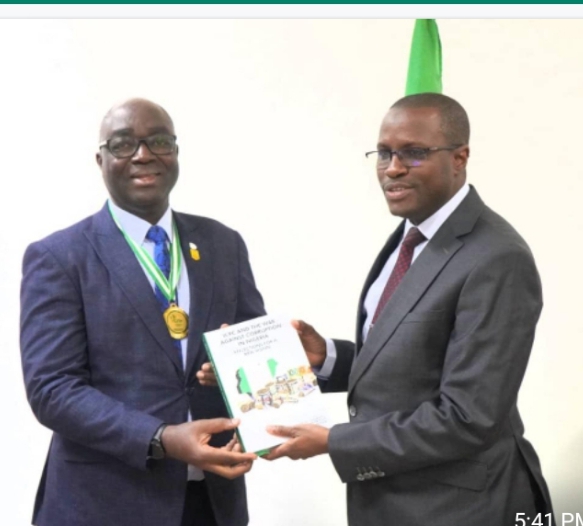
The ICPC boss, Dr. Musa Adamu Aliyu, who played host to the President of CITN, Samuel Agbeluyi, mni today, January 16, endorsed the request, describing such partnership as necessary to curbing tax related corruption.
Dr. Aliyu outlined key agenda for the partnership to include public awareness, technology and policy advocacy, which according to him, are crucial to the promotion of transparency, accountability and excellence in the taxation sector.
He stressed the need for Nigerians to contribute to its development by normalising tax payment.
“The relationship between ICPC and CITN will be consolidated by revisiting the existing Memorandum of Understanding (MOU) and ensuring that the terms are reviewed and improved upon.”
ICPC boss assured CITN of the Commission’s unwavering support, as well as collaboration with other key players in the sector, including Federal Inland Revenue Service (FIRS) to effectively prevent and check tax related offences.
This was even as Agbeluyi reiterated the commitment of CITN to make Nigeria great by plugging loopholes in the taxation system “that has led us to numerous interactions with stakeholders to discuss promotingexcellence, professionalism and ethical standards in the practice of taxation.
“The crucial role that an efficient tax system plays in building a sustainable and prosperous economy cannot be over emphasised.In his opinion, the drive to make taxation a cornerstone of national economic development necessitated collaboration with key stakeholders.”
The President of CITN outlined capacity building and public advocacy as some of the areas in which the institute hoped to partner, with the aim of creating a robust and efficient tax administration system that will boost revenue generation of the country.

 According to him, the government owes a duty to ensure the safety of the Capital Territory, which is home to all Nigerians, and that his government is providing the necessary support required by the various security agencies in to provide solution to the challenges.




How Not To Abuse Taxpayers Contribution To Nation’s Commonwealth, By Rashidat Yusuf
To be sure, taxes are generated from all tax payable individuals, be it in the formal or informa sector of the economy. Indeed, the money considered as “government money” belongs to the citizens.
It is the money that is put together from both the market women selling pepper and tomatoes, ewedu, ugwu as well as other petty traders; it is equally the money drawn from salary earners, whether well paid at work or under paid (public and private). They all have taxes deducted fom their salaries. Also Indigenous companies as well as multinationals all pay taxes.
I remember during our NYSC days, we were made to go on tax collection drive in Makurdi, capital of Benue State. We were on duty every market day. We learnt the difference between tickets for “open shops” and for “lock up shops.”
All such taxes go into government coffers, from where it is utilised for the day to day running of government .
The estacode you receive when going on foreign and local trips for mainly, official assignments is drawn from taxpayers money, which cumulatively, is called COMMONWEALTH. Taxes, from various sources are a wealth which belongs to all citizens.
And so, when you are privileged to partake in the Commonwealth, by virtue of your position, you become indebted to the state or the country. A “give back” then becomes imperative on you. You must be seen to be contributing meaningful to the growth and development of such a state or the country.
As part of measures to safeguard the “taxpayers” money and ensure proper utilization, President Bola Tinubu, on the 9th of January 2024, came up with the idea of cutting down by 60 percent, the number of entourage that would accompany him on both local and foreign trips. The President’s decision was greeted with wide spread commendations.
Against that background, it is obvious from time immemorial that many people who have been accompanying Chief executives in government on trips have no business doing so.
They usually go abroad with state money without any tangible assignment. What they do mostly is to go into shopping malls or markets in search of the latest phone, ipad, shoes, clothes, perfumes and so on.
One is not saying however that such shopping is not necessary, but the shoppers should always ask themselves whether it is the taxpayers, by extension, that should be so wasted.
It is expected that after President Tinubu’s exemplary move, state governments and others down the line, should take a coo. Ministries, Departments and Agencies should also tow the line, in the genuine drive towards prudence.
Monies earmark for projects must be properly utilised for the benefit of the taxpayers of all hoos.
It must be pointed out that extravagance and unnecessary spending by Nigerians is not limited to local and foreign trips alone; those in offices too, running the day to day activities of government need a reorientatioion
Taxes are, for emphasis, our collective wealth and must be treated as such .
As you get opportunity to serve, remember that funds at your disposal is from the commonwealth and should be judiciously used for the purpose of creating more wealth and or comfort for the citizens.