The Independent Corrupt Practices and Other Related Offences Commission (ICPC) has revealed how officials looted about N980.2 million from the Ministry of Environment and three Federal Government Colleges in the country even as the money has been returned to the treasuries of the affected institutions.
The amount included the stolen N924 million voted for the Great Green Wall to fight desertification in 11 states and N56, 211,086.23 diverted votes for the feeding of students in Federal Government Girls College (FGGC), Shagamu, Federal Government College, Odogbolu and the Federal Science Technical College, Ijebu-Imushin.
Chairman of ICPC, Mr. Ekpo Nta, said: “The funds were returned pursuant to court orders,” even as he made it clear that ICPC is still tracking and investigating the movement of another N468, 794,613.79. [myad]
Six Nigerian pilgrims have been confirmed to be among 107 who died when a crane collapsed at Mecca’s Grand Mosque in Saudi Arabia at the weekend.
Spokesman for the National Hajj Commission of Nigeria (NAHCON), Uba Mana said yesterday that so far, “we have lost six pilgrims — two males and four females while we have three injuries.”
Uba Mana said that the death toll could rise further, saying: “we can’t say this is the final death toll because the situation is still unfolding. We are still visiting the hospitals and mortuaries in search of more casualties from Nigeria.”
He said that over 61,0000 Nigerians have so far been airlifted to the Holy land for the Hajj out of 76,000 expected for this year’s pilgrimage.
“The rest will be airlifted in the coming days,” he said. [myad]
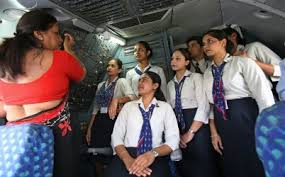
State-run Indian airline has grounded nearly 125 members of cabin staff because they are overweight. Reports reaching Greenbarge Reporters reveal that the Indian national carrier had, last year, asked about 600 cabin crew members to lose weight or be grounded.
It was reported that some of the grounded crew members have been re-assigned to positions on the ground while others have been offered voluntary retirement.
Sources in the airline hinted that those crew singled out, including stewardesses who have failed to maintain the weight requirements stipulated by the aviation regulator, the Directorate General of Civil Aviation.
A BMI of 25-29.9 for male crew is considered overweight and 30 and above is obese, while for females BMI of 22-27 is overweight and 27 and above obese.
Employees that fall in the overweight category would be deemed ‘temporarily unfit’.
Staff can continue to fly for up to 19 months with this tag but if they don’t slim down in that time they will eventually be seen as ‘permanently unfit’ and grounded. [myad]
President of the United State of America has advised her daughter Malia, to be open to new experiences when she goes to college and ensure that she gets a good grade.
“The advice… is to be open to new experiences when you go to college. Don’t go to college just to duplicate the same experience you had in high school,” Obama said yesterday at a Town Hall on college access and affordability at Des Moines, Iowa.
“Don’t make your decision based on, ‘well, where are all my friends going so that I can do the exact same things with the exact same friends that I did in high school,’” Obama said.
“The whole point is for you to push yourself out of your comfort level, meet people you haven’t met before, take classes that you hadn’t thought of before. Stretch yourself. Because this is the time to do it, when you’re young. Seek out new experiences,” he added.
He was responding to a question on what advice he would give to his daughter Malia, 17, when she goes to her college.
“Now, this is assuming that Malia would listen to my advice. She’s very much like her mother at this point. She’s got her own mind. One piece of advice that I’ve given her is not to stress too much about having to get into one particular college.
“There are a lot of good colleges and universities out there, and it’s important I think for everybody here to understand you can find a college or university that gives you a great education, and just because it’s not some name-brand, famous, fancy school doesn’t mean that you’re not going to get a great education there.
So one is lower the stress levels in terms of just having to get into one particular school; I think that’s important.
“The second piece of advice I have is keep your grades up until you get in, and after that, make sure you pass. Because it’s important that you kind of, run through the tape in your senior year and not start feeling a little slack. I don’t worry about that with her; she’s a hard worker.” [myad]
Nigerian banks have frozen the interbank money market to await further instructions on how to comply with a directive to transfer government revenues into a single account with the central bank.
One of the dealers said: “no trading is currently going on because no bank was willing to put out quotes until there is a clearer direction with the implementation of the Treasury Single Account. The market is right now frozen, as no trading going on.”
Analysts have predicted that implementation of the government policy will drain naira liquidity from the banking system, potentially putting some banks in a dire situation.
The overnight lending rate closed at 5 percent on Monday, but dealers said the rate was initially quoted at 200 percent on Tuesday. No deals were done using that rate.
Chief executive at Financial Derivative Company, Mr.Bismarck Rewane, confirmed that about 1.2 trillion naira, or 10 percent of banking sector deposits, would be transferred to the government account with the central bank, in the course of implementing the TSA policy.
“We expect an initial paralysis in the market and a disruption of operations of some of the banks, but they would overcome that.”
He said the central bank could reduce the size of the cash reserve requirement (CRR) commercial lenders are expected to keep with it and inject some liquidity into the banking system to minimize the impact of the new account policy.
The CRR, which is the amount the central bank requires banks to set aside, is currently 31 percent for both public and private sector deposits.
It would be recalled that President Muhammadu Buhari ordered that all revenues be paid into the “Treasury Single Account” (TSA) with effect from today, September 15, as part of a drive to fight corruption and aid transparency. [myad]
President Muhammadu Buhari has taken his time to list numerous investment opportunities that are waiting to be explored as he addressed French community today in Paris, France.
Buhari made it clear that there is more to Nigeria investment opportunities than just oil exploration, adding that the country is blessed with lands rich in agricultural and mineral resources coupled with skilled and low-cost labour, large market, robust and competitive private sector, stressing that the areas remained largely untapped.
According to the President, other critical areas, such as agriculture, energy, automobile and skill development needed to be expanded to provide jobs for the youths. President Buhari who spoke at a gathering of investors at the Nigerian-France presidential business forum which held at the headquarters of the French Business Confederation (MEDEF) in Paris called on the French investors to explore vast untapped natural deposits in Nigeria even as he said that the idea behind his aggressive campaign against insurgency is to create a safe haven for local and foreign business and investments.
President Buhari recalled that Nigeria and France already have a cordial trade partnership,saying that both countries needed to exceed their annual trade volume of $5billion, adding that the long standing economic ties between the two countries which dates back to 1902 when the CFO set up a training programme in Lagos State.
He promised evolve a competitive, virile, productive economy based on excellence, integrity, transparency, accountability and respect for the rule of law.
“It is a positive development that today Nigeria is the largest trading partner with France in Africa.
“But opportunities abound to greatly increase the current $5billion annual trade volume and I fully agree with President Hollande when he declared in February, 2014 in Abuja that trade volume between both countries should double in four years.
“Today many French companies are happy to have flourishing businesses in Nigeria, opportunities abound to greatly increase the $5billion annual trade volume between the two countries”
“Nigeria is now at a new dawn to chart and reposition its destiny for greatness. We are resolved and firmly determined to consolidate on industrializing Nigeria and diversifying its economy into sectors such as agro-processing, mining, manufacturing, petro-chemicals, food processing and textiles.
“Nigeria has what it takes to make a break-through and there is more to Nigeria than oil. It is a blessed land rich in agricultural and mineral resources coupled with skilled and low-cost labour, large market, robust and competitive private sector”, he said.
The President also expressed his gratitude to President of the Movement of French Entrepreneurs (MEDEF), Mr Pierre Gattaz, organizers of the French-Nigeria Business Forum for making the gathering a possibility.
He said that he was looking forward to hosting the French business community in three weeks time. Earlier, Mr. Gattaz who described Nigeria as the biggest economy in Nigeria expressed their readiness to do business in Nigeria, saying that electoral victory of president Buhari was one way of taking Nigeria out of the economic doldrums, assuring the president of their support through businesses and investments in the country. [myad]
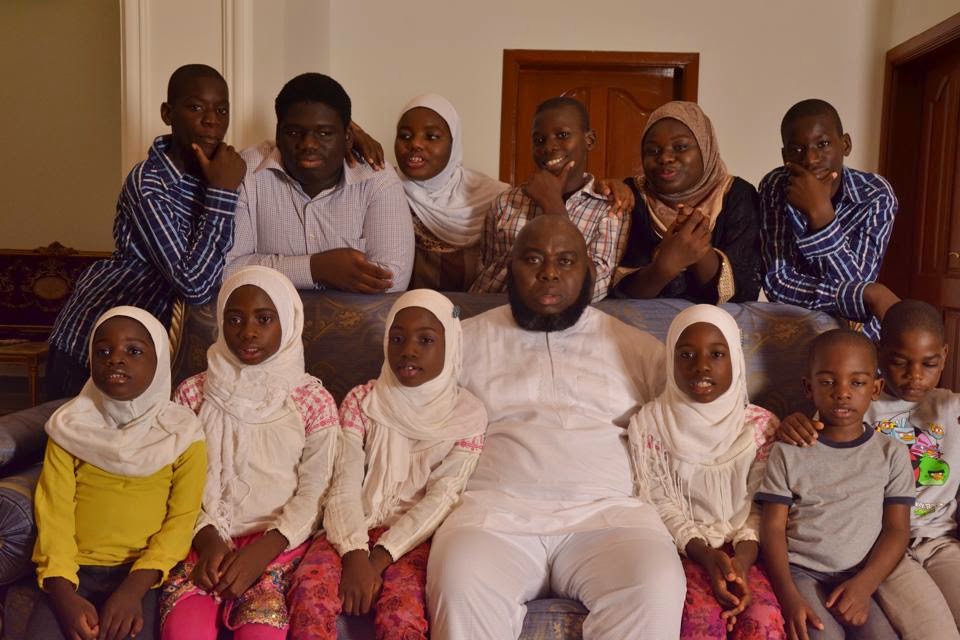
Leader of the now rested Niger Delta Volunteer force, Alhaji Mujahideen Asari Dokubo recently displayed some of his children in a family picture. [myad]
Criminals who kidnapped Toyin Nwosu, wife of the Deputy Managing Director of The Sun newspaper, Steve Nwosu, in the early hours of today, have finally contacted the family, demanding the sum of N100 Million as ransom.
This was even as the Lagos State Commissioner of Police, Fatai Owoseni has described the attack as an ‘armed robbery operation.’
Owoseni who spoke to newsmen at his office in GRA, Ikeja, Lagos, today said the home of the senior journalist remains an active crime scene since his wife was held hostage.
“Steve Nwosu was a victim of armed robbery attack. The place is still an active crime scene, so we are careful in order not to jeopardize investigation.” [myad]
The Nigeria Supreme Council for Islamic Affairs (NSCIA) has declared September 24 as Eid-el-Kabir across the country. The position of NSCIA slightly differs from that of the Jamaátu Nasril Islam, the umbrella body for Islamic organizations in Nigeria, which has earlier declared Wednesday, September 23 as Eid-el-Kabir.
The JNI had in a statement on Sunday by its Secretary General, Khalid Aliyu, said the month of Dhul Hajj begins today (Monday), meaning Eid-el-Kabir would be observed on Wednesday, September 23.
The JNI, like the NSCIA, is under the leadership of the Sultan of Sokoto, Mohammed Saád Abubakar.
However, the Secretary General of the NSCIA, Ishaq Oloyede today said the announcement by the JNI was done in error.
“The NSCIA would issue a statement on the new month of Dhul hajj later today,”he said.
He also said the Moon-Sighting committee of the NSCIA already agreed with the decision of authorities in Saudi Arabia that the month of Dhul Hajj begins tomorrow (Tuesday).
“Consequently, Eid-el-Kabir would be observed on Thursday September 24, while Wednesday is Arafat day,” he said. [myad]
The investment drive of the Lagos State Government received a major boost today when the representative of the Knauf Group International, Mrs. Isabel Knauf expressed her company’s readiness to commence work on a N14 billion manufacturing firm in the state.
This was made known when the German Ambassador, Michael Zenner led a group of German diplomats and investors on a courtesy visit to Governor Akinwunmi Ambode at the Lagos House, Alausa, Ikeja.
Zenner canvassed for an increased presence of German businesses in Lagos, even as he sought for improved bilateral trade relations with the State Government.
“We are here to introduce and express our interest in business and economic cooperation, especially on food processing and building materials. A lot of allied companies in Germany also wish to join hands in the investment drive of the Governor”, the ambassador said.
In his remarks, Governor Ambode who expressed his administration’s readiness to receive German investors, described Lagos as the economic hub of Nigeria and fifth largest economy in Africa, thereby making it investors’ first choice of destination in Nigeria.
“As the economic hub of the country, we pride ourselves as the largest of the nation’s economy with the GDP of $131billion. For any German company that wants to do business in Nigeria, Lagos is your best bet. We are committed to the rule of law and we assure you of a safer and secured environment.”
The Governor, who described the visit by the German envoy as the first by an ambassador to actually visit and commit to commence immediate foreign direct investment, lauded their confidence in the Lagos economy.
He assured the delegation of his administration’s commitment to do everything possible to ensure smooth take off of the project and sought to activate a state sister relationship with the city of Hamburg to further boost cooperation.
“I also want to let you know that you are the first ambassador to come out openly that you want to come and start business immediately. With your coming, investors are beginning to have confidence in our quest to build an investor-friendly environment. I want to say openly that we are committed to give everything required by this group to start work immediately”, Ambode enthused.
Earlier, Mrs. Isabel Knauf of the Knauf Group International had solicited the support of the Governor towards locating a $70million (N14billion) building/construction tools manufacturing company in Lagos.
She solicited the support of the Governor saying the preference for Lagos was informed by its proximity to ports, availability of gas pipeline and a ready market.
“We are looking to invest and build a factory here. We are looking for your support. We have been to Lekki Sea Port and want to proceed on investing straight off. I wish to express our interest in investing about 70million US dollars in construction tools factory in Lagos for the first stage.”
We use cookies on our website to give you the most relevant experience by remembering your preferences and repeat visits. By clicking “Accept”, you consent to the use of ALL the cookies.
This website uses cookies to improve your experience while you navigate through the website. Out of these, the cookies that are categorized as necessary are stored on your browser as they are essential for the working of basic functionalities of the website. We also use third-party cookies that help us analyze and understand how you use this website. These cookies will be stored in your browser only with your consent. You also have the option to opt-out of these cookies. But opting out of some of these cookies may affect your browsing experience.
Necessary cookies are absolutely essential for the website to function properly. This category only includes cookies that ensures basic functionalities and security features of the website. These cookies do not store any personal information.
Any cookies that may not be particularly necessary for the website to function and is used specifically to collect user personal data via analytics, ads, other embedded contents are termed as non-necessary cookies. It is mandatory to procure user consent prior to running these cookies on your website.