Home Blog Page 213

Fake Degrees: NUC Investigates Keffi, 7 Other Nigerian Universities

The National Universities Commission (NUC), the regulatory agency for universities in Nigeria has listed eight Nigeria’s universities being investigated currently in its effort to eradicate fake degree certificates in Nigeria.
Information from the NUC website, said that the investigations ongoing is one of the highlights aimed at weeding out universities awarding fake certificates.
The Commission gave the list of universities under investigation as follows:
1. National University of Nigeria, Keffi, Nasarawa State
2. North Central University, Otukpo, Benue State
3. Christ Alive Christian Seminary and University, Enugu
4. Richmond Open University, Arochukwu, Abia State
5. West Coast University, Umuahia
6. Saint Clements University, Iyin Ekiti, Ekiti State
7. Volta University College, Aba, Abia State
8. L.I.F.E Leadership University, Benin City, Edo State
The NUC warned that certificates from these institutions will not be recognized for NYSC, employment, or further studies.
It said that law enforcement agencies have been notified for necessary action.
So far, NUC has uncovered 58 illegal universities in the country.

Nigeria, Saudi Arabia Sign 2024 Hajj Memorandum of Understanding

Nigeria, under the National Hajj Commission of Nigeria (NAHCON), has solidified its commitment to a seamless Hajj exercise by signing the 2024 Hajj Memorandum of Understanding with the Saudi Ministry of Hajj and Umrah.
The signing ceremony held today , January 7, in Jeddah, had in attendance key representatives from Nigeria led by Minister of Foreign Affairs Ambassador Yusuf Maitama Tuggar and Malam Jalal Ahmad Arabi, Ag. Chairman/CEO of NAHCON.
The host country’s contingent was led by the Saudi Arabian Minister of Hajj and Umrah, Dr. Taufiq Al-Rabiah.
Prior to the MoU signing, the two Ministers held a brief discussion where Nigeria requested for a lasting solution to the shortage of tents in Mina and pressed for more favourable terms for Nigerian Carriers during Hajj airlifts.
The Nigerian team also invited the Minister of Hajj and Umrah to visit Nigeria,
In response, the Saudi Minster, Dr. Rabiah, acknowledged the challenge of space in Mina and assured that efforts are being made to maximize the use of the available two Million square meters for the over two million pilgrims performing Hajj annually. He expressed the Ministry’s support for all measures aimed at giving pilgrims the best services. Dr Rabiah accepted to visit Nigeria soon.
Other participants from Nigeria include Nigerian Consul-General in Jeddah, Amb. Bello Hussaini Kazaure, senior officers from the Nigerian Mission in Saudi Arabia and NAHCON.

How EFCC Embarrassed Me After Attending To It’s Request, Aliko Dangote Complains

Aliko Dangote

President of Dangote Group, Alhaji Aliko Dangote has complained about the deliberate move by officers of the Economic and Financial Crimes Commission (EFCC) to embarrass him by invading the headquarters of the group in Lagos.
Reacting to the action of the offers of the Commission in a statement, Dangote complained: “whilst our representatives were still at the EFCC’s office to deliver the documents, a team of their officers proceeded to visit our offices to demand the same documents in a manner that appeared designed to cause us unwarranted embarrassment.”
Dangote recalled that on 4 January 2024, “our team delivered the first batch of documents to the EFCC. However, officers of the EFCC did not accept the documents, insisting on visiting our offices to collect the same set of documents directly.”
Dangote said that the officials who raided his office did not take any documents or files “from our Head office during their visit as these were already in their office.
“We must emphasize that, to our knowledge, no accusations of wrongdoing have been made against any company within our Group. At present, we are only responding to a request for information to assist the EFCC with their ongoing investigation.
“As a law-abiding and ethical corporate citizen, we remain committed to providing the EFCC with all necessary information and cooperation. “We have already delivered the first batch of documents and are actively working to compile and submit the remaining documents, in good time, to aid their investigation.
“Our Group is a key contributor to the national GDP, the largest employer in the private sector, one of the largest groups listed on the Nigerian Stock Exchange, and one of the highest taxpayers in the country. We remain steadfast in our belief in Nigeria’s commitment to the rule of law and its dedication to fostering an environment conducive for investment and value creation for both local and foreign investors.
“We therefore call for the understanding and patience of our stakeholders. We will keep our stakeholders informed of any further developments.”
Dangote reiterated the Group’s commitment to provide EFCC with all necessary information, saying: “we have already delivered the first batch of documents and are actively working to compile and submit the remaining documents, in good time, to aid their investigation.”
Giving details of how it all happened, Dangote said that on 6 December 2023, “we received a letter requesting details of all the foreign exchange allocated to our company by the Central Bank of Nigeria from 2014 to the present. We understand similar letters were sent to 51 other Groups of companies requesting for same information spanning the same period.
“We responded to the EFCC to acknowledge receipt of the letter whilst seeking clarification on the subsidiaries or companies within the Group that they required information on. We also requested additional time to compile and properly present the extensive documentation spanning ten years.
“The EFCC did not provide the clarification sought and also did not honour our request for an extension and insisted on receiving the complete set of documents within the limited timeframe. Despite this constraint, we assured the EFCC of our commitment to providing the information and pledged to share documents in batches as we complete the compilation.”

Insecurity: No Cause For Alarm, Veritas University Assures Returning Students

The management of Veritas University, Abuja has assured students and staff of the institution as well as parents and guardians of adequate security arrangements as the students return from Christmas and New Year break.
The assurance is coming against the background of the recent reported incidence of a security breach in Bwari Area Council of the Federal Capital Territory (FCT).
In a statement today, January 6, the Head, Corporate Affairs and Communications of the institution, Ben Agande emphasised that adequate measures have been put in place to ensure the safety of students and staff “as we resume from the Christmas and New Year break.
“While we do not intend to divulge details of what we have put in place to ensure the safety of students and staff, it is imperative to state that the recent visit of the commissioner of police FCT command to the University is part of measures to beef up security in the area.
“We have also put in place elaborate and multi-layered security arrangement of armed guards, university internal security unit and other conventional security agencies to arrest any threats of security breach.
“The management will continue to collaborate with security agencies to tackle every security threats to students and staff in the University community.
“We urge students and staff of Veritas University to be vigilant and promptly report any suspicious activities to the appropriate authorities.
“Once again, we welcome our students back from the holidays as we resume academic activities in full.”

Weaponising Misinformation Against Sadiya Umar-Farouq, By Louis Achi

Fundamentally, poverty alleviation and productive youth engagement remain major challenges of modern economies around the world today. Nigeria is no exception. To cage a poor enterprise culture and mainstream poverty alleviation, a full-blown ministry under the Muhammadu Buhari administration was birthed and carefully designed poverty alleviation programmes and skills acquisition projects became major drivers of change, despite the extreme challenges of the period.
Then named the Federal Ministry of Humanitarian Affairs, Disaster Management and Social Development, ably led by the Honourable Minister, Hajiya Sadiya Umar-Farouq, it is now rechristened Ministry for Humanitarian Affairs and Poverty Alleviation led by Betty Edu. Today, it has been tweaked by the Bola Ahmed Tinubu presidency; the successor regime to Buhari’s.
Just recently, some online news and social media platforms went into a feeding frenzy over spurious, alleged links of the former Minister, Sadiya Umar-Farouq with the activities of a certain Mr. James Okwete reportedly being investigated by the Economic and Financial Crimes Commission (EFCC) over alleged financial improprieties.
Reports of this foggy linkage are clearly products of mischief makers who take delight in defamation, especially from some temporary positions of authority. Sadiya Umar-Farouq is proud to have served her country as Minister of the Federal Republic of Nigeria with every sense of responsibility and would defend her actions, stewardship and programmes during her tenure whenever called upon to do so.
Hajiya Sadiya Umar-Farouq is not in any way linked with the activities of Okwete who is reportedly being investigated by the EFCC over alleged financial misdemeanours. She does not know the said Okwete nor has he ever represented her in any way whatsoever. Therefore, linking her with him in whatever guise is most inappropriate and verges on mischief.
This makes it a major puzzle why suddenly some online media platforms are stridently trying to smear the lady’s image. It can then only be seen as a funded agenda by shadowy crisis entrepreneurs.
No wonder, the recourse to diminishing the impact of Sadiya Umar-Farouq appears logical and a fair game. But a more rigorous, logical analysis of poverty alleviation dynamics in a stuttering national economy suggests this is totally wrong and unfair.
Cut to the bone, these unmerited, obviously paid-for and scurrilous attacks represent deliberate weaponisation of misinformation for untoward ends. Sources close to the ex-minister have stated she is not familiar with the said Okwete.
Even under a new political dispensation, an analysis of Sadiya Umar-Farouq stewardship and legacies over some of the most challenging years of the national journey including two recessions, the seismic Covid-19 pandemic and global disruptions seeded by the new nationalism that swept Europe and North America will certainly not diminish but highlight her tenure’s positives.
The agencies under the supervision of the humanitarian ministry under reference whose financial activities attracted the attention of the anti-graft agency had their budgets independently and exclusively administered by them as long as expenditures do not exceed the threshold envisioned in the Public Procurement Act, of 2007, as amended. Extant service regulations have clearly defined these procedures.
If proposed expenditures go above the threshold, the agencies would revert to the higher authorities for ministerial, or other approvals. However, the agencies, in their judgment, ensured that expenditures for contracts were below ministerial or other approvals. So the agencies, as learnt, did not need to seek ministerial approvals. These are basic, if routine facts, the ex-Minister would explain when she honours EFCC’s invitation.
Not one to back away from clarifying needful positions, the ex-minister has acknowledged the huge responsibilities she bore while in office, requiring the supervision of the nation’s poverty mitigation programmes. The figures involved often sound enormous, because of the nation’s huge poverty level, against the background of government determination to alleviate the people’s plight.
Adroitly navigating under former President Buhari’s broad and often controversial development vision, the then Minister of Humanitarian Affairs, Disaster Management and Social Development fundamentally impacted the dynamics of that intervention niche through specific innovative measures that touched many lives.
Tracking back, not many would’ve forgotten that, conceived in 2016, the Buhari administration’s carefully designed poverty alleviation programmes and skills acquisition projects assumed a multi-dimensional footing cutting across all facets of age groups, educational strata and geographies. These were the N-Power Programme and other National Social Investment Programmes (NSIPs) – job creation and empowerment initiatives.
The N-Power was designed for both young graduates and non-graduates. It was the flagship component of the federal government’s Social Investment Programme (SIP). Others are the National Home-Grown School Feeding Programme, Government Enterprise and Entrprenuership Programme (GEEP) under which Tradermoni, Marketmoni and Farmermoni are captured and the Conditional Cash Transfer.
Fundamentally, the N-Power was a job creation and empowerment initiative. It was designed for both young graduates and non-graduates in order to harness their skills for innovation, entrepreneurship and productivity. The targeted sectors are in the nation’s critical areas of needs in education, agriculture, health, technology, creative industry, construction and artisanal industries.
It is hardly disputable that the driving forces of economic growth and social development pivot around skills and knowledge. Notwithstanding the current high level of unemployment, harnessing the nation’s young demography through appropriate skill development efforts provides an opportunity to simultaneously achieve national inclusion and productivity. Not surprisingly, large-scale skill development is the main policy thrust of the N-Power Programme.
The key N-Power Programmes include: N-Power Agro, N-Power Tax, N-Power Build, N-Power Creative, N-Power Health, N-Power Teach, N-Power Tech Hardware and N-Power Tech Software. N-Power is also linked to the Federal Government’s policies in the economic, empowerment and social development arenas
The programme addressed the challenge of youth unemployment by providing a structure for large scale and relevant work skills acquisition and development while linking its core and outcomes to fixing inadequate public services and stimulating the larger economy.
The modular programmes under N-Power ensured that each participant learns and practices most of what is necessary to find or create work. The N-Power Volunteer Corp involved a massive deployment of 500,000 trained graduates who will assist to improve the inadequacies in the public services in education, health and civic education. Some of these graduates will also help in actualising Nigeria’s economic and strategic aspirations of achieving food security and self-sufficiency.
Good a thing Sadiya Umar-Farouq’s lawyer, Sir Oladipo Okpeseyi, SAN, has stepped in to clarify matters so that her detractors would be logically hobbled and denied the pleasures of their failed smear project.
Read him: “She did not shun the invitation extended to her by the Economic and Financial Crimes Commission (EFCC). She was eager to make herself available to offer clarifications to operatives of the anti-graft agency who were looking into the books of two financially independent agencies under the ministry, including the National Social Investment Programme Agency (NSIPA).
“I was at the headquarters of the Commission on Tuesday to submit a letter to that effect and to seek an extension of time (a shift in date) to enable my client, Hajiya Sadiya Umar Farouq, to make herself available at another opportune time to offer clarifications about activities of some agencies under the ministry she superintended in the immediate past administration.
“Although the EFCC has yet to send me a formal reply, the leadership availed us of its understanding, which resulted in parties amicably agreeing to have the interview originally scheduled for Wednesday (January 3, 2024) postponed to a time that the Commission would subsequently fix after looking through its schedules.”
This couldn’t have been more succinctly delivered. In effect, once the coast is clear and a new date is fixed by the Commission, Sadiya Umar-Farouq, his client, would be available to answer questions and offer clarifications on the areas of her stewardship that are not clear to the Commission.
Hence, according to Sir Oladipo Okpeseyi, SAN, “the impression created in a section of the media that my client was being invited for alleged misappropriation of funds is false. That is not the case in this circumstance. She has been invited to clarify certain expenditures by some agencies under her ministry. That is all.”
Strengthening the economic recovery process in Nigeria is clearly not a picnic. As it is, when the project was or is being guided by patriots who genuinely believe in Nigeria, who have unflinching faith in the ingenuity of Nigerians and who hold dear, the promise of the nation’s shared future, they should be honoured, not reviled.
Hajiya Sadiya Umar-Farouq is one such patriot and certainly does not deserve the weaponisation of misinformation against her person.

● Achi, a development journalist, contributed this piece from Abuja.

With N50,000, You Can Marry Beautiful Girl In Idoma Land Of Benue State 

The Idoma traditional ruler, the Och’Idoma In Benue State, Elaigwu John, has simplified the act of marriage in his domain, by bringing down to N50,000, unified beside price.
The first class ruler, in his New Year message issued by the Chief Palace Scribe, Onuminya Odoba on Wednesday, January 3, stressed that the traditional bride price in Idomaland “is hereby unified and fixed at N50,000.
“All forms of stringent conditions, stipulations, and expectations associated with traditional marriage are hereby removed and prohibited.”
On burial of the dead, the Monarch, who until his enthronement was a Life Pastor, said: “Imposition of costly prescriptions, stipulations, and requirements on the bereaved family for the burial rites of a deceased person is hereby prohibited in Idomaland.
“Burial rites should be conducted within affordable means of the family and, as much as possible, concluded within two to three weeks from the date of death.
“The practice whereby relatives deny and deprive the children and wife or wives of the deceased of their right to inheritance of the deceased’s property is hereby prohibited.”
According to the statement, the monarch decided to reform “some self-imposed, barbaric, and harsh cultural practices” that make life difficult for the people.
It said that the Idoma Area Traditional Council made the reform after wide consultations with rulers, political leaders, and their subjects.
Source: The Punch.

Expert Calls On President Tinubu To Urgently Unbundle Nigerian Railways 

A railway policy professional, Olawale Rasheed has called on President Bola Tinubu and the Federal Executive Council to implement reform of the Nigerian Railway Corporation to solve national transport challenges and jumpstart the nation’s economy.
In a series of tweets yesterday evening, January 5, Rasheed, who was the Chief Executive Officer of African Railway Consulting Limited until recently, said that solving the transport challenges, occasioned by bad roads demands revitalisation of the railway system which presently suffers from outdated laws, structures and equipment.
He noted that professionals in the railway sector are patiently awaiting the agenda of the President in unbundling the monumental benefits that the sector holds for the country, adding that President Tinubu must embrace critical reforms to turn things around for the better.
“Many rail professionals in Nigeria are feverishly awaiting the railway agenda of President Tinubu (@officialABAT),” his tweet reads in part.
“Mr President must embrace private sector led initiative, unbundle the NRC into four companies, pursue amendment of 1958 Railway act and adopt PPP funding model.
“The Presidency needs to enforce the unbundling of the NRC for four reasons namely it is against global best practice for a firm to be the operator and regulator. It gives room for inefficiency and corruption.
“Operating a 1958 Act is really a great disservice to the growth and development of the rail sector. How do you apply a 1958 Act in a 21st century economy?”
The expert dismissed as unfounded the fear of job loss that may have dissuaded the management of the Nigeria Railway Corporation from tapping onto unbundling the firm, noting that jobs will be created just as promotes efficiency in the sector.
“The fear of job loss by NRC management is unfounded and shortsighted. Creation of 4 new firms will create more job opportunities and elevation for stagnant top level officials.
“The Presidency should equally take note that the railway sector remain the only area of the national economy without liberalisation. Telecom, aviation, oil and gas and whatever are liberalised with billions of dollars in private investment. Railway remains the most backward.
“Conclusively, the rail sector will remain weak, moribund, financially bankrupt, inefficient and an embarrassment to the nation unless President @officialABAT act decisively now.”

Nigerian Govt Approves Max Air, 2 Other Airlines For 2024 Hajj Airlift Operations


The Federal Government of Nigeria has officially granted approval to three airlines to serve as exclusive carriers to airlift intending pilgrims for the 2024 Hajj operations.
They are Air Peace Ltd., FlyNas and Max Air.
The government also approved three air cargo companies that will airfreight pilgrims’ excess luggage. They are Cargo Zeal Technologies Ltd, Nahco Aviance and Qualla Investment Limited.
A statement today, January 5, by the spokesperson of the National Hajj Commission of Nigeria (NAHCON), Fatima Sanda Usara said that the approval reinforced Government’s commitment to ensuring a seamless and secure pilgrimage experience for Nigerian intending pilgrims.
“Consequently, the Federal government concurrently approved allocation of pilgrims from various states to each of the approved airlines as follows:
i.​Air Peace is to transport intending pilgrims from: Abia, Akwa Ibom, Anambra, Bayelsa, Cross River, Delta, Ebonyi, Edo, Ekiti, Enugu, FCT, Imo, Kwara, Ondo and Rivers.
ii.​FlyNas will airlift Muslim pilgrims from: Borno, Lagos, Osun, Ogun,Niger, Sokoto, Kebbi, Yobe and Zamfara.
iii. ​Max Air with the highest allocation will be responsible for moving pilgrims from: Bauchi, Benue, Kano, Katsina, Kogi, Nasarawa, Adamawa, Oyo, Taraba, Kaduna, Armed Forces, Gombe, Jigawa and Plateau States.”
The statement said that the allocation of pilgrims to the airlines is in line with the subsisting Bilateral Air Service Agreement (BASA) between Nigeria and Saudi Arabia on airlift of pilgrims under government quota. “However, state governments may choose to designate any of the approved freight companies to convey their pilgrims’ excess luggage. Should any state enter such exclusive arrangement, the decision should be communicated to the Commission accordingly.”
This came as the Nigerian Minister of Foreign Affairs, Ambassador Yusuf Maitama Tuggar, set to lead a delegation from NAHCON to partake in the signing of a Memorandum of Understanding (MOU) for the 2024 Hajj operations on 7th January 2024.
Meanwhile, the NAHCON chairman, Malam Jalal Arabi has congratulated airlines on their selection and called on them to gear up to facilitating smooth pilgrimage in 2024 season.
He said that NAHCON would continue to be dedicated to upholding the highest standards in pilgrimage organization, with a focus on the safety and satisfaction of pilgrims.

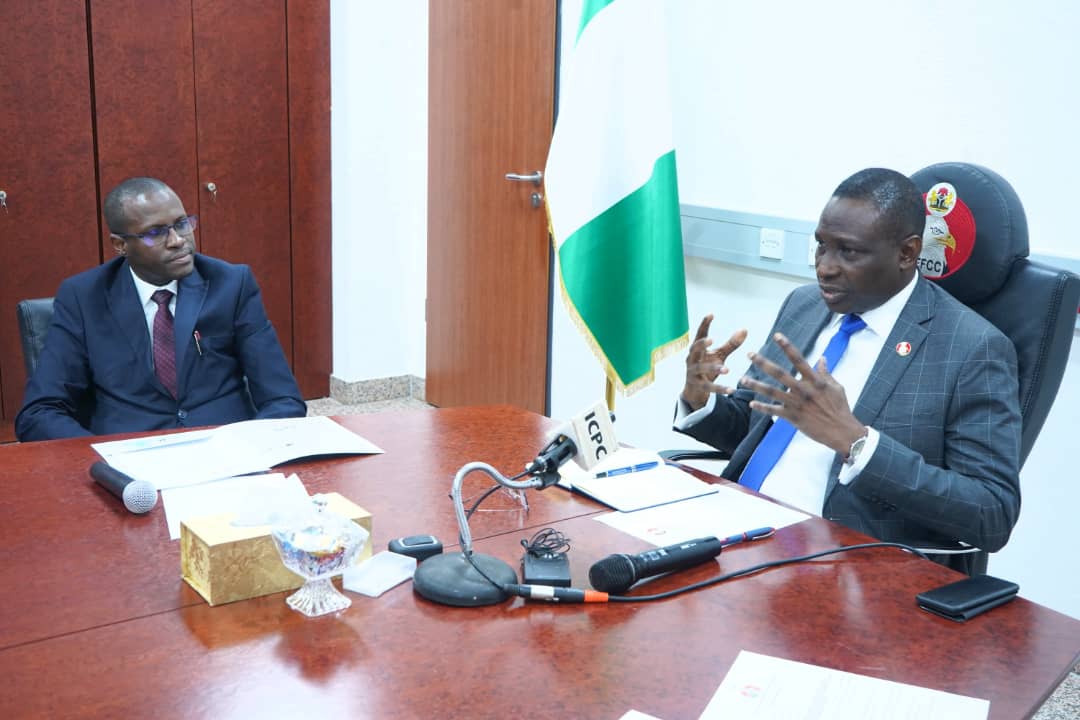
Let’s Integrate Innovative Technology To Combat Corruption, ICPC Boss Tells NITDA Counterpart

The Chairman of the Independent Corrupt Practices and Other Related Offences Commission (ICPC), Dr. Musa Adamu Aliyu, has suggested to his counterpart in the National Information Technology Development Agency (NITDA) to integrate innovative technology in the fight against corruption
The ICPC boss, who visited NITDA today, January 5, also called for the mapping areas of deployment of such technologies.
He said that the area of focus in the fight against corruption should be on technology drive, which he said, is one of the ICPC’s mandates.
“This aligns with the ICPC’s dedication to adapt and evolve in a digital landscape.
“With advancements in all sectors, adopting the best technologies in fighting and preventing corruption is crucial. Our partnership with NITDA is aimed at exploring support in digitising ICPC, enhancing transparency, accountability, and effectiveness, thereby boosting public confidence.
“Fighting corruption without technology is unthinkable at this stage. Our primary responsibilities at ICPC include preventing corruption, investigating, and prosecuting. Technology is essential for us to operate effectively.”
This was even as the NITDA’s Director-General, Kashifu Inuwa Abdullahi, expressed readiness to assist the ICPC, sharing insights on NITDA’s Digital Transformation Playbook.
He emphasised that digital transformation is a continuous journey, highlighting the importance of building capabilities for sustainable results.
The meeting also entailed discussions on forming a joint committee, symbolising an ongoing collaboration between ICPC and NITDA. This joint effort underscores the commitment to digital transformation as a constant process, crucial for a proactive approach in the fight against corruption.

Ex Justice Minister, Bello Adoke Laughs Last, Cleared Of Bribery Charges

Bello Adoke

Mohammed Bello Adoke, Attorney General of the Federation and Minister of Justice in the government of ex President Goodluck Jonathan has laughed last as the Economic and Financial Crimes Commission (EFCC), agreed at last that it has no evidence to support its charges of fraud, bribery and conspiracy against him.
In its response to the no-case submission filed by Bello Adoke, who was listed as first defendant in the charges all related to the OPL 245 transaction of 2011, the EFCC told the FCT high court that it would not oppose the application.
The anti-graft body also said it would not oppose the no-case applications by the other defendants, Aliyu Abubakar, Malabu Oil & Gas Ltd, Nigeria Agip Exploration Ltd, Shell Ultra Deep Nigeria Ltd, and Shell Nigeria Exploration Production Company Ltd (SNEPCo), over some of the charges.
However, the EFCC said that Rasky Gbinigie (Malabu Oil & Gas Ltd’s company secretary) has a case to answer over the alleged forgery of company documents to remove the name of Mohammed Abacha as a director.
The EFCC had charged Adoke before the FCT high court, Abuja, alleging that he collected a gratification of N300 million from Abubakar over the OPL 245 resolution.
He was accused of conspiring with other defendants to “commit the offence of public servant disobeying direction of law with intent to cause injury or to save person from punishment or property from forfeiture”.
The former AGF was accused of “knowingly disobeying direction of law” by allegedly “saving Shell Nigeria Ultra-Deep Limited, Nigeria Agip Exploration Limited and Shell Nigeria Exploration Company Limited from charges of taxes”.
He was also accused of “having accepted a gratification of N300,000,000.00 (Three Hundred Million Naira) in the exercise of his official functions”.
Adoke denied all allegations, maintaining that the N300 million being classified as bribery by the EFCC was a mortgage he took from Unity Bank Plc in 2012.
He said that it was transferred by the bank directly to the account of Abubakar, a property developer, and was refunded by Abubakar in 2013 when Adoke could not come up with his equity contribution.
Abubakar then sold the property to the Central Bank of Nigeria (CBN).
The EFCC had also filed another case against Adoke and Abubakar, alleging money laundering to the tune of $2 million (then worth about N300 million) before the federal high court in Abuja.
In a twist, an EFCC witness told the federal high court that it was the same failed mortgage transaction that was classified as bribery in the FCT high court by the anti-graft body.
Bello Adoke always insisted that he was a victim of political victimisation by former president Muhammadu Buhari on behalf of the Abacha family who felt cheated in the OPL 245 transaction.
On April 9, 1998, the federal military government awarded OPL 245 to Malabu Oil and Gas Ltd, which was said to be owned mainly by Mohammed Abacha, son of former military ruler Sani Abacha, and Dan Etete, who was the petroleum minister at the time.
On July 2, 2001, President Olusegun Obasanjo revoked Malabu’s licence and assigned the oil block to Shell — without a public bid. Malabu went to court and ownership was reverted to it in 2006 after it reached an out-of-court settlement with the federal government.
Shell fought back and commenced arbitration against Nigeria, but when President Goodluck Jonathan came to power in 2010 and implemented the consent judgment returning the oil block to Malabu, the controversy appeared to have been resolved with Shell and Eni agreeing to buy the oil block from the Nigerian company for $1.1 billion.
The oil companies also paid $210 million as signature bonus to the federal government of Nigeria.
But activists launched an international campaign alleging that the OPL 245 deal was fraudulent and that the proceeds were used to bribe government officials.
When Buhari came to office in 2015, his administration started a series of litigation against Royal Dutch Shell, Eni/Nigeria Agip Exploration (NAE), Shell Nigeria Ultra Deep (SNUD) Ltd, and Shell Nigeria Exploration Company (SNEPCO) over the allegations.
On May 22, 2020, a UK court declined jurisdiction in a case filed by Nigeria against Shell/SNUD and Eni asking for compensation in the sum of $1.1 billion.
On March 17, 2021, an Italian court acquitted Shell, Eni and all defendants of corruption charges in the $1.1 billion deal.
Also in June 2022, Nigeria lost its $1.7 billion claim against JP Morgan Bank over the transfers of proceeds from the sale of the oil block to Malabu’s directors.
Previously, the US Department of Justice investigated the transaction and announced in October 2019 that it was closing the case.
In April 2020, the US Securities and Exchange Commission also closed investigation into the deal after it could not prove fraud or corruption.
Meanwhile, Bello Adoke recently said Ibrahim Magu, former acting chairman of the EFCC, has apologised to him over the criminal trials which he said Magu masterminded to help Nigeria win the cases in Italy and the UK to no avail.
In April 2018, a federal high court in Abuja had ruled that Adoke could not be held personally liable for carrying out lawful presidential directives.
Source: The Cable, excluding headline

Advertisement ADVERTORIAL
WP2Social Auto Publish Powered By : XYZScripts.com