Former Vice President Atiku Abubakar, has lamented what he described as too many cases of miscalculated air strikes by the Nigerian armed personnel leading to unfortunate death of innocent Nigerians. Atiku was reacting to Sunday’s bombing over about 100 villagers at the Tudun Biri Village, Kaduna who were said to be marking the year’s Maulud event. The former vice president said that he was grieved by the news of the drone airstrike that killed dozens of people and left scores of others with various degrees of injury in the Tudun Biri community in Igabi Local Government Area of Kaduna State. “Ironically, the victims of this unfortunate incident were celebrating the Maulud anniversary. “The incidence of miscalculated air strikes is assuming a worrisome dimension in the country.” He stressed the need for the country to develop counterinsurgency strategies that will insulate the civilian population from tragic incidents of this nature. “I call on the authorities to launch a thorough investigation into this tragedy to avert future occurrences. “Meanwhile, no resource should be spared in medical attention to the injured and assistance to the families of the dead. I pray that the Almighty Allah comforts the bereaved families and grants the dead eternal peace.” The Nigerian Army had admitted yesterday, December 4, that its operatives mistakenly bombed the worshippers. Reported has it that President Bola Tinubu had ordered an investigation into the miscalculated bombing.
Management of University of Ilorin have announced the promotion of 48 of its academic staff members to the rank of professors. The university, in a bulletin today, December 4, said that the Vice-Chancellor, Professor Wahab Egbewole, made this known at a meeting he held with the new professors at the university. Egbewole said that 59 others were also elevated to the rank of associate professors in the latest promotion exercise by the institution. The vice-chancellor, who is also the Secretary-General of Association of West African Universities (AWAU), said that the Minister of Education, Professor Tahir Mamman, had approved the request of the university’s Appointments and Promotion Committee. He said that this culminated in the promotion of the new professors from their previous positions of readers/associate professors. Egbewole said that the approval of the minister was necessitated by the absence of a properly-constituted Governing Council for the university, which ought to have discharged the responsibility. He congratulated the new professors for attaining the peak of their careers, even as he expressed confidence in their dignity and competence. The vice-chancellor said that the promotions were meritorious and well-deserved, even as he commended their dedication to the achievement of the institution’s corporate objectives through quality teaching, meaningful research and impactful community services. He encouraged the newly-promoted dons not to rest on their oars, but work harder on their responsibilities so as to justify the confidence reposed in them by the authorities of the university and the society at large. Speaking earlier, the Registrar, Mr Mansur Alfanla, congratulated the new professors on their promotion to the pinnacle of the teaching career. Responding on behalf of the newly-promoted professors, Professor Jaiye Opadiji, of the Department of Computer Engineering, expressed profound gratitude to the vice-chancellor and the management for their consistent support which culminated in the attaining the peak of their career. He pledged their determination to intensify efforts toward advancing the university’s academic excellence and overall success. Source: NAN.
The Embassy of the United States of America in Nigeria has said that over 150,000 Nigerians have overwhelmed the embassy with requests for visas to visit the country. “What folks do not know is that this year we have interviewed more than 150,000 Nigerians. “This is in addition to 30,000 students. “Hundreds of thousands of students have had the opportunity to seek visas from the U.S.” Chargé d’Affaires of the U.S Embassy in Nigeria, David Greene made these points known today, December 3, in a chat with the News Agency of Nigeria (NAN) in Abuja. David Greene stressed that the demand for visa appointments by Nigerians outnumbers the supply “So, those appointments are available and we are doing everything we can to address that gap. “We are doing the best we can to get proper ways for all the categories and after having an enormous backlog as a result of COVID-19, and all that. “We have made great progress though. In March (this year), we instituted a five-year term for visas to the U.S.” He advised persons desiring to travel to the U.S to apply early and ensure that the visa requests are tied to events. “Folks that are seeking visas should apply early, make sure that the plan is for an event as they can. “This is because we do acknowledge that there is a backlog and we will do what we can to make sure people that need a warrant visa to the U.S., can get them.”
President of the Senate, Senator Godswill Akpabio has said that in spite of the challenges and uncertainty surrounding the world today, Nigerians should not despair. He admonished the Christian faithful to embrace Jesus’s teachings in order to discover strength, redemption and the promise of eternal life. Senator Akpabio, who served as the Chief Host of the 20th Anniversary edition of the Service of Nine Lessons tagged ‘the National Carols 2023″ jointly organised today , December 3, by the Nigerian Television Authority (NTA), Radio Nigeria and Voice of Nigeria (VON) at the National Ecumenical Centre, Abuja, said that the power of hope resonates deeply within Nigeria. He advised Nigerians to show compassion and forgiveness towards one another. “As we gather here today, united in celebration and joy, we are reminded of the true essence of Christmas – the birth of Jesus Christ, our eternal hope. Let us, therefore, reflect upon this profound theme of “Jesus Our Hope,” and embrace His love and grace. “In Nigeria, the power of hope resonates deeply within us. We have faced our fair share of trials and tribulations, but our faith and the hope found in the message of Jesus have kept us resilient. Today, as we celebrate Christmas in unity and love, let us rekindle that hope within our hearts, inspiring change, forgiveness, and compassion towards one another.” The Senate President, who read the Eight Lesson from Matthew 2: 3-6, said “This Christmas carol event, graciously organised by the Nigeria Television Authority, serves as a reminder for us all that our hope in Jesus shall never fail because God’s word shall never pass away. His love, which was made manifest in Christmas, shall never cease and it brings good will and peace to all of mankind. “In celebration of this, we have come to witness the power of music, transcending barriers, and touching the depths of our souls. We are reminded of the angelic music the shepherds heard when they heralded his birth. As we embrace these harmonious melodies, let us remember that they, too, carry the message of hope through the ages, reminding us of Jesus’ everlasting impact on humanity. “In this season of joy, may Jesus’ birth echo within us all, guiding our thoughts, our words, and our actions. May His hope reignite our spirits, encouraging us to spread love and kindness to those around us. Each small act of goodwill can illuminate a life, bringing light to the darkest corners of our world. “As we sing our carols and rejoice together, may Jesus, our eternal hope, fill us with renewed faith, strength, and purpose. Let us carry His message of love and hope throughout the year, illuminating our homes, communities, and our beloved Nigeria. “Christmas is a time when hope fills the air, when merriment and goodwill permeate our hearts. Yet, amidst the glittering lights and festive cheer, it is essential to remember the reason for this season – the birth of our Saviour, Jesus Christ. In a world grappling with uncertainty, strife, and challenges, Jesus remains the beacon of hope, offering solace and assurance to all who seek Him.” Giving an analogy of his stint as governor of Akwa Ibom state, the Senate President declared: “We are in the Guinness Book of World Records for the largest ever ensemble of Christmas Carol Singers. This feat was attained when I was the Governor of Akwa Ibom State. We wanted to have a taste of Heaven when the Bible says in Revelation 7:9 that “… a great multitude which no one could number, of all nations, tribes, peoples, and tongues, standing before the throne and before the Lamb, clothed with white robes, with palm branches in their hands. “I believe that one day, Nigerians of all tribes, peoples and tongues will come together in unity and patriotism, and share the love of Jesus Christ as He is known to us Christians and Isa as He is known to our Moslem brethren. “Just as the star led the way to the humble manger in Bethlehem, Jesus continues to light the path for those who place their trust in Him. His birth represents a promise, a divine covenant calling us out of darkness into His marvelous light. His life exemplifies limitless compassion, forgiveness, and unwavering love. By embracing Jesus as our hope, we discover strength, redemption, and the promise of eternal life.”
No fewer than 200 private legal practitioners from the 19 Northern states have volunteered to assist Governor Abba Kabir Yusuf of Kano State to win his governorship election appeal case at the Supreme Court of Nigeria. Yusuf Ibrahim, spokesman of the group, under the banner of ‘Abba Kabir Yusuf Volunteer Lawyers Forum From the 19 Northern States and Abuja’ called on President Bola Tinubu not to allow the country slide into one party system. At a news conference today, December 3, in Kaduna, the spokesman said that one party system is an unhealthy democratic practice. The lawyers expressed concern over independence of judiciary in the country, even as they insisted that the rule of law must be obeyed to ensure that the vote of every Nigerian count during elections. They expressed solidarity with Governor Abba, saying that the Appeal Court judgment in favour of APC was a clear miscarriage of justice. “We volunteer as private legal practitioners to participate in the litigation in solidarity for Gov. Yusuf at the Supreme Court of Nigeria. “We want to represent the truth in the fight to reclaim his mandate and that of the people of Kano State.” The group also demanded a reworking of the Electoral Act. “It is pertinent to state here that the Electoral Act needs a holistic reworking in order to address these anomalies of our judicial system and democracy, if we must save it.” According to the group, pre-election matters must be seen to be addressed as no longer litigable issues after the winner of an election has been declared. “The attempts by Court to conclude upon their findings to declare politicians as winners must also be divested of such powers. At best, order a re-run in the affected areas. “The dangers are that if this trends should proceed without being checkmated, then there would no be need any longer for open balloting and casting of votes by the general electorate. “This is so as their mandate would be taken over by those who know the rules of the game and of course, it will no longer be a matter of who wins the election at the general voting posts.” The lawyers called on the Supreme Court to resist any form of external interference to protect the image of the judiciary and uphold the rule of law. “We are hopeful that the apex court would do the right thing devoid of any sentiments.” Responding to questions from journalists, another member, Usman Ashafa, said that the judgment of the Appeal Court left much to be desired.
Is there something with the presidential system of democracy we have twice adopted for ourselves that necessitates involving the courts where judges are made to be the ultimate arbiter between contestants? In 1979, it was the judges who decided who emerged as the president between Alhaji Shehu Shagari and Chief Obafemi Awolowo when they told the nation what two-thirds of nineteen should be in a judgment that is more of a compromise between the spirit of the law and political practicality. The requirement to be the president was a majority of votes and national spread, determined by the ability of a presidential candidate to score 25 per cent in at least two-thirds of the states of the federation. Nigeria then had nineteen states with Lagos as a state and federal capital, therefore avoiding the controversy associated with Abuja now. In the presidential election held on the 11th of August, 1979, Alhaji Shehu Usman Aliyu Shagari of the National Party of Nigeria (NPN) got 5,688,857, defeating his closest rival, Chief Obafemi Jeremiah Awolowo of the Unity Party of Nigeria (UPN), who garnered 4,916,551 in an election where the total registered voters were 48,633,782 with 16,846,533 voting. That represented 33.77% for Shagari who won in nine states, and 29.18% for Awolowo. The Federal Electoral Commission (FEDECO) headed by Michael Ani thus declared Shehu Shagari the winner of the 1979 presidential election. By the declared results, Shehu Shagari got 25% of the votes cast in twelve states, namely: Bauchi, Bendel, Borno, Cross River, Gongola, Kaduna, Kwara, Niger, Plateau, Rivers and Sokoto. The 13th state was the issue. It was Kano State – where he scored 243,423 votes, equivalent to 19.4% of the 1,220,763 votes cast in total. A dispute thus ensued over whether Shehu Shagari had met the required threshold, with arguments centred on his 25% win in twelve states and 19.4% in Kano State. But Shagari argued that his 19.9% in Kano represented two-thirds of the 12 2/3 that was two-thirds of 19 states. And so Chief Obafemi Awolowo went to the Special Election Petition Tribunal at Lagos, which started on the 4th of September, 1979. In just six days, the Election Tribunal dismissed the appellant’s claims, affirming Shehu Shagari’s victory. Not satisfied, he went to the Supreme Court. The justices that heard his appeal were Atanda Fatai Williams, Mohammed Bello, Mohammed Uwais, Andrews Otutu Obaseki, Kayode Eso, Ayo Gabriel Irikefe and Chike Idigbe. On 26th September 1979, Williams, who was the presiding judge, and others decided the case in favour of Shagari, with only Eso dissenting. The Fourth Republic came in after the presidential elections held on 27th February 1999. The result was a victory for Olusegun Obasanjo of the People’s Democratic Party, who defeated Olu Falae on a joint Alliance for Democracy/All People’s Party ticket. Out of the total registered voters of 57,938,945, 30,280,052 voted with Obasanjo getting 18,738,154 (or 62.8%) and Falae got 11,110,287 (or 37.2%) of the votes. Olu Falae contested the election at the tribunal where he, among other allegations, said Obasanjo was an ex-convict and a member of a secret cult, the Ogboni fraternity. Falae went to the Court of Appeal on March 15 and on Friday, April 16, 1999, Justice Dahiru Musdapher entered judgment in favour of Obasanjo. It is worth noting that the first election in 1979 was conducted with the presidential election coming first; however, the beneficiary reversed the order in 1983 and the NPN won with 48%. Chief Obafemi Awolowo this time did not go to the Supreme Court after losing at the tribunal, claiming that it would amount to a waste of time. He also hinted that it may take one year to gather evidence of the rigging by Shagari’s party. We have also seen that an election was held in August and the petition hearing started in the first week of September at a special tribunal that gave judgement within a week. An appeal went to the Supreme Court which decided on it by the 26 of that month and the swearing-in of the president took place on October 1. Again, the presidential election came first in 1999, but by the next round of elections in 2023, the sequence was reversed with that of the president first. Judgement in the petition by Falae against the election was also delivered within a month. From the elections of 1979 and 1999, we can deduce a reasonable, fairly tolerable process. But in each case, four years later, beneficiaries invariably put their interests first before that of the nation. And in this, there is always collaboration with the electoral body that is anything but independent, from the way its managers are appointed and how the body is funded. You ask why the electoral timetable is always reversed after the first election. In 1983, sensing dissatisfaction among the people with the way the country was being governed, the ruling NPN, afraid of defeat, capitalised on Shehu Shagari’s perceived likeability and reversed the timetable. Afraid that the party would lose states and legislators, which could affect the electoral fortunes of the sitting president, the executive decided to start from the top. They relied on what they christened the “bandwagon effect” to commit electoral heists, calling it a “landslide” victory. Opponents and critics derisively called it a “moonslide.” In 2003, the same fear of losing, threat from General Muhammadu Buhari’s foray into the presidential race, altercation with his deputy, Atiku Abubakar, and knowing how wary his party and governors were of his dictatorial tendencies, made Obasanjo, in cahoots with the electoral umpire, reverse the election timetable to start with his and that of the National Assembly. Filled with paranoia, he assumed that he would be sacrificed once others won their elections, and so he engineered the reversal of the order of the elections. The calculation was that the governors and the party structure would of necessity fight for him to win because his defeat would also signpost theirs. And they know him: if he lost the election, Obasanjo would make sure every one of them lost theirs. The National Assembly easily became accomplices because the arrangement also favoured their political survival. Plus, he introduced the politics of “Ghana-Must-Go.” We will consequently look to see if at any point there is always a convergence by the executive, legislature and judiciary against the ordinary voter for their interests other than that of the nation. Afterwards, we will look at electoral litigations and why the political class deliberately jettisoned the process where election petitions were concluded before the inauguration, as we saw in 1979, 1983 and 1999. Hassan Gimba is the Publisher and Editor-in-Chief of Neptune Prime.
A ten-man German national team has beaten France on penalties to lift the Under-17 World Cup football final in Indonesia today, December 2. The match had gone into extra time when the teams were unable to break a 2-2 deadlock in humid conditions in Surakarta on Java island. The young Germans then held their nerve in the penalty shootout to beat the Blues and win their first Under-17 world title in a rematch of this year’s European Championship final, which they also won on penalties. Goalkeeper Konstantin Heide was the German hero, saving two penalties before Borussia Dortmund’s Almugera Kabar scored the decisive spot-kick to seal the shootout 4-3. Germany missed two penalties but France also missed two to let their opponents back into the shootout before Tidiam Gomis missed the penultimate shot. Germany had taken a two-goal lead in normal time, through Borussia Dortmund’s talented forward Paris Brunner in the 28th minute and captain Noah Darvich in the 50th, but were pegged back by a stubborn French side. France replied three minutes after Darvich’s goal through Monaco’s Saimon Bouabre, who cut into the penalty area and shot across the unsighted Heide. France were then given a one-man advantage when Germany midfielder Winners Osawe was sent off for diving in on Ismail Bouneb while already on a yellow card. The Blues continued to apply pressure and it paid off when Mathis Amougou scored a tap-in in the 85th minute. A staunch German defence then held out for the penalty shootout that would secure them the title, succeeding 2019 champions Brazil.
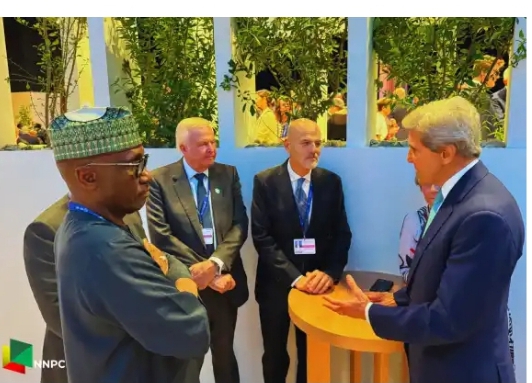
From left: Group Chief Executive Officer, Nigerian National Petroleum Company (NNPC) Limited, Malam Mele Kyari; Special Presidential Envoy on Climate, White House, Senator John Kerry; Chief Executive Officer of the Bank of America, Mr. Brian Moynihan and another guest at the COP28 UAE Presidency and The Sustainable Markets Initiative Reception in Dubai, recently.
The conversation on the climate issues amongst the leaders was held on the sidelines of the 2023 United Nations Climate Change Conference or Conference of the Parties of the UNFCCC, more commonly referred to as COP28 in the UAE. A statement from the spokesman of the NNPC Limited, Olufemi Soneye said that the reception was organized by COP28 Presidency and the Sustainable Markets Initiatives to open the business and philanthropy climate forum in the presence of His Majesty, King Charles III and His Highness Sheik Mohammed bin Zayed Al Nahyan, was held at the VIP Lounge at DEC North, Blue Zone, Expo City in Dubai.
Three prominent traditional rulers in Ogbomosho, Oyo State, have been reported dead when their vehicle rammed into an oncoming truck. The three monarchs, from the Oriire local government Area, are Olodogbo of Odogbo, Onibowula of Bowula, and Alayetoro of Ayetoro.
They were said to be attending the burial ceremony of the mother of another traditional ruler, Oloolo of Oolo, Oba Oyebunmi Ajayi. They were reported to be on their way to the party when the accident occurred. Olodogbo was confirmed dead on the spot but it’s unclear at what point the other two passed away. Speaking to newsmen, a medical source at the Ladoke Akintola University of Technology Teaching Hospital Ogbomoso, confirmed the incident. It was confirmed that the bodies of the monarchs have been deposited in the hospital’s morgue. The medical source said: “confirmed, the incident happened. It is true.”
Executive Chairman of the Federal Inland Revenue Services (FIRS), Dr. Zacch Adedeji has appointed , Dare Adekanmbi, a veteran journalist and senior editor at the Tribune to serve as his Special Assistant on Media. Adekanmbi replaces, Johannes Oluwatobi Wojuola who served in the same capacity as SA media to the immediate past FIRS boss, Mohammed Nami Wojuola, on his part, has secured an appointment as the Special Assistant on Media and Communication to the Executive Vice Chairman of the Nigerian Communications Commission (NCC), Dr. Aminu Maida Dr. Maida is an accomplished technology executive with experience spanning across telecommunication and payment industries.
We use cookies on our website to give you the most relevant experience by remembering your preferences and repeat visits. By clicking “Accept”, you consent to the use of ALL the cookies.
This website uses cookies to improve your experience while you navigate through the website. Out of these, the cookies that are categorized as necessary are stored on your browser as they are essential for the working of basic functionalities of the website. We also use third-party cookies that help us analyze and understand how you use this website. These cookies will be stored in your browser only with your consent. You also have the option to opt-out of these cookies. But opting out of some of these cookies may affect your browsing experience.
Necessary cookies are absolutely essential for the website to function properly. This category only includes cookies that ensures basic functionalities and security features of the website. These cookies do not store any personal information.
Any cookies that may not be particularly necessary for the website to function and is used specifically to collect user personal data via analytics, ads, other embedded contents are termed as non-necessary cookies. It is mandatory to procure user consent prior to running these cookies on your website.






When Shall We Stop Going To Court After Elections? By Hassan Gimba
Is there something with the presidential system of democracy we have twice adopted for ourselves that necessitates involving the courts where judges are made to be the ultimate arbiter between contestants?
In 1979, it was the judges who decided who emerged as the president between Alhaji Shehu Shagari and Chief Obafemi Awolowo when they told the nation what two-thirds of nineteen should be in a judgment that is more of a compromise between the spirit of the law and political practicality.
The requirement to be the president was a majority of votes and national spread, determined by the ability of a presidential candidate to score 25 per cent in at least two-thirds of the states of the federation. Nigeria then had nineteen states with Lagos as a state and federal capital, therefore avoiding the controversy associated with Abuja now.
In the presidential election held on the 11th of August, 1979, Alhaji Shehu Usman Aliyu Shagari of the National Party of Nigeria (NPN) got 5,688,857, defeating his closest rival, Chief Obafemi Jeremiah Awolowo of the Unity Party of Nigeria (UPN), who garnered 4,916,551 in an election where the total registered voters were 48,633,782 with 16,846,533 voting. That represented 33.77% for Shagari who won in nine states, and 29.18% for Awolowo. The Federal Electoral Commission (FEDECO) headed by Michael Ani thus declared Shehu Shagari the winner of the 1979 presidential election.
By the declared results, Shehu Shagari got 25% of the votes cast in twelve states, namely: Bauchi, Bendel, Borno, Cross River, Gongola, Kaduna, Kwara, Niger, Plateau, Rivers and Sokoto. The 13th state was the issue. It was Kano State – where he scored 243,423 votes, equivalent to 19.4% of the 1,220,763 votes cast in total.
A dispute thus ensued over whether Shehu Shagari had met the required threshold, with arguments centred on his 25% win in twelve states and 19.4% in Kano State. But Shagari argued that his 19.9% in Kano represented two-thirds of the 12 2/3 that was two-thirds of 19 states.
And so Chief Obafemi Awolowo went to the Special Election Petition Tribunal at Lagos, which started on the 4th of September, 1979. In just six days, the Election Tribunal dismissed the appellant’s claims, affirming Shehu Shagari’s victory.
Not satisfied, he went to the Supreme Court. The justices that heard his appeal were Atanda Fatai Williams, Mohammed Bello, Mohammed Uwais, Andrews Otutu Obaseki, Kayode Eso, Ayo Gabriel Irikefe and Chike Idigbe.
On 26th September 1979, Williams, who was the presiding judge, and others decided the case in favour of Shagari, with only Eso dissenting.
The Fourth Republic came in after the presidential elections held on 27th February 1999. The result was a victory for Olusegun Obasanjo of the People’s Democratic Party, who defeated Olu Falae on a joint Alliance for Democracy/All People’s Party ticket. Out of the total registered voters of 57,938,945, 30,280,052 voted with Obasanjo getting 18,738,154 (or 62.8%) and Falae got 11,110,287 (or 37.2%) of the votes.
Olu Falae contested the election at the tribunal where he, among other allegations, said Obasanjo was an ex-convict and a member of a secret cult, the Ogboni fraternity.
Falae went to the Court of Appeal on March 15 and on Friday, April 16, 1999, Justice Dahiru Musdapher entered judgment in favour of Obasanjo.
It is worth noting that the first election in 1979 was conducted with the presidential election coming first; however, the beneficiary reversed the order in 1983 and the NPN won with 48%. Chief Obafemi Awolowo this time did not go to the Supreme Court after losing at the tribunal, claiming that it would amount to a waste of time. He also hinted that it may take one year to gather evidence of the rigging by Shagari’s party.
We have also seen that an election was held in August and the petition hearing started in the first week of September at a special tribunal that gave judgement within a week. An appeal went to the Supreme Court which decided on it by the 26 of that month and the swearing-in of the president took place on October 1.
Again, the presidential election came first in 1999, but by the next round of elections in 2023, the sequence was reversed with that of the president first.
Judgement in the petition by Falae against the election was also delivered within a month.
From the elections of 1979 and 1999, we can deduce a reasonable, fairly tolerable process. But in each case, four years later, beneficiaries invariably put their interests first before that of the nation. And in this, there is always collaboration with the electoral body that is anything but independent, from the way its managers are appointed and how the body is funded.
You ask why the electoral timetable is always reversed after the first election. In 1983, sensing dissatisfaction among the people with the way the country was being governed, the ruling NPN, afraid of defeat, capitalised on Shehu Shagari’s perceived likeability and reversed the timetable.
Afraid that the party would lose states and legislators, which could affect the electoral fortunes of the sitting president, the executive decided to start from the top. They relied on what they christened the “bandwagon effect” to commit electoral heists, calling it a “landslide” victory. Opponents and critics derisively called it a “moonslide.”
In 2003, the same fear of losing, threat from General Muhammadu Buhari’s foray into the presidential race, altercation with his deputy, Atiku Abubakar, and knowing how wary his party and governors were of his dictatorial tendencies, made Obasanjo, in cahoots with the electoral umpire, reverse the election timetable to start with his and that of the National Assembly. Filled with paranoia, he assumed that he would be sacrificed once others won their elections, and so he engineered the reversal of the order of the elections.
The calculation was that the governors and the party structure would of necessity fight for him to win because his defeat would also signpost theirs. And they know him: if he lost the election, Obasanjo would make sure every one of them lost theirs. The National Assembly easily became accomplices because the arrangement also favoured their political survival. Plus, he introduced the politics of “Ghana-Must-Go.”
We will consequently look to see if at any point there is always a convergence by the executive, legislature and judiciary against the ordinary voter for their interests other than that of the nation.
Afterwards, we will look at electoral litigations and why the political class deliberately jettisoned the process where election petitions were concluded before the inauguration, as we saw in 1979, 1983 and 1999.
Hassan Gimba is the Publisher and Editor-in-Chief of Neptune Prime.