A 29-year-old young Nollywood actor , Kanayo Awurum, who was arrested by the Operatives of the Special Anti Robbery Squad (SARS), of the Lagos State Command for selling his two-year-old baby for N300,000 has blamed it on poverty. The suspect who has featured in seven Nollywood movies also complained that he has not been given roles to play in movies in recent time after he said that he recuperated from an auto crash. Kanayo Awurum said that a friend whose identity he gave simply as Emmanuel, sold the idea to him when he approached him for financial assistance. According to the young actor, Emmanuel also introduced him to the buyers; Nkechi Obi and Gladys Nwobodo who came all the way from Port Harcourt to Owerri, Imo state , where the transaction took place.
President Muhammadu Buhari and Idriss Deby of Chad
President Muhammadu Buhari and his Chadian counterpart, President Idriss Deby Itno, Thursday in N’Djamena reaffirmed the commitment of their countries to greater cooperation in the fight against Boko Haram. According to a communiqué issued at the end of President Buhari’s one-day official visit to Chad, both leaders agreed on the need to quickly make the Multi-National Joint Task Force (MNJTF) fully operational to effectively combat terrorism in North-East Nigeria and “everywhere” that Boko Haram operates. President Buhari and President Deby called on the international community to provide the Lake Chad Basin Commission and neigbouring countries with all necessary support to combat terrorism and insurgency “Both Heads of State agreed that the war on Boko Haram should be supported by emergency development initiatives in areas affected by this insurgency group. “This will help to overcome the harmful effects faced by local populations,’’ the communiqué said. President Buhari paid tribute to the gallantry of Chadian soldiers who have engaged in operations against Boko Haram and condoled the families of their comrades who were killed in action. While in the Chadian capital, President Buhari also held a closed-door meeting with Major-General Tukur Buratai of Nigeria, who was recently appointed Force Commander of the MNJTF, with headquarters in N’Djamena. Earlier on his arrival, President Buhari had stressed the need for member-countries of the Lake Chad Commission to redouble their efforts and intensify the operations of the Multi-National Joint Task Force (MNJTF) established to tackle the Boko Haram insurgency. President Buhari said that the security of Nigeria and her neighbours are intrinsically linked and that this makes it very essential that they cooperate on security issues in a robust and sustained manner. The President said that he was quite certain that when it becomes fully deployed and functional, the MNJTF, which comprises Nigeria, Chad, Niger and Cameroon will be able to secure and stabilize all the areas affected by the Boko Haram insurgency. President Buhari reaffirmed his conviction that with greater cooperation among Nigeria and neighbouring countries, the Boko Haram insurgency will be brought to an end very soon. His remarks came on the heels of Wednesday’s appointment of Major-General Tukur Buratai of Nigeria as the Force Commander of the reorganised MNJTF, which also has Benin Republic as honorary member. The President thanked Chad for her invaluable support in the fight against insurgency and terrorism. “Your troops have stood shoulder to shoulder and fought gallantly with ours in the fight against the forces of evil. “This is a remarkable show of good neighbourliness, which we must reinforce in the years ahead,’’ he told President Idriss Deby Itno. President Buhari, who is on his first visit to Chad, after assuming office as President of Nigeria, expressed concern that the insurgency has taken a huge toll on citizens of both countries, many of whom have been forced to flee their homes. The President said that the harrowing images of displaced citizens of both countries, in search of safety and succour, must spur their governments and others in the sub-region to do more “to restore their dignity and give them the relief they need”. On the bilateral relations between Nigeria and Chad, President Buhari noted that both countries were bound by “nature’’, adding that they must therefore work together to find lasting solutions to issues of border management, migration and movement of goods and services. The President, who had earlier thanked President Deby for attending his inauguration ceremony on May 29 in Abuja, said that he would return to Nigeria with the assurance that Nigeria and Chad are poised to intensify their cooperation. In his remarks, President Deby commended Buhari for his “wise decision’’ to relocate the Nigerian Military Command center from Abuja to Maiduguri. The Chadian President said that the decision, which was announced in President Buhari’s inaugural address, was a right step towards restoring peace and security to states affected by terrorism, and the sub-region. He assured President Buhari that Chad will continue to work with Nigeria to achieve lasting peace and security in the sub-region, given their historic, cultural and economic ties. [myad]
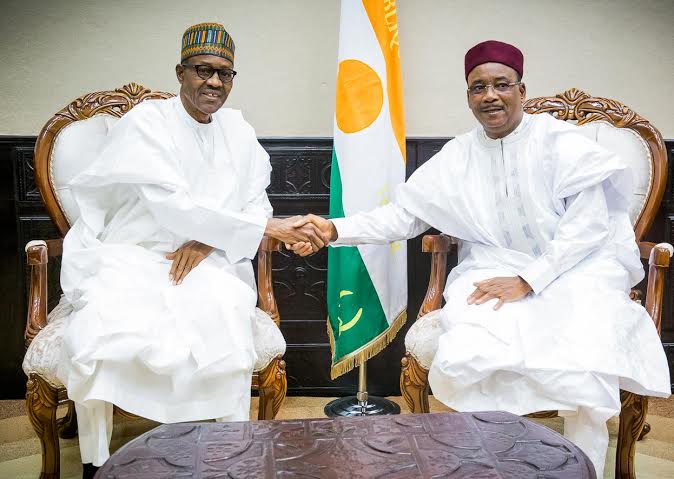
President of Niger Republic, Issoufou Mahamadou and President Muhammadu Buhari of Nigeria address a joint press conference in Niamey, Niger Republic during the visit of President Buhari today to that country. [myad]
The former Borno State Governor, Modu Sheriff, today, handed himself to the Economic and Financial Crimes Commission (EFCC) and has consequently been detained by the anti-graft agency over an alleged N300 Billion misappropriation when he was in office.
The EFCC had earliefr invited him to answer to charges of corruption when he was governor of the state between 2003 and 2011.
The spokesperson for the EFCC, Wilson Uwujaren, confirmed that Sheriff was currently being held by the commission.
It was gathered that the anti-graft agency was looking for him to explain how his administration spent N300 billion it received from the Federation Account between 2003 and 2011.
The EFCC had on April 23, 2015 moved to declare him wanted when he failed to honour its invitations for questioning.
The former governor was said to have damned the invitation and stayed away.
A source said the investigation began in 2012 and had not been concluded ever since.
Sheriff, who governed Borno State on the platform of the defunct All Nigeria Peoples Party (ANPP) was a senator between 1999 and 2003 on the ticket of the same party.
He was a founding member of the ruling All Progressives Congress (APC) before he defected to the Peoples Democratic Party (PDP). [myad]
Officials of the United States government are now believed to be investigation FIFA President, Sepp Blatter, in a bid to conclusively unravel the corruption allegations in the world football body.
Blatter declared yesterday that he would be stepping down as FIFA to allow for restructuring in the organisation. He had won re-election for a fifth term on Friday but bowed to pressure to quit amid scandals in FIFA.
U.S. prosecutors spearheaded the recent wave of arrests and probes, with seven FIFA officials arrested in Zurich, Switzerland last Wednesday.
U.S media quoted officials who said they hoped to gain the co-operation of some of the FIFA figures now under indictment on charges of racketeering and money laundering to try to build a case against Blatter. [myad]
President Muhammadu Buhari has assured the Amnesty International that his government will not condone impunity and human right violation from any quarters, even as he acknowledged receipt of the Amnesty’s report on Nigeria, titled: “Nigeria: Stories of horror in their own words.”
A statement from in Niamey, Niger Republic, the Senior Special Assistant on Media and Publicity), Malam Garba Shehu quoted President Buhari as acknowledging receipt of the report which he said contained many disturbing allegations.
The President assured that his administration will study the document and act appropriately, adding: “I assure you that your report will be looked into.”
He said that without meaning to prejudice the outcome of any investigation, Nigerians needed to be reassured that his administration will leave no stone unturned to promote the rule of law, and deal with all cases of human rights abuses.
“Respect for human rights and adherence to the rule of law are the life and soul of the democratic system. We will not tolerate or condone impunity and reckless disregard for human rights.”
Meanwhile, Nigerian Director of Defense Information, Major General Chris Olukolade, has accused Amnesty International of attempting to blackmail the Nigerian government and military.
In his official response to a report published by the Amnesty International, detailing egregious human rights abuses by the Nigerian military, Olukolade described the allegation as part of the international human rights organization’s efforts at supporting the actions of Boko Haram terrorists in Nigeria and trying to blackmail Nigerian officials.
The report implored the new Nigerian government under President Buhari to investigate military officials for the deaths of more than 8,000 people by murder, starvation, suffocation, and torture.
The Major General said: “the loud publicity given to these damning allegations suggests an intention to blackmail the military and particular senior officers rather than a sincere advise to the government.”
He called the report a calculated attempt to destroy the reputation and image of the Nigerian military. He also claimed that Amnesty International is trying to distract the public from the narrative of Boko Haram’s dwindling power.
“It is clear that Amnesty International (AI) becomes more active in presenting distractive allegations whenever the terrorists are losing ground in the battle.”
The Nigerian military has continuously had criticism lodged against it for human rights abuses, corruption, extrajudicial murders, and torture by local and international human rights organizations. [myad]
No fewer than 50 civil servants in Niger State have dragged the former State Governor, Dr. Babangida Aliyu, before a Minna High Court, demanding N100 Million for the unlawful seizure and sale of their motorcycles.
The civil servants argued that the seizure of their motorcycles amounted to a violation of their fundamental human rights.
The applicants, in a suit filed at the High Court 4, on May 25, by their counsel, Mr. Adegoke Omoloja of Cosmic Chambers, Abuja, prayed the court for a declaration that the seizure and the subsequent sale of the applicants motorcycles by the former governor through his Commissioner of Works, was illegal, null and void and constituted a violation of their fundamental human rights as enshrined in the constitution.
The applicants also prayed the court for an order awarding compensation of one N1m in favour of each applicant against the respondents and another N50m as general damages.
In a 60-paragraph affidavit in support of the case deposed to by one Ndagi Mohammed, the applicants said the arrest, seizure and sale of their motorcycles had brought untold hardship and difficulties to their families especially in getting to places of work, taking children to school and taking their wives to places of work or for maternity checks.
“That some of us bought the motorcycle through cooperatives (as can be seen on purchase receipts attached) on loan which they still deduct from our salaries monthly,” he said.
He stated that the then governor acted as prosecutor, judge, jury and auctioneer, which was a direct violation of “our right to fair hearing,” adding that “our freedom to movement and right to liberty has been violated by the restriction placed on motorcycles by the first respondent, Muazu Babangida Aliyu.”
Vice President Yemi Osinbajo, today visited the scene of the fuel tanker accident, which claimed over 40 lives at Upper Iweka in Onitsha in Anambra state.
Osinbajo, who also visited the injured at Toronto Hospital said that President Muhammadu Buhari was very concerned and pained by the incident, adding that the president felt it was not enough to send a condolence message and as such asked him to go and commiserate with the people.
“Every Nigerian citizen matters to the Federal Government no matter his status or where he resides. Mr. President asked me to come and first commiserate with Gov. Willie Obiano and Anambra people.
“He was very concerned that he felt it was not enough to issue condolence message and so asked me to come and commiserate with the people.
“I have been taken round to see the heroic action of the hospital staff and those involved in emergency.
“Unfortunately, many lost their lives but some have seen today and are responding to treatment,’’ he said.
Vice President Osinbajo told a crowd that gathered around Upper Iweka, scene of the accident, that he had been discussing with Gov. Obiano on possible ways the Federal Government and Anambra Government could cooperate to forestall further accident.
He commended Governor Willie Obiano for undertaking to settle the hospital bills of the victims.
Earlier, while briefing the vice-president, Mr. Obiano said the Anambra Government had banned long trucks and petrol tankers from plying roads in Anambra during the day.
The governor said the government had banned heavy duty vehicles from plying state roads, adding that they must trans-load their cargoes on getting to state roads.
According to him, the materials used in constructing state roads are not the same as the ones used in building federal roads and each time heavy duty trucks ply state roads, they cause heavy damage on them.
Amnesty International has said that it has sufficient evidence to sue five senior officers in the Nigeria Army at the International Criminal Court for war crimes in the battle against Boko Haram, even as the military reacted with anger, rejecting the charge. The Amnesty, in a new 133-page report it compiled, based on hundreds of interviews, including with military sources, and using leaked defence ministry documents said that the reports were centred on thousands of people that were extra-judicially murdered by the security forces and its civilian vigilante allies, as well as crimes against those held in military custody. Amnesty’s secretary general Salil Shetty described the abuses as “sickening” but Nigeria’s military hit back, saying that the report was designed to besmirch its reputation. “In the course of security operations against Boko Haram in north-east Nigeria, Nigerian military forces have extrajudicially executed more than 1,200 people; they have arbitrarily arrested at least 20,000 people, mostly young men and boys,” the report said. Nigerian forces “have committed countless acts of torture; hundreds, if not thousands, of Nigerians have become victims of enforced disappearance; and at least 7,000 people have died in military detention as a result of starvation, extreme overcrowding and denial of medical assistance”, it added. Amnesty said commanders based in the northeast “should be investigated for potential responsibility for war crimes of murder, enforced disappearances and torture”. Top service chiefs in the capital Abuja “should be investigated for their potential command responsibility for crimes committed by their subordinates given that they knew or should have known about the commission of the crimes, and failed to take adequate action”. The ICC in The Hague has previously opened a preliminary investigation into the Boko Haram conflict, which Amnesty said has killed at least 17,000 people since 2009. The tribunal has however stated there was insufficient evidence tying Nigeria’s military to systematic and orchestrated atrocities targeting civilians. But the report said: “Amnesty International believes that the evidence contained in this report and submitted separately to the (ICC) Office of the Prosecutor is sufficient to reopen this issue.
President Muhammadu Buhari and Nigerien President, Issoufou Mahamadou
President Muhammadu Buhari has given assurance that despite that he is just four days in office as President of Nigeria, he has started the process of ending Boko Haram, even as he expressed confidence in the ability of the Nigerian military to overcome and eradicate the sect. Speaking today at an interactive session with journalists after talks with the President of the Republic of Niger, Issoufou Mahamadou in Niamey, Niger Republic, President Buhari declared: “my administration will bring new impetus and a renewed commitment to the efforts to wipe out the menace of the Boko Haram insurgents. “As a first step, we have directed the relocation of the command post of the counter-insurgency operations to Maiduguri until such a time that the insurgency is completely defeated.” President Buhari declared that the Nigerian Army which has earned a good reputation across the world, remains a virile fighting force. “I am four days in office today and we have already started the process of ending the insurgency. “The ultimate objective however, remains to end the insurgency and facilitate their return to their homes.” He said that in the course of the over five hours meeting he held with heads of Nigeria’s Armed Forces and Security Agencies yesterday, on-going operations against Boko Haram were reviewed for better results. President Buhari said that because of the peculiarities of terrorism, the movement of terrorists across borders and the unconventional nature of the war against terror, Nigeria will continue to seek the support of neighbouring countries in its bid to overcome Boko Haram. The President said that his visit to Niger was to seek more support from the country in bringing a quick end to the atrocities of Boko Haram. President Buhari said he would hold similar meetings on security and the war against terrorism with the Chadian authorities after leaving Niameytomorrow. He said that Nigeria would also require the assistance of other nations and multi-lateral institutions to rebuild areas that have been adversely affected by the Boko Haram insurgency and rehabilitate displaced persons. At the opening of bilateral talks between Nigeria and Niger earlier, President Buhari praised the contributions of his hosts to the on-going multi-national effort against terrorism, insurgency and cross-border crimes. “Permit me also to acknowledge the consistency with which the government and people of Niger Republic have stood beside Nigeria under all circumstances. I would like to convey the appreciation of Nigeria for the sacrifices by Niger in the on-going efforts to counter the menace of the Boko Haram insurgency. “Niger Republic has over the years, proven to be a reliable ally to Nigeria both at bilateral and multilateral levels. It is our hope and aspiration that this special relationship would be further consolidated during my administration. “Another issue of concern to us which is closely associated with the insurgency in the region is the influx of refugees and other displaced persons. We are aware that currently, there are over one hundred and fifty thousand displaced persons comprising refugees and returnees taking refuge in various parts of Niger. “Our administration will work closely with governments of the affected States to continue to provide humanitarian assistance to the displaced persons and their host communities. In his remarks, the President of Niger commended President Buhari for making Niger the first country he will visit after his inauguration. “Your decision to move the military command of Nigeria to the North East has further strengthened our conviction that the war against terrorism will soon come to an end.” He assured President Buhari that Niger will continue to support Nigeria in the fight against Boko Haram.
We use cookies on our website to give you the most relevant experience by remembering your preferences and repeat visits. By clicking “Accept”, you consent to the use of ALL the cookies.
This website uses cookies to improve your experience while you navigate through the website. Out of these, the cookies that are categorized as necessary are stored on your browser as they are essential for the working of basic functionalities of the website. We also use third-party cookies that help us analyze and understand how you use this website. These cookies will be stored in your browser only with your consent. You also have the option to opt-out of these cookies. But opting out of some of these cookies may affect your browsing experience.
Necessary cookies are absolutely essential for the website to function properly. This category only includes cookies that ensures basic functionalities and security features of the website. These cookies do not store any personal information.
Any cookies that may not be particularly necessary for the website to function and is used specifically to collect user personal data via analytics, ads, other embedded contents are termed as non-necessary cookies. It is mandatory to procure user consent prior to running these cookies on your website.