The Abuja Writers Forum (AWF) has scheduled May 30 to play host to three upcoming artists. They are Despan Kwardem who is a budding novelist, Zainab Sule, a growing guitarist/ songwriter) and Sylvia Bethel, a promising singer.
The May 30 series in the activities of AWF, which will also feature raffle draw for book prizes, will be held at Nanet Suites, Abuja and is expected to commence at 4pm.
Despan was born in Plateau state and finished at the Boys’s Secondary School Gindiri and University of Agriculture, Makurdi graduating with a degree in Food Science and Technology in 1994.
However he caught the writing bug during his national service period in Lagos, when he decided to document some tough situations he was confronting.
He is currently the Technical Assistant to the Permanent Secretary, Federal Ministry of Youth Development, and the Drama Director of the Youth Fellowship in his Church. He lives with his wife, Patience and two sons in Abuja.
Zainab Sule and Sylvia Bethel will pep up the session with a variety of musical interventions, ranging from soft-rock to jazz. For Zainab, the show is part of her annual month long tour to promote her music. These tours have been significant in gaining recognition for her brand and of music. Her songs are charactersised by intense lyrics and a laid back style. It is really no wonder her fans dub her the Queen of Soft Rock.
Sylvia has an operatic background, having trained with the legendary Laz Ekwueme. Her musical interests are eclectic and she combines singing with songwriting. She is currently working on her debut album.
The Guest Writer Session which started in June 2008 has established a reputation as the most consistent literary event in the country and has featured an enviable list of emerging and established writers. [myad]
President-elect, Muhammadu Buhari, has expressed disappointment with ministers and other government leaders under the current Nigerian President, Dr. Goodluck Jonathan for refusing to cooperate with his transition committee to brief it on their stewardship. Buhari said however: “since the bureaucrats who write the reports will be at hand after the departure of the politicians, whatever is there will eventually be known.” This is even as he requested the Joda-led transition committee to be ready to resume work the moment the outgoing government’s handover notes are received. The President-elect spoke today when he received the interim report of the Transition Committee, set up to assist the newly-elected President to transit smoothly to the Presidency. The committee was led by Alhaji Ahmed Joda. The chairman had informed Buhari that the committee received tremendous cooperation from members of the organized private sector (OPS), Nigeria’s international development partners as well as stakeholders from across the country nut that the report does not have any input from the out-going administration. Alhaji Joda said his committee worked hard through four sub- committees to arrive at the interim report and was optimistic that the final report of the committee would include the input of the present administration, provided it is made available. The interim report dealt with issues of good governance namely the executive, legislature and judiciary, finance and economy as well as core sectors like agriculture, oil and gas and solid minerals. The report also looked at Infrastructure and power and national security as well as education, health and social welfare which featured in the manifesto of the party, the All Progressives Congress (APC). The President-elect, thanked the committee for doing a thorough job and presenting an interim report within the time allocated to it. Present at the event were APC National Chairman, Chief John Odigie-Oyegun, Chief Bisi Akande, APC national leader, Asiwaju Bola Tinubu and Governor Rotimi Amaechi of Rivers. Meanwhile, Buhari, today, received the President of Niger Republic, Mahamadou Issoufou who paid him a solidarity and congratulatory visit. In a statement by Mallam Garba Shehu, Director of Media and Publicity of the Media Team of the President-elect, the Niger leader said he brought the felicitations and good wishes of the people of his country to the President-elect as well as out-going Nigerian leader, President Goodluck Jonathan for the free and fair election that brought a peaceful change of leadership. The Niger leader said that the free and peaceful elections in Nigeria would impact positively on the development of democracy in Africa. In his response, the President-elect thanked the Niger leader for his interest and good wishes for Nigeria, adding that Niger has always been a good neighbour to Nigeria. Buhari went down memory lane to say that there is a lot in common between Nigeria, Niger, Cameroun, Benin Republic and Chad in terms of overlapping ethnic groups, language and culture. He said that the two countries as well as all other neighbours would continue to cooperate for their common good and wished President Issoufou and the people of Niger well.
There are strong indications that Islamic State militant forces have embarked on massive recruitment from no fewer than 90 countries of the world in the conflict raging in Syria.
It has been confirmed that Syria contingent of foreigners who have taken up arms on behalf of Islamic State during the past three years is more than twice as big as the French Foreign Legion. The conflict in Syria and Iraq has now drawn more volunteer fighters than past Islamist causes in Afghanistan and the former Yugoslavia, and an estimated eight out of 10 of those who enlisted have joined Islamic State.
Reports have it that between 16,000 and 17,000, according to one independent Western estimate, men and a small number of women from 90 countries or more have streamed to Syria and Iraq to wage Muslim holy war for the Islamic State.
Abu Bakr Al-Baghdadi, the group’s leader, has appealed to Muslims throughout the world to move to lands under its control — to fight, but also to work as administrators, doctors, judges, engineers and scholars, and to marry, put down roots and start families.
“Every person can contribute something to the Islamic State,” a Canadian who enlisted in Islamic State, Andre Poulin, says in a videotaped statement that has been used for online recruitment. “You can easily earn yourself a higher station with God Almighty for the next life by sacrificing just a small bit of this worldly life.”
They have been there for defeats and victories. Following major losses in both Syria and Iraq, the fighters of Islamic State appear to have gotten a second wind in recent days, capturing Ramadi, capital of Iraq’s largest Sunni province, and the ancient city of Palmyra, famous for its 2,000-year-old ruins.
There are battle-hardened Bosnians and Chechens, prized for their experience and elan under fire. There are religious zealots untested in combat but eager to die for their faith.
They include around 3,300 Western Europeans and 100 or so Americans, according to the International Center for the Study of Radicalization, a think tank at King’s College London.
Ten to 15 percent of the enlistees are believed to have died in action. Hundreds of others have survived and gone home; their governments now worry about the consequences.
“We all share the concern that fighters will attempt to return to their home countries or regions, and look to participate in or support terrorism and the radicalization to violence,” Nicholas J. Rasmussen, director of the U.S. government’s National Counterterrorism Center, told a Senate hearing earlier this year.
“Just like Osama bin Laden started his career in international terrorism as a foreign fighter in Afghanistan in the 1980s, the next generation of Osama bin Ladens are currently starting theirs in Syria and Iraq,” ICSR director Peter Neumann told a White House summit on combating extremist violence in February.
The study reported that among people leaving that country for Syria out of “Islamic extremist motives,” 65 percent were believed to have prior criminal records. They ranged in age between 15 and 63. Sixty-one percent were German-born, and there were nine men for every woman.
In contrast, John G. Horgan, a psychologist who directs the Center for Terrorism & Security Studies at the University of Massachusetts Lowell, found some common traits among American recruits or would-be recruits for jihad. Typically, he said, they are in their late teens or early 20s, though a few have been in their mid-30s.
“From a psychological perspective, many of them are at a stage in their lives where they are trying to find their place in the world — who they are, what their purpose is,” Horgan said. “They certainly describe themselves as people who are struggling with conflict. They are trying to reconcile this dual identity of being a Muslim and being a Westerner, or being an American.”
Some are driven by religious zeal to protect the caliphate, or Muslim theocracy, that the Islamic State has proclaimed in the one-third of Syrian and Iraqi territory now in its hands; others are thrilled by the chance to join what is tantamount to a secret and forbidden club.
Still others appear to enlist mainly because others do.
“What they have in common is that they are young, they are impressionable and they are hungry for excitement,” Horgan said.
Once recruits arrive in areas held by Islamic State, they appear to receive only rudimentary military training — including how to load and fire a Kalashnikov assault rifle. Nonetheless, they have been involved in “some of the most violent forms of attacks” by the group, including suicide bombings and filmed beheadings of foreigners, said William Braniff, executive director for the National Consortium for the Study of Terrorism and Responses to Terrorism, a multidisciplinary research center headquartered at the University of Maryland.
Areeb Majeed, 23, from a suburb of Mumbai, India, joined Islamic State in May 2014 and fought for six months, killing up to 55 people and taking a gunshot to the chest.
But all was not heroics. He eventually called his parents from Turkey and asked to come home, according to Indian newspapers. Majeed’s chief complaint, officials from India’s National Investigation Agency were quoted as saying, was that the group didn’t pay him, and made him clean toilets and haul water on the battlefield.
Often, though, the foreign combatants use social media to serve as “role models and facilitators for the next volunteers,” Braniff said.
“Before I came here to Syria, I had money, I had a family, I had good friends, it wasn’t like I was some anarchist or somebody who just wants to destroy the world, to kill everybody,” said Poulin, the Canadian ISIS recruiter.
“Put God almighty before your family, put it before yourself, put it before everything. Put Allah before everything,” the bearded and bespectacled transplant from Ontario urges in the video.
Poulin’s jihad ended last August; he was reported killed during an assault on a government-controlled airfield in northern Syria.
But not, according to the Canadian Broadcasting Corp., before he had recruited five others from Toronto to come fight for the Islamic State. [myad]
President-elect, Muhammadu Buhari visits his farm in Daura, Katsina State today, Thursday, 21, accompanied by Governor of Ogun State, Senator Ibikunle Amosun and Abbah Kyari. [myad]
First, the President-elect, General Muhammadu Buhari had appeared rather uncomfortable with the sumptuous and swanky Defence Guest House, Maitama, Abuja, which was kept at his disposal recently as part of the transition to the presidency. It must be noted that the late President Umaru Yar’Adua also used the same group of chalets in that large undulating compound, with well-watered lawns and beautiful flowers, as he got ready to take over power from former President Olusegun Obasanjo.
The moment Buhari began to use the place, security presence made the area a hell for the public. Buhari personally complained about such abuses and asked that the number of security personnel on duty to guard him be reduced. Also, it was said that Buhari was only coming there during the day to receive visitors and to transact other official businesses but that he was not sleeping there at night.
So, where was he passing the night? A source said that he was alternating between his Abuja home and Nasir el-Rufai’s house in Aso Drive, Abuja. There has been a little controversy about the ownership of this particular house and how a Buhari that appears to be moderately wealthy, if not poor, could own two Abuja homes. On this, the source said that what has been taken to be Buhari’s main house in Abuja was actually given to him by Lt. Gen Theophilus Danjuma (rtd) but it is not known if Danjuma changed the deeds of the property’s ownership to Buhari or he simply allowed Buhari to use it for as long as he wished. The other house that Buhari was said to have also occupied in Abuja was said to have been owned by the business mogul, Aliko Dangote.
It was in the same way that Aliko Dangote also came to the help of the former Speaker of the House of Representatives, Ghali Umar Na’Abba. It would surprise many to know that the house that Na’Abba first occupied after his Speakership, in Wuse Two, Abuja, was a rented property. When he could no longer sustain the rent payment, Dangote was said to have come to his aid for a while by making a building available for his use, having known that Na’Abba did not won an Abuja home because of his transparency while in office . Now, Na’abba resides in Kano.
Buhari left Abuja abruptly early this week for his home town Daura. Many have speculated that he fled Abuja for security reasons. But sources close to Buhari said that Buhari’s security details are up to any task, having protected him adequately during the hot days of the acrimonious election campaign. Buhari so appears to have an implicit faith in his personal security team that when the State Security Services (SSS) posted an operative of a higher rank as head of his security details, Buhari rejected the new appointee and said that he had been with the other one for six years and he was happy with his services. This happened after Buhari emerged President-elect. The man with the higher rank had to go. Again it could not be ascertained if Buhari took that decision because he did not fully trust the Department of State Secuirty, which openly sided with the Peoples Democratic Party during the campaign and once raided the All Progressives Congress office in Lagos, in a dastardly manner.
Yet, the source said that Buhari had complained about the influx of people scheming for appointment in his government and the struggle for attention from sundry influence peddlers and tale bearers, that such brazenness has been disturbing him and detracting from his attention on Nigeria’s problems, which by the day, appear much worse that he ever anticipated. [myad]
Nigerian Senate has expressed worry over the persistent fuel scarcity across the country and has asked its committee on Petroleum Resources (Upstream and Downstream) to commence an investigation into the causes of the crisis.
The directive followed a motion moved by the Deputy Senate Majority Leader, Senator Abdul Ningi, who prayed the senate to pay attention to the fuel crisis that has created hardship for Nigerians.
Responding, the Deputy Senate President, Ike Ekweremadu, who presided over plenary, said since Ningi raised the motion under personal explanation, the senate would not debate it but rather approve his prayers.
Ekweremadu said: “Ningi’s prayers are simple and straightforward. He is asking us, as representatives of the people, to direct our committees on upstream and downstream to find out what is currently going on in the oil sector and possibly find a way of addressing it.
“In that regard, we now ask our committees on Petroleum Resources (Upstream and Downstream), to find out what is going on and what the government is doing about it and report back on Tuesday next week. That is our wish.”
While moving the motion, Ningi said since the Senate still have the mandate of the people until June 1, its responsibility to intervene in the unfortunate development remains.
“We need to know whether fuel scarcity has come to stay. We need to know whether it has become part of our lives. We need to plan.
“By planning and talking about it, we are now sensitising Nigerians to brace up for the impending issue of fuel scarcity whether it is going to be here permanently or temporary.
“But we can’t know all these things until we hear from the experts. Therefore my prayer is to ask the committee on downstream and upstream to come up with explanations next Tuesday through which Nigerians will know and plan their future.
“Otherwise, I think it’s legally and morally wrong to keep silent about it, sweep it under the carpet and to continue to believe these things are usual.” [myad]
A Nigerian student, Ufot Ekong, has broken a 50-year record in Japan, graduating with first class degree and best overall student from Tokai University in Tokyo, Japan.
Ekong from Akwa Ibom State was the first Nigerian to achieve this feat since 1965, solving a mathematical equation that could not be solved 30 years ago in his first semester.
Ekong won a Japanese language award for foreigners, in addition to two patents under his name for developing an electric car.
Ufot Ekong is currently working with Nissan. [myad]
A judge of the Federal High Court, sitting in Yola Justice Bilikus Bello Aliyu, has dismissed a suit filed by former governor Murtala Nyako challenging his impeachment by Adamawa State House of Assembly last year, accusing Nyako of abusing court processes..
In his judgement, Justice Bello Aliyu said the case brought before her by Nyako was an abuse of court process as three suits are pending before competent courts of law on the same issue and as such she can not entertain the suit.
“This suit is an abuse of this court and courts should protect themselves from abuse,” she said.
The judge has in the course of delivering the ruling, upheld the objection of the counsel to first respondent Leonard Zadon that the same case is pending before three high courts.
The Judge had earlier upheld the appellant argument that his right was grossly infringed upon by the respondent, citing section 36 of the 1999 constitution of federal republic of Nigeria as amended.
“I cannot continue with this case as the court runs concurrently, we will not encourage litigants abusing court processes,” she added. [myad]
The Inspector-General of Police (IGP), Solomon Arase has ordered Zonal Assistant Inspectors General of Police and Command Commissioners of Police to beef up security around all key and vulnerable points in rthe country as the nation prepares for the inauguration of President-elect, Muhammadu Buhari and state governors on May 29.
Other places the police boss wanted to be properly policed are critical infrastructures like mega filling stations, major hotels, national/ State Houses of Assembly, Eagle Square among others.
A statement from the Nigeria Police Force Public Relations Officer, CP Emmanuel Ojukwu said that the security measure have become imperative “in a bid to ward off possible plans by insurgents to carry out widespread violence and coordinated attacks on these installations and public places ahead of May 29th, 2015 with a view to undermining presidential/ Governorship inauguration/ swearing- in ceremonies in the country.”
The Police High Command enjoins members of the public to remain steadfast in collaborating with officers and men of the Nigeria Police and other security agencies to stamp out crimes, including war against terror.
The statement assured that the Police have perfected strategies to prepare a safe and secured ground to ensure hitch free inauguration/ swearing-in nationwide. [myad]
One of the oldest indigenous actors who acted as Village Headmaster on the Nigeria Television Authority series in the early 80’s, Mr. Femi Robinson, 75, is dead even as President Goodluck Jonathan mourned his death which occurred today.
Robinson’s death was announced through a post on his Facebook page credited to his sons, Seun and Wole Robinson. The post read: “This To Notify You That We Lost Our Father Femi Robinson This Morning – Seun & Wole Robinson (Sons).”
The Late Robinson kicked off his acting career by playing the role of Odewale in Ola Rotimi’s ‘The gods are not to blame,’ and afterwards bagged the role of Village Headmaster. He was also a public relations expert and a business and theatre administrator as well as the pioneer Director of Programs of the Ogun State Television (OGTV).
Many of the 80s/90s babies might not be familiar with Femi Robinson or The Village Headmaster series for that matter, but it apparently was one of the biggest shows on TV at the time. It had a huge audience and was popular among people of different age groups.
In his condolence message today, President Jonathan said that Robinson was loved and admired by the public for his edifying role in the famous Nigerian Television Authority (NTA) series, “The Village Headmaster” and that he will be long remembered for his great inventiveness, professionalism and humility.
The President asked members of his family to honour his memory by constantly upholding the values of inter-ethnic harmony, education, civility and proficiency, which he passionately promoted through successful careers as an actor and broadcaster.
The President commiserated with all members of the creative and broadcast industry in Nigeria on the death of the popular actor.
Robinson’s death adds to the number of the cast and crew of the Village Headmaster who have died, joining others like Oba Funsho Adeolu, Chief Segun Olusola and Justus Esiri. [myad]
We use cookies on our website to give you the most relevant experience by remembering your preferences and repeat visits. By clicking “Accept”, you consent to the use of ALL the cookies.
This website uses cookies to improve your experience while you navigate through the website. Out of these, the cookies that are categorized as necessary are stored on your browser as they are essential for the working of basic functionalities of the website. We also use third-party cookies that help us analyze and understand how you use this website. These cookies will be stored in your browser only with your consent. You also have the option to opt-out of these cookies. But opting out of some of these cookies may affect your browsing experience.
Necessary cookies are absolutely essential for the website to function properly. This category only includes cookies that ensures basic functionalities and security features of the website. These cookies do not store any personal information.
Any cookies that may not be particularly necessary for the website to function and is used specifically to collect user personal data via analytics, ads, other embedded contents are termed as non-necessary cookies. It is mandatory to procure user consent prior to running these cookies on your website.


 Zainab Sule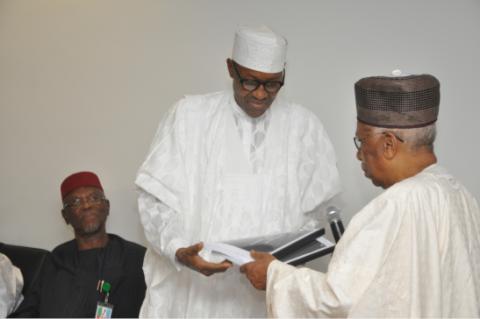




Why Buhari Abandoned Abuja, By Tony Eluemunor
First, the President-elect, General Muhammadu Buhari had appeared rather uncomfortable with the sumptuous and swanky Defence Guest House, Maitama, Abuja, which was kept at his disposal recently as part of the transition to the presidency. It must be noted that the late President Umaru Yar’Adua also used the same group of chalets in that large undulating compound, with well-watered lawns and beautiful flowers, as he got ready to take over power from former President Olusegun Obasanjo.
The moment Buhari began to use the place, security presence made the area a hell for the public. Buhari personally complained about such abuses and asked that the number of security personnel on duty to guard him be reduced. Also, it was said that Buhari was only coming there during the day to receive visitors and to transact other official businesses but that he was not sleeping there at night.
So, where was he passing the night? A source said that he was alternating between his Abuja home and Nasir el-Rufai’s house in Aso Drive, Abuja. There has been a little controversy about the ownership of this particular house and how a Buhari that appears to be moderately wealthy, if not poor, could own two Abuja homes. On this, the source said that what has been taken to be Buhari’s main house in Abuja was actually given to him by Lt. Gen Theophilus Danjuma (rtd) but it is not known if Danjuma changed the deeds of the property’s ownership to Buhari or he simply allowed Buhari to use it for as long as he wished. The other house that Buhari was said to have also occupied in Abuja was said to have been owned by the business mogul, Aliko Dangote.
It was in the same way that Aliko Dangote also came to the help of the former Speaker of the House of Representatives, Ghali Umar Na’Abba. It would surprise many to know that the house that Na’Abba first occupied after his Speakership, in Wuse Two, Abuja, was a rented property. When he could no longer sustain the rent payment, Dangote was said to have come to his aid for a while by making a building available for his use, having known that Na’Abba did not won an Abuja home because of his transparency while in office . Now, Na’abba resides in Kano.
Buhari left Abuja abruptly early this week for his home town Daura. Many have speculated that he fled Abuja for security reasons. But sources close to Buhari said that Buhari’s security details are up to any task, having protected him adequately during the hot days of the acrimonious election campaign. Buhari so appears to have an implicit faith in his personal security team that when the State Security Services (SSS) posted an operative of a higher rank as head of his security details, Buhari rejected the new appointee and said that he had been with the other one for six years and he was happy with his services. This happened after Buhari emerged President-elect. The man with the higher rank had to go. Again it could not be ascertained if Buhari took that decision because he did not fully trust the Department of State Secuirty, which openly sided with the Peoples Democratic Party during the campaign and once raided the All Progressives Congress office in Lagos, in a dastardly manner.
Yet, the source said that Buhari had complained about the influx of people scheming for appointment in his government and the struggle for attention from sundry influence peddlers and tale bearers, that such brazenness has been disturbing him and detracting from his attention on Nigeria’s problems, which by the day, appear much worse that he ever anticipated. [myad]