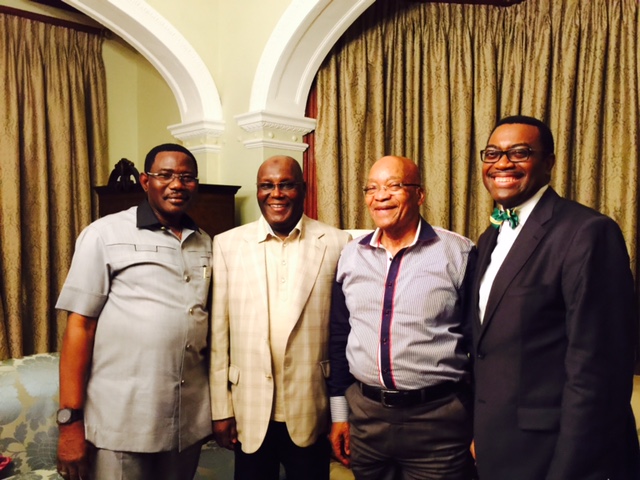
File photo: Ekiti state Governor, Ayodele Fayose standing at the court premises in Ekiti state
Embattled Ekiti State Governor, Ayo Fayose, has begged the 19 All Progressives Congress (APC) lawmakers that are hell bent on impeaching him to enter into peaceful dialogue with him towards resolving the lingering crisis between the executive and the legislature.
Fayose who spoke today at a special prayer session organized for him by the Ansarudeen Mosque, Odo-Ado, Atikankan in Ado-Ekiti to celebrate his recent electoral victory at the Supreme Court said that he is not opposed to whatever political solution that could end the imbroglio as long as the warring APC lawmakers also embraced such idea.
He pleaded and apologized to anyone he might have offended in the performance of his duties as governor of the state to forgive him and forget the past, saying only God is perfect.
Fayose said he was waving the olive branch in the overall interest of Ekiti State people as well as restoration of peace in the state, adding that several calls and appeals for amicable solution to the lingering crisis by eminent leaders, religious leaders as well as traditional rulers informed his latest stance.
He regretted that the activities of the 19 APC lawmakers had taken its toll on legitimate businesses of innocent people of the state, with one life lost in the process.
Fayose’s move to stop his impeachment was earlier frustrated by the Federal High Court in Abuja presided over by Justice Ahmed Mohammed who refused to stop the current impeachment proceedings.
Filling a case before the court, the governor and his deputy, Kolapo Olusola, prayed the court for an interim order to stop the impeachment notice served on them.
However, justice Ahmed denied the plea and only permitted their application to serve court documents on the legislators, who are defendants in the case.
Mohammed also ordered the defendants, including the Chief Judge of the state, Justice Ayodeji Daramola, to appear in the court on Thursday, April 16, 2015.
Other defendants in the suit are the Inspector-General of Police, Suleiman Abba, and the Independent National Electoral Commission (INEC).
The impeachment plot, which Fayose initially dismissed as a joke, has led to chaos in Ekiti after a riot broke out leaving one person dead.
The lawmakers are presently determined to impeach the governor over allegations bordering on impunity and breach of the constitution. [myad]
It has been confirmed that the citizens of South Africa have so far looted shops and businesses belonging to Nigerian living in Durban and Johannesburg even as some other shops have been burnt. The information said that goods worth 400,000 Rand were lost in the process.
The President of the Nigerian Union in South Africa, Ikechukwu Anyene, who made this known in an interview from Pretoria, South Africa today said: “in Jeppes Town, near Johannesburg, five shops were looted and one burnt while the estimated loss is put at One million Rand.
“The incidents have been reported to the police and we are still taking stock of attacks on Nigerians,’’ he said.
Ikechukwu said that the union has concluded arrangements to resettle 50 Nigerians affected by the xenophobic attacks, adding that many Nigerians were displaced at Jeppes Town near Johannesburg.
“We met about 300 Nigerians in Jeppes town, near Johannesburg, who fled for their safety and about 50 of them do not have any place to stay.
“We are making arrangements with the Nigerian mission in South Africa to get them a place to stay for their safety.
“The Nigerian union has also presented relief materials to those affected by the attacks and we are in touch with various branch chapters of the union in the provinces on their safety and security,’’ he said.
He called on te Nigerian Federal Government to put more pressure on the South African government to halt the attacks.
Meanwhile, the Nigerian foreign minister, Ambassador Aminu Bashir Wali has assured on Thursday that Nigerians had so far not been attacked, saying it would only evacuate Nigerians only if the situation gets worse.
“With the discussions I have been having with Nigeria’s Head of Mission in Pretoria, no Nigerian has so far been affected. They informed me that they have called the Nigerian community and addressed them and told them to close their shops, stay home and keep out of trouble and obey the laws of South Africa.
“They have also confirmed that the South African authority has moved in to take actions that would forestall any further disturbance in South Africa.”
Aminu Wali said that it will move to evacuate Nigerian citizens if the xenophobic attacks get worse.
“If it gets worse it is the duty of our country to make sure our people are brought back, and we are taking that duty serious.
”We are not prepared to allow any of our nationals to be subjected to such inhuman treatment.
“We are monitoring the situation and will now take action according to the situation that develops,” he said. Xenophobia in South Africa dates back to 1994 and are mainly targeted at citizens of other African Countries.
In May 2008 a series of xenophobic attack left 62 people dead.
In the current attack, at least five people have been killed and hundreds forced to flee their homes in one of South Africa’s worst outbreaks of xenophobic violence in years. [myad]
The President-elect, General Muhammadu Buhari of All Progressives Congress (APC) has expressed full support for the steps taken by the Federal Government, led by President Goodluck Jonathan, to protect Nigerians from xenophobic attacks in South Africa.
This was contained in a statement by the Director, Media and Publicity of the APC Presidential Campaign Organisation, Mallam Garba Shehu, in Abuja.
“Nigeria’s Head of Mission in Pretoria had taken the right steps by advising the Nigerian community in South Africa to close their shops, stay at home and keep out of trouble.
“Nigerians in South Africa should obey the laws of their host country,’’ the statement quoted Buhari as saying, adding: “we equally understand that the South African government is making efforts to bring an end to this unfortunate situation.
“In the meantime, Nigerians in South Africa should abide by the words of caution extended to them by their government’s representative in Pretoria.
“I am happy to see that the Nigerian government is very well aware of its responsibilities to its citizens in South Africa.”
General Buhari, in the statement, commended the Federal Government for its decision to monitor the situation in South Africa and evacuate its citizens at any sign of escalation.
The President-elect however expressed sadness at the unfolding events in South Africa, even as he recalled Nigeria’s friendly relations with the country since the end of apartheid. [myad]
The National Assembly has come to be known as one of the strongest pillars of our democracy. This arm of government’s role became much more appreciated when a President took ill and constitutional crisis loomed. The senate stepped in and saved the country’s democratic process.
Nigerians expressed huge appreciation but to the legislators alone. Little was mentioned of supporting staff who play indispensable roles in the National Assembly to keep the democratic wheels turning. The whole lot falls on the Clerk of the National Assembly (CNA) who is charged with providing effective bureaucracy for the lawmakers.
Since 1999, the assembly has had various Clerks which rolled over to the current Clerk, Alhaji Salisu Abubakar Maikasuwa. Like the Senate President and other Principal Officers, Maikasuwa has played a very crucial role in stabilizing and even repositioning the out-going seventh National Assembly. It has even been argued that for obvious reasons and for being a civil servant, Salisu and his team were indeed the unseen hand or force that made it possible for the lawmakers to successfully carryout their assignments properly and scored a high marks in discharging their responsibilities.
The CNA has used his wide administrative experience and exposure as well as contacts to provide a conducive environment for the lawmakers to do their work very well. Salisu’s administrative ingenuity coupled with his style of operations has succeeded in sorting out many knotty issues faced in the assembly in the past four years. A critical look at the score card of this silent achiever shows the CNA’s efforts at boosting the morale of workers through improved welfare packages, transportation and housing facilities, enthroning the culture of transparency, due process and the rule of law in the assembly’s management, apart from insisting on merit and accountability as well as providing conducive atmosphere for workers to do the best. As narrated by an insider recently, the proactive stance of the Maikasuwa’s team since it came on board has brought him closer it to both staff, the lawmakers as well as their leaders to an extent that service delivery and others are now smoothly done in a manner that compares to what obtains in developed democracies. It must be noted here that one of the issues which got prominent attention of Salisu has to do with the welfare of workers as recently admitted by most of the workers. The Maikasuwa’s-led team did not spare any minute in ensuring that justice and fair play prevailed in this issue. The way and manner workers issue were given priority attention in the schemes of things had gladden people’s heart.
It is not surprising that most of the projects initiated by the Maikasuwa team like transportation for workers and office furniture etc, have been successfully accomplished due to the support and interest shown by the Senate President, Senator David Mark and his Principal Officers. Some of these projects also include office extensions, ICT appliances, and some mouth-watering incentives for the workers. The National assembly Staff housing project has also left the drawing board and is being pursued apart from refresher course organized for the training and re-training of workers. His open-door policy, transparency, rule of law, merit and compliance with due process has put him as an innovative CNA in the history of the assembly. The reasons for the success so far recorded by the incumbent CNA are not far-fetched. To begin with, he is a tested administrator having served meticulously in various positions of responsibility in the country’s bureaucracy. He came in with a vast experience having which he garnered in the sensitive offices he held before he transferred his services to the NASS. Another advantage the CNA has is the fact that he has worked closely with some of his predecessors directly in their offices. Salisu is also a patient leader or is it silent achiever who believes in striking when the iron hot in order to achieve desired objective. But more than any other issue, Salisu has guts to do what many of his predecessors could not attempt to do while in office. Outside the National Assembly, Maikasuwa is a non-political and a completely detribalized leader. Maikasuwa’s current grassroots appeal stemmed from the humanitarian services he has been rendering to the people where orphans, youths, widows and many other groups of people are assisted giving them hope and reason to live. His friends cut across political divides and from all tribes. [myad]
Two women Non-governmental Organizations (NGOs): Ladies of Grace and Agape Sisters, have threatened to protest naked on April 25 if the female governorship candidate of All Progressives Congress (APC) in the Taraba state governorship race, Senator Aisha Alhassan is cheated and intimidated.
Coordinator of Agape Sisters, Mrs. Jean Onuh, issued the threat in Abuja today at a news briefing in Abuja on the Taraba election run-off election scheduled for April 25.
Onuh said that Senator Aisha represented the interest of Nigerian women in the Taraba governorship poll holding on April 25, even as she alleged that the Senator is being intimidated by her opponents and officials of the Independent Electoral commission (INEC).
“We would have remained quiet and very neutral but for our disadvantaged background and the clamour to sustain the goals set for Nigerian women in the post Beijing Conference.
“We dare warn of adverse consequences should the establishment known as the Taraba cabal insist on intimidating a female contestant in the race.
“We will mobilise hundreds of thousands of Nigerian women to protest nude on April 25, if any official behaves funny,’’ Onuh said.
She called on all involved in the Taraba poll to remain neutral and urged registered voters, especially women, to ignore all kinds of intimidation to come out and vote for Aisha. [myad]
There was a drama at the Independent National Electoral Commission (INEC), Enugu today, when two persons presented themselves to collect the certificate of return for the same Nsukka/Igboeze South federal constituency.
The two persons, Mr. Ikechukwu Ugwuegede and Dr. Patrick Asadu, both of them members of the Peoples Democratic Party (PDP), have been engulfed in a legal tussle over the party’s candidacy for the election.
Asadu, a member of the House of Representatives, secured a ruling at the Federal High Court sitting in Abuja recognizing him as the right candidate for the election.
Ugwuegede, however, appealed the ruling.
The two appeared at the INEC office during the presentation of certificates of return to the Governor-elect and National Assembly members-elect but were denied the certificate.
Each of the candidates pleaded to the National Commissioner of INEC, Dame Gladys Nwafor, to collect the certificate but the commissioner declined.
Presenting the certificates, Nwafor, who is the INEC National Commissioner for Enugu, Imo and Ebonyi states, urged the elected officials to fulfill their campaign promises to the people.
According to her, today is a very unique day for the INEC and the government of Enugu State.
“We are here to give certificates of return to whom the electorate has given the mandate to serve the people.
“It has not been an easy task for both the commission and the contestants. I call it a divine mandate to serve the people.
“Enugu State is one of the most peaceful states and I am happy to be associated with the state,” she said. [myad]
The Governor of Niger State, Dr. Babangida Aliyu has said that the recent defeat of the People Democratic Party (PDP) at both national and state elections did not come to Nigerians as a surprise because “we saw it coming.”
Governor Babangida, who spoke in Minna as a special guest of honour at a convocation lecture of the Federal University of Technology (FUT) today, said that the refusal of the PDP to honour the “single-term agreement” led to the party’s heavy defeat at both the Presidential and governorship polls.
In a lecture, titled: ‘The role of Law in the enhancement of socio-economic growth of the nation,’ Governor Babangida said: “Many of us saw it coming. When I reminded us that we had an agreement for one term (that President Goodluck Jonathan had agreed to run for one term), they nearly crucified me. When I led the G7 (group of seven aggrieved PDP governors), they did not do what we wanted them to do until five members left and they did what we asked them to do.
“I recall also that when APC (All Progressives Congress) came on board(emerged as a political party), I was the first person to say I was very happy that ‘now, we have a strong party to put PDP on its toes’ and many people were asking that ‘are you really a member.’
“Up until the last elections, the allegation against me had always been that I was a supporter of APC; and now, you have seen the results.”
Governor Babangida listed other reasons he believed accounted for the failure of the PDP at the polls, saying: “Nigerians wanted a change and Nigerians got the change. You will have many reasons. One, PDP has been around for 16 years and there is no way you will be around for 16 years and you will not make mistakes. So, there are many reasons that will be put together and we will be able to understand and guide people.”
The governor explained that corruption did not end at stealing money but indulging in malpractices, admonishing people to desist from acts that were capable of destroying our economy.
Speaking after former Chief Justice of Nigeria, Justice Legbo Kutigi, delivered a lecture, Babangida said that not only government officials were corrupt, but that corruption “starts from the home.”
He called for devolution of power in the country, saying politics was about bringing development to the society and not to enrich oneself.
In his remarks, the Chairman of the Governing Council, FUTM, Prof. Ahmed Alkali, said, “Nigeria is at a crossroads because 2015 is a year of political transition.
“If Nigeria must fight corruption, we must all check ourselves to ensure that at all levels, we kill corruption. Anything we do in excess is corruption.” [myad]
Nigeria Football Federation (NFF) has again put off the planned contract signing of Coach Stephen Keshi, contrary to assurances by NFF General Secretary, Mohammed Sanusi. No official explanation was given by the federation but a top staff contacted on the matter simply volunteered the federation was not ready. Another top board member who did not want to be quoted explained that there were some issues that needed to be trashed and which necessitated the shift. He could not confirm a new date but said that the signing may hold next week. However, a source hinted at possible reason for suspension of the event, noting that Keshi’s contract papers were supposed to be vetted and approved by the National Sports Commission but which has not been done. Such statutory role of the commission, it was learnt cannot be carried out in a hurry, suggesting that next week may not yet be feasible. Other reasons adduced include the fact that the NFF President, Amaju Pinnick is away in London. [myad]
Reasons of high unemployment and a failure to address growing inequality by the government have been advanced as the cause of a wave of anti-immigrant attacks in South Africa.
An analysts, Mr. Mienke Mary Steytler of the South African Institute of Race Relations said: “We believe that the cause of the xenophobic attacks is policy failure by the government. High unemployment and inequality are not being tackled.”
The violence against immigrants has left at least six dead and more than a thousand displaced since the beginning of the month, with attacks spreading from the east coast city of Durban to parts of the economic hub, Johannesburg.
“The root of this problem lies in our inability to bring about economic growth and decrease the inequality that plagues our nation,” said the main opposition Democratic Alliance’s leader in parliament Mmusi Maimane.
South African President, Jacob Zuma, on April 16, appealed for the end of attacks on immigrants as a wave of violence that has left at least six people dead threatened to spread across the country. In the past two weeks, shops and homes owned by Somalis, Ethiopians, Malawians and other immigrants in Durban and surrounding townships have been targeted, forcing families to flee to camps protected by armed guards.
“It is the hopelessness that results from unemployment that drives drug use and criminality in these communities, and underlies xenophobic attacks.”
In January, foreign shopkeepers in and around the vast township of Soweto, south of Johannesburg, were forced to flee and six were killed as looters rampaged through the area.
And in 2008, 62 people were killed in xenophobic violence across the city’s townships.
The current outbreak has been largely blamed on a speech last month by King Goodwill Zwelethini, traditional leader of the Zulus, in which he blamed foreigners for South Africa’s high crime rate and said they must “take their bags and go” — to loud applause.
The king has since said his words were misinterpreted, but for some, Zwelithini simply articulated what many were feeling.
“People are frustrated,” said Braam Hanekom, director of Passop (People against Suffering, Oppression and Poverty), a Cape Town non-profit organisation that supports asylum seekers, refugees and immigrants.
“It’s hard to fight for jobs. It’s hard to fix the economy. It’s hard to create opportunities. It’s very easy to blame someone, but it’s hard to blame the elected leadership who have the majority of support on the ground.
“It’s much easier to find a soft target to express your frustrations, whatever those frustrations are, and foreign nationals are the soft target that frustrated communities have chosen to pick on.”
– 1 percent of population –
Accused of flooding the country, foreigners in fact make up just one percent of the working population in KwaZulu-Natal province — where the latest violence began — and only four percent nationally, according to a study released last year by the Wits University-based Migrating for Work Research Consortium.
The researchers also found foreign workers were more likely to take jobs South Africans are not willing to do, or to start their own business: 21 percent were self-employed, 11 percent were employers.
In downtown Johannesburg earlier this week, as foreign traders closed shop and clustered anxiously on the sidewalk, South African Eveline Mangani elbowed her way in front of a camera and began loudly decrying the anti-immigrant sentiments.
“I’m very hurt by people saying they must be kicked out of the country, because I survive thanks to them,” she said.
“I get all my stock to resell from them. So I can put food on the table so that my five kids can survive. Now the shops are closed and look at my bag: it’s empty. I want the shops to open and I want them to be protected -– Somalis, Ghanaians, Ethiopians must be protected.”
The commercial success of foreigners running small general stores can be a sore point -– and a cause for envy, said Paul Ngema, provincial general secretary of the National African Chamber of Commerce and Industry (NAFCOC).
“When you look at people, they derive their income from running ‘spaza’ shops. Most of these foreigners, they come and also run the same small businesses -– and they happen to do it better than the local ones. You may call it perhaps jealousy.”
In January, Small Business Development Minister Lindiwe Zulu was accused of fuelling anti-immigrant sentiment when she said foreign shopkeepers must share their trade secrets.
“Foreigners need to understand that they are here as a courtesy and our priority is to the people of this country first and foremost,” she was reported as saying at the time. “They cannot barricade themselves in and not share their practices with local business owners.”
But as the violence has continued the message from government has changed.
“Many (foreigners) are in the country legally and contribute to the economy and social development of the country. Many bring skills that are scarce that help us to develop the economy and are most welcome to live our country,” President Jacob Zuma said in parliament yesterday. [myad]
A former National Chairman of the Peoples Democratic Party (PDP), Vincent Ogbulafor, has made it clear that if he would defect to All Progressives Congress (APC), it is not now, saying that his visit to the party’s office in Abuja was meant for him to congratulate it’s national chairman, John Oyegun over the victory of the party in the just concluded general elections.
The former PDP boss, whosneaked into the national Secretariat of APC in Abuja told newsmen after emerging from a private meeting with Oyegun that he just came back into town yesterday and decided to drop-by to congratulate the national chairman of APC for a job well done.
He said when asked if he is moving over to the APC: “I am still in PDP. Not yet. Even if I will, not yet.”
The former PDP Chairman also expressed delight with the victory of General Muhammadu Buhari in the presidential election even though he blamed the lost which PDP encountered in the election to the dismantling of the Governors’Forum. [myad]
We use cookies on our website to give you the most relevant experience by remembering your preferences and repeat visits. By clicking “Accept”, you consent to the use of ALL the cookies.
This website uses cookies to improve your experience while you navigate through the website. Out of these, the cookies that are categorized as necessary are stored on your browser as they are essential for the working of basic functionalities of the website. We also use third-party cookies that help us analyze and understand how you use this website. These cookies will be stored in your browser only with your consent. You also have the option to opt-out of these cookies. But opting out of some of these cookies may affect your browsing experience.
Necessary cookies are absolutely essential for the website to function properly. This category only includes cookies that ensures basic functionalities and security features of the website. These cookies do not store any personal information.
Any cookies that may not be particularly necessary for the website to function and is used specifically to collect user personal data via analytics, ads, other embedded contents are termed as non-necessary cookies. It is mandatory to procure user consent prior to running these cookies on your website.
Maikasuwa, Vehicle That Drives National Assembly, By Ibrahim Biu
The National Assembly has come to be known as one of the strongest pillars of our democracy. This arm of government’s role became much more appreciated when a President took ill and constitutional crisis loomed. The senate stepped in and saved the country’s democratic process.
Nigerians expressed huge appreciation but to the legislators alone. Little was mentioned of supporting staff who play indispensable roles in the National Assembly to keep the democratic wheels turning.
The whole lot falls on the Clerk of the National Assembly (CNA) who is charged with providing effective bureaucracy for the lawmakers.
Since 1999, the assembly has had various Clerks which rolled over to the current Clerk, Alhaji Salisu Abubakar Maikasuwa. Like the Senate President and other Principal Officers, Maikasuwa has played a very crucial role in stabilizing and even repositioning the out-going seventh National Assembly. It has even been argued that for obvious reasons and for being a civil servant, Salisu and his team were indeed the unseen hand or force that made it possible for the
lawmakers to successfully carryout their assignments properly and scored a high marks in discharging their responsibilities.
The CNA has used his wide administrative experience and exposure as well as contacts to provide a conducive environment for the lawmakers to do their work very well. Salisu’s administrative ingenuity coupled with his style of operations has succeeded in sorting out many knotty issues faced in the assembly in the past four years.
A critical look at the score card of this silent achiever shows the CNA’s efforts at boosting the morale of workers through improved welfare packages, transportation and housing facilities, enthroning the culture of transparency, due process and the rule of law in the assembly’s management, apart from insisting on merit and accountability as well as providing conducive atmosphere for workers to do the best.
As narrated by an insider recently, the proactive stance of the Maikasuwa’s team since it came on board has brought him closer it to both staff, the lawmakers as well as their leaders to an extent that service delivery and others are now smoothly done in a manner that compares to what obtains in developed democracies. It must be noted here that one of the issues which got prominent attention of Salisu has to do with the welfare of workers as recently admitted by most of the workers. The Maikasuwa’s-led team did not spare any minute in ensuring that justice and fair play prevailed in this issue. The way and manner workers issue were given priority attention in the schemes of things had gladden people’s heart.
It is not surprising that most of the projects initiated by the Maikasuwa team like transportation for workers and office furniture etc, have been successfully accomplished due to the support
and interest shown by the Senate President, Senator David Mark and his Principal Officers. Some of these projects also include office extensions, ICT appliances, and some mouth-watering incentives for the workers. The National assembly Staff housing project has also left the
drawing board and is being pursued apart from refresher course organized for the training and re-training of workers. His open-door policy, transparency, rule of law, merit and compliance with due process has put him as an innovative CNA in the history of the assembly.
The reasons for the success so far recorded by the incumbent CNA are not far-fetched. To begin with, he is a tested administrator having served meticulously in various positions of responsibility in the country’s bureaucracy. He came in with a vast experience having which
he garnered in the sensitive offices he held before he transferred his services to the NASS.
Another advantage the CNA has is the fact that he has worked closely with some of his predecessors directly in their offices. Salisu is also a patient leader or is it silent achiever who believes in striking when the iron hot in order to achieve desired objective. But more than any other issue, Salisu has guts to do what many of his predecessors could not attempt to do while in office.
Outside the National Assembly, Maikasuwa is a non-political and a completely detribalized leader. Maikasuwa’s current grassroots appeal stemmed from the humanitarian services he has been rendering to the people where orphans, youths, widows and many other groups of people
are assisted giving them hope and reason to live. His friends cut across political divides and from all tribes. [myad]