The Nigeria’s Coordinating Minister for the Economy and Minister of Finance, Dr. Ngozi Okonjo-Iweala has bagged the title of “Unsung Leaders of 2014” from the Global Business Policy Council of A.T Kearney, a top global management consulting firm. She was picked as number one on the list of five people selected. Chairman of the Council, Mr. Paul Laudicina said in Forbes magazine that Okonjo-Iweala the and four other distinguished leaders stood out for demonstrating “capability, reliability and authenticity” in the discharge of their duties at different levels. He lauded Okonjo-Iweala, the first woman finance minister of Nigeria, the world’s seventh largest country, for fighting endemic corruption and helping to refurbish Nigeria’s image and economic prospects. The management expert said that while there is a tendency to focus on the negative and on leaders who fail to live up to expectation, “maybe we have not looked long or hard enough to find the real leaders right under our gaze. “We all know intuitively that none of our institutions would be working at all if there weren’t committed, capable, reliable and authentic leaders delivering on their promises day in and out, and adding value to the lives of the people they serve. “We also know the difference a respected leader can make in inspiring broader support for noble humanitarian, peacekeeping, or governmental missions.” Others on list are: Pope Francis’ right-hand man and Vatican Secretary of State, Pietro Parolin, Indian-born engineer, Arati Prabhakar, who is the Director of the US Department of Defence’s Defence Advanced Research Projects Agency (DARPA), the brother of Jordan’s King, Prince Feisal Al Hussein, Prince Feisal, and former President of Mexico, Felipe Calderon. [myad]
Judicial workers in Nigeria, today, shut down all the courts across the country in compliance with the industrial action their union embarked on. Our correspondents in the states of the federation reported that judges who arrived at the courts could not carry out their jobs just as litigants and lawyers were prevented from gaining access into the court premises. The judges had to return home as officials of JUSUN barricaded the entrances to the courts. It was reported that in a few courts where the registrars were found, the judges and other workers were absent. The Judiciary Staff Union of Nigeria (JUSUN), which had been having a running battle with the Federal Government over issues that bother on their welfare, had announced an indefinite strike beginning today, to protest the non-implementation of the 13th January, 2014 judgment of a Federal High Court in Abuja. The union said it would only allow its members return to work after its demands are met, especially as the stakeholders had flouted the Memorandum of Understanding in which it was agreed that the financial autonomy of the judiciary as ordered by the court would be given effect from December 2014. [myad]
Younger sister of President Goodluck Jonathan, Mrs. Nancy Jonathan Olei is dead. She died today, Sunday January 4th at a hospital in Yenagoa, the Bayelsa State capital, after a brief illness. The deceased, according to a statement by Presidential spokesman, Dr. Reuben Abati, was 52 years old. Burial arrangements will be announced later by the family. [myad]
Spokesman of the opposition All Progressives Congress (APC) in the South East, Mr. Osita Okechukwu has cautioned the umbrella body of Igbo people, Ohanaeze Ndigbo against putting their eggs in the same political basket as the nation prepares for general elections in February. This even as he commended the body for “shooting down” a motion for the endorsement of President Goodluck Jonathan as the candidate of the Igbos in the 2015 presidential election. Osita Okechukwu, in a statement, described those that opposed the motion, which was moved by a Peoples Democratic Party chieftain, Chief Emmanuel Iwuanyanwu, at the Imeobi (inner caucus) meeting of the Ohanaeze Ndigbo on Saturday as “true Igbo patriots.” He was glad that “Ndigbo have realized that it doesn’t make sense to put all our eggs in one basket, especially when the political scenario in the 2015 presidential election differs remarkably from that of 2011 when Jonathan was endorsed. “Ohanaeze by refusing to endorse President Jonathan has taken a cue from Rev. Fr. Ejike Mbaka’s New Year sermon at the Adoration Ground, that Nigeria needs change for the better. “As Mbaka said, ‘I love President Jonathan and I used to be his fan, but I want good for my people and that’s why I want Nigerians to vote out Jonathan and vote Buhari.” According to Okechukwu: “If the Hausas have spread their dragnets in both PDP and APC and Yorubas have spread their dragnets in both PDP and APC, then Ndigbo should not blame anybody for marginalization in the event of APC’s victory in the forth coming 14th February 2015 presidential election.” He stressed that the APC in the South East believes that Ohanaeze Ndigbo should remain neutral in the 2015 general elections as there are Igbos in all the parties. “Igbos are not only in PDP – we have Igbo sons and daughters in APC, the main opposition party in the country today. “Our son, Chief Chekwas Okorie, is contesting under UPP, what happens to him if we endorse Jonathan? “Ohanaeze is a polygamous father, we must spread our dragnet like our contemporaries in the Nigeria project. “Like the Hausas and Yorubas, we should take the battle to every flank, not just one flank because if we channel all our arsenals to one flank, and it goes the other flank at the end of the day, nobody will take us serious if tomorrow again we start complaining about marginalization,” he said. He said that only the self serving Igbo politicians could rise up in the midst of the prevailing political scenario which favours APC to canvass for Jonathan’s endorsement. [myad]
The General Secretary of the union the Petroleum and Natural Gas Senior Staff Association of Nigeria (PENGASSAN), Mr Bayo Olowoshile has made it clear that it is only domestic refining of crude oil that can stop the current crises in oil and gas sector of the Nigerian economy. In an interview in Lagos today, Olowoshile advised the federal government to demonstrate commitment to stimulating local refining of crude oil in 2015. “The key focus of the government in 2015 should be to stimulate local refining of petroleum, white products and petrochemical products. “Domestic gas production for energy, industry, agricultural and automotive purposes should be given ultimate attention in the New Year,’’ Olowoshile said. The PENGASSAN scribe said that the government should cut the rate of importation of products by 50 per cent, adding: “Job creation and manpower utilisation should also be a priority of the government at such time like this when crime rate has increased. “Many of our present challenges are tied to unemployment and government’s inability to channel the youthful strength of our young people into productive activities.” Olowoshile said that a slice in importations of products would not only stabilise the economy but also create millions of jobs for the unemployed youths in the country. He said that importation of finished products into the country was a `canker worm’ that had left many Nigerians jobless. According to him, government should boost local capacity development and curb idleness in the country. Olowoshile urged government to halt capital flights in the New Year to save enough money for infrastructure and socio-economic development of the nation. The oil workers’ leader advised the government to do everything possible toward ensuring restoration of national peace and tranquillity. [myad]
President Goodluck Jonathan has made it clear that despite the Boko Haram menace and other security challenges, Nigeria will get to the Promised Land.
The President who participated in the First Sunday of the Year service at St. Stephens Anglican Church, Otuoke, Bayelsa State today, stressed that Nigeria’s future is very bright, even as he acknowledged the huge potentials that abound in all parts of the country.
President Jonathan said his administration will continue to tap into those potentials in order to move the country forward.
He thanked the church and Christians for praying for the nation, acknowledging that this period is a challenging one for the whole world.
“I thank you for your prayers, especially at this period. This is a period the world is passing through challenges. We have a lot of potentials and I see a bright future for the country. Despite the challenges and bumps, Nigeria will move on and get to the Promised Land.”
In his sermon, the officiating pastor, who is the Bishop of Ogbia Diocese, Rev James Aye Oruwori urged the congregation to avoid committing sin and strike a strong convenient relationship with God to be able to fight all their battles. He used the example of David and Goliath in the Bible, saying the former’s strong covenant with God gave him victory.
He urged Nigerians to remain calm ahead of the upcoming general elections, adding that God had already taking a decision on the outcome. He said no one can alter the decision.
“God has written his decision on the next election, no one can change it. He wrote the decision long ago. Election is the biggest thing we are expecting this year, we must stop exhibiting fear. We should be calm and abide by God’s decision,” he noted. [myad]
In the last three months, two sets of soldiers totaling 64 were charged with conspiracy to mutiny before a court-martial which sat in Abuja. The “offence” proved against the accused soldiers was that they demanded for adequate weapons to fight the well-equipped and well-motivated troops of the dreaded Boko Haram sect. Although there was no scintilla of evidence to substantiate the charge of mutiny against them the military judges discharged and acquitted 12 of the accused soldiers and convicted and sentenced 58 others to death. As the verdict is characterized by gross miscarriage of justice the defence team has strongly urged the confirming authority to quash the questionable conviction and the sentence.
In challenging the death penalty imposed on the soldiers some persons have defended the right of members of the armed forces to request for equipment in fighting the war on terror in the north east region. Piqued by the growing rejection of the death penalty prominent Nigerians the military authorities issued an angry statement last week, warning politicians and activists against actions capable of inciting or endorsing indiscipline in the Nigerian Armed Forces. According to the Director of Defence Information, Maj.General Chris Olukolade, the call became necessary in view of the statement credited to a politician that “soldiers have the right to protest for the Federal Government’s failure to fully equip them.” He advised those commenting on the matter to realize that the actions of the military authorities were justified in law.
However, a retired army general, Ishola Williams, has said that the convicted soldiers were right in disobeying orders that would lead to certain death as a result of the failure of their commanding officers to provide them the necessary equipment. The respected general who was the Chief of Defence Operations, Planning and Training, at the Defence Headquarters, Nigerian Army before resigning in 1993 said that “Those playing politics with the lives of these soldiers who were being sent to commit suicide in the name of fatherland and they refused, have to be ashamed. The army’s top hierarchy is covering up its weaknesses by court-martialing these soldiers. The staff from the HQ (defence headquarters) and the generals are to blame.
Contrary to the general belief in military circles, a demand made by soldiers does not constitute mutiny per se. In the case of Oladele & Ors v Nigerian Army (2003) 36 WRN 48, the Appellants who were injured in the ECOMOG peace keeping operations in Liberia were flown to Egypt for medical treatment. On the day they were to return to Nigeria, they protested violently at the Cairo Airport over the non-payment of their estacode. They were brought home and charged with mutiny, convicted and sentenced to various prisons terms including life imprisonment by a Court Martial. In setting aside the conviction and sentences passed on the Appellants, the Court of Appeal observed thus:
“Mutiny is a criminal offence of a serious dimension. The pieces of evidence that l have reviewed supra have not shown that the appellants disobeyed any order deliberately nor did they use any violence. If anything at all, all they did was to protest the non – payment of their estacode. Such a protest finds justification on the admission of PW4 that he had paid some soldiers who earlier traveled with some estacode and was emphatic that the Appellants were not prohibited but there was no express provision for the payment of estacode to them”
In the light of the reasoning of the Court of Appeal in the Oladele’s case, we submit that in demanding for adequate support weapons the convicted soldiers did not engage in violence. To that extent their demand found justification in fact and in law. In his oral evidence before the Court Martial, Lt-Col T Opurum, the Commanding Officer who was the first prosecution witness (Pw 1) stated that the unit was ambushed on 9 July 2014 by the terrorists and that a total of 3 officers and 23 soldiers were killed in that attack while about 82 others had various degrees of injuries. PW1 further told the court that on 4 August 2014 when he ordered the convicted soldiers and others to advance and capture Delwa, Bulabulin and Damboa they demanded for adequate to avoid another tragic encounter with the terrorists.
In their defence the convicts admitted that they demanded for equipment to fight the Boko Haram insurgents who were armed with weapons like Anti Aircrafts, APCs, BMGs, RPGs and AK47s. Each soldier was only armed with aAK47 and 60 rounds of ammunition. They said that sequel to the tragic development, PW 1 promised that adequate weapons would be provided for any other operation as the terrorists “have superior fire power.” He was quoted as saying, “ I, Lt-Col Opurum will not take soldiers in my battalion to the war front again without adequate weapons.” The promise was not kept when PW 1 asked the convicts and other soldiers to confront the terrorists on August 4, 2014.
Unlike the 8 soldiers who deserted the army the convicted soldiers responded to the call for reinforcement on 18 August 2014, when Delwa was attacked by the insurgents. As the army headquarters in Maiduguri had provided weapons the convicts extricated the commander and others from the terrorists . During cross examination PW 1 admitted that the minimum strength of a Battalion in the Nigerian Army is about 750-800 personnel whereas he had just 174 soldiers and that the terrorists were equipped with “superior fire power”. On the allegation that the convicts requested for weapons PW 1 admitted that all other soldiers involved in the operations against insurgency had made a similar demand.
In view of the lack of equipment which led to the tragic killing of 3 officers and 23 soldiers by the insurgents in July it cannot be said that the demand for weapons to engage in the operations against the enemy constituted mutiny. Indeed, the request for adequate support weapons is justified by Section 217 (2) of the 1999 Constitution which provides that “The Federation shall, subject to an Act of the National Assembly made in that behalf equip and maintain the armed forces as may be considered adequate …”
No doubt, the accused had subscribed to the oath of allegiance to defend the territorial integrity of the nation but the oath is not a license to commit suicide. It is a solemn undertaking to defend the nation based on the expectation that the Federal Government would have complied with Section 217 of the Constitution on the mandatory requirement to equip the armed forces adequately. The failure of the Federal Government to provide adequate weapons recently led President Jonathan to request for a loan of $ 1 billion to purchase military hardware for the armed forces to fight the terrorists. Although the request was granted there is no indication that the weapons have been acquired!
In 2008, 27 soldiers were convicted and sentenced to life imprisonment by a court-martial which sat at Akure, Ondo state. The soldiers who had taken part in the United Nations peace keeping operations in Liberia embarked on a violent street demonstration to protest the diversion of their operational allowances by some officers. Based on the representation made by us on behalf of the convicts reason prevailed and the confirming authority commuted the life imprisonment to 7 years. On a further review of the case the convicts were pardoned. As in the instant case, the authorities initially believed that soldiers had no right to protest against injustice.
It is germane to draw the attention of the military authorities to section 179 of the Armed Forces Act, Cap A20. Laws of the Federation of Nigeria, 2004 which permits a soldier, rating or aircraftman to make a complaint to his commanding officer who is obligated to address the complaint. Under no condition shall the complainant be penalised for having made a complaint so far as the complaint does not contravene any provisions of the Act. In this case, the complaint of the convicted soldiers pertaining to lack of adequate weapons to fight terrorism was made in accordance with the Armed Forces Act and the Constitution. In the circumstance, the charge of mutiny is illegal and unconstitutional in every material particular. Permit us to refer once again to the case of Cpl Segun Oladele & 22 Others v Nigerian Army supra, where the Court of Appeal held that:
“Let it be said that members of the armed forces in this country have not denounced their membership of the Nigerian society and it seems to me that they cannot do so in a manner calculated to jettison the provisions of the Nigerian Constitution, the grundnorm.
The members of the armed forces are not excluded from the application of the provisions of the Fundamental Rights the likes of right to life, right to personal liberty, right to fair hearing, right to freedom from discrimination etc.”
Conclusion
The convicts soldiers would have been guilty as charged if they had vamoosed or deserted the army when ordered to advance. They never said that they won’t fight. But having regard to the casualties of July 9 due to the superior fire power of the terrorists they rightly demanded for support weapons. And when adequate weapons were made available on August 18, 2014 they fought with courage, commitment and loyalty to their country and routed out the insurgents. They deserved commendation and not condemnation. Having requested for weapons in exercise of their constitutional right the convicts did not commit the offence of mutiny or any offence whatsoever. In the circumstance, they ought to have their conviction and sentence quashed by the confirming authority.
Mr. Femi Falana, a member of the Nigerian Bar’s velvet club, Senior Advocate of Nigeria –SAN, is a famed human rights advocate and public interest litigant. He sent in the piece from Lagos. [myad]
Members of the deadly Boko Haram militants have reportedly overpowered Nigerian and Chadian soldiers and took over the military base outside the Nigerian town of Baga near Lake Chad, in Borno state.
Eye witness said that members of Boko Haram engaged the troops in a fierce battle that last several hours before they (Boko Haram) overwhelmed the troops and forced them to abandon the base which the gunmen took over.
The base is used by the Multinational Joint Task Force (MNJTF), which was established in 1998 to battle cross-border crime but whose mandate was expanded to fighting Boko Haram when the Islamist group emerged.
The force is made up of troops from Nigeria as well as Niger and Chad.
Hundreds of fear-stricken residents from Baga and five other Nigerian towns and villages have poured into neighbouring Chad to escape Boko Haram raids on their homes on the shores of Lake Chad, witnesses said.
Residents of Kauyen Kuros, Mile 3, Mile 4, Baga, Doron-Baga and Bundaram fled across the lake in fishing boats and canoes into Chad following hours-long attacks on Saturday by hundreds of militants from the Islamist group.
“We are now seeking refuge in Gubuwa, Kangallam and Kaiga villages inside Chad near the border with Nigeria,” Dansubdu said on phone from Gubuwa.
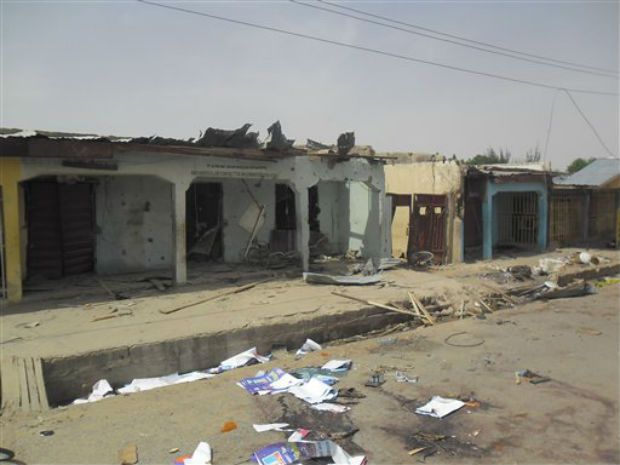
Suspected Boko Haram gunmen late Saturday also raided the town of Babban Gida, 50 kilometres (30 miles) from Damaturu, the capital of neighbouring Yobe state, according to residents, who said they destroyed several buildings. [myad]
Igbo people, under the canopy of Ohanaeze Ndigbo, today fight themselves over whether they should reach a consensus to adopt President Goodluck Jonathan for the 2015 presidential election failed at the Ime-Obi (inner caucus) meeting of the body today in Enugu.
A motion which was sneaked into the meetingby the chieftain of the Peoples Democratic Party (PDP), Chief Emmanuel Iwuanyanwu for the body to collectively adopt President Jonathan as the consensus candidate for the next year’s election was roundly defeated.
Information reaching us indicated that the idea of adopting Jonathan as the consensus candidate of the Igbo was not on the agenda of the meeting, which held at the apex Igbo socio-political organisation’s secretariat in Enugu but that midway into the meeting, Chief Iwuanyanwu moved the motion. He informed the Ime-Obi that he came with a message from ’90 per cent of Igbo, who were supporting Jonathan’s election for a second term.
He asked the meeting to give him an answer so that he could report back to those who sent him.
The motion was said to have caused an uproar, forcing the President General, Chief Gary Igariwey, to adjourn the meeting, which ended abruptly with a shouting match between those against and those in support of the failed motion to adopt Jonathan as the consensus candidate.
Following the failure of the motion, Iwuanyanwu walked out of the meeting and drove away from the venue.
Earlier, some members of the Ime-Obi had kicked against an attempt to extend the tenure of the organisation’s national executive committee to four years from the statutory two years tenure in office.
A representative of Ndigbo in the Diaspora, Mr. Nwachukwu Anakwenze, had told the meeting that the constitution was amended under the previous administration, extending the tenure to four years.
Anakwenze alleged that those who were challenging the tenure of the executive were hired to cause trouble in Ohanaeze Ndigbo.
The comment apparently irked a former national chairman of the defunct Justice Party, Chief Ralph Obiorah, who immediately walked out of the meeting.
In an encounter with journalists, Obioha maintained that the tenure of the executive had long elapsed, saying those supporting the tenure elongation were persons, who masqueraded under Ohanaeze Ndigbo in the Diaspora’s umbrella, to collect N4m from the N20m released to Ohanaeze Ndigo by Governor Willie Obiano of Anambra State.
He noted that it was obvious that some people came to the meeting with a predetermined agenda.
A communiqué released after the meeting however stated that the tenure of the executive was four years.
The communiqué also explained that the motion for the adoption of a presidential candidate was kept in abeyance, until further notice, as the leadership of Ohanaeze Ndigbo was still consulting.
The communiqué reads: “The amendment of the Constitution of Ohanaeze Ndigbo during the Ime-Obi meetings of August 14, 2010 and October 30, 2010 as well as during the General Assembly meeting of November 6, 2010 as shown in the video tape today is hereby ratified by the Ime-Obi meeting today January 3, 2015, hence the tenure of the office of National and State officers of Ohanaeze Ndigbo remains four years.
“A committee will be set up by the NEC of Ohanaeze Ndigbo on the issue of reconciliation of all aggrieved parties in Ohanaeze Ndigbo.
“The said committee shall equally look into the issues of multiple litigation plundering confronting Ohanaeze Ndigbo.
“The amendment of tenure done to the Constitution of Ohanaeze Ndigbo as ratified by the General Assembly meeting of November 6, 2010, be published and reflected in the constitution, which took effect from the said date; as a substitute to the constitution dated January 27, 2004, which has the same contents, and is currently in use after the amendment.
“The issue of adopting any presidential candidate in the forth-coming presidential election in Nigeria was raised, but kept in abeyance as the leadership of Ohanaeze Ndigbo is still consulting.” [myad]
We use cookies on our website to give you the most relevant experience by remembering your preferences and repeat visits. By clicking “Accept”, you consent to the use of ALL the cookies.
This website uses cookies to improve your experience while you navigate through the website. Out of these, the cookies that are categorized as necessary are stored on your browser as they are essential for the working of basic functionalities of the website. We also use third-party cookies that help us analyze and understand how you use this website. These cookies will be stored in your browser only with your consent. You also have the option to opt-out of these cookies. But opting out of some of these cookies may affect your browsing experience.
Necessary cookies are absolutely essential for the website to function properly. This category only includes cookies that ensures basic functionalities and security features of the website. These cookies do not store any personal information.
Any cookies that may not be particularly necessary for the website to function and is used specifically to collect user personal data via analytics, ads, other embedded contents are termed as non-necessary cookies. It is mandatory to procure user consent prior to running these cookies on your website.











Does A Soldier Have The Right To Protest? By Femi Falana
In the last three months, two sets of soldiers totaling 64 were charged with conspiracy to mutiny before a court-martial which sat in Abuja. The “offence” proved against the accused soldiers was that they demanded for adequate weapons to fight the well-equipped and well-motivated troops of the dreaded Boko Haram sect. Although there was no scintilla of evidence to substantiate the charge of mutiny against them the military judges discharged and acquitted 12 of the accused soldiers and convicted and sentenced 58 others to death. As the verdict is characterized by gross miscarriage of justice the defence team has strongly urged the confirming authority to quash the questionable conviction and the sentence.
In challenging the death penalty imposed on the soldiers some persons have defended the right of members of the armed forces to request for equipment in fighting the war on terror in the north east region. Piqued by the growing rejection of the death penalty prominent Nigerians the military authorities issued an angry statement last week, warning politicians and activists against actions capable of inciting or endorsing indiscipline in the Nigerian Armed Forces. According to the Director of Defence Information, Maj.General Chris Olukolade, the call became necessary in view of the statement credited to a politician that “soldiers have the right to protest for the Federal Government’s failure to fully equip them.” He advised those commenting on the matter to realize that the actions of the military authorities were justified in law.
However, a retired army general, Ishola Williams, has said that the convicted soldiers were right in disobeying orders that would lead to certain death as a result of the failure of their commanding officers to provide them the necessary equipment. The respected general who was the Chief of Defence Operations, Planning and Training, at the Defence Headquarters, Nigerian Army before resigning in 1993 said that “Those playing politics with the lives of these soldiers who were being sent to commit suicide in the name of fatherland and they refused, have to be ashamed. The army’s top hierarchy is covering up its weaknesses by court-martialing these soldiers. The staff from the HQ (defence headquarters) and the generals are to blame.
Contrary to the general belief in military circles, a demand made by soldiers does not constitute mutiny per se. In the case of Oladele & Ors v Nigerian Army (2003) 36 WRN 48, the Appellants who were injured in the ECOMOG peace keeping operations in Liberia were flown to Egypt for medical treatment. On the day they were to return to Nigeria, they protested violently at the Cairo Airport over the non-payment of their estacode. They were brought home and charged with mutiny, convicted and sentenced to various prisons terms including life imprisonment by a Court Martial. In setting aside the conviction and sentences passed on the Appellants, the Court of Appeal observed thus:
“Mutiny is a criminal offence of a serious dimension. The pieces of evidence that l have reviewed supra have not shown that the appellants disobeyed any order deliberately nor did they use any violence. If anything at all, all they did was to protest the non – payment of their estacode. Such a protest finds justification on the admission of PW4 that he had paid some soldiers who earlier traveled with some estacode and was emphatic that the Appellants were not prohibited but there was no express provision for the payment of estacode to them”
In the light of the reasoning of the Court of Appeal in the Oladele’s case, we submit that in demanding for adequate support weapons the convicted soldiers did not engage in violence. To that extent their demand found justification in fact and in law. In his oral evidence before the Court Martial, Lt-Col T Opurum, the Commanding Officer who was the first prosecution witness (Pw 1) stated that the unit was ambushed on 9 July 2014 by the terrorists and that a total of 3 officers and 23 soldiers were killed in that attack while about 82 others had various degrees of injuries. PW1 further told the court that on 4 August 2014 when he ordered the convicted soldiers and others to advance and capture Delwa, Bulabulin and Damboa they demanded for adequate to avoid another tragic encounter with the terrorists.
In their defence the convicts admitted that they demanded for equipment to fight the Boko Haram insurgents who were armed with weapons like Anti Aircrafts, APCs, BMGs, RPGs and AK47s. Each soldier was only armed with aAK47 and 60 rounds of ammunition. They said that sequel to the tragic development, PW 1 promised that adequate weapons would be provided for any other operation as the terrorists “have superior fire power.” He was quoted as saying, “ I, Lt-Col Opurum will not take soldiers in my battalion to the war front again without adequate weapons.” The promise was not kept when PW 1 asked the convicts and other soldiers to confront the terrorists on August 4, 2014.
Unlike the 8 soldiers who deserted the army the convicted soldiers responded to the call for reinforcement on 18 August 2014, when Delwa was attacked by the insurgents. As the army headquarters in Maiduguri had provided weapons the convicts extricated the commander and others from the terrorists . During cross examination PW 1 admitted that the minimum strength of a Battalion in the Nigerian Army is about 750-800 personnel whereas he had just 174 soldiers and that the terrorists were equipped with “superior fire power”. On the allegation that the convicts requested for weapons PW 1 admitted that all other soldiers involved in the operations against insurgency had made a similar demand.
In view of the lack of equipment which led to the tragic killing of 3 officers and 23 soldiers by the insurgents in July it cannot be said that the demand for weapons to engage in the operations against the enemy constituted mutiny. Indeed, the request for adequate support weapons is justified by Section 217 (2) of the 1999 Constitution which provides that “The Federation shall, subject to an Act of the National Assembly made in that behalf equip and maintain the armed forces as may be considered adequate …”
No doubt, the accused had subscribed to the oath of allegiance to defend the territorial integrity of the nation but the oath is not a license to commit suicide. It is a solemn undertaking to defend the nation based on the expectation that the Federal Government would have complied with Section 217 of the Constitution on the mandatory requirement to equip the armed forces adequately. The failure of the Federal Government to provide adequate weapons recently led President Jonathan to request for a loan of $ 1 billion to purchase military hardware for the armed forces to fight the terrorists. Although the request was granted there is no indication that the weapons have been acquired!
In 2008, 27 soldiers were convicted and sentenced to life imprisonment by a court-martial which sat at Akure, Ondo state.
The soldiers who had taken part in the United Nations peace keeping operations in Liberia embarked on a violent street demonstration to protest the diversion of their operational allowances by some officers. Based on the representation made by us on behalf of the convicts reason prevailed and the confirming authority commuted the life imprisonment to 7 years. On a further review of the case the convicts were pardoned. As in the instant case, the authorities initially believed that soldiers had no right to protest against injustice.
It is germane to draw the attention of the military authorities to section 179 of the Armed Forces Act, Cap A20. Laws of the Federation of Nigeria, 2004 which permits a soldier, rating or aircraftman to make a complaint to his commanding officer who is obligated to address the complaint. Under no condition shall the complainant be penalised for having made a complaint so far as the complaint does not contravene any provisions of the Act. In this case, the complaint of the convicted soldiers pertaining to lack of adequate weapons to fight terrorism was made in accordance with the Armed Forces Act and the Constitution. In the circumstance, the charge of mutiny is illegal and unconstitutional in every material particular. Permit us to refer once again to the case of Cpl Segun Oladele & 22 Others v Nigerian Army supra, where the Court of Appeal held that:
“Let it be said that members of the armed forces in this country have not denounced their membership of the Nigerian society and it seems to me that they cannot do so in a manner calculated to jettison the provisions of the Nigerian Constitution, the grundnorm.
The members of the armed forces are not excluded from the application of the provisions of the Fundamental Rights the likes of right to life, right to personal liberty, right to fair hearing, right to freedom from discrimination etc.”
Conclusion
The convicts soldiers would have been guilty as charged if they had vamoosed or deserted the army when ordered to advance. They never said that they won’t fight. But having regard to the casualties of July 9 due to the superior fire power of the terrorists they rightly demanded for support weapons. And when adequate weapons were made available on August 18, 2014 they fought with courage, commitment and loyalty to their country and routed out the insurgents. They deserved commendation and not condemnation. Having requested for weapons in exercise of their constitutional right the convicts did not commit the offence of mutiny or any offence whatsoever. In the circumstance, they ought to have their conviction and sentence quashed by the confirming authority.
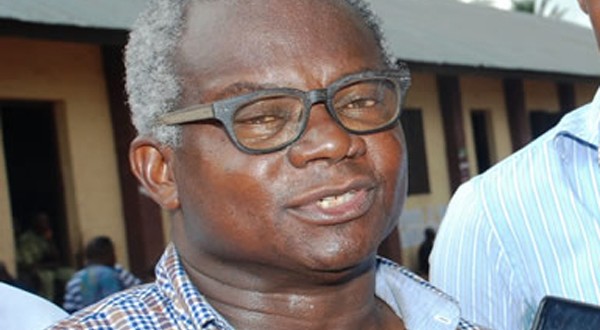
Mr. Femi Falana, a member of the Nigerian Bar’s velvet club, Senior Advocate of Nigeria –SAN, is a famed human rights advocate and public interest litigant. He sent in the piece from Lagos. [myad]