Chief coach of the senior national women’s football team, the Super Falcons, Edwin Okon has made it clear that he is not afraid of the likes of former champions, Sweden and the United States of America (USA) as well as Australia which are in the same group with the Falcons, described as ‘a group of death.’
Okon said that his players can hold their own anywhere, saying that Super Falcons will come out as leaders of the group when the championship begins in Canada.
“I trust in ‘can do spirit’ of the average Nigerian. I am a Nigerian and Nigerians always have a way of coming out of difficult situations. Many people have been talking of the group of death but I don’t see any death for my team, we are not even talking of surviving in the group, but we are thinking of coming out tops of that group, that is our calculation.”
The coach would not talk about the players he intends to prosecute the championship with insisting that such is basically a technical issue which he will not discuss openly, even as he assured that every Nigerian will be happy with the list when it is made public.
The Peoples Democratic Party (PDP) has reminded Nigerians that their vote for General Muhammadu Buhari who has just won the Presidential primary of the opposition All Progressives Congress (APC) in 2015 will take Nigeria backward while President Goodluck Jonathan, who also emerged as a consensus candidate of the ruling PDP will move the country forward.
In a statement today meant to welcome the emergence of General Buhari as the opposition party candidate to sweat it out with Jonathan in the 2015 election, the PDP National Publicity Secretary, Chief Olisa Metuh took time to quote the words of President Jonathan where he said: “The choice before Nigerians in the coming election is simple: A choice between going forward or going backwards; between the new ways and the old ways; between freedom and repression; between a record of visible achievements and beneficial reforms – and desperate power-seekers with empty promises.”
Metuh called on Buhari to be issue- based in the course of his campaigns, adding, “We hope that this time round, General Buhari will conduct a campaign that is issue based and devoid of ethno-religious sentiments.”
Metuh made it clear that President Jonathan remains the best for the country, adding: “this will be the fourth time General Buhari will be contesting in the presidential elections. On each of the three previous occasions, he failed to articulate a vision of the future that was acceptable to Nigerians. On each occasion his brand of politics was rejected across Nigeria. Apart from changing to a dinner suit, General Buhari, has not changed the tired ideas and provocative utterances that Nigerians rejected in previous elections.
“We are convinced that the Peoples Democratic Party (PDP) remains the only truly National Political Party in Nigeria, a platform on which all Nigerians can pursue their legitimate aspirations.
” We also believe that despite the distractions, President Goodluck Jonathan has a genuine record of accomplishments on which to run and deserves a second term. President Jonathan’s re-election will guarantee Unity and Stability for Nigerians. His second term will also deliver prosperity to Nigerians.”
Former Vice President Atiku Abubakar who lost the Presidential primary of the opposition All Progressives Congress (APC) to the former Nigeria’s military Head of State, General Muhammadu Buhari, has called on Nigerians, especially the supporters of the party. to rally behind the General for the 2015 Presidential election.
Atiku stressed: “I call on all other contestants and our party’s rank and file to unite behind our candidates at all levels to ensure that the PDP is defeated, so Nigerians can have real change.nI will hand over to Gen. Buhari for his review and possible implementation my policy document which was developed in line with the party’s philosophy.
Atiku who sent congratulatory message to General Buhari shortly after he was declared winner at the APC’s national convention and Presidential primary in Lagos, acknowledged that Buhari ran a spirited campaign and that since the delegates have spoken, he fully deserves the victory.
“I am very confident that you will provide the needed leadership to turn this country around. I have no doubt that you will work with dedicated and qualified Nigerians to protect our citizens, improve our economy, create jobs, improve education, reform governance and fight corruption. You will indeed bring the change Nigerians have been yearning for. Once more, congratulations.
“I congratulate the other contestants, namely Governors Rabiu Musa Kwankwaso and Rochas Okorocha as well as the erudite Sam Nda-Isaiah. You have all demonstrated your commitment to democracy by participating in this transparent process and by campaigning vigorously across this country.
“I thank our delegates for their sacrifices and their commitment to democracy. In particular, I thank those who voted for me for your faith in me. However, since we came up short, we have to now rally behind General Buhari to help him prevail in the coming Presidential election.
“The APC has demonstrated, through the transparent process, the Party’s commitment to democracy and rule of law. It has demonstrated its respect for people and their choice through the ballot box.
“I sincerely thank the Convention Committee for putting together a hitch-free convention.
“My dear friends, we have voted, a winner has emerged. I pledge my commitment to this Party, and to campaign vigorously for our candidate, Gen. Muhammadu Buhari and all APC candidates to ensure victory in the 2015 elections.
General Buhari emerged as the Presidential Candidate of APC for the February 2015 Presidential elections by polling a total of 3,430 votes to beat Atiku who polled 954 votes and Kano State Governor Rabiu Kwankwaso with 975 votes.
The other contestants were publisher of LEADERSHIP Newspapers, Same Nda-Isaiah who polled 10 votes and Imo state Governor, Rochas Okorocha who polled 624 votes.
Unlike the ruling Peoples Democratic Party (PDP), whose candidate emerged by consensus, the opposition APC went into full contest.
The final result of the primary was announced today by the Chairman of the APC convention committee and immediate past Governor of Ekiti State, Dr. Kayode Fayemi.
President Goodluck Jonathan has said that Peoples Democratic Party (PDP) has been repositioned and that today, the party is stronger, bigger and more in tune with the yearnings of Nigerians.
The President, in his acceptance speech, delivered shortly after he was formally confirmed as the Presidential candidate of the party yesterday remarked: “today we are stronger, bigger, and more in tune with the yearnings of our people.”
Jonathan said that Nigeria is undergoing great changes at this time, even as he also admitted that the country is experiencing great challenges, advising political parties to rise above the fray, to provide hope and clear direction, to propel the development of the country.
“As expected in every contest, especially political contests, the journey to this convention has not been without issues in some constituencies. Indeed, Party Congresses from the ward to state levels, and the legislative and state primaries, have produced both triumphs and some misgivings.
“Without prejudice to various on-going resolution mechanisms, we will take steps, after the elections to review and refine the candidate selection procedures within our party. An appropriate committee will be set up to work on this, with contributions across board.”
President Jonathan who insisted thatPDP remains a large, accommodating and responsible party, assured party members that conflicts arising from the various congresses of the party across the country would be amicably resolved and that the genuine interest of every member is respected and assured.
“For the sake of the entire nation, we must, at this time, more than ever, stand together as one united party. We are all joint stake holders, this party belongs to all of us.
“What we have achieved today should be a lesson to all who care about Nigeria. What we have done exemplifies our unity. What we have done exemplifies our determination. What we have done exemplifies our purpose.
“We are a Party that accepts challenges. We are a Party that confronts those challenges. But above all, we are a Party that resolves challenges. And it is exactly these qualities that will lead us to victory.”
The President assureed party members that he would embark on a campaign, and an election, that will serve to consolidate the party’s successes.
“I will give my all. I will not let you down. I will not fail the PDP. I will not fail you. Above all, I promise, I will not fail our great nation, Nigeria. This convention shows that we are ready. The PDP is ready. Nigerians know we are ready. And today in Abuja, we begin the next phase of our mission. Our mission is to secure Nigeria’s future.
“First of all, let me give gratitude to God Almighty who has sustained the nation. There is much to say, but permit me some special words of gratitude. These last four years have not always been easy, but through it all, my wife has effortlessly taken care of our home. So to you, my companion and my foremost supporter, I thank you from the bottom of my heart.
“I also want to thank, the Vice President, my brother, Arch Namadi Sambo, and his dear wife. You have both provided loyal support and commitment to this presidency; working with you for our people, has been a pleasure.
“The work and progress recorded these past four years has been possible because we have had the best team possible. The Ministers, Advisers, Assistants and staff that have formed the Transformation team, have shown great dedication, creativity and loyalty.
“They have put in extra hours when necessary, and always gone the extra mile to ensure delivery. Today, I thank them fervently for their patriotism and hard work.
“Our Party, the PDP, has been the foundation of our Transformation Agenda. I thank the Chairman and Party Executive at all levels, the Board of Trustees and National Working Committee, the PDP Governors Forum, Federal and state legislators, Secretariat Staff and volunteers, across the country. You have played your part well, and I am indeed very grateful.”
Jonathan commended himself that no Nigerian has been exiled or imprisoned by his government for holding contrary views, adding that he would continue to water the tree bearing the fruits of freedom, for Nigerians.
“In the last 16 years, the PDP has kept faith with the Nigerian people by promoting and projecting a united nation, under God. We have united our people around common national goals for the good of our citizens and the development of our nation.
“Through its years of office, our great Party, the PDP created the Anti-corruption agencies, that is, the EFCC and the ICPC, the Excess Crude Account, the Pension Reforms, Fiscal Responsibility Regime, the Sovereign Wealth Fund and various privatization programmes.”
Saudi Arabia’s King Abdullah bin Abdulaziz al-Saud has given out a grant of US$35 million to help fight Ebola in West Africa.
In a statement today, President of the Islamic Development Bank (IDB), Dr. Ahmad Mohamed Ali said that the Ebola fighting programme, initiated by the Custodian of the Two Holy Mosques and implemented by IDB, comprises the following elements:
1-Providing schools with thermal sensors and medical examination equipment designed to diagnose the disease, thereby facilitating its treatment and preventing its spread. The equipment will allow governments to open schools for the current academic year. Pupils will be examined at entry to ensure they have not contracted the disease, thus reassuring parents about the safety of their children at school.
2-Providing thermal sensors and medical examination equipment at airports, railway stations and bus stations to diagnose the disease and ensure early treatment.
3-Establishing a specialized treatment centre in each of the three endemic countries, Sierra Leone, Guinea and Liberia, designed to serve suspected cases in schools, hospitals and public transport, and wherever contamination is likely to occur in crowded conditions. Suspected cases will be received in these centres for further medical tests before they are referred for specialized treatment if necessary.
4-Establishing a specialized treatment centre in Mali where Ebola appears to have broken out but is not widespread. The centre will help the country’s health authorities cope with potential epidemics in the future.
The IDB President said that the money would further boost the Islamic world’sefforts in supporting the international fight against Ebola, adding that the equipment financed by this donation would speed up the opening of schools in the countries concerned, reinforce the institutional and health infrastructure to fight the current epidemic and any potential epidemics in the future, Allah forbids, thus saving thousands of lives and ensuring the safety of those at risk of contamination.
Dr. Ahmad Mohamed Ali implored wished King Abdullah bin Abdulaziz long life to continue to save the lives of people in line with Allah’s saying in the Quran “and that whoever saves one life should be regarded as though he had saved all mankind“. He also prayed the Almighty to cure the sick and to protect humanity from all evils and disease.
In the heat of campaign for the presidential candidacy of the opposition All Progressives Congress (APC) in the ongoing national convention of the party in Lagos, the Nigeria former Head of State, General Muhammadu Buhari has written to the delegates, asking them not to allow anyone to sell the fate of the country at this critical moment in its life.
In a letter he personally wrote to the delegates today, General Buhari said: “I am not a rich person. I can’t give you a pocketful of dollars or naira to purchase your support. Even if I could, I would not do so. The fate of this nation is not up for sale.
“What I will give you, and this nation is all of my strength, commitment, sweat and toil in the service of the people. What I can give you is my all.”
Part of his letter goes thus:
“As you gather for our convention, please remember that history, change and the hopes of Nigeria are there with you. They are there to ask you to perform according to your best judgment and patriotic conscience. I also ask you to do the same.
“We seek a new Nigeria. It starts with us. It starts today. I have placed myself before you seeking your help to nominate me as your standard bearer for our progressive party, APC.
“Personal ambition does not drive me in this regard. I seek to be the next president of our beloved nation because I believe I have something to offer Nigeria at this time of multiple crises. Insecurity, corruption, and economic collapse have brought the nation low. Time is past due that we work together to lift Nigeria up. I am ready to lead Nigeria to its rightful future.
“I have always served Nigeria to the best of my ability. I have always tried to give more to the nation than it has given me. This is the principle of service that has guided my public life. Thus, I am not a rich person. I can’t give you a pocketful of dollars or naira to purchase your support. Even if I could, I would not do so. The fate of this nation is not up for sale.
“What I will give you, and this nation is all of my strength, commitment, sweat and toil in the service of the people. What I can give you is my all.
“I do not intend to rule Nigeria. I want to democratically govern it with your help. I seek a Nigeria where Christians and Muslims may practise their faiths in peace and security; a Nigeria that is just and where corruption no longer trespasses into our institutions and national behavior and a Nigeria where our diversity could be used for our national prosperity.
“Nigeria is our home. Let us now turn it into the great nation we know it can and should be.
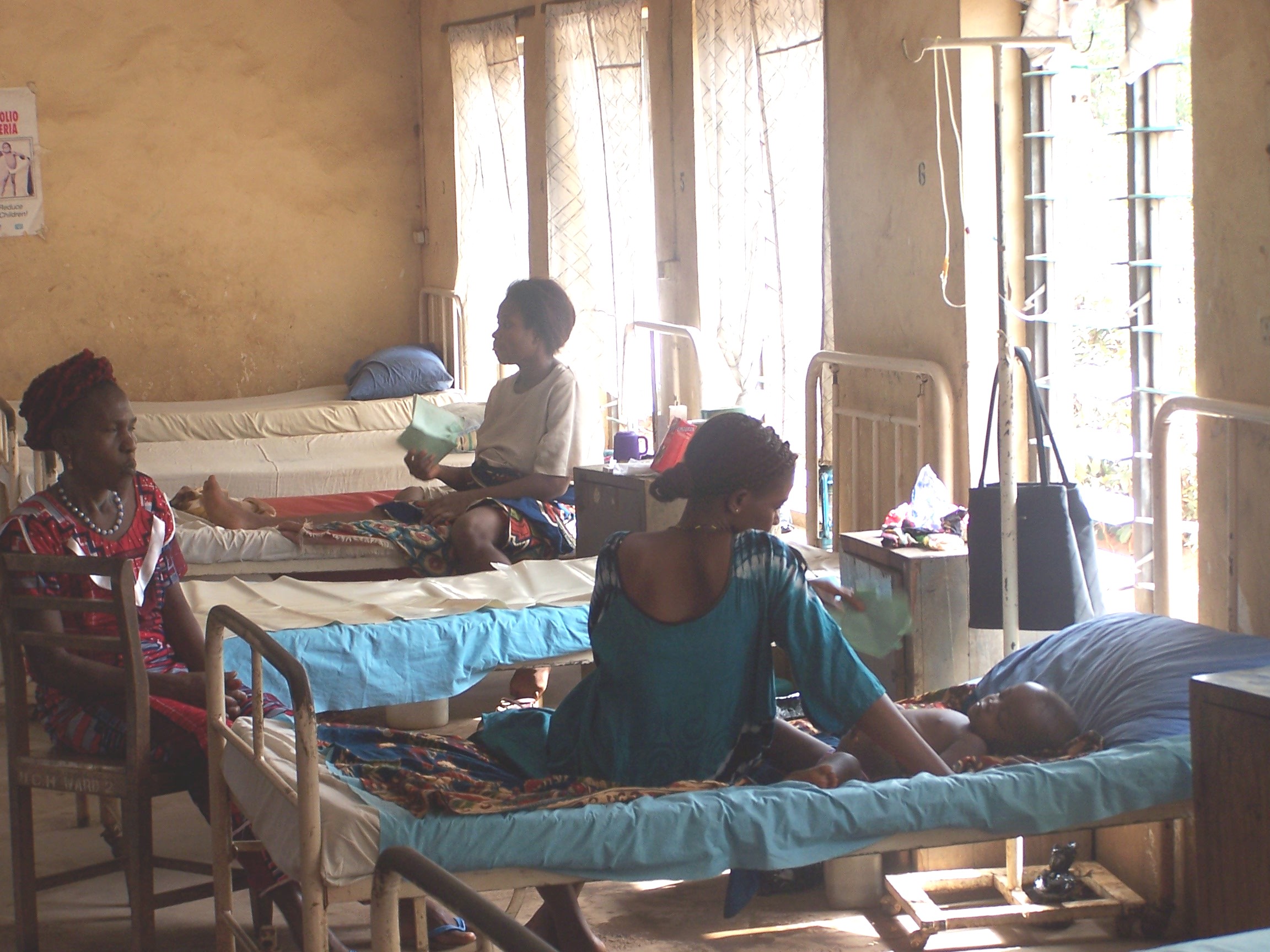
The leadership of of the Joint Health Sector Union (JOHESU), whose members have been on strike for sometimes now, have raised an alarm that government has started using quacks health officers to service innocent patients.
In a statement after an emergency meeting today to review the strike which has been adversely affecting health service across the country said that the claim by the management that it had employed and deployed unqualified hands to render health services is not true, saying that such workers were not trained or licensed to do the job.
Chairman of JOHESU, Tony Asiodu, said that the workers advised the public to be careful and not to play with their health.
“The management has thrown away tenets of professionalism and ethics of professional conducts in a bid to create a posture that the hospital is providing services, when in actual sense they are rendering unhealthy and quack services, which poses a great threat to Delta State citizens and members of the public at large.
“All the qualified professional, whose job they are trying to do, are on strike.”
He said non-qualified and non-licensed casual staff were employed to carry out laboratory and nursing services.
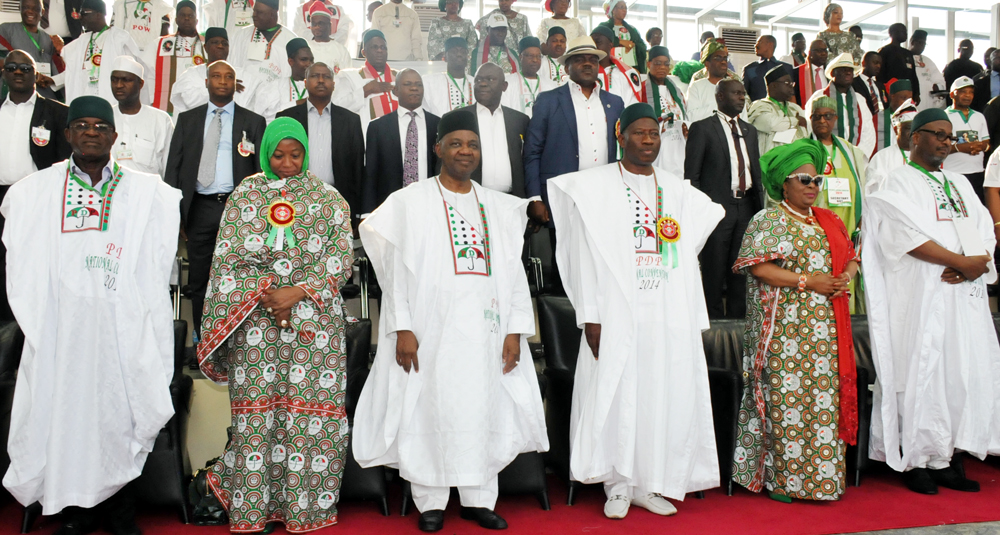
From left: Senate President, David Mark; wife of Vice President Mohammed Namadi Sambo, Mrs. Amina Sambo: Vice President Mohammed Namadi ambo: President Goodluck Jonathan: First Lady, Dame Patience Jonathan and PDP National chairman, Alhaji Adamu Mu’azu at PDP Presidential primary election in Abuja today, Wednesday, December 10. [myad]
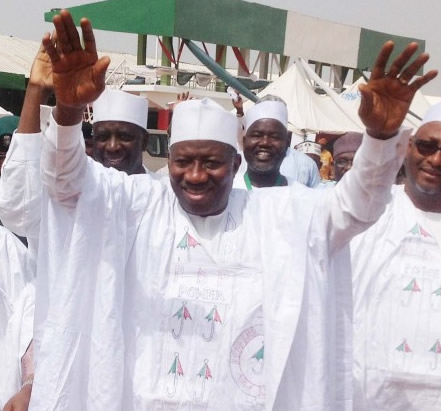
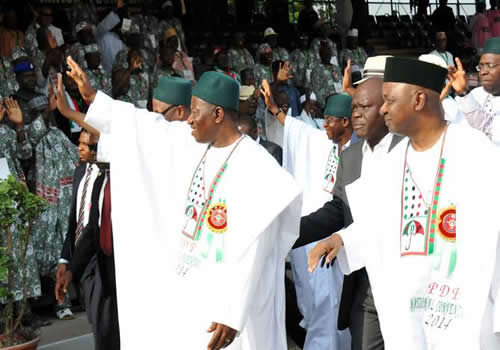
PRESIDENT GOODLUCK JONATHAN; VICE-PRESIDENT NAMADI SAMBO ACKNOWLEDGING CHEERS DURING THEIR ARRIVAL AT THE EAGLE SQUARE FOR THE THE PDP PRESIDENTIAL PRIMARY ELECTION IN ABUJA ON WEDNESDAY (10/12/14)
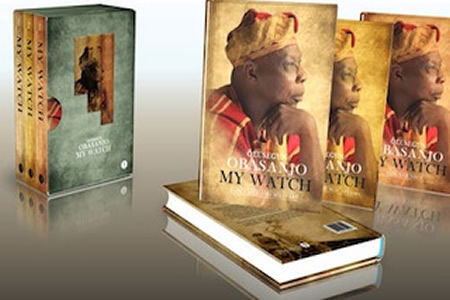
Former President Olusegun Obasanjo and an Abuja High Court are now in a running battle over a book: an autobiography titled: My Watch. While the court found the former leader guilty of contempt for defying it directive barring him from releasing the book, Obasanjo insisted that the court order came after he had written it.
The court had ordered that the book launch be put on hold over claim the three-volume series contained details of a libel case already before the court. The case involves a drug trafficking allegation made by Mr. Obasanjo against Buruji Kasahmu, a leader of the ruling Peoples Democratic Party (PDP) in the southwest.
Kashamu had requested the court order to stop the release of the book, citing the case. But the move is believed to have been a cover to block Obasanjo from making public some of his most scathing assessments of President Goodluck Jonathan, as contained in the book.
On Tuesday, the former president proceeded with the book launch saying the judge acted in error and deserved to be sanctioned. The former president also said the book had already been published before the court gave its order.
Justice Valentine Ashi, in a ruling today in Abuja, gave Obasanjo 21 days to demonstrate why he should not be punished for going ahead to publish the book. The court also ordered the Inspector General of Police, the Director General of the State Security Service (SSS) and the Comptroller of Customs to recover all the books all book stands, sales agents, vendors, the sea and airports and deposit them with the court’s registrar pending the determination of the case.
Justice Ashi said that it is immaterial that the book was published before the interim orders were made, adding that Obasanjo should not have in the first place published the book since the Kashamu case was already in court.
“The fact that the book was published in November is irrelevant. As long as the substantive suit is not yet determined, no party is entitled to publish or comment on material facts that are yet to be decided on by the court,” the judge said.
“I hold the defendant, not only in contempt of the court, but to show cause why he should not be punished for contempt and ordered to undo what he has wrongly done.”
“The defendant, Chief Olusegun Obasanjo shall be given 21 days, from the day this order is served on him, to show cause, via affidavit, why he should not be punished for contempt committed by publishing and distributing for sale to the public, the book, My Watch, in plain disregard of the pendency of substantive the suit and the order of this court made on December 5, 2014 restraining him from doing so.
“The defendants, whether by himself, agents, servants, privies or whatever name called, is hereby restrained from further publication or offering for sale or distribution, in any way or manner, the book called My Watch or the like of the visual or written materials which contains a re-publication or statement extracted from the letter referred to by the plaintiff.”
He also directed that orders of the court be served on all media houses in the country and be equally served on Obasanjo by publication in two national dailies.
The judge rejected claims by Obasanjo’s lawyer that Kashamu failed to produce the book to prove it contained libellous details.
The judge said it was the duty, instead, of the defendant, in whose custody the book was, to show the court that the plaintiff’s fear was misplaced.
He said Obasanjo’s failure to do so, showed he had something to hide.
But Obasanjo’s lawyer, Realwon Okpanach, said the former president will appeal the ruling.
He said the court order, which the former president flouted, was given in error since it was not proven that the book contained libellous materials.
“The orders made cannot be enforced. They want the court to stop an act that had been concluded. That is impossible. We had published the book in November, they came before the court in December and asked that the publishing shroud be stopped. Is that possible?” he said.
“We shall file our appeal within the stipulated time of 14 days in the case of interlocutory orders.”
We use cookies on our website to give you the most relevant experience by remembering your preferences and repeat visits. By clicking “Accept”, you consent to the use of ALL the cookies.
This website uses cookies to improve your experience while you navigate through the website. Out of these, the cookies that are categorized as necessary are stored on your browser as they are essential for the working of basic functionalities of the website. We also use third-party cookies that help us analyze and understand how you use this website. These cookies will be stored in your browser only with your consent. You also have the option to opt-out of these cookies. But opting out of some of these cookies may affect your browsing experience.
Necessary cookies are absolutely essential for the website to function properly. This category only includes cookies that ensures basic functionalities and security features of the website. These cookies do not store any personal information.
Any cookies that may not be particularly necessary for the website to function and is used specifically to collect user personal data via analytics, ads, other embedded contents are termed as non-necessary cookies. It is mandatory to procure user consent prior to running these cookies on your website.



 Chief coach of the senior national women’s football team, the Super Falcons, Edwin Okon has made it clear that he is not afraid of the likes of former champions, Sweden and the United States of America (USA) as well as Australia which are in the same group with the Falcons, described as ‘a group of death.’