

President Jonathan Jumps In, Formally Declares To Contest 2015 Election
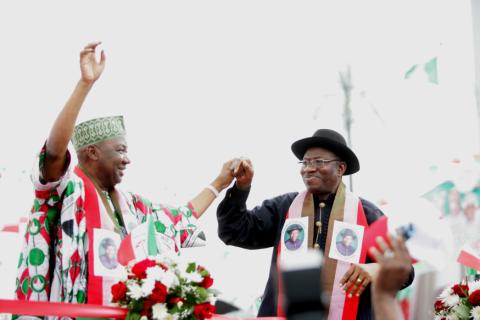
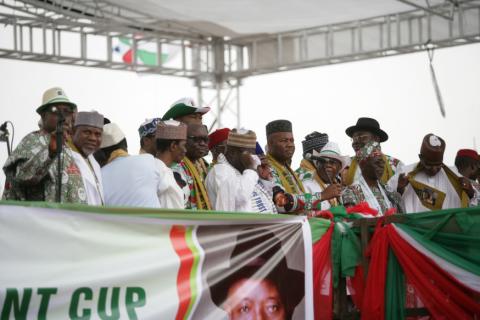
“I, Goodluck Ebele Azikiwe Jonathan, have accepted to present myself on the platform of the PDP.” These were the decisive words from President Goodluck Jonathan today at the Eagle Square, Abuja before a large crowd of party supporters.
President Jonathan has been in the saddle of the Nigeria’s affairs since 2010, when he took over following the death of President Umara Yar’Adua. He also won election to continue in 2011.
Here are a few key activities and dates since he became substantive President in 2010:
May 6, 2010 — Interim president Jonathan is sworn in, a day after the death of Umaru Yar’Adua following a long illness. Yar’Adua had disappeared from public life for more than five months, during which Jonathan stood in.
April 9, 2011 — The first of a series of key election dates is marred by deadly bomb blasts.
April 16: Jonathan won the presidential election against his rival, Muhammadu Buhari. More than 800 die in post-electoral violence, according to Human Rights Watch.
November 4: At least 150 were killed in a series of attacks claimed by extremist Islamist group Boko Haram against police stations and churches in its northeastern stronghold.
December 25: A wave of attacks claimed by Boko Haram targeting churches during Christmas services and police leave nearly 50 people dead.
— 2012 —
January 9-16: A nationwide general strike called to protest against a doubling of the price of petrol, which the government had previously set at about $0.40 (0.32 euros) per litre. Jonathan ended the strike by agreeing to a subsidy that fixed the price at $0.60 per litre.
January 20: Coordinated attacks by Boko Haram against the symbols of power in the northern city of Kano leave 185 dead.
— 2013 —
May 16: The army launches an offensive against Boko Haram in the northeastern states of Borno, Yobe and Adamawa, where Jonathan declares a state of emergency.
— 2014 —
February 2: Nigeria’s ruling party, weakened by mass defections and riven by months of in-fighting, is dealt a fresh blow, when one of its most senior figures, former vice president Atiku Abubakar left to join the main opposition, All Progressives Congress.
April 6: Nigeria becomes Africa’s biggest economy, leap-frogging South Africa, after the government announces a re-basing of the country’s gross domestic product.
April 14: At least 75 people die in a bomb blast in a bus station on the outskirts of Abuja — the deadliest attack yet to strike the city. Boko Haram claims responsibility. Two other attacks, in May and June, leave at least 40 dead in the capital.
– 276 teenage girls were abducted from their school by Boko Haram gunmen in Chibok, a remote corner of Borno state. Fifty-seven of the girls manage to flee, while 219 are still captive.
May 7: Jonathan hosts the World Economic Forum on Africa in Abuja, an event aimed at highlighting the continent’s growing economic strength, but is overshadowed by the Chibok hostage crisis.
August 24: Boko Haram’s leader Abubakar Shekau said in a video that he has created an Islamic caliphate in the northeast town of Gwoza. The group took control of several dozen towns and villages in the states of Adamawa, Borno and Yobe.
October 17: The army and the presidency announce a ceasefire with Boko Haram and an accord for the release of the schoolgirls. Boko Haram denies the accord and says on November 1 that the schoolgirls have converted to Islam and been married off.
November 11: Jonathan announces he is standing for re-election.
He has been heavily criticized for having not stamped out the Boko Haram insurgency which has left more than 10,000 dead over the past five years. [myad]
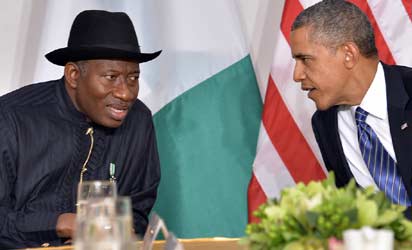
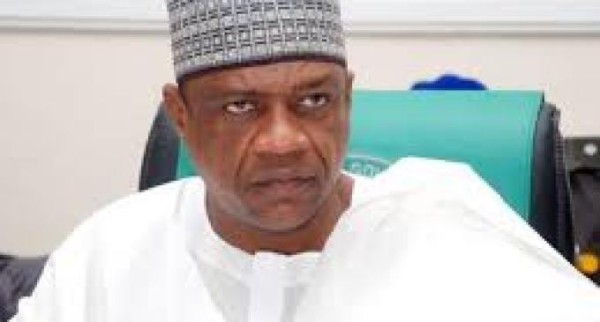
 President Goodluck Jonathan has expressed worries over the current challenge of falling crude oil prices and called on oil producing countries to cooperate more and work together to overcome the challenge.
 President Goodluck Jonathan has directed the Bureau of Public Procurement (BPP) that from the 2015 financial year, any contractor that is not in its database should not be allowed to do contract business of any sort with the Federal Government.
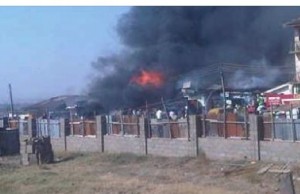 President Goodluck Jonathan has vowed again that no matter how long it takes, his government is determined to defeat Boko Haram insurgence, even as former Vice President Atiku Abubakar expressed outrage at today’s bombing of the Government Technical Science College, Potiskum by a yet unidentified suicide bomber dressed as a student of the school.
 Delta State Governor, Dr. Emmanuel Uduaghan has said that the injection of new commissioners into the State Executive council is aimed at ensuring the success of his administration as he prepares to end his second and last time tenure next year.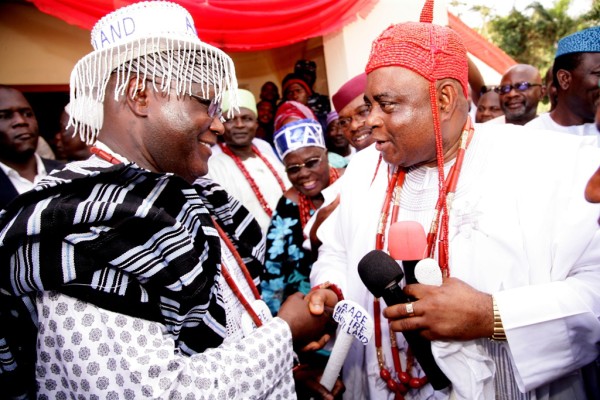
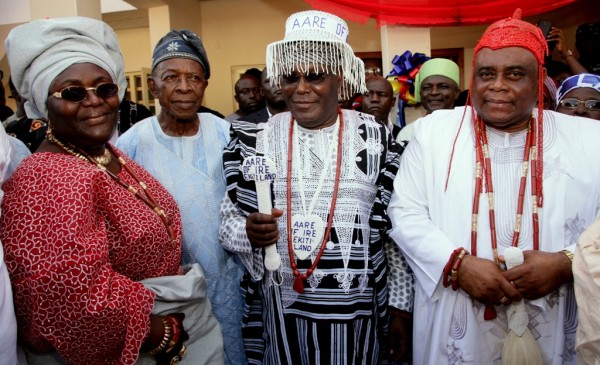


New Media And Kangaroo Journalists, By Femi Davies
The advent of new media also known as Online gave birth to what can be termed kangaroo journalists who suddenly become mega writers with ability to own a domain site, a laptop and fast fingers.
It is such a shame that the basic training expected before anyone can practice is not on the mind of these commercial writers.
To them, being a journalist is the needed weapon to obtain money from celebrities, opinion leaders, politicians and all attention seeking people.
The ethos of the journalistic profession, of removing judgement from news reporting and giving equal opportunities to all sides, was the first casualty of the kangaroo journalist, he cares neither for objectivity, the fundamental right to reply nor is he interested in the reputation and livelihood of those he is supposedly maligning just for the fun of it.
The role of the press, from time immemorial, is to inform, educate and entertain. These however, do not exclude the press from the economic realities and the cost implication of running a business, hence the resort to advert support for survival.
This delicate relationship between the media and advertisers, in any shape or form, has been on since the dawn of the profession, and over time, a delicate balance was achieved in which advert relationship has little or nothing to do with the direction of editorial policy.
All these rules, developed over time, mean absolute nothing to the kangaroo journalist. his main aim is to use his platform for blackmail, and because until now, he has nothing to lose, he assumed he could get away with it.
It is therefore not surprising, that a blogger of no repute, who has had face offs with the Niger State Government over issues of editorial blackmail, could not differentiate between an advert on a news site and a PR package. While one is a clear cut Above The Line transaction, the other is essentially a public relations function.
So, when such a blogger goes to town, impugning on the integrity of seasoned journalists and insinuating an act of wrongdoing on their part, simply because their news sites were given adverts, which was appropriately placed and visible, the same advert the said blogger lobbied for but did not get, then you know such a person needed to have his head examined.
For the records, Metronews would continue to uphold the tenants of the journalism profession, because unlike our friend, the blackmail blogger, we have a reputation to protect.
To the likes of Tego Oghenedoro or should we add Fejiro Oliver and their likes, if they refuse to get trained and adopt the rules of the game, their blackmail antics will only fetch them visits and clashes with the security agencies.
. Femi Davies is the Publisher of MetroNews Online. [myad]