A Federal High Court sitting in Abuja has ordered the Inspector General of Police (IGP), Suleiman Abba, to restore the security details of the Speaker of the House of Representatives, Aminu Waziri Tambuwal. This followed a suit filed by Tambuwal challenging the withdrawal of his security details among other infractions against his office.
The speaker had also asked the Court to stop the People’s Democratic Party (PDP) lawmakers from impeaching him.
The court, today, said that the Inspector General of Police erred in law by withdrawing the security details of the Speaker when he has not been removed from office. The IGP had, while withdrawing Tambuwal security details on Thursday last week, defended the action through a statement by the Ag. Force Public Relation Officer, Emmanuel Ojukwu that the Speaker’s security personnel were withdrawn because of his defection from the Peoples Democratic Party under which he was elected as speaker.
He cited the violation section 68 (1) g of the 1999 constitution as the basis for his action.
Speaker Tambuwal had on Tuesday October 28, announced his defection from PDP to the opposition All Progressives Congress citing political development in his home state, Sokoto but failed to resign as the Speaker of the House. [myad]
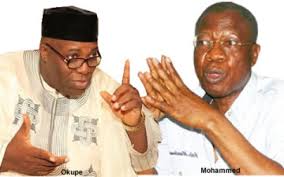
National Publicity Secretary of All Progressives Congress (APC), Alhaji Lai Mohammed has asked the senior special assistant on public affairs to President Goodluck Jonathan, Dr. Doyin Okupe to take a refresher course in history on a leader that had ever had cause to resign from office in the course of a war being fought by his country in order to change the course of the war.
In a statement issued in Abuja today, Lai Mohammed reminded Dr, Okupe and the presidency that Neville Chamberlain resigned as British Prime Minister on May 10th 1940 after Adolf Hitler forced the allies to retreat from Norway.
”According to available information, Chamberlain led Britain through the first eight months of World War II but had to resign after the Allies were forced to retreat from Norway, because of his belief that a government supported by all parties was essential for the unity needed to defeat Adolf Hitler. The resignation paved the way for Winston Churchill who later became the hero of the War.”
Alhaji Mohammed said that the call by Asiwaju Bola Ahmed Tinubu on President Goodluck Jonathan to resign in view of the widespread insecurity in the land and the fact that some parts of Nigeria are now under occupation by terrorists is neither extraordinary nor unprecedented.
”The call by one of our leaders is about taking responsibility. President Jonathan is the Commander-in-Chief of the Armed Forces of the Federal Republic of Nigeria. If under his watch Nigerian territories are being annexed progressively by insurgents, and all that he has demonstrated so far is sheer cluelessness and incompetence, it is time for him to take responsibility and quit in the national interest, to pave the way for a leader who can lead the country to victory.”
The APC spokesman said that all the blame game and name calling by the presidency, targeted at the opposition, constitute a mere distraction.
”The presidency is right to say that when terrorists attacked the US in September 2001, the leaders of the Democratic Party did not demand a resignation of President George Bush but rather they rose in defence of the American nation to support the various measures taken by the President to defeat the Al-Qaeda terrorists.
”What the presidency forgot to say, however, is that Americans would not have rallied behind then President Bush if he had been photographed snuggling with any sponsor of Al-Qaeda as President Jonathan did with one of the alleged sponsors of Boko Haram in Chad. Americans would not have rallied behind Bush if 9-11 had occurred not just once but twice or thrice, because it would have shown that the President is simply incompetent to lead.
”President Jonathan watched helplessly as Boko Haram moved from Sambisa Forest to take over a large chunk of territory in Adamawa, Borno and Yobe states and proclaim a Caliphate. President Jonathan watched helplessly as Boko Haram abducted and took away almost 300 girls, holding most of them for over 200 days….still counting. His Administration is even mocking and harassing those who are campaigning for the release of the girls. No people in the world will give such a leader unconditional support.
”Therefore, even if no leader in history has ever resigned during war (even though we have now proved that is not correct), nothing prevents President Jonathan from becoming the first leader to do so. After all, never in the history of any nation has incompetence and cluelessness been exhibited by any leader, as President Jonathan has done, when the country is at war.” [myad]
Governor Godswill Akpabio of Akwa Ibom state has said that the multi-purpose international stadium he built in Uyo, the capital of Akwa Ibom state is being handed over to Africa as a gift.
Speaking today at the inauguration of the stadium, the governor said that he has presented the stadium to Africa.
“And I believe that from here, Africa will produce a lot of champions. Never again should we go for Olympics and come back without gold medal, never again. That is why I’ve presented this to Africa”.
He said that the maintenance plan for the stadium is being handled by Julius Berger with which he said, the state government has signed a 10-year contract.
He described Julius Berger, which has been in Nigeria for over 35 years as having cut a niche for itself in the construction industry.
“Like I told the Former President of Ghana, Jerry Rawlings, for me I’m very humbled to have had the opportunity to present this to Africa.”
The Governor said that he decided to the secret to do many projects in Akwa Ibom State because he wanted to show that government can work.
“I had made up my mind, with a lot of anger when I came in that I must show that government can work and indeed seeing this kind of edifice, I can tell you that the anger is waning. That, yes indeed, government can work.
“I wanted to prove something to future generations and I hope that Nigerians after me, aspiring for leadership, will feel the need to learn the little I have experienced here”.
The President of Nigeria Football Federation (NFF), Amaju Pinnick, expressed excitement over the Stadium even as assured that the Federation will host world class matches in it.
Pannick who was among the delegation watching the last minute rehearsals for the official commissioning of the Stadium by President Goodluck Jonathan and three other African Presidents, said he was a fulfilled man seeing such edifice in Nigeria.
He said the stadium will henceforth be the home to Super Eagles and Super Falcons, saying that the NFF is going to take full advantage of the well crafted edifice for world class matches.
“I feel very fulfilled and like I said, this is the home of the NFF, this is the home of the Super Eagles, this is the home of the Super Falcons. And we are very proud to have been associated with the government of Akwa-Ibom State.
“It is a edifice that is so well crafted and I can assure you that you will be seeing first class marches. We are going to take good advantage of this edifice in making sure that we bring in first class marches, A-rated marches to this stadium”.
The former President of Ghana, Jerry Rawlings, expressed confidence that many champions would emerge from the edifice and advised that the maintenance culture should not be taken for granted.
“It (stadium) is unique and it is not just a gift to this state, a gift to Nigeria but to Africa and there is no doubt in my mind you’re going to develop a lot of champions out of this place.
“I just hope that those who are going to be given the responsibility to take care of this place, will maintain a high maintenance culture to ensure that it is perfectly secured.” [myad]
In compliance with a judgment of a Federal High Court which resolved the crisis rocking the Association of Local Governments of Nigeria (ALGON) association in favour of the board of trustees, the entire national leadership of association has been sacked.
This was even as the national secretariat of the association located at the sixth floor of West African Examinations Council (WAEC) building in Maitama, Abuja, has also been taken over by the board of trustees of ALGON with the support of police who were mandated to enforce the court order. The Chairman of the Board of Trustees of ALGON, Mr. Umar Kassim Ibrahim, who led the police to recover the office complex, told journalists that the action was to put an end to the era of impunity, arrogance, and lawlessness in the body by the former leaders of the association. He said that the tenure of the former President of ALGON, Chief Nwabueze Okafor, had expired since January and had become a former local government boss but declined to vacate office in-line with the provision of the constitution of the body. Ibrahim stated that in spite of several court judgments and orders against his continued stay in office, Okafor allegedly disregarded and disobeyed the orders. He said explained that police have to be brought into the tussle in order to force the former leaders out of office. “By our constitution only serving chairmen of the 774 local government areas in the country are eligible to be ALGON members and to hold offices as officers. “The movement your tenure expires as a local government Chairman, you have to automatically vacate office for the new officers but in the case of Nwabueze Okafor, his tenure as Chairman of Enugu South Local Government expired since January. He had handed over to his successor Mr. Victor Oguejiofo Agbo. “But unfortunately, the same Nwabueze refused bluntly to vacate office as ALGON President even when his is no longer a council chairman, so we have to invite the law enforcement agents to do their lawful duty.” He said that a six-man interim committee had been set up to hit the ground running and conduct election for new officers within 30 day. The interim committee is headed by Dr. Emmanuel Loman with Mr. Amodu Okandeji, Kwara ALGON Chairman, as legal adviser. Others are Prince Cornelius Nnaji from Enugu, Khalid Ibrahim from Jigawa, Mrs. Comfort Olarewaju from Delta, Maina Gana from Yobe and Olarewaju Ibrahim who will act as deputy chairman, treasurer, financial secretary respectively. [myad]
In the last few weeks, the PDP Publicity Directorate has been on tour of states across the nation to showcase the achievements of PDP elected and appointed officers in the past 15 years as a way, not only to showcase the party’s achievements but also to stimulate more action for the benefit of Nigerians. Already, the team has visited Jigawa, Akwa-Ibom, Bayelsa and Abia states where it highlighted the achievements of successive PDP governments, including constituency projects and interventions by special agencies of the Federal Government. It is against this background that the criticisms and personal attacks in the media against the PDP National Publicity Secretary, Chief Olisa Metuh and the tour by some elements in Abia state became completely unnecessary. Of particular note is an article by one Amadi Onuoha published in Tuesday, October 28, 2014 edition of The Sun Newspapers on the same day a similar article by Willie Ikpeazu appeared in the New Telegraph, a sister newspaper of The Sun. Reading through these articles, it is easy to notice that the writers, out on a hatchet job, hurriedly built on narrow interests, carried on with wrong postulations and ended up misplacing issues while attempting to mischievously put words into Chief Metuh’s mouth. To begin with, those who monitored the team’s activities in Abia state can attest that the PDP National Publicity Secretary was focused on his mission to highlight the successes of the PDP in Abia and never made comparison between the incumbent government and the previous administration. In fact, those following the tours since its commencement know that the team had never dwelt on comparisons even in Jigawa state where the PDP transformed the state after it took over from another party. The previous administration in Abia state was a PDP government and there was no way the party system would go into comparison when it was showcasing 15 years of the PDP in the state and in the country. The fact was that in Abia, while appreciating the achievements of the Governor Theodore Orji-led government, the Publicity Secretary listed some outstanding projects in various parts of the state and wondered why they were not given adequate mention in the media. He noted that there must be a case of conspiracy to underplay the achievements and portray the government as non-performing for selfish reasons. The credibility of the Abia tour and Metuh’s intentions were underscored by his position on the deplorable state of federal roads in the South East. Speaking with journalists after the tours, the PDP spokesman was bold to admit that although some of the federal roads in the region are under reconstruction, there must be an urgent intervention by the Federal Ministry of Works to give the people a sense of belonging. Though all informed minds in Abia believe that there is room for improvement in the state, we find nothing offensive in Metuh’s statement as the two writers want Nigerians to believe. This is especially as his visit not only drew attention to the state of our roads but also showed the progress made in Abia as a means of promoting the state and opening it up to the world as an investment destination. Ikpeazu and Onuoha are particularly angry with Metuh because according to them, the PDP spokesman described Abia as the ‘Dubai of Africa,’ This is not only childish but also betrays the writers’ ill will towards the state. In any case, some of us have taken time to read through the Thisday report of October 21, 2014 upon which they based their attack and we did not see anywhere Metuh was quoted to have said so. Instead, Thisday clearly reported that upon the arrival of the tour team at the New Ubani Modern Market in Umuahia, the “shout of Abia is Dubai of Africa” rent the air. The question is; was Metuh the one shouting? Ikpeazu and Onuoha should vent their anger on the traders who now enjoy space, security and amenities at the market and not on the PDP Publicity Secretary whose genuine efforts to bring the state to the limelight for the good of all is highly commendable. It is indeed laughable that the articles attempted to question Metuh’s credentials and competence as PDP’s National Publicity Secretary. The fact is that these hired hands must have either lost touch with reality or are simply blinded by avarice. In fact, it is not hard to decipher an agenda to cause confusion and weaken the PDP by targeting its publicity machinery as it prepares for the 2015 general election. The mischievous suggestion that Metuh was at loggerheads with PDP National Chairman and the mention of Chyna Iwuanyanwu as being schemed out in the race for the Publicity Secretary betrays this failed plot. It is incontrovertible that since his emergence in a keenly contested election, Metuh has repositioned the PDP Publicity to effectively project the image, ideals and achievements of his party, while matching the propaganda machinery of the opposition. Political watchers are aware that since its formation, the PDP has never been confronted with a highly organized and ambitious opposition with formidable propaganda machinery like the APC, which capitalized on the internal crisis within the PDP at a time. To the admiration of party members and supporters, the PDP spokesman vigorously applied his intellectual temerity to put the opposition under check with a combination of positive attitude, far-reaching innovations and persuasive messages on the positives of the PDP as the only true national and democratic party while profiling the APC as an undemocratic party out to destroy the unity of the nation. Before the emergence of Metuh, the PDP publicity was largely a reactionary organ to the misinformation by the opposition but the situation at the moment, which is verifiable, is that the ruling party has subdued the opposition to the extent that its voracious spokesman, Alhaji Lai Mohammed has been overwhelmed and is hardly heard. This is the reality on the ground. All informed Nigerians know that since the formation of the party, the current PDP image-maker is the most active, most vibrant and most productive in sustaining the popularity of the PDP, putting the party and its candidates in good stead for the forthcoming elections. If Metuh were not good, why would the opposition hire foreign media consultants and spend hundreds of millions of naira to oil their propaganda machinery against his person and office? The fact that PDP National Publicity Secretary has elevated the bar in party image making with his innovations and compelling personality is a point, which most Nigerian, even those in the opposition have come to accept.
President Goodluck Jonathan’s Senior Special Assistant on Public Affairs, Dr. Doyin Okupe has described the opposition All Progressives Congress (APC) as a bunch of political anarchists and charlatans blinded by an unbridled appetite for power.
Okupe, who was reacting to the demand by the leadership of the APC, including its National Leader, Asiwaju Bola Tinubu, that President Goodluck Jonathan should resign because of the ongoing war against the country by the members of the Boko Haram sect in a statement today, dismissed such call.
“The suggestion by one of the leaders of the All Progressives Congress, Senator Bola Tinubu, that President Goodluck Jonathan resign from office as a result of the activities of insurgents in the north eastern part of the country has once again shown beyond doubt that the former Lagos State Governor and his colleagues in the opposition are a bunch of political anarchists and charlatans blinded by an unbridled appetite for power.
“The assertion by Tinubu at a political rally in Ilorin, Kwara State, on Wednesday that in ‘civilised’ societies, the President should have resigned is unfounded and lacking in historical precedence.
“We challenge him to tell Nigerians which part of his ‘civilized’ world has there been a call on a President to resign during an on-going war.
“When terrorists attacked the United States of America in September, 2001, leaders of the Democratic Party did not demand a resignation of President George Bush but rather they rose in defence of the American Nation to support the various measures taken by the President to defeat the Al Qaeda terrorists.” [myad]
Former Nigeria Vice President Atiku Abubakar has come up with a suggestion for the institutionalization of a well-funded welfare system as part of the effort to protect and promote the rights of women and the girl-child in Nigeria. Another ways, he said is for the government to combat sexual violence against women by encouraging them to speak out about sexual violence and other violations of their rights and prevention of all forms of child abuse, such as child labour, child marriage and child abandonment.
Atiku, who is one of the Presidential hopefuls on the platform of the opposition All Progressives Congress (APC), spoke today at the public presentation/launching of a book: “Re-thinking the legal framework for rights of women and girl-child in Nigeria,” in honour of the founder of Women Trafficking and Child Labour Eradication Foundation (WOTCLEF), Hajiya Amina Titi Atiku Abubakar.
The former Vice President listed the ways to protect and promote the rights of women and the girl-child to include free compulsory basic education for all children under 18 years of age, to be funded by the states and local governments with support of the Federal Government, public health efforts to reduce the rate of maternal and child mortality.
The former Vice President condemned the poor educational, health and social situation of women and the girl-child in Nigeria, even as he criticized the lack of opportunities available to the girl-child.
He, however, commended the effort and foresight of the founder of WOTCLEF and the team that made the endeavour a success.
He described as “very poor and embarrassing, the 2012 Gender in Nigeria report which placed Nigeria at 118 out of the 134 countries in gender equality index stating that the report shows that we are not treating our women and girls well.”
Atiku called on all Nigerians, especially the state and national authorities to do all in their power to redress the situation by complementing the efforts.
Speaking at the event, representative of NAPTIP, Abdulrahim Opotu Shaibu, a director, disclosed that the organization has rescued more than 6,000 trafficked women and children and achieved the conviction of 258 traffickers since the agency came into being.
He praised the role of Mrs. Titi Abubakar in initiating the private bill that led to the enactment of the law providing for the NAPTIP and criminalization of child and women trafficking. [myad]
Since he first took office, President Barack Obama is said to have legislatively decimated the Democratic Party, losing more seats under his watch than any president since Harry Truman. From 2008, Democrats have forfeited at least 69 House seats, and that number could increase as unsettled midterm election results are announced.
The Hill reports added that the loss of 13 Democratic seats in the Senate during Obama’s six years in the White House has made it obvious that Democratic candidates who blame Obama’s negative influence for their loss have a legitimate complaint. [myad]
Director General of the National Agency for the Control of AIDS (NACA), Professor John Idoko, has said that about 3.2 million Nigerians are living with the Human Immuno-deficiency Virus (HIV) out of which about 40 per cent of that number (1,280,000) is not aware of their status. Idoko who spoke at the flag-off of the 2014 NACA/MDG medical outreach and HIV counselling and testing in Kafanchan, Kaduna State advised Nigerians to go to hospital and know their HIV status. Idoko, who was represented by the acting Director of Programmes Co-ordination Department at NACA, Dr. Priscilla Ibekwe, said: “NACA is working to raise awareness about HIV/AIDS in Nigeria to give opportunity to people to know their status, because it is better for people to know their status. When they know their status and find out they are negative, they will do everything to remain negative.” Also speaking at the flag-off, Kaduna State Governor, Mukhtar Ramalan Yero, urged the people of the state to take the issue of HIV/AIDS seriously. “The 9.2 per cent prevalence rate of HIV in the state is currently the highest in the North West zone and it has therefore become imperative for all to intensify efforts to reverse this unacceptable prevalence rate through massive scale up of HIV counselling and testing for the general population.” Governor Yero, who was represented by his deputy, Nuhu Audu Bajoga, gave assurance of the state’s continued commitment to the fight against HIV/AIDS. He said this has been done consistently through the funding of KADSACA to enable the body carry out its functions effectively. “This campaign is timely as it is intended to enable us face the issue of HIV/AIDS in Kaduna State. Let me assure you of our government’s continued commitment to give maximum support to fight HIV/AIDS scourge in the state,” he said. According to him, the state has received funding support from the World Bank and other development partners like UNICEF, ICAP, DFID, UNDP AIDS Relief, USAID and PATHS 1 and 2 among others to fight the scourge. [myad]
Nigeria’s Inspector-General of Police (IGP), Suleiman Abba has said that all processes have been concluded for the extradition of a 23-year-old murder suspect wanted in the United Kingdom, Jeffery Azuka Okafor back the UK. Okafor was arrested in Asaba, Delta State, last week.
In a statement by the police spokesman, Emmanuel Ojukwu, a in Abuja yesterday, the police boss said: “all the necessary procedures to enable the handover of the fugitive to the UK authorities have already been concluded.” The IGP assured the international law enforcement community that the Nigeria Police would always ensure that all fugitives that show up in Nigeria would be apprehended upon request and turned over accordingly. Abba commended police intelligence operatives for the arrest of the suspect, who fled to Nigeria after the alleged murder of Carl Beatson Asiedu on August 1, 2009, in London. He was arrested on September 23, 2014 in Asaba, after a diligent search. The IGP particularly praised the high level of professionalism displayed by police operatives as well as the effective deployment of high-tech equipment in tracking the suspect. He added that despite the fugitive’s frequent change of identity and locations, the police were able to keep a tab on him without raising any suspicion. [myad]
We use cookies on our website to give you the most relevant experience by remembering your preferences and repeat visits. By clicking “Accept”, you consent to the use of ALL the cookies.
This website uses cookies to improve your experience while you navigate through the website. Out of these, the cookies that are categorized as necessary are stored on your browser as they are essential for the working of basic functionalities of the website. We also use third-party cookies that help us analyze and understand how you use this website. These cookies will be stored in your browser only with your consent. You also have the option to opt-out of these cookies. But opting out of some of these cookies may affect your browsing experience.
Necessary cookies are absolutely essential for the website to function properly. This category only includes cookies that ensures basic functionalities and security features of the website. These cookies do not store any personal information.
Any cookies that may not be particularly necessary for the website to function and is used specifically to collect user personal data via analytics, ads, other embedded contents are termed as non-necessary cookies. It is mandatory to procure user consent prior to running these cookies on your website.










Those Misrepresenting PDP’s Abia Tour Rating, By Cletus Nwangaga
In the last few weeks, the PDP Publicity Directorate has been on tour of states across the nation to showcase the achievements of PDP elected and appointed officers in the past 15 years as a way, not only to showcase the party’s achievements
but also to stimulate more action for the benefit of Nigerians.
Already, the team has visited Jigawa, Akwa-Ibom, Bayelsa and Abia states where it highlighted the achievements of successive PDP governments, including constituency projects and interventions by special agencies of the Federal Government.
It is against this background that the criticisms and personal attacks in the media against the PDP National Publicity Secretary, Chief Olisa Metuh and the tour by some elements in Abia state became completely unnecessary.
Of particular note is an article by one Amadi Onuoha published in Tuesday, October 28, 2014 edition of The Sun Newspapers on the same day a similar article by Willie Ikpeazu appeared in the New Telegraph, a sister newspaper of The Sun.
Reading through these articles, it is easy to notice that the writers, out on a hatchet job, hurriedly built on narrow interests, carried on with wrong postulations and ended up misplacing issues while attempting to mischievously put words into Chief Metuh’s mouth.
To begin with, those who monitored the team’s activities in Abia state can attest that the PDP National Publicity Secretary was focused on his mission to highlight the successes of the PDP in Abia and never made comparison between the incumbent government and the previous administration.
In fact, those following the tours since its commencement know that the team had never dwelt on comparisons even in Jigawa state where the PDP transformed the state after it took over from another party.
The previous administration in Abia state was a PDP government and there was no way the party system would go into comparison when it was showcasing 15 years of the PDP in the state and in the country.
The fact was that in Abia, while appreciating the achievements of the Governor Theodore Orji-led government, the Publicity Secretary listed some outstanding projects in various parts of the state and wondered why they were not given adequate mention in the media. He noted that there must be a case of conspiracy to underplay the achievements and portray the government as non-performing for selfish reasons. The credibility of the Abia tour and Metuh’s intentions were underscored by his position on the deplorable state of federal roads in the South East. Speaking with journalists after the tours, the PDP spokesman was bold to admit that although some of the federal roads in the region are under reconstruction, there must be an urgent intervention by the Federal Ministry of Works to give the people a sense of belonging.
Though all informed minds in Abia believe that there is room for improvement in the state, we find nothing offensive in Metuh’s statement as the two writers want Nigerians to believe. This is especially as his visit not only drew attention to the state of our roads but also showed the progress made in Abia as a means of promoting the state and opening it up to the world as an investment destination.
Ikpeazu and Onuoha are particularly angry with Metuh because according to them, the PDP spokesman described Abia as the ‘Dubai of Africa,’ This is not only childish but also betrays the writers’ ill will towards the state. In any case, some of us have taken time to read through the Thisday report of October 21, 2014 upon which they based their attack and we did not see anywhere Metuh was quoted to have said so.
Instead, Thisday clearly reported that upon the arrival of the tour team at the New Ubani Modern Market in Umuahia, the “shout of Abia is Dubai of Africa” rent the air.
The question is; was Metuh the one shouting? Ikpeazu and Onuoha should vent their anger on the traders who now enjoy space, security and amenities at the market and not on the PDP Publicity Secretary whose genuine efforts to bring the state to the limelight for the good of all is highly commendable.
It is indeed laughable that the articles attempted to question Metuh’s credentials and competence as PDP’s National Publicity Secretary. The fact is that these hired hands must have either lost touch with reality or are simply blinded by avarice.
In fact, it is not hard to decipher an agenda to cause confusion and weaken the PDP by targeting its publicity machinery as it prepares for the 2015 general election. The mischievous suggestion that Metuh was at loggerheads with PDP National Chairman and the mention of Chyna Iwuanyanwu as being schemed out in the race for the Publicity Secretary betrays this failed plot.
It is incontrovertible that since his emergence in a keenly contested election, Metuh has repositioned the PDP Publicity to effectively project the image, ideals and achievements of his party, while matching the propaganda machinery of the opposition.
Political watchers are aware that since its formation, the PDP has never been confronted with a highly organized and ambitious opposition with formidable propaganda machinery like the APC, which capitalized on the internal crisis within the PDP at a time.
To the admiration of party members and supporters, the PDP spokesman vigorously applied his intellectual temerity to put the opposition under check with a combination of positive attitude, far-reaching innovations and persuasive messages on the positives of the PDP as the only true national and democratic party while profiling the APC as an undemocratic party out to destroy the unity of the nation.
Before the emergence of Metuh, the PDP publicity was largely a reactionary organ to the misinformation by the opposition but the situation at the moment, which is verifiable, is that the ruling party has subdued the opposition to the extent that its voracious spokesman, Alhaji Lai Mohammed has been overwhelmed and is hardly heard. This is the reality on the ground.
All informed Nigerians know that since the formation of the party, the current PDP image-maker is the most active, most vibrant and most productive in sustaining the popularity of the PDP, putting the party and its candidates in good stead for the forthcoming elections.
If Metuh were not good, why would the opposition hire foreign media consultants and spend hundreds of millions of naira to oil their propaganda machinery against his person and office? The fact that PDP National Publicity Secretary has elevated the bar in party image making with his innovations and compelling personality is a point, which most Nigerian, even those in the opposition have come to accept.
Nwanganga wrote in from Aba. [myad]