South East Leaders and Presiden Goodluck Ebele Jonathan
It really boggles one’s mind the degree to which Ndigbo appear to be excessively reveling in complacency over President Goodluck Jonathan’s so-called favourable disposition to Igbo interest as relates to his 2015 Presidential ambition. As it were, it is though understandable that this Igbo complacency about President Jonathan’s administration is drawn from some empirical facts. For one, analysts believe that until the ascendancy of President Jonathan, no one of the past administrations in Nigeria – be it the military or its
civilian counterpart – ever made conscious efforts towards genuinely initiating the process of the de-marginalization of Ndigbo – a people erroneously and hitherto perceived to be the “real enemies” of the corporate entity called Nigeria by a section of fellow compatriots who are wont to think that they are more Nigerian than others. And the reason for this line of thought is not unconnected with the fact that the Igbo were the first to rise up to say no in practical and clear terms to the mindless, senseless and idiotic killings of their kiths and kin in the old Northern region, in the 1960s. As painful as the thought of this orgy remains, it is clearly a bygone however. And so that Dr Goodluck Jonathan appears to be the first and the only Nigerian President to genuinely show more than a passing interest in the question of Igbo de-marginalization in the scheme of things in Nigeria, apparently leaves no one in doubt about the rationale behind the enormous goodwill and rapport he is enjoying among the Igbo.
No doubt, a cursory look at the level of improvement which the Igbo seem to experience – as opposed to the status quo ante – in terms of their involvement in the running of the affairs of the Federal government is not unlikely to make some gullible minds to fall to the illusion that this seemingly remarkable trend as it were, has ultimately ushered in the full de-marginalization and reintegration of the Igbo into the mainstream of governance and government at the centre. But this is not certainly the true picture of the Igbo situation in Nigeria today. Truth be told, the Igbo are yet to be fully involved, absorbed or re-absorbed into the diverse network of Federal government business. To be precise, it is axiomatic that up till today compatriots from certain sections of Nigeria still maintain hegemonic control of government business in almost all facets of our national life. But then, let us leave this issue here for now.
Meanwhile, one wonders if it will be a misplaced assertion to submit that the same government of President Jonathan (irrespective of the thinking of the South-East elite club) has no known place or visible space for the Igbo youths in his national agenda for Nigerian youths. Lest we mix everything up, this piece is not concerned with the much talked about but less felt SURE-P youth empowerment programme of this government or its politically motivated new found love affairs with Nollywood and/or Hollywood where of course we have no illusions about the commendable survival efforts of the preponderance of Igbo youths in the industry. By the same token, the focus is not on the few individual Igbo youths Mr. President has appointed in few positions of influence in order to use them or their appointments in due course to advance the cause of his 2015 Presidential project. Rather, the main focus here borders on the fate of that section of Igbo youths/wards who do not receive any form of government support in their daily struggle to survive and who are hardly allowed to come close their elite class by the angry looking security details of the latter. Of specific concern here is the question of the real Igbo side of a related national space such as the President has created for the youths and/or wards of the Niger-Delta region via the amnesty programme. However, while of course the attempt here is not to de-emphasize or down play the peculiar exigencies that interacted to give birth to the amnesty programme for the Niger-Delta wards, but talking about the kind of special national space the President has created for the North or, better still, the Hausa-Fulani folks through the Almajiri education programme reinforces the bone of contention here. Understandably, it is commendable that the Northern wards are immensely benefiting from the Almajiri education programme. Ditto to the Yoruba who equally derive a good deal of benefits from this same programme. Yet the big question remains: whither the Igbo share of this mileage?
But lest err, let no one be deceived that the so-called Girl-child education programme purportedly put in place in the South-East as Almajiri education equivalent is anything to write home about. The fact of the matter is that, this so-called Girl-child education thing purportedly existing in the South-East is not only ill-conceived but also it appears to negate the real needs of the people of South-East, which accounts for its total failure so far. Little wonder the programme is perceived in certain quarters as solely designed to be used to show President Jonathan’s stage-managed/feigned appreciation of the imperative of ensuring national spread and balancing in the pursuit of the entire exercise. Somehow, this might not be unconnected with the truth. Otherwise, it baffles why the federal government always takes great delight in enthusing about the achievements of the Almajiri education system in the North and elsewhere while it says little or, more often, nothing about its Girl-child education counterpart in the South-East. Incidentally, apart from Ebonyi state where the FG might be inclined to point at the possible presence of Girl-child education infrastructure, one is totally at lost at the knowledge of the presence of same anywhere else in the South-East geo-political zone. Again, this explains why some persons have argued that the Girl-child education project is a white elephant project meant to placate potential critics – especially those of South-East origin – who might be impelled to raise issues concerning the discriminatory or lopsided nature of the Almajiri education programme as tilted solely in favour of the Muslim faithful. As seemingly untenable as this argument may appear, it is curious that no Igbo leader or group has thus far deemed it necessary to question the level of implementation of this Girl-child education programme in the South-East states. Worst still, not even the Governors of these states under whose watch the programme is meant to be smoothly implemented are least interested in telling us how they have failed in this regard. For some of them though, it appears there is no need for this Girl-child education project in the very first place. The reason being that the handing over of schools to churches and the unrelenting efforts of the state governments concerned in providing these schools with financial and moral support fundamentally obviates the need for such a separate scheme like the Girl-child education. In the circumstance therefore,one still wonders if it cannot be safely submitted that the Girl-child education in the South-East only serves as a conduit pipe through which the Federal government enriches Igbo politicians and their ilk.
As farcical as this whole Girl-child education thing looks, there is no gainsaying that this is perhaps one of the reasons some Nigerians are wont to think that President Jonathan’s government is running out of track. But this in itself is their thinking and they are well entitled to hold it. However, this brings us to yet another serious issue as it adversely affects the Igbo. To say the least, it is appalling that of all other ethnic nationalities in Nigeria today, only the Igbo nation has no one of her sons/daughters heading any of the country’s strategic security agencies – military and para-military entities alike. At the moment, therefore, while some folks riles that no Igbo is among the country’s service Chiefs, other believe that the issue is not such a serious one to “make fuss about it”. Unfortunately, this same situation is no less the case in the para-military categories such the Nigeria Customs Service, Nigeria Immigration Service, Nigeria Prison Service, Nigeria Fire Service, Nigeria Security and Civil Defencde Corps, National Drug Law Enforcement Agency, just name them, where so far no Igbo man or woman is heading any of these organizations. And to even add insult to injury, the Federal Road Safety Commission which hiterto was ably headed by Mr. Osita Chidoka has long been handed over to somebody from one of ethnic nationalities Mr. President appears to be desperately striving to please at all cost.
What is more, in what seems to be a swift show of astuteness, the same Mr. President has(without being reminded) readily re-appointed Mr. Ita Epkeyong as the Director General of State Security Service, who incidentally hails from his Niger-Delta region. Besides, whatever are his reasons, the same President Jonathan has gone ahead for the second time in close sucession to appoint a new (Acting) Inspector General of Police – in the person of Mr. Suleiman Abba who took over from Mr. Muhammed Abubakar – from the same North-West geo-political zone like his immediate predecessor (pretending in each of the foregoing cases to be completely unaware of the fact that the South-East geo-political zone is not represented in the present team of the country’s Service Chiefs). Yet, with all due respect, all these Igbo politicians and business men dancing around naked for President Jonathan’s undisclosed 2015 Presidential ambition seem not to recognise this undeserving, disgusting and deplorable ill-treatment of Ndigbo in the sharing of the headship of the country’s command structures and its attendant far- reaching pernicious implications for the Igbo nation.
As we know it well, one the reasons why the desert and arid people of Northern Nigeria are deemed today to have more top military and para-military brass (whether in service or out of service) is not because of their false claim of being more populated than the savannah people of Southern Nigeria, or their ostensible penchant for opting for Armed Forces jobs either. Rather, it is basically because of their long stay in positions of power secured through a series of successive and successful coups that invariably gave them outright privileged dominance in the areas of recruitment, promotion as well as appointment of key officers of military and para-military bodies in Nigeria – an advantage they still subtly and, in some cases, brazenly employ to shortchange others (especially as still obtainable in the Nigeria Customs Service at present). Yet somebody, somewhere will continue to argue that this glaring aspect of continued marginalization of Ndigbo is not such a serious matter for the Igbo to begin to register their displeasure in an ungentlemanly manner deviod of voilence.
But be that as it may, while it is perhaps expedient for Ndigbo to continue supporting President Jonathan by their unrelenting efforts to drum up his 2015 Presidential ambition and/or even joining the supposedly growing queue of other Nigerians ostensibly “begging” him to run for the second term, it is imperative for the Igbo foot soldiers in this lucrative business of drafting Mr. President to equally strive to remind him to attend to Igbo interest in much the same way he is seen so far to be attending to other nationalities’ interest. And there is no gainsaying that one of the ways of doing this is for Mr. President to appoint qualified senior security personnel of Igbo origin into the top security echalons in Nigeria, bearing in mind that what is good for the goose is good for the gander. Agreed, President Goodluck Ebele Azikiwe Jonathan is one of “us” and our “brother” and so we must never abandon him; but he must be seen to be treating us not only as such, so to speak, but also as one of the equal members of this federal entity called Nigeria. Otherwise, a situation whereby no qualified senior Igbo security personnel are at present principal Heads of military and para-military bodies in Nigeria does not in any way speak volumes about our professed “affinity” with President Goodluck Ebele Azikiwe Jonathan and/or his professed recognition of the need to carry Ndigbo and Igbo youths in particular along, especially as relates to the security aspect of his national transformation agenda. This in fact accounts for why it is apparently outrageous that Igbo youths are actively participating in the ongoing naked dance for President Goodluck Ebele Jonathan’s undisclosed 2015 Presidential ambition/project.
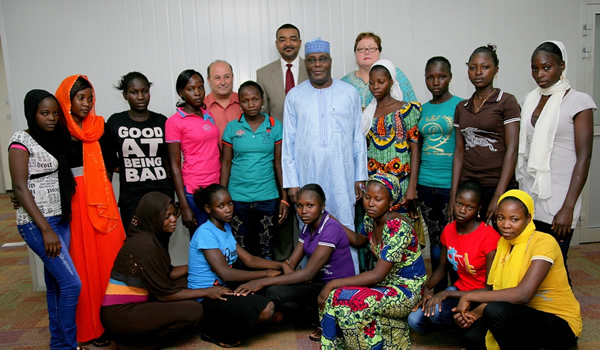
Founder of American University of Nigeria (AUN) Yola, Atiku Abubakar in a group photograph with the 15 abducted Chibok girls who escaped from Boko Haram custody, and were recently awarded scholarships to study at the AUN Academy in Yola, Adamawa State on Tuesday
Acting Nigerian Inspector General of Police (IGP), Suleiman Abba has confirmed that about 20 policemen out of many of them that were declared missing in Gwoza, Borno state after a battle with members of Boko Haram are yet to be found almost a month after. Several policemen were declared missing at the Gwoza Police Training School in Borno state early last month. Answering questions from newsmen shortly after a close door meeting with Vice President Namadi Sambo at the Presidential Villa, Abuja today, the Inspector General of police admitted: “I must tell you it is just less than 20 (policemen that are still missing), but we are still concern with every one of them and unless we are able to account for each and everyone of them, we will not relent in that efforts of tracing them.” He said however that the turn out of those missing has been impressive “because, we have been able to trace some of the officers who have reported, either back to their bases or their families. “When you go through what they went through, the likelihood of you knowing what to do is not very tenable. There is a possibility that the decision of what to do may not be easily comprehensible. “So, some they went back to their homes but our concern is that once they are in safety, we are satisfied and the process of bringing them back to their units has already commenced. The Inspector General said that every police officer faces all sort of characters, including crimina once he is on duty and is therefore constantly in danger of being attacked. “So, to us, facing dangers in the performance of police duties is not new. What is new is that this time around, the enemy is highly armed and that is why the military is there to support us in fighting them.” On the ongoing reorganization in police, Suleiman said that it is meant to repositioning officers for what he called advancement, adding: “what we are trying to do is a normal thing. It has always been done. We access performance and also take into cognizance vacancies available. We are all aware that quite a number of commissioners of police retired recently. Some of them were course mates of the retired Inspector General, so they left along with him after their 35 years in service. “So, it is just an effort to fill vacancies and, of course, to reposition the officers, based on performance, to face the challenges. The police boss said that his priority is to change the culture that has been there for too long in the system, saying that this is a big challenge for him, “and I consider it most important and most difficult. I should know that I am going to make a lot of changes. Those involved in the changes will tell you changing the culture, changing the character, changing the attitudes of personnel is very difficult. “Naturally, it comes with resistance, it omes with a lot of challenges on its own. Somehow someone has to do it and I felt not minding the challenges I will face, the good thing is that we have started. “Like I said, it is a difficult thing to do but it will take a little while to see it through.”
President Goodluck Jonathan has made a call to his colleagues African leaders to be part of the digital revolution that is taking place all around the world. “We must, in fact, be at the forefront of that revolution, creating information societies and knowledge based economies.” The President who spoke today at an international conference on information and communications technology in the Chadian capital, noted that because of the strong correlation between the efficient deployment of ICTs and socio-economic development, African countries stand to gain a lot from the effective adoption of the new technologies. “Africa and Africans must be active participants in the digital revolution that is taking place all around the world. We must in fact be at the forefront of that revolution, creating information societies and knowledge based economies. “African governments must facilitate and support the deployment of the necessary ICT infrastructure required to connect our citizens to each other and the rest of the world, we need to educate our citizens on ICTs and make them digitally literate so they can actively participate in this revolution, we need to encourage the development of our local ICT industries, creating companies to drive added domestic economic value, create jobs and support sustainable growth in GDP.” President Jonathan said that to ensure Nigeria gets the full benefits of new information and communication technologies which include improving national commerce, the development of an ICT workforce, the creation of high skilled, high paying jobs, improved international competitiveness and the establishment of stronger, more competitive small and medium businesses, the Federal Government is judiciously implementing a National ICT Policy, National Broadband Strategy and Roadmap and the Guidelines for Nigerian Content in the ICT industry. “The results of our efforts in this regard include an ICT sector that is 19% of our Services sector which in itself is 54% of total GDP. In addition to this, the ICT sector has an enabling effect on other sectors of the economy contributing a further 2.56% of added value.” President Jonathan said that in addition to encouraging and facilitating the development of ICTs within Nigeria, his administration is also helping to increase the geographic spread of high capacity broadband networks to support the harmonious and integrated development of regional economies in Africa. “With over 10 terabytes of undersea cable landing on our shores we are, through the bi-lateral Nigeria Niger Joint Commission, extending that capacity to Niger and we are in the process of entering into an MoU with the Chadian Government to interconnect the optic fibre networks of Chad and Nigeria.” According to him, information and communication technologies as well as the internet have clearly become catalysts that can expand the scope and scale of socio-economic development, even as he commended his Chadian counterpart for hosting the conference.
The recent spate of defection by some Nigerian politicians from one party to another is a shameful phenomenon that graphically retells the odious rat race, ideological vacuity and mundane craving that typify Nigeria’s political life. Lacking in any form of public-spirited motive or any principled intention to develop the structure and content of partisan politics, this wave is nothing more than self-seeking, whimsical and disdainful political prostitution. To this end, it calls to question the capacity, moral integrity and character of those who are ruling or aspiring to rule this country. While the cases of many sinecurists and position-seekers flirting around from one party to another in search of comfort zones are well known, erstwhile ‘progressives’ and supposed champions of the masses who are equally becoming turn-coats give cause for worry. Since the last election, it is not as if a better formula to govern the country has been found. It is not as if a new set of policy framework for socio-economic development has been formulated; neither is it that a roadmap for industrialization has been drawn. It then beats the imagination what the attraction of defection from one party to the other is apart from power for its sake. In the last 15 years, the quality of political leadership at all levels has remained generally low. Power, violence and money remain instruments of statecraft in the hands of the ruling party, while vanity or indiscernible ideas characterize the opposition. The result is the forfeiture of character as the system remains unable to build strong institutions. The fear of poverty, the unwillingness to develop indigenous capital, inferiority complex, acute selfishness and the imperviousness to a conference of reason have conspired to unleash mediocre persons on the polity. In the continuing sequence of this entropic trend, the political party has become a mere special purpose vehicle for some aggregation of political aspirants. A few months ago, President Goodluck Jonathan in his usual, self-inculpating posture aptly expressed this degenerate quality and moral bankruptcy, when he stated that more than 50 per cent of those in politics had no business being there. In the same vein, a former Economic and Financial Crimes Commission (EFCC) boss once observed that judging by their proclivity for gluttonous accumulation of wealth, many politicians and aspirants were mentally and psychologically unsuitable for public office. All these raise the question: what is the character of the Nigerian political elite? What, in the thinking of the politicians, is the whole purpose of the political party? Owing to the absence of any identifiable ideology within the Nigerian political party system, there is a dissonance between the idea of development of the political class and the aspirations of the people. Where Nigeria needs simple, basic amenities for survival, there is a deliberate dehumanization of the people through abuse of tax-payers’ money by the ruling elite. At a time when the nation’s political experience needs sound footing in democratic governance, the absence of internal democracy testifies to the lack of character in all the parties. If this odious political state is not a reflection of the way Nigeria is, what is? Why wouldn’t the masses vote for mass mobilization movements in the mould of Aminu Kano’s Peoples Redemption Party (PRP), or the National Conscience Party (NCP) of the late Lagos lawyer, Gani Fawehinmi to sack atrocious political parties? Moreover, when the decadent society from which the political elite is recruited is considered, it boggles the mind what kind of model they would be for present and oncoming generations. Unlike in established traditions of excellence, where the succession management process considers the institutions that nurtured would-be politicians, the Nigerian situation is an all-comers affair of contractors, lawbreakers, political hangers-on and sundry jobbers, all lacking in the requisite knowledge for governance. The situation is so deplorable and so scary that senior citizens, who have had the best of this country and may not benefit from any transformation agenda, are now the ones seeking a revolution on behalf of the populace. In the contemplation of some, the redemption of Nigeria’s state of spiraling decadence is so far-fetched and the possibility of a revolution so slim that Nigerians would have to take solace in the anticipation of a spiritual super force or divine direction. Whether Nigeria could even be extricated from the morass of degeneracy through this means is, of course, a matter of metaphysical conjecture. But one reassuring perspective is that this rudderlessness and moral degeneracy has not always been the case. In earlier democratic encounters, politicians had always defected from one party to another; but such carpet-crossing had been based on profound ideological differences and working principles. Not a few have marveled at the exemplary character of Nigeria’s political fathers: the simplicity of Tafawa Balewa, the selflessness of Ahmadu Bello, the nationalism of Nnamdi Azikiwe and the enduring vision of Obafemi Awolowo, all of which tower above their personal foibles. So, a good place to start Nigeria’s clean-up is for the nation’s school curriculum to take history and civic education seriously. Nigerians have to learn from the past; they have to learn the culture of civility, heroism, patriotism and other virtues that build successful nations. Today’s generation of moral orphans need to know and understand that the present obsession with inordinate materialism, the rabid pursuit of power for its sake and the abysmally low productivity in virtually all aspects of national life stand in contrast to the vision of the nation’s founding fathers. Another way of morally fumigating the nation’s political space is to have good people as political aspirants. Yet, it would be simplistic to assume that some air-splitting ethical evaluation of would-be leaders can be carried out to ascertain who a good person is. The political space must however, be made safe for good people and genuine potential political leaders to vie for elective positions. To complement this, communities should inculcate the system of fielding decent people who are not ambitious but competent, and dissuade scavengers and incompetent persons. Furthermore, there is need for a human capital development plan in order to entrench the inexorable symbiosis between the quality of universities and the intellectual capital of a country. Besides its contribution to global culture and civilization, what this wedding of town and gown would do is to re-introduce the value of scholarship to personal refinement and positive transformation of Nigeria’s immediate environment. Judging by the frenetic struggle over political positions, it is clear that pecuniary incentives and other attractive appurtenances of office are the primary motivations of today’s ruling class, and not service. Thus, there is need for a constitutional means to reduce and de-emphasise the monetary rewards and scandalous perquisites for public office holders. This reduction of pecuniary rewards would attract people who are genuinely interested in public service, and dissuade political scavengers. This position is based on the conviction that the political space is not occupied only by redundant and money-hungry politicians as there are also many well meaning persons who are morally upright, politically sagacious, determined, and visionary enough to become change agents. This is where the role of the media comes in. Apart from providing information that would enable people become free and self-governing, the media’s first loyalty to citizens demands that it sincerely highlights and celebrates courageous and self-sacrificing Nigerians who can transform the country, and at the same time bring to opprobrium fortune-seekers in government and party careerists who will routinely run the mill. At the regulatory level, the Independent National Electoral Commission (INEC) should be equipped through legislation to implement the INEC laws. In the same vein, political parties should professionally organize their structures of management in such a way that they are not brought to ridicule and abuse by crashers and opportunists. They should deliberately write and publicize their vision and mission statements as well as their manifestoes to ensure that the aspirations and personal philosophy of their members align with their objectives. Parties should ensure that members pay subscription fees regularly, while stiff rules should be put in place for the re-entry of defectors. To stem the corruption pervading the party system, the law should be enforced to peg contribution to a political party at a certain amount. This will not only remove the parties from the pocket of a few godfathers, it will help the process of mass inclusion and engender the culture of questioning.
As embarrassing as it is, the on-going carpet-crossing phenomenon is an opportunity for political parties to look inwards and re-invent themselves. As parties are now, all are in bad odour and those crossing from one party to the other are merely carrying the same stench around. This shame is made more painful because this is the time Nigeria needs men and women of character, oases of sanity in a desert of though. (This is Guardian’s Editorial). [myad]
Former Nigerian Vice President Atiku Abubakara has described All Progressives Congress (APC) as a party on a rescue mission to Adamawa state. In a statement from his Media office in Abuja, Atiku said that the successful APC primary in Adamawa State was not a personality contest, but a rescue mission, which will pave the way for the transformation and economic development of the state and the wellbeing of its citizens. “It is a mission which all patriots and friends of the state must be a part of by ensuring victory for the APC in the October 11 election.” Atiku Abubakar congratulated Senator Bindo Jibrilla who emerged the party’s governorship candidate in the October 11 governorship election in Adamawa State. According to him, APC in Adamawa had by the conduct of a free, fair and transparent primaries devoid of any rancour, signalled its intention to work together to wrestle power from the PDP in the state. The former Vice President who voted in Jada Ward 1 in Jada Local Government Area of Adamawa called on the other contestants to rally support for Senator Bindow in the interest of the party unity to dislodge PDP in the state. He said that as a democrat, he has accepted the result of the APC primaries and urged other party members to follow suit. “As a democrat, I accept the outcome and ask all party members in the state to do the same. As members of a truly democratic party, the outcome of the election is binding on all party members and we must all work to pull our support behind the flag-bearer of our great party during the governorship election.” [myad]
With the look of things across the country, it does seem that Nigeria’s light fingered ruling elite have found their collective answer and solution to the ‘Poor question’ that is to the question of what to do with the poor, as a way of dealing with poverty.
This will not be the first time in history though that a ruling class has collectively decided on a solution to very persistent and nagging questions, that is issues of existential developmental challenge that they are unable to, or incapable of resolving in any other way.
The Nazis under their supreme leader, the Fuhrer in the first half of the 20th century also arrived at their final solution to the problem they had dubbed the ‘Jewish question’. And what was the Nazi’s final solution? Exterminate the Jew!
So what is Nigeria’s ruling class of the 21st century’s final solution to the ‘poor question’? Eliminate the poor! Ingenious isn’t it?
Every time the treasury looting elite gets up boastfully, beating its chest as to how under its watch we have become Africa’s largest economy, and the world’s 26th largest economy; or as to how a Nigerian man is Africa’s richest man, and the world’s 25th richest, while a Nigerian woman is the world’s richest black woman; etc, each time it goes on this euphoric grandstandings, the poor and poverty keeps popping up to burst the balloons of lies and puncture big potholes in the tarmac of falsehoods.
So yes we are Africa’s largest economy, but we are also home to the largest concentration of poor people in Africa, and the third largest concentration in the whole wide world.
Yes 15 of Africa’s 40 richest are Nigerians, but 112 million Nigerians at a poverty rate of 70% live in poverty.
And whereas Nigeria’s rich own some of the choicest properties, the overwhelming majority of which are empty and not being lived in across Abuja, in Lagos, in PH, in Europe and the Americas, and in Dubai; yet the country suffers a 17 million housing deficit. The implication of this at an average household size of 6, is that nearly 90 million Nigerians are living in subhuman housing conditions are simply homeless.
And so it seems that as the country has grown in wealth, the lot of its ruling elites has improved magnificently while the conditions of living of the overwhelming majority of citizens have largely regressed or at best stagnated engendering a precarious existence for them.
And yes GDP has grown steadily since 1999 at more than 6% annually, nevertheless so has the rate of unemployment; with general unemployment growing from 8% in 2004 to 24% in 2013, and youth unemployment topping 54% in 2012.
And in the midst of this grinding, crushing and alienating poverty and misery that is the lot of the majority, what has the thieving ruling elite been upto?
Every year in the last 5 to 6 years at least, outside of the annual budget of more than N4tn, the country’s ruling class has expropriated extra-budgetary funds to the tune of at least on the average $8bn from the Excess Crude Account annually, and at least another annual average of not less than $10bn from the External Reserves.
The implication of this is that at least in the last 6 years, on the average Nigeria’s ruling elite have had access to and claimed to spend on the Nigerian economy at least the combined sum of N4tn [annual national budget] plus N4tn [combined annual budget of the 36 states] plus N2tn [being additional withdrawals from both the excess crude account and the external reserves] on a yearly basis. That is more than N10tn each year, and more than N60tn over the 6 year period.
This is in exclusion of the untraceable stolen resources that simply disappear into the bottomless pockets of these gangs of treasury looters. Take just one instance, that of the so-called crude oil theft. If we take the lowest but clearly understated estimate on loss of 100,000 barrels of crude oil daily to theft, at $100 per barrel this amounts to nearly $10m per day over 6 years.
Additionally since celebrating with fanfare our debt free nature after paying back in excess of $12bn at once in order to be forgiven the remaining $18bn of debt in 2005; our external debt profile has since climbed back to just below $10bn, growing by about 40% between June 2013 and July 2014 alone.
Where have all of these monies gone? Is it a mere coincidence therefore that a mere 10% of wealthiest Nigerians now own more than 40% of national wealth, while the bottom 20% of the population own a mere insignificant 4% of national wealth?
And so how have they addressed the poverty question? Well we have 17 million housing deficits; what to do? Demolish the houses of the poor and evict them from the urban cities.
We have such a high unemployment rate; what to do? Criminalise the livelihood of the poor. So you ban street trading, ban okadas, ban buses plying some routes; harass street traders, okada riders, bus drivers, sometimes chase them to their deaths, sometimes destroy their equipment, and oftentimes arrest and jail them and absolutely provide no alternatives.
Then to hasten this quick fix solution, ensure that hospitals are either nonexistent or not equipped and staffed and charge exorbitant fees. That way when the poor get sick from your harassment, they can die quickly.
Obviously therefore it seems that to this clueless, irredeemably greedy, light fingered treasury looting elite, the solution to poverty is not to curb their humongous appetite to steal, not to drastically scale back the historic scale and scope of their corruption, and certainly not to punish the impunity that drives this piracy; but instead, it is to eliminate and eradicate the poor from the face of the earth.
Our bounden duty is to chase this inhumane and inconsiderate treasury looting ruling elite from power before they get the chance to fully realize their final solution to poverty and the poor.
Only by waging a war against this thieving ruling class can we end their war on the poor. And we can do this only by taking concrete steps to Take Back Nigeria.
(Follow me on Twitter: @jayegaskia&@[DPSR]
protesttopower; Interact with me on FaceBook; JayeGaskia& Take Back Nigeria)
(Jaye Gaskia Is National Coordinator Of Protest To Power Movement [P2pm] & Co-Convener Of Say No Campaign [Snc])
Nigerian students like their counterparts across the world have historically been the last bastion of the oppressed. From Soweto to Sharpeville in South Africa, from “Ali Must Go” in Nigeria in the 1970s, the French Students revolt in the late 1960s and American students during the Vietnam war, students have always been in the vanguard of the struggle for a better society. Many Nigerians could not believe the recent spectacle of the Yinka Gbadebo-led National Association of Nigerian Students (NANS) passing a vote of confidence on Dame Patience Jonathan, wife of the President and President Goodluck Ebele Jonathan himself. Yinka Gbadebo and his fellow sycophants include some former presidents of the once prestigious Students Union. They fawningly told the First Lady that they have endorsed her husband for a second term. Their sycophancy went up notches higher when they met the President and Commander-in-Chief of the Armed Forces of Nigeria Dr. Goodluck Ebele Jonathan, a former university lecturer under whose watch the universities, polytechnics and colleges of education were on strike for more than half of their academic calendar. Mr. Gbadebo and his co travelers gave President Jonathan the hitherto non-existent and meaningless award of Grand Commander of Nigerian Students. That conduct and action negate the principle and charter of demands of NANS. It is completely at variance with what NANS stands for or stood for since one is now confused about NANS. If such honour exist at all, it’s the sole prerogative of the NANS Congress, not even the NANS Senate to ratify before being conferred on the beneficiary. Thus, the conferment of the Grand Commander on Jonathan is null and void as it lacks the requisite legal backing of the appropriate organ of NANS charged with the responsibility. There is nothing wrong in the leadership of NANS paying a courtesy visit to the First Lady, the self-styled “Mama Peace” and “Mother of the Nation” or to her husband the President whom she adoringly calls the “Father of the Nation”, since by virtue of their positions they are symbols of the State and deserve due respect. What is wrong however is using such an opportunity for personal aggrandizement instead of pursuing the common interest of the greater majority of their constituents – the students. The Yinka Gbadebo-led Union Executive has completely derailed from the focus and priority of NANS and this has exposed the level of rot in modern student unionism. Nigerian students like their counterparts across the world have historically been the last bastion of the oppressed. From Soweto to Sharpeville in South Africa, from “Ali Must Go” in Nigeria in the 1970s, the French Students revolt in the late 1960s and American students during the Vietnam war, students have always been in the vanguard of the struggle for a better society. The Chibok school girls who are their immediate constituency have been living in nightmare since their abduction over 145 days ago, yet not a word was uttered about them by Mr. Gbadebo and his coterie of shameless sycophants. This is wicked, heartless, unconscionable and in bad taste. They should have used the opportunity to challenge the First Lady to use her immense influence and the President to use his innermost powers to address the Chibok Girls issue and the rot in the education sector which requires the declaration of an emergency. Only 31% of the students who sat for the General Certificate of Education (GCE) recorded passes in 5 subjects and above including English and Mathematics. The Universities, Polytechnics and Colleges of Education only resumed recently from their prolonged strikes. Mr. Gbadebo and those former NANS leaders who went on this misplaced and opportunistic courtesy visit are a disgrace to the fond memories of our past student heroes who laid down their lives for a better Nigeria. They are not and can never be the true reflection of the minds of Nigerian students. They have politicized NANS but the will of the majority of Nigerian students shall prevail. As the first convener of the Forum of Former NANS Presidents, I completely dissociate and distance myself from the shenanigans of these former NANS leaders who condescended so low, to the extend of being blindly led by those they should guide. God bless Nigeria! Comrade Daniel Onjeh, Former NANS President, Ex-President West Africa Students’ Union (WASU
The crisis that has engulfed the Nigeria Football Federation (NFF) took another dimension over the weekend as the factional president, Chris Giwa, took the world football governing body, FIFA to the Court of Arbitration for Sports (CAS) over its threat to suspend Nigeria if he fails to vacate office by Monday.
Giwa’s representative said yesterday that the case has been filed at the sports Court in Switzerland to stop FIFA from interfering in Nigerian football affairs but did not give details of the suit.
One of Giwa’s aides, Ben Agary, confirmed: “Delegates on behalf of Chris Giwa has taken the matter to CAS because that is the only recognised football court, he is waiting for them to decide and call FIFA to other and stop their ban threats, he’s the rightful President of the NFF so we will wait and see, they don’t have the power to ban us over internal crisis.”
Giwa is currently insisting on heading a faction of the Nigerian football body, which has been rocked by leadership crisis for months between him and Aminu Maigari who has been in charge for years.
Maigari has also insisted that he is in charge until an election he would supervise held sometime this month, September.
Giwa’s claim to the office has been rejected by FIFA, which has threatened to suspend Nigeria if he fails to step down by Monday. [myad]
No fewer than 33 people died in the dawn boat mishap when it capsized between Dere in Niger state and Murtala bridge on the River Niger.
The boat, carrying about 100 passengers was said to have capsized about 4.30 am when a pipeline patrol team flashed its light on the boat which led to the loss of control. The boat was said to have hit a tree in the river before it capsized. The boat, going to Lokoja market from Katcha Local Government of Niger State, was said to have broken into two.
It was gathered that the passengers did not have life vests on, which was believed to have caused the high casualty figure.
The time of the travel may have also shielded the boat from checks by concerned authorities, just as the seaworthiness of the boat could not be confirmed. It is common for river transporters to overload their boats without providing safety jackets for passengers.
It was also gathered that among the victims were people from Yawa and Baka in Lapai Local Government Area of Niger State.
Aside the 100 persons, which the boat was conveying, it was also gathered that it had on board 100 bags of rice, baskets of fish and other valuables, fuelling suspicion that the boat may have been overloaded.
When contacted, the Niger State Police Command Public Relations Officer, ASP Abiodun Gambari, confirmed the incident but said that it occurred outside the jurisdiction of Niger State. [myad]
We use cookies on our website to give you the most relevant experience by remembering your preferences and repeat visits. By clicking “Accept”, you consent to the use of ALL the cookies.
This website uses cookies to improve your experience while you navigate through the website. Out of these, the cookies that are categorized as necessary are stored on your browser as they are essential for the working of basic functionalities of the website. We also use third-party cookies that help us analyze and understand how you use this website. These cookies will be stored in your browser only with your consent. You also have the option to opt-out of these cookies. But opting out of some of these cookies may affect your browsing experience.
Necessary cookies are absolutely essential for the website to function properly. This category only includes cookies that ensures basic functionalities and security features of the website. These cookies do not store any personal information.
Any cookies that may not be particularly necessary for the website to function and is used specifically to collect user personal data via analytics, ads, other embedded contents are termed as non-necessary cookies. It is mandatory to procure user consent prior to running these cookies on your website.


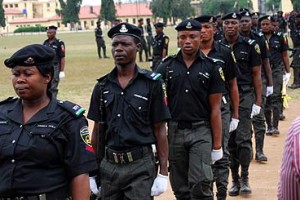 Acting Nigerian Inspector General of Police (IGP), Suleiman Abba has confirmed that about 20 policemen out of many of them that were declared missing in Gwoza, Borno state after a battle with members of Boko Haram are yet to be found almost a month after.
 President Goodluck Jonathan has made a call to his colleagues African leaders to be part of the digital revolution that is taking place all around the world.
 With the look of things across the country, it does seem that Nigeria’s light fingered ruling elite have found their collective answer and solution to the ‘Poor question’ that is to the question of what to do with the poor, as a way of dealing with poverty.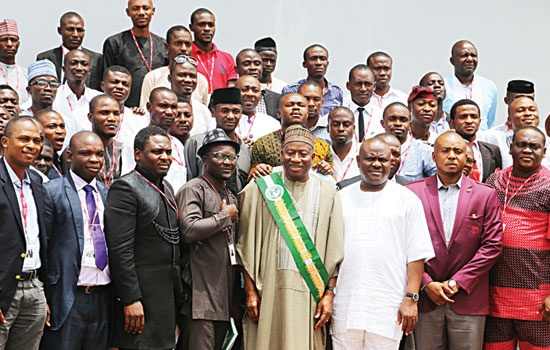




The Igbo Naked Dance For Jonathan, By Onyiorah Chiduluemije Paschal
It really boggles one’s mind the degree to which Ndigbo appear to be excessively reveling in complacency over President Goodluck Jonathan’s so-called favourable disposition to Igbo interest as relates to his 2015 Presidential ambition. As it were, it is though understandable that this Igbo complacency about President Jonathan’s administration is drawn from some empirical facts. For one, analysts believe that until the ascendancy of President Jonathan, no one of the past administrations in Nigeria – be it the military or its
Onyiorah Chiduluemije Paschal writes from Abuja via duluemije4justice@yahoo.com – 08037738607.
[myad]